Adhyaya 7
Bharata Mahārāja’s Ideal Kingship and His Transition from Yajña to Exclusive Bhakti at Pulahāśrama
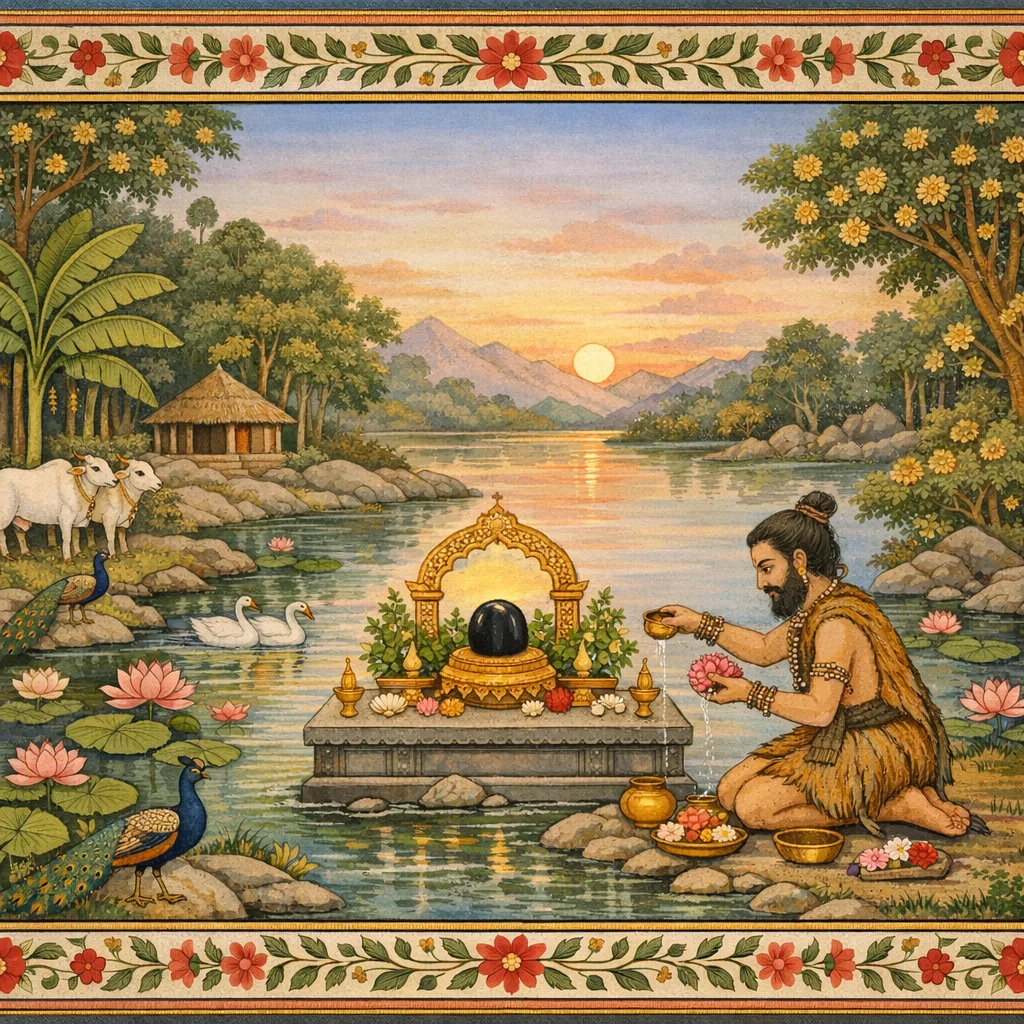
Śukadeva continues the dynasty narrative by presenting Bharata Mahārāja as a consummate devotee-king who assumes sovereignty under his father’s order and sustains citizens by keeping them aligned with varṇāśrama duties. He marries Pañcajanī and begets five sons, and the land formerly called Ajanābha-varṣa becomes renowned as Bhārata-varṣa due to his rule. Bharata performs major Vedic sacrifices (agni-hotra, darśa-pūrṇamāsa, cāturmāsya, paśu-yajña, soma-yajña) but with a mature theological vision: all devatā oblations are offerings to the limbs of Vāsudeva, freeing him from lust, greed, and attachment. As his heart becomes purified, his devotion intensifies, recognizing Kṛṣṇa as Bhagavān—realized by yogīs as Paramātmā, by jñānīs as Brahman, and by devotees as the personal Vāsudeva described in śāstra. When his destined term of opulence ends, he renounces, distributes wealth to his sons, and retires to Pulahāśrama near the Gaṇḍakī River, worshiping with śālagrāma-śilā and simple forest offerings. His devotion flowers into ecstasy, sometimes eclipsing regulative ritual, and he offers a sunrise hymn to Nārāyaṇa, setting the stage for the next developments in his inner life and the narrative consequences of intense absorption.
Shlokas
Verse 1
श्रीशुक उवाच भरतस्तु महाभागवतो यदा भगवतावनितलपरिपालनाय सञ्चिन्तितस्तदनुशासनपर: पञ्चजनीं विश्वरूपदुहितरमुपयेमे ॥ १ ॥
Śukadeva Gosvāmī continued speaking to Mahārāja Parīkṣit: My dear King, Bharata Mahārāja was a topmost devotee. Following the orders of his father, who had already decided to install him on the throne, he began to rule the earth accordingly. When Bharata Mahārāja ruled the entire globe, he followed the orders of his father and married Pañcajanī, the daughter of Viśvarūpa.
Verse 2
तस्यामु ह वा आत्मजान् कार्त्स्न्येनानुरूपानात्मन: पञ्च जनयामास भूतादिरिव भूतसूक्ष्माणि सुमतिं राष्ट्रभृतं सुदर्शनमावरणं धूम्रकेतुमिति ॥ २ ॥
Just as the false ego creates the subtle sense objects, Mahārāja Bharata created five sons in the womb of Pañcajanī, his wife. These sons were named Sumati, Rāṣṭrabhṛta, Sudarśana, Āvaraṇa and Dhūmraketu.
Verse 3
अजनाभं नामैतद्वर्षं भारतमिति यत आरभ्य व्यपदिशन्ति ॥ ३ ॥
Formerly this planet was known as Ajanābha-varṣa, but since Mahārāja Bharata’s reign it has become known as Bhārata-varṣa.
Verse 4
स बहुविन्महीपति: पितृपितामहवदुरुवत्सलतया स्वे स्वे कर्मणि वर्तमाना: प्रजा: स्वधर्ममनुवर्तमान: पर्यपालयत् ॥ ४ ॥
Mahārāja Bharata was a very learned and experienced king on this earth. He perfectly ruled the citizens, being himself engaged in his own respective duties. Mahārāja Bharata was as affectionate to the citizens as his father and grandfather had been. Keeping them engaged in their occupational duties, he ruled the earth.
Verse 5
ईजे च भगवन्तं यज्ञक्रतुरूपं क्रतुभिरुच्चावचै: श्रद्धयाऽऽहृताग्निहोत्रदर्शपूर्णमासचातुर्मास्यपशुसोमानां प्रकृतिविकृतिभिरनुसवनं चातुर्होत्रविधिना ॥ ५ ॥
With great faith King Bharata performed various kinds of sacrifice. He performed the sacrifices known as agni-hotra, darśa, pūrṇamāsa, cāturmāsya, paśu-yajña [wherein a horse is sacrificed] and soma-yajña [wherein a kind of beverage is offered]. Sometimes these sacrifices were performed completely and sometimes partially. In any case, in all the sacrifices the regulations of cāturhotra were strictly followed. In this way Bharata Mahārāja worshiped the Supreme Personality of Godhead.
Verse 6
सम्प्रचरत्सु नानायागेषु विरचिताङ्गक्रियेष्वपूर्वं यत्तत्क्रियाफलं धर्माख्यं परे ब्रह्मणि यज्ञपुरुषे सर्वदेवतालिङ्गानां मन्त्राणामर्थनियामकतया साक्षात्कर्तरि परदेवतायां भगवति वासुदेव एव भावयमान आत्मनैपुण्यमृदितकषायो हवि:ष्वध्वर्युभिर्गृह्यमाणेषु स यजमानो यज्ञभाजो देवांस्तान् पुरुषावयवेष्वभ्यध्यायत् ॥ ६ ॥
After performing the preliminaries of various sacrifices, Mahārāja Bharata offered the results in the name of religion to the Supreme Personality of Godhead, Vāsudeva. In other words, he performed all the yajñas for the satisfaction of Lord Vāsudeva, Kṛṣṇa. Mahārāja Bharata thought that since the demigods were different parts of Vāsudeva’s body, He controls those who are explained in the Vedic mantras. By thinking in this way, Mahārāja Bharata was freed from all material contamination, such as attachment, lust and greed. When the priests were about to offer the sacrificial ingredients into the fire, Mahārāja Bharata expertly understood how the offering made to different demigods was simply an offering to the different limbs of the Lord. For instance, Indra is the arm of the Supreme Personality of Godhead, and Sūrya [the sun] is His eye. Thus Mahārāja Bharata considered that the oblations offered to different demigods were actually offered unto the different limbs of Lord Vāsudeva.
Verse 7
एवं कर्मविशुद्ध्या विशुद्धसत्त्वस्यान्तर्हृदयाकाशशरीरे ब्रह्मणि भगवति वासुदेवे महापुरुषरूपोपलक्षणे श्रीवत्सकौस्तुभवनमालारिदरगदादिभिरुपलक्षिते निजपुरुषहृल्लिखितेनात्मनि पुरुषरूपेण विरोचमान उच्चैस्तरां भक्तिरनुदिनमेधमानरयाजायत ॥ ७ ॥
In this way, being purified by ritualistic sacrifices, the heart of Mahārāja Bharata was completely uncontaminated. His devotional service unto Vāsudeva, Lord Kṛṣṇa, increased day after day. Lord Kṛṣṇa, the son of Vasudeva, is the original Personality of Godhead manifest as the Supersoul [Paramātmā] as well as the impersonal Brahman. Yogīs meditate upon the localized Paramātmā situated in the heart, jñānīs worship the impersonal Brahman as the Supreme Absolute Truth, and devotees worship Vāsudeva, the Supreme Personality of Godhead, whose transcendental body is described in the śāstras. His body is decorated with the Śrīvatsa, the Kaustubha jewel and a flower garland, and His hands hold a conchshell, disc, club and lotus flower. Devotees like Nārada always think of Him within their hearts.
Verse 8
एवं वर्षायुतसहस्रपर्यन्तावसितकर्मनिर्वाणावसरोऽधिभुज्यमानं स्वतनयेभ्यो रिक्थं पितृपैतामहं यथादायं विभज्य स्वयं सकलसम्पन्निकेतात्स्वनिकेतात् पुलहाश्रमं प्रवव्राज ॥ ८ ॥
Destiny fixed the time for Mahārāja Bharata’s enjoyment of material opulence at one thousand times ten thousand years. When that period was finished, he retired from family life and divided the wealth he had received from his forefathers among his sons. He left his paternal home, the reservoir of all opulence, and started for Pulahāśrama, which is situated in Hardwar. The śālagrāma-śilās are obtainable there.
Verse 9
यत्र ह वाव भगवान् हरिरद्यापि तत्रत्यानां निजजनानां वात्सल्येन सन्निधाप्यत इच्छारूपेण ॥ ९ ॥
At Pulaha-āśrama, the Supreme Personality of Godhead, Hari, out of His transcendental affection for His devotee, becomes visible to His devotee, satisfying His devotee’s desires.
Verse 10
यत्राश्रमपदान्युभयतोनाभिभिर्दृषच्चक्रैश्चक्रनदी नाम सरित्प्रवरा सर्वत: पवित्रीकरोति ॥ १० ॥
In Pulaha-āśrama is the Gaṇḍakī River, which is the best of all rivers. The śālagrāma-śilā, the marble pebbles, purify all those places. On each and every marble pebble, up and down, circles like navels are visible.
Verse 11
तस्मिन् वाव किल स एकल: पुलहाश्रमोपवने विविधकुसुमकिसलयतुलसिकाम्बुभि: कन्दमूलफलोपहारैश्च समीहमानो भगवत आराधनं विविक्त उपरतविषयाभिलाष उपभृतोपशम: परां निर्वृतिमवाप ॥ ११ ॥
In the gardens of Pulaha-āśrama, Mahārāja Bharata lived alone and collected a variety of flowers, twigs and tulasī leaves. He also collected the water of the Gaṇḍakī River, as well as various roots, fruits and bulbs. With these he offered food to the Supreme Personality of Godhead, Vāsudeva, and, worshiping Him, he remained satisfied. In this way his heart was completely uncontaminated, and he did not have the least desire for material enjoyment. All material desires vanished. In this steady position, he felt full satisfaction and was situated in devotional service.
Verse 12
तयेत्थमविरतपुरुषपरिचर्यया भगवति प्रवर्धमानानुरागभरद्रुतहृदयशैथिल्य: प्रहर्षवेगेनात्मन्युद्भिद्यमानरोमपुलककुलक औत्कण्ठ्यप्रवृत्तप्रणयबाष्पनिरुद्धावलोकनयन एवं निजरमणारुणचरणारविन्दानुध्यानपरिचितभक्तियोगेन परिप्लुतपरमाह्लादगम्भीरहृदयह्रदावगाढधिषणस्तामपि क्रियमाणां भगवत्सपर्यां न सस्मार ॥ १२ ॥
That most exalted devotee, Mahārāja Bharata, in this way engaged constantly in the devotional service of the Lord. Naturally his love for Vāsudeva, Kṛṣṇa, increased more and more and melted his heart. Consequently he gradually lost all attachment for regulative duties. The hairs of his body stood on end, and all the ecstatic bodily symptoms were manifest. Tears flowed from his eyes, so much so that he could not see anything. Thus he constantly meditated on the reddish lotus feet of the Lord. At that time, his heart, which was like a lake, was filled with the water of ecstatic love. When his mind was immersed in that lake, he even forgot the regulative service to the Lord.
Verse 13
इत्थं धृतभगवद्व्रत ऐणेयाजिनवाससानुसवनाभिषेकार्द्रकपिशकुटिलजटाकलापेन च विरोचमान: सूर्यर्चा भगवन्तं हिरण्मयं पुरुषमुज्जिहाने सूर्यमण्डलेऽभ्युपतिष्ठन्नेतदु होवाच ॥ १३ ॥
Mahārāja Bharata appeared very beautiful. He had a wealth of curly hair on his head, which was wet from bathing three times daily. He dressed in a deerskin. He worshiped Lord Nārāyaṇa, whose body was composed of golden effulgence and who resided within the sun. Mahārāja Bharata worshiped Lord Nārāyaṇa by chanting the hymns given in the Ṛg Veda, and he recited the following verse as the sun rose.
Verse 14
परोरज: सवितुर्जातवेदो देवस्य भर्गो मनसेदं जजान । सुरेतसाद: पुनराविश्य चष्टे हंसं गृध्राणं नृषद्रिङ्गिरामिम: ॥ १४ ॥
“The Supreme Personality of Godhead is situated in pure goodness. He illuminates the entire universe and bestows all benedictions upon His devotees. The Lord has created this universe from His own spiritual potency. According to His desire, the Lord entered this universe as the Supersoul, and by virtue of His different potencies He is maintaining all living entities desiring material enjoyment. Let me offer my respectful obeisances unto the Lord, who is the giver of intelligence.”
Frequently Asked Questions
The renaming marks Bharata Mahārāja’s exemplary reign and the cultural-spiritual identity shaped by his rule. In Bhāgavata’s vaṁśānucaritam, names memorialize dharmic exemplars; thus Bhārata-varṣa signifies a land defined by Bharata’s standard of governance and devotion, and it frames human life there as especially oriented toward dharma and God-realization.
He interprets devatās as functional limbs or powers of Vāsudeva’s universal form, so oblations to Indra, Sūrya, and others are ultimately offerings to the Supreme Person. This vision preserves Vedic ritual while purifying it of sectarianism and fruitive intent, transforming karma-kāṇḍa into bhakti-centered worship and removing material contamination such as attachment and greed.
Bharata worships Hari/Vāsudeva (Nārāyaṇa) in a simple renounced setting using Gaṇḍakī water, tulasī, flowers, and śālagrāma-śilās. Śālagrāma-śilā is revered as a self-manifest form connected with Viṣṇu worship; its presence supports focused arcana and symbolizes the Lord’s special accessibility (poṣaṇam) to His devotee in that holy place.
The chapter describes the intensification of devotion where love (bhāva) overwhelms formal procedure. This does not denigrate rules; it indicates that regulated service can mature into spontaneous absorption in the Lord’s lotus feet, evidenced by tears, standing hairs, and uninterrupted remembrance—signs of the heart’s deep purification and exclusive dependence on Vāsudeva.