Adhyaya 23
Dhruva-loka as the Cosmic Pivot and the Śiśumāra-cakra (Viṣṇu’s Astral Form)
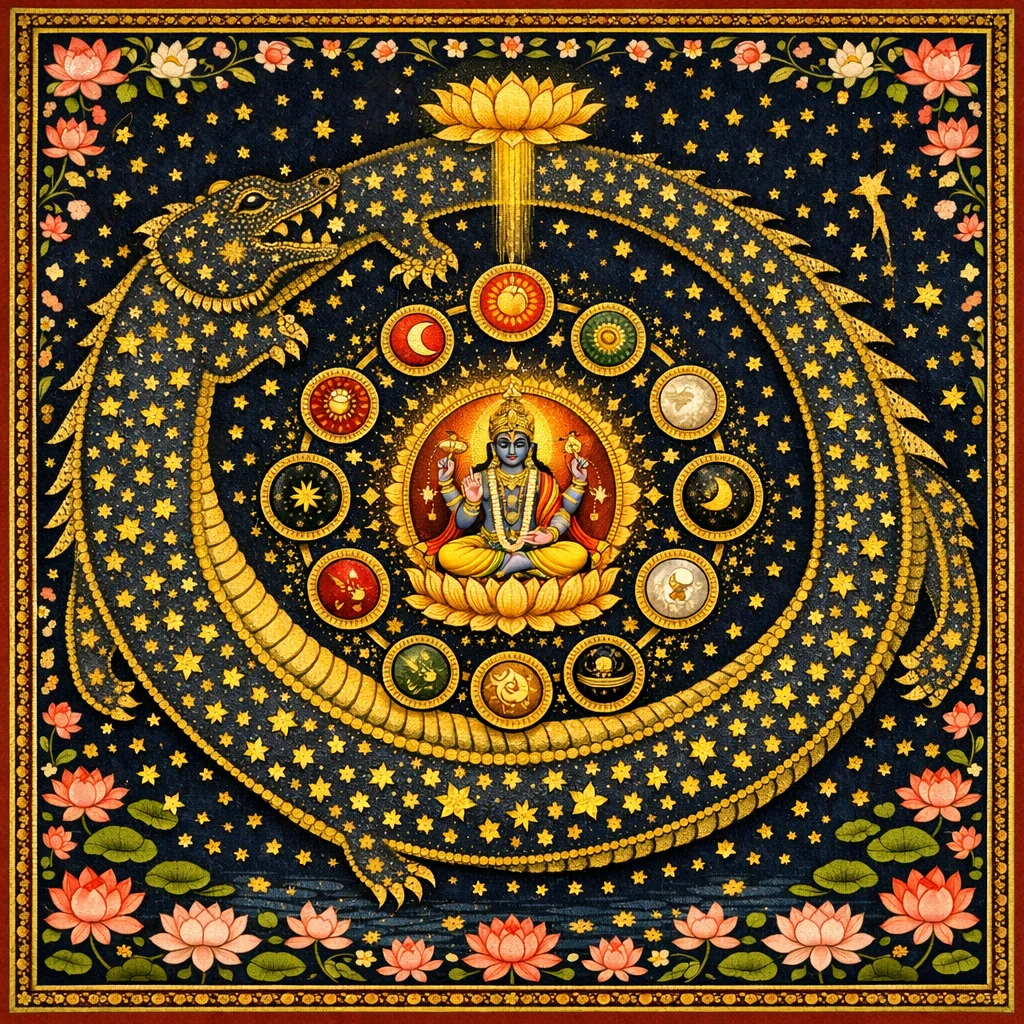
Continuing the Fifth Canto’s systematic ascent through higher planetary arrangements, Śukadeva identifies Dhruva-loka far above the Saptarṣi-maṇḍala, honoring Mahārāja Dhruva as an enduring devotee revered by Agni, Indra, Prajāpati, Kaśyapa, and Dharma. Dhruva’s pole-star position is then presented as the fixed pivot around which all luminaries revolve, driven by the invisible, unsleeping force of kāla under the Supreme Lord’s will. A vivid analogy of bulls circling a central post explains orbital hierarchy and karmically fixed paths. The chapter culminates in the Śiśumāra-cakra: the star-and-planet system visualized as a coiled dolphin-like form, treated as a visible manifestation for yogic meditation on Vāsudeva. Specific nakṣatras, planets, and deities are mapped onto limbs and organs, with Nārāyaṇa in the heart. The narrative moves from cosmic description to sādhana by prescribing thrice-daily mantra worship and remembrance, previewing subsequent discussions where cosmography consistently serves purification and God-centered contemplation.
Shlokas
Verse 1
श्रीशुक उवाच अथ तस्मात्परतस्त्रयोदशलक्षयोजनान्तरतो यत्तद्विष्णो: परमं पदमभिवदन्ति यत्र ह महाभागवतो ध्रुव औत्तानपादिरग्निनेन्द्रेण प्रजापतिना कश्यपेन धर्मेण च समकालयुग्भि: सबहुमानं दक्षिणत: क्रियमाण इदानीमपि कल्पजीविनामाजीव्य उपास्ते तस्येहानुभाव उपवर्णित: ॥ १ ॥
Śukadeva Gosvāmī continued: My dear King, 1,300,000 yojanas [10,400,000 miles] above the planets of the seven sages is the place that learned scholars describe as the abode of Lord Viṣṇu. There the son of Mahārāja Uttānapāda, the great devotee Mahārāja Dhruva, still resides as the life source of all the living entities who live until the end of the creation. Agni, Indra, Prajāpati, Kaśyapa and Dharma all assemble there to offer him honor and respectful obeisances. They circumambulate him with their right sides toward him. I have already described the glorious activities of Mahārāja Dhruva [in the Fourth Canto of Śrīmad-Bhāgavatam].
Verse 2
स हि सर्वेषां ज्योतिर्गणानां ग्रहनक्षत्रादीनामनिमिषेणाव्यक्तरंहसा भगवता कालेन भ्राम्यमाणानां स्थाणुरिवावष्टम्भ ईश्वरेण विहित: शश्वदवभासते ॥ २ ॥
Established by the supreme will of the Supreme Personality of Godhead, the polestar, which is the planet of Mahārāja Dhruva, constantly shines as the central pivot for all the stars and planets. The unsleeping, invisible, most powerful time factor causes these luminaries to revolve around the polestar without cessation.
Verse 3
यथा मेढीस्तम्भ आक्रमणपशव: संयोजितास्त्रिभिस्त्रिभि: सवनैर्यथास्थानं मण्डलानि चरन्त्येवं भगणा ग्रहादय एतस्मिन्नन्तर्बहिर्योगेन कालचक्र आयोजिता ध्रुवमेवावलम्ब्य वायुनोदीर्यमाणा आकल्पान्तं परिचङ्क्रमन्ति नभसि यथा मेघा: श्येनादयो वायुवशा: कर्मसारथय: परिवर्तन्ते एवं ज्योतिर्गणा: प्रकृतिपुरुषसंयोगानुगृहीता: कर्मनिर्मितगतयो भुवि न पतन्ति ॥ ३ ॥
When bulls are yoked together and tied to a central post to thresh rice, they tread around that pivot without deviating from their proper positions — one bull being closest to the post, another in the middle, and a third on the outside. Similarly, all the planets and all the hundreds and thousands of stars revolve around the polestar, the planet of Mahārāja Dhruva, in their respective orbits, some higher and some lower. Fastened by the Supreme Personality of Godhead to the machine of material nature according to the results of their fruitive acts, they are driven around the polestar by the wind and will continue to be so until the end of creation. These planets float in the air within the vast sky, just as clouds with hundreds of tons of water float in the air or as the great śyena eagles, due to the results of past activities, fly high in the sky and have no chance of falling to the ground.
Verse 4
केचनैतज्ज्योतिरनीकं शिशुमारसंस्थानेन भगवतो वासुदेवस्य योगधारणायामनुवर्णयन्ति ॥ ४ ॥
This great machine, consisting of the stars and planets, resembles the form of a śiśumāra [dolphin] in the water. It is sometimes considered an incarnation of Kṛṣṇa, Vāsudeva. Great yogīs meditate upon Vāsudeva in this form because it is actually visible.
Verse 5
यस्य पुच्छाग्रेऽवाक्शिरस: कुण्डलीभूतदेहस्य ध्रुव उपकल्पितस्तस्य लाङ्गूले प्रजापतिरग्निरिन्द्रो धर्म इति पुच्छमूले धाता विधाता च कट्यां सप्तर्षय: । तस्य दक्षिणावर्तकुण्डलीभूतशरीरस्य यान्युदगयनानि दक्षिणपार्श्वे तु नक्षत्राण्युपकल्पयन्ति दक्षिणायनानि तु सव्ये । यथा शिशुमारस्य कुण्डलाभोगसन्निवेशस्य पार्श्वयोरुभयोरप्यवयवा: समसंख्या भवन्ति । पृष्ठे त्वजवीथी आकाशगङ्गा चोदरत: ॥ ५ ॥
This form of the śiśumāra has its head downward and its body coiled. On the end of its tail is the planet of Dhruva, on the body of its tail are the planets of the demigods Prajāpati, Agni, Indra and Dharma, and at the base of its tail are the planets of the demigods Dhātā and Vidhātā. Where the hips might be on the śiśumāra are the seven saintly sages like Vasiṣṭha and Aṅgirā. The coiled body of the Śiśumāra-cakra turns toward its right side, on which the fourteen constellations from Abhijit to Punarvasu are located. On its left side are the fourteen stars from Puṣyā to Uttarāṣāḍhā. Thus its body is balanced because its sides are occupied by an equal number of stars. On the back of the śiśumāra is the group of stars known as Ajavīthī, and on its abdomen is the Ganges that flows in the sky [the Milky Way].
Verse 6
पुनर्वसुपुष्यौ दक्षिणवामयो: श्रोण्योरार्द्राश्लेषे च दक्षिणवामयो: पश्चिमयो: पादयोरभिजिदुत्तराषाढे दक्षिणवामयोर्नासिकयोर्यथासङ्ख्यं श्रवणपूर्वाषाढे दक्षिणवामयोर्लोचनयोर्धनिष्ठा मूलं च दक्षिणवामयो: कर्णयोर्मघादीन्यष्ट नक्षत्राणि दक्षिणायनानि वामपार्श्ववङ्क्रिषु युञ्जीत तथैव मृगशीर्षादीन्युदगयनानि दक्षिणपार्श्ववङ्क्रिषु प्रातिलोम्येन प्रयुञ्जीत शतभिषाज्येष्ठे स्कन्धयोर्दक्षिणवामयोर्न्यसेत् ॥ ६ ॥
On the right and left sides of where the loins might be on the Śiśumāra-cakra are the stars named Punarvasu and Puṣyā. Ārdrā and Aśleṣā are on its right and left feet, Abhijit and Uttarāṣāḍhā are on its right and left nostrils, Śravaṇā and Pūrvāṣāḍhā are at its right and left eyes, and Dhaniṣṭhā and Mūlā are on its right and left ears. The eight stars from Maghā to Anurādhā, which mark the southern course, are on the ribs of the left of its body, and the eight stars from Mṛgaśīrṣā to Pūrvabhādra, which mark the northern course, are on the ribs on the right side. Śatabhiṣā and Jyeṣṭhā are on the right and left shoulders.
Verse 7
उत्तराहनावगस्तिरधराहनौ यमो मुखेषु चाङ्गारक: शनैश्चर उपस्थे बृहस्पति: ककुदि वक्षस्यादित्यो हृदये नारायणो मनसि चन्द्रो नाभ्यामुशना स्तनयोरश्विनौ बुध: प्राणापानयो राहुर्गले केतव: सर्वाङ्गेषु रोमसु सर्वे तारागणा: ॥ ७ ॥
On the upper chin of the śiśumāra is Agasti; on its lower chin, Yamarāja; on its mouth, Mars; on its genitals, Saturn; on the back of its neck, Jupiter; on its chest, the sun; and within the core of its heart, Nārāyaṇa. Within its mind is the moon; on its navel, Venus; and on its breasts, the Aśvinī-kumāras. Within its life air, which is known as prāṇāpāna, is Mercury, on its neck is Rāhu, all over its body are comets, and in its pores are the numerous stars.
Verse 8
एतदु हैव भगवतो विष्णो: सर्वदेवतामयं रूपमहरह: सन्ध्यायां प्रयतो वाग्यतो निरीक्षमाण उपतिष्ठेत नमो ज्योतिर्लोकाय कालायनायानिमिषां पतये महापुरुषायाभिधीमहीति ॥ ८ ॥
My dear King, the body of the śiśumāra, as thus described, should be considered the external form of Lord Viṣṇu, the Supreme Personality of Godhead. Morning, noon and evening, one should silently observe the form of the Lord as the Śiśumāra-cakra and worship Him with this mantra: “O Lord who have assumed the form of time! O resting place of all the planets moving in different orbits! O master of all demigods, O Supreme Person, I offer my respectful obeisances unto You and meditate upon You.”
Verse 9
ग्रहर्क्षतारामयमाधिदैविकं पापापहं मन्त्रकृतां त्रिकालम् । नमस्यत: स्मरतो वा त्रिकालं नश्येत तत्कालजमाशु पापम् ॥ ९ ॥
The body of the Supreme Lord, Viṣṇu, which forms the Śiśumāra-cakra, is the resting place of all the demigods and all the stars and planets. One who chants this mantra to worship that Supreme Person three times a day — morning, noon and evening — will surely be freed from all sinful reactions. If one simply offers his obeisances to this form or remembers this form three times a day, all his recent sinful activities will be destroyed.
Frequently Asked Questions
Mahārāja Dhruva is the exemplary child devotee (previously narrated in Skandha 4) who attained a unique, enduring post by Viṣṇu’s grace. In SB 5.23, Dhruva-loka is central because it functions as the cosmic pivot (dhruva) around which stars and planets revolve, illustrating Sthāna (cosmic arrangement) and Poṣaṇa (divine maintenance) while honoring Dhruva’s bhakti as the spiritual reason behind his exalted station.
The chapter states that the luminaries revolve around Dhruva-loka due to the Supreme Lord’s arrangement, with kāla (the time factor) acting as the irresistible driver. Their relative positions—higher and lower—are compared to bulls yoked around a central post, indicating fixed orbits determined by karmic results and sustained by the mechanisms of material nature under divine sanction.
Śiśumāra-cakra is the astral configuration of stars, planets, and deities visualized as a coiled dolphin-like form. The Bhāgavatam presents it as the external form of Lord Viṣṇu, with nakṣatras and grahas positioned on specific limbs and organs, and Nārāyaṇa situated in the heart—making the cosmos itself a meditative icon of Vāsudeva.
Because it is “actually visible” as the night-sky arrangement, it provides a concrete support for dhyāna. The text frames this visibility as an aid for fixing the mind on Vāsudeva, transforming observation of cosmic order into remembrance of the Supreme Person who governs time and movement.
The chapter prescribes thrice-daily worship with a mantra addressing the Lord as time (kāla-rūpa), the resting place of planets, and master of the demigods, offering obeisances and meditation. It promises purification: chanting and worship three times daily frees one from sinful reactions, and even offering obeisances or remembering this form three times daily destroys recent sinful activities.