Adhyaya 1
Priyavrata Accepts Kingship by Brahmā’s Instruction; Sapta-dvīpa Formation and Renunciation
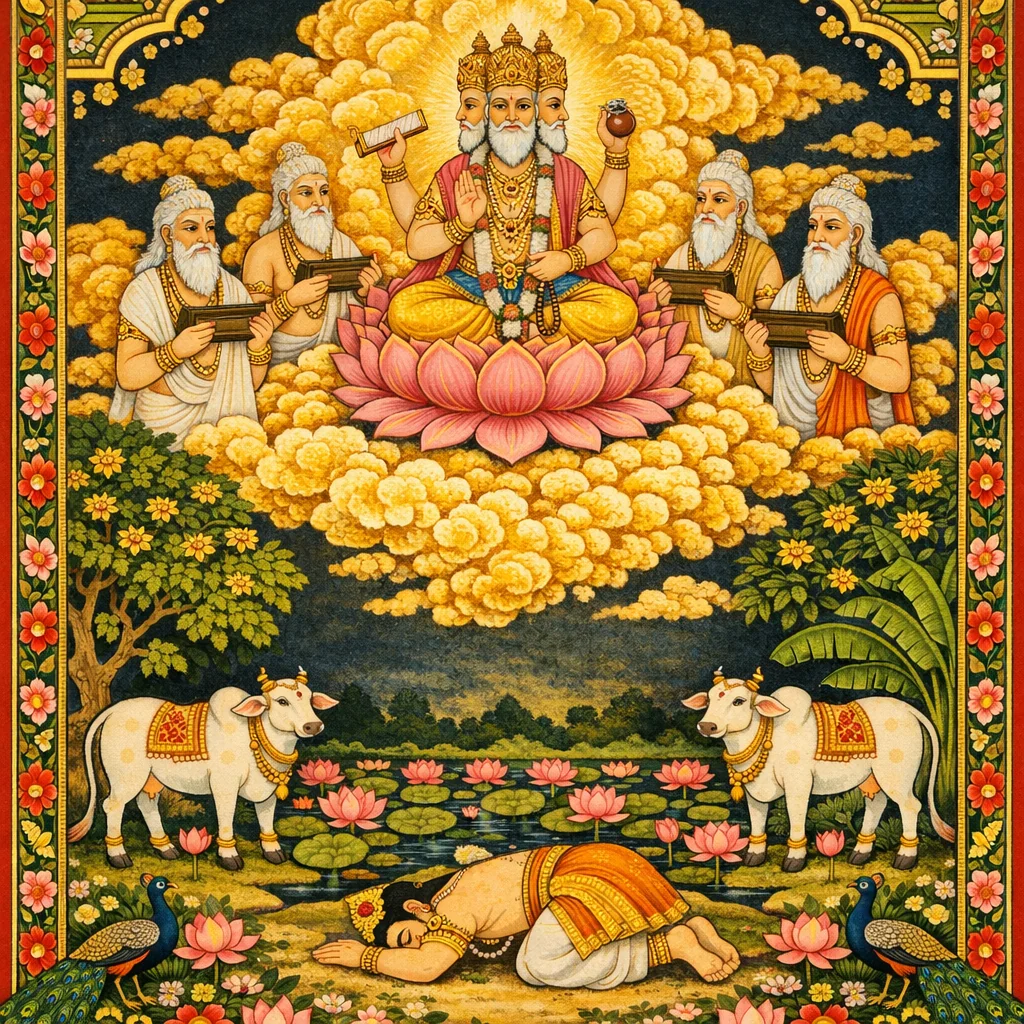
Continuing the Purāṇic focus on dynastic transmission and dharmic governance, Parīkṣit questions how the self-realized devotee Priyavrata could remain entangled in household life, seemingly contrary to liberation. Śukadeva affirms the premise—devotees are beyond bondage—yet explains that impediments may appear without destroying devotion. Priyavrata, trained by Nārada in bhakti and jñāna, hesitates to accept rulership when Svāyambhuva Manu requests it. Brahmā descends with the personified Vedas and instructs Priyavrata that no being can defy the Supreme Lord’s order; varṇāśrama duties must be executed without envy, with inner shelter at the Lord’s lotus feet. Priyavrata accepts, rules powerfully, marries Barhiṣmatī, begets heirs, and performs a cosmic feat: following the sun, his chariot marks seven oceans, dividing Bhū-maṇḍala into seven dvīpas and oceans, which he assigns to his sons. Despite apparent domestic absorption, he remains internally liberated. Later, he awakens to renunciation, divides his kingdom, abandons attachment, and returns to pure Kṛṣṇa consciousness—setting the stage for subsequent geographical and genealogical expansions of Canto 5.
Shlokas
Verse 1
राजोवाच प्रियव्रतो भागवत आत्माराम: कथं मुने । गृहेऽरमत यन्मूल: कर्मबन्ध: पराभव: ॥ १ ॥
King Parīkṣit inquired from Śukadeva Gosvāmī: O great sage, why did King Priyavrata, who was a great, self-realized devotee of the Lord, remain in household life, which is the root cause of the bondage of karma [fruitive activities] and which defeats the mission of human life?
Verse 2
न नूनं मुक्तसङ्गानां तादृशानां द्विजर्षभ । गृहेष्वभिनिवेशोऽयं पुंसां भवितुमर्हति ॥ २ ॥
Devotees are certainly liberated persons. Therefore, O greatest of the brāhmaṇas, they cannot possibly be absorbed in family affairs.
Verse 3
महतां खलु विप्रर्षे उत्तमश्लोकपादयो: । छायानिर्वृतचित्तानां न कुटुम्बे स्पृहामति: ॥ ३ ॥
Elevated mahātmās who have taken shelter of the lotus feet of the Supreme Personality of Godhead are fully satiated by the shade of those lotus feet. Their consciousness cannot possibly become attached to family members.
Verse 4
संशयोऽयं महान् ब्रह्मन् दारागारसुतादिषु । सक्तस्य यत्सिद्धिरभूत्कृष्णे च मतिरच्युता ॥ ४ ॥
The King continued: O great brāhmaṇa, this is my great doubt. How was it possible for a person like King Priyavrata, who was so attached to wife, children and home, to achieve the topmost infallible perfection in Kṛṣṇa consciousness?
Verse 5
श्रीशुक उवाच बाढमुक्तं भगवत उत्तमश्लोकस्य श्रीमच्चरणारविन्दमकरन्दरस आवेशितचेतसो भागवतपरमहंस दयितकथां किञ्चिदन्तरायविहतां स्वां शिवतमां पदवीं न प्रायेण हिन्वन्ति ॥ ५ ॥
Śrī Śukadeva Gosvāmī said: What you have said is correct. The glories of the Supreme Personality of Godhead, who is praised in eloquent, transcendental verses by such exalted personalities as Brahmā, are very pleasing to great devotees and liberated persons. One who is attached to the nectarean honey of the Lord’s lotus feet, and whose mind is always absorbed in His glories, may sometimes be checked by some impediment, but he still never gives up the exalted position he has acquired.
Verse 6
यर्हि वाव ह राजन् स राजपुत्र: प्रियव्रत: परमभागवतो नारदस्य चरणोपसेवयाञ्जसावगतपरमार्थसतत्त्वो ब्रह्मसत्रेण दीक्षिष्यमाण: अवनितलपरिपालनायाम्नातप्रवरगुणगणैकान्तभाजनतया स्वपित्रोपामन्त्रितो भगवति वासुदेव एवाव्यवधानसमाधियोगेन समावेशित-सकलकारकक्रियाकलापो नैवाभ्यनन्दद्यद्यपि तदप्रत्याम्नातव्यं तदधिकरण आत्मनोऽन्यस्माद सतोऽपि पराभवमन्वीक्षमाण: ॥ ६ ॥
Śukadeva Gosvāmī continued: My dear King, Prince Priyavrata was a great devotee because he sought the lotus feet of Nārada, his spiritual master, and thus achieved the highest perfection in transcendental knowledge. With advanced knowledge, he always engaged in discussing spiritual subjects and did not divert his attention to anything else. The Prince’s father then asked him to take charge of ruling the world. He tried to convince Priyavrata that this was his duty as indicated in the revealed scriptures. Prince Priyavrata, however, was continuously practicing bhakti-yoga by constantly remembering the Supreme Personality of Godhead, thus engaging all his senses in the service of the Lord. Therefore, although the order of his father could not be rejected, the Prince did not welcome it. Thus he very conscientiously raised the question of whether he might be diverted from devotional service by accepting the responsibility of ruling over the world.
Verse 7
अथ ह भगवानादिदेव एतस्य गुणविसर्गस्य परिबृंहणानुध्यानव्यवसित सकलजगदभिप्राय आत्मयोनिरखिलनिगमनिजगणपरिवेष्टित: स्वभवनादवततार ॥ ७ ॥
Śrī Śukadeva Gosvāmī continued: The first created being and most powerful demigod in this universe is Lord Brahmā, who is always responsible for developing universal affairs. Born directly from the Supreme Personality of Godhead, he dedicates his activities to the welfare of the entire universe, for he knows the purpose of the universal creation. This supremely powerful Lord Brahmā, accompanied by his associates and the personified Vedas, left his own abode in the highest planetary system and descended to the place of Prince Priyavrata’s meditation.
Verse 8
स तत्र तत्र गगनतल उडुपतिरिव विमानावलिभिरनुपथममरपरिवृढैरभिपूज्यमान: पथि पथि च वरूथश: सिद्धगन्धर्वसाध्यचारणमुनिगणैरुपगीयमानो गन्धमादनद्रोणीमवभासयन्नुपससर्प ॥ ८ ॥
As Lord Brahmā descended on his carrier, the great swan, all the residents of the planets named Siddhaloka, Gandharvaloka, Sādhyaloka and Cāraṇaloka, as well as great sages and demigods flying in their different airplanes, assembled within the canopy of the sky to receive Lord Brahmā and worship him. As he received respect and adoration from the residents of the various planets, Lord Brahmā appeared just like the full moon surrounded by illuminating stars. Lord Brahmā’s great swan then arrived at the border of Gandhamādana Hill and approached Prince Priyavrata, who was sitting there.
Verse 9
तत्र ह वा एनं देवर्षिर्हंसयानेन पितरं भगवन्तं हिरण्यगर्भमुपलभमान: सहसैवोत्थायार्हणेन सह पितापुत्राभ्यामवहिताञ्जलिरुपतस्थे ॥ ९ ॥
Lord Brahmā, the father of Nārada Muni, is the supreme person within this universe. As soon as Nārada saw the great swan, he could understand that Lord Brahmā had arrived. Therefore he immediately stood up, along with Svāyambhuva Manu and his son Priyavrata, whom Nārada was instructing. Then they folded their hands and began to worship Lord Brahmā with great respect.
Verse 10
भगवानपि भारत तदुपनीतार्हण: सूक्तवाकेनातितरामुदितगुणगणावतारसुजय: प्रियव्रतमादि पुरुषस्तं सदयहासावलोक इति होवाच ॥ १० ॥
My dear King Parīkṣit, because Lord Brahmā had finally descended from Satyaloka to Bhūloka, Nārada Muni, Prince Priyavrata and Svāyambhuva Manu came forward to offer him objects of worship and to praise him in highly qualified language, according to Vedic etiquette. At that time, Lord Brahmā, the original person of this universe, felt compassion for Priyavrata and, looking upon him with a smiling face, spoke to him as follows.
Verse 11
श्रीभगवानुवाच निबोध तातेदमृतं ब्रवीमि मासूयितुं देवमर्हस्यप्रमेयम् । वयं भवस्ते तत एष महर्षि- र्वहाम सर्वे विवशा यस्य दिष्टम् ॥ ११ ॥
Lord Brahmā, the supreme person within this universe, said: My dear Priyavrata, kindly hear attentively what I shall say to you. Do not be jealous of the Supreme Lord, who is beyond our experimental measurements. All of us, including Lord Śiva, your father and the great sage Mahārṣi Nārada, must carry out the order of the Supreme. We cannot deviate from His order.
Verse 12
न तस्य कश्चित्तपसा विद्यया वा न योगवीर्येण मनीषया वा । नैवार्थधर्मै: परत: स्वतो वा कृतं विहन्तुं तनुभृद्विभूयात् ॥ १२ ॥
One cannot avoid the order of the Supreme Personality of Godhead, not by the strength of severe austerities, an exalted Vedic education, or the power of mystic yoga, physical prowess or intellectual activities. Nor can one use his power of religion, his material opulence or any other means, either by himself or with the help of others, to defy the orders of the Supreme Lord. That is not possible for any living being, from Brahmā down to the ant.
Verse 13
भवाय नाशाय च कर्म कर्तुं शोकाय मोहाय सदा भयाय । सुखाय दु:खाय च देहयोग- मव्यक्तदिष्टं जनताङ्ग धत्ते ॥ १३ ॥
My dear Priyavrata, by the order of the Supreme Personality of Godhead, all living entities accept different types of bodies for birth and death, activity, lamentation, illusion, fear of future dangers, and happiness and distress.
Verse 14
यद्वाचि तन्त्यां गुणकर्मदामभि: सुदुस्तरैर्वत्स वयं सुयोजिता: । सर्वे वहामो बलिमीश्वराय प्रोता नसीव द्विपदे चतुष्पद: ॥ १४ ॥
My dear boy, all of us are bound by the Vedic injunctions to the divisions of varṇāśrama according to our qualities and work. These divisions are difficult to avoid because they are scientifically arranged. We must therefore carry out our duties of varṇāśrama-dharma, like bulls obliged to move according to the direction of a driver pulling on ropes knotted to their noses.
Verse 15
ईशाभिसृष्टं ह्यवरुन्ध्महेऽङ्ग दु:खं सुखं वा गुणकर्मसङ्गात् । आस्थाय तत्तद्यदयुङ्क्त नाथ- श्चक्षुष्मतान्धा इव नीयमाना: ॥ १५ ॥
My dear Priyavrata, according to our association with different modes of material nature, the Supreme Personality of Godhead gives us our specific bodies and the happiness and distress we achieve. One must therefore remain situated as he is and be conducted by the Supreme Personality of Godhead, exactly as a blind man is led by a person who has eyes with which to see.
Verse 16
मुक्तोऽपि तावद्बिभृयात्स्वदेह- मारब्धमश्नन्नभिमानशून्य: । यथानुभूतं प्रतियातनिद्र: किं त्वन्यदेहाय गुणान्न वृङ्क्ते ॥ १६ ॥
Even if one is liberated, he nevertheless accepts the body he has received according to his past karma. Without misconceptions, however, he regards his enjoyment and suffering due to that karma the way an awakened person regards a dream he had while sleeping. He thus remains steadfast and never works to achieve another material body under the influence of the three modes of material nature.
Verse 17
भयं प्रमत्तस्य वनेष्वपि स्याद् यत: स आस्ते सहषट्सपत्न: । जितेन्द्रियस्यात्मरतेर्बुधस्य गृहाश्रम: किं नु करोत्यवद्यम् ॥ १७ ॥
Even if he goes from forest to forest, one who is not self-controlled must always fear material bondage because he is living with six co-wives — the mind and knowledge-acquiring senses. Even householder life, however, cannot harm a self-satisfied, learned man who has conquered his senses.
Verse 18
य: षट् सपत्नान् विजिगीषमाणो गृहेषु निर्विश्य यतेत पूर्वम् । अत्येति दुर्गाश्रित ऊर्जितारीन् क्षीणेषु कामं विचरेद्विपश्चित् ॥ १८ ॥
One who is situated in household life and who systematically conquers his mind and five sense organs is like a king in his fortress who conquers his powerful enemies. After one has been trained in household life and his lusty desires have decreased, he can move anywhere without danger.
Verse 19
त्वं त्वब्जनाभाङ्घ्रिसरोजकोश- दुर्गाश्रितो निर्जितषट्सपत्न: । भुङ्क्ष्वेह भोगान् पुरुषातिदिष्टान् विमुक्तसङ्ग: प्रकृतिं भजस्व ॥ १९ ॥
Lord Brahmā continued: My dear Priyavrata, seek shelter inside the opening in the lotus of the feet of the Lord, whose navel is also like a lotus. Thus conquer the six sense organs [the mind and knowledge-acquiring senses]. Accept material enjoyment because the Lord, extraordinarily, has ordered you to do this. You will thus always be liberated from material association and be able to carry out the Lord’s orders in your constitutional position.
Verse 20
श्रीशुक उवाच इति समभिहितो महाभागवतो भगवतस्त्रिभुवनगुरोरनुशासनमात्मनो लघुतयावनतशिरोधरो बाढमिति सबहुमानमुवाह ॥ २० ॥
Śrī Śukadeva Gosvāmī continued: After thus being fully instructed by Lord Brahmā, who is the spiritual master of the three worlds, Priyavrata, his own position being inferior, offered obeisances, accepted the order and carried it out with great respect.
Verse 21
भगवानपि मनुना यथावदुपकल्पितापचिति: प्रियव्रतनारदयोरविषममभिसमीक्षमाणयोरात्मसमवस्थानमवाङ्मनसं क्षयमव्यवहृतं प्रवर्तयन्नगमत् ॥ २१ ॥
Lord Brahmā was then worshiped by Manu, who respectfully satisfied him as well as he could. Priyavrata and Nārada also looked upon Brahmā with no tinges of resentment. Having engaged Priyavrata in accepting his father’s request, Lord Brahmā returned to his abode, Satyaloka, which is indescribable by the endeavor of mundane mind or words.
Verse 22
मनुरपि परेणैवं प्रतिसन्धितमनोरथ: सुरर्षिवरानुमतेनात्मजमखिलधरामण्डलस्थितिगुप्तय आस्थाप्य स्वयमतिविषमविषयविषजलाशयाशाया उपरराम ॥ २२ ॥
Svāyambhuva Manu, with the assistance of Lord Brahmā, thus fulfilled his desires. With the permission of the great sage Nārada, he delivered to his son the governmental responsibility for maintaining and protecting all the planets of the universe. He thus achieved relief from the most dangerous, poisonous ocean of material desires.
Verse 23
इति ह वाव स जगतीपतिरीश्वरेच्छयाधिनिवेशितकर्माधिकारोऽखिलजगद्बन्धध्वंसनपरानुभावस्य भगवत आदिपुरुषस्याङ्घ्रियुगलानवरतध्यानानुभावेन परिरन्धितकषायाशयोऽवदातोऽपि मानवर्धनो महतां महीतलमनुशशास ॥ २३ ॥
Following the order of the Supreme Personality of Godhead, Mahārāja Priyavrata fully engaged in worldly affairs, yet he always thought of the lotus feet of the Lord, which are the cause of liberation from all material attachment. Although Priyavrata Mahārāja was completely freed from all material contamination, he ruled the material world just to honor the orders of his superiors.
Verse 24
अथ च दुहितरं प्रजापतेर्विश्वकर्मण उपयेमे बर्हिष्मतीं नाम तस्यामु ह वाव आत्मजानात्मसमानशीलगुणकर्मरूपवीर्योदारान्दश भावयाम्बभूव कन्यां च यवीयसीमूर्जस्वतीं नाम ॥ २४ ॥
Thereafter, Mahārāja Priyavrata married Barhiṣmatī, the daughter of the prajāpati named Viśvakarmā. In her he begot ten sons equal to him in beauty, character, magnanimity and other qualities. He also begot a daughter, the youngest of all, named Ūrjasvatī.
Verse 25
आग्नीध्रेध्मजिह्वयज्ञबाहुमहावीरहिरण्यरेतोघृतपृष्ठसवनमेधातिथिवीतिहोत्रकवय इति सर्व एवाग्निनामान: ॥ २५ ॥
The ten sons of Mahārāja Priyavrata were named Āgnīdhra, Idhmajihva, Yajñabāhu, Mahāvīra, Hiraṇyaretā, Ghṛtapṛṣṭha, Savana, Medhātithi, Vītihotra and Kavi. These are also names of Agni, the fire-god.
Verse 26
एतेषां कविर्महावीर: सवन इति त्रय आसन्नूर्ध्वरेतसस्त आत्मविद्यायामर्भभावादारभ्य कृतपरिचया: पारमहंस्यमेवाश्रममभजन् ॥ २६ ॥
Three among these ten — namely Kavi, Mahāvīra and Savana — lived in complete celibacy. Thus trained in brahmacārī life from the beginning of childhood, they were very conversant with the highest perfection, known as the paramahaṁsa-āśrama.
Verse 27
तस्मिन्नु ह वा उपशमशीला: परमर्षय: सकलजीवनिकायावासस्य भगवतो वासुदेवस्य भीतानां शरणभूतस्य श्रीमच्चरणारविन्दाविरतस्मरणाविगलितपरमभक्तियोगानुभावेन परिभावितान्तर्हृदयाधिगते भगवति सर्वेषां भूतानामात्मभूते प्रत्यगात्मन्येवा- त्मनस्तादात्म्यमविशेषेण समीयु: ॥ २७ ॥
Thus situated in the renounced order from the beginning of their lives, all three of them completely controlled the activities of their senses and thus became great saints. They concentrated their minds always upon the lotus feet of the Supreme Personality of Godhead, who is the resting place of the totality of living entities and who is therefore celebrated as Vāsudeva. Lord Vāsudeva is the only shelter of those who are actually afraid of material existence. By constantly thinking of His lotus feet, these three sons of Mahārāja Priyavrata became advanced in pure devotional service. By the prowess of their devotional service, they could directly perceive the Supreme Personality of Godhead, who is situated in everyone’s heart as the Supersoul, and realize that there was qualitatively no difference between themselves and Him.
Verse 28
अन्यस्यामपि जायायां त्रय: पुत्रा आसन्नुत्तमस्तामसो रैवत इति मन्वन्तराधिपतय: ॥ २८ ॥
In his other wife, Mahārāja Priyavrata begot three sons, named Uttama, Tāmasa and Raivata. All of them later took charge of manvantara millenniums.
Verse 29
एवमुपशमायनेषु स्वतनयेष्वथ जगतीपतिर्जगतीमर्बुदान्येकादश परिवत्सराणामव्याहताखिलपुरुषकारसारसम्भृतदोर्दण्डयुगलापीडितमौर्वीगुणस्तनितविरमितधर्मप्रतिपक्षो बर्हिष्मत्याश्चानुदिनमेधमानप्रमोदप्रसरणयौषिण्यव्रीडाप्रमुषितहासावलोकरुचिरक्ष्वेल्यादिभि: पराभूयमानविवेक इवानवबुध्यमान इव महामना बुभुजे ॥ २९ ॥
After Kavi, Mahāvīra and Savana were completely trained in the paramahaṁsa stage of life, Mahārāja Priyavrata ruled the universe for eleven arbudas of years. Whenever he was determined to fix his arrow upon his bowstring with his two powerful arms, all opponents of the regulative principles of religious life would flee from his presence in fear of the unparalleled prowess he displayed in ruling the universe. He greatly loved his wife Barhiṣmatī, and with the increase of days, their exchange of nuptial love also increased. By her feminine behavior as she dressed herself, walked, got up, smiled, laughed, and glanced about, Queen Barhiṣmatī increased his energy. Thus although he was a great soul, he appeared lost in the feminine conduct of his wife. He behaved with her just like an ordinary man, but actually he was a great soul.
Verse 30
यावदवभासयति सुरगिरिमनुपरिक्रामन् भगवानादित्यो वसुधातलमर्धेनैव प्रतपत्यर्धेनावच्छादयति तदा हि भगवदुपासनोपचितातिपुरुषप्रभावस्तदनभिनन्दन् समजवेन रथेन ज्योतिर्मयेन रजनीमपि दिनं करिष्यामीति सप्तकृत्वस्तरणिमनुपर्यक्रामद् द्वितीय इव पतङ्ग: ॥ ३० ॥
While so excellently ruling the universe, King Priyavrata once became dissatisfied with the circumambulation of the most powerful sun-god. Encircling Sumeru Hill on his chariot, the sun-god illuminates all the surrounding planetary systems. However, when the sun is on the northern side of the hill, the south receives less light, and when the sun is in the south, the north receives less. King Priyavrata disliked this situation and therefore decided to make daylight in the part of the universe where there was night. He followed the orbit of the sun-god on a brilliant chariot and thus fulfilled his desire. He could perform such wonderful activities because of the power he had achieved by worshiping the Supreme Personality of Godhead.
Verse 31
ये वा उ ह तद्रथचरणनेमिकृतपरिखातास्ते सप्त सिन्धव आसन् यत एव कृता: सप्त भुवो द्वीपा: ॥ ३१ ॥
When Priyavrata drove his chariot behind the sun, the rims of his chariot wheels created impressions that later became seven oceans, dividing the planetary system known as Bhū-maṇḍala into seven islands.
Verse 32
जम्बूप्लक्षशाल्मलिकुशक्रौञ्चशाकपुष्करसंज्ञास्तेषां परिमाणं पूर्वस्मात्पूर्वस्मादुत्तर उत्तरो यथासंख्यं द्विगुणमानेन बहि: समन्तत उपक्लृप्ता: ॥ ३२ ॥
The names of the islands are Jambū, Plakṣa, Śālmali, Kuśa, Krauñca, Śāka and Puṣkara. Each island is twice as large as the one preceding it, and each is surrounded by a liquid substance, beyond which is the next island.
Verse 33
क्षारोदेक्षुरसोदसुरोदघृतोदक्षीरोददधिमण्डोदशुद्धोदा: सप्त जलधय: सप्त द्वीपपरिखा इवाभ्यन्तरद्वीपसमाना एकैकश्येन यथानुपूर्वं सप्तस्वपि बहिर्द्वीपेषु पृथक्परित उपकल्पितास्तेषु जम्ब्वादिषु बर्हिष्मतीपतिरनुव्रतानात्मजानाग्नीध्रेध्मजिह्वयज्ञबाहुहिरण्यरेतोघृतपृष्ठमेधातिथिवीतिहोत्रसंज्ञान् यथा संख्येनैकैकस्मिन्नेकमेवाधिपतिं विदधे ॥ ३३ ॥
The seven oceans respectively contain salt water, sugarcane juice, liquor, clarified butter, milk, emulsified yogurt, and sweet drinking water. All the islands are completely surrounded by these oceans, and each ocean is equal in breadth to the island it surrounds. Mahārāja Priyavrata, the husband of Queen Barhiṣmatī, gave sovereignty over these islands to his respective sons, namely Āgnīdhra, Idhmajihva, Yajñabāhu, Hiraṇyaretā, Ghṛtapṛṣṭha, Medhātithi and Vītihotra. Thus they all became kings by the order of their father.
Verse 34
दुहितरं चोर्जस्वतीं नामोशनसे प्रायच्छद्यस्यामासीद् देवयानी नाम काव्यसुता ॥ ३४ ॥
King Priyavrata then gave his daughter, Ūrjasvatī, in marriage to Śukrācārya, who begot in her a daughter named Devayānī.
Verse 35
नैवंविध: पुरुषकार उरुक्रमस्यपुंसां तदङ्घ्रिरजसा जितषड्गुणानाम् । चित्रं विदूरविगत: सकृदाददीतयन्नामधेयमधुना स जहाति बन्धम् ॥ ३५ ॥
My dear King, a devotee who has taken shelter of the dust from the lotus feet of the Lord can transcend the influence of the six material waves — namely hunger, thirst, lamentation, illusion, old age and death — and he can conquer the mind and five senses. However, this is not very wonderful for a pure devotee of the Lord because even a person beyond the jurisdiction of the four castes — in other words, an untouchable — is immediately relieved of bondage to material existence if he utters the holy name of the Lord even once.
Verse 36
स एवमपरिमितबलपराक्रम एकदा तु देवर्षिचरणानुशयनानुपतितगुणविसर्गसंसर्गेणानिर्वृतमिवात्मानं मन्यमान आत्मनिर्वेद इदमाह ॥ ३६ ॥
While enjoying his material opulences with full strength and influence, Mahārāja Priyavrata once began to consider that although he had fully surrendered to the great saint Nārada and was actually on the path of Kṛṣṇa consciousness, he had somehow become again entangled in material activities. Thus his mind now became restless, and he began to speak in a spirit of renunciation.
Verse 37
अहो असाध्वनुष्ठितं यदभिनिवेशितोऽहमिन्द्रियैरविद्यारचितविषमविषयान्धकूपे तदलमलममुष्या वनिताया विनोदमृगं मां धिग्धिगिति गर्हयाञ्चकार ॥ ३७ ॥
The King thus began criticizing himself: Alas, how condemned I have become because of my sense gratification! I have now fallen into material enjoyment, which is exactly like a covered well. I have had enough! I am not going to enjoy any more. Just see how I have become like a dancing monkey in the hands of my wife. Because of this, I am condemned.
Verse 38
परदेवताप्रसादाधिगतात्मप्रत्यवमर्शेनानुप्रवृत्तेभ्य: पुत्रेभ्य इमां यथादायं विभज्य भुक्तभोगां च महिषीं मृतकमिव सह महाविभूतिमपहाय स्वयं निहितनिर्वेदो हृदि गृहीतहरिविहारानुभावो भगवतो नारदस्य पदवीं पुनरेवानुससार ॥ ३८ ॥
By the grace of the Supreme Personality of Godhead, Mahārāja Priyavrata reawakened to his senses. He divided all his earthly possessions among his obedient sons. He gave up everything, including his wife, with whom he had enjoyed so much sense gratification, and his great and opulent kingdom, and he completely renounced all attachment. His heart, having been cleansed, became a place of pastimes for the Supreme Personality of Godhead. Thus he was able to return to the path of Kṛṣṇa consciousness, spiritual life, and resume the position he had attained by the grace of the great saint Nārada.
Verse 39
तस्य ह वा एते श्लोका:— प्रियव्रतकृतं कर्म को नु कुर्याद्विनेश्वरम् । यो नेमिनिम्नैरकरोच्छायां घ्नन् सप्त वारिधीन् ॥ ३९ ॥
There are many famous verses regarding Mahārāja Priyavrata’s activities:
Verse 40
भूसंस्थानं कृतं येन सरिद्गिरिवनादिभि: । सीमा च भूतनिर्वृत्यै द्वीपे द्वीपे विभागश: ॥ ४० ॥
“To stop the quarreling among different peoples, Mahārāja Priyavrata marked boundaries at rivers and at the edges of mountains and forests so that no one would trespass upon another’s property.”
Verse 41
भौमं दिव्यं मानुषं च महित्वं कर्मयोगजम् । यश्चक्रे निरयौपम्यं पुरुषानुजनप्रिय: ॥ ४१ ॥
“As a great follower and devotee of the sage Nārada, Mahārāja Priyavrata considered hellish the opulences he had achieved by dint of fruitive activities and mystic power, whether in the lower or heavenly planetary systems or in human society.”
Frequently Asked Questions
Because Brahmā establishes that the Supreme Lord’s order is unavoidable for all beings—from Brahmā to an ant. Priyavrata accepted rulership not from personal desire but as service to the divine plan and to his superiors (Manu, Brahmā), while keeping his consciousness sheltered at the Lord’s lotus feet. This preserves bhakti while fulfilling dharma.
The chapter distinguishes uncontrolled wandering from controlled household discipline: the true danger is the unconquered mind and senses (the ‘six co-wives’). A self-satisfied, learned person who systematically conquers the mind and senses can live as a gṛhastha without being harmed, treating karmic happiness and distress like a dream—without generating new bondage.
They are Jambū, Plakṣa, Śālmali, Kuśa, Krauñca, Śāka, and Puṣkara, each surrounded by corresponding oceans of salt water, sugarcane juice, liquor, ghee, milk, yogurt, and sweet water. They are narrated to show the cosmic-scale effects of a devotee-king acting under divine empowerment, and to transition Canto 5 into its broader cosmographical exposition.
Because resistance to one’s prescribed duty can subtly become envy toward the Lord’s governance—treating divine arrangement as negotiable. Brahmā reframes duty as alignment with the Supreme will: obedience without ego preserves devotion, whereas refusal can mask personal preference as spirituality.