Adhyaya 25
The Glories of Lord Ananta (Śeṣa/Saṅkarṣaṇa) and the Cosmic Foundation Beneath Pātāla
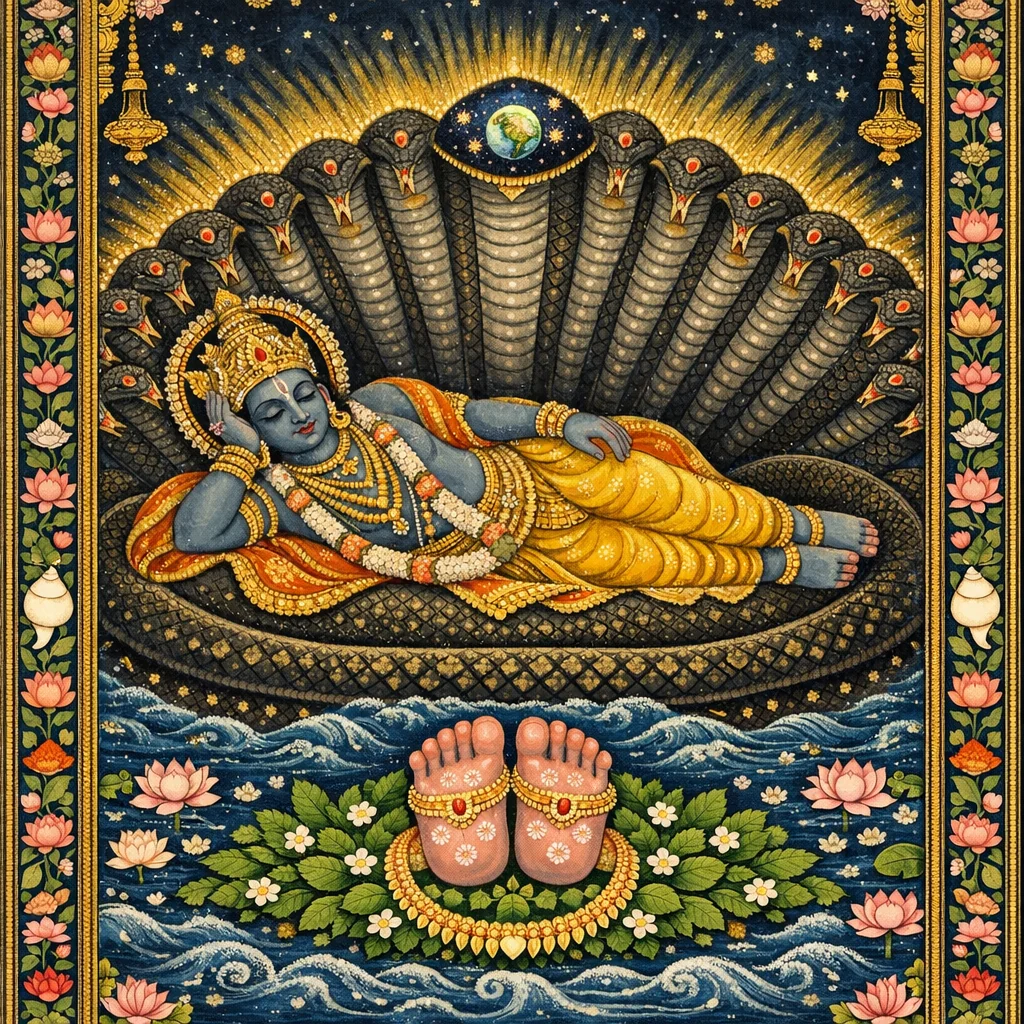
Continuing the Fifth Canto’s descent through cosmic geography and the karmic placement of beings, Śukadeva identifies the ultimate ontological support beneath the lower planetary systems: Lord Ananta (Śeṣa), also known as Saṅkarṣaṇa, situated far below Pātāla. He is portrayed as a Viṣṇu-expansion who presides over tamo-guṇa and the conditioned soul’s false ego—specifically the enjoyer-conception that makes one think oneself supreme. The universe, resting like a mustard seed on one of His countless hoods, is shown to be infinitesimal before His magnitude. At dissolution, Rudra manifests from between His eyebrows to enact devastation, linking Ananta to nirodha. The chapter then shifts to devotional aesthetics: His lotus feet, jeweled toenails, spiritual arms, ornaments, and tulasī garland; celestial beings and serpent dynasties worship Him. Hearing His glories through paramparā and meditating on Him purifies the heart-knot of domination. The chapter closes by summarizing the broader cosmological teaching: beings migrate through higher and lower worlds according to desire and karma, preparing the listener for the next movement in Śukadeva’s exposition beyond this cosmographic segment.
Shlokas
Verse 1
श्रीशुक उवाच तस्य मूलदेशे त्रिंशद्योजनसहस्रान्तर आस्ते या वै कला भगवतस्तामसी समाख्यातानन्त इति सात्वतीया द्रष्टृदृश्ययो: सङ्कर्षणमहमित्यभिमानलक्षणं यं सङ्कर्षणमित्याचक्षते ॥ १ ॥
Śrī Śukadeva Gosvāmī said to Mahārāja Parīkṣit: My dear King, approximately 240,000 miles beneath the planet Pātāla lives another incarnation of the Supreme Personality of Godhead. He is the expansion of Lord Viṣṇu known as Lord Ananta or Lord Saṅkarṣaṇa. He is always in the transcendental position, but because He is worshiped by Lord Śiva, the deity of tamo-guṇa or darkness, He is sometimes called tāmasī. Lord Ananta is the predominating Deity of the material mode of ignorance as well as the false ego of all conditioned souls. When a conditioned living being thinks, “I am the enjoyer, and this world is meant to be enjoyed by me,” this conception of life is dictated to him by Saṅkarṣaṇa. Thus the mundane conditioned soul thinks himself the Supreme Lord.
Verse 2
यस्येदं क्षितिमण्डलं भगवतोऽनन्तमूर्ते: सहस्रशिरस एकस्मिन्नेव शीर्षणि ध्रियमाणं सिद्धार्थ इव लक्ष्यते ॥ २ ॥
Śukadeva Gosvāmī continued: This great universe, situated on one of Lord Anantadeva’s thousands of hoods, appears just like a white mustard seed. It is infinitesimal compared to the hood of Lord Ananta.
Verse 3
यस्य ह वा इदं कालेनोपसञ्जिहीर्षतोऽमर्षविरचितरुचिरभ्रमद्भ्रुवोरन्तरेण साङ्कर्षणो नाम रुद्र एकादशव्यूहस्त्र्यक्षस्त्रिशिखं शूलमुत्तम्भयन्नुदतिष्ठत् ॥ ३ ॥
At the time of devastation, when Lord Anantadeva desires to destroy the entire creation, He becomes slightly angry. Then from between His two eyebrows appears three-eyed Rudra, carrying a trident. This Rudra, who is known as Sāṅkarṣaṇa, is the embodiment of the eleven Rudras, or incarnations of Lord Śiva. He appears in order to devastate the entire creation.
Verse 4
यस्याङ्घ्रिकमलयुगलारुणविशदनखमणिषण्डमण्डलेष्वहिपतय: सह सात्वतर्षभैरेकान्तभक्तियोगेनावनमन्त: स्ववदनानि परिस्फुरत्कुण्डलप्रभामण्डितगण्डस्थलान्यतिमनोहराणि प्रमुदितमनस: खलु विलोकयन्ति ॥ ४ ॥
The pink, transparent toenails on the Lord’s lotus feet are exactly like valuable gems polished to a mirror finish. When the unalloyed devotees and the leaders of the snakes offer their obeisances to Lord Saṅkarṣaṇa with great devotion, they become very joyful upon seeing their own beautiful faces reflected in His toenails. Their cheeks are decorated with glittering earrings, and the beauty of their faces is extremely pleasing to see.
Verse 5
यस्यैव हि नागराजकुमार्य आशिष आशासानाश्चार्वङ्गवलयविलसितविशद विपुलधवलसुभगरुचिरभुजरजतस्तम्भेष्वगुरुचन्दनकुङ्कुमपङ्कानुलेपेनावलिम्पमानास्तदभिमर्शनोन्मथितहृदयमकरध्वजावेशरुचिरललितस्मितास्तदनुरागमदमुदितमद् विघूर्णितारुणकरुणावलोकनयनवदनारविन्दं सव्रीडं किल विलोकयन्ति ॥ ५ ॥
Lord Ananta’s arms are attractively long, beautifully decorated with bangles and completely spiritual. They are white, and so they appear like silver columns. When the beautiful princesses of the serpent kings, hoping for the Lord’s auspicious blessing, smear His arms with aguru pulp, sandalwood pulp and kuṅkuma, the touch of His limbs awakens lusty desires within them. Understanding their minds, the Lord looks at the princesses with a merciful smile, and they become bashful, realizing that He knows their desires. Then they smile beautifully and look upon the Lord’s lotus face, which is beautified by reddish eyes rolling slightly from intoxication and delighted by love for His devotees.
Verse 6
स एव भगवाननन्तोऽनन्तगुणार्णव आदिदेव उपसंहृतामर्षरोषवेगो लोकानां स्वस्तय आस्ते ॥ ६ ॥
Lord Saṅkarṣaṇa is the ocean of unlimited spiritual qualities, and thus He is known as Anantadeva. He is nondifferent from the Supreme Personality of Godhead. For the welfare of all living entities within this material world, He resides in His abode, restraining His anger and intolerance.
Verse 7
ध्यायमान: सुरासुरोरगसिद्धगन्धर्वविद्याधरमुनिगणैरनवरतमदमुदितविकृतविह्वललोचन: सुललितमुखरिकामृतेनाप्यायमान: स्वपार्षदविबुधयूथपतीनपरिम्लानरागनवतुलसिकामोदमध्वासवेन माद्यन्मधुकरव्रातमधुरगीतश्रियं वैजयन्तीं स्वां वनमालां नीलवासा एककुण्डलो हलककुदि कृतसुभगसुन्दरभुजो भगवान्महेन्द्रो वारणेन्द्र इव काञ्चनीं कक्षामुदारलीलो बिभर्ति ॥ ७ ॥
Śukadeva Gosvāmī continued: The demigods, the demons, the Uragas [serpentine demigods], the Siddhas, the Gandharvas, the Vidyādharas and many highly elevated sages constantly offer prayers to the Lord. Because He is intoxicated, the Lord looks bewildered, and His eyes, appearing like flowers in full bloom, move to and fro. He pleases His personal associates, the heads of the demigods, by the sweet vibrations emanating from His mouth. Dressed in bluish garments and wearing a single earring, He holds a plow on His back with His two beautiful and well-constructed hands. Appearing as white as the heavenly King Indra, He wears a golden belt around His waist and a vaijayantī garland of ever-fresh tulasī blossoms around His neck. Bees intoxicated by the honeylike fragrance of the tulasī flowers hum very sweetly around the garland, which thus becomes more and more beautiful. In this way, the Lord enjoys His very magnanimous pastimes.
Verse 8
य एष एवमनुश्रुतो ध्यायमानो मुमुक्षूणामनादिकालकर्मवासनाग्रथितमविद्यामयं हृदयग्रन्थिं सत्त्वरजस्तमोमयमन्तर्हृदयं गत आशु निर्भिनत्ति तस्यानुभावान् भगवान् स्वायम्भुवो नारद: सह तुम्बुरुणा सभायां ब्रह्मण: संश्लोकयामास ॥ ८ ॥
If persons who are very serious about being liberated from material life hear the glories of Anantadeva from the mouth of a spiritual master in the chain of disciplic succession, and if they always meditate upon Saṅkarṣaṇa, the Lord enters the cores of their hearts, vanquishes all the dirty contamination of the material modes of nature, and cuts to pieces the hard knot within the heart, which has been tied tightly since time immemorial by the desire to dominate material nature through fruitive activities. Nārada Muni, the son of Lord Brahmā, always glorifies Anantadeva in his father’s assembly. There he sings blissful verses of his own composition, accompanied by his stringed instrument [or a celestial singer] known as Tumburu.
Verse 9
उत्पत्तिस्थितिलयहेतवोऽस्य कल्पा: सत्त्वाद्या: प्रकृतिगुणा यदीक्षयाऽऽसन्॒ । यद्रूपं ध्रुवमकृतं यदेकमात्मन् नानाधात्कथमु ह वेद तस्य वर्त्म ॥ ९ ॥
By His glance, the Supreme Personality of Godhead enables the modes of material nature to act as the causes of universal creation, maintenance and destruction. The Supreme Soul is unlimited and beginningless, and although He is one, He has manifested Himself in many forms. How can human society understand the ways of the Supreme?
Verse 10
मूर्तिं न: पुरुकृपया बभार सत्त्वं संशुद्धं सदसदिदं विभाति तत्र । यल्लीलां मृगपतिराददेऽनवद्या- मादातुं स्वजनमनांस्युदारवीर्य: ॥ १० ॥
This manifestation of subtle and gross matter exists within the Supreme Personality of Godhead. Out of causeless mercy toward His devotees, He exhibits various forms, which are all transcendental. The Supreme Lord is most liberal, and He possesses all mystic power. To conquer the minds of His devotees and give pleasure to their hearts, He appears in different incarnations and manifests many pastimes.
Verse 11
यन्नाम श्रुतमनुकीर्तयेदकस्मा- दार्तो वा यदि पतित: प्रलम्भनाद्वा । हन्त्यंह: सपदि नृणामशेषमन्यं कं शेषाद्भगवत आश्रयेन्मुमुक्षु: ॥ ११ ॥
Even if he be distressed or degraded, any person who chants the holy name of the Lord, having heard it from a bona fide spiritual master, is immediately purified. Even if he chants the Lord’s name jokingly or by chance, he and anyone who hears him are freed from all sins. Therefore how can anyone seeking disentanglement from the material clutches avoid chanting the name of Lord Śeṣa? Of whom else should one take shelter?
Verse 12
मूर्धन्यर्पितमणुवत्सहस्रमूर्ध्नो भूगोलं सगिरिसरित्समुद्रसत्त्वम् । आनन्त्यादनिमितविक्रमस्य भूम्न: को वीर्याण्यधिगणयेत्सहस्रजिह्व: ॥ १२ ॥
Because the Lord is unlimited, no one can estimate His power. This entire universe, filled with its many great mountains, rivers, oceans, trees and living entities, is resting just like an atom on one of His many thousands of hoods. Is there anyone, even with thousands of tongues, who can describe His glories?
Verse 13
एवम्प्रभावो भगवाननन्तो दुरन्तवीर्योरुगुणानुभाव: । मूले रसाया: स्थित आत्मतन्त्रो यो लीलया क्ष्मां स्थितये बिभर्ति ॥ १३ ॥
There is no end to the great and glorious qualities of that powerful Lord Anantadeva. Indeed, His prowess is unlimited. Though self-sufficient, He Himself is the support of everything. He resides beneath the lower planetary systems and easily sustains the entire universe.
Verse 14
एता ह्येवेह नृभिरुपगन्तव्या गतयो यथाकर्मविनिर्मिता यथोपदेशमनुवर्णिता: कामान् कामयमानै: ॥ १४ ॥
My dear King, as I heard of it from my spiritual master, I have fully described to you the creation of this material world according to the fruitive activities and desires of the conditioned souls. Those conditioned souls, who are full of material desires, achieve various situations in different planetary systems, and in this way they live within this material creation.
Verse 15
एतावतीर्हि राजन् पुंस: प्रवृत्तिलक्षणस्य धर्मस्य विपाकगतय उच्चावचा विसदृशा यथाप्रश्नं व्याचख्ये किमन्यत्कथयाम इति ॥ १५ ॥
My dear King, I have thus described how people generally act according to their different desires and, as a result, get different types of bodies in higher or lower planets. You inquired of these things from me, and I have explained to you whatever I have heard from authorities. What shall I speak of now?
Frequently Asked Questions
In this chapter, Saṅkarṣaṇa is described as the principle behind the conditioned soul’s “I am the enjoyer” mentality—ahaṅkāra rooted in ignorance. As the presiding deity of tamo-guṇa, He governs the cosmic function by which living beings misidentify with matter; yet as Viṣṇu-tattva He remains transcendental, and remembrance of Him destroys that very contamination.
The comparison is theological and contemplative: it establishes the immeasurable greatness of Bhagavān and the relative insignificance of the cosmos. The teaching redirects awe from the created order to the Creator-support, cultivating humility and devotion rather than cosmic pride or materialistic self-importance.
The text describes a three-eyed Rudra, armed with a trident, who embodies the eleven Rudras and appears for universal dissolution. This connects Ananta to nirodha: the Lord’s will activates the destructive agency (Rudra/Śiva-tattva function) to wind up creation at the appointed time.
Hearing from a bona fide spiritual master in disciplic succession (paramparā) and meditating on Saṅkarṣaṇa brings the Lord into the heart, where He removes guṇa-contamination and cuts the hṛdaya-granthi—the deep knot of domination and fruitive desire. The chapter also emphasizes nāma-kīrtana: chanting the Lord’s name purifies even when done inadvertently.
The aesthetic description functions as bhakti-śāstra: it supplies concrete forms for meditation (dhyāna), intensifies personalism (Bhagavān as a beautiful person), and shows how diverse beings—devas, siddhas, gandharvas, nāgas—are drawn into worship by His transcendental qualities, reinforcing poṣaṇa (the Lord’s benevolent care for devotees).