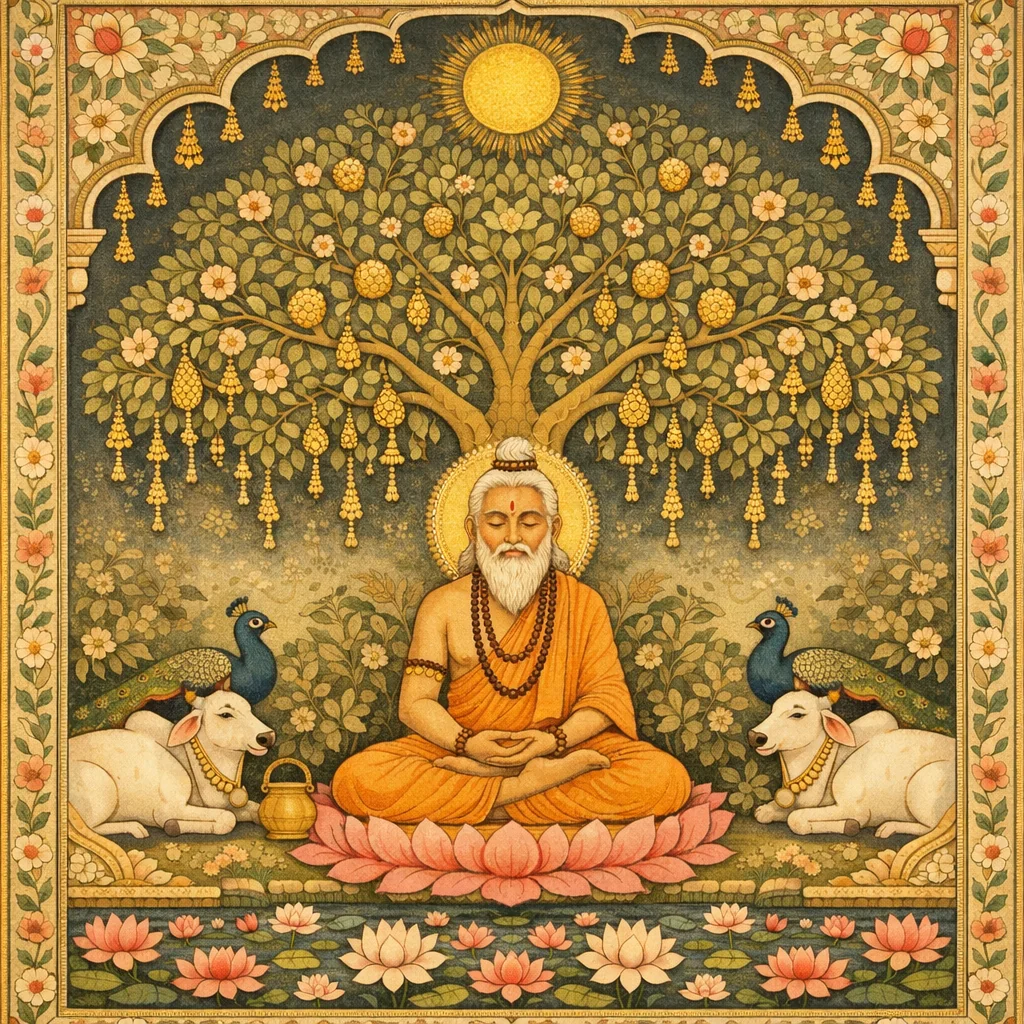
Adhyaya 12
Continuation and Future of the Sūrya-vaṁśa: From Kuśa to the Last Ikṣvāku King
Śukadeva Gosvāmī continues the Ikṣvāku/Sūrya-vaṁśa line after Śrī Rāmacandra by enumerating descendants beginning with Kuśa and proceeding through successive kings. The chapter highlights Vajranābha’s solar origin and especially Hiraṇyanābha’s role as a yogic ācārya—disciple of Jaimini and teacher of Yājñavalkya in ādhyātma-yoga—linking royal succession to the transmission of spiritual science. The narrative then moves to Maru, who, having attained yogic perfection, remains alive in Kalāpa-grāma and is prophesied to revive the dynasty at the end of Kali-yuga. From Maru onward, Śukadeva lists later and future kings, including Bṛhadbala (killed by Parīkṣit’s father), and then projects the remaining line until Sumitra, the final king after whom the solar dynasty’s male line ends. This chapter thus closes the Sūrya-vaṁśa arc by combining genealogy, yogic tradition, prophecy, and the theme of dynastic impermanence—setting the Purāṇa to transition from past exemplars to future outcomes and closures of royal lines.
Shlokas
Verse 1
श्रीशुक उवाच कुशस्य चातिथिस्तस्मान्निषधस्तत्सुतो नभ: । पुण्डरीकोऽथ तत्पुत्र: क्षेमधन्वाभवत्तत: ॥ १ ॥
Śukadeva Gosvāmī said: The son of Rāmacandra was Kuśa, the son of Kuśa was Atithi, the son of Atithi was Niṣadha, and the son of Niṣadha was Nabha. The son of Nabha was Puṇḍarīka, and from Puṇḍarīka came a son named Kṣemadhanvā.
Verse 2
देवानीकस्ततोऽनीह: पारियात्रोऽथ तत्सुत: । ततो बलस्थलस्तस्माद् वज्रनाभोऽर्कसम्भव: ॥ २ ॥
The son of Kṣemadhanvā was Devānīka, Devānīka’s son was Anīha, Anīha’s son was Pāriyātra, and Pāriyātra’s son was Balasthala. The son of Balasthala was Vajranābha, who was said to have been born from the effulgence of the sun-god.
Verse 3
सगणस्तत्सुतस्तस्माद् विधृतिश्चाभवत् सुत: । ततो हिरण्यनाभोऽभूद् योगाचार्यस्तु जैमिने: ॥ ३ ॥ शिष्य: कौशल्य आध्यात्मं याज्ञवल्क्योऽध्यगाद् यत: । योगं महोदयम् ऋषिर्हृदयग्रन्थिभेदकम् ॥ ४ ॥
The son of Vajranābha was Sagaṇa, and his son was Vidhṛti. The son of Vidhṛti was Hiraṇyanābha, who became a disciple of Jaimini and became a great ācārya of mystic yoga. It is from Hiraṇyanābha that the great saint Yājñavalkya learned the highly elevated system of mystic yoga known as ādhyātma-yoga, which can loosen the knots of material attachment in the heart.
Verse 4
सगणस्तत्सुतस्तस्माद् विधृतिश्चाभवत् सुत: । ततो हिरण्यनाभोऽभूद् योगाचार्यस्तु जैमिने: ॥ ३ ॥ शिष्य: कौशल्य आध्यात्मं याज्ञवल्क्योऽध्यगाद् यत: । योगं महोदयम् ऋषिर्हृदयग्रन्थिभेदकम् ॥ ४ ॥
The son of Vajranābha was Sagaṇa, and his son was Vidhṛti. The son of Vidhṛti was Hiraṇyanābha, who became a disciple of Jaimini and became a great ācārya of mystic yoga. It is from Hiraṇyanābha that the great saint Yājñavalkya learned the highly elevated system of mystic yoga known as ādhyātma-yoga, which can loosen the knots of material attachment in the heart.
Verse 5
पुष्पो हिरण्यनाभस्य ध्रुवसन्धिस्ततोऽभवत् । सुदर्शनोऽथाग्निवर्ण: शीघ्रस्तस्य मरु: सुत: ॥ ५ ॥
The son of Hiraṇyanābha was Puṣpa, and the son of Puṣpa was Dhruvasandhi. The son of Dhruvasandhi was Sudarśana, whose son was Agnivarṇa. The son of Agnivarṇa was named Śīghra, and his son was Maru.
Verse 6
सोऽसावास्ते योगसिद्ध: कलापग्राममास्थित: । कलेरन्ते सूर्यवंशं नष्टं भावयिता पुन: ॥ ६ ॥
Having achieved perfection in the power of mystic yoga, Maru still lives in a place known as Kalāpa-grāma. At the end of Kali-yuga, he will revive the lost Sūrya dynasty by begetting a son.
Verse 7
तस्मात् प्रसुश्रुतस्तस्य सन्धिस्तस्याप्यमर्षण: । महस्वांस्तत्सुतस्तस्माद् विश्वबाहुरजायत ॥ ७ ॥
From Maru was born a son named Prasuśruta, from Prasuśruta came Sandhi, from Sandhi came Amarṣaṇa, and from Amarṣaṇa a son named Mahasvān. From Mahasvān, Viśvabāhu took his birth.
Verse 8
तत: प्रसेनजित् तस्मात् तक्षको भविता पुन: । ततो बृहद्बलो यस्तु पित्रा ते समरे हत: ॥ ८ ॥
From Viśvabāhu came a son named Prasenajit, from Prasenajit came Takṣaka, and from Takṣaka came Bṛhadbala, who was killed in a fight by your father.
Verse 9
एते हीक्ष्वाकुभूपाला अतीता: शृण्वनागतान् । बृहद्बलस्य भविता पुत्रो नाम्ना बृहद्रण: ॥ ९ ॥
All these kings in the dynasty of Ikṣvāku have passed away. Now please listen as I describe the kings who will be born in the future. From Bṛhadbala will come Bṛhadraṇa.
Verse 10
ऊरुक्रिय: सुतस्तस्य वत्सवृद्धो भविष्यति । प्रतिव्योमस्ततो भानुर्दिवाको वाहिनीपति: ॥ १० ॥
The son of Bṛhadraṇa will be Ūrukriya, who will have a son named Vatsavṛddha. Vatsavṛddha will have a son named Prativyoma, and Prativyoma will have a son named Bhānu, from whom Divāka, a great commander of soldiers, will take birth.
Verse 11
सहदेवस्ततो वीरो बृहदश्वोऽथ भानुमान् । प्रतीकाश्वो भानुमत: सुप्रतीकोऽथ तत्सुत: ॥ ११ ॥
Thereafter, from Divāka will come a son named Sahadeva, and from Sahadeva a great hero named Bṛhadaśva. From Bṛhadaśva will come Bhānumān, and from Bhānumān will come Pratīkāśva. The son of Pratīkāśva will be Supratīka.
Verse 12
भविता मरुदेवोऽथ सुनक्षत्रोऽथ पुष्कर: । तस्यान्तरिक्षस्तत्पुत्र: सुतपास्तदमित्रजित् ॥ १२ ॥
Thereafter, from Supratīka will come Marudeva; from Marudeva, Sunakṣatra; from Sunakṣatra, Puṣkara; and from Puṣkara, Antarikṣa. The son of Antarikṣa will be Sutapā, and his son will be Amitrajit.
Verse 13
बृहद्राजस्तु तस्यापि बर्हिस्तस्मात् कृतञ्जय: । रणञ्जयस्तस्य सुत: सञ्जयो भविता तत: ॥ १३ ॥
From Amitrajit will come a son named Bṛhadrāja, from Bṛhadrāja will come Barhi, and from Barhi will come Kṛtañjaya. The son of Kṛtañjaya will be known as Raṇañjaya, and from him will come a son named Sañjaya.
Verse 14
तस्माच्छाक्योऽथ शुद्धोदो लाङ्गलस्तत्सुत: स्मृत: । तत: प्रसेनजित् तस्मात् क्षुद्रको भविता तत: ॥ १४ ॥
From Sañjaya will come Śākya, from Śākya will come Śuddhoda, and from Śuddhoda will come Lāṅgala. From Lāṅgala will come Prasenajit, and from Prasenajit, Kṣudraka.
Verse 15
रणको भविता तस्मात् सुरथस्तनयस्तत: । सुमित्रो नाम निष्ठान्त एते बार्हद्बलान्वया: ॥ १५ ॥
From Kṣudraka will come Raṇaka, from Raṇaka will come Suratha, and from Suratha will come Sumitra, ending the dynasty. This is a description of the dynasty of Bṛhadbala.
Verse 16
इक्ष्वाकूणामयं वंश: सुमित्रान्तो भविष्यति । यतस्तं प्राप्य राजानं संस्थां प्राप्स्यति वै कलौ ॥ १६ ॥
The last king in the dynasty of Ikṣvāku will be Sumitra; after Sumitra there will be no more sons in the dynasty of the sun-god, and thus the dynasty will end.
Frequently Asked Questions
Hiraṇyanābha is presented as a king in the Sūrya-vaṁśa who becomes a major ācārya of mystic yoga. As a disciple of Jaimini, he embodies the meeting of royal responsibility and spiritual attainment. His importance is amplified because Yājñavalkya learns ādhyātma-yoga from him—yoga that ‘loosens the knots of material attachment’—showing that the Bhāgavata’s dynastic history also preserves the lineage of liberating knowledge.
Bhāgavata 9.12 describes Maru as having achieved yogic siddhi (perfection) enabling extraordinary longevity. Kalāpa-grāma functions as a sacred, concealed locus associated with advanced yogic preservation. The text uses Maru’s continued existence to support a prophetic continuity: at Kali-yuga’s end he will beget a son and ‘revive’ the lost Sūrya dynasty, illustrating how divine time and yogic power can extend a lineage beyond ordinary historical limits.
This note ties the dynastic record to the Mahābhārata-era horizon familiar to the listener (Mahārāja Parīkṣit). By linking Bṛhadbala’s death to Parīkṣit’s father (Abhimanyu), the Bhāgavata synchronizes Purāṇic genealogy with epic history, reinforcing that vaṁśānucarita is not isolated listing but integrated narrative chronology.
The chapter identifies Sumitra as the final king in the Ikṣvāku/Sūrya-vaṁśa line. After Sumitra, the text states there will be no more sons in the dynasty, marking a formal closure of that royal succession within the Bhāgavata’s genealogical framework.