Adhyaya 8
Mahārāja Sagara, Kapila Muni, and the Deliverance of the Sixty Thousand Sons
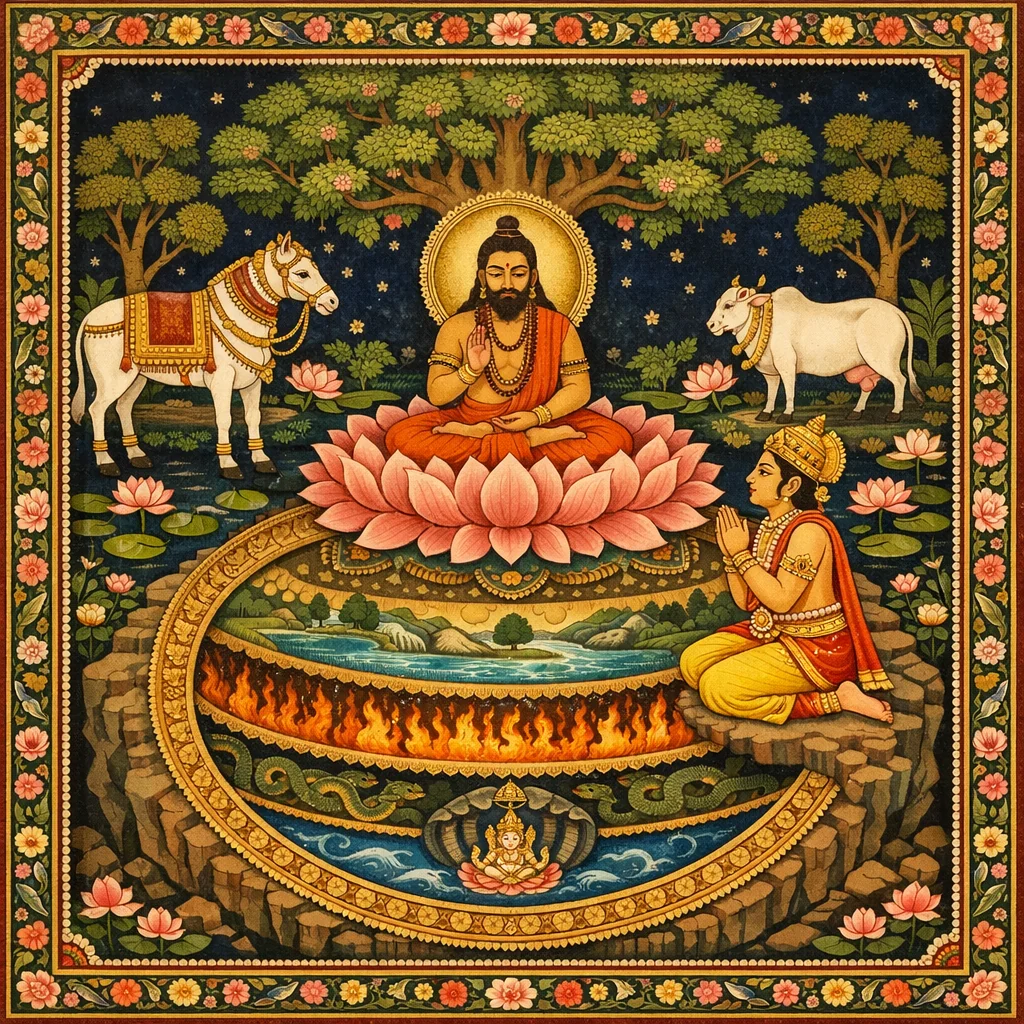
Continuing the Sūryavaṁśa succession, Śukadeva outlines the descent from Rohita to Bāhuka, whose loss of kingdom leads to vānaprastha. After Bāhuka’s death, a pregnant queen is saved from satī by Aurva Muni; despite co-wives’ poisoning, a son is born “with poison,” named Sagara. As emperor, Sagara—obeying Aurva—restrains from slaughtering frontier tribes (Yavanas, Śakas, etc.), instead marking them by distinctive appearances, and he performs aśvamedha. Indra steals the sacrificial horse, prompting Sagara’s sixty thousand sons to excavate the earth in search; they find the horse near Kapila Muni’s āśrama and, deluded by Indra, accuse the sage. Their offense results in their own fiery destruction. The text clarifies Kapila’s transcendence and his role as teacher of Sāṅkhya. Sagara’s grandson Aṁśumān, unlike the rash uncles, approaches Kapila with prayers on the Lord’s unknowability and the bondage of the guṇas. Kapila instructs that only Gaṅgā water can deliver the ancestors. Aṁśumān returns the horse; Sagara completes the rite, hands the kingdom to Aṁśumān, and attains the supreme destination—setting up the next narrative movement toward bringing Gaṅgā for ancestral liberation.
Shlokas
Verse 1
श्रीशुक उवाच हरितो रोहितसुतश्चम्पस्तस्माद् विनिर्मिता । चम्पापुरी सुदेवोऽतो विजयो यस्य चात्मज: ॥ १ ॥
Śukadeva Gosvāmī continued: The son of Rohita was Harita, and Harita’s son was Campa, who constructed the town of Campāpurī. The son of Campa was Sudeva, and his son was Vijaya.
Verse 2
भरुकस्तत्सुतस्तस्माद् वृकस्तस्यापि बाहुक: । सोऽरिभिर्हृतभू राजा सभार्यो वनमाविशत् ॥ २ ॥
The son of Vijaya was Bharuka, Bharuka’s son was Vṛka, and Vṛka’s son was Bāhuka. The enemies of King Bāhuka took away all his possessions, and therefore the King entered the order of vānaprastha and went to the forest with his wife.
Verse 3
वृद्धं तं पञ्चतां प्राप्तं महिष्यनुमरिष्यती । और्वेण जानतात्मानं प्रजावन्तं निवारिता ॥ ३ ॥
Bāhuka died when he was old, and one of his wives wanted to die with him, following the satī rite. At that time, however, Aurva Muni, knowing her to be pregnant, forbade her to die.
Verse 4
आज्ञायास्यै सपत्नीभिर्गरो दत्तोऽन्धसा सह । सह तेनैव सञ्जात: सगराख्यो महायशा: । सगरश्चक्रवर्त्यासीत् सागरो यत्सुतै: कृत: ॥ ४ ॥
Knowing that she was pregnant, the co-wives of the wife of Bāhuka conspired to give her poison with her food, but it did not act. Instead, the son was born along with the poison. Therefore he became famous as Sagara [“one who is born with poison”]. Sagara later became the emperor. The place known as Gaṅgāsāgara was excavated by his sons.
Verse 5
यस्तालजङ्घान् यवनाञ्छकान् हैहयबर्बरान् । नावधीद् गुरुवाक्येन चक्रे विकृतवेषिण: ॥ ५ ॥ मुण्डाञ्छ्मश्रुधरान् कांश्चिन्मुक्तकेशार्धमुण्डितान् । अनन्तर्वासस: कांश्चिदबहिर्वाससोऽपरान् ॥ ६ ॥
Sagara Mahārāja, following the order of his spiritual master, Aurva, did not kill the uncivilized men like the Tālajaṅghas, Yavanas, Śakas, Haihayas and Barbaras. Instead, some of them he made dress awkwardly, some of them he shaved clean but allowed to wear mustaches, some of them he left wearing loose hair, some he half shaved, some he left without underwear, and some without external garments. Thus these different clans were made to dress differently, but King Sagara did not kill them.
Verse 6
यस्तालजङ्घान् यवनाञ्छकान् हैहयबर्बरान् । नावधीद् गुरुवाक्येन चक्रे विकृतवेषिण: ॥ ५ ॥ मुण्डाञ्छ्मश्रुधरान् कांश्चिन्मुक्तकेशार्धमुण्डितान् । अनन्तर्वासस: कांश्चिदबहिर्वाससोऽपरान् ॥ ६ ॥
Sagara Mahārāja, following the order of his spiritual master, Aurva, did not kill the uncivilized men like the Tālajaṅghas, Yavanas, Śakas, Haihayas and Barbaras. Instead, some of them he made dress awkwardly, some of them he shaved clean but allowed to wear mustaches, some of them he left wearing loose hair, some he half shaved, some he left without underwear, and some without external garments. Thus these different clans were made to dress differently, but King Sagara did not kill them.
Verse 7
सोऽश्वमेधैरयजत सर्ववेदसुरात्मकम् । और्वोपदिष्टयोगेन हरिमात्मानमीश्वरम् । तस्योत्सृष्टं पशुं यज्ञे जहाराश्वं पुरन्दर: ॥ ७ ॥
Following the instructions of the great sage Aurva, Sagara Mahārāja performed aśvamedha sacrifices and thus satisfied the Supreme Lord, who is the supreme controller, the Supersoul of all learned scholars, and the knower of all Vedic knowledge, the Supreme Personality of Godhead. But Indra, the King of heaven, stole the horse meant to be offered at the sacrifice.
Verse 8
सुमत्यास्तनया दृप्ता: पितुरादेशकारिण: । हयमन्वेषमाणास्ते समन्तान्न्यखनन् महीम् ॥ ८ ॥
[King Sagara had two wives, Sumati and Keśinī.] The sons of Sumati, who were very proud of their prowess and influence, following the order of their father, searched for the lost horse. While doing so, they dug into the earth very extensively.
Verse 9
प्रागुदीच्यां दिशि हयं ददृशु: कपिलान्तिके । एष वाजिहरश्चौर आस्ते मीलितलोचन: ॥ ९ ॥ हन्यतां हन्यतां पाप इति षष्टिसहस्रिण: । उदायुधा अभिययुरुन्मिमेष तदा मुनि: ॥ १० ॥
Thereafter, in the northeastern direction, they saw the horse near the āśrama of Kapila Muni. “Here is the man who has stolen the horse,” they said. “He is staying there with closed eyes. Certainly he is very sinful. Kill him! Kill him!” Shouting like this, the sons of Sagara, sixty thousand all together, raised their weapons. When they approached the sage, the sage opened His eyes.
Verse 10
प्रागुदीच्यां दिशि हयं ददृशु: कपिलान्तिके । एष वाजिहरश्चौर आस्ते मीलितलोचन: ॥ ९ ॥ हन्यतां हन्यतां पाप इति षष्टिसहस्रिण: । उदायुधा अभिययुरुन्मिमेष तदा मुनि: ॥ १० ॥
Thereafter, in the northeastern direction, they saw the horse near the āśrama of Kapila Muni. “Here is the man who has stolen the horse,” they said. “He is staying there with closed eyes. Certainly he is very sinful. Kill him! Kill him!” Shouting like this, the sons of Sagara, sixty thousand all together, raised their weapons. When they approached the sage, the sage opened His eyes.
Verse 11
स्वशरीराग्निना तावन्महेन्द्रहृतचेतस: । महद्व्यतिक्रमहता भस्मसादभवन् क्षणात् ॥ ११ ॥
By the influence of Indra, the King of heaven, the sons of Sagara had lost their intelligence and disrespected a great personality. Consequently, fire emanated from their own bodies, and they were immediately burned to ashes.
Verse 12
न साधुवादो मुनिकोपभर्जिता नृपेन्द्रपुत्रा इति सत्त्वधामनि । कथं तमो रोषमयं विभाव्यते जगत्पवित्रात्मनि खे रजो भुव: ॥ १२ ॥
It is sometimes argued that the sons of King Sagara were burned to ashes by the fire emanating from the eyes of Kapila Muni. This statement, however, is not approved by great learned persons, for Kapila Muni’s body is completely in the mode of goodness and therefore cannot manifest the mode of ignorance in the form of anger, just as the pure sky cannot be polluted by the dust of the earth.
Verse 13
यस्येरिता साङ्ख्यमयी दृढेह नौ- र्यया मुमुक्षुस्तरते दुरत्ययम् । भवार्णवं मृत्युपथं विपश्चित: परात्मभूतस्य कथं पृथङ्मति: ॥ १३ ॥
Kapila Muni enunciated in this material world the Sāṅkhya philosophy, which is a strong boat with which to cross over the ocean of nescience. Indeed, a person eager to cross the ocean of the material world may take shelter of this philosophy. In such a greatly learned person, situated on the elevated platform of transcendence, how can there be any distinction between enemy and friend?
Verse 14
योऽसमञ्जस इत्युक्त: स केशिन्या नृपात्मज: । तस्य पुत्रोशुमान् नाम पितामहहिते रत: ॥ १४ ॥
Among the sons of Sagara Mahārāja was one named Asamañjasa, who was born from the King’s second wife, Keśinī. The son of Asamañjasa was known as Aṁśumān, and he was always engaged in working for the good of Sagara Mahārāja, his grandfather.
Verse 15
असमञ्जस आत्मानं दर्शयन्नसमञ्जसम् । जातिस्मर: पुरा सङ्गाद् योगी योगाद् विचालित: ॥ १५ ॥ आचरन् गर्हितं लोके ज्ञातीनां कर्म विप्रियम् । सरय्वां क्रीडतो बालान्प्रास्यदुद्वेजयञ्जनम् ॥ १६ ॥
Formerly, in his previous birth, Asamañjasa had been a great mystic yogī, but by bad association he had fallen from his exalted position. Now, in this life, he was born in a royal family and was a jāti-smara; that is, he had the special advantage of being able to remember his past birth. Nonetheless, he wanted to display himself as a miscreant, and therefore he would do things that were abominable in the eyes of the public and unfavorable to his relatives. He would disturb the boys sporting in the river Sarayū by throwing them into the depths of the water.
Verse 16
असमञ्जस आत्मानं दर्शयन्नसमञ्जसम् । जातिस्मर: पुरा सङ्गाद् योगी योगाद् विचालित: ॥ १५ ॥ आचरन् गर्हितं लोके ज्ञातीनां कर्म विप्रियम् । सरय्वां क्रीडतो बालान्प्रास्यदुद्वेजयञ्जनम् ॥ १६ ॥
Formerly, in his previous birth, Asamañjasa had been a great mystic yogī, but by bad association he had fallen from his exalted position. Now, in this life, he was born in a royal family and was a jāti-smara; that is, he had the special advantage of being able to remember his past birth. Nonetheless, he wanted to display himself as a miscreant, and therefore he would do things that were abominable in the eyes of the public and unfavorable to his relatives. He would disturb the boys sporting in the river Sarayū by throwing them into the depths of the water.
Verse 17
एवं वृत्त: परित्यक्त: पित्रा स्नेहमपोह्य वै । योगैश्वर्येण बालांस्तान् दर्शयित्वा ततो ययौ ॥ १७ ॥
Because Asamañjasa engaged in such abominable activities, his father gave up affection for him and had him exiled. Then Asamañjasa exhibited his mystic power by reviving the boys and showing them to the King and their parents. After this, Asamañjasa left Ayodhyā.
Verse 18
अयोध्यावासिन: सर्वे बालकान् पुनरागतान् । दृष्ट्वा विसिस्मिरे राजन् राजा चाप्यन्वतप्यत ॥ १८ ॥
O King Parīkṣit, when all the inhabitants of Ayodhyā saw that their boys had come back to life, they were astounded, and King Sagara greatly lamented the absence of his son.
Verse 19
अंशुमांश्चोदितो राज्ञा तुरगान्वेषणे ययौ । पितृव्यखातानुपथं भस्मान्ति ददृशे हयम् ॥ १९ ॥
Thereafter, Aṁśumān, the grandson of Mahārāja Sagara, was ordered by the King to search for the horse. Following the same path traversed by his uncles, Aṁśumān gradually reached the stack of ashes and found the horse nearby.
Verse 20
तत्रासीनं मुनिं वीक्ष्य कपिलाख्यमधोक्षजम् । अस्तौत् समाहितमना: प्राञ्जलि: प्रणतो महान् ॥ २० ॥
The great Aṁśumān saw the sage named Kapila, the saint who is an incarnation of Viṣṇu, sitting there by the horse. Aṁśumān offered Him respectful obeisances, folded his hands and offered Him prayers with great attention.
Verse 21
अंशुमानुवाच न पश्यति त्वां परमात्मनोऽजनो न बुध्यतेऽद्यापि समाधियुक्तिभि: । कुतोऽपरे तस्य मन:शरीरधी- विसर्गसृष्टा वयमप्रकाशा: ॥ २१ ॥
Aṁśumān said: My Lord, even Lord Brahmā is to this very day unable to understand Your position, which is far beyond himself, either by meditation or by mental speculation. So what to speak of others like us, who have been created by Brahmā in various forms as demigods, animals, human beings, birds and beasts? We are completely in ignorance. Therefore, how can we know You, who are the Transcendence?
Verse 22
ये देहभाजस्त्रिगुणप्रधाना गुणान् विपश्यन्त्युत वा तमश्च । यन्मायया मोहितचेतसस्त्वां विदु: स्वसंस्थं न बहि:प्रकाशा: ॥ २२ ॥
My Lord, You are fully situated in everyone’s heart, but the living entities, covered by the material body, cannot see You, for they are influenced by the external energy, conducted by the three modes of material nature. Their intelligence being covered by sattva-guṇa, rajo-guṇa and tamo-guṇa, they can see only the actions and reactions of these three modes of material nature. Because of the actions and reactions of the mode of ignorance, whether the living entities are awake or sleeping, they can see only the workings of material nature; they cannot see Your Lordship.
Verse 23
तं त्वामहं ज्ञानघनं स्वभाव- प्रध्वस्तमायागुणभेदमोहै: । सनन्दनाद्यैर्मुनिभिर्विभाव्यं कथं विमूढ: परिभावयामि ॥ २३ ॥
O my Lord, sages freed from the influence of the three modes of material nature — sages such as the four Kumāras [Sanat, Sanaka, Sanandana and Sanātana] — are able to think of You, who are concentrated knowledge. But how can an ignorant person like me think of You?
Verse 24
प्रशान्त मायागुणकर्मलिङ्ग- मनामरूपं सदसद्विमुक्तम् । ज्ञानोपदेशाय गृहीतदेहं नमामहे त्वां पुरुषं पुराणम् ॥ २४ ॥
O completely peaceful Lord, although material nature, fruitive activities and their consequent material names and forms are Your creation, You are unaffected by them. Therefore, Your transcendental name is different from material names, and Your form is different from material forms. You assume a form resembling a material body just to give us instructions like those of Bhagavad-gītā, but actually You are the supreme original person. I therefore offer my respectful obeisances unto You.
Verse 25
त्वन्मायारचिते लोके वस्तुबुद्ध्या गृहादिषु । भ्रमन्ति कामलोभेर्ष्यामोहविभ्रान्तचेतस: ॥ २५ ॥
O my Lord, those whose hearts are bewildered by the influence of lust, greed, envy and illusion are interested only in false hearth and home in this world created by Your māyā. Attached to home, wife and children, they wander in this material world perpetually.
Verse 26
अद्य न: सर्वभूतात्मन् कामकर्मेन्द्रियाशय: । मोहपाशो दृढश्छिन्नो भगवंस्तव दर्शनात् ॥ २६ ॥
O Supersoul of all living entities, O Personality of Godhead, simply by seeing You I have now been freed from all lusty desires, which are the root cause of insurmountable illusion and bondage in the material world.
Verse 27
श्रीशुक उवाच इत्थंगीतानुभावस्तं भगवान्कपिलो मुनि: । अंशुमन्तमुवाचेदमनुग्राह्य धिया नृप ॥ २७ ॥
O King Parīkṣit, when Aṁśumān had glorified the Lord in this way, the great sage Kapila, the powerful incarnation of Viṣṇu, being very merciful to him, explained to him the path of knowledge.
Verse 28
श्रीभगवानुवाच अश्वोऽयं नीयतां वत्स पितामहपशुस्तव । इमे च पितरो दग्धा गङ्गाम्भोऽर्हन्ति नेतरत् ॥ २८ ॥
The Personality of Godhead said: My dear Aṁśumān, here is the animal sought by your grandfather for sacrifice. Please take it. As for your forefathers, who have been burnt to ashes, they can be delivered only by Ganges water, and not by any other means.
Verse 29
तं परिक्रम्य शिरसा प्रसाद्य हयमानयत् । सगरस्तेन पशुना यज्ञशेषं समापयत् ॥ २९ ॥
Thereafter, Aṁśumān circumambulated Kapila Muni and offered Him respectful obeisances, bowing his head. After fully satisfying Him in this way, Aṁśumān brought back the horse meant for sacrifice, and with this horse Mahārāja Sagara performed the remaining ritualistic ceremonies.
Verse 30
राज्यमंशुमते न्यस्य नि:स्पृहो मुक्तबन्धन: । और्वोपदिष्टमार्गेण लेभे गतिमनुत्तमाम् ॥ ३० ॥
After delivering charge of his kingdom to Aṁśumān and thus being freed from all material anxiety and bondage, Sagara Mahārāja, following the means instructed by Aurva Muni, achieved the supreme destination.
Frequently Asked Questions
The chapter frames the event as the consequence of aparādha (disrespect) intensified by Indra’s influence, which robbed the sons of discrimination. Learned authorities reject the idea that Kapila acted in anger, because Kapila’s body and consciousness are described as fully in sattva and transcendence; anger (tamas/rajas-driven) cannot contaminate such a sage. Their destruction is presented as fire arising from their own bodies—i.e., the karmic reaction of offensive aggression toward a mahātmā.
Obeying Aurva Muni, Sagara did not annihilate these groups; instead he imposed distinguishing external marks (shaving patterns, hair, garments) to regulate social identity and boundaries. The significance is twofold: it highlights guru-ājñā as superior to royal impulse, and it portrays restraint as a dhārmic act—state power is subordinated to higher moral and spiritual counsel.
Aṁśumān is Sagara’s grandson (son of Asamañjasa) who succeeds where the sixty thousand fail. His prayers model the Bhagavatam’s ideal approach: humility before the Lord, recognition that Brahmā and others cannot fully grasp the Supreme, and insight that the guṇas cover perception of the indwelling Lord. This devotional-jñāna posture invites Kapila’s mercy and instruction.
Kapila states that the ashes of the forefathers can be purified only by Gaṅgā-jala, indicating a specific śāstric potency: Gaṅgā is not merely a river but a sacred descent connected with Viṣṇu (and later Śiva’s bearing of her flow). The narrative sets a theological premise that ancestral upliftment requires divine grace embodied in tīrtha, not merely ritual completion or royal power.
The text uses Asamañjasa to show that extraordinary capacities (like memory of past births) do not guarantee virtue. Bad association can degrade even a former yogī, and social trust can be damaged by deliberate misconduct. His exile also advances the plot by placing future responsibility on Aṁśumān, who embodies a more sattvic and devotional temperament.