Adhyaya 2
Śrāddhadeva Manu’s Sons: Pṛṣadhra’s Curse and Renunciation; Genealogies of Nariṣyanta and Diṣṭa
Following Sudyumna’s departure to the forest for vānaprastha, Vaivasvata Manu (Śrāddhadeva), desiring more heirs, performs long austerities on the Yamunā and worships the Supreme Lord, obtaining ten sons, led by Ikṣvāku. The chapter then highlights Pṛṣadhra: while guarding cows at night, he mistakenly kills a cow in darkness, and Vasiṣṭha curses him to lose kṣatriya status and be born a śūdra. Accepting the guru’s word without resentment, Pṛṣadhra adopts brahmacarya, becomes equipoised and God-centered, attains pure devotional service, and finally enters a forest fire to reach the spiritual realm. The narrative then briefly notes other sons (e.g., Kavi’s early renunciation; Karūṣa’s line; Dhṛṣṭa’s social transformation) and expands into genealogical sequences—Nariṣyanta’s descendants leading to Agniveśya and the Āgniveśyāyana brāhmaṇas, and Diṣṭa’s line culminating in Marutta’s extraordinary golden sacrifice and the Vaiśālī dynasty through Tṛṇabindu. This chapter bridges personal moral exempla (sin, curse, surrender, bhakti) with the canto’s wider dynastic architecture, setting up further lineage narratives ahead.
Shlokas
Verse 1
श्रीशुक उवाच एवं गतेऽथ सुद्युम्ने मनुर्वैवस्वत: सुते । पुत्रकामस्तपस्तेपे यमुनायां शतं समा: ॥ १ ॥
Śukadeva Gosvāmī said: Thereafter, when his son Sudyumna had thus gone to the forest to accept the order of vānaprastha, Vaivasvata Manu [Śrāddhadeva], being desirous of getting more sons, performed severe austerities on the bank of the Yamunā for one hundred years.
Verse 2
ततोऽयजन्मनुर्देवमपत्यार्थं हरिं प्रभुम् । इक्ष्वाकुपूर्वजान् पुत्रान्लेभे स्वसदृशान् दश ॥ २ ॥
Then, because of this desire for sons, the Manu known as Śrāddhadeva worshiped the Supreme Lord, the Personality of Godhead, the Lord of the demigods. Thus he got ten sons exactly like himself. Among them all, Ikṣvāku was the eldest.
Verse 3
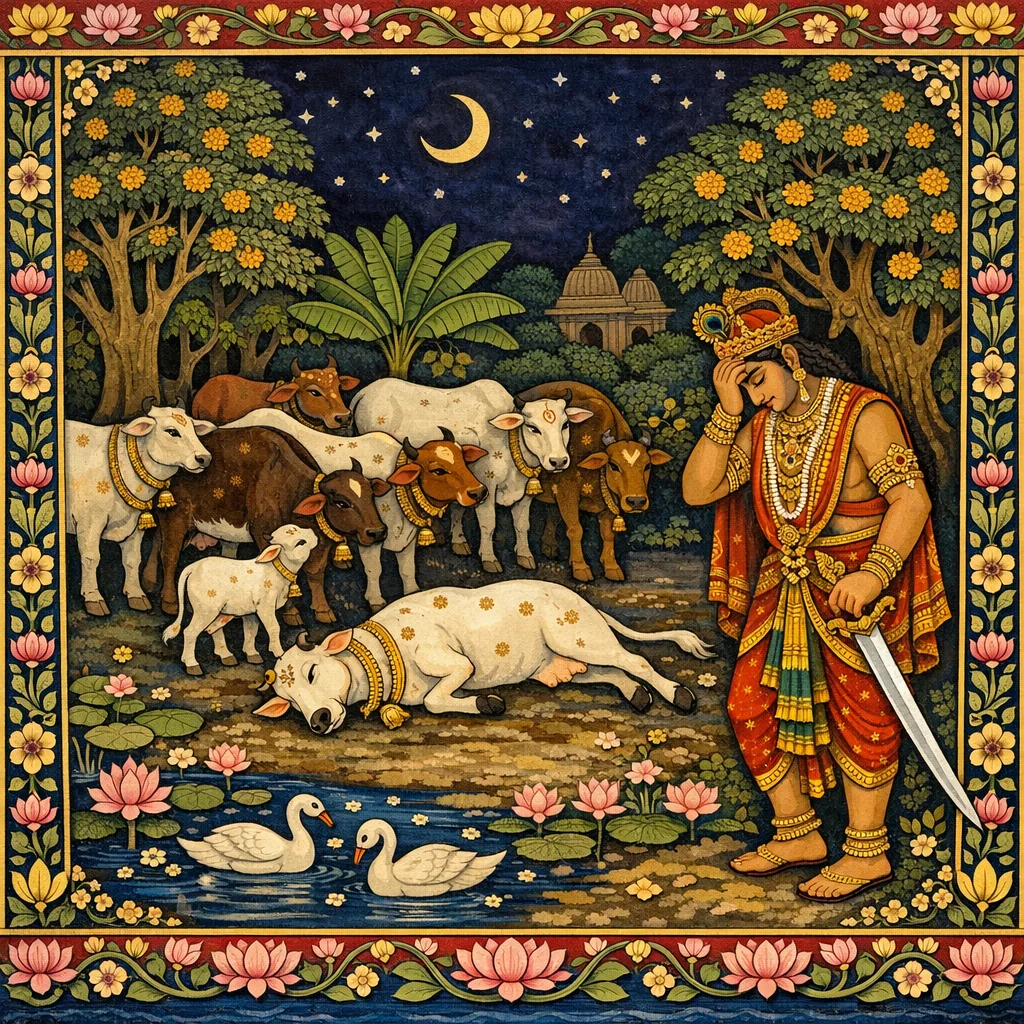
पृषध्रस्तु मनो: पुत्रो गोपालो गुरुणा कृत: । पालयामास गा यत्तो रात्र्यां वीरासनव्रत: ॥ ३ ॥
Among these sons, Pṛṣadhra, following the order of his spiritual master, was engaged as a protector of cows. He would stand all night with a sword to give the cows protection.
Verse 4
एकदा प्राविशद् गोष्ठं शार्दूलो निशि वर्षति । शयाना गाव उत्थाय भीतास्ता बभ्रमुर्व्रजे ॥ ४ ॥
Once at night, while it was raining, a tiger entered the land of the cowshed. Upon seeing the tiger, all the cows, who were lying down, got up in fear and scattered here and there on the land.
Verse 5
एकां जग्राह बलवान् सा चुक्रोश भयातुरा । तस्यास्तु क्रन्दितं श्रुत्वा पृषध्रोऽनुससार ह ॥ ५ ॥ खड्गमादाय तरसा प्रलीनोडुगणे निशि । अजानन्नच्छिनोद् बभ्रो: शिर: शार्दूलशङ्कया ॥ ६ ॥
When the very strong tiger seized the cow, the cow screamed in distress and fear, and Pṛṣadhra, hearing the screaming, immediately followed the sound. He took up his sword, but because the stars were covered by clouds, he mistook the cow for the tiger and mistakenly cut off the cows’ head with great force.
Verse 6
एकां जग्राह बलवान् सा चुक्रोश भयातुरा । तस्यास्तु क्रन्दितं श्रुत्वा पृषध्रोऽनुससार ह ॥ ५ ॥ खड्गमादाय तरसा प्रलीनोडुगणे निशि । अजानन्नच्छिनोद् बभ्रो: शिर: शार्दूलशङ्कया ॥ ६ ॥
When the very strong tiger seized the cow, the cow screamed in distress and fear, and Pṛṣadhra, hearing the screaming, immediately followed the sound. He took up his sword, but because the stars were covered by clouds, he mistook the cow for the tiger and mistakenly cut off the cows’ head with great force.
Verse 7
व्याघ्रोऽपि वृक्णश्रवणो निस्त्रिंशाग्राहतस्तत: । निश्चक्राम भृशं भीतो रक्तं पथि समुत्सृजन् ॥ ७ ॥
Because the tiger’s ear had been cut by the edge of the sword, the tiger was very afraid, and it fled from that place, while bleeding on the street.
Verse 8
मन्यमानो हतं व्याघ्रं पृषध्र: परवीरहा । अद्राक्षीत् स्वहतां बभ्रुं व्युष्टायां निशि दु:खित: ॥ ८ ॥
In the morning, when Pṛṣadhra, who was quite able to subdue his enemy, saw that he had killed the cow although at night he thought he had killed the tiger, he was very unhappy.
Verse 9
तं शशाप कुलाचार्य: कृतागसमकामत: । न क्षत्रबन्धु: शूद्रस्त्वं कर्मणा भवितामुना ॥ ९ ॥
Although Pṛṣadhra had committed the sin unknowingly, his family priest, Vasiṣṭha, cursed him, saying, “In your next life you shall not be able to become a kṣatriya. Instead, you shall take birth as a śūdra because of killing the cow.”
Verse 10
एवं शप्तस्तु गुरुणा प्रत्यगृह्णात् कृताञ्जलि: । अधारयद् व्रतं वीर ऊर्ध्वरेता मुनिप्रियम् ॥ १० ॥
When the hero Pṛṣadhra was thus cursed by his spiritual master, he accepted the curse with folded hands. Then, having controlled his senses, he took the vow of brahmacarya, which is approved by all great sages.
Verse 11
वासुदेवे भगवति सर्वात्मनि परेऽमले । एकान्तित्वं गतो भक्त्या सर्वभूतसुहृत् सम: ॥ ११ ॥ विमुक्तसङ्ग: शान्तात्मा संयताक्षोऽपरिग्रह: । यदृच्छयोपपन्नेन कल्पयन् वृत्तिमात्मन: ॥ १२ ॥ आत्मन्यात्मानमाधाय ज्ञानतृप्त: समाहित: । विचचार महीमेतां जडान्धबधिराकृति: ॥ १३ ॥
Thereafter, Pṛṣadhra gained relief from all responsibilities, became peaceful in mind, and established control over all his senses. Being unaffected by material conditions, being pleased with whatever was available by the grace of the Lord to maintain body and soul together, and being equal toward everyone, he gave full attention to the Supreme Personality of Godhead, Vāsudeva, who is the transcendental Supersoul, free from material contamination. Thus Pṛṣadhra, fully satisfied in pure knowledge, always keeping his mind on the Supreme Personality of Godhead, achieved pure devotional service to the Lord and began traveling all over the world, without affection for material activities, as if he were deaf, dumb and blind.
Verse 12
वासुदेवे भगवति सर्वात्मनि परेऽमले । एकान्तित्वं गतो भक्त्या सर्वभूतसुहृत् सम: ॥ ११ ॥ विमुक्तसङ्ग: शान्तात्मा संयताक्षोऽपरिग्रह: । यदृच्छयोपपन्नेन कल्पयन् वृत्तिमात्मन: ॥ १२ ॥ आत्मन्यात्मानमाधाय ज्ञानतृप्त: समाहित: । विचचार महीमेतां जडान्धबधिराकृति: ॥ १३ ॥
Thereafter, Pṛṣadhra gained relief from all responsibilities, became peaceful in mind, and established control over all his senses. Being unaffected by material conditions, being pleased with whatever was available by the grace of the Lord to maintain body and soul together, and being equal toward everyone, he gave full attention to the Supreme Personality of Godhead, Vāsudeva, who is the transcendental Supersoul, free from material contamination. Thus Pṛṣadhra, fully satisfied in pure knowledge, always keeping his mind on the Supreme Personality of Godhead, achieved pure devotional service to the Lord and began traveling all over the world, without affection for material activities, as if he were deaf, dumb and blind.
Verse 13
वासुदेवे भगवति सर्वात्मनि परेऽमले । एकान्तित्वं गतो भक्त्या सर्वभूतसुहृत् सम: ॥ ११ ॥ विमुक्तसङ्ग: शान्तात्मा संयताक्षोऽपरिग्रह: । यदृच्छयोपपन्नेन कल्पयन् वृत्तिमात्मन: ॥ १२ ॥ आत्मन्यात्मानमाधाय ज्ञानतृप्त: समाहित: । विचचार महीमेतां जडान्धबधिराकृति: ॥ १३ ॥
Thereafter, Pṛṣadhra gained relief from all responsibilities, became peaceful in mind, and established control over all his senses. Being unaffected by material conditions, being pleased with whatever was available by the grace of the Lord to maintain body and soul together, and being equal toward everyone, he gave full attention to the Supreme Personality of Godhead, Vāsudeva, who is the transcendental Supersoul, free from material contamination. Thus Pṛṣadhra, fully satisfied in pure knowledge, always keeping his mind on the Supreme Personality of Godhead, achieved pure devotional service to the Lord and began traveling all over the world, without affection for material activities, as if he were deaf, dumb and blind.
Verse 14
एवं वृत्तो वनं गत्वा दृष्ट्वा दावाग्निमुत्थितम् । तेनोपयुक्तकरणो ब्रह्म प्राप परं मुनि: ॥ १४ ॥
With this attitude, Pṛṣadhra became a great saint, and when he entered the forest and saw a blazing forest fire, he took this opportunity to burn his body in the fire. Thus he achieved the transcendental, spiritual world.
Verse 15
कवि: कनीयान् विषयेषु नि:स्पृहो विसृज्य राज्यं सह बन्धुभिर्वनम् । निवेश्य चित्ते पुरुषं स्वरोचिषं विवेश कैशोरवया: परं गत: ॥ १५ ॥
Being reluctant to accept material enjoyment, Manu’s youngest son, whose name was Kavi, gave up the kingdom before attaining full youth. Accompanied by his friends, he went to the forest, always thinking of the self-effulgent Supreme Personality of Godhead within the core of his heart. Thus he attained perfection.
Verse 16
करूषोन्मानवादासन् कारूषो: क्षत्रजातय: । उत्तरापथगोप्तारो ब्रह्मण्या धर्मवत्सला: ॥ १६ ॥
From Karūṣa, another son of Manu, came the Kārūṣa dynasty, a family of kṣatriyas. The Kārūṣa kṣatriyas were the kings of the northern direction. They were celebrated protectors of brahminical culture and were all firmly religious.
Verse 17
धृष्टाद् धार्ष्टमभूत् क्षत्रं ब्रह्मभूयं गतं क्षितौ । नृगस्य वंश: सुमतिर्भूतज्योतिस्ततो वसु: ॥ १७ ॥
From the son of Manu named Dhṛṣṭa came a kṣatriya caste called Dhārṣṭa, whose members achieved the position of brāhmaṇas in this world. Then, from the son of Manu named Nṛga came Sumati. From Sumati came Bhūtajyoti, and from Bhūtajyoti came Vasu.
Verse 18
वसो: प्रतीकस्तत्पुत्र ओघवानोघवत्पिता । कन्या चौघवती नाम सुदर्शन उवाह ताम् ॥ १८ ॥
The son of Vasu was Pratīka, whose son was Oghavān. Oghavān’s son was also known as Oghavān, and his daughter was Oghavatī. Sudarśana married that daughter.
Verse 19
चित्रसेनो नरिष्यन्तादृक्षस्तस्य सुतोऽभवत् । तस्य मीढ्वांस्तत: पूर्ण इन्द्रसेनस्तु तत्सुत: ॥ १९ ॥
From Nariṣyanta came a son named Citrasena and from him a son named Ṛkṣa. From Ṛkṣa came Mīḍhvān, from Mīḍhvān came Pūrṇa, and from Pūrṇa came Indrasena.
Verse 20
वीतिहोत्रस्त्विन्द्रसेनात् तस्य सत्यश्रवा अभूत् । उरुश्रवा: सुतस्तस्य देवदत्तस्ततोऽभवत् ॥ २० ॥
From Indrasena came Vītihotra, from Vītihotra came Satyaśravā, from Satyaśravā came the son named Uruśravā, and from Uruśravā came Devadatta.
Verse 21
ततोऽग्निवेश्यो भगवानग्नि: स्वयमभूत् सुत: । कानीन इति विख्यातो जातूकर्ण्यो महानृषि: ॥ २१ ॥
From Devadatta came a son known as Agniveśya, who was the fire-god Agni himself. This son, who was a celebrated saint, was well known as Kānīna and Jātūkarṇya.
Verse 22
ततो ब्रह्मकुलं जातमाग्निवेश्यायनं नृप । नरिष्यन्तान्वय: प्रोक्तो दिष्टवंशमत: शृणु ॥ २२ ॥
O King, from Agniveśya came a brahminical dynasty known as Āgniveśyāyana. Now that I have described the descendants of Nariṣyanta, let me describe the descendants of Diṣṭa. Please hear from me.
Verse 23
नाभागो दिष्टपुत्रोऽन्य: कर्मणा वैश्यतां गत: । भलन्दन: सुतस्तस्य वत्सप्रीतिर्भलन्दनात् ॥ २३ ॥ वत्सप्रीते: सुत: प्रांशुस्तत्सुतं प्रमतिं विदु: । खनित्र: प्रमतेस्तस्माच्चाक्षुषोऽथ विविंशति: ॥ २४ ॥
Diṣṭa had a son by the name Nābhāga. This Nābhāga, who was different from the Nābhāga described later, became a vaiśya by occupational duty. The son of Nābhāga was known as Bhalandana, the son of Bhalandana was Vatsaprīti, and his son was Prāṁśu. Prāṁśu’s son was Pramati, Pramati’s son was Khanitra, Khanitra’s son was Cākṣuṣa, and his son was Viviṁśati.
Verse 24
नाभागो दिष्टपुत्रोऽन्य: कर्मणा वैश्यतां गत: । भलन्दन: सुतस्तस्य वत्सप्रीतिर्भलन्दनात् ॥ २३ ॥ वत्सप्रीते: सुत: प्रांशुस्तत्सुतं प्रमतिं विदु: । खनित्र: प्रमतेस्तस्माच्चाक्षुषोऽथ विविंशति: ॥ २४ ॥
Diṣṭa had a son by the name Nābhāga. This Nābhāga, who was different from the Nābhāga described later, became a vaiśya by occupational duty. The son of Nābhāga was known as Bhalandana, the son of Bhalandana was Vatsaprīti, and his son was Prāṁśu. Prāṁśu’s son was Pramati, Pramati’s son was Khanitra, Khanitra’s son was Cākṣuṣa, and his son was Viviṁśati.
Verse 25
विविंशते: सुतो रम्भ: खनीनेत्रोऽस्य धार्मिक: । करन्धमो महाराज तस्यासीदात्मजो नृप ॥ २५ ॥
The son of Viviṁśati was Rambha, whose son was the great and religious King Khanīnetra. O King, the son of Khanīnetra was King Karandhama.
Verse 26
तस्यावीक्षित् सुतो यस्य मरुत्तश्चक्रवर्त्यभूत् । संवर्तोऽयाजयद् यं वै महायोग्यङ्गिर:सुत: ॥ २६ ॥
From Karandhama came a son named Avīkṣit, and from Avīkṣit a son named Marutta, who was the emperor. The great mystic Saṁvarta, the son of Aṅgirā, engaged Marutta in performing a sacrifice [yajña].
Verse 27
मरुत्तस्य यथा यज्ञो न तथान्योऽस्ति कश्चन । सर्वं हिरण्मयं त्वासीद् यत् किञ्चिच्चास्य शोभनम् ॥ २७ ॥
The sacrificial paraphernalia of King Marutta was extremely beautiful, for everything was made of gold. Indeed, no other sacrifice could compare to his.
Verse 28
अमाद्यदिन्द्र: सोमेन दक्षिणाभिर्द्विजातय: । मरुत: परिवेष्टारो विश्वेदेवा: सभासद: ॥ २८ ॥
In that sacrifice, King Indra became intoxicated by drinking a large quantity of soma-rasa. The brāhmaṇas received ample contributions, and therefore they were satisfied. For that sacrifice, the various demigods who control the winds offered foodstuffs, and the Viśvedevas were members of the assembly.
Verse 29
मरुत्तस्य दम: पुत्रस्तस्यासीद् राज्यवर्धन: । सुधृतिस्तत्सुतो जज्ञे सौधृतेयो नर: सुत: ॥ २९ ॥
Marutta’s son was Dama, Dama’s son was Rājyavardhana, Rājyavardhana’s son was Sudhṛti, and his son was Nara.
Verse 30
तत्सुत: केवलस्तस्माद् धुन्धुमान्वेगवांस्तत: । बुधस्तस्याभवद् यस्य तृणबिन्दुर्महीपति: ॥ ३० ॥
The son of Nara was Kevala, and his son was Dhundhumān, whose son was Vegavān. Vegavān’s son was Budha, and Budha’s son was Tṛṇabindu, who became the king of this earth.
Verse 31
तं भेजेऽलम्बुषा देवी भजनीयगुणालयम् । वराप्सरा यत: पुत्रा: कन्या चेलविलाभवत् ॥ ३१ ॥
The best of the Apsarās, the highly qualified girl named Alambuṣā, accepted the similarly qualified Tṛṇabindu as her husband. She gave birth to a few sons and a daughter known as Ilavilā.
Verse 32
यस्यामुत्पादयामास विश्रवा धनदं सुतम् । प्रादाय विद्यां परमामृषिर्योगेश्वर: पितु: ॥ ३२ ॥
After the great saint Viśravā, the master of mystic yoga, received absolute knowledge from his father, he begot in the womb of Ilavilā the greatly celebrated son known as Kuvera, the giver of money.
Verse 33
विशाल: शून्यबन्धुश्च धूम्रकेतुश्च तत्सुता: । विशालो वंशकृद् राजा वैशालीं निर्ममे पुरीम् ॥ ३३ ॥
Tṛṇabindu had three sons, named Viśāla, Śūnyabandhu and Dhūmraketu. Among these three, Viśāla created a dynasty and constructed a palace called Vaiśālī.
Verse 34
हेमचन्द्र: सुतस्तस्य धूम्राक्षस्तस्य चात्मज: । तत्पुत्रात् संयमादासीत् कृशाश्व: सहदेवज: ॥ ३४ ॥
The son of Viśāla was known as Hemacandra, his son was Dhūmrākṣa, and his son was Saṁyama, whose sons were Devaja and Kṛśāśva.
Verse 35
कृशाश्वात् सोमदत्तोऽभूद् योऽश्वमेधैरिडस्पतिम् । इष्ट्वा पुरुषमापाग्र्यां गतिं योगेश्वराश्रिताम् ॥ ३५ ॥ सौमदत्तिस्तु सुमतिस्तत्पुत्रो जनमेजय: । एते वैशालभूपालास्तृणबिन्दोर्यशोधरा: ॥ ३६ ॥
The son of Kṛśāśva was Somadatta, who performed aśvamedha sacrifices and thus satisfied the Supreme Personality of Godhead, Viṣṇu. By worshiping the Supreme Lord, he achieved the most exalted post, a residence on the planet to which great mystic yogīs are elevated. The son of Somadatta was Sumati, whose son was Janamejaya. All these kings appearing in the dynasty of Viśāla properly maintained the celebrated position of King Tṛṇabindu.
Verse 36
कृशाश्वात् सोमदत्तोऽभूद् योऽश्वमेधैरिडस्पतिम् । इष्ट्वा पुरुषमापाग्र्यां गतिं योगेश्वराश्रिताम् ॥ ३५ ॥ सौमदत्तिस्तु सुमतिस्तत्पुत्रो जनमेजय: । एते वैशालभूपालास्तृणबिन्दोर्यशोधरा: ॥ ३६ ॥
The son of Kṛśāśva was Somadatta, who performed aśvamedha sacrifices and thus satisfied the Supreme Personality of Godhead, Viṣṇu. By worshiping the Supreme Lord, he achieved the most exalted post, a residence on the planet to which great mystic yogīs are elevated. The son of Somadatta was Sumati, whose son was Janamejaya. All these kings appearing in the dynasty of Viśāla properly maintained the celebrated position of King Tṛṇabindu.
Frequently Asked Questions
The episode illustrates the Bhagavata’s teaching that dharma—especially go-rakṣya and nonviolence toward protected beings—carries grave social and spiritual weight, and that actions can produce consequences even when unintended (ajñāta-pāpa). Vasiṣṭha’s curse functions as a narrative device to show the seriousness of cow-killing in a kṣatriya’s duty-context, while simultaneously revealing the higher ideal: Pṛṣadhra’s non-defensive acceptance of the guru’s verdict and his turn to brahmacarya and bhakti demonstrate that surrender to dharma and devotion can spiritually surpass social designation.
He accepted the curse with humility, restrained the senses, adopted brahmacarya, and fixed his mind on Vāsudeva, the Paramātmā free from material contamination. By becoming equal to all, satisfied with what came by the Lord’s arrangement, and detached from worldly identity, he matured into pure devotional service. His final act—entering a forest fire without material attachment—signals completion of renunciation and transition to the spiritual destination described as transcendental.
Marutta appears in Diṣṭa’s lineage as an emperor whose yajña, arranged by the sage Saṁvarta (son of Aṅgirā), was unparalleled—its paraphernalia made of gold and its assembly attended by prominent devas. The account underscores the Bhagavata’s view that royal power is ideally expressed through dharma and yajña, yet it also subtly warns that even divine participants (e.g., Indra’s intoxication with soma) remain within material vulnerability—thereby highlighting the superiority of bhakti over mere ritual grandeur.