Adhyaya 19
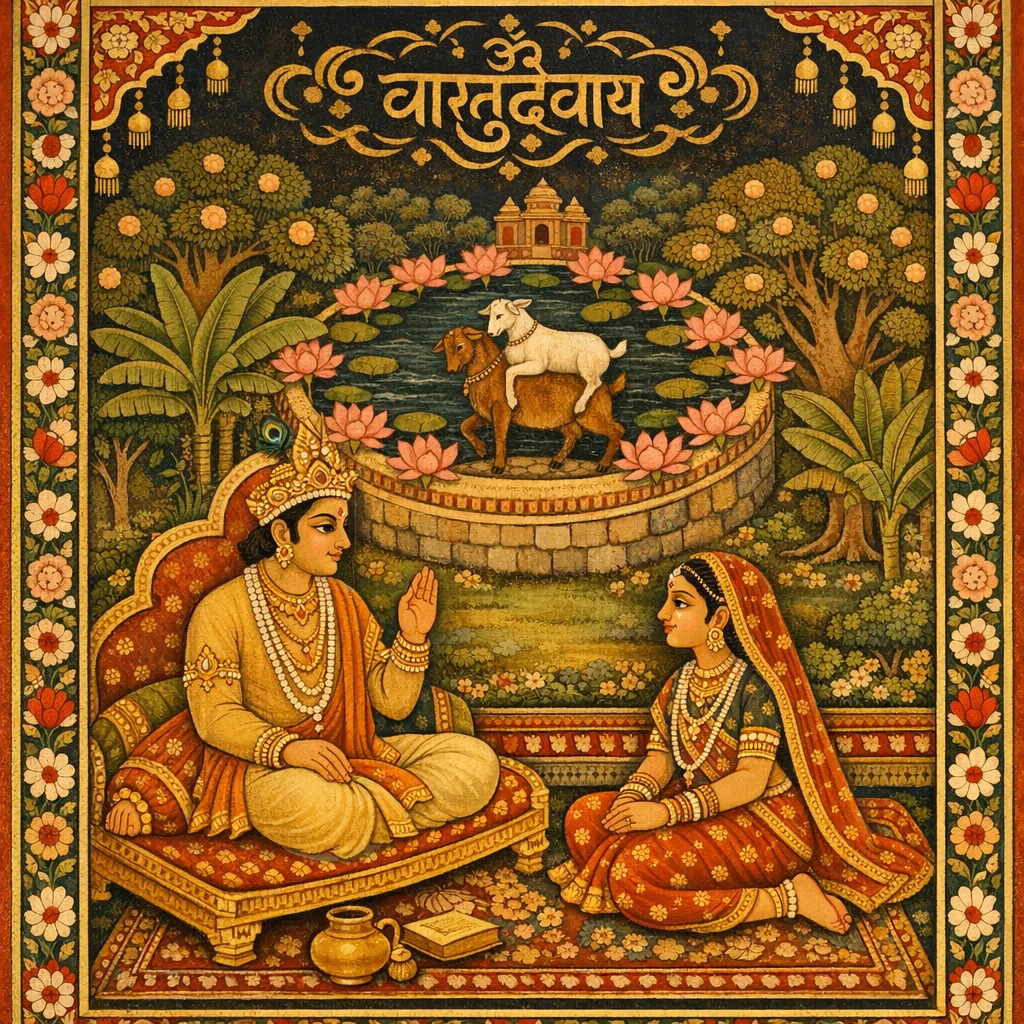
Yayāti’s Renunciation: The Allegory of the He-Goat and She-Goat
Continuing the Yayāti narrative, Śukadeva explains how the king—once intensely attached to sensual life—becomes disgusted with its consequences and instructs Devayānī through an allegorical tale. Yayāti recounts a lust-driven he-goat who rescues a she-goat from a well (karma’s predicament) but then becomes enslaved by sexual competition and forgets self-realization. Jealousy and rupture follow; a brāhmaṇa punishes the goat by cutting his testicles, later restoring them by yogic power—yet even after ‘restoration,’ satisfaction never arrives. Yayāti applies the parable to himself, teaching that lust is insatiable (like ghee in fire) and that true happiness requires voluntary renunciation, restraint, and meditation on Vāsudeva. He then acts: exchanging old age for youth with Pūru, distributing territories to his sons, enthroning Pūru, and abandoning enjoyment instantly. Surrendering to Vāsudeva, he attains purity and association with the Lord. Devayānī awakens, recognizes social bonds as māyā-like (hotel/dream), fixes her mind on Kṛṣṇa, and achieves liberation—preparing the narrative to move forward through the dynasty under Pūru’s imperial leadership.
Shlokas
Verse 1
श्रीशुक उवाच स इत्थमाचरन् कामान् स्त्रैणोऽपह्नवमात्मन: । बुद्ध्वा प्रियायै निर्विण्णो गाथामेतामगायत ॥ १ ॥
Śukadeva Gosvāmī said: O Mahārāja Parīkṣit, Yayāti was very much attached to woman. In due course of time, however, when disgusted with sexual enjoyment and its bad effects, he renounced this way of life and narrated the following story to his beloved wife.
Verse 2
शृणु भार्गव्यमूं गाथां मद्विधाचरितां भुवि । धीरा यस्यानुशोचन्ति वने ग्रामनिवासिन: ॥ २ ॥
My dearly beloved wife, daughter of Śukrācārya, in this world there was someone exactly like me. Please listen as I narrate the history of his life. By hearing about the life of such a householder, those who have retired from householder life always lament.
Verse 3
बस्त एको वने कश्चिद् विचिन्वन् प्रियमात्मन: । ददर्श कूपे पतितां स्वकर्मवशगामजाम् ॥ ३ ॥
While wandering in the forest, eating to satisfy his senses, a he-goat by chance approached a well, in which he saw a she-goat standing helplessly, having fallen into it by the influence of the results of fruitive activities.
Verse 4
तस्या उद्धरणोपायं बस्त: कामी विचिन्तयन् । व्यधत्त तीर्थमुद्धृत्य विषाणाग्रेण रोधसी ॥ ४ ॥
After planning how to get the she-goat out of the well, the lusty he-goat dug up the earth on the well’s edge with the point of his horns in such a way that she was able to come out very easily.
Verse 5
सोत्तीर्य कूपात् सुश्रोणी तमेव चकमे किल । तया वृतं समुद्वीक्ष्य बह्व्योऽजा: कान्तकामिनी: ॥ ५ ॥ पीवानं श्मश्रुलं प्रेष्ठं मीढ्वांसं याभकोविदम् । स एकोऽजवृषस्तासां बह्वीनां रतिवर्धन: । रेमे कामग्रहग्रस्त आत्मानं नावबुध्यत ॥ ६ ॥
When the she-goat, who had very nice hips, got out of the well and saw the very handsome he-goat, she desired to accept him as her husband. When she did so, many other she-goats also desired him as their husband because he had a very beautiful bodily structure and a nice mustache and beard and was expert in discharging semen and in the art of sexual intercourse. Therefore, just as a person haunted by a ghost exhibits madness, the best of the he-goats, attracted by the many she-goats, engaged in erotic activities and naturally forgot his real business of self-realization.
Verse 6
सोत्तीर्य कूपात् सुश्रोणी तमेव चकमे किल । तया वृतं समुद्वीक्ष्य बह्व्योऽजा: कान्तकामिनी: ॥ ५ ॥ पीवानं श्मश्रुलं प्रेष्ठं मीढ्वांसं याभकोविदम् । स एकोऽजवृषस्तासां बह्वीनां रतिवर्धन: । रेमे कामग्रहग्रस्त आत्मानं नावबुध्यत ॥ ६ ॥
When the she-goat, who had very nice hips, got out of the well and saw the very handsome he-goat, she desired to accept him as her husband. When she did so, many other she-goats also desired him as their husband because he had a very beautiful bodily structure and a nice mustache and beard and was expert in discharging semen and in the art of sexual intercourse. Therefore, just as a person haunted by a ghost exhibits madness, the best of the he-goats, attracted by the many she-goats, engaged in erotic activities and naturally forgot his real business of self-realization.
Verse 7
तमेव प्रेष्ठतमया रममाणमजान्यया । विलोक्य कूपसंविग्ना नामृष्यद् बस्तकर्म तत् ॥ ७ ॥
When the she-goat who had fallen into the well saw her beloved goat engaged in sexual affairs with another she-goat, she could not tolerate the goat’s activities.
Verse 8
तं दुर्हृदं सुहृद्रूपं कामिनं क्षणसौहृदम् । इन्द्रियाराममुत्सृज्य स्वामिनं दु:खिता ययौ ॥ ८ ॥
Aggrieved by her husband’s behavior with another, the she-goat thought that the he-goat was not actually her friend but was hardhearted and was her friend only for the time being. Therefore, because her husband was lusty, she left him and returned to her former maintainer.
Verse 9
सोऽपि चानुगत: स्त्रैण: कृपणस्तां प्रसादितुम् । कुर्वन्निडविडाकारं नाशक्नोत् पथि सन्धितुम् ॥ ९ ॥
Being very sorry, the he-goat, who was subservient to his wife, followed the she-goat on the road and tried his best to flatter her, but he could not pacify her.
Verse 10
तस्यतत्र द्विज: कश्चिदजास्वाम्यच्छिनद् रुषा । लम्बन्तं वृषणं भूय: सन्दधेऽर्थाय योगवित् ॥ १० ॥
The she-goat went to the residence of a brāhmaṇa who was the maintainer of another she-goat, and that brāhmaṇa angrily cut off the he-goat’s dangling testicles. But at the he-goat’s request, the brāhmaṇa later rejoined them by the power of mystic yoga.
Verse 11
सम्बद्धवृषण: सोऽपि ह्यजया कूपलब्धया । कालं बहुतिथं भद्रे कामैर्नाद्यापि तुष्यति ॥ ११ ॥
My dear wife, when the he-goat had his testicles restored, he enjoyed the she-goat he had gotten from the well, but although he continued to enjoy for many, many years, even now he has not been fully satisfied.
Verse 12
तथाहं कृपण: सुभ्रु भवत्या: प्रेमयन्त्रित: । आत्मानं नाभिजानामि मोहितस्तव मायया ॥ १२ ॥
O my dear wife with beautiful eyebrows, I am exactly like that he-goat, for I am so poor in intelligence that I am captivated by your beauty and have forgotten the real task of self-realization.
Verse 13
यत् पृथिव्यां व्रीहियवं हिरण्यं पशव: स्त्रिय: । न दुह्यन्ति मन:प्रीतिं पुंस: कामहतस्य ते ॥ १३ ॥
A person who is lusty cannot satisfy his mind even if he has enough of everything in this world, including rice, barley and other food grains, gold, animals and women. Nothing can satisfy him.
Verse 14
न जातु काम: कामानामुपभोगेन शाम्यति । हविषा कृष्णवर्त्मेव भूय एवाभिवर्धते ॥ १४ ॥
As supplying butter to a fire does not diminish the fire but instead increases it more and more, the endeavor to stop lusty desires by continual enjoyment can never be successful. [In fact, one must voluntarily cease from material desires.]
Verse 15
यदा न कुरुते भावं सर्वभूतेष्वमङ्गलम् । समदृष्टेस्तदा पुंस: सर्वा: सुखमया दिश: ॥ १५ ॥
When a man is nonenvious and does not desire ill fortune for anyone, he is equipoised. For such a person, all directions appear happy.
Verse 16
या दुस्त्यजा दुर्मतिभिर्जीर्यतो या न जीर्यते । तां तृष्णां दु:खनिवहां शर्मकामो द्रुतं त्यजेत् ॥ १६ ॥
For those who are too attached to material enjoyment, sense gratification is very difficult to give up. Even when one is an invalid because of old age, one cannot give up such desires for sense gratification. Therefore, one who actually desires happiness must give up such unsatisfied desires, which are the cause of all tribulations.
Verse 17
मात्रा स्वस्रा दुहित्रा वा नाविविक्तासनो भवेत् । बलवानिन्द्रियग्रामो विद्वांसमपि कर्षति ॥ १७ ॥
One should not allow oneself to sit on the same seat even with one’s own mother, sister or daughter, for the senses are so strong that even though one is very advanced in knowledge, he may be attracted by sex.
Verse 18
पूर्णं वर्षसहस्रं मे विषयान् सेवतोऽसकृत् । तथापि चानुसवनं तृष्णा तेषूपजायते ॥ १८ ॥
I have spent a full one thousand years enjoying sense gratification, yet my desire to enjoy such pleasure increases daily.
Verse 19
तस्मादेतामहं त्यक्त्वा ब्रह्मण्यध्याय मानसम् । निर्द्वन्द्वो निरहङ्कारश्चरिष्यामि मृगै: सह ॥ १९ ॥
Therefore, I shall now give up all these desires and meditate upon the Supreme Personality of Godhead. Free from the dualities of mental concoction and free from false prestige, I shall wander in the forest with the animals.
Verse 20
दृष्टं श्रुतमसद्बुद्ध्वा नानुध्यायेन्न सन्दिशेत् । संसृतिं चात्मनाशं च तत्र विद्वान् स आत्मदृक् ॥ २० ॥
One who knows that material happiness, whether good or bad, in this life or in the next, on this planet or on the heavenly planets, is temporary and useless, and that an intelligent person should not try to enjoy or even think of such things, is the knower of the self. Such a self-realized person knows quite well that material happiness is the very cause of continued material existence and forgetfulness of one’s own constitutional position.
Verse 21
इत्युक्त्वा नाहुषो जायां तदीयं पूरवे वय: । दत्त्वा स्वजरसं तस्मादाददे विगतस्पृह: ॥ २१ ॥
Śukadeva Gosvāmī said: After speaking in this way to his wife, Devayānī, King Yayāti, who was now free from all material desires, called his youngest son, Pūru, and returned Pūru’s youth in exchange for his own old age.
Verse 22
दिशि दक्षिणपूर्वस्यां द्रुह्युं दक्षिणतो यदुम् । प्रतीच्यां तुर्वसुं चक्र उदीच्यामनुमीश्वरम् ॥ २२ ॥
King Yayāti gave the southeast to his son Druhyu, the south to his son Yadu, the west to his son Turvasu, and the north to his son Anu. In this way he divided the kingdom.
Verse 23
भूमण्डलस्य सर्वस्य पूरुमर्हत्तमं विशाम् । अभिषिच्याग्रजांस्तस्य वशे स्थाप्य वनं ययौ ॥ २३ ॥
Yayāti enthroned his youngest son, Pūru, as the emperor of the entire world and the proprietor of all its riches, and he placed all the other sons, who were older than Pūru, under Pūru’s control.
Verse 24
आसेवितं वर्षपूगान् षड्वर्गं विषयेषु स: । क्षणेन मुमुचे नीडं जातपक्ष इव द्विज: ॥ २४ ॥
Having enjoyed sense gratification for many, many years, O King Parīkṣit, Yayāti was accustomed to it, but he gave it up entirely in a moment, just as a bird flies away from the nest as soon as its wings have grown.
Verse 25
स तत्र निर्मुक्तसमस्तसङ्ग आत्मानुभूत्या विधुतत्रिलिङ्ग: । परेऽमले ब्रह्मणि वासुदेवे लेभे गतिं भागवतीं प्रतीत: ॥ २५ ॥
Because King Yayāti completely surrendered unto the Supreme Personality of Godhead, Vāsudeva, he was freed from all contamination of the material modes of nature. Because of his self-realization, he was able to fix his mind upon the Transcendence [Parabrahman, Vāsudeva], and thus he ultimately achieved the position of an associate of the Lord.
Verse 26
श्रुत्वा गाथां देवयानी मेने प्रस्तोभमात्मन: । स्त्रीपुंसो: स्नेहवैक्लव्यात् परिहासमिवेरितम् ॥ २६ ॥
When Devayānī heard Mahārāja Yayāti’s story of the he-goat and she-goat, she understood that this story, which was presented as if a funny joke for entertainment between husband and wife, was intended to awaken her to her constitutional position.
Verse 27
सा सन्निवासं सुहृदां प्रपायामिव गच्छताम् । विज्ञायेश्वरतन्त्राणां मायाविरचितं प्रभो: ॥ २७ ॥ सर्वत्र सङ्गमुत्सृज्य स्वप्नौपम्येन भार्गवी । कृष्णे मन: समावेश्य व्यधुनोल्लिङ्गमात्मन: ॥ २८ ॥
Thereafter, Devayānī, the daughter of Śukrācārya, understood that the materialistic association of husband, friends and relatives is like the association in a hotel full of tourists. The relationships of society, friendship and love are created by the māyā of the Supreme Personality of Godhead, exactly as in a dream. By the grace of Kṛṣṇa, Devayānī gave up her imaginary position in the material world. Completely fixing her mind upon Kṛṣṇa, she achieved liberation from the gross and subtle bodies.
Verse 28
सा सन्निवासं सुहृदां प्रपायामिव गच्छताम् । विज्ञायेश्वरतन्त्राणां मायाविरचितं प्रभो: ॥ २७ ॥ सर्वत्र सङ्गमुत्सृज्य स्वप्नौपम्येन भार्गवी । कृष्णे मन: समावेश्य व्यधुनोल्लिङ्गमात्मन: ॥ २८ ॥
Thereafter, Devayānī, the daughter of Śukrācārya, understood that the materialistic association of husband, friends and relatives is like the association in a hotel full of tourists. The relationships of society, friendship and love are created by the māyā of the Supreme Personality of Godhead, exactly as in a dream. By the grace of Kṛṣṇa, Devayānī gave up her imaginary position in the material world. Completely fixing her mind upon Kṛṣṇa, she achieved liberation from the gross and subtle bodies.
Verse 29
नमस्तुभ्यं भगवते वासुदेवाय वेधसे । सर्वभूताधिवासाय शान्ताय बृहते नम: ॥ २९ ॥
O Lord Vāsudeva, O Supreme Personality of Godhead, You are the creator of the entire cosmic manifestation. You live as the Supersoul in everyone’s heart and are smaller than the smallest, yet You are greater than the greatest and are all-pervading. You appear completely silent, having nothing to do, but this is due to Your all-pervading nature and Your fullness in all opulences. I therefore offer my respectful obeisances unto You.
Frequently Asked Questions
It is Yayāti’s mirror: the he-goat represents the conditioned soul who ‘rescues’ and then becomes trapped in erotic entanglement, mistaking stimulation for fulfillment. The well signifies karmic predicament; the expanding harem signifies proliferating desires; and the continuing dissatisfaction after ‘restoration’ shows that enjoyment does not cure craving. The allegory functions as vairāgya-upadeśa—teaching that only deliberate withdrawal and remembrance of Vāsudeva can end bondage.
Because kāma is portrayed as self-amplifying: like pouring ghee into fire, repeated indulgence strengthens the underlying saṁskāras (impressions) and increases demand. Therefore the text recommends voluntary cessation, inner discipline, and higher taste through meditation and devotion, rather than attempting to ‘finish’ desire by feeding it.
Pūru is Yayāti’s youngest son who accepts his father’s old age (and gives his youth), becoming the rightful heir. The enthronement of Pūru secures dynastic continuity (vaṁśa) while highlighting Bhagavata ethics: humility and service qualify one for sovereignty, and renunciation can coexist with responsible political transition.
By insight and grace: she recognizes relationships rooted in material identity as temporary, māyā-constructed (like tourists in a hotel or a dream), gives up possessiveness and false designation, and fixes the mind on Kṛṣṇa. The text attributes her release from gross and subtle bodies to Kṛṣṇa’s grace combined with awakened discernment.