Adhyaya 6
Ikṣvāku Dynasty: Vikukṣi’s Offense, Purañjaya’s Victory, Māndhātā’s Birth, and Saubhari’s Fall and Renunciation
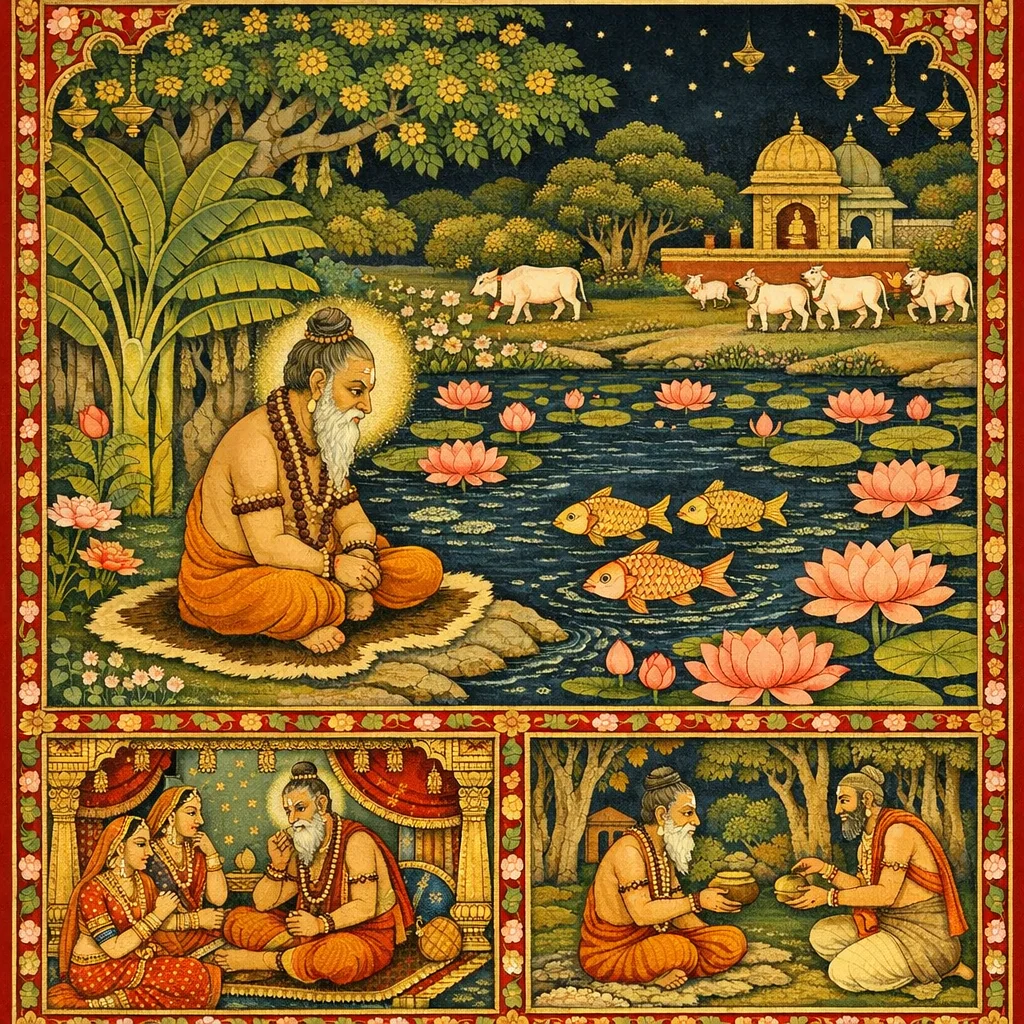
Śukadeva continues the dynastic narration by first closing the Ambarīṣa line through Virūpa → Pṛṣadaśva → Rathītara, then explaining Rathītara’s sonless state and the niyoga-like begetting of sons by Aṅgirā, producing offspring famed for brāhmaṇical prowess and a dual identity (Rathītara/Aṅgirā line). The focus then shifts to Manu’s son Ikṣvāku—born from Manu’s nostrils—and the spread of his hundred sons across Āryāvarta. A ritual crisis occurs during aṣṭakā-śrāddha: Vikukṣi brings flesh but eats a rabbit, rendering the offering impure; Vasiṣṭha detects the breach, leading to Vikukṣi’s exile and Ikṣvāku’s subsequent renunciation and yogic perfection. Vikukṣi returns as king (Śaśāda), whose son Purañjaya (Indravāha/Kakutstha) defeats the demons with Indra as his bull-carrier by Viṣṇu’s order, earning multiple epithets through action. The genealogy proceeds to Kuvalayāśva (Dhundhumāra) and then to another Yuvanāśva, whose childlessness prompts sages to perform an Indra-yajña; providentially, the king drinks the sanctified water, and Māndhātā is miraculously born from his abdomen and nourished by Indra—becoming the world-emperor Trasaddasyu. The chapter culminates in Saubhari Ṛṣi’s temptation after seeing mating fish, his marriage to Māndhātā’s fifty daughters, opulence, dissatisfaction, self-critique on saṅga (association), and eventual vānaprastha and liberation—setting a moral bridge toward subsequent dynastic continuations and the recurring Bhāgavata warning against sense-driven association.
Shlokas
Verse 1
श्रीशुक उवाच विरूप: केतुमाञ्छम्भुरम्बरीषसुतास्त्रय: । विरूपात् पृषदश्वोऽभूत्तत् पुत्रस्तु रथीतर: ॥ १ ॥
Śukadeva Gosvāmī said: O Mahārāja Parīkṣit, Ambarīṣa had three sons, named Virūpa, Ketumān and Śambhu. From Virūpa came a son named Pṛṣadaśva, and from Pṛṣadaśva came a son named Rathītara.
Verse 2
रथीतरस्याप्रजस्य भार्यायां तन्तवेऽर्थित: । अङ्गिरा जनयामास ब्रह्मवर्चस्विन: सुतान् ॥ २ ॥
Rathītara had no sons, and therefore he requested the great sage Aṅgirā to beget sons for him. Because of this request, Aṅgirā begot sons in the womb of Rathītara’s wife. All these sons were born with brahminical prowess.
Verse 3
एते क्षेत्रप्रसूता वै पुनस्त्वाङ्गिरसा: स्मृता: । रथीतराणां प्रवरा: क्षेत्रोपेता द्विजातय: ॥ ३ ॥
Having been born from the womb of Rathītara’s wife, all these sons were known as the dynasty of Rathītara, but because they were born from the semen of Aṅgirā, they were also known as the dynasty of Aṅgirā. Among all the progeny of Rathītara, these sons were the most prominent because, owing to their birth, they were considered brāhmaṇas.
Verse 4
क्षुवतस्तु मनोर्जज्ञे इक्ष्वाकुर्घ्राणत: सुत: । तस्य पुत्रशतज्येष्ठा विकुक्षिनिमिदण्डका: ॥ ४ ॥
The son of Manu was Ikṣvāku. When Manu was sneezing, Ikṣvāku was born from Manu’s nostrils. King Ikṣvāku had one hundred sons, of whom Vikukṣi, Nimi and Daṇḍakā were the most prominent.
Verse 5
तेषां पुरस्तादभवन्नार्यावर्ते नृपा नृप । पञ्चविंशति: पश्चाच्च त्रयो मध्येऽपरेऽन्यत: ॥ ५ ॥
Of the one hundred sons, twenty-five became kings in the western side of Āryāvarta, a place between the Himālaya and Vindhya mountains. Another twenty-five sons became kings in the east of Āryāvarta, and the three principal sons became kings in the middle. The other sons became kings in various other places.
Verse 6
स एकदाष्टकाश्राद्धे इक्ष्वाकु: सुतमादिशत् । मांसमानीयतां मेध्यं विकुक्षे गच्छ मा चिरम् ॥ ६ ॥
During the months of January, February and March, oblations offered to the forefathers are called aṣṭakā-śrāddha. The śrāddha ceremony is held during the dark fortnight of the month. When Mahārāja Ikṣvāku was performing his oblations in this ceremony, he ordered his son Vikukṣi to go immediately to the forest to bring some pure flesh.
Verse 7
तथेति स वनं गत्वा मृगान् हत्वा क्रियार्हणान् । श्रान्तो बुभुक्षितो वीर: शशं चाददपस्मृति: ॥ ७ ॥
Thereafter, Ikṣvāku’s son Vikukṣi went to the forest and killed many animals suitable for being offered as oblations. But when fatigued and hungry he became forgetful and ate a rabbit he had killed.
Verse 8
शेषं निवेदयामास पित्रे तेन च तद्गुरु: । चोदित: प्रोक्षणायाह दुष्टमेतदकर्मकम् ॥ ८ ॥
Vikukṣi offered the remnants of the flesh to King Ikṣvāku, who gave it to Vasiṣṭha for purification. But Vasiṣṭha could immediately understand that part of the flesh had already been taken by Vikukṣi, and therefore he said that it was unfit to be used in the śrāddha ceremony.
Verse 9
ज्ञात्वा पुत्रस्य तत् कर्म गुरुणाभिहितं नृप: । देशान्नि:सारयामास सुतं त्यक्तविधिं रुषा ॥ ९ ॥
When King Ikṣvāku, thus informed by Vasiṣṭha, understood what his son Vikukṣi had done, he was extremely angry. Thus he ordered Vikukṣi to leave the country because Vikukṣi had violated the regulative principles.
Verse 10
स तु विप्रेण संवादं ज्ञापकेन समाचरन् । त्यक्त्वा कलेवरं योगी स तेनावाप यत् परम् ॥ १० ॥
Having been instructed by the great and learned brāhmaṇa Vasiṣṭha, who discoursed about the Absolute Truth, Mahārāja Ikṣvāku became renounced. By following the principles for a yogī, he certainly achieved the supreme perfection after giving up his material body.
Verse 11
पितर्युपरतेऽभ्येत्य विकुक्षि: पृथिवीमिमाम् । शासदीजे हरिं यज्ञै: शशाद इति विश्रुत: ॥ ११ ॥
After his father’s disappearance, Vikukṣi returned to the country and thus became the king, ruling the planet earth and performing various sacrifices to satisfy the Supreme Personality of Godhead. Vikukṣi later became celebrated as Śaśāda.
Verse 12
पुरञ्जयस्तस्य सुत इन्द्रवाह इतीरित: । ककुत्स्थ इति चाप्युक्त: शृणु नामानि कर्मभि: ॥ १२ ॥
The son of Śaśāda was Purañjaya, who is also known as Indravāha and sometimes as Kakutstha. Please hear from me how he received different names for different activities.
Verse 13
कृतान्त आसीत् समरो देवानां सह दानवै: । पार्ष्णिग्राहो वृतो वीरो देवैर्दैत्यपराजितै: ॥ १३ ॥
Formerly, there was a devastating war between the demigods and the demons. The demigods, having been defeated, accepted Purañjaya as their assistant and then conquered the demons. Therefore this hero is known as Purañjaya, “he who conquered the residence of the demons.”
Verse 14
वचनाद् देवदेवस्य विष्णोर्विश्वात्मन: प्रभो: । वाहनत्वे वृतस्तस्य बभूवेन्द्रो महावृष: ॥ १४ ॥
Purañjaya agreed to kill all the demons, on the condition that Indra would be his carrier. Because of pride, Indra could not accept this proposal, but later, by the order of the Supreme Lord, Viṣṇu, Indra did accept it and became a great bull carrier for Purañjaya.
Verse 15
स सन्नद्धो धनुर्दिव्यमादाय विशिखाञ्छितान् । स्तूयमानस्तमारुह्य युयुत्सु: ककुदि स्थित: ॥ १५ ॥ तेजसाप्यायितो विष्णो: पुरुषस्य महात्मन: । प्रतीच्यां दिशि दैत्यानां न्यरुणत् त्रिदशै: पुरम् ॥ १६ ॥
Well protected by armor and desiring to fight, Purañjaya took up a transcendental bow and very sharp arrows, and, while being highly praised by the demigods, he got up on the back of the bull [Indra] and sat on its hump. Thus he is known as Kakutstha. Being empowered by Lord Viṣṇu, who is the Supersoul and the Supreme Person, Purañjaya sat on the great bull and is therefore known as Indravāha. Surrounded by the demigods, he attacked the residence of the demons in the west.
Verse 16
स सन्नद्धो धनुर्दिव्यमादाय विशिखाञ्छितान् । स्तूयमानस्तमारुह्य युयुत्सु: ककुदि स्थित: ॥ १५ ॥ तेजसाप्यायितो विष्णो: पुरुषस्य महात्मन: । प्रतीच्यां दिशि दैत्यानां न्यरुणत् त्रिदशै: पुरम् ॥ १६ ॥
Well protected by armor and desiring to fight, Purañjaya took up a transcendental bow and very sharp arrows, and, while being highly praised by the demigods, he got up on the back of the bull [Indra] and sat on its hump. Thus he is known as Kakutstha. Being empowered by Lord Viṣṇu, who is the Supersoul and the Supreme Person, Purañjaya sat on the great bull and is therefore known as Indravāha. Surrounded by the demigods, he attacked the residence of the demons in the west.
Verse 17
तैस्तस्य चाभूत्प्रधनं तुमुलं लोमहर्षणम् । यमाय भल्लैरनयद् दैत्यान् अभिययुर्मृधे ॥ १७ ॥
There was a fierce battle between the demons and Purañjaya. Indeed, it was so fierce that when one hears about it one’s hairs stand on end. All the demons bold enough to come before Purañjaya were immediately sent to the residence of Yamarāja by his arrows.
Verse 18
तस्येषुपाताभिमुखं युगान्ताग्निमिवोल्बणम् । विसृज्य दुद्रुवुर्दैत्या हन्यमाना: स्वमालयम् ॥ १८ ॥
To save themselves from the blazing arrows of Indravāha, which resembled the flames of devastation at the end of the millennium, the demons who remained when the rest of their army was killed fled very quickly to their respective homes.
Verse 19
जित्वा पुरं धनं सर्वं सश्रीकं वज्रपाणये । प्रत्ययच्छत् स राजर्षिरिति नामभिराहृत: ॥ १९ ॥
After conquering the enemy, the saintly king Purañjaya gave everything, including the enemy’s riches and wives, to Indra, who carries a thunderbolt. For this he is celebrated as Purañjaya. Thus Purañjaya is known by different names because of his different activities.
Verse 20
पुरञ्जयस्य पुत्रोऽभूदनेनास्तत्सुत: पृथु: । विश्वगन्धिस्ततश्चन्द्रो युवनाश्वस्तु तत्सुत: ॥ २० ॥
The son of Purañjaya was known as Anenā, Anenā’s son was Pṛthu, and Pṛthu’s son was Viśvagandhi. Viśvagandhi’s son was Candra, and Candra’s son was Yuvanāśva.
Verse 21
श्रावस्तस्तत्सुतो येन श्रावस्ती निर्ममे पुरी । बृहदश्वस्तु श्रावस्तिस्तत: कुवलयाश्वक: ॥ २१ ॥
The son of Yuvanāśva was Śrāvasta, who constructed a township known as Śrāvastī Purī. The son of Śrāvasta was Bṛhadaśva, and his son was Kuvalayāśva. In this way the dynasty increased.
Verse 22
य: प्रियार्थमुतङ्कस्य धुन्धुनामासुरं बली । सुतानामेकविंशत्या सहस्रैरहनद् वृत: ॥ २२ ॥
To satisfy the sage Utaṅka, the greatly powerful Kuvalayāśva killed a demon named Dhundhu. He did this with the assistance of his twenty-one thousand sons.
Verse 23
धुन्धुमार इति ख्यातस्तत्सुतास्ते च जज्वलु: । धुन्धोर्मुखाग्निना सर्वे त्रय एवावशेषिता: ॥ २३ ॥ दृढाश्व: कपिलाश्वश्च भद्राश्व इति भारत । दृढाश्वपुत्रो हर्यश्वो निकुम्भस्तत्सुत: स्मृत: ॥ २४ ॥
O Mahārāja Parīkṣit, for this reason Kuvalayāśva is celebrated as Dhundhumāra [“the killer of Dhundhu”]. All but three of his sons, however, were burned to ashes by the fire emanating from Dhundhu’s mouth. The remaining sons were Dṛḍhāśva, Kapilāśva and Bhadrāśva. From Dṛḍhāśva came a son named Haryaśva, whose son is celebrated as Nikumbha.
Verse 24
धुन्धुमार इति ख्यातस्तत्सुतास्ते च जज्वलु: । धुन्धोर्मुखाग्निना सर्वे त्रय एवावशेषिता: ॥ २३ ॥ दृढाश्व: कपिलाश्वश्च भद्राश्व इति भारत । दृढाश्वपुत्रो हर्यश्वो निकुम्भस्तत्सुत: स्मृत: ॥ २४ ॥
O Mahārāja Parīkṣit, for this reason Kuvalayāśva is celebrated as Dhundhumāra [“the killer of Dhundhu”]. All but three of his sons, however, were burned to ashes by the fire emanating from Dhundhu’s mouth. The remaining sons were Dṛḍhāśva, Kapilāśva and Bhadrāśva. From Dṛḍhāśva came a son named Haryaśva, whose son is celebrated as Nikumbha.
Verse 25
बहुलाश्वो निकुम्भस्य कृशाश्वोऽथास्य सेनजित् । युवनाश्वोऽभवत् तस्य सोऽनपत्यो वनं गत: ॥ २५ ॥
The son of Nikumbha was Bahulāśva, the son of Bahulāśva was Kṛśāśva, the son of Kṛśāśva was Senajit, and the son of Senajit was Yuvanāśva. Yuvanāśva had no sons, and thus he retired from family life and went to the forest.
Verse 26
भार्याशतेन निर्विण्ण ऋषयोऽस्य कृपालव: । इष्टिं स्म वर्तयांचक्रुरैन्द्रीं ते सुसमाहिता: ॥ २६ ॥
Although Yuvanāśva went into the forest with his one hundred wives, all of them were very morose. The sages in the forest, however, being very kind to the King, began very carefully and attentively performing an Indra-yajña so that the King might have a son.
Verse 27
राजा तद् यज्ञसदनं प्रविष्टो निशि तर्षित: । दृष्ट्वा शयानान् विप्रांस्तान् पपौ मन्त्रजलं स्वयम् ॥ २७ ॥
Being thirsty one night, the King entered the arena of sacrifice, and when he saw all the brāhmaṇas lying down, he personally drank the sanctified water meant to be drunk by his wife.
Verse 28
उत्थितास्ते निशम्याथ व्युदकं कलशं प्रभो । पप्रच्छु: कस्य कर्मेदं पीतं पुंसवनं जलम् ॥ २८ ॥
When the brāhmaṇas got up from bed and saw the waterpot empty, they inquired who had done this work of drinking the water meant for begetting a child.
Verse 29
राज्ञा पीतं विदित्वा वै ईश्वरप्रहितेन ते । ईश्वराय नमश्चक्रुरहो दैवबलं बलम् ॥ २९ ॥
When the brāhmaṇas came to understand that the King, inspired by the supreme controller, had drunk the water, they all exclaimed “Alas! The power of providence is real power. No one can counteract the power of the Supreme.” In this way they offered their respectful obeisances unto the Lord.
Verse 30
तत: काल उपावृत्ते कुक्षिं निर्भिद्य दक्षिणम् । युवनाश्वस्य तनयश्चक्रवर्ती जजान ह ॥ ३० ॥
Thereafter, in due course of time, a son with all the good symptoms of a powerful king came forth from the lower right side of King Yuvanāśva’s abdomen.
Verse 31
कं धास्यति कुमारोऽयं स्तन्ये रोरूयते भृशम् । मां धाता वत्स मा रोदीरितीन्द्रो देशिनीमदात् ॥ ३१ ॥
The baby cried so much for breast milk that all the brāhmaṇas were very unhappy. “Who will take care of this baby?” they said. Then Indra, who was worshiped in that yajña, came and solaced the baby. “Do not cry,” Indra said. Then Indra put his index finger in the baby’s mouth and said, “You may drink me.”
Verse 32
न ममार पिता तस्य विप्रदेवप्रसादत: । युवनाश्वोऽथ तत्रैव तपसा सिद्धिमन्वगात् ॥ ३२ ॥
Because Yuvanāśva, the father of the baby, was blessed by the brāhmaṇas, he did not fall a victim to death. After this incident, he performed severe austerities and achieved perfection in that very spot.
Verse 33
त्रसद्दस्युरितीन्द्रोऽङ्ग विदधे नाम यस्य वै । यस्मात् त्रसन्ति ह्युद्विग्ना दस्यवो रावणादय: ॥ ३३ ॥ यौवनाश्वोऽथ मान्धाता चक्रवर्त्यवनीं प्रभु: । सप्तद्वीपवतीमेक: शशासाच्युततेजसा ॥ ३४ ॥
Māndhātā, the son of Yuvanāśva, was the cause of fear for Rāvaṇa and other thieves and rogues who caused anxiety. O King Parīkṣit, because they feared him, the son of Yuvanāśva was known as Trasaddasyu. This name was given by King Indra. By the mercy of the Supreme Personality of Godhead, the son of Yuvanāśva was so powerful that when he became emperor he ruled the entire world, consisting of seven islands, without any second ruler.
Verse 34
त्रसद्दस्युरितीन्द्रोऽङ्ग विदधे नाम यस्य वै । यस्मात् त्रसन्ति ह्युद्विग्ना दस्यवो रावणादय: ॥ ३३ ॥ यौवनाश्वोऽथ मान्धाता चक्रवर्त्यवनीं प्रभु: । सप्तद्वीपवतीमेक: शशासाच्युततेजसा ॥ ३४ ॥
Māndhātā, the son of Yuvanāśva, was the cause of fear for Rāvaṇa and other thieves and rogues who caused anxiety. O King Parīkṣit, because they feared him, the son of Yuvanāśva was known as Trasaddasyu. This name was given by King Indra. By the mercy of the Supreme Personality of Godhead, the son of Yuvanāśva was so powerful that when he became emperor he ruled the entire world, consisting of seven islands, without any second ruler.
Verse 35
ईजे च यज्ञं क्रतुभिरात्मविद् भूरिदक्षिणै: । सर्वदेवमयं देवं सर्वात्मकमतीन्द्रियम् ॥ ३५ ॥ द्रव्यं मन्त्रो विधिर्यज्ञो यजमानस्तथर्त्विज: । धर्मो देशश्च कालश्च सर्वमेतद् यदात्मकम् ॥ ३६ ॥
The Supreme Personality of Godhead is not different from the auspicious aspects of great sacrifices, such as the ingredients of the sacrifice, the chanting of Vedic hymns, the regulative principles, the performer, the priests, the result of the sacrifice, the arena of sacrifice, and the time of sacrifice. Knowing the principles of self-realization, Māndhātā worshiped that transcendentally situated Supreme Soul, the Supreme Personality of Godhead, Lord Viṣṇu, who comprises all the demigods. He also gave immense charity to the brāhmaṇas, and thus he performed yajña to worship the Lord.
Verse 36
ईजे च यज्ञं क्रतुभिरात्मविद् भूरिदक्षिणै: । सर्वदेवमयं देवं सर्वात्मकमतीन्द्रियम् ॥ ३५ ॥ द्रव्यं मन्त्रो विधिर्यज्ञो यजमानस्तथर्त्विज: । धर्मो देशश्च कालश्च सर्वमेतद् यदात्मकम् ॥ ३६ ॥
The Supreme Personality of Godhead is not different from the auspicious aspects of great sacrifices, such as the ingredients of the sacrifice, the chanting of Vedic hymns, the regulative principles, the performer, the priests, the result of the sacrifice, the arena of sacrifice, and the time of sacrifice. Knowing the principles of self-realization, Māndhātā worshiped that transcendentally situated Supreme Soul, the Supreme Personality of Godhead, Lord Viṣṇu, who comprises all the demigods. He also gave immense charity to the brāhmaṇas, and thus he performed yajña to worship the Lord.
Verse 37
यावत् सूर्य उदेति स्म यावच्च प्रतितिष्ठति । तत् सर्वं यौवनाश्वस्य मान्धातु: क्षेत्रमुच्यते ॥ ३७ ॥
All places, from where the sun rises on the horizon, shining brilliantly, to where the sun sets, are known as the possession of the celebrated Māndhātā, the son of Yuvanāśva.
Verse 38
शशबिन्दोर्दुहितरि बिन्दुमत्यामधान्नृप: । पुरुकुत्समम्बरीषं मुचुकुन्दं च योगिनम् । तेषां स्वसार: पञ्चाशत् सौभरिं वव्रिरे पतिम् ॥ ३८ ॥
Māndhātā begot three sons in the womb of Bindumatī, the daughter of Śaśabindu. These sons were Purukutsa, Ambarīṣa, and Mucukunda, a great mystic yogī. These three brothers had fifty sisters, who all accepted the great sage Saubhari as their husband.
Verse 39
यमुनान्तर्जले मग्नस्तप्यमान: परन्तप: । निर्वृतिं मीनराजस्य दृष्ट्वा मैथुनधर्मिण: ॥ ३९ ॥ जातस्पृहो नृपं विप्र: कन्यामेकामयाचत । सोऽप्याह गृह्यतां ब्रह्मन् कामं कन्या स्वयंवरे ॥ ४० ॥
Saubhari Ṛṣi was engaged in austerity, deep in the water of the river Yamunā, when he saw a pair of fish engaged in sexual affairs. Thus he perceived the pleasure of sex life, and induced by this desire he went to King Māndhātā and begged for one of the King’s daughters. In response to this request, the King said, “O brāhmaṇa, any of my daughters may accept any husband according to her personal selection.”
Verse 40
यमुनान्तर्जले मग्नस्तप्यमान: परन्तप: । निर्वृतिं मीनराजस्य दृष्ट्वा मैथुनधर्मिण: ॥ ३९ ॥ जातस्पृहो नृपं विप्र: कन्यामेकामयाचत । सोऽप्याह गृह्यतां ब्रह्मन् कामं कन्या स्वयंवरे ॥ ४० ॥
Saubhari Ṛṣi was engaged in austerity, deep in the water of the river Yamunā, when he saw a pair of fish engaged in sexual affairs. Thus he perceived the pleasure of sex life, and induced by this desire he went to King Māndhātā and begged for one of the King’s daughters. In response to this request, the King said, “O brāhmaṇa, any of my daughters may accept any husband according to her personal selection.”
Verse 41
स विचिन्त्याप्रियं स्त्रीणां जरठोऽहमसन्मत: । वलीपलित एजत्क इत्यहं प्रत्युदाहृत: ॥ ४१ ॥ साधयिष्ये तथात्मानं सुरस्त्रीणामभीप्सितम् । किं पुनर्मनुजेन्द्राणामिति व्यवसित: प्रभु: ॥ ४२ ॥
Saubhari Muni thought: I am now feeble because of old age. My hair has become grey, my skin is slack, and my head always trembles. Besides, I am a yogī. Therefore women do not like me. Since the King has thus rejected me, I shall reform my body in such a way as to be desirable even to celestial women, what to speak of the daughters of worldly kings.
Verse 42
स विचिन्त्याप्रियं स्त्रीणां जरठोऽहमसन्मत: । वलीपलित एजत्क इत्यहं प्रत्युदाहृत: ॥ ४१ ॥ साधयिष्ये तथात्मानं सुरस्त्रीणामभीप्सितम् । किं पुनर्मनुजेन्द्राणामिति व्यवसित: प्रभु: ॥ ४२ ॥
Saubhari Muni thought: I am now feeble because of old age. My hair has become grey, my skin is slack, and my head always trembles. Besides, I am a yogī. Therefore women do not like me. Since the King has thus rejected me, I shall reform my body in such a way as to be desirable even to celestial women, what to speak of the daughters of worldly kings.
Verse 43
मुनि: प्रवेशित: क्षत्रा कन्यान्त:पुरमृद्धिमत् । वृत: स राजकन्याभिरेकं पञ्चाशता वर: ॥ ४३ ॥
Thereafter, when Saubhari Muni became quite a young and beautiful person, the messenger of the palace took him inside the residential quarters of the princesses, which were extremely opulent. All fifty princesses then accepted him as their husband, although he was only one man.
Verse 44
तासां कलिरभूद् भूयांस्तदर्थेऽपोह्य सौहृदम् । ममानुरूपो नायं व इति तद्गतचेतसाम् ॥ ४४ ॥
Thereafter, the princesses, being attracted by Saubhari Muni, gave up their sisterly relationship and quarreled among themselves, each one of them contending, “This man is just suitable for me, and not for you.” In this way there ensued a great disagreement.
Verse 45
स बह्वऋचस्ताभिरपारणीय- तप:श्रियानर्घ्यपरिच्छदेषु । गृहेषु नानोपवनामलाम्भ:- सरस्सु सौगन्धिककाननेषु ॥ ४५ ॥ महार्हशय्यासनवस्त्रभूषण- स्नानानुलेपाभ्यवहारमाल्यकै: । स्वलङ्कृत स्त्रीपुरुषेषु नित्यदा रेमेऽनुगायद्द्विजभृङ्गवन्दिषु ॥ ४६ ॥
Because Saubhari Muni was expert in chanting mantras perfectly, his severe austerities resulted in an opulent home, with garments, ornaments, properly dressed and decorated maidservants and manservants, and varieties of parks with clear-water lakes and gardens. In the gardens, fragrant with varieties of flowers, birds chirped and bees hummed, surrounded by professional singers. Saubhari Muni’s home was amply provided with valuable beds, seats, ornaments, and arrangements for bathing, and there were varieties of sandalwood creams, flower garlands, and palatable dishes. Thus surrounded by opulent paraphernalia, the muni engaged in family affairs with his numerous wives.
Verse 46
स बह्वऋचस्ताभिरपारणीय- तप:श्रियानर्घ्यपरिच्छदेषु । गृहेषु नानोपवनामलाम्भ:- सरस्सु सौगन्धिककाननेषु ॥ ४५ ॥ महार्हशय्यासनवस्त्रभूषण- स्नानानुलेपाभ्यवहारमाल्यकै: । स्वलङ्कृत स्त्रीपुरुषेषु नित्यदा रेमेऽनुगायद्द्विजभृङ्गवन्दिषु ॥ ४६ ॥
Because Saubhari Muni was expert in chanting mantras perfectly, his severe austerities resulted in an opulent home, with garments, ornaments, properly dressed and decorated maidservants and manservants, and varieties of parks with clear-water lakes and gardens. In the gardens, fragrant with varieties of flowers, birds chirped and bees hummed, surrounded by professional singers. Saubhari Muni’s home was amply provided with valuable beds, seats, ornaments, and arrangements for bathing, and there were varieties of sandalwood creams, flower garlands, and palatable dishes. Thus surrounded by opulent paraphernalia, the muni engaged in family affairs with his numerous wives.
Verse 47
यद्गार्हस्थ्यं तु संवीक्ष्य सप्तद्वीपवतीपति: । विस्मित: स्तम्भमजहात् सार्वभौमश्रियान्वितम् ॥ ४७ ॥
Māndhātā, the King of the entire world, consisting of seven islands, was struck with wonder when he saw the household opulence of Saubhari Muni. Thus he gave up his false prestige in his position as emperor of the world.
Verse 48
एवं गृहेष्वभिरतो विषयान् विविधै: सुखै: । सेवमानो न चातुष्यदाज्यस्तोकैरिवानल: ॥ ४८ ॥
In this way, Saubhari Muni enjoyed sense gratification in the material world, but he was not at all satisfied, just as a fire never ceases blazing if constantly supplied with drops of fat.
Verse 49
स कदाचिदुपासीन आत्मापह्नवमात्मन: । ददर्श बह्वृचाचार्यो मीनसङ्गसमुत्थितम् ॥ ४९ ॥
Thereafter, one day while Saubhari Muni, who was expert in chanting mantras, was sitting in a secluded place, he thought to himself about the cause of his falldown, which was simply that he had associated himself with the sexual affairs of the fish.
Verse 50
अहो इमं पश्यत मे विनाशं तपस्विन: सच्चरितव्रतस्य । अन्तर्जले वारिचरप्रसङ्गात् प्रच्यावितं ब्रह्म चिरं धृतं यत् ॥ ५० ॥
Alas! While practicing austerity, even within the depths of the water, and while observing all the rules and regulations practiced by saintly persons, I lost the results of my long austerities simply by association with the sexual affairs of fish. Everyone should observe this falldown and learn from it.
Verse 51
सङ्गं त्यजेत मिथुनव्रतीनां मुमुक्षु: सर्वात्मना न विसृजेद् बहिरिन्द्रियाणि । एकश्चरन् रहसि चित्तमनन्त ईशे युञ्जीत तद्व्रतिषु साधुषु चेत् प्रसङ्ग: ॥ ५१ ॥
A person desiring liberation from material bondage must give up the association of persons interested in sex life and should not employ his senses externally [in seeing, hearing, talking, walking and so on]. One should always stay in a secluded place, completely fixing his mind at the lotus feet of the unlimited Personality of Godhead, and if one wants any association at all, he should associate with persons similarly engaged.
Verse 52
एकस्तपस्व्यहमथाम्भसि मत्स्यसङ्गात् पञ्चाशदासमुत पञ्चसहस्रसर्ग: । नान्तं व्रजाम्युभयकृत्यमनोरथानां मायागुणैर्हृतमतिर्विषयेऽर्थभाव: ॥ ५२ ॥
In the beginning I was alone and engaged in performing the austerities of mystic yoga, but later, because of the association of fish engaged in sex, I desired to marry. Then I became the husband of fifty wives, and in each of them I begot one hundred sons, and thus my family increased to five thousand members. By the influence of the modes of material nature, I became fallen and thought that I would be happy in material life. Thus there is no end to my material desires for enjoyment, in this life and the next.
Verse 53
एवं वसन् गृहे कालं विरक्तो न्यासमास्थित: । वनं जगामानुययुस्तत्पत्न्य: पतिदेवता: ॥ ५३ ॥
In this way he passed his life in household affairs for some time, but then he became detached from material enjoyment. To renounce material association, he accepted the vānaprastha order and went to the forest. His devoted wives followed him, for they had no shelter other than their husband.
Verse 54
तत्र तप्त्वा तपस्तीक्ष्णमात्मदर्शनमात्मवान् । सहैवाग्निभिरात्मानं युयोज परमात्मनि ॥ ५४ ॥
When Saubhari Muni, who was quite conversant with the self, went to the forest, he performed severe penances. In this way, in the fire at the time of death, he ultimately engaged himself in the service of the Supreme Personality of Godhead.
Verse 55
ता: स्वपत्युर्महाराज निरीक्ष्याध्यात्मिकीं गतिम् । अन्वीयुस्तत्प्रभावेण अग्निं शान्तमिवार्चिष: ॥ ५५ ॥
O Mahārāja Parīkṣit, by observing their husband progressing in spiritual existence, Saubhari Muni’s wives were also able to enter the spiritual world by his spiritual power, just as the flames of a fire cease when the fire is extinguished.
Frequently Asked Questions
Vikukṣi’s act violated śrāddha regulations: offerings for pitṛ-yajña must be uncontaminated and ritually pure. By eating part of the hunted flesh, he rendered it ucchiṣṭa (remnants), which Vasiṣṭha—guardian of brāhmaṇical standards—recognized as unfit. The exile underscores that even royal heirs are accountable to dharma, and that yajña is not a mere formality but a sacred interface requiring purity and obedience to śāstra.
Purañjaya agreed to defeat the demons on the condition that Indra become his carrier. By Viṣṇu’s order, Indra accepted and served as a great bull. Riding on the bull, Purañjaya sat upon its hump (kakut), thus becoming Kakutstha; because Indra was his vāhana (carrier), he became Indravāha. The Bhāgavata presents names as theological-historical markers of specific dharmic acts.
Dhundhu was a destructive demon killed by Kuvalayāśva to satisfy the sage Utaṅka. The king’s epithet Dhundhumāra (“slayer of Dhundhu”) memorializes this service to a brāhmaṇa and the protection of the world. The near-total loss of his sons—burned by Dhundhu’s fire—also illustrates the peril inherent in kṣatriya duty and the cost of confronting adharma.
During an Indra-yajña performed to obtain a son, Yuvanāśva—moved by the supreme controller—drank the sanctified water intended for his wife. The sages recognized providence (daiva) as irresistible, and in time the child emerged from the king’s right abdomen. The episode teaches that outcomes are ultimately governed by the Lord, and it frames Māndhātā’s sovereignty as divinely sanctioned rather than merely biological.
Saubhari’s austerity was disrupted by contemplating the mating of fish, which awakened latent desire. The Bhāgavata uses this to teach saṅga-doṣa: the mind internalizes what it repeatedly observes, and desire expands without satiation (illustrated by the ‘fire fed with ghee’ analogy). His later renunciation shows the corrective path—detachment, seclusion, and fixation on the Lord’s lotus feet with spiritually aligned association.