Adhyaya 5
Ambarīṣa’s Prayers to Sudarśana and the Deliverance of Durvāsā
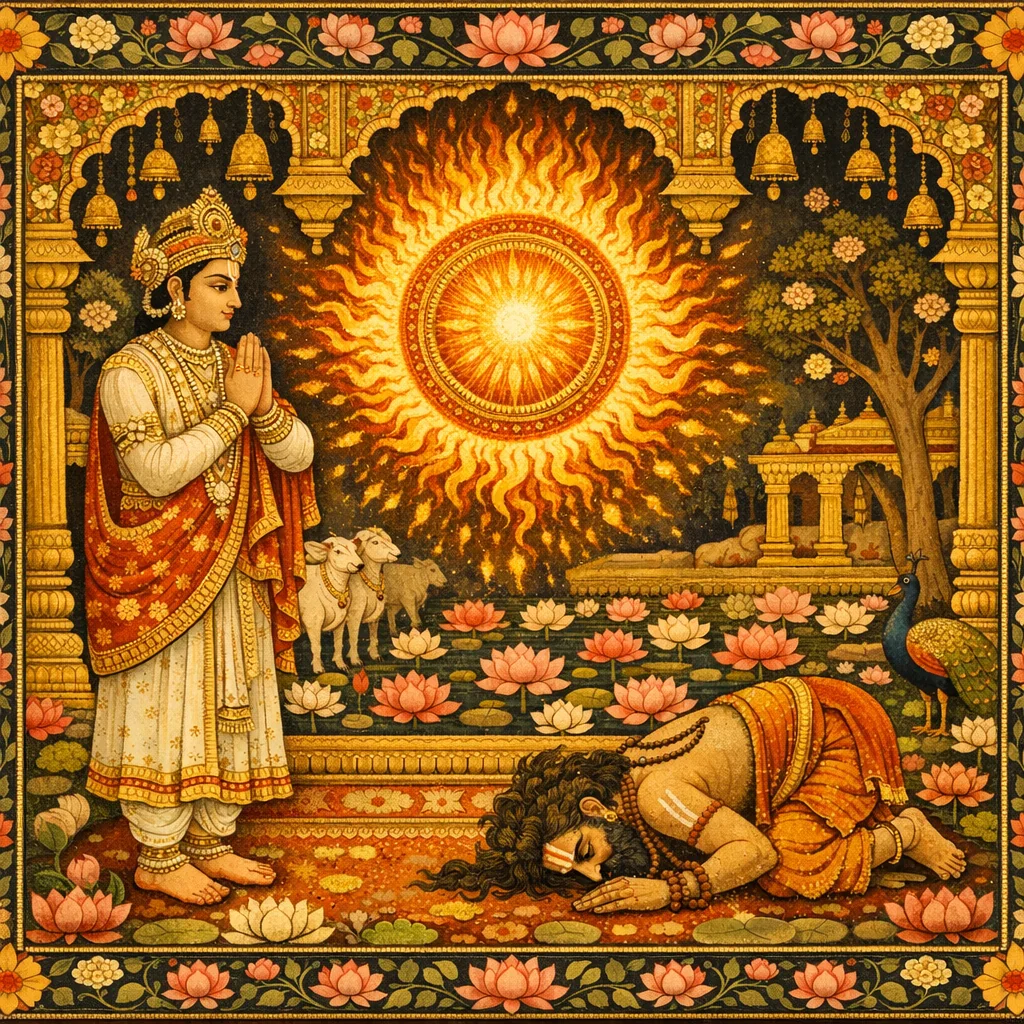
Continuing from the prior tension—Durvāsā Muni pursued by the Sudarśana cakra after offending the devotee-king—this chapter opens with the sage’s return to Mahārāja Ambarīṣa in distress, falling at the king’s feet. Ambarīṣa, rather than retaliating, feels shame and compassion and offers a theologically rich stuti to Sudarśana, identifying it as the Lord’s all-pervading, cosmic principle and invincible protector. He petitions the cakra to grant shelter to the brāhmaṇa, grounding his request in the merit of his family’s dharma, yajña, charity, and—above all—the Lord’s pleasure. The Sudarśana becomes pacified and ceases burning Durvāsā, who then praises the greatness of devotees and acknowledges the purifying power of the Lord’s name. The king, having fasted until the sage’s return, honors him with food; Durvāsā blesses him and departs. The chapter concludes by affirming Ambarīṣa’s perfected devotion, his renunciation into vānaprastha, and the phala-śruti: hearing or remembering this narration grants devotion and liberation—setting a devotional model for what follows in dynastic history.
Shlokas
Verse 1
श्रीशुक उवाच एवं भगवतादिष्टो दुर्वासश्चक्रतापित: । अम्बरीषमुपावृत्य तत्पादौ दु:खितोऽग्रहीत् ॥ १ ॥
Śukadeva Gosvāmī said: When thus advised by Lord Viṣṇu, Durvāsā Muni, who was very much harassed by the Sudarśana cakra, immediately approached Mahārāja Ambarīṣa. Being very much aggrieved, the muni fell down and clasped the King’s lotus feet.
Verse 2
तस्य सोद्यममावीक्ष्य पादस्पर्शविलज्जित: । अस्तावीत् तद्धरेरस्त्रं कृपया पीडितो भृशम् ॥ २ ॥
When Durvāsā touched his lotus feet, Mahārāja Ambarīṣa was very much ashamed, and when he saw Durvāsā attempting to offer prayers, because of mercy he was aggrieved even more. Thus he immediately began offering prayers to the great weapon of the Supreme Personality of Godhead.
Verse 3
अम्बरीष उवाच त्वमग्निर्भगवान् सूर्यस्त्वं सोमो ज्योतिषां पति: । त्वमापस्त्वं क्षितिर्व्योम वायुर्मात्रेन्द्रियाणि च ॥ ३ ॥
Mahārāja Ambarīṣa said: O Sudarśana cakra, you are fire, you are the most powerful sun, and you are the moon, the master of all luminaries. You are water, earth and sky, you are the air, you are the five sense objects [sound, touch, form, taste and smell], and you are the senses also.
Verse 4
सुदर्शन नमस्तुभ्यं सहस्राराच्युतप्रिय । सर्वास्त्रघातिन् विप्राय स्वस्ति भूया इडस्पते ॥ ४ ॥
O most favorite of Acyuta, the Supreme Personality of Godhead, you have thousands of spokes. O master of the material world, destroyer of all weapons, original vision of the Personality of Godhead, I offer my respectful obeisances unto you. Kindly give shelter and be auspicious to this brāhmaṇa.
Verse 5
त्वं धर्मस्त्वमृतं सत्यं त्वं यज्ञोऽखिलयज्ञभुक् । त्वं लोकपाल: सर्वात्मा त्वं तेज: पौरुषं परम् ॥ ५ ॥
O Sudarśana wheel, you are religion, you are truth, you are encouraging statements, you are sacrifice, and you are the enjoyer of the fruits of sacrifice. You are the maintainer of the entire universe, and you are the supreme transcendental prowess in the hands of the Supreme Personality of Godhead. You are the original vision of the Lord, and therefore you are known as Sudarśana. Everything has been created by your activities, and therefore you are all-pervading.
Verse 6
नम: सुनाभाखिलधर्मसेतवे ह्यधर्मशीलासुरधूमकेतवे । त्रैलोक्यगोपाय विशुद्धवर्चसे मनोजवायाद्भुतकर्मणे गृणे ॥ ६ ॥
O Sudarśana, you have a very auspicious hub, and therefore you are the upholder of all religion. You are just like an inauspicious comet for the irreligious demons. Indeed, you are the maintainer of the three worlds, you are full of transcendental effulgence, you are as quick as the mind, and you are able to work wonders. I can simply utter the word “namaḥ,” offering all obeisances unto you.
Verse 7
त्वत्तेजसा धर्ममयेन संहृतं तम: प्रकाशश्च दृशो महात्मनाम् । दुरत्ययस्ते महिमा गिरां पते त्वद्रूपमेतत् सदसत् परावरम् ॥ ७ ॥
O master of speech, by your effulgence, full of religious principles, the darkness of the world is dissipated, and the knowledge of learned persons or great souls is manifested. Indeed, no one can surpass your effulgence, for all things, manifested and unmanifested, gross and subtle, superior and inferior, are but various forms of you that are manifested by your effulgence.
Verse 8
यदा विसृष्टस्त्वमनञ्जनेन वै बलं प्रविष्टोऽजित दैत्यदानवम् । बाहूदरोर्वङ्घ्रिशिरोधराणि वृश्चन्नजस्रं प्रधने विराजसे ॥ ८ ॥
O indefatigable one, when you are sent by the Supreme Personality of Godhead to enter among the soldiers of the Daityas and the Dānavas, you stay on the battlefield and unendingly separate their arms, bellies, thighs, legs and heads.
Verse 9
स त्वं जगत् त्राण खलप्रहाणये निरूपित: सर्वसहो गदाभृता । विप्रस्य चास्मत्कुलदैवहेतवे विधेहि भद्रं तदनुग्रहो हि न: ॥ ९ ॥
O protector of the universe, you are engaged by the Supreme Personality of Godhead as His all-powerful weapon in killing the envious enemies. For the benefit of our entire dynasty, kindly favor this poor brāhmaṇa. This will certainly be a favor for all of us.
Verse 10
यद्यस्ति दत्तमिष्टं वा स्वधर्मो वा स्वनुष्ठित: । कुलं नो विप्रदैवं चेद् द्विजो भवतु विज्वर: ॥ १० ॥
If our family has given charity to the proper persons, if we have performed ritualistic ceremonies and sacrifices, if we have properly carried out our occupational duties, and if we have been guided by learned brāhmaṇas, I wish, in exchange, that this brāhmaṇa be freed from the burning caused by the Sudarśana cakra.
Verse 11
यदि नो भगवान् प्रीत एक: सर्वगुणाश्रय: । सर्वभूतात्मभावेन द्विजो भवतु विज्वर: ॥ ११ ॥
If the Supreme Personality of Godhead, who is one without a second, who is the reservoir of all transcendental qualities, and who is the life and soul of all living entities, is pleased with us, we wish that this brāhmaṇa, Durvāsā Muni, be freed from the pain of being burned.
Verse 12
श्रीशुक उवाच इति संस्तुवतो राज्ञो विष्णुचक्रं सुदर्शनम् । अशाम्यत् सर्वतो विप्रं प्रदहद् राजयाञ्चया ॥ १२ ॥
Śukadeva Gosvāmī continued: When the King offered prayers to the Sudarśana cakra and Lord Viṣṇu, because of his prayers the Sudarśana cakra became peaceful and stopped burning the brāhmaṇa known as Durvāsā Muni.
Verse 13
स मुक्तोऽस्त्राग्नितापेन दुर्वास: स्वस्तिमांस्तत: । प्रशशंस तमुर्वीशं युञ्जान: परमाशिष: ॥ १३ ॥
Durvāsā Muni, the greatly powerful mystic, was indeed satisfied when freed from the fire of the Sudarśana cakra. Thus he praised the qualities of Mahārāja Ambarīṣa and offered him the highest benedictions.
Verse 14
दुर्वासा उवाच अहो अनन्तदासानां महत्त्वं दृष्टमद्य मे । कृतागसोऽपि यद् राजन् मङ्गलानि समीहसे ॥ १४ ॥
Durvāsā Muni said: My dear King, today I have experienced the greatness of devotees of the Supreme Personality of Godhead, for although I have committed an offense, you have prayed for my good fortune.
Verse 15
दुष्कर: को नु साधूनां दुस्त्यजो वा महात्मनाम् । यै: संगृहीतो भगवान् सात्वतामृषभो हरि: ॥ १५ ॥
For those who have achieved the Supreme Personality of Godhead, the master of the pure devotees, what is impossible to do, and what is impossible to give up?
Verse 16
यन्नामश्रुतिमात्रेण पुमान् भवति निर्मल: । तस्य तीर्थपद: किं वा दासानामवशिष्यते ॥ १६ ॥
What is impossible for the servants of the Lord? By the very hearing of His holy name one is purified.
Verse 17
राजन्ननुगृहीतोऽहं त्वयातिकरुणात्मना । मदघं पृष्ठत: कृत्वा प्राणा यन्मेऽभिरक्षिता: ॥ १७ ॥
O King, overlooking my offenses, you have saved my life. Thus I am very much obliged to you because you are so merciful.
Verse 18
राजा तमकृताहार: प्रत्यागमनकाङ्क्षuया । चरणावुपसङ्गृह्य प्रसाद्य समभोजयत् ॥ १८ ॥
Expecting the return of Durvāsā Muni, the King had not taken his food. Therefore, when the sage returned, the King fell at his lotus feet, pleasing him in all respects, and fed him sumptuously.
Verse 19
सोऽशित्वादृतमानीतमातिथ्यं सार्वकामिकम् । तृप्तात्मा नृपतिं प्राह भुज्यतामिति सादरम् ॥ १९ ॥
Thus the King respectfully received Durvāsā Muni, who after eating varieties of palatable food was so satisfied that with great affection he requested the King to eat also, saying, “Please take your meal.”
Verse 20
प्रीतोऽस्म्यनुगृहीतोऽस्मि तव भागवतस्य वै । दर्शनस्पर्शनालापैरातिथ्येनात्ममेधसा ॥ २० ॥
Durvāsā Muni said: I am very pleased with you, my dear King. At first I thought of you as an ordinary human being and accepted your hospitality, but later I could understand, by my own intelligence, that you are the most exalted devotee of the Lord. Therefore, simply by seeing you, touching your feet and talking with you, I have been pleased and have become obliged to you.
Verse 21
कर्मावदातमेतत् ते गायन्ति स्व:स्त्रियो मुहु: । कीर्तिं परमपुण्यां च कीर्तयिष्यति भूरियम् ॥ २१ ॥
All the blessed women in the heavenly planets will continuously chant about your spotless character at every moment, and the people of this world will also chant your glories continuously.
Verse 22
श्रीशुक उवाच एवं सङ्कीर्त्य राजानं दुर्वास: परितोषित: । ययौ विहायसामन्त्र्य ब्रह्मलोकमहैतुकम् ॥ २२ ॥
Śrī Śukadeva Gosvāmī continued: Thus being satisfied in all respects, the great mystic yogī Durvāsā took permission and left, continuously glorifying the King. Through the skyways, he went to Brahmaloka, which is devoid of agnostics and dry philosophical speculators.
Verse 23
संवत्सरोऽत्यगात् तावद् यावता नागतो गत: । मुनिस्तद्दर्शनाकाङ्क्षोत राजाब्भक्षो बभूव ह ॥ २३ ॥
Durvāsā Muni had left the place of Mahārāja Ambarīṣa, and as long as he had not returned — for one complete year — the King had fasted, maintaining himself simply by drinking water.
Verse 24
गतेऽथ दुर्वाससि सोऽम्बरीषो द्विजोपयोगातिपवित्रमाहरत् । ऋषेर्विमोक्षं व्यसनं च वीक्ष्य मेने स्ववीर्यं च परानुभावम् ॥ २४ ॥
After one year, when Durvāsā Muni had returned, King Ambarīṣa sumptuously fed him all varieties of pure food, and then he himself also ate. When the King saw that the brāhmaṇa Durvāsā had been released from the great danger of being burned, he could understand that by the grace of the Lord he himself was also powerful, but he did not take any credit, for everything had been done by the Lord.
Verse 25
एवं विधानेकगुण: स राजा परात्मनि ब्रह्मणि वासुदेवे । क्रियाकलापै: समुवाह भक्तिं ययाविरिञ्च्यान् निरयांश्चकार ॥ २५ ॥
In this way, because of devotional service, Mahārāja Ambarīṣa, who was endowed with varieties of transcendental qualities, was completely aware of Brahman, Paramātmā and the Supreme Personality of Godhead, and thus he executed devotional service perfectly. Because of his devotion, he thought even the topmost planet of this material world no better than the hellish planets.
Verse 26
श्रीशुक उवाच अथाम्बरीषस्तनयेषु राज्यं समानशीलेषु विसृज्य धीर: । वनं विवेशात्मनि वासुदेवे मनो दधद् ध्वस्तगुणप्रवाह: ॥ २६ ॥
Śrīla Śukadeva Gosvāmī continued: Thereafter, because of his advanced position in devotional life, Mahārāja Ambarīṣa, who no longer desired to live with material things, retired from active family life. He divided his property among his sons, who were equally as qualified, and he himself took the order of vānaprastha and went to the forest to concentrate his mind fully upon Lord Vāsudeva.
Verse 27
इत्येतत् पुण्यमाख्यानमम्बरीषस्य भूपते । सङ्कीर्तयन्ननुध्यायन् भक्तो भगवतो भवेत् ॥ २७ ॥
Anyone who chants this narration or even thinks of this narration about the activities of Mahārāja Ambarīṣa certainly becomes a pure devotee of the Lord.
Verse 28
अम्बरीषस्यचरितं येशृण्वन्तिमहात्मन: । मुक्तिं प्रयान्तितेसर्वेभक्त्याविष्णो: प्रसादत: ॥ २८ ॥
By the grace of the Lord, those who hear about the activities of Mahārāja Ambarīṣa, the great devotee, certainly become liberated or become devotees without delay.
Frequently Asked Questions
Because Ambarīṣa acts as a pure bhakta: he is non-envious and seeks the offender’s welfare. Sudarśana is the Lord’s delegated protective power; since the disturbance arose from an offense against a devotee, the devotee’s compassionate prayer is the proper spiritual resolution. The episode teaches that bhakti expresses itself as forgiveness and dependence on the Lord, not personal vengeance.
Ambarīṣa’s stuti portrays Sudarśana as both the Lord’s weapon and an all-pervading manifestation of divine vision and potency—linked with cosmic elements, luminaries, sense-objects, dharma, truth, and sacrificial order. This frames Sudarśana not merely as a physical disc but as the Lord’s irresistible protective intelligence (śakti) that maintains cosmic and moral balance.
The chapter’s conclusion is that all effective power belongs to the Lord, manifest through His protection of devotees. Durvāsā’s mystic strength cannot counteract Sudarśana; Ambarīṣa is ‘powerful’ only by grace and does not claim credit. The narrative establishes bhakti and divine favor as superior to tapas and siddhi.
Because the king had initiated a hospitality and ritual context that required honoring the guest’s return, and he would not complete his own meal while the brāhmaṇa remained unresolved. Spiritually, it displays steadfastness in dharma and Vaiṣṇava character: patience, self-control, and commitment to the welfare of the very person who harmed him.
The text states that chanting, hearing, or even thinking of Ambarīṣa’s activities leads one toward pure devotion and swift liberation. The implied siddhānta is that association with bhakta-kathā (narrations of devotees) purifies the heart, strengthens śraddhā, and aligns the listener with the Lord’s protective grace (rakṣā).