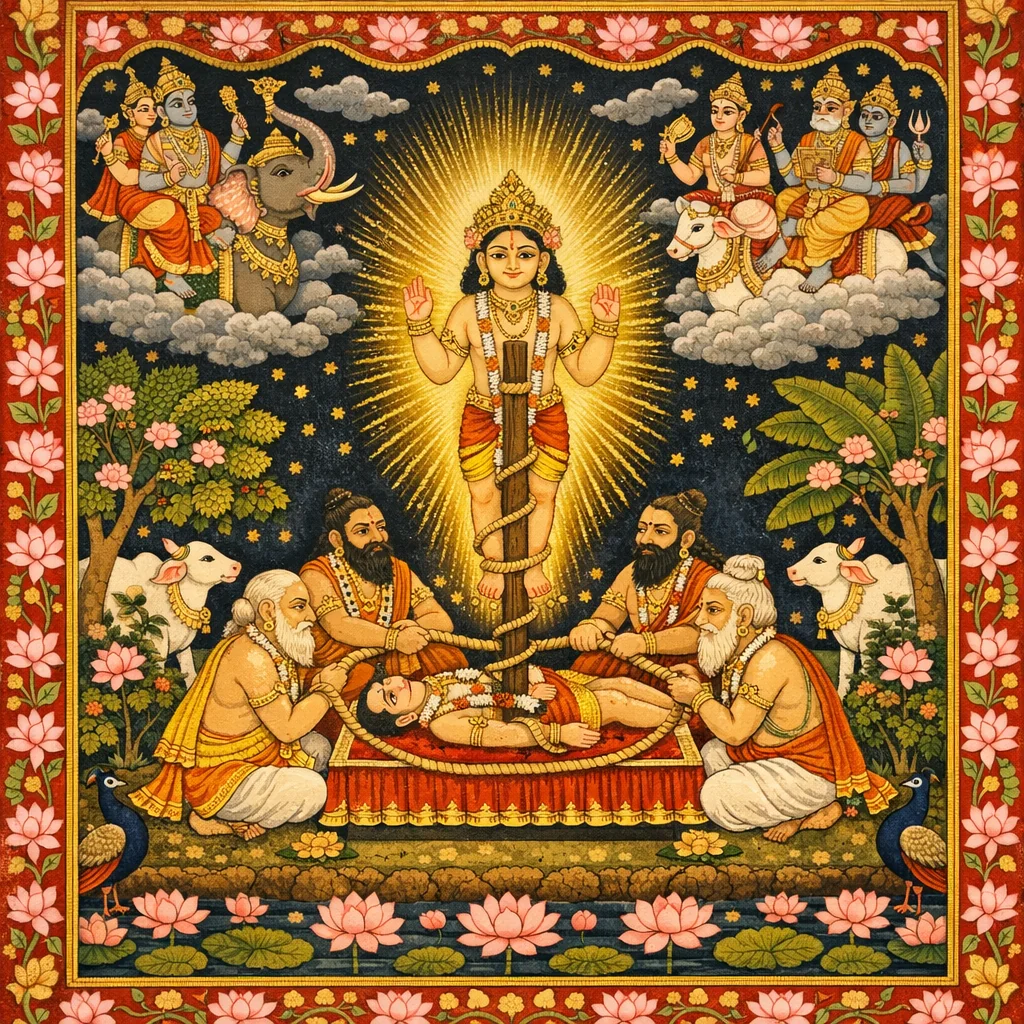
Adhyaya 13
Nimi’s Disembodied Liberation and the Rise of the Mithilā (Videha) Dynasty
Continuing the royal histories of Skandha 9, this chapter centers on Mahārāja Nimi (Ikṣvāku’s son) and a pivotal conflict of authority between king and guru. Nimi requests Vasiṣṭha as chief priest, but Vasiṣṭha is engaged in Indra’s sacrifice and asks Nimi to wait. Seeing life as fleeting, Nimi proceeds with other priests, prompting Vasiṣṭha to curse his body to fall; Nimi countercurses, and both relinquish their bodies—Vasiṣṭha later re-manifesting through his extraordinary birth connected with Mitra and Varuṇa. The sages preserve Nimi’s body and ask the devas to restore him, but Nimi refuses re-embodiment, distinguishing the fear-based liberation of Māyāvādīs from the fearless, service-filled intelligence of devotees who use the body for bhakti. The devas grant him an existence without a gross body. To prevent political disorder, the sages churn Nimi’s preserved body and produce Janaka (Vaideha/Mithila), initiating a detailed genealogy culminating in Śīradhvaja Janaka, from whose plow appears Sītā, linking Mithilā to Lord Rāmacandra’s līlā. The chapter closes by affirming that Mithilā’s kings were self-realized and liberated despite household life, setting a paradigm for spiritually grounded governance as the narrative proceeds through subsequent descendants.
Shlokas
Verse 1
श्रीशुक उवाच निमिरिक्ष्वाकुतनयो वसिष्ठमवृतर्त्विजम् । आरभ्य सत्रं सोऽप्याह शक्रेण प्राग्वृतोऽस्मि भो: ॥ १ ॥
Śrīla Śukadeva Gosvāmī said: After beginning sacrifices, Mahārāja Nimi, the son of Ikṣvāku, requested the great sage Vasiṣṭha to take the post of chief priest. At that time, Vasiṣṭha replied, “My dear Mahārāja Nimi, I have already accepted the same post in a sacrifice begun by Lord Indra.”
Verse 2
तं निर्वर्त्यागमिष्यामि तावन्मां प्रतिपालय । तूष्णीमासीद् गृहपति: सोऽपीन्द्रस्याकरोन्मखम् ॥ २ ॥
“I shall return here after finishing the yajña for Indra. Kindly wait for me until then.” Mahārāja Nimi remained silent, and Vasiṣṭha began to perform the sacrifice for Lord Indra.
Verse 3
निमिश्चलमिदं विद्वान् सत्रमारभतात्मवान् । ऋत्विग्भिरपरैस्तावन्नागमद् यावता गुरु: ॥ ३ ॥
Mahārāja Nimi, being a self-realized soul, considered that this life is flickering. Therefore, instead of waiting long for Vasiṣṭha, he began performing the sacrifice with other priests.
Verse 4
शिष्यव्यतिक्रमं वीक्ष्य तं निर्वर्त्यागतो गुरु: । अशपत् पतताद् देहो निमे: पण्डितमानिन: ॥ ४ ॥
After completing the sacrificial performance for King Indra, the spiritual master Vasiṣṭha returned and found that his disciple Mahārāja Nimi had disobeyed his instructions. Thus Vasiṣṭha cursed him, saying, “May the material body of Nimi, who considers himself learned, immediately fall.”
Verse 5
निमि: प्रतिददौ शापं गुरवेऽधर्मवर्तिने । तवापि पतताद् देहो लोभाद्धर्ममजानत: ॥ ५ ॥
For unnecessarily cursing him when he had committed no offense, Mahārāja Nimi countercursed his spiritual master. “For the sake of getting contributions from the King of heaven,” he said, “you have lost your religious intelligence. Therefore I pronounce this curse: your body also will fall.”
Verse 6
इत्युत्ससर्ज स्वं देहं निमिरध्यात्मकोविद: । मित्रावरुणयोर्जज्ञे उर्वश्यां प्रपितामह: ॥ ६ ॥
After saying this, Mahārāja Nimi, who was expert in the science of spiritual knowledge, gave up his body. Vasiṣṭha, the great-grandfather, gave up his body also, but through the semen discharged by Mitra and Varuṇa when they saw Urvaśī, he was born again.
Verse 7
गन्धवस्तुषु तद् देहं निधाय मुनिसत्तमा: । समाप्ते सत्रयागे च देवानूचु: समागतान् ॥ ७ ॥
During the performance of the yajña, the body relinquished by Mahārāja Nimi was preserved in fragrant substances, and at the end of the Satra-yāga the great saints and brāhmaṇas made the following request to all the demigods assembled there.
Verse 8
राज्ञो जीवतु देहोऽयं प्रसन्ना: प्रभवो यदि । तथेत्युक्ते निमि: प्राह मा भून्मे देहबन्धनम् ॥ ८ ॥
“If you are satisfied with this sacrifice and if you are actually able to do so, kindly bring Mahārāja Nimi back to life in this body.” The demigods said yes to this request by the sages, but Mahārāja Nimi said, “Please do not imprison me again in a material body.”
Verse 9
यस्य योगं न वाञ्छन्ति वियोगभयकातरा: । भजन्ति चरणाम्भोजं मुनयो हरिमेधस: ॥ ९ ॥
Mahārāja Nimi continued: Māyāvādīs generally want freedom from accepting a material body because they fear having to give it up again. But devotees whose intelligence is always filled with the service of the Lord are unafraid. Indeed, they take advantage of the body to render transcendental loving service.
Verse 10
देहं नावरुरुत्सेऽहं दु:खशोकभयावहम् । सर्वत्रास्य यतो मृत्युर्मत्स्यानामुदके यथा ॥ १० ॥
I do not wish to accept a material body, for such a body is the source of all distress, lamentation and fear, everywhere in the universe, just as it is for a fish in the water, which lives always in anxiety because of fear of death.
Verse 11
देवा ऊचु: विदेह उष्यतां कामं लोचनेषु शरीरिणाम् । उन्मेषणनिमेषाभ्यां लक्षितोऽध्यात्मसंस्थित: ॥ ११ ॥
The demigods said: Let Mahārāja Nimi live without a material body. Let him live in a spiritual body as a personal associate of the Supreme Personality of Godhead, and, according to his desire, let him be manifest or unmanifest to common materially embodied people.
Verse 12
अराजकभयं नृणां मन्यमाना महर्षय: । देहं ममन्थु: स्म निमे: कुमार: समजायत ॥ १२ ॥
Thereafter, to save the people from the danger of an unregulated government, the sages churned Mahārāja Nimi’s material body, from which, as a result, a son was born.
Verse 13
जन्मना जनक: सोऽभूद् वैदेहस्तु विदेहज: । मिथिलो मथनाज्जातो मिथिला येन निर्मिता ॥ १३ ॥
Because he was born in an unusual way, the son was called Janaka, and because he was born from the dead body of his father, he was known as Vaideha. Because he was born from the churning of his father’s material body, he was known as Mithila, and because he constructed a city as King Mithila, the city was called Mithilā.
Verse 14
तस्मादुदावसुस्तस्य पुत्रोऽभून्नन्दिवर्धन: । तत: सुकेतुस्तस्यापि देवरातो महीपते ॥ १४ ॥
O King Parīkṣit, from Mithila came a son named Udāvasu; from Udāvasu, Nandivardhana; from Nandivardhana, Suketu; and from Suketu, Devarāta.
Verse 15
तस्माद् बृहद्रथस्तस्य महावीर्य: सुधृत्पिता । सुधृतेर्धृष्टकेतुर्वै हर्यश्वोऽथ मरुस्तत: ॥ १५ ॥
From Devarāta came a son named Bṛhadratha and from Bṛhadratha a son named Mahāvīrya, who became the father of Sudhṛti. The son of Sudhṛti was known as Dhṛṣṭaketu, and from Dhṛṣṭaketu came Haryaśva. From Haryaśva came a son named Maru.
Verse 16
मरो: प्रतीपकस्तस्माज्जात: कृतरथो यत: । देवमीढस्तस्य पुत्रो विश्रुतोऽथ महाधृति: ॥ १६ ॥
The son of Maru was Pratīpaka, and the son of Pratīpaka was Kṛtaratha. From Kṛtaratha came Devamīḍha; from Devamīḍha, Viśruta; and from Viśruta, Mahādhṛti.
Verse 17
कृतिरातस्ततस्तस्मान्महारोमा च तत्सुत: । स्वर्णरोमा सुतस्तस्य ह्रस्वरोमा व्यजायत ॥ १७ ॥
From Mahādhṛti was born a son named Kṛtirāta, from Kṛtirāta was born Mahāromā, from Mahāromā came a son named Svarṇaromā, and from Svarṇaromā came Hrasvaromā.
Verse 18
तत: शीरध्वजो जज्ञे यज्ञार्थं कर्षतो महीम् । सीता शीराग्रतो जाता तस्मात् शीरध्वज: स्मृत: ॥ १८ ॥
From Hrasvaromā came a son named Śīradhvaja [also called Janaka]. When Śīradhvaja was plowing a field, from the front of his plow [śīra] appeared a daughter named Sītādevī, who later became the wife of Lord Rāmacandra. Thus he was known as Śīradhvaja.
Verse 19
कुशध्वजस्तस्य पुत्रस्ततो धर्मध्वजो नृप: । धर्मध्वजस्य द्वौ पुत्रौ कृतध्वजमितध्वजौ ॥ १९ ॥
The son of Śīradhvaja was Kuśadhvaja, and the son of Kuśadhvaja was King Dharmadhvaja, who had two sons, namely Kṛtadhvaja and Mitadhvaja.
Verse 20
कृतध्वजात् केशिध्वज: खाण्डिक्यस्तु मितध्वजात् । कृतध्वजसुतो राजन्नात्मविद्याविशारद: ॥ २० ॥ खाण्डिक्य: कर्मतत्त्वज्ञो भीत: केशिध्वजाद्द्रुत: । भानुमांस्तस्य पुत्रोऽभूच्छतद्युम्नस्तु तत्सुत: ॥ २१ ॥
O Mahārāja Parīkṣit, the son of Kṛtadhvaja was Keśidhvaja, and the son of Mitadhvaja was Khāṇḍikya. The son of Kṛtadhvaja was expert in spiritual knowledge, and the son of Mitadhvaja was expert in Vedic ritualistic ceremonies. Khāṇḍikya fled in fear of Keśidhvaja. The son of Keśidhvaja was Bhānumān, and the son of Bhānumān was Śatadyumna.
Verse 21
कृतध्वजात् केशिध्वज: खाण्डिक्यस्तु मितध्वजात् । कृतध्वजसुतो राजन्नात्मविद्याविशारद: ॥ २० ॥ खाण्डिक्य: कर्मतत्त्वज्ञो भीत: केशिध्वजाद्द्रुत: । भानुमांस्तस्य पुत्रोऽभूच्छतद्युम्नस्तु तत्सुत: ॥ २१ ॥
O Mahārāja Parīkṣit, the son of Kṛtadhvaja was Keśidhvaja, and the son of Mitadhvaja was Khāṇḍikya. The son of Kṛtadhvaja was expert in spiritual knowledge, and the son of Mitadhvaja was expert in Vedic ritualistic ceremonies. Khāṇḍikya fled in fear of Keśidhvaja. The son of Keśidhvaja was Bhānumān, and the son of Bhānumān was Śatadyumna.
Verse 22
शुचिस्तुतनयस्तस्मात् सनद्वाज: सुतोऽभवत् । ऊर्जकेतु: सनद्वाजादजोऽथ पुरुजित्सुत: ॥ २२ ॥
The son of Śatadyumna was named Śuci. From Śuci, Sanadvāja was born, and from Sanadvāja came a son named Ūrjaketu. The son of Ūrjaketu was Aja, and the son of Aja was Purujit.
Verse 23
अरिष्टनेमिस्तस्यापि श्रुतायुस्तत्सुपार्श्वक: । ततश्चित्ररथो यस्य क्षेमाधिर्मिथिलाधिप: ॥ २३ ॥
The son of Purujit was Ariṣṭanemi, and his son was Śrutāyu. Śrutāyu begot a son named Supārśvaka, and Supārśvaka begot Citraratha. The son of Citraratha was Kṣemādhi, who became the king of Mithilā.
Verse 24
तस्मात् समरथस्तस्य सुत: सत्यरथस्तत: । आसीदुपगुरुस्तस्मादुपगुप्तोऽग्निसम्भव: ॥ २४ ॥
The son of Kṣemādhi was Samaratha, and his son was Satyaratha. The son of Satyaratha was Upaguru, and the son of Upaguru was Upagupta, a partial expansion of the fire-god.
Verse 25
वस्वनन्तोऽथ तत्पुत्रो युयुधो यत् सुभाषण: । श्रुतस्ततो जयस्तस्माद् विजयोऽस्मादृत: सुत: ॥ २५ ॥
The son of Upagupta was Vasvananta, the son of Vasvananta was Yuyudha, the son of Yuyudha was Subhāṣaṇa, and the son of Subhāṣaṇa was Śruta. The son of Śruta was Jaya, from whom there came Vijaya. The son of Vijaya was Ṛta.
Verse 26
शुनकस्तत्सुतो जज्ञे वीतहव्यो धृतिस्तत: । बहुलाश्वो धृतेस्तस्य कृतिरस्य महावशी ॥ २६ ॥
The son of Ṛta was Śunaka, the son of Śunaka was Vītahavya, the son of Vītahavya was Dhṛti, and the son of Dhṛti was Bahulāśva. The son of Bahulāśva was Kṛti, and his son was Mahāvaśī.
Verse 27
एते वै मैथिला राजन्नात्मविद्याविशारदा: । योगेश्वरप्रसादेन द्वन्द्वैर्मुक्ता गृहेष्वपि ॥ २७ ॥
Śukadeva Gosvāmī said: My dear King Parīkṣit, all the kings of the dynasty of Mithila were completely in knowledge of their spiritual identity. Therefore, even though staying at home, they were liberated from the duality of material existence.
Frequently Asked Questions
Nimi is described as self-realized and reflective on the flickering nature of embodied life; he judged prolonged delay as spiritually and practically risky. His decision highlights a tension between urgency in dharma and obedience to the guru’s instruction, which becomes the narrative trigger for the curse-countercurse and the chapter’s deeper teaching on embodiment and liberation.
The episode dramatizes the potency of brahminical speech and the ethical weight of authority. It also functions as a providential pivot: Nimi’s fall leads to his ‘Videha’ condition and the birth of Janaka through churning, thereby establishing the Mithilā line. Theologically, it shows how even conflict can be woven into the Lord’s larger arrangement for protecting society through qualified dynasties.
Nimi states that Māyāvādīs often seek freedom from embodiment due to fear of repeated loss and suffering, whereas devotees—whose intelligence is saturated with service—do not fear embodiment because they see the body as an instrument for loving service (bhakti). The contrast is motivational and relational: impersonal escape versus personal service to Bhagavān.
Janaka is produced when sages churn Nimi’s preserved body to avert the danger of unregulated government. He is called Janaka due to unusual birth, Vaideha because he arises from a dead (videha) father, and Mithila/Mithilā in connection with the churning origin and the founding of the city Mithilā. The names encode theology and history: lineage continuity, social protection, and sacred geography.
Sītā appears during the reign of Śīradhvaja Janaka: while plowing (śīra), she manifests from the earth at the front of the plow. This anchors Sītā’s appearance within the Videha-Mithilā lineage and explicitly connects Skandha 9’s vaṁśānucarita to the Rāma-līlā, strengthening the Purāṇic bridge to the Rāmāyaṇa tradition.