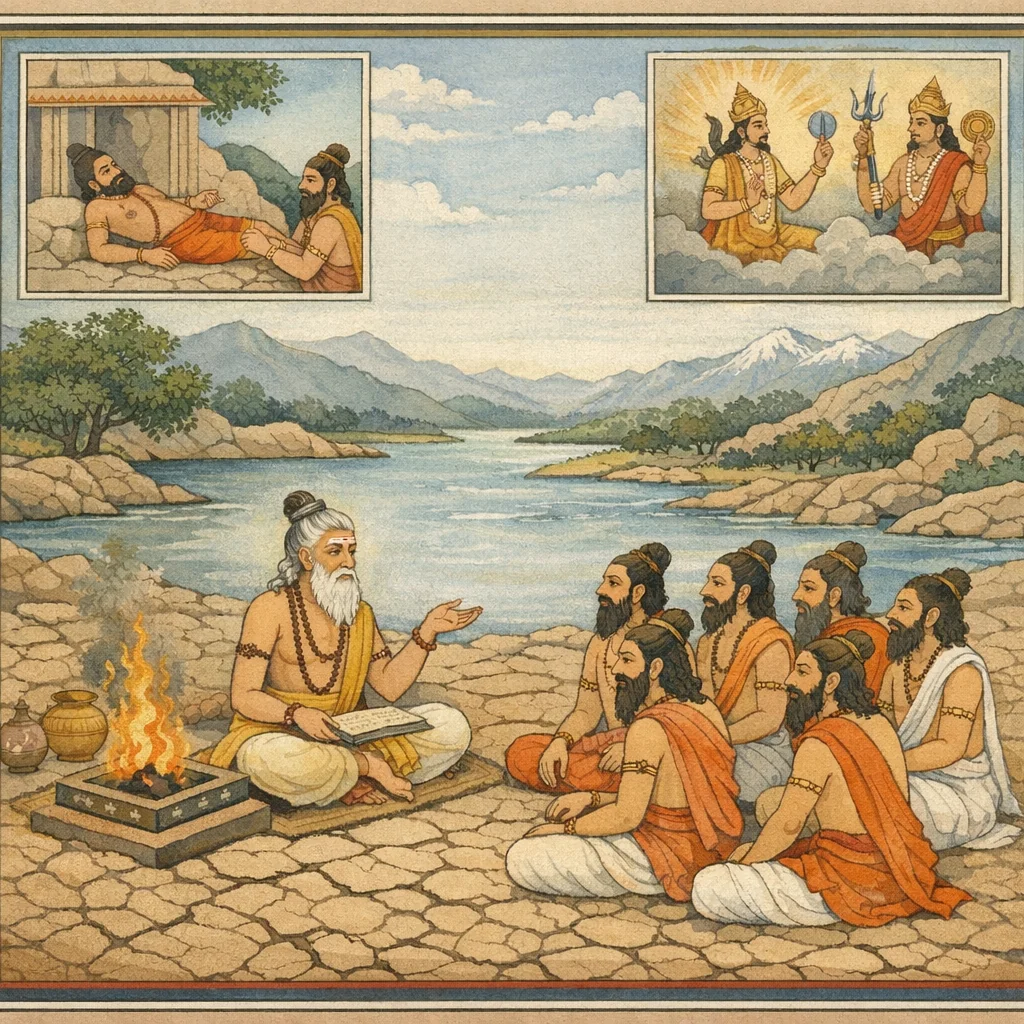
Adhyaya 51
Vṛddha-kanyā-carita and Balarāma’s Kurukṣetra Inquiry (वृद्धकन्या-चरितम् / कुरुक्षेत्रफल-प्रश्नः)
Upa-parva: Vṛddha-kanyā Tapas (Episode of the Aged Maiden’s Asceticism)
Janamejaya asks how a maiden previously became devoted to austerity and what rule (niyama) governed her practice (1–2). Vaiśaṃpāyana recounts that the powerful sage Kuṇi Gārgya, after intense tapas, generated a fair, mind-born daughter and then departed for heaven (3–4). The maiden establishes an āśrama through severe austerities, honoring ancestors and gods with fasting; much time passes, yet she declines a husband offered by her father because she finds none equal to herself (5–8). Worn by age and austerity, unable to move, she resolves upon death; Nārada intervenes, stating that without saṃskāra a maiden cannot claim the worlds, despite attaining high tapas (9–12). She responds before an assembly of sages that she will grant half her tapas to a worthy pāṇigrahītā; the sage Prākśṛṅgavān (of Gālava lineage) takes her hand under a condition that she stay with him for one night (13–16). That night she becomes youthful and radiant; after the night she affirms the agreement, announces a tīrtha-related fruit for one who keeps a long brahmacarya observance, then abandons her body and ascends to heaven (17–21). The sage, afflicted by attachment to her beauty, receives the transferred tapas with difficulty and later follows her course; the narrative concludes as the ‘great conduct’ of the aged maiden (22–23). The chapter then returns to the war context: Balarāma hears Śalya has been slain, gives gifts to brāhmaṇas, exits via Samantapañcaka’s gate, and asks ṛṣis about the merit of Kurukṣetra, which they explain (24–26).
Chapter Arc: वैशम्पायन बलराम के तीर्थ-पर्यटन का प्रसंग उठाते हैं—धर्मात्मा बलराम सरस्वती-तीर्थों में स्नान-दान करते हुए उस पावन स्थल पर पहुँचते हैं जहाँ सारस्वत मुनि की कीर्ति गूँजती है। → कथा बारह-वर्षीय अनावृष्टि की भयावहता पर टिकती है: भूख से व्याकुल ऋषि दिशाओं में बिखर जाते हैं, वेद-स्वाध्याय टूटने लगता है और स्मृति तक डगमगा जाती है—धर्म-परंपरा के लुप्त होने का संकट खड़ा होता है। → सारस्वत मुनि उस आपदा में भी वेदों को थाम लेते हैं—स्वाध्याय और अध्यापन का दीपक बनकर; साठ हजार मुनि उनके शिष्य बनते हैं और वेद-परंपरा पुनः प्रवाहित होती है। साथ ही दधीच का महात्म्य उभरता है: उनके अस्थियों से इन्द्र के लिए दिव्य आयुध (गदा, वज्र, चक्र, दण्ड) बनते हैं—त्याग का चरम शिखर। → सरस्वती की उत्पत्ति-कीर्ति और उसके तट के तपस्वियों का गौरव स्थापित होता है; अनावृष्टि के अंधकार में भी ज्ञान-धर्म की रक्षा करने वाले सारस्वत और लोक-हित हेतु देह तक अर्पित करने वाले दधीच—दोनों के चरित्र तीर्थ-महिमा को पूर्ण करते हैं। → बलराम का तीर्थ-क्रम आगे किन-किन रहस्यमय स्थलों और कथाओं को उद्घाटित करेगा—यह जिज्ञासा बनी रहती है।
Shlokas
Verse 1
ऑपन-आक्रात बछ। 2 एकपज्चाशत्तमो< ध्याय: सारस्वततीर्थकी महिमाके प्रसंगमें दधीच ऋषि और सारस्वत मुनिके चरित्रका वर्णन वैशम्पायन उवाच यत्रेजिवानुड॒पती राजसूयेन भारत । तस्मिंस्तीर्थे महानासीत् संग्रामस्तारकामय:,वैशम्पायनजी कहते हैं--भरतनन्दन! वही सोम-तीर्थ है, जहाँ नक्षत्रोंके स्वामी चन्द्रमाने राजसूययज्ञ किया था। उसी तीर्थमें महान् तारकामय संग्राम हुआ था
Vaiśampāyana said: O Bhārata, this is that Soma-tīrtha where the Moon—lord of the constellations—performed the Rājasūya sacrifice. At that very sacred ford there once took place the great Tārakāmaya war, a reminder that even exalted beings, when driven by desire and rivalry, can turn holy ground into a field of conflict.
Verse 2
तत्राप्युपस्पृश्य बले दत्त्वा दानानि चात्मवान् | सारस्वतस्य धर्मात्मा मुनेस्तीर्थ जगाम ह,धर्मात्मा एवं मनस्वी बलरामजी उस तीर्थमें भी स्नान एवं दान करके सारस्वत मुनिके तीर्थमें गये
There too, after performing ritual purification by touching water and then making charitable gifts with self-control, the righteous Balarāma proceeded to the sacred ford associated with the sage Sārasvata—acting with a mind devoted to dharma.
Verse 3
तत्र द्वादशवार्षिक्यामनावृष्ट्यां द्विजोत्तमान् | वेदानध्यापयामास पुरा सारस्वतो मुनि:,प्राचीनकालमें जब बारह वर्षोंतक अनावृष्टि हो गयी थी, सारस्वत मुनिने वहीं उत्तम ब्राह्मणोंको वेदाध्ययन कराया था
There, in ancient times, when a drought lasting twelve years had occurred, the sage Sārasvata taught the Vedas to the best of the twice-born. The passage highlights how, even amid prolonged calamity, the preservation and transmission of sacred knowledge through disciplined teaching remains a sustaining duty.
Verse 4
जनमेजय उवाच कथं द्वादशवार्षिक्यामनावृष्ट्यां द्विजोत्तमान् । ऋषीनध्यापयामास पुरा सारस्वतो मुनि:,जनमेजयने पूछा--मुने! प्राचीनकालमें सारस्वत मुनिने बारह वर्षोकी अनावृष्टिके समय उत्तम ब्राह्मणोंको किस प्रकार वेदोंका अध्ययन कराया था?
Janamejaya said: “O sage, in ancient times, during a twelve-year drought, how did the sage Sārasvata manage to instruct the foremost Brahmins—those seer-students—in the Vedas?”
Verse 5
वैशम्पायन उवाच आसीत् पूर्व महाराज मुनिर्धीमान् महातपा: । दधीच इति विख्यातो ब्रह्म॒चारी जितेन्द्रिय:,वैशम्पायनजीने कहा--महाराज! पूर्वकालमें एक बुद्धिमान् महातपस्वी मुनि रहते थे, जो ब्रह्मचारी और जितेन्द्रिय थे। उनका नाम था दधीच
Vaiśampāyana said: O great king, in former times there lived a wise sage of great austerity. He was renowned by the name Dadhīca—steadfast in celibate discipline and master of his senses.
Verse 6
तस्यातितपस: शक्रो बिभेति सततं विभो । न स लोभयितुं शक््य: फलैर्बहुविधैरपि,प्रभो! उनकी भारी तपस्यासे इन्द्र सदा डरते रहते थे। नाना प्रकारके फलोंका प्रलोभन देनेपर भी उन्हें लुभाया नहीं जा सकता था
Vaiśampāyana said: Because of his extraordinary austerities, Indra (Śakra) remained continually afraid. That ascetic could not be enticed or swayed—even by offering many kinds of rewards—showing how steadfast self-control and tapas can stand beyond worldly inducements.
Verse 7
प्रलोभनार्थ तस्याथ प्राहिणोत् पाकशासन: । दिव्यामप्सरसं पुण्यां दर्शनीयामलम्बुषाम्,तब इन्द्रने मुनिको लुभानेके लिये एक पवित्र दर्शनीय एवं दिव्य अप्सरा भेजी, जिसका नाम था अलम्बुषा
Then, with the intention of tempting him, Pākaśāsana (Indra) dispatched the divine apsaras Alambuṣā—holy and captivating to behold. The episode underscores how even exalted beings may resort to allure as a strategy, testing the steadiness of one’s self-control and resolve.
Verse 8
तस्य तर्पयतो देवान् सरस्वत्यां महात्मन: । समीपतो महाराज सोपातिष्ठत भाविनी,महाराज! एक दिन, जब महात्मा दधीच सरस्वती नदीमें देवताओंका तर्पण कर रहे थे, वह माननीय अप्सरा उनके पास जाकर खड़ी हो गयी
Vaiśampāyana said: While that great-souled sage was offering libations to the gods on the banks of the Sarasvatī, a radiant and noble apsaras came near and stood close by him, O king. The scene frames a moment where disciplined ritual duty (tarpana) draws the attention of celestial beings, highlighting the moral force attributed to austerity and sacred observance.
Verse 9
तां दिव्यवपुषं दृष्टवा तस्यर्षेभावितात्मन: । रेत: स्कन्नं सरस्वत्यां तत् सा जग्राह निम्नगा,उस दिव्यरूपधारिणी अप्सराको देखकर उन विशुद्ध अन्तःकरणवाले महर्षिका वीर्य सरस्वतीके जलमें गिर पड़ा। उस वीर्यको सरस्वती नदीने स्वयं ग्रहण कर लिया
Seeing that apsaras of radiant, divine beauty, the semen of that great seer—whose inner self was purified and disciplined—spilled into the waters of the Sarasvatī. The river Sarasvatī herself, the flowing stream, received that seed.
Verse 10
कुक्षौ चाप्यदधाद् हृष्टा तद् रेत: पुरुषर्षभ । सा दधार च त॑ गर्भ पुत्रहेतोर्महानदी,पुरुषप्रवर! उस महानदीने हर्षमें भरकर पुत्रके लिये उस वीर्यको अपनी कुक्षिमें रख लिया और इस प्रकार वह गर्भवती हो गयी
Vaiśaṃpāyana said: Rejoicing, that great river received that seed into her womb, O best of men. Bearing it as an embryo for the sake of obtaining a son, she thus became pregnant—an episode that underscores how extraordinary births in the epic often arise from purposeful intent rather than ordinary union.
Verse 11
सुषुवे चापि समये पुत्र सा सरितां वरा । जगाम पुत्रमादाय तमृषिं प्रति च प्रभो,प्रभो! समय आनेपर सरिताओंमें श्रेष्ठ सरस्वतीने एक पुत्रको जन्म दिया और उसे लेकर वह ऋषिके पास गयी
Vaiśampāyana said: At the appointed time, Sarasvatī—the foremost among rivers—gave birth to a son. Taking the child in her arms, she went to that sage, O lord, to present him in accordance with the prior understanding. The episode underscores fidelity to one’s pledged word and the orderly fulfillment of what has been agreed upon.
Verse 12
ऋषिसंसदि तं दृष्टवा सा नदी मुनिसत्तमम् | ततः प्रोवाच राजेन्द्र ददती पुत्रमस्य तम्,राजेन्द्र! ऋषियोंकी सभामें बैठे हुए मुनिश्रेष्ठ दधीचको देखकर उन्हें उनका वह पुत्र सौंपती हुई सरस्वती नदी इस प्रकार बोली--
Seeing that foremost sage Dadhīca seated in the assembly of seers, the river Sarasvatī, as she handed over his son to him, addressed him in these words—O best of kings. The scene underscores reverence for the sages’ council and the ethical weight of restoring what is due—returning a child to his rightful guardian in a sanctified setting.
Verse 13
ब्रह्मर्षे तव पुत्रो5यं त्वद्धक्त्या धारितो मया । दृष्टवा ते5प्सरसं रेतो यत् स्कन्न॑ प्रागलम्बुषाम्,प्रतिगृह्लीष्व पुत्र स््व॑ मया दत्तमनिन्दितम् | “ब्रह्मर्ष! यह आपका पुत्र है। इसे आपके प्रति भक्ति होनेके कारण मैंने अपने गर्भमें धारण किया था। ब्रह्मर्ष] पहले अलम्बुषा नामक अप्सराको देखकर जो आपका वीर्य स्खलित हुआ था, उसे आपके प्रति भक्ति होनेके कारण मैंने अपने गर्भमें धारण कर लिया था; क्योंकि मेरे मनमें यह विचार हुआ था कि आपका यह तेज नष्ट न होने पावे। अत: आप मेरे दिये हुए अपने इस अनिन्दनीय पुत्रको ग्रहण कीजिये”
Vaiśampāyana said: “O brahmarṣi, this is your son. Out of devotion to you I bore him in my womb. When you once beheld the apsaras Alambuṣā, the semen that fell from you then—I received it, moved by reverence, thinking that your spiritual power should not be wasted. Therefore accept this blameless son of yours, given by me.”
Verse 14
तत् कुक्षिणा वै ब्रह्म्षे त्वद्धक्त्या धृतवत्यहम् । न विनाशमिदं गच्छेत् त्वत्तेज इति निश्चयात्
Vaiśampāyana said: “O Brahman, I have borne this within my womb solely through devotion to you. For I was firmly convinced that this would not come to ruin, since it is sustained by your spiritual radiance.”
Verse 15
इत्युक्त: प्रतिजग्राह प्रीतिं चावाप पुष्कलाम्
Thus addressed, he accepted the proposal and attained abundant joy—his heart filled with pleased assent in response to what had been spoken.
Verse 16
स्वसुतं चाप्यजिप्रत् त॑ मूर्थ्नि प्रेम्णा द्विजोत्तम: । परिष्वज्य चिरं काल तदा भरतसत्तम
Vaiśampāyana said: The foremost of the twice-born then affectionately kissed his own son upon the head; and, O best of the Bharatas, he embraced him for a long time—an intimate gesture of reconciliation and familial tenderness amid the surrounding turmoil.
Verse 17
सरस्वत्यै वरं प्रादात् प्रीयमाणो महामुनि: । विश्वेदेवाः सपितरो गन्धर्वाप्सरसां गणा:
Vaiśampāyana said: Pleased at heart, the great sage granted a boon to Sarasvatī. Present there as witnesses and celebrants were the Viśvedevas, the Pitṛs (ancestral spirits), and the assembled companies of Gandharvas and Apsarases—marking the boon as a solemn, divinely sanctioned act rather than a private favor.
Verse 18
तृप्तिं यास्यन्ति सुभगे तर्प्पमाणास्तवाम्भसा । उसके ऐसा कहनेपर मुनिने उस पुत्रको ग्रहण कर लिया और वे बड़े प्रसन्न हुए। भरतभूषण! उन द्विजश्रेष्ठने बड़े प्रेमसे अपने उस पुत्रका मस्तक सूँघा और दीर्घ-गकालतक छातीसे लगाकर अत्यन्त प्रसन्न हुए महामुनिने सरस्वतीको वर दिया--'सुभगे! तुम्हारे जलसे तर्पण करनेपर विश्वेदेव, पितृणगण तथा गन्धर्वों और अप्सराओंके समुदाय सभी तृप्ति-लाभ करेंगे” || १५-१७ $ ।। इत्युक्त्वा स तु तुष्टाव वचोभिवैं महानदीम्
Vaiśampāyana said: “O auspicious one, those who perform offerings of satisfaction with your waters will attain fulfillment.” In context, the sage, pleased, accepts the son and affectionately embraces him; then he grants Sarasvatī a boon that her waters, when used for ritual libations, will bring satisfaction to the Viśvedevas, the Pitṛs, and the hosts of Gandharvas and Apsarases—affirming the ethical power of sacred giving and proper rites to benefit both divine and ancestral orders.
Verse 19
प्रस्ुतासि महाभागे सरसो ब्रह्मण: पुरा,“महाभागे! तुम पूर्वकालमें ब्रह्माजीके सरोवरसे प्रकट हुई हो। सरिताओंमें श्रेष्ठ सरस्वती! कठोर व्रतका पालन करनेवाले मुनि तुम्हारी महिमाको जानते हैं। प्रियदर्शने! तुम सदा मेरा भी प्रिय करती रही हो; अतः वरवर्णिनि! तुम्हारा यह लोकभावन महान पुत्र तुम्हारे ही नामपर “सारस्वत” कहलायेगा
Vaiśaṃpāyana said: “O noble lady, in ancient times you arose from the lake of Brahmā. O Sarasvatī, best among rivers, sages who practice severe vows know your greatness. O lovely one, you have always shown me favor as well. Therefore, O fair-complexioned lady, this great son—who brings welfare to the world—will be known by your very name as ‘Sārasvata.’”
Verse 20
जानन्ति त्वां सरिच्छेछे मुनय: संशितव्रता: । मम प्रियकरी चापि सतत प्रियदर्शने,“महाभागे! तुम पूर्वकालमें ब्रह्माजीके सरोवरसे प्रकट हुई हो। सरिताओंमें श्रेष्ठ सरस्वती! कठोर व्रतका पालन करनेवाले मुनि तुम्हारी महिमाको जानते हैं। प्रियदर्शने! तुम सदा मेरा भी प्रिय करती रही हो; अतः वरवर्णिनि! तुम्हारा यह लोकभावन महान पुत्र तुम्हारे ही नामपर “सारस्वत” कहलायेगा
Vaiśaṃpāyana said: “O best of rivers, the austere sages who keep their vows know your greatness. O fair to behold, you have always acted for my good as well. O fortunate one—born in ancient times from Brahmā’s lake—O Sarasvatī, foremost among streams: since this great son of yours will be a benefactor of the world, he shall be known by your very name as ‘Sārasvata.’”
Verse 21
तस्मात् सारस्वत: पुत्रो महांस्ते वरवर्णिनि । तवैव नाम्ना प्रथित:ः पुत्रस्ते लोकभावन:,“महाभागे! तुम पूर्वकालमें ब्रह्माजीके सरोवरसे प्रकट हुई हो। सरिताओंमें श्रेष्ठ सरस्वती! कठोर व्रतका पालन करनेवाले मुनि तुम्हारी महिमाको जानते हैं। प्रियदर्शने! तुम सदा मेरा भी प्रिय करती रही हो; अतः वरवर्णिनि! तुम्हारा यह लोकभावन महान पुत्र तुम्हारे ही नामपर “सारस्वत” कहलायेगा
Vaiśaṃpāyana said: “Therefore, O fair-complexioned lady, this great son of yours shall be known as ‘Sārasvata’, famed by your very name. He is a benefactor of the worlds.”
Verse 22
सारस्वत इति ख्यातो भविष्यति महातपा: । एष द्वादशवार्षिक्यामनावृष्ट्यां द्विजर्षभान्
Vaiśampāyana said: “This great ascetic will become renowned by the name ‘Sārasvata.’ In the twelve-year drought, he will sustain the foremost of the twice-born (brāhmaṇas).”
Verse 23
पुण्याभ्यश्व सरिद्धयस्त्वं सदा पुण्यतमा शुभे
Vaiśampāyana said: “O auspicious lady, you are ever the most meritorious—one whose very approach brings holiness and well-being, like sacred rivers that confer purity.”
Verse 24
एवं सा संस्तुतानेन वरं लब्ध्वा महानदी
Thus, that great river—having been praised by him—obtained a boon, marking a moment where reverent speech and due honor are shown to yield auspicious results within the unfolding narrative.
Verse 25
एतस्मिन्नेव काले तु विरोधे देवदानवै:
Vaiśampāyana said: “At that very time, amid the clash and hostility between the gods and the Dānavas…” (The line sets the scene by marking a decisive moment of conflict, evoking the moral tension of war where opposing forces meet in open enmity.)
Verse 26
न चोपलेभे भगवान् शक्र: प्रहरणं तदा
And at that moment even the illustrious Śakra (Indra) could not obtain his weapon—suggesting a divinely imposed restraint, where power and entitlement yield to the higher order governing the unfolding of events.
Verse 27
ततोअब्रवीत् सुरान् शक्रो न मे शक््या महासुरा:
Then Śakra (Indra) spoke to the gods: “Those mighty Asuras cannot be overcome by me.” The line underscores a moral tension in the epic’s war-narratives: even the powerful must acknowledge limits, and righteous action often requires counsel, collective effort, and humility rather than pride in strength alone.
Verse 28
तस्माद् गत्वा ऋषिश्रेष्ठो याच्यतां सुरसत्तमा:
Therefore, let the foremost of sages go and make the request of those best among the gods—so that what is right and needful may be obtained through proper supplication rather than force.
Verse 29
स च तैर्याचितो5स्थीनि यत्नादृषिवरस्तदा,कुरुश्रेष्ठ! देवताओंके द्वारा प्रयत्नपूर्वक अस्थियोंके लिये याचना की जानेपर मुनिवर दधीचने बिना कोई विचार किये अपने प्राणोंका परित्याग कर दिया। उस समय देवताओंका प्रिय करनेके कारण वे अक्षय लोकोंमें चले गये
Vaiśampāyana said: O best of the Kurus, when the gods earnestly begged the great sage for his bones, the eminent ascetic Dadhīci—without hesitation or calculation—gave up his very life. Because this act was done to please the gods and for the welfare it enabled, he attained the imperishable worlds.
Verse 30
प्राणत्यागं कुरुश्रेष्ठ चकारैवाविचारयन् । स लोकानक्षयान प्राप्तो देवप्रियकरस्तदा,कुरुश्रेष्ठ! देवताओंके द्वारा प्रयत्नपूर्वक अस्थियोंके लिये याचना की जानेपर मुनिवर दधीचने बिना कोई विचार किये अपने प्राणोंका परित्याग कर दिया। उस समय देवताओंका प्रिय करनेके कारण वे अक्षय लोकोंमें चले गये
Vaiśampāyana said: “O best of the Kurus, without pausing to deliberate, he indeed renounced his life. Because he acted to please the gods, he then attained the imperishable worlds.” The verse highlights the ethical ideal of selfless sacrifice—giving up even one’s own body for a higher, protective purpose—presented here through the exemplar of the sage Dadhīci responding to the gods’ urgent request for his bones.
Verse 31
तस्यास्थिभिरथो शक्र: सम्प्रहृष्टमनास्तदा । कारयामास दिव्यानि नानाप्रहरणानि च
Vaiśampāyana said: Then Śakra (Indra), his mind filled with delight, had various divine weapons fashioned from that one’s bones. The passage underscores the epic motif that extraordinary power in war is often grounded in prior sacrifice and merit, and that even the gods employ such earned potency for cosmic order.
Verse 32
स हि तीव्रेण तपसा सम्भूत: परमर्षिणा,ब्रह्माजीके पुत्र महर्षि भृगुने तीव्र तपस्यासे भरे हुए लोकमंगलकारी विशालकाय एवं तेजस्वी दधीचको उत्पन्न किया था। ऐसा जान पड़ता था, मानो सम्पूर्ण जगत्के सारतत्त्वसे उनका निर्माण किया गया हो
Vaiśampāyana said: By intense austerity, that great being came into existence. The sage Bhṛgu—son of Brahmā—through severe penance brought forth Dadhīca, vast in form, radiant, and devoted to the welfare of the worlds. He appeared as though fashioned from the very essence of the entire universe.
Verse 33
प्रजापतिसुतेनाथ भूगुणा लोकभावन: । अतिकाय: स तेजस्वी लोकसारो विनिर्मित:,ब्रह्माजीके पुत्र महर्षि भृगुने तीव्र तपस्यासे भरे हुए लोकमंगलकारी विशालकाय एवं तेजस्वी दधीचको उत्पन्न किया था। ऐसा जान पड़ता था, मानो सम्पूर्ण जगत्के सारतत्त्वसे उनका निर्माण किया गया हो
Vaiśampāyana said: Then the sage Bhṛgu, son of Prajāpati, brought forth Dadhīca—benefactor of the worlds—vast in stature and radiant in power. He seemed as though fashioned from the very essence of the universe, a being generated through intense ascetic force for the welfare of all.
Verse 34
जज्ञे शैलगुरु: प्रांशुर्महिम्ना प्रथित: प्रभु: । नित्यमुद्विजते चास्य तेजस: पाकशासन:,वे पर्वतके समान भारी और ऊँचे थे। अपनी महत्ताके लिये वे सामर्थ्यशाली मुनि सर्वत्र विख्यात थे। पाकशासन इन्द्र उनके तेजसे सदा उद्विग्न रहते थे
Vaiśaṃpāyana said: “There was born Śailaguru—lofty as a mountain, a mighty lord renowned everywhere for his greatness. And because of his blazing spiritual power, Pākaśāsana (Indra) remained continually uneasy and apprehensive.”
Verse 35
तेन वज्रेण भगवान् मन्त्रयुक्तेन भारत । भृशं क्रोधविसूष्टेन ब्रह्मतेजोद्धवेन च
Vaiśampāyana said: O Bhārata, with that thunderbolt—empowered by sacred incantations— the divine one struck with overwhelming force, driven by fierce wrath and uplifted by the blazing potency of brahman. The verse underscores how, in the war’s climax, destructive power is portrayed as intensified not only by weaponry but also by mantra and spiritual energy, raising ethical tension about the fusion of sacred force with anger.
Verse 36
अथ काले व्यतिक्रान्ते महत्यतिभयंकरे
Then, when that time had passed—an hour of immense and extraordinary terror—the narrative turns to what followed after the peak of dread had run its course.
Verse 37
तस्यां द्वादशवार्षिक्यामनावृष्ट्यां महर्षय:
Vaiśampāyana said: During that twelve-year period of drought, the great seers (maharṣis) were afflicted along with the world—an episode that frames suffering as a collective trial and highlights the moral urgency of sustaining dharma when nature withholds its support.
Verse 38
दिग्भ्यस्तान् प्रद्रुतान् दृष्टवा मुनि: सारस्वतस्तदा
Vaiśampāyana said: Then, seeing those men fleeing in all directions, the sage Sārasvata at that moment took note of the rout—an image of how fear and confusion can scatter even armed hosts when resolve and right order collapse in war.
Verse 39
गमनाय मतिं चक्रे तं प्रोवाच सरस्वती । सम्पूर्ण दिशाओंसे भागकर इधर-उधर जाते हुए उन महर्षियोंको देखकर सारस्वत मुनिने भी वहाँसे अन्यत्र जानेका विचार किया। तब सरस्वतीदेवीने उनसे कहा ।। न गन्तव्यमित: पुत्र तवाहारमहं सदा
Vaiśaṃpāyana said: Seeing the great seers scattering in all directions and fleeing here and there, the sage Sārasvata also resolved to depart from that place. Then the goddess Sarasvatī addressed him: “My son, you should not go from here; I shall always provide your sustenance.”
Verse 40
दास्यामि मत्स्यप्रवरानुष्यतामिह भारत । भरतनन्दन! सरस्वती इस प्रकार बोलीं--“बेटा! तुम्हें यहाँसे कहीं नहीं जाना चाहिये। मैं सदा तुम्हें भोजनके लिये उत्तमोत्तम मछलियाँ दूँगी; अतः तुम यहीं रहो' ।। इत्युक्तस्तर्पपामास स पितृन् देवतास्तथा
Sarasvatī spoke in this manner: “Child, you should not go anywhere from here. I will always give you the finest fish for your food; therefore stay here.” Thus addressed, he proceeded to satisfy the Pitṛs (ancestral spirits) and the gods as well.
Verse 41
आहारमकरोमत्रित्यं प्राणान् वेदांश्न धारयन् । सरस्वतीके ऐसा कहनेपर सारस्वत मुनि वहीं रहकर देवताओं और पितरोंको तृप्त करने लगे। वे प्रतिदिन भोजन करते और अपने प्राणों तथा वेदोंकी रक्षा करते थे || ४० ३ || अथ तस्यामनावृष्ट्यामतीतायां महर्षय:
Vaiśampāyana said: In that place he took food each day, sustaining his life-breath and preserving the Vedas. Thus, remaining there, the sage Sārasvata continued to satisfy the gods and the ancestors—upholding sacred duty through disciplined self-maintenance even amid hardship.
Verse 42
तेषां क्षुधापरीतानां नष्टा वेदाभिधावताम्
Vaiśaṃpāyana said: For those men, overwhelmed by hunger and running about in search of sustenance, their sense of the Veda—its remembered learning and guiding clarity—was lost. In the extremity of need, even sacred knowledge can be eclipsed, showing how bodily distress can shake discipline and ethical steadiness.
Verse 43
अथ वकद्रिदृषिस्तेषां सारस्वतमुपेयिवान्
Vaiśampāyana said: Then the sage Vakadr̥dṛṣi approached Sārasvata in their presence, moving toward him as the narrative turns to the counsel and intervention of seers amid the turmoil of war.
Verse 44
कुर्वाणं संशितात्मानं स्वाध्यायमृषिसत्तमम् | तदनन्तर उनमेंसे कोई ऋषि प्रतिदिन स्वाध्याय करनेवाले शुद्धात्मा मुनिवर सारस्वतके पास आये ।। स गत्वा5<चष्ट तेभ्यश्व॒ सारस्वतमतिप्रभम्
Vaiśampāyana said: “At that time the foremost of sages, Sārasvata, disciplined in spirit and steadfast in daily sacred study, was engaged in his recitation. Thereafter, one of the sages—pure-souled and regular in daily svādhyāya—came to Sārasvata. Having gone to him, he then spoke to the others about the exceedingly radiant Sārasvata.”
Verse 45
स्वाध्यायममरप्रख्यं कुर्वाणं विजने वने । फिर वहाँसे जाकर उन्होंने सब महर्षियोंको बताया कि “देवताओंके समान अत्यन्त कान्तिमान् एक सारस्वत मुनि हैं, जो निर्जन वनमें रहकर सदा स्वाध्याय करते हैं” ।। ततः सर्वे समाजम्मुस्तत्र राजन् महर्षय:
Vaiśampāyana said: “There is a sage of the Sarasvatī lineage, radiant like the gods, who dwells in a lonely forest and is constantly engaged in self-recitation and sacred study.” Hearing this report, O King, all the great seers then gathered together there—drawn by reverence for learning and the quiet power of disciplined austerity.
Verse 46
सारस्वतं मुनिश्रेष्ठमिदमूचु: समागता: । अस्मानध्यापयस्वेति तानुवाच ततो मुनि:
Those who had assembled addressed Sārasvata, the foremost of sages, with this request: “Teach us.” Thereupon the sage spoke to them—framing the scene as a respectful approach to learning, where knowledge is sought through humility and granted through the teacher’s consent and guidance.
Verse 47
शिष्यत्वमुपगच्छध्वं विधिवद्धि ममेत्युत । राजन्! यह सुनकर वे सब महर्षि वहाँ आये और आकर मुनिश्रेष्ठ सारस्वतसे इस प्रकार बोले--'मुने! आप हम लोगोंको वेद पढ़ाइये।” तब सारस्वतने उनसे कहा --“आपलोग विधिपूर्वक मेरी शिष्यता ग्रहण करें ।। तत्राब्रुवन् मुनिगणा बालस्त्वमसि पुत्रक
Vaiśampāyana said: “O King, hearing this, all those great seers came there. Having arrived, they addressed the foremost sage Sārasvata: ‘O sage, teach us the Vedas.’ Sārasvata replied, ‘Then accept discipleship under me in the proper manner, according to rule.’”
Verse 48
स तानाह न मे धर्मो नश्येदिति पुनर्मुनीन् । यो हाधर्मेण वै ब्रूयाद् गृल्लीयाद् यो5प्यधर्मत:
Vaiśaṃpāyana said: He spoke again to those sages, saying, “Let not my dharma be destroyed. For whoever speaks by unrighteous means, and whoever covets or grasps through unrighteousness—both fall away from the path of right conduct.”
Verse 49
हीयेतां तावुभीौ क्षिप्रं स्थातां वा वैरिणावुभौ । तब वहाँ उन मुनियोंने कहा--'बेटा! तुम तो अभी बालक हो” (हम तुम्हारे शिष्य कैसे हो सकते हैं?) तब सारस्वतने पुनः उन मुनियोंसे कहा--“मेरा धर्म नष्ट न हो, इसलिये मैं आपलोगोंको शिष्य बनाना चाहता हूँ; क्योंकि जो अधर्मपूर्वक वेदोंका प्रवचन करता है तथा जो अधर्मपूर्वक उन वेदमन्त्रोंको ग्रहण करता है, वे दोनों शीघ्र ही हीनावस्थाको प्राप्त होते हैं अथवा दोनों एक-दूसरेके वैरी हो जाते हैं || ४७-४८ $ ।। न हायनैर्न पलितैर्न वित्तेन न बन्धुभि:
Vaiśampāyana said: “If one teaches the Veda in an unrighteous manner and another receives those Vedic mantras in an unrighteous manner, then both quickly fall into a degraded condition—or else the two become enemies of each other.”
Verse 50
इस प्रकार श्रीमहाभारत शल्यपर्वके अन्तर्गत गदापव॑नें बलदेवजीकी तीर्थयात्राके प्रसंगमें सारस्वतोपाख्यानविषयक पचासवाँ अध्याय पूरा हुआ,ऋषयश्षक्रिरे धर्म योडनूचान: स नो महान् | “न बहुत वर्षोकी अवस्था होनेसे, न बाल पकनेसे, न धनसे और न अधिक भाई- बन्धुओंसे कोई बड़ा होता है। ऋषियोंने हमारे लिये यही धर्म निश्चित किया है कि हममेंसे जो वेदोंका प्रवचन कर सके, वही महान् है” ।। एतच्छुत्वा वचस्तस्य मुनयस्ते विधानत:
The sages laid down this rule of dharma for us: “He alone is truly great among us who has mastered the Vedas and can teach them. Greatness does not come from many years of age, nor from grey hair, nor from wealth, nor from having many brothers and kinsmen.” Hearing these words, the sages accepted them in due order and according to proper procedure.
Verse 51
तस्माद् वेदाननुप्राप्य पुनर्धर्म प्रचक्रिरे । सारस्वतकी यह बात सुनकर वे मुनि उनसे विधिपूर्वक वेदोंका उपदेश पाकर पुनः धर्मका अनुष्ठान करने लगे || ५० $ ।। षष्टिर्मुनिसहस्राणि शिष्यत्वं प्रतिपेदिरे,इति श्रीमहाभारते शल्यपर्वणि गदापर्वणि बलदेवतीर्थयात्रायां सारस्वतोपाख्याने एकपज्चाशत्तमो5ध्याय:
Vaiśaṃpāyana said: Having thus obtained the Vedas once again, they resumed the practice of dharma. Sixty thousand sages accepted discipleship—receiving instruction in due form—and thereafter returned to disciplined religious observance.
Verse 52
मुष्टिं मुष्टिं तत: सर्वे दर्भाणां ते ह्युपाहरन् । तस्यासनार्थ विप्रर्षेर्बालस्यापि वशे स्थिता:
Then all of them brought handful after handful of darbha grass. They did so to prepare a seat for that brahmin-sage; and, though he was but a boy, they remained under his direction—showing disciplined obedience to spiritual authority rather than to mere age or worldly power.
Verse 53
वे ब्रह्मर्षि यद्यपि बालक थे तो भी वे सभी बड़े-बड़े महर्षि उनकी आज्ञाके अधीन रहकर उनके आसनके लिये एक-एक मुट्ठी कुश ले आया करते थे ।। तत्रापि दत्त्वा वसु रौहिणेयो महाबल: केशवपूर्वजो5थ । जगाम तीर्थ मुदितः क्रमेण ख्यातं महद् वृद्धकन्या सम यत्र,श्रीकृष्णके बड़े भाई महाबली रोहिणीनन्दन बलरामजी वहाँ भी स्नान और धन दान करके प्रसन्नतापूर्वक क्रमश: सब तीर्थोंमें विचरते हुए उस विख्यात महातीर्थमें गये, जहाँ कभी वृद्धा कुमारी कन्या निवास करती थी
Vaiśampāyana said: Although they were still boys, those brahmarṣis were so revered that even great sages lived under their discipline and would bring, each one, a handful of kuśa grass for their seat. There too, the mighty Rauhiṇeya—Keśava’s elder brother—after bathing and giving wealth in charity, moved on in gladness from one sacred ford to the next, and in due course reached a renowned great tīrtha, the hermitage associated with the ‘aged maiden’ (Vṛddha-kanyā), where she was said to have dwelt.
Verse 143
प्रतिगृह्लीष्व पुत्र स््व॑ मया दत्तमनिन्दितम् | “ब्रह्मर्ष! यह आपका पुत्र है। इसे आपके प्रति भक्ति होनेके कारण मैंने अपने गर्भमें धारण किया था। ब्रह्मर्ष] पहले अलम्बुषा नामक अप्सराको देखकर जो आपका वीर्य स्खलित हुआ था, उसे आपके प्रति भक्ति होनेके कारण मैंने अपने गर्भमें धारण कर लिया था; क्योंकि मेरे मनमें यह विचार हुआ था कि आपका यह तेज नष्ट न होने पावे। अत: आप मेरे दिये हुए अपने इस अनिन्दनीय पुत्रको ग्रहण कीजिये”
Vaiśampāyana said: “O blameless one, accept your own son—this faultless child whom I have given. Out of devotion to you, I bore within my womb the seed that had fallen from you earlier upon seeing the apsaras Alambuṣā, thinking, ‘May this radiance of the brahmarṣi not be lost.’ Therefore, receive this irreproachable son that I now offer.”
Verse 183
प्रीत: परमहृष्टात्मा यथावच्छूणु पार्थिव । राजन्! ऐसा कहकर अत्यन्त हर्षोत्फुल्ल हृदयसे मुनिने प्रेमपूर्वक उत्तम वाणीद्वारा सरस्वती देवीका स्तवन किया। उस स्तुतिको तुम यथार्थरूपसे सुनो
Vaiśampāyana said: “O king, listen exactly as it happened. Having spoken thus, the sage—filled with affection and his heart overflowing with joy—praised the goddess Sarasvatī in noble words. Hear that hymn in its true sense.”
Verse 226
सारस्वतो महाभागे वेदानध्यापयिष्यति । “यह सारस्वत नामसे विख्यात महातपस्वी होगा। महाभागे! इस संसारमें बारह वर्षोतक जब वर्षा बंद हो जायगी, उस समय यह सारस्वत ही श्रेष्ठ ब्राह्मणोंको वेद पढ़ायेगा
Vaiśampāyana said: “O noble lady, this great ascetic, renowned by the name Sārasvata, will teach the Vedas. When, in this world, the rains cease for twelve years, it is Sārasvata who will instruct the foremost Brāhmaṇas in Vedic learning.”
Verse 233
भविष्यसि महाभागे मत्प्रसादात् सरस्वति । 'शुभे! महासौभाग्यशालिनी सरस्वति! तुम मेरे प्रसादसे अन्य पवित्र सरिताओंकी अपेक्षा सदा ही अधिक पवित्र बनी रहोगी'
Vaiśampāyana said: “O greatly fortunate Sarasvatī, by my favor you shall remain ever more sacred than other holy rivers.” The statement frames purity not merely as a physical quality but as a moral-spiritual status conferred through blessing and merit, elevating Sarasvatī as a uniquely sanctifying presence.
Verse 246
पुत्रमादाय मुदिता जगाम भरतर्षभ । भरतश्रेष्ठ) इस प्रकार उनके द्वारा प्रशंसित हो वर पाकर वह महानदी पुत्रको लेकर प्रसन्नतापूर्वक चली गयी
Vaiśampāyana said: Taking her son with her, she departed joyfully, O bull among the Bharatas. Thus, having been praised by them and having obtained the boon, that great river-goddess went away, pleased, carrying her child—an episode that underscores the power of rightful praise and the fulfillment of granted promises.
Verse 256
शक्र: प्रहरणान्वेषी लोकांस्त्रीन् विचचार ह । इसी समय देवताओं और दानवोंमें विरोध होने-पर इन्द्र अस्त्र-शस्त्रोंकी खोजके लिये तीनों लोकोंमें विचरण करने लगे
Vaiśampāyana said: When hostility arose between the gods and the demons, Indra (Śakra), intent on finding weapons and means of combat, ranged through the three worlds in search of arms. The episode underscores how even divine power, when confronted by conflict, turns to preparation and resource-seeking rather than complacency.
Verse 266
यद्वैतेषां भवेद् योग्यं वधाय विबुधद्विषाम् । परंतु भगवान् शक्र उस समय ऐसा कोई हथियार न पा सके, जो उन देदवद्रोहियोंके वधके लिये उपयोगी हो सके
Vaiśaṃpāyana said: “Whatever might have been suitable for the slaying of those who hate the gods, even the blessed Śakra, at that time, could not find any weapon that would truly serve to destroy those traitors to the devas.”
Verse 273
ऋते<स्थिभिर्दधीचस्य निहन्तुं त्रिदशद्विष: । तदनन्तर इन्द्रने देवताओंसे कहा--“दधीच मुनिकी अस्थियोंके सिवा और किसी अस्त्र- शस्त्रसे मेरे द्वारा देवद्रोही महान् असुर नहीं मारे जा सकते
Vaiśampāyana said: “Except with the bones of the sage Dadhīca, it is not possible to slay the enemy of the gods.” After this, Indra told the deities that no other weapon could, by his hand, bring down that great demon who had turned against the gods—only Dadhīca’s bones could become the means. The passage underscores a moral logic of sacrifice: the victory of the devas depends not merely on force, but on the sanctified self-offering of a righteous ascetic.
Verse 283
दधीचास्थीनि देहीति तैर्वधिष्यामहे रिपून् “अतः सुरश्रेष्ठठण! तुमलोग जाकर मुनिवर दधीचसे याचना करो कि आप अपनी हड्डियाँ हमें दे दें। हम उन्हींके द्वारा अपने शत्रुओंका वध करेंगे”
Vaiśampāyana said: “Ask for the bones of the sage Dadhīca—‘Give us your bones.’ With those very bones we shall strike down our enemies.” The line evokes the ethic of self-sacrifice for the protection of the gods and the restoration of cosmic order, where even a saint’s body becomes an instrument for ending a destructive threat.
Verse 356
दैत्यदानववीराणां जघान नवतीर्नव । भरतनन्दन! ब्रह्मतेजसे प्रकट हुए उस वज्रको मन्त्रोच्चारणके साथ अत्यन्त क्रोधपूर्वक छोड़कर भगवान् इन्द्रने आठ सौ दस दैत्य-दानव वीरोंका वध कर डाला
Vaiśampāyana said: O delight of the Bharatas, Indra—having brought forth that thunderbolt made manifest by the radiance of Brahman, and hurling it with mantra-recitation in fierce wrath—slew the Daitya and Dānava champions: ninety-nine, and then eight hundred and ten more. The passage underscores how overwhelming power, even when sanctified by sacred force and ritual speech, becomes ethically charged when driven by anger and unleashed in war.
Verse 363
अनावृष्टिरनुप्राप्ता राजन् द्वादशवार्षिकी । राजन! तदनन्तर सुदीर्घ काल व्यतीत होनेपर जगत्में बारह वर्षोतक स्थिर रहनेवाली अत्यन्त भयंकर अनावृष्टि प्राप्त हुई
Vaiśampāyana said: “O King, after a long passage of time, a dreadful drought set in—one that persisted throughout the world for twelve years.”
Verse 373
वृत्त्यर्थ प्राद्रवन् राजन क्षुधार्ता: सर्वतोदिशम् । नरेश्वर! बारह वर्षोकी उस अनावृष्टिमें सब महर्षि भूखसे पीड़ित हो जीविकाके लिये सम्पूर्ण दिशाओंमें दौड़ने लगे
Vaiśaṃpāyana said: “O King, stricken by hunger, the great seers ran in every direction in search of livelihood. In that twelve-year drought, even the sages—normally steadfast in austerity—were compelled to disperse simply to sustain life.”
Verse 413
अन्योन्यं परिपप्रच्छु: पुन: स्वाध्यायकारणात् | जब बारह वर्षोंकी वह अनावृष्टि प्रायः बीत गयी, तब महर्षि पुनः स्वाध्यायके लिये एक-दूसरेसे पूछने लगे
Vaiśampāyana said: When the long drought of twelve years had almost passed, the sages once again began to question one another, resuming their mutual inquiry for the sake of sacred study and the preservation of Vedic learning.
Verse 426
सर्वेषामेव राजेन्द्र न कश्चित् प्रतिभानवान् । राजेन्द्र! उस समय भूखसे पीड़ित होकर इधर-उधर दौड़नेवाले सभी महर्षि वेद भूल गये थे। कोई भी ऐसा प्रतिभाशाली नहीं था, जिसे वेदोंका स्मरण रह गया हो
Vaiśampāyana said: “O king, among them all there was not a single person of clear, inspired intellect. Stricken by hunger and running about in distress, those great seers had even forgotten the Vedas; none retained the power to recall the sacred learning.”
Verse 513
सारस्वतस्य विप्रषेषेवेंदस्वाध्यायकारणात् । साठ हजार मुनियोंने स्वाध्यायके निमित्त ब्रह्मर्षि सारस्वतकी शिष्यता ग्रहण की थी
Vaiśampāyana said: Because of the cause of Vedic self-study, sixty thousand sages accepted discipleship under the brahmarṣi Sārasvata—seeking instruction and continuity of sacred learning. The passage underscores that the preservation of the Veda depends upon disciplined study and the humility to learn from a worthy teacher.
Verse 3136
गदावज्राणि चक्राणि गुरून् दण्डांश्व॒ पुष्कलान् । तब इन्द्रने प्रसन्नचित्त होकर दधीचकी हड्डियोंसे गदा, वज्र, चक्र और बहुसंख्यक भारी दण्ड आदि नाना प्रकारके दिव्य आयुध तैयार कराये
Vaiśampāyana said: From the bones of the sage Dadhīci, Indra—his mind made serene and resolute—had fashioned many kinds of divine weapons: clubs, thunderbolts, discus-weapons, and numerous heavy staffs. The episode underscores the ethical idea that self-sacrifice and purity of intent can be transformed into protective power for the welfare of the world.
Frequently Asked Questions
Whether extraordinary tapas alone is sufficient for posthumous attainment, or whether dharmic qualification through saṃskāra (here, marriage rites) is required—prompting the maiden to reconcile ascetic accomplishment with ritual-social norms.
The text models dharma as a system where intention, observance, and recognized rites jointly structure merit; it also cautions that attachment can destabilize even a sage’s composure, indicating that inner discipline must accompany external austerity.
Yes. The maiden articulates a stated fruit for a long brahmacarya observance (years enumerated in the verse) and the narrative links the episode to tīrtha discourse by transitioning to Balarāma’s question about Kurukṣetra’s merit, framing the chapter’s practices within a results-oriented dharmic economy.