Adhyaya 58
Karṇa-parva Adhyāya 58 — Arjuna’s Arrow-Storm and Relief of Bhīmasena
Upa-parva: Arjuna’s Counter-Offensive to Relieve Bhīma (Battlefield Report Segment)
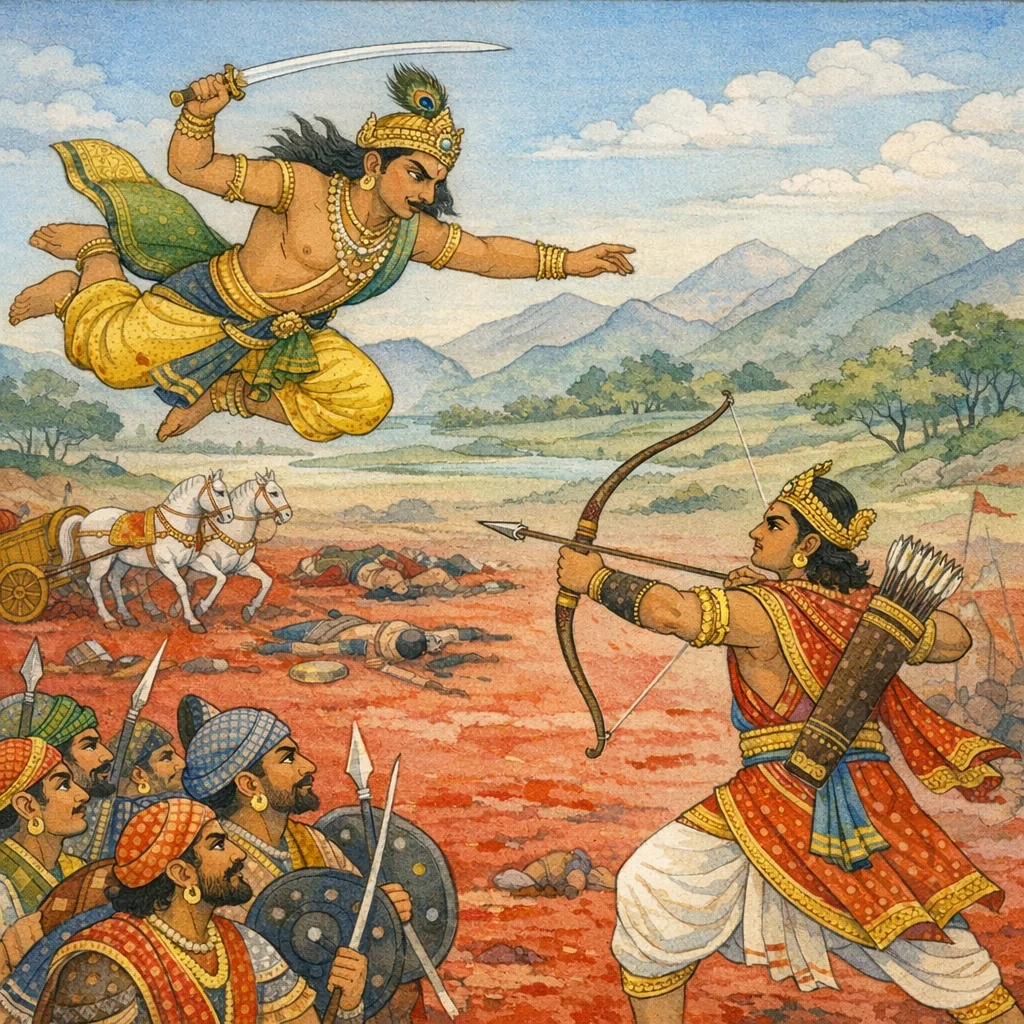
Saṃjaya reports to Dhṛtarāṣṭra that Arjuna, intending to lift Bhīma from a dangerous press, crushes the Sūtaputra’s (Karna-associated) host with dense volleys. The sky is described as covered by segmented nets of arrows; Arjuna becomes ‘an end’ to the Kuru forces in this moment. Using bhalla, kṣurapra, and nārāca missiles, he disables bodies, armor, and heads, producing a battlefield likened to a great Vaitaraṇī due to the density of fallen men, horses, elephants, and shattered chariots. A contingent of war-elephants, adorned and driven by enraged officers, advances; many are felled by Arjuna’s arrow-rain. The Gāṇḍīva’s sound is compared to thunder, and the opposing army breaks like a storm-struck ship, scattering in directions like animals fleeing a forest fire. After the Kuru line recoils, Arjuna returns briefly to Bhīma, consults, and conveys that Yudhiṣṭhira is safe and unpierced. With Bhīma’s assent, Arjuna advances again, only to be surrounded by ten formidable Kaurava princes (younger than Duḥśāsana). Kṛṣṇa maneuvers the chariot to disadvantage them; Arjuna swiftly cuts down their standards, bows, and arrows, and then dispatches them with precise head-strikes, continuing onward after wounding additional Kauravas.
Chapter Arc: रक्त-नदी-सा बहता रण—कर्ण और पाण्डवों का लोमहर्षक संग्राम आरम्भ होता है, और उसी उथल-पुथल में धृष्टद्युम्न पर अश्वत्थामा का प्रचण्ड आक्रमण टूट पड़ता है। → संशप्तकों के बचे हुए शूरवीर उन्मत्त होकर युद्ध को और घना करते हैं; धृष्टद्युम्न का धनुष कटता है, वह नया धनुष उठाकर विष-समान बाणों की वर्षा करता है, पर अश्वत्थामा उसे दबोचने को निकट आता जाता है—मानो शस्त्र से अवध्य होने का अभिमान लेकर। → जब बाणों से वध न कर पाने पर अश्वत्थामा धनुष त्यागकर रथ से कूद पड़ता है और गरुड़ की तरह झपटकर धृष्टद्युम्न को पकड़ने दौड़ता है—तभी युद्ध का रूप शस्त्र-युद्ध से देह-बल और क्रोध के उन्माद तक पहुँच जाता है। → पाञ्चाल-वीरों के जयघोष के बीच धृष्टद्युम्न संकट से मुक्त दिखता है और द्रोणपुत्र पीड़ित/पीछे हटता है; उधर अर्जुन अपने पराक्रम के बाद कृष्ण से संशप्तकों की ओर रथ मोड़ने को कहता है—रणनीति बदलकर मोर्चा संभाला जाता है। → कर्ण-पाण्डव संग्राम की यम-राज्य-वर्धक धारा चल ही रही है; अर्जुन का संशप्तकों पर धावा अगले क्षणों में युद्ध की दिशा पलटने को तत्पर है।
Shlokas
Verse 1
ऑपनआक्रात बछ। अड्-क्ाज एकोनषष्टितमो< ध्याय: धृष्टदुम्न और 55 , अश्वत्थामाका धृष्टद्युम्नपर आक्रमण तथा द्वारा धृष्टद्युम्नकी रक्षा और अश्वत्थामाकी पराजय संजय उवाच ततः पुनः: समाजग्मुरभीता: कुरुसृञ्जया: । युधिष्ठटिरमुखा: पार्था: सूतपुत्रमुखा वयम्,संजय कहते हैं--राजन्! तदनन्तर पुनः: कौरव और सूंजय योद्धा निर्भय होकर एक- दूसरेसे भिड़ गये। एक ओर युधिष्ठिर आदि पाण्डवदलके लोग थे और दूसरी ओर कर्ण आदि हमलोग
Sanjaya said: Then again, O King, the Kurus and the Sṛñjayas—undaunted—closed in upon one another. On one side stood the sons of Pāṇḍu led by Yudhiṣṭhira; on the other side were we, led by the charioteer’s son, Karṇa. Thus the battle renewed itself with resolute hearts, each host rallying around its foremost champion.
Verse 2
ततः प्रववृते भीम: संग्रामो लोमहर्षण: । कर्णस्य पाण्डवानां च यमराष्ट्रविवर्धन:,उस समय कर्ण और पाण्डवोंका बड़ा भयंकर और रोमांचकारी संग्राम आरम्भ हुआ, जो यमराजके राज्यकी वृद्धि करनेवाला था
Then there commenced a hair-raising battle—terrible in its force—between Karṇa and the Pāṇḍavas, a conflict that would only swell the dominion of Yama by sending many warriors to death.
Verse 3
तस्मिन् प्रवृत्ते संग्रामे तुमुले शोणितोदके । संशप्तकेषु शूरेषु किंचिच्छिष्टेषु भारत,भारत! जहाँ खून पानीके समान बहाया जाता था, उस भयंकर संग्रामके छिड़ जानेपर तथा थोड़े-से ही संशप्तक वीरोंके शेष रह जानेपर समस्त राजाओं-सहित धृष्टद्युम्नने कर्णपर ही आक्रमण किया। महाराज! अन्य पाण्डव महारथियोंने भी उन्हींका साथ दिया
Sañjaya said: When that dreadful battle had begun—roaring tumultuously, with blood flowing like water—and when only a few of the vowed Saṁśaptaka heroes remained, O Bhārata, Dhṛṣṭadyumna, together with all the kings, launched an assault upon Karṇa; and the other Pāṇḍava great chariot-warriors also supported him. The verse underscores the grim momentum of war: as sworn fighters are nearly spent, leadership and collective resolve concentrate against a pivotal champion, intensifying both the strategic and moral pressure of the conflict.
Verse 4
धृष्टद्युम्नो महाराज सहित: सर्वराजभि: । कर्णमेवाभिदुद्राव पाण्डवा श्व॒ महारथा:,भारत! जहाँ खून पानीके समान बहाया जाता था, उस भयंकर संग्रामके छिड़ जानेपर तथा थोड़े-से ही संशप्तक वीरोंके शेष रह जानेपर समस्त राजाओं-सहित धृष्टद्युम्नने कर्णपर ही आक्रमण किया। महाराज! अन्य पाण्डव महारथियोंने भी उन्हींका साथ दिया
Sañjaya said: O King, Dhṛṣṭadyumna, accompanied by all the allied rulers, rushed straight at Karṇa. And the Pāṇḍava great chariot-warriors too advanced in support—at that dreadful moment when the battle had fully flared up, blood was being poured out like water, and only a small remnant of the Saṁśaptaka fighters remained. The verse underscores the grim momentum of war: once slaughter becomes commonplace, leaders concentrate their force upon a pivotal champion, seeking a decisive turn while bearing the moral weight of escalating violence.
Verse 5
आगच्छमानांस्तान् संख्ये प्रहशन् विजयैषिण: । दधारैको रणे कर्णो जलौघानिव पर्वत:,युद्धस्थलमें विजयकी अभिलाषा लेकर हर्ष और उललासके साथ आते हुए उन वीरोंको रणभूमिमें अकेले कर्णने उसी प्रकार रोक दिया, जैसे जलके प्रवाहोंको पर्वत रोक देता है
Sañjaya said: Smiling as those warriors advanced into the battle, eager for victory, Karṇa alone held them back on the field—just as a mountain checks the rushing torrents of water. The verse underscores Karṇa’s formidable martial resolve and the relentless momentum of war, where individual prowess can momentarily restrain the surge of many.
Verse 6
समासाद्य तु ते कर्ण व्यशीर्यन्त महारथा: । यथाचलं समासाद्य वार्योघा: सर्वतोदिशम्,कर्णके पास पहुँचकर वे सब महारथी बिखर गये, ठीक वैसे ही जैसे जलके प्रवाह किसी पर्वतके पास पहुँचकर सम्पूर्ण दिशाओंमें फैल जाते हैं
Sañjaya said: “O Karṇa, when those great chariot-warriors closed in upon you, they were scattered and broken apart—just as torrents of water, on reaching an immovable mountain, spread out in every direction.”
Verse 7
तयोरासीन्महाराज संग्रामो लोमहर्षण: । धृष्टय्युम्नस्तु राधेयं शरेणानतपर्वणा
Sañjaya said: O King, between those two there arose a battle that made the hair stand on end. Then Dhṛṣṭadyumna struck Rādheya (Karna) with an arrow whose joints were unbroken, intensifying the dreadful clash of champions.
Verse 8
विजयं च धनु: श्रेष्ठ विधुन्वानो महारथ:,तब महारथी कर्णने अपने विजय नामक श्रेष्ठ धनुषको कम्पित करके धृष्टद्युम्नके धनुष और विषधर सर्पके समान विषैले बाणोंको भी काट डाला। फिर क्रोधमें भरकर नौ बाणोंसे धृष्टद्यम्मको भी घायल कर दिया
Sañjaya said: Shaking his famed bow Vijaya, the great chariot-warrior Karṇa cut down both Dhṛṣṭadyumna’s bow and even his venomous, serpent-like arrows. Then, surging with wrath, Karṇa struck Dhṛṣṭadyumna with nine shafts, wounding him. The scene underscores how, in the fury of battle, martial excellence and anger together drive the rapid escalation of violence, where skill becomes an instrument of relentless harm rather than restraint.
Verse 9
पार्षतस्य धनुश्कछित्त्वा शरांश्षाशीविषोपमान् । ताडयामास संक्रुद्ध: पार्षत॑ नवभि: शरै:,तब महारथी कर्णने अपने विजय नामक श्रेष्ठ धनुषको कम्पित करके धृष्टद्युम्नके धनुष और विषधर सर्पके समान विषैले बाणोंको भी काट डाला। फिर क्रोधमें भरकर नौ बाणोंसे धृष्टद्यम्मको भी घायल कर दिया
Sañjaya said: Having cut down the Pārṣata’s bow, and also his arrows—venomous like deadly serpents—Karna, inflamed with wrath, struck Dṛṣṭadyumna himself with nine shafts. The verse underscores the brutal precision of battlefield skill, where anger and prowess combine to disable an opponent’s means of defense and then wound the warrior directly.
Verse 10
ते वर्म हेमविकृतं भित्त्वा तस्य महात्मन: । शोणिताक्ता व्यराजन्त शक्रगोपा इवानघ,निष्पाप नरेश! वे बाण महामना धृष्टद्युम्नके सुवर्णनिर्मित कवचको छेदकर उनके रक्तसे रंजित हो इन्द्रगोप (वीरबहूटी) नामक कीड़ोंके समान सुशोभित होने लगे
Sañjaya said: Having pierced the golden, finely wrought armour of that great-souled warrior, those arrows—smeared with blood—shone forth like indragopa insects. O blameless king, the scene underscores the grim splendour of battle: even noble heroes, protected by splendid gear, are made vulnerable by fate and martial skill, and the battlefield’s beauty is inseparable from its violence.
Verse 11
तदपास्य धनुश्किन्नं धृष्टद्युन्मो महारथ: । अथान्यद् धनुरादाय शरांश्षाशीविषोपमान्
Sañjaya said: Casting aside the bow that had been cut, the great chariot-warrior Dhṛṣṭadyumna then took up another bow and seized arrows like venomous serpents—resolute to continue the fight without yielding, even when his weapon was broken.
Verse 12
तथैव राजन् कर्णो5पि पार्षतं शत्रुतापनम्,राजन! इसी प्रकार कर्णने भी समरांगणमें विषधर सर्पोके समान विषैले बाणोंद्वारा शत्रुओंको संताप देनेवाले धृष्टद्यम्मको आच्छादित कर दिया। फिर द्रोणशत्रु महाधनुर्धर धष्टद्युम्नने भी कर्णको पैने बाणोंसे घायल कर दिया
Sanjaya said: “Even so, O King, Karna covered Dhrishtadyumna—the son of Prishata, a tormentor of foes—on the battlefield with venomous arrows, like a poison-bearing serpent. Then Dhrishtadyumna, the slayer of Drona and a mighty archer, in turn struck Karna and wounded him with sharp shafts.”
Verse 13
छादयामास समरे शरैराशीविषोपमै: । द्रोणशत्रुर्महेष्वासो विव्याध निशितै: शरै:,राजन! इसी प्रकार कर्णने भी समरांगणमें विषधर सर्पोके समान विषैले बाणोंद्वारा शत्रुओंको संताप देनेवाले धृष्टद्यम्मको आच्छादित कर दिया। फिर द्रोणशत्रु महाधनुर्धर धष्टद्युम्नने भी कर्णको पैने बाणोंसे घायल कर दिया
Sañjaya said: In the thick of battle, the great archer—Drona’s slayer, Dhṛṣṭadyumna—was covered over with arrows like venomous serpents. Yet that same mighty bowman pierced (his foe) with sharp shafts in return, showing how, in the war’s relentless reciprocity, valor and injury answer one another without pause.
Verse 14
तस्य कर्णो महाराज शरं कनकभूषणम् | प्रेषयामास संक्रुद्धों मृत्युदण्डमिवापरम्,महाराज! तब कर्णने अत्यन्त कुपित हो धृष्टद्युम्नपर द्वितीय मृत्युदण्डके समान एक सुवर्ण- भूषित बाण चलाया
Sañjaya said: O King, then Karṇa, inflamed with anger, launched at him a golden-ornamented arrow—like a second rod of Death itself. The verse heightens the moral gravity of the battlefield: wrath turns martial skill into an instrument that resembles Yama’s punishment, underscoring how anger intensifies violence and its consequences in war.
Verse 15
तमापतन्तं सहसा घोररूप॑ विशाम्पते । चिच्छेद शतधा राजज्शैनेय: कृतहस्तवत्,प्रजानाथ! नरेश! सहसा आते हुए उस भयंकर बाणके सात्यकिने सिद्धहस्त योद्धाकी भाँति सौ टुकड़े कर डाले
Sañjaya said: O lord of the people, O king—when that dreadful missile came rushing in all at once, Śaineya (Sātyaki), like a consummate master of arms, cut it into a hundred pieces. The scene underscores the ruthless speed of war and the disciplined skill by which a warrior restrains imminent destruction.
Verse 16
दृष्टवा विनिहतं बाणं शरै: कर्णो विशाम्पते । सात्यकिं शरवर्षेण समन्तात् पर्यवारयत्,प्रजापालक नरेश! सात्यकिके बाणोंसे अपने बाणको नष्ट हुआ देख कर्णने चारों ओरसे बाण बरसाकर सात्यकिको ढक दिया
Sañjaya said: Seeing his missile shattered by Sātyaki’s arrows, Karṇa, O lord of the people, countered by pouring a rain of shafts from every side, hemming Sātyaki in on all directions. The scene underscores the relentless logic of battle: skill answers skill, and pride wounded becomes fiercer resolve—yet all within the grim, duty-bound machinery of war.
Verse 17
विव्याध चैनं समरे नाराचैस्तत्र सप्तभि: । त॑ प्रत्यविध्यच्छैनेय: शरैहेमपरिष्कृतै:,साथ ही समरांगणमें सात नाराचोंद्वारा उन्हें घायल कर दिया। तब सात्यकिने भी सुवर्णभूषित बाणोंसे कर्णको घायल करके बदला चुकाया
Sañjaya said: In that battle, he pierced him there with seven nārāca arrows. In return, the son of Śini struck back, wounding Karṇa with arrows adorned with gold—thus repaying blow for blow in the fierce ethics of kṣatriya warfare, where valor is answered immediately by counter-valor.
Verse 18
ततो युद्ध महाराज चक्षु:श्रोत्रभयानकम् | आसीदू घोर च चित्र च प्रेक्षणीयं समन््तत:,महाराज! तब नेत्रोंसे देखने और कानोंसे सुननेपर भी भय उत्पन्न करनेवाला घोर एवं विचित्र युद्ध छिड़ गया, जो सब ओरसे देखने ही योग्य था
Sañjaya said: Then, O great king, the battle broke out—terrifying to behold with the eyes and dreadful to hear with the ears. It was fierce and strange in its many forms, and yet, on every side, it compelled attention as a spectacle of war.
Verse 19
सर्वेषां तत्र भूतानां लोमहर्षो5भ्यजायत । तद् दृष्टवा समरे कर्म कर्णशैनेययोर्नूप,नरेश्वर! समरभूमिमें कर्ण और सात्यकिका वह कर्म देखकर समस्त प्राणियोंके रोंगटे खड़े हो गये
Sañjaya said: Seeing the deed performed in that battle by Karṇa and Śaineya (Sātyaki), all beings present were seized with horripilation. O king, O lord of men, the spectacle of their combat on the battlefield stirred awe and dread, revealing the fearful power and moral gravity of warrior action when driven to its utmost in war.
Verse 20
एतस्मिन्नन्तरे द्रौणिरभ्ययात् सुमहाबलम् | पार्षतं शत्रुदमनं शत्रुवीर्यासुनाशनम्,इसी समय शत्रुओंके बल और प्राणोंका नाश करनेवाले शत्रुसूदन महाबली धृष्टद्युम्नके पास द्रोणकुमार अश्वत्थामा आ पहुँचा
Sañjaya said: Just then, Droṇa’s son Aśvatthāmā advanced toward the mighty Dhṛṣṭadyumna, the son of Pṛṣata—one famed for subduing enemies and for destroying the strength and very lives of hostile warriors. The moment signals an intensification of the battle’s moral tension, where personal enmity and martial duty converge into a deadly encounter.
Verse 21
अभ्यभाषत संक्रुद्धो द्रौणि: परपुरंजय: । तिष्ठ तिष्ठाद्य ब्रह्मघ्न न मे जीवन् विमोक्ष्यसे,शत्रुओंकी राजधानीपर विजय पानेवाला द्रोणपुत्र अश्वत्थामा वहाँ पहुँचते ही अत्यन्त कुपित होकर बोला--'ब्रह्महत्या करनेवाले पापी! खड़ा रह, खड़ा रह, आज तू मेरे हाथसे जीवित नहीं छूट सकेगा”
Sañjaya said: Enraged, Droṇa’s son Aśvatthāmā—conqueror of enemy strongholds—addressed him at once: “Stand! Stand there today, you slayer of a brāhmaṇa! You shall not escape me alive.” The outcry frames the combat not merely as martial pursuit but as moral indictment, invoking the grave sin of brahma-hatyā to justify relentless retribution in the war’s escalating brutality.
Verse 22
इत्युक्त्वा सुभृशं वीरं शीघ्रकृन्निशितै: शरै: । पार्षत॑ छादयामास घोररूपै: सुतेजनै:
Sañjaya said: Having spoken thus, he swiftly showered that mighty warrior with sharp arrows, covering the son of Pṛṣata with dreadful, blazing shafts—an image of relentless martial resolve where speech immediately turns into action on the battlefield.
Verse 23
यथा हि समरे द्रोण: पार्षतं वीक्ष्य मारिष,आर्य! जैसे द्रोणाचार्य समरभूमिमें धृष्टद्युम्मको देखकर मन-ही-मन खिन्न हो उसे अपनी मृत्यु मानते थे, उसी प्रकार शत्रुवीरोंका संहार करनेवाले धृष्टद्युम्न भी रफक्षेत्रमें अश्वत्थामाको देखकर अप्रसन्न हो उसे अपनी मृत्यु समझते थे
Verse 24
तथा द्रौणिं रणे दृष्टवा पार्षत: परवीरहा । नातिदह्ृष्टमना भूत्वा मन्यते मृत्युमात्मन:,आर्य! जैसे द्रोणाचार्य समरभूमिमें धृष्टद्युम्मको देखकर मन-ही-मन खिन्न हो उसे अपनी मृत्यु मानते थे, उसी प्रकार शत्रुवीरोंका संहार करनेवाले धृष्टद्युम्न भी रफक्षेत्रमें अश्वत्थामाको देखकर अप्रसन्न हो उसे अपनी मृत्यु समझते थे
Sañjaya said: Just as Dṛṣṭadyumna, the son of Pṛṣata and slayer of enemy-heroes, upon seeing Aśvatthāmā (Drauṇi) on the battlefield, felt no great joy and inwardly regarded him as his own death—so too, when Aśvatthāmā saw Dṛṣṭadyumna in the fight, he likewise took him to be the very cause of his death. The verse underscores the grim reciprocity of war: each warrior recognizes in the other not merely an opponent, but a fated end shaped by past enmity and the moral weight of violence.
Verse 25
स ज्ञात्वा समरे55त्मानं शस्त्रेणावध्यमेव तु । जवेनाभ्याययौ द्रौणिं काल: कालमिव क्षये,वे अपने-आपको समरभूमिमें शस्त्रद्वारा अवध्य मानकर बड़े वेगसे अश्वत्थामाके सामने आये, मानो प्रलयके समय काल ही कालपर टूट पड़ा हो
Sañjaya said: Knowing himself to be invulnerable to weapons on the battlefield, he rushed at Drauṇi (Aśvatthāmā) with great speed—like Time itself, at the hour of dissolution, crashing upon Time.
Verse 26
द्रौणिस्तु दृष्टवा राजेन्द्र धृष्टद्युम्नमवस्थितम् । क्रोधेन नि:श्वसन् वीर: पार्षत॑ समुपाद्रवत्,राजेन्द्र! वीर अश्वत्थामाने द्रुपदकुमार धृष्टद्युम्मनको सामने खड़ा देख क्रोधसे लंबी साँस खींचते हुए उनपर आक्रमण किया
Sanjaya said: O king, when Drona’s son (Aśvatthāmā) saw Dhṛṣṭadyumna, the son of Drupada, standing ready before him, the warrior—breathing hard in anger—rushed straight at that Pārṣata. The verse highlights how wrath, once kindled on the battlefield, drives a fighter from measured judgment into immediate violent action, tightening the cycle of retaliation that war sustains.
Verse 27
तावन्योन्यं तु दृष्टवैव संरम्भं जग्मतु: परम् । अथाब्रवीन्महाराज द्रोणपुत्र: प्रतापवान्
Sañjaya said: Seeing one another, the two at once rose to the height of fierce wrath. Then, O great king, the valiant son of Droṇa spoke—his words poised to drive the encounter toward its decisive turn amid the moral darkness of war.
Verse 28
धृष्टद्युम्न॑ समीपस्थं त्वरमाणो विशाम्पते । महाराज! वे दोनों एक-दूसरेको देखते ही अत्यन्त क्रोधमें भर गये। प्रजानाथ! फिर प्रतापी द्रोणपुत्रने बड़ी उतावलीके साथ अपने पास ही खड़े हुए धृष्टद्युम्नसे कहा-- ।। २७ ई || पाञ्चालापसदाद्य त्वां प्रेषयिष्यामि मृत्यवे,'पांचालकुलकलंक! आज मैं तुझे मौतके मुँहमें भेज दूँगा। तुमने पूर्वकालमें ट्रोणाचार्यका वध करके जो पापकर्म किया है, वह एक अमंगलकारी कर्मकी भाँति आज तुझे संताप देगा
Sanjaya said: O lord of the people, Dhrishtadyumna stood close by, and the other warrior rushed toward him. O great king, the moment the two saw each other, they were seized by fierce wrath. Then the mighty son of Drona, in great haste, addressed Dhrishtadyumna who was standing near him: “O disgrace of the Panchalas! Today I shall send you to Death. The sinful deed you committed long ago—slaying Drona—will now burn you like an ill-omened act returning upon its doer.”
Verse 29
पापं हि यत् त्वया कर्म घ्नता द्रोणं पुरा कृतम् । अद्य त्वां तप्स्यते तद् वै यथा न कुशलं तथा,'पांचालकुलकलंक! आज मैं तुझे मौतके मुँहमें भेज दूँगा। तुमने पूर्वकालमें ट्रोणाचार्यका वध करके जो पापकर्म किया है, वह एक अमंगलकारी कर्मकी भाँति आज तुझे संताप देगा
Sañjaya said: “The sinful deed that you once committed—slaying Droṇa—will indeed burn you today. It will torment you like an inauspicious act, bringing you no welfare.”
Verse 30
अरक्ष्यमाण: पार्थेन यदि तिष्ठसि संयुगे । नापक्रामसि वा मूढ सत्यमेतद् ब्रवीमि ते,'ओ मूर्ख! यदि तू अर्जुनसे अरक्षित रहकर युद्धभूमिमें खड़ा रहेगा, भाग नहीं जायगा तो अवश्य तुझे मार डालूँगा, यह मैं तुझसे सत्य कहता हूँ”
Sañjaya said: “O fool! If, in the thick of battle, you remain standing without being protected by Pārtha (Arjuna), and do not withdraw, then I will surely strike you down. This I tell you in truth.”
Verse 31
एवमुक्त: प्रत्युवाच धृष्टद्युम्न: प्रतापवान् | प्रतिवाक्यं स एवासिमामको दास्यते तव
Sañjaya said: Thus addressed, the valiant Dhṛṣṭadyumna replied in return: “You are the very one who will give me the fitting answer—my sword shall be delivered to you.” The exchange frames the combat as a matter of honor and consequence, where words are immediately tested by deeds on the battlefield.
Verse 33
एवमुक््त्वा महाराज सेनापतिरमर्षण:
Sañjaya said: Having spoken thus, O King, the commander of the army—burning with indignation—(proceeded onward).
Verse 34
ततो द्रौणि: सुसंक्रुद्ध: शरै: संनतपर्वभि:
Sañjaya said: Then Droṇi’s son, inflamed with fierce anger, attacked with arrows whose joints were well-bent and firmly set—missiles launched with disciplined skill amid the moral chaos of war, where wrath drives action and mastery of arms becomes a decisive, if ethically fraught, instrument.
Verse 35
नैवान्तरिक्षं न दिशो नापि योधा: समन्तत:
Sanjaya said: Neither the sky above, nor the directions all around, nor even the warriors on every side could be clearly made out—everything seemed swallowed by the tumult and confusion of battle.
Verse 36
दृश्यन्ते वै महाराज शरैश्छन्ना: सहस्रश: । महाराज! उस समय सब ओरसे बाणोंद्वारा आच्छादित होनेके कारण न तो आकाश दिखायी देता था, न दिशाएँ दीखती थीं और न सहसौरों योद्धा ही दृष्टिगोचर होते थे ।। ३५३६ || तथैव पार्षतो राजन द्रौणिमाहवशोभिनम्
Sañjaya said: O great king, thousands were seen completely covered by arrows. In that moment, because everything was veiled by flights of shafts from every side, neither the sky nor the directions could be made out, and even the mass of warriors was no longer clearly visible—so dense and blinding had the battle become.
Verse 37
राधेयो5पि महाराज पञज्चालान् सह पाण्डवै:,महाराज! सब ओरसे दर्शनीय राधापुत्र कर्णने भी पाण्डवोंसहित पांचालों, द्रौपदीके पाँचों पुत्रों, युधामन््यु और महारथी सात्यकिको अकेले ही आगे बढ़नेसे रोक दिया था
Sanjaya said: O King, Radheya (Karna) too—splendid to behold on every side—single-handedly checked the advance of the Panchalas allied with the Pandavas, along with Draupadi’s five sons, Yudhamanyu, and the great charioteer Satyaki. In this moment the narrative highlights the stark ethics of war: individual prowess can halt a collective surge, yet such power is exercised within the relentless, duty-bound machinery of the battlefield.
Verse 38
द्रौपदेयान् युधामन्युं सात्यकिं च महारथम् । एक: संवारयामास प्रेक्षणीय: समनन््ततः,महाराज! सब ओरसे दर्शनीय राधापुत्र कर्णने भी पाण्डवोंसहित पांचालों, द्रौपदीके पाँचों पुत्रों, युधामन््यु और महारथी सात्यकिको अकेले ही आगे बढ़नेसे रोक दिया था
Sanjaya said: O King, Karna—the son of Radha, a sight worthy of all eyes—single-handedly checked the advance of the Panchalas allied with the Pandavas, including Draupadi’s five sons, Yudhamanyu, and the great chariot-warrior Satyaki. In that moment, his solitary stand displayed the fierce resolve and martial discipline that drive the war’s relentless escalation, even as it deepens the moral cost borne by all sides.
Verse 39
धृष्टझ्ुम्नस्तु समरे द्रौणेश्चिच्छेद कार्मुकम् । तदपास्य भनुद्रौणिरन्यदादाय कार्मुकम्,हयान् सूतं रथं चैव निमेषाद् व्यधमच्छरै: । धष्टद्युम्नने समरांगणमें अश्वत्थामाके धनुषको काट डाला। राजेन्द्र! तब वेगवान् अश्वत्थामाने उस कटे हुए धनुषको फेंककर दूसरा धनुष और विषधर सर्पोके समान भयंकर बाण हाथमें लेकर उनके द्वारा पलक मारते-मारते धृष्टद्युम्नके धनुष, शक्ति, गदा, ध्वज, अश्व, सारथि एवं रथको तहस-नहस कर दिया
Sañjaya said: In the thick of battle, Dhṛṣṭadyumna cut down Aśvatthāman’s bow. Casting aside the severed weapon, the radiant son of Droṇa instantly seized another bow and, with a swift shower of arrows, struck down Dhṛṣṭadyumna’s horses, charioteer, and chariot. The episode underscores the brutal momentum of war: skill and resolve can reverse a momentary setback, yet the very speed of retaliation reveals how violence escalates and how quickly the supports of a warrior—vehicle, team, and standard—are destroyed.
Verse 40
वेगवान् समरे घोरे शरांश्वाशीविषोपमान् । स पार्षतस्य राजेन्द्र धनुः शक्ति गदां ध्वजम्
Sañjaya said: In that dreadful battle, he swiftly discharged arrows like venomous serpents. O king, he struck down the son of Pṛṣata’s bow, spear, mace, and banner—an image of how war’s fury aims not only at the warrior’s body but at the very instruments of his agency and honor.
Verse 41
सच्छिन्नधन्वा विरथो हताश्वचो हतसारथि:
Sañjaya said: With his bow cut to pieces, deprived of his chariot, his horses slain, and his charioteer killed, the warrior stood utterly disabled in the chariot-war—an image of how, in battle, prowess and pride can be reduced to helplessness in a moment.
Verse 42
द्रौणिस्तदपि राजेन्द्र भल्लै: क्षिप्रं महारथ:,राजेन्द्र! शीघ्रतापूर्वक हाथ चलानेवाले सुदृढ़ आयुधधारी वीर महारथी अअभ्वत्थामाने समरांगणमें अनेक भल्लोंद्वारा रथसे उतरनेके पहले ही धृष्टद्युम्मकी उस ढाल-तलवारको भी काट दिया। यह एक अद्भुत-सी बात हुई
Sanjaya said: O king, even so, the great chariot-warrior Ashvatthama—swift in action and firm in his weapons—on the battlefield, with many sharp arrows, cut down Dhrishtadyumna’s shield and sword even before he could descend from his chariot. It was a deed that seemed truly astonishing.
Verse 43
चिच्छेद समरे वीर: क्षिप्रहस्तो दृढायुध: । रथादनवरूढस्य तदद्भुतमिवाभवत्,राजेन्द्र! शीघ्रतापूर्वक हाथ चलानेवाले सुदृढ़ आयुधधारी वीर महारथी अअभ्वत्थामाने समरांगणमें अनेक भल्लोंद्वारा रथसे उतरनेके पहले ही धृष्टद्युम्मकी उस ढाल-तलवारको भी काट दिया। यह एक अद्भुत-सी बात हुई
Sañjaya said: In the thick of battle, that heroic warrior—swift of hand and firm in his weapons—cut it down. Before his opponent could even descend from the chariot, he severed his shield and sword; and, O best of kings, it seemed like something wondrous. The passage underscores the terrifying efficiency of martial skill in war, where prowess can eclipse ordinary expectations and intensify the moral weight of violence on the battlefield.
Verse 44
धृष्टय्युम्नं हि विरथं हताश्चं छिन्नकार्मुकम् । शरैश्व बहुधा विद्धमस्त्रैश्न शकलीकृतम्
Sañjaya said: “Indeed, Dhṛṣṭadyumna was left without his chariot, his horses slain, his bow cut down; pierced in many places by arrows and shattered by weapon-strikes.” The verse underscores the brutal momentum of battle, where prowess is tested not only by skill but by endurance amid sudden reversals of fortune.
Verse 45
तस्यान्तमिषुभी राजन् यदा द्रौणिर्न जग्मिवान्
Sañjaya said: O King, when Droṇi’s son could not reach his end even with volleys of arrows, the battle’s course revealed the grim resilience of a warrior sustained by wrath and resolve—an image of how, in war, mere force often fails to conclude what fate and conduct have set in motion.
Verse 46
आसीदाप्लवतो वेगस्तस्य राजन् महात्मन:
Sañjaya said: O King, the mighty-souled warrior’s onset was irresistible—his momentum surged like a flood, sweeping forward with overwhelming force amid the moral chaos of war.
Verse 47
एतस्मिन्नेव काले तु माधवो<र्जुनमब्रवीत्,इसी समय श्रीकृष्णने अर्जुनसे कहा--'पार्थ! वह देखो, द्रोणकुमार अभश्वत्थामा धृष्टद्युम्नके वधके लिये कैसा महान् प्रयत्न कर रहा है? वह इन्हें मार सकता है, इसमें संशय नहीं है
Sañjaya said: At that very moment Mādhava (Kṛṣṇa) spoke to Arjuna: “Pārtha, look—Droṇa’s son Aśvatthāmā is making a tremendous effort to kill Dhṛṣṭadyumna. He is capable of slaying him; there is no doubt about it.” The remark underscores the grim clarity of battlefield ethics: Kṛṣṇa urges alertness and responsibility in protecting an ally when a decisive, targeted killing is imminent.
Verse 48
पश्य पार्थ यथा द्रौणि: पार्षतस्य वरध॑ प्रति । यत्नं करोति विपुलं हन्याच्चैनं न संशय:,इसी समय श्रीकृष्णने अर्जुनसे कहा--'पार्थ! वह देखो, द्रोणकुमार अभश्वत्थामा धृष्टद्युम्नके वधके लिये कैसा महान् प्रयत्न कर रहा है? वह इन्हें मार सकता है, इसमें संशय नहीं है
Sañjaya said: “Look, O Pārtha—see how Droṇa’s son, Aśvatthāman, is exerting immense effort against the son of Pārṣata (Dhṛṣṭadyumna). He can indeed slay him; of this there is no doubt.” The verse highlights the grim certainty that, amid the chaos of war, even a capable and righteous commander may become vulnerable when targeted by a determined and powerful foe—raising the ethical tension between martial prowess, fate, and the cost of vengeance-driven combat.
Verse 49
त॑ मोचय महाबाहो पार्षतं शत्रुकर्शन । द्रौणेरास्यमनुप्राप्तं मृत्योरास्यगतं यथा,“महाबाहो! शत्रुसूदन! जैसे कोई मौतके मुखमें पड़ गया हो, उसी प्रकार अश्वत्थामाके मुखमें पहुँचे हुए धृष्टद्युम्मको छुड़ाओ'
Sañjaya said: “O mighty-armed one, O crusher of foes, rescue that son of Pṛṣata (Dhṛṣṭadyumna), who has fallen into the very mouth of Droṇa’s son (Aśvatthāmā)—as though he had entered the jaws of Death itself.” The appeal underscores the grim moral pressure of battlefield duty: to save an ally from imminent slaughter even when the opponent is a formidable, wrath-driven warrior.
Verse 50
एवमुकक््त्वा महाराज वासुदेव: प्रतापवान् | प्रैषयत् तुरगांस्तत्र यत्र द्रौणिव्यवस्थित:,महाराज! ऐसा कहकर प्रतापी वसुदेवनन्दन श्रीकृष्णने अपने घोड़ोंको उसी ओर हाँका जहाँ द्रोणकुमार अश्वत्थामा खड़ा था
Sañjaya said: “Having spoken thus, O King, the mighty Vāsudeva (Kṛṣṇa), radiant with prowess, urged the horses forward in that very direction—toward the place where Droṇa’s son (Aśvatthāmā) stood ready.” The verse underscores deliberate, duty-bound action in the midst of war: after counsel is given, the charioteer-leader decisively moves to confront a dangerous opponent, prioritizing protection of allies and the demands of righteous strategy.
Verse 51
ते हयाश्रन्द्रसंकाशा: केशवेन प्रचोदिता: । आपिबन्त इव व्योम जम्मुद्रौणिरथं प्रति,भगवान् श्रीकृष्णके द्वारा हाँके गये वे चन्द्रमाके समान श्वेत रंगवाले घोड़े अश्वत्थामाके रथकी ओर इस प्रकार दौड़े, मानो आकाशको पीते जा रहे हों
Sañjaya said: Urged on by Keśava (Śrī Kṛṣṇa), those horses—white and radiant like the moon—rushed toward Aśvatthāmā’s chariot, as though they were drinking up the very sky. The image underscores Kṛṣṇa’s steady, purposeful charioteering amid the fury of war, where speed and resolve become instruments of a larger, disciplined strategy.
Verse 52
दृष्टवा55यातौ महावीर्यावुभौ कृष्णधनंजयौ । धृष्टद्युम्नवधे यत्नं चक्रे राजन् महाबल:,राजन! महापराक्रमी श्रीकृष्ण और अर्जुन दोनोंको आते देख महाबली अअभश्वत्थामा धष्टद्युम्नके वधके लिये विशेष प्रयत्न करने लगा
Sañjaya said: Seeing the two mighty heroes—Kṛṣṇa and Dhanañjaya (Arjuna)—approaching, the greatly powerful Aśvatthāmā, O King, intensified his efforts to slay Dhṛṣṭadyumna. The verse underscores the hardening of resolve in war: the arrival of revered champions provokes a decisive, ethically fraught escalation toward targeted killing rather than restraint.
Verse 53
विकृष्यमाणं दृष्टवैव धृष्टट्युम्न॑ नरेश्वर । शरांभ्षिक्षेप वै पार्थो द्रौणिं प्रति महाबल:,नरेश्वर! धृष्टद्युम्मनको खींचे जाते देख महाबली अर्जुनने अश्वत्थामापर बहुत-से बाण चलाये
Sañjaya said: O king, seeing Dhṛṣṭadyumna being dragged away, the mighty Pārtha (Arjuna) hurled a dense shower of arrows toward Drauṇi (Aśvatthāmā). In the chaos of war, Arjuna’s response reflects the kṣatriya duty to protect an ally and resist an act that violates the warrior’s code—seizing and dragging a combatant rather than meeting him in fair combat.
Verse 54
ते शरा हेमविकृता गाण्डीवप्रेषिता भृशम् | द्रौणिमासाद्य विविशुर्वल्मीकमिव पन्नगा:,गाण्डीव धनुषसे वेगपूर्वक छूटे हुए वे सुवर्ण-निर्मित बाण अश्वत्थामाके पास पहुँचकर उसके शरीरमें उसी प्रकार घुस गये, जैसे सर्प बाँबीमें प्रवेश करते हैं
Sañjaya said: Those arrows, fashioned of gold and shot with great force from the Gāṇḍīva, reached Droṇa’s son (Aśvatthāmā) and entered his body—just as serpents slip into an anthill. The image underscores the relentless, inescapable penetration of martial skill in the heat of war, where prowess and intent translate into immediate bodily consequence.
Verse 55
स विद्धस्तै: शरैघरिद्रोंणपुत्र: प्रतापवान् उत्सृज्य समरे राजन् पाज्चाल्यममितौजसम्,राजन्! उन भयंकर बाणोंसे घायल हुआ प्रतापी वीर द्रोणपुत्र अश्वत्थामा समरांगणमें अमित बलशाली धृष्टद्यम्मको छोड़कर अपने रथपर जा चढ़ा। वह धनंजयके बाणोंसे अत्यन्त पीड़ित हो चुका था; इसलिये उसने भी श्रेष्ठ धनुष हाथमें लेकर बाणोंद्वारा अर्जुनको घायल कर दिया
Sañjaya said: O King, the valiant son of Droṇa—Aśvatthāmā—pierced by those dreadful arrows, withdrew in the midst of battle, leaving the mighty Pāñcāla warrior Dhṛṣṭadyumna. Mounting his own chariot, he—severely tormented by Dhanañjaya’s shafts—took up his excellent bow and, in return, wounded Arjuna with volleys of arrows. The passage underscores the relentless reciprocity of violence in war: injury provokes counter-injury, and prowess is measured by endurance and retaliation rather than restraint.
Verse 56
रथमारुरुहे वीरो धनंजयशरार्दित: । प्रगृह्य च धनु: श्रेष्ठ पार्थ विव्याध सायकै:,राजन्! उन भयंकर बाणोंसे घायल हुआ प्रतापी वीर द्रोणपुत्र अश्वत्थामा समरांगणमें अमित बलशाली धृष्टद्यम्मको छोड़कर अपने रथपर जा चढ़ा। वह धनंजयके बाणोंसे अत्यन्त पीड़ित हो चुका था; इसलिये उसने भी श्रेष्ठ धनुष हाथमें लेकर बाणोंद्वारा अर्जुनको घायल कर दिया
Sañjaya said: Wounded by Dhanañjaya’s arrows, the valiant warrior mounted his chariot again. Taking up his excellent bow, Pārtha (Arjuna) struck him with shafts, O King. In the fierce reciprocity of battle, the injured fighter—driven by the kṣatriya code to re-enter combat rather than yield—answered in kind, turning pain into renewed aggression and continuing the cycle of violence that defines this war’s grim ethic.
Verse 57
एतस्मिन्नन्तरे वीर: सहदेवो जनाधिप । अपोवाह रथेनाजोौ पार्षत॑ शत्रुतापनम्,नरेश्वर! इसी बीचमें वीर सहदेव शत्रुओंको संताप देनेवाले धृष्टद्युम्नको अपने रथके द्वारा रणभूमिमें अन्यत्र हटा ले गये
Sanjaya said: In the midst of that encounter, the valiant Sahadeva, O king, drew away from the battlefield by his chariot the Pārṣata hero—Dhrishtadyumna—who was a scourge to his foes. The act signals tactical prudence amid the fury of war: preserving a key commander and repositioning him rather than letting valor harden into needless loss.
Verse 58
इस प्रकार श्रीमह्याभारत कर्णपर्वमें भगवान् श्रीकृष्णका वाक्यविषयक अद्गदावनवाँ अध्याय पूरा हुआ,अर्जुनो5पि महाराज द्रौणिं विव्याध पत्रिभि: | त॑ द्रोणपुत्र: संक्रुद्धों बाह्वोरुगसि चार्पयत् महाराज! अर्जुनने भी अपने बाणोंसे अश्वत्थामाको घायल कर दिया। तब द्रोणपुत्रने अत्यन्त कुपित हो अर्जुनकी छाती और दोनों भुजाओंमें प्रहार किया
Sanjaya said: O King, Arjuna too struck Drauṇi (Aśvatthāmā) with his arrows. Enraged, Droṇa’s son retaliated, directing his blows against Arjuna’s arms and chest. The passage underscores the escalating cycle of wrath and counter-violence on the battlefield, where personal anger drives immediate reprisal and deepens the moral burden of war.
Verse 59
क्रोधितस्तु रणे पार्थो नाराचं कालसम्मितम् । द्रोणपुत्राय चिक्षेप कालदण्डमिवापरम्,रणमें कुपित हुए कुन्तीकुमारने द्रोणपुत्रपर द्वितीय कालदण्डके समान साक्षात् कालस्वरूप नाराच चलाया इति श्रीमहाभारते कर्णपर्वणि द्रौण्यपयाने एकोनषष्टितमो5ध्याय:
Verse 60
ब्राह्मणस्यांसदेशे स निपपात महाद्युति: । स विह्वलो महाराज शरवेगेन संयुगे
Sañjaya said: Struck in the fury of battle, that radiant warrior fell upon the shoulder-region of a Brahmin. O King, he lay stunned and shaken by the arrow’s violent force amid the combat—an image of how, in war, even the mighty are reduced to helplessness in a moment, and how the innocent can become unintended witnesses or sufferers of martial rage.
Verse 61
निषसाद रथोपस्थे वैक्लव्यं च परं॑ ययौ । महाराज! वह महातेजस्वी नाराच उस ब्राह्मणके कंधेपर जा लगा। अभश्वत्थामा युद्धस्थलमें उस बाणके वेगसे व्याकुल हो रथकी बैठकमें धम्मसे बैठ गया और अत्यन्त मूर्च्छित हो गया ।। ६० ई ।। तत: कर्णो महाराज व्याक्षिपद् विजयं धनु:,राजराजेश्वर! तत्पश्चात् कर्णने समरांगणमें कुपित हो अर्जुनकी ओर बारंबार देखते हुए विजय नामक धनुषकी टंकार की। वह महासमरमें अर्जुनके साथ द्वैरथ युद्धकी अभिलाषा करता था
Sanjaya said: O King, he sank down upon the chariot-seat and fell into extreme helplessness. That blazing narāca arrow struck the brahmin on the shoulder. Aśvatthāmā, shaken by the force of that shaft on the battlefield, collapsed heavily onto the chariot-bench and became deeply unconscious. Then, O King, Karṇa brandished his bow named Vijaya. O lord of kings, thereafter Karṇa, enraged in the arena of battle and repeatedly casting his gaze toward Arjuna, made the Vijaya bow resound with its twang—yearning in that great war for a direct chariot-to-chariot duel with Arjuna.
Verse 62
अर्जुनं समरे क्रुद्धः प्रेक्षमाणो मुहुर्मुहुः | दैरथं चापि पार्थेन कामयानो महारणे,राजराजेश्वर! तत्पश्चात् कर्णने समरांगणमें कुपित हो अर्जुनकी ओर बारंबार देखते हुए विजय नामक धनुषकी टंकार की। वह महासमरमें अर्जुनके साथ द्वैरथ युद्धकी अभिलाषा करता था
Sanjaya said: Enraged in the battle, Karna kept looking again and again toward Arjuna. In that great combat, longing to engage Arjuna (the son of Pṛthā) in a chariot-duel, he caused the twang of his bow to resound—signaling both challenge and the fierce resolve that drives warriors into single combat amid the wider slaughter.
Verse 63
विह्वलं तं तु वीक्ष्याथ द्रोणपुत्रं च सारथि: । अपोवाह रथेनाजौ त्वरमाणो रणाजिरात्,द्रोणकुमारको विह्नलल देखकर उसका सारथि बड़ी उतावलीके साथ उसे रथके द्वारा समरांगणसे दूर हटा ले गया
Sañjaya said: Seeing Droṇa’s son in a state of confusion and distress, his charioteer, in great haste, drew the chariot away from the battlefield, removing him from the thick of the fight. The scene underscores how, amid the harsh demands of war, a companion’s duty can shift from aggression to protection when a warrior is overwhelmed.
Verse 64
अथोकत्क्रुष्ट महाराज पज्चालैर्जितकाशिभि: । मोक्षितं पार्षतं दृष्टवा द्रोणपुत्रं च पीडितम्,महाराज! धृष्टद्युम्नको संकटसे मुक्त और द्रोणपुत्रको पीड़ित देख विजयसे उललसित होनेवाले पांचालोंने बड़े जोरसे गर्जना की
Sañjaya said: “O King, when the victorious Pāñcālas—those who had conquered Kāśī—saw Dhṛṣṭadyumna (the son of Pṛṣata) freed from danger and Droṇa’s son hard-pressed, they roared aloud in exultation.”
Verse 65
वादित्राणि च दिव्यानि प्रावाद्यन्त सहस्रश: । सिंहनादांश्व चक्रुस्ते दृष्टवा संख्ये तदद्भुतम्,उस समय सहसौरों दिव्य वाद्य बजने लगे। वे पांचाल-सैनिक युद्धस्थलमें वह अद्भुत कार्य देखकर सिंहनाद करने लगे
Sañjaya said: Then, by the thousand, celestial instruments were sounded. Seeing that wondrous feat upon the battlefield, they raised lion-like roars—an exultant acclaim that marked how extraordinary the deed appeared amid the harsh ethics of war.
Verse 66
एवं कृत्वाब्रवीत् पार्थों वासुदेवं धनंजय: । याहि संशप्तकान् कृष्ण कार्यमेतत् परं मम,ऐसा पराक्रम करके कुन्तीपुत्र धनंजयने भगवान् श्रीकृष्णसे कहा--“श्रीकृष्ण! अब संशप्तकोंकी ओर चलिये। इस समय यही मेरा सबसे प्रधान कार्य है”
Having thus displayed his prowess, Pārtha (Arjuna), the winner of wealth, addressed Vāsudeva (Kṛṣṇa): “Kṛṣṇa, drive toward the Saṁśaptakas. This is my foremost duty at this moment.” The verse highlights Arjuna’s deliberate prioritizing of immediate martial responsibility within the larger framework of righteous conduct in war—choosing the task that best serves his side’s protection and the demands of the battlefield.
Verse 67
ततः प्रयातो दाशार्ह: श्रुत्वा पाण्डवभाषितम् | रथेनातिपताकेन मनोमारुतरंहसा,श्रीकृष्ण अर्जुनका वह कथन सुनकर मन और वायुके समान वेगशाली तथा अत्यन्त ऊँची पताकावाले रथके द्वारा वहाँसे चल दिये
Sanjaya said: Hearing the words spoken by the Pandava, the descendant of the Daśārhas (Śrī Kṛṣṇa) set out from there, mounting a chariot crowned with a very lofty banner and moving with the speed of mind and wind—swiftly carrying forward the resolve of the righteous cause amid the pressures of war.
Verse 116
कर्ण विव्याध सप्तत्या शरै: संनतपर्वभि: । महारथी धृष्टद्युम्नने उस कटे हुए धनुषको फेंककर दूसरा धनुष और विषधर सर्पके समान विषैले बाण हाथमें लेकर झुकी हुई गाँठवाले सत्तर बाणोंसे कर्णको बींध डाला
Sanjaya said: The great chariot-warrior Dhrishtadyumna, casting aside his bow that had been cut, seized another bow and took in hand venomous arrows like a poison-bearing serpent. With seventy arrows whose joints were bent, he pierced Karna. The scene underscores the relentless escalation of skill and resolve in battle, where composure after loss and swift rearmament become decisive, even as the use of deadly, poison-like weaponry heightens the moral gravity of the conflict.
Verse 226
यतमानं परं शक्त्या यतमानो महारथ: । ऐसा कहकर शीघ्रता करनेवाले प्रयत्नशील महारथी अभ्व॒त्थामाने अत्यन्त तेज, घोर एवं पैने बाणोंद्वारा यथाशक्ति विजयके लिये प्रयत्न करनेवाले वीर धृष्टद्युम्नको ढक दिया
Sañjaya said: Striving with all his might, the great chariot-warrior—himself exerting to the utmost—covered the valiant Dhṛṣṭadyumna, who was also laboring for victory to the best of his power, with exceedingly fierce, sharp arrows. The passage underscores how, in the heat of war, matched resolve meets matched resolve, and victory is pursued through relentless effort rather than restraint.
Verse 316
येनैव ते पितुर्दत्तं यतमानस्य संयुगे । अश्वत्थामाके ऐसा कहनेपर प्रतापी धृष्टद्युम्नने उससे इस प्रकार उत्तर दिया--“अरे! तेरी इस बातका जवाब तुझे मेरी वही तलवार देगी, जिसने युद्धस्थलमें विजयके लिये प्रयत्न करनेवाले तेरे पिताको दिया था
Sañjaya said: “With that very (weapon) by which your father was struck down while striving for victory in battle…” (Thus, in the narrative, Dhṛṣṭadyumna replies to Aśvatthāmā that the same sword which felled his father in the fight will serve as the answer to his challenge—framing the exchange in the harsh ethic of retaliatory warfare and personal enmity.)
Verse 326
यदि तावन्मया द्रोणो निहतो ब्राह्मणब्रुव: ३२ ।। त्वामिदानीं कथं युद्धे न हनिष्यामि विक्रमात् । “यदि मैंने नाममात्रके ब्राह्मण द्रोणाचार्यको पहले मार डाला था, तो इस समय पराक्रम करके तुझे भी मैं कैसे नहीं मार डालूँगा”
Sañjaya said: “If I have already slain Droṇa—one who merely claimed the status of a brāhmaṇa—then how, now in this battle, should I not also strike you down by force of my valor?”
Verse 333
निशितेनातिबाणेन द्रौणिं विव्याध पार्षत: । महाराज! ऐसा कहकर अमर्षशील सेनापति ट्रुपदकुमारने अत्यन्त तीखे बाणसे द्रोणपुत्रको बींध डाला
Sañjaya said: “O King, having spoken thus, the fierce and unyielding commander—the son of Drupada—pierced Droṇa’s son with an exceedingly sharp arrow.” The moment underscores how, in the fury of war, personal resolve and martial duty drive swift, decisive violence, even against renowned warriors.
Verse 343
आच्छादयद् दिशो राजन धृष्टद्युम्नस्य संयुगे । इससे अभश्वत्थामाका क्रोध बहुत बढ़ गया। राजन्! उसने झुकी हुई गाँठवाले बाणोंसे युद्धस्थलमें धृष्टद्युम्नकी सम्पूर्ण दिशाओंको आच्छादित कर दिया
Sanjaya said: O King, in the thick of battle he covered all the directions around Dhrishtadyumna. Seeing this, Ashvatthama’s wrath swelled greatly. O Rajan, on the battlefield he blanketed every quarter with his arrows—those shafts with bent, knotted joints—so that Dhrishtadyumna found himself hemmed in on all sides. The scene underscores how anger, once unleashed in war, seeks not merely victory but overwhelming domination.
Verse 366
शरै: संछादयामास सूतपुत्रस्य पश्यत: । राजन! उसी प्रकार युद्धमें शोभा पानेवाले अश्वत्थामाको धूृष्टद्युम्नने भी कर्णके देखते- देखते बाणोंसे ढक दिया
Sañjaya said: “O King, even as Karṇa looked on, he was covered over with arrows. In the same manner, the glory-seeking Aśvatthāmā, before Karṇa’s very eyes, also blanketed Dhṛṣṭadyumna with a shower of shafts.” The verse underscores how, in the frenzy of battle, prowess is displayed through overwhelming force, while the onlooking warrior’s presence heightens the moral tension of witnessing allies and foes alike being struck down.
Verse 406
हयान् सूतं रथं चैव निमेषाद् व्यधमच्छरै: । धष्टद्युम्नने समरांगणमें अश्वत्थामाके धनुषको काट डाला। राजेन्द्र! तब वेगवान् अश्वत्थामाने उस कटे हुए धनुषको फेंककर दूसरा धनुष और विषधर सर्पोके समान भयंकर बाण हाथमें लेकर उनके द्वारा पलक मारते-मारते धृष्टद्युम्नके धनुष, शक्ति, गदा, ध्वज, अश्व, सारथि एवं रथको तहस-नहस कर दिया
Sañjaya said: In the very blink of an eye, with his arrows he struck down the horses, the charioteer, and the chariot. On the battlefield he cut down Dhṛṣṭadyumna’s bow. Then, O king, the swift Aśvatthāmā cast aside that severed bow, seized another, and taking up dreadful arrows like venomous serpents, in an instant shattered Dhṛṣṭadyumna’s weapons and emblems—his bow, spear, mace, banner—as well as his horses, charioteer, and chariot. The passage underscores the ruthless efficiency of war-skill when unrestrained by compassion, where martial prowess becomes a force that annihilates not only an opponent’s arms but the very supports of his agency.
Verse 416
खड्गमादत्त विपुलं शतचन्द्रं च भानुमत् धनुष कट जाने और घोड़ों तथा सारथिके मारे जानेपर रथहीन हुए धृष्टद्युम्नने विशाल खड्ग और सौ चन्द्राकार चिह्नोंसे युक्त चमकती हुई ढाल हाथमें ले ली
Sañjaya said: When his bow was broken and his horses and charioteer had been slain, Dhṛṣṭadyumna—now without a chariot—took up a massive sword and a radiant shield marked with a hundred moon-like emblems. In the midst of ruin and loss, he chooses steadfast resistance rather than retreat, embodying the warrior’s resolve to continue the fight even when the usual supports of battle are destroyed.
Verse 446
नाशकद् भरतश्रेष्ठ यतमानो महारथ: । भरतश्रेष्ठ! यद्यपि धृष्टद्युम्न रथहीन हो गये थे, उनके घोड़े मारे जा चुके थे, धनुष कट गया था तथा वे बाणोंसे बारंबार घायल और अस्त्र-शस्त्रोंसे जर्जर हो गये थे तो भी महारथी अश्वत्थामा लाख प्रयत्न करनेपर भी उन्हें मार न सका
Sañjaya said: O best of the Bharatas, though the great chariot-warrior Aśvatthāmā strove with all his might, he could not slay Dhṛṣṭadyumna. Even when Dhṛṣṭadyumna had been left without a chariot, his horses were slain, his bow was cut down, and he was repeatedly wounded by arrows—his body worn and battered by weapons—still Aśvatthāmā, despite relentless effort, failed to bring about his death. The passage underscores how, in the chaos of war, valor and effort do not always yield the intended result, and how fate and the momentum of battle can frustrate even a mighty warrior’s purpose.
Verse 453
अथ त्यक्त्वा धर्नुर्वीर: पार्षतं त्वरितोडन्वगात् । राजन! जब वीर द्रोणकुमार बाणोंद्वारा उनका वध न कर सका, तब वह धनुष फेंककर तुरंत ही धृष्टद्युम्नकी ओर दौड़ा
Sañjaya said: Then the warrior, casting aside his bow, swiftly ran after the son of Pṛṣata (Dhṛṣṭadyumna). O King, when the heroic son of Droṇa could not slay him with arrows, he threw down his bow and rushed at Dhṛṣṭadyumna at once—shifting from ranged combat to direct assault in the heat of battle.
Verse 463
गरुडस्थेव पततो जिघृक्षो: पन्नगोत्तमम् । नरेश्वर! रथसे उछलकर दौड़ते हुए महामना अश्वत्थामाका वेग बहुत बड़े सर्पको पकड़नेके लिये झपटे हुए गरुड़के समान प्रतीत हुआ
Sañjaya said: “O king, as he sprang up on his chariot and rushed forward, the high-souled Aśvatthāman appeared like Garuḍa swooping down from the sky, intent on seizing the best of serpents. His onrushing speed and predatory focus conveyed the ruthless momentum of battle, where prowess and intent can eclipse restraint.”
Verse 736
ताडयामास समरे तिष्ठ तिछेति चाब्रवीत् । महाराज! उस समय उन दोनोंमें रोमांचकारी युद्ध होने लगा। धृष्टद्युम्नने समरांगणमें झुकी हुई गाँठवाले बाणसे राधापुत्र कर्णको चोट पहुँचायी और कहा--'खड़ा रह, खड़ा रह'
Sanjaya said: In the thick of battle he struck him, and cried, “Stand firm—stand firm!” Thus, as the fight between the two grew fierce and thrilling, Dhṛṣṭadyumna wounded Karṇa, the son of Rādhā, on the battlefield with a knot-jointed (crooked) arrow, challenging him to hold his ground. The moment underscores the warrior code of confronting one’s equal openly—testing resolve and valor amid the moral gravity of fratricidal war.
Frequently Asked Questions
The implicit dilemma is prioritization under crisis: Arjuna must choose between pursuing broader strategic pressure and immediately intervening to prevent Bhīma’s isolation—an ethical decision framed as protective duty within collective warfare.
Effective action in high-stakes environments requires disciplined skill aligned with responsibility: prowess (śaurya) is depicted as ethically complete only when directed toward safeguarding allies, stabilizing morale, and restoring operational order.
No explicit phalaśruti appears in the provided verses; the passage functions as narrative evidence within Saṃjaya’s report, reinforcing themes of consequence, duty, and the escalating irreversibility of war.