Adhyaya 101
भीष्मरक्षण-प्रकरणम् / The Protective Screen around Bhīṣma and the Śalya–Yudhiṣṭhira Clash
Upa-parva: Bhīṣma-vadha / Bhīṣma-saṃbandhita Yuddha-vṛttānta (War Chronicle under Bhīṣma’s Command)
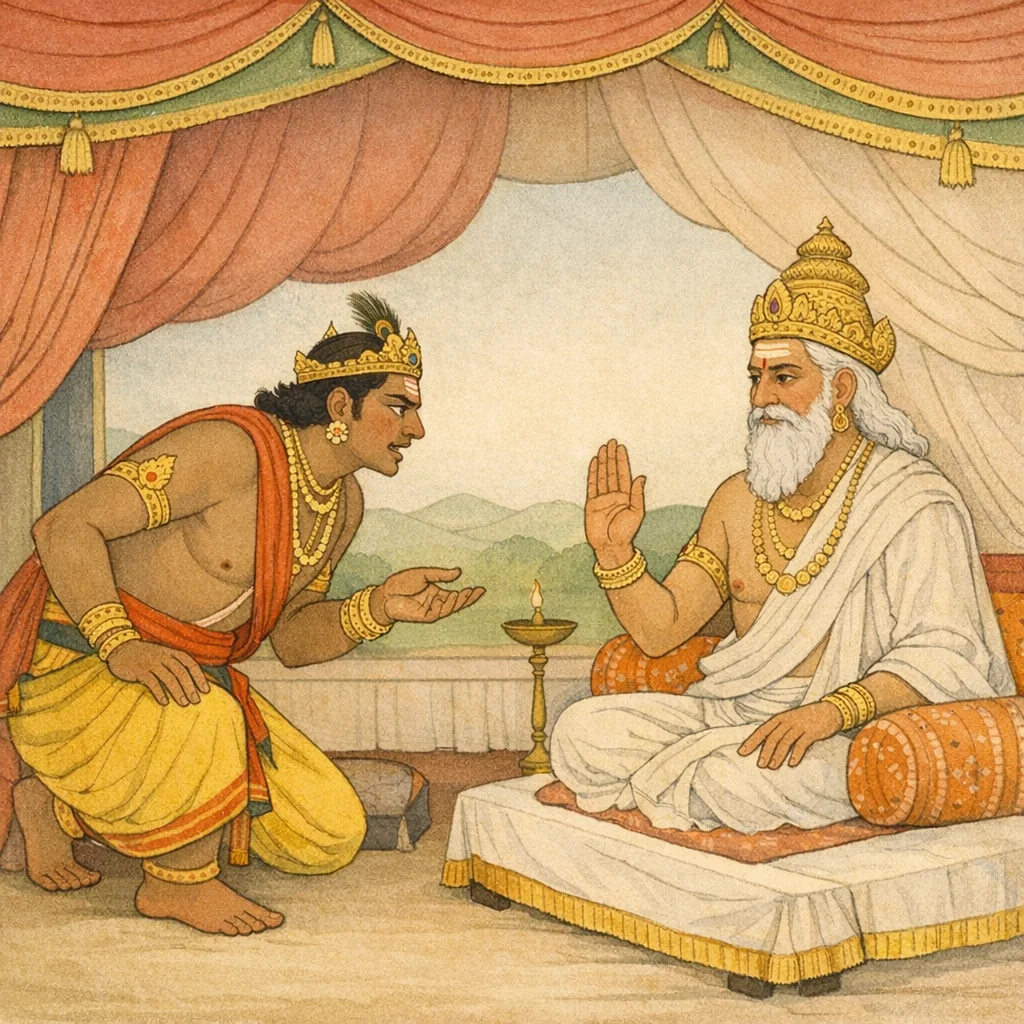
Sañjaya reports Bhīṣma seen enraged in battle, encircled by Pāṇḍava fighters like the sun veiled by clouds. Duryodhana instructs Duḥśāsana to prioritize Bhīṣma’s protection, asserting that a guarded Bhīṣma can strike down the Pāṇḍavas and the Pāñcālas. Duḥśāsana complies, surrounding Bhīṣma with a large contingent. A massive cavalry force advances with speed and noise, raising dust that obscures visibility; the Pāṇḍava side is shaken but Yudhiṣṭhira with Nakula and Sahadeva counters the charge, inflicting heavy losses. The routed horsemen flee; the Pāṇḍavas signal advantage with conches and drums. Observing Kaurava disarray, Duryodhana appeals to Śalya (Madrarāja) to restrain Yudhiṣṭhira, describing him as driving the army back. Śalya advances; Yudhiṣṭhira strikes him with multiple arrows, and Nakula–Sahadeva add supporting fire. Śalya retaliates with dense volleys, placing Yudhiṣṭhira under pressure; Bhīma then rushes to support, and the engagement escalates into a severe, wide-ranging battle as the sun glows toward the western direction.
Chapter Arc: कौरव-सभा के भीतर धुएँ-सा घना क्रोध: दुर्योधन दीर्घ श्वास लेता, नाग की भाँति फुफकारता, और अर्जुन के पराक्रम की चर्चा से भीतर-भीतर जल उठता है। → दुर्योधन भीष्म के सामने युद्ध की दिशा और विजय-पराजय का भय रखता है—पाण्डवों के बढ़ते प्रभाव, अर्जुन की अजेयता, और सेनाओं के मनोबल पर पड़ते आघात का संकेत देता है। भीष्म शांत, पर अडिग, अपने व्रत और मर्यादा की सीमा स्पष्ट करता है। → भीष्म का निर्णायक वचन: ‘प्राण-त्याग हो जाए, तब भी मैं शिखण्डी को नहीं मारूँगा’—स्त्री/स्त्री-पूर्व होने के कारण उसे लक्ष्य न बनाने की प्रतिज्ञा को वह युद्ध-नीति से ऊपर रख देता है। → भीष्म दुर्योधन को अपने धर्म-आचरण की रेखा दिखाता है: वह पाण्डवों से युद्ध करेगा, पर कुछ सीमाएँ अटल हैं। दुर्योधन को यह स्वीकार करना पड़ता है कि भीष्म की शक्ति के साथ-साथ उसकी मर्यादा भी युद्ध का भाग्य लिखेगी। → दुर्योधन की बेचैनी अगले दिन की रचना की ओर धकेलती है—भीष्म की ‘सीमा’ को जानकर कौरव पक्ष शिखण्डी को साधन बनाकर भीष्म-वध की संभावना से घिरता है।
Shlokas
Verse 1
[दाक्षिणात्य अधिक पाठके २ ३ श*लोक मिलाकर कुल ४५ ६ “लोक हैं।] 30:22 धन हि कमी अष्टनवतितमोब् ध्याय: भीष्मका दुर्योधनको अर्जुनका पराक्रम बताना और भयंकर युद्धके लिये प्रतिज्ञा करना तथा प्रात:काल दुर्योधनके द्वारा भीष्मकी रक्षाकी व्यवस्था संजय उवाच वाक् शल्यैस्तव पुत्रेण सो5तिविद्धों महामना: । दुःखेन महता<5<विष्टो नोवाचाप्रियमण्वपि,संजय कहते हैं--महाराज! आपके पुत्रद्वारा वाग्बाणोंसे अत्यन्त विद्ध होकर महामना भीष्मको महान् दुःख हुआ; तथापि उन्होंने उससे कोई किंचिन्मात्र भी अप्रिय वचन नहीं कहा
Sañjaya said: O great king, though the high-souled Bhīṣma was pierced again and again by the sharp barbs of speech from your son, and was overwhelmed by intense sorrow, he did not utter even the slightest word that was unpleasant. The scene underscores Bhīṣma’s disciplined restraint: even when wounded by insult, he refuses to abandon propriety and self-control amid the moral strain of war.
Verse 2
स ध्यात्वा सुचिरं काल॑ दुः:खरोषसमन्वित: । श्वसमानो यथा नाग: प्रणुन्नो वाकुशलाकया,वे दुःख और रोषसे युक्त होकर दीर्घकालतक कुछ सोचते हुए लंबी साँस खींचते रहे। वाणीरूपी अंकुशसे पीड़ित होकर वे हाथीके समान व्यथाका अनुभव करने लगे
Sañjaya said: After pondering for a long time, overcome with grief and anger, he breathed heavily; like an elephant goaded by a speech-like hook, he felt the sting of inner torment. The verse highlights how harsh or pointed words can wound the mind as sharply as a physical prod, stirring passions that cloud judgment in the midst of grave decisions.
Verse 3
उद्वृत्य चक्षुषी कोपान्निर्दहन्निव भारत । सदेवासुरगन्धर्व लोक॑ लोकविदां वर:
Sañjaya said: “O Bhārata, he raised his eyes in anger, as though burning (all before him). The foremost among those who know the worlds seemed capable of scorching the entire realm—of gods, demons, and Gandharvas.”
Verse 4
भारत! फिर क्रोधसे दोनों आँखें चढ़ाकर लोकवेत्ताओंमें श्रेष्ठ भीष्म इस प्रकार देखने लगे, मानो देवताओं, असुरों और गन्धर्वोंसहित सम्पूर्ण लोकोंको दग्ध कर डालेंगे ।। अब्रवीत् तव पुत्र स सामपूर्वमिदं वच: । कि त्वं दुर्योधनैवं मां वाकृशल्यैरपकृन्तसि,फिर आपके पुत्रको सान्त्वना देते हुए वे उससे इस प्रकार बोले--“बेटा दुर्योधन! तुम इस प्रकार वाग्बाणोंसे मुझे क्यों छेद रहे हो? मैं तो यथाशक्ति शत्रुओंपर विजय पानेकी चेष्टा करता हूँ और तुम्हारे प्रिय साधनमें लगा हुआ हूँ। इतना ही नहीं, तुम्हारा प्रिय करनेकी इच्छासे मैं समराग्निमें अपने प्राणोंको होम देनेके लिये भी तैयार हूँ
O Bhārata, then Bhīṣma—foremost among those who know the ways of the world—raised his eyes in anger and looked as though he would burn up all the worlds, together with gods, demons, and Gandharvas. Yet, soothing your son with conciliatory words, he said: “Duryodhana, why do you pierce me like this with barbed speech? I strive, to the best of my power, to overcome the enemy, and I am engaged in the means you desire. Indeed, for the sake of what pleases you, I am even ready to offer my very life into the fire of battle.”
Verse 5
घटमानं यथाशक्ति कुर्वाणं च तव प्रियम् । जुद्दानं समरे प्राणांस्तव वै प्रियकाम्यया,फिर आपके पुत्रको सान्त्वना देते हुए वे उससे इस प्रकार बोले--“बेटा दुर्योधन! तुम इस प्रकार वाग्बाणोंसे मुझे क्यों छेद रहे हो? मैं तो यथाशक्ति शत्रुओंपर विजय पानेकी चेष्टा करता हूँ और तुम्हारे प्रिय साधनमें लगा हुआ हूँ। इतना ही नहीं, तुम्हारा प्रिय करनेकी इच्छासे मैं समराग्निमें अपने प्राणोंको होम देनेके लिये भी तैयार हूँ
Sanjaya said: “I am striving to the best of my ability, and I am acting for what is dear to you. Indeed, out of the desire to please you, I am ready even to stake—yes, to offer up—my very life in the battle.”
Verse 6
यदा तु पाण्डव: शूर: खाण्डवेडग्निमतर्पयत् । पराजित्य रणे शक्रं पर्याप्त॑ तन्निदर्शनम्,“परंतु तुम्हें याद होगा, जब शूरवीर पाण्डुनन्दन अर्जुनने युद्धमें देवराज इन्द्रको परास्त करके खाण्डव-वनमें अग्निको तृप्त किया था, वही उनकी अजेयताका पूरा प्रमाण है
Verse 7
यदा च त्वां महाबाहो गन्धर्वैर््वतमोजसा । अमोचयत् पाण्डुसुतः पर्याप्तं तन्निदर्शनम्,“महाबाहो! जब गन्धर्वलोग तुम्हें बलपूर्वक पकड़ ले गये थे, उस समय भी पाण्घुपुत्र अर्जुनने ही तुम्हें छुड़ाया था। उनके अनन्त पराक्रमको समझनेके लिये यह दृष्टान्त पर्याप्त होगा
Verse 8
द्रवमाणेषु शूरेषु सोदरेषु तव प्रभो । सूतपुत्रे च राधेये पर्याप्तं तन्निदर्शनम्,'प्रभो! उस अवसरपर तुम्हारे ये शूरवीर भाई और राधानन्दन सूतपुत्र कर्ण तो मैदान छोड़कर भाग गये थे। यह अर्जुनकी अदभुत शक्तिका पर्याप्त उदाहरण है
Sanjaya said: “O lord, when your own heroic brothers were fleeing in disarray—and when Radheya, the charioteer’s son (Karna), also turned away from the field—that itself is sufficient proof of Arjuna’s extraordinary might.”
Verse 9
यच्च नः सहितान् सर्वान् विराटनगरे तदा । एक एव समुद्यात: पर्याप्त॑ तन्निदर्शनम्,“उन दिनों विराटनगरमें हम सब लोग एक साथ युद्धके लिये डटे हुए थे, परंतु अर्जुनने अकेले ही हमलोगोंपर आक्रमण किया। यह उनकी अपरिमित शक्तिका पर्याप्त उदाहरण है
Sañjaya said: “And when all of us, united together, stood firm for battle in the city of Virāṭa, he alone rose up and attacked us. That itself is sufficient proof—an illustration enough—of Arjuna’s immeasurable might.”
Verse 10
द्रोणं य युधि संरब्धं मां च निर्जित्य संयुगे । वासांसि स समादत्त पर्याप्तं तन्निदर्शनम्,'अर्जुनने क्रोधमें भरे हुए द्रोणाचार्यको तथा मुझे भी युद्धमें परास्त करके सबके वस्त्र छीन लिये थे। यह उनकी अजेयताका पर्याप्त प्रमाण है
Sañjaya said: “In battle, he overcame the enraged Droṇa and defeated me as well in the fight, and then took away their garments. This, indeed, is sufficient evidence of his irresistible prowess.”
Verse 11
तथा द्रौणिं महेष्वासं शारद्वतमथापि च । गोग्रहे जितवान् पूर्व पर्याप्तं॑ तन्निदर्शनम्,'पूर्वकालमें उसी गोग्रहके अवसरपर पाण्डु-कुमारने महाधनुर्धर अश्वत्थामा तथा कृपाचार्यको भी परास्त कर दिया था। यह दृष्टान्त उन्हें समझनेके लिये पर्याप्त है
Sañjaya said: “Likewise, in the earlier cattle-raid, the son of Pāṇḍu had already defeated the great archer Aśvatthāmā and also Śāradvata (Kṛpa). That precedent alone is sufficient evidence for understanding this matter.”
Verse 12
विजित्य च यदा कर्ण सदा पुरुषमानिनम् । उत्तरायै ददौ वस्त्र पर्याप्तं तन्निदर्शनम्,“उन दिनों सदा अपने पुरुषार्थका अभिमान रखनेवाले कर्णको भी जीतकर अर्जुनने उसके वस्त्र छीनकर उत्तराको अर्पित किये थे। यह दृष्टान्त पर्याप्त होगा
Sañjaya said: “And when Arjuna had defeated Karṇa—who was ever proud of his manly prowess—he took away Karṇa’s garment and presented it to Uttarā. This example, indeed, is sufficient as evidence.”
Verse 13
निवातकवचान् युद्धे वासवेनापि दुर्जयान् । जितवान् समरे पार्थ: पर्याप्त॑ तन्निदर्शनम्,“जिन्हें परास्त करना इन्द्रके लिये भी कठिन था, उन निवातकवचोंको अर्जुनने युद्धमें परास्त कर दिया था। उनकी अलौकिक शक्तिको समझनेके लिये यह दृष्टान्त पर्याप्त होगा
Sañjaya said: In battle, Arjuna—the son of Pṛthā—defeated the Nivātakavacas, foes whom even Indra (Vāsava) would have found hard to conquer. This example alone is sufficient to indicate the extraordinary might that Arjuna possesses.
Verse 14
को हि शक्तो रणे जेतुं पाण्डवं रभसं तदा । यस्य गोप्ता जगद्गोप्ता शड्खचक्रगदाधर:,“विश्वरक्षक, शंख, चक्र और गदा धारण करनेवाले अनन्तशक्ति, सृष्टि और संहारके एकमात्र कर्ता देवाधिदेव सनातन परमात्मा सर्वेश्वर भगवान् वासुदेव जिनकी रक्षा करनेवाले हैं, उन वेगशाली वीर पाण्डुपुत्र अर्जुनको युद्धके मैदानमें कौन जीत सकता है
Sañjaya said: Who, indeed, could then defeat the impetuous Pāṇḍava in battle—him whose protector is the Protector of the whole world, the bearer of conch, discus, and mace? The verse underscores that Arjuna’s martial force is inseparable from the moral and cosmic guardianship of Vāsudeva; where divine protection aligns with a righteous cause, mere human prowess cannot prevail.
Verse 15
वासुदेवो5नन्तशक्ति: सृष्टिसंहारकारक: । सर्वेश्व॒रो देवदेव: परमात्मा सनातन:,“विश्वरक्षक, शंख, चक्र और गदा धारण करनेवाले अनन्तशक्ति, सृष्टि और संहारके एकमात्र कर्ता देवाधिदेव सनातन परमात्मा सर्वेश्वर भगवान् वासुदेव जिनकी रक्षा करनेवाले हैं, उन वेगशाली वीर पाण्डुपुत्र अर्जुनको युद्धके मैदानमें कौन जीत सकता है
Sanjaya said: Vāsudeva, of limitless power, the sole agent of creation and dissolution, the Lord of all, God of gods, the eternal Supreme Self—when such a protector stands with Arjuna, the swift and valiant son of Pāṇḍu, who in the battlefield can truly conquer him? The verse frames victory not merely as martial skill, but as the moral and spiritual force that arises when one is aligned with the Supreme and fights for a righteous cause.
Verse 16
उक्तोडसि बहुशो राजन् नारदाद्यर्महर्षिभि: । त्वं तु मोहान्न जानीषे वाच्यावाच्यं सुयोधन,“राजन! सुयोधन! यह बात नारद आदि महर्षियोंने तुमसे कई बार कही है, परंतु तुम मोहवश कहने और न कहनेयोग्य बातको समझते ही नहीं हो
Sañjaya said: “O King, the great seers—Nārada and others—have told you this many times. Yet, blinded by delusion, you, O Suyodhana, do not discern what ought to be spoken and what ought not to be spoken.”
Verse 17
मुमूर्षुर्हि नर: सर्वान् वृक्षान् पश्यति काउचनान् । तथा त्वमपि गान्धारे विपरीतानि पश्यसि,'गान्धारीनन्दन! जैसे मरणासन्न मनुष्य सभी वृक्षोंको सुनहरे रंगका देखता है, उसी प्रकार तुम भी सब कुछ विपरीत ही देख रहे हो
Sañjaya said: “For a man on the verge of death sees all trees as if they were made of gold. In the same way, O Dhṛtarāṣṭra, you too are perceiving everything in a distorted, inverted manner.”
Verse 18
स्वयं वैरं महत् कृत्वा पाण्डवै: सह सूंजयै: । युद्धास्व तानद्य रणे पश्याम: पुरुषो भव,(अशक्या: पाण्डवा जेतुं देवेरपि सवासवै: ।) “तुमने स्वयं ही पाण्डवों तथा सूंजयोंके साथ महान् वैर ठाना है। अतः अब तुम्हीं युद्ध करो। हम सब लोग देखते हैं। तुम स्वयं पुरुषत्वका परिचय दो। पाण्डवोंको तो इन्द्रसहित सम्पूर्ण देवता भी नहीं जीत सकते
Sañjaya said: “Having yourself created a great enmity with the Pāṇḍavas together with the Sṛñjayas, now fight them today on the battlefield. We shall watch—show your manhood. The Pāṇḍavas cannot be conquered even by the gods, even with Indra at their head.”
Verse 19
अहं तु सोमकान् सर्वान् पज्चालांश्व॒ समागतान् | निहनिष्ये नरव्यात्र वर्जयित्वा शिखण्डिनम्,'किंतु पुरुषसिंह! मैं केवल शिखण्डीको छोड़कर युद्धमें आये हुए समस्त सोमकों और पांचालोंको भी मार डालूँगा
Sañjaya said: “But I, O tiger among men, will slay all the Somakas and the assembled Pāñcālas who have come to this battle—except for Śikhaṇḍin.” The statement underscores a warrior’s vow shaped by personal resolve and battlefield ethics: a sweeping intent to destroy the opposing host is paired with a deliberate exclusion, reflecting the complex moral codes and strategic considerations that govern combatants in the Kurukṣetra war.
Verse 20
तैर्वाहं निहतः संख्ये गमिष्ये यमसादनम् । तान् वा निहत्य समरे प्रीति दास्याम्पहं तव,'या तो उन्हींके हाथों युद्धमें मारा जाकर मैं यमलोकका रास्ता लूँगा अथवा उन्हींको समरांगणमें मारकर मैं तुम्हें हर्ष प्रदान करूँगा
Sañjaya said: “Either I shall be struck down by them in the thick of battle and go to Yama’s abode, or, having slain them on the battlefield, I shall bring you joy.” The statement frames a stark warrior’s resolve: accepting death without complaint, yet also embracing the duty to fight decisively for the sake of one’s lord’s satisfaction.
Verse 21
पूर्व हि स्त्री समुत्पन्ना शिखण्डी राजवेश्मनि । वरदानात् पुमाञ्जात: सैषा वै स्त्री शिखण्डिनी,“शिखण्डी पहले राजभवनमें स्त्रीके रूपमें उत्पन्न हुआ था; फिर वरदानसे पुरुष हो गया, अतः मेरी दृष्टिमें तो यह स्त्रीरूपा शिखण्डिनी ही है
Sañjaya said: “Formerly, Śikhaṇḍī was born in the royal palace as a woman. Later, by the power of a boon, he became a man. Therefore, in my judgment, this is still Śikhaṇḍinī—female in origin.”
Verse 22
तमहं न हनिष्यामि प्राणत्यागेडपि भारत । यासौ प्राड्निर्मिता धात्रा सैषा वै स्त्री शिखण्डिनी,“भारत! मेरे प्राणोंपर संकट आ जाय तो भी मैं उसे नहीं मारूँगा। जिसे विधाताने पहले स्त्री बनाया था, वह शिखण्डिनी आज भी मेरी दृष्टिमें स्त्री ही है
Sañjaya said: “O Bhārata, even if it should cost me my very life, I will not strike him. For the one whom the Creator fashioned earlier as a woman—Śikhaṇḍinī—remains, in my judgment, a woman still.”
Verse 23
सुखं स्वपिहि गान्धारे श्वो5पि कर्ता महारणम् । यं जना: कथयिष्यन्ति यावत् स्थास्यति मेदिनी
Sañjaya said: “Sleep in peace, O Gāndhārī. For tomorrow he will bring about a mighty battle—one that people will speak of for as long as the earth endures.”
Verse 24
'गान्धारीनन्दन! अब तुम सुखसे जाकर सो रहो। कल मैं बड़ा भीषण युद्ध करूँगा, जिसकी चर्चा लोग तबतक करते रहेंगे, जबतक कि यह पृथ्वी बनी रहेगी” ।। एवमुक्तस्तव सुतो निर्जगाम जनेश्वर । अभिवाद्य गुरुं मूर्थ्ना प्रययौ स्वं निवेशनम्,जनेश्वर! भीष्मके ऐसा कहनेपर आपका पुत्र दुर्योधन अपने उन गुरुजनके चरणोंमें मस्तक रखकर प्रणाम करनेके पश्चात् अपने शिविरको चला गया
Sanjaya said: “O son of Gandhari, go now in comfort and sleep. Tomorrow I shall wage a most dreadful battle—one whose tale people will recount for as long as the earth endures.” Thus addressed, O lord of men, your son departed. Having bowed with his head to his elder and teacher, he went back to his own quarters. The passage underscores the grim resolve of war and the outward observance of reverence to elders even as destruction is being prepared.
Verse 25
आगम्य तु ततो राजा विसृज्य च महाजनम् । प्रविवेश ततस्तूर्ण क्षयं शत्रुक्षयड्कर:,वहाँ आकर शत्रुओंका विनाश करनेवाले राजा दुर्योधनने लोगोंके उस महान् समुदायको तुरंत विदा कर दिया और स्वयं शिविरके भीतर प्रवेश किया
Sañjaya said: Having arrived there, the king—Duryodhana, a bringer of destruction to his enemies—promptly dismissed the great gathering of people and then entered his own camp. The verse underscores the war-leader’s decisive, inward turn from public assembly to private counsel, hinting at the moral weight of choices made away from the crowd on the eve of violence.
Verse 26
प्रविष्ट: स निशां तां च गमयामास पार्थिव: । प्रभातायां च शर्वर्या प्रातरुत्थाय तान् नृप:,भूपाल! वहाँ जाकर राजाने सुखसे रात बितायी और सबेरा होनेपर उसने प्रात:काल उठकर राजाओंको यह आज्ञा दी--'राजसिंहो! तुम सब लोग सेनाको युद्धके लिये तैयार करो, आज पितामह भीष्म रणभूमिमें कुपित होकर सोमकोंका संहार करेंगे”
Sañjaya said: Having entered (his quarters), the king passed that night. When the night had ended and dawn arrived, the ruler rose early and issued orders to those kings: “O lion-like kings, make the army ready for battle. Today grandsire Bhīṣma, angered on the field, will bring about the destruction of the Somakas.” The verse underscores the deliberate, command-driven momentum of war—how resolve and wrath, once set in motion, are translated into collective action by royal authority.
Verse 27
राज्ञ: समाज्ञापयत सेनां योजयतेति ह । अद्य भीष्मो रणे क्रुद्धों निहनिष्यति सोमकान्,भूपाल! वहाँ जाकर राजाने सुखसे रात बितायी और सबेरा होनेपर उसने प्रात:काल उठकर राजाओंको यह आज्ञा दी--'राजसिंहो! तुम सब लोग सेनाको युद्धके लिये तैयार करो, आज पितामह भीष्म रणभूमिमें कुपित होकर सोमकोंका संहार करेंगे”
Sañjaya said: “The king issued the command, ‘Let the army be arrayed.’ For today, O lord of the earth, Bhīṣma—angered on the battlefield—will strike down the Somakas.” The verse underscores the grim momentum of war: royal authority mobilizes the host, while Bhīṣma’s wrath signals an escalation in violence, raising the ethical tension between duty to one’s side and the human cost of slaughter.
Verse 28
दुर्योधनस्य तच्छुत्वा रात्रौ विलपितं बहु | मन्यमान: स तं राजन प्रत्यादेशमिवात्मन:,राजन! रातमें दुर्योधनके अनेक प्रकारके विलापको सुनकर भीष्मने यह समझ लिया कि अब दुर्योधन मुझे युद्धसे हटाना चाहता है
Sañjaya said: Hearing Duryodhana’s many lamentations in the night, Bhīṣma understood, O King, that this was as though a rejection directed at himself—Duryodhana was, in effect, seeking to have him withdraw from the battle. The moment reveals how grief and fear can turn into blame, and how a leader’s despair may pressure elders and teachers, testing loyalty, duty, and the ethics of command in war.
Verse 29
निर्वेद परमं गत्वा विनिन्द्य परवश्यताम् | दीर्घ दध्यौ शान्तनवो योद्धुकामोअ<र्जुनं रणे,इससे उनके मनमें बड़ा खेद हुआ। भीष्मने पराधीनताकी भूरि-भूरि निन््दा करके रणभूमिमें अर्जुनके साथ युद्ध करनेका संकल्प लेकर दीर्घकालतक विचार किया
Sanjaya said: Having fallen into the deepest remorse, and after strongly condemning the state of being under another’s control, the son of Śāntanu (Bhīṣma) reflected for a long time, resolved to fight Arjuna on the battlefield. The verse highlights Bhīṣma’s inner conflict: he recognizes the moral pain of compelled service, yet chooses the warrior’s duty as he understands it, turning deliberation into a firm decision to meet Arjuna in combat.
Verse 30
इज्धितेन तु तउज्ञात्वा गाड़ेयेन विचिन्तितम् । दुर्योधनो महाराज दुःशासनमचोदयत्,महाराज! गंगानन्दन भीष्मने क्या सोचा है? इस बातको संकेतसे समझकर दुर्योधनने दुःशासनसे कहा--
Sañjaya said: Understanding, by a subtle sign, what the son of the Gaṅgā (Bhīṣma) had firmly resolved in his mind, King Duryodhana urged Duḥśāsana to act—an indication of how the Kaurava leadership watched Bhīṣma’s intentions and moved quickly to exploit them in the unfolding war.
Verse 31
“दुःशासन! तुम शीघ्र ही भीष्मकी रक्षा करनेवाले रथोंको जोतकर तैयार कराओ। अपने पास कुल बाईस सेनाएँ हैं। उन सबको भीष्मकी रक्षामें ही नियुक्त कर दो
Sanjaya said: “Duhshasana, quickly have the chariots that will protect Bhishma yoked and made ready. You have a total of twenty-two divisions at hand—assign every one of them solely to Bhishma’s protection.”
Verse 32
इदं हि समनुप्राप्तं वर्षपूगाभिचिन्तितम् । पाण्डवानां ससैन्यानां वधो राज्यस्य चागम:,“आज वह अवसर प्राप्त हुआ है, जिसके लिये हम बहुत वर्षोंसे विचार करते आ रहे हैं। आज सेनासहित समस्त पाण्डवोंका वध तथा राज्यका लाभ होगा
Sañjaya said: “Indeed, the long-awaited moment—pondered over through many years—has now arrived: the destruction of the Pāṇḍavas together with their armies, and the gaining of the kingdom.” The line conveys the Kaurava camp’s calculated, outcome-driven mindset, where political acquisition is tied to mass killing, setting a stark ethical contrast with dharma-centered restraint.
Verse 33
तत्र कार्यतमं मन्ये भीष्मस्यैवाभिरक्षणम् | स नो गुप्त: सहाय: स्याद्धन्यात् पार्थाश्व संयुगे,“इस विषयमें मैं भीष्मकी रक्षाको ही अपना प्रधान कर्तव्य समझता हूँ। वे सुरक्षित रहनेपर हमारे सहायक होंगे और संग्रामभूमिमें कुन्तीकुमारोंका वध कर सकेंगे
Sañjaya said: “In this matter, I consider the foremost duty to be the protection of Bhīṣma alone. If he is kept secure, he will stand as our support and, on the battlefield, will be able to strike down the sons of Pṛthā.”
Verse 34
अब्रवीद्धि विशुद्धात्मा नाहं हन्यां शिखण्डिनम् । स्त्रीपूर्वको हासौ राजंस्तस्माद् वर्ज्यों मया रणे,“विशुद्ध अन्तःकरणवाले महात्मा भीष्मने मुझसे कहा है कि “राजन! मैं शिखण्डीको नहीं मार सकता; क्योंकि वह पहले स्त्रीरूपमें उत्पन्न हुआ था और इसीलिये युद्धमें मुझे उसका परित्याग कर देना है
Sañjaya said: The pure-souled Bhīṣma told me, “O King, I will not strike down Śikhaṇḍin. He was formerly born as a woman; therefore, in battle I must refrain from engaging him.”
Verse 35
लोकस्तद्ू वेद यदहं पितु: प्रियचिकीर्षया । राज्यं स्फीतं महाबाहो स्त्रियश्न त्यक्तवान् पुरा,“महाबाहो! सारा संसार यह जानता है कि मैंने पूर्वकालमें पिताका प्रिय करनेकी इच्छासे समृद्धिशाली राज्य तथा स्त्रियोंका परित्याग कर दिया था
Sañjaya said: “O mighty-armed one, the whole world knows this—that long ago, wishing to do what was dear to my father, I renounced a flourishing kingdom, and even women as well.”
Verse 36
नैवं चाहं स्त्रियं जातु न स्त्रीपूर्व कथंचन । हन्यां युधि नरश्रेष्ठ सत्यमेतद् ब्रवीमि ते,“नरश्रेष्ठ! मैं कभी किसी स्त्रीको अथवा जो पहले स्त्री रहा हो, उस पुरुषको भी किसी प्रकार युद्धमें मार नहीं सकता; यह मैं तुमसे सत्य कहता हूँ
Sañjaya said: “Never would I strike down a woman—nor, in any circumstance, one who was formerly a woman—even in the midst of battle. O best of men, I tell you this as the truth.”
Verse 37
अयं स्त्रीपूर्वको राजज्छिखण्डी यदि ते श्रुतः । उद्योगे कथितं यत्तत् तथा जाता शिखण्डिनी,“राजन! तुमने भी सुना होगा, यह शिखण्डी पहले स्त्रीरूपमें पैदा हुआ था। यह बात मैंने तुमसे युद्धकी तैयारीके समय बता दी थी। इस प्रकार कन्यारूपमें उत्पन्न हुई शिखण्डिनी पहले स्त्री होकर अब पुरुष हो गयी है। वह पुरुष बना हुआ शिखण्डी यदि मुझसे युद्ध करेगा तो मैं उसके ऊपर किसी प्रकार भी बाण नहीं चलाऊँगा
Sanjaya said: “O King, you have surely heard that this Shikhandi was formerly a woman. What I told you earlier, at the time of war preparations, has indeed come to pass: Shikhandini, born as a maiden, has now become Shikhandi in the form of a man.”
Verse 38
कन्या भूत्वा पुमाउ्जात: स च मां योधयिष्यति । तस्याहं प्रमुखे बाणान् न मुज्चेयं कथंचन,“राजन! तुमने भी सुना होगा, यह शिखण्डी पहले स्त्रीरूपमें पैदा हुआ था। यह बात मैंने तुमसे युद्धकी तैयारीके समय बता दी थी। इस प्रकार कन्यारूपमें उत्पन्न हुई शिखण्डिनी पहले स्त्री होकर अब पुरुष हो गयी है। वह पुरुष बना हुआ शिखण्डी यदि मुझसे युद्ध करेगा तो मैं उसके ऊपर किसी प्रकार भी बाण नहीं चलाऊँगा
Sañjaya said: “Having been born as a maiden, he has now become a man, and he will come to fight me. But even if he stands directly before me, I will not release arrows at him in any way.”
Verse 39
युद्धे हि क्षत्रियांस्तात पाण्डवानां जयैषिण: । सर्वानन्यान् हनिष्यामि सम्प्राप्तान् रणमूर्थनि,“तात! पाण्डवपक्षके दूसरे जो-जो विजयाभिलाषी क्षत्रिय युद्धके मुहानेपर मेरे सामने आयेंगे, उन सबका मैं वध करूँगा'
Sañjaya said: “In battle, dear one, I shall slay all those other kṣatriyas who, seeking the Pāṇḍavas’ victory, come before me at the very forefront of the fight.” The utterance frames war as a field of vowed violence, where loyalty to one side is treated as sufficient cause for lethal action, revealing the hardening of ethical perception under martial resolve.
Verse 40
एवं मां भरतश्रेष्ठ गाड़ेय: प्राह शास्त्रवित् । तत्र सर्वात्मना मन्ये गाड्नेयस्यैव पालनम्,“भरतश्रेष्ठ दुःशासन! शास्त्रोंके ज्ञाता गंगानन्दन भीष्मने इस प्रकार मुझसे कहा है। अतः युद्धभूमिमें सब प्रकारसे भीष्मकी रक्षाको ही मैं अपना मुख्य कर्तव्य मानता हूँ
Verse 41
अरक्ष्यमाणं हि वृको हन्यात् सिंहं महाहवे । मा वृकेणेव गाड़ेयं घातयेम शिखण्डिना,“यदि महायुद्धमें सिंहकी रक्षा नहीं की जाय तो उसे एक भेड़िया मार सकता है, परंतु हम भेड़ियेके सदूश शिखण्डीके हाथसे सिंहके समान भीष्मका वध नहीं होने देंगे
Sañjaya said: “In a great battle, if a lion is left unprotected, even a wolf could strike it down. But we shall not allow Bhīṣma—lion-like in valor—to be slain through Śikhaṇḍin, who is like a wolf.”
Verse 42
मातुलः शकुनि: शल्य: कृपो द्रोणो विविंशति: । यत्ता रक्षन्तु गाड़ेयं तस्मिन् गुप्ते ध्रुवोी जय:,(अतः उनकी रक्षाके लिये सारी आवश्यक व्यवस्था करो।) मामा शकुनि, शल्य, कृपाचार्य, द्रोणाचार्य और विविंशति--ये सब लोग सावधान होकर गंगानन्दन भीष्मकी रक्षा करें। उनके सुरक्षित रहनेपर हमारी विजय निश्चित है”
Sanjaya said: “Let my maternal uncle Shakuni, Shalya, Kripa, Drona, and Vivimshati remain vigilant and firmly protect Bhishma, the son of the Ganga. If he is kept secure, our victory is assured.” The verse underscores a wartime ethic in which the fate of an army is tied to the protection of its foremost commander, making strategic guardianship a decisive moral and practical duty.
Verse 43
एतच्छुत्वा तु ते सर्वे दुर्योधनवचस्तदा । सर्वतो रथवंशेन गाज़ेयं पर्यवारयन्,उस समय दुर्योधनकी यह बात सुनकर उन सब वीरोंने रथकी विशाल सेनाद्वारा गंगानन्दन भीष्मको सब ओरसे घेर लिया
Sañjaya said: Hearing Duryodhana’s words at that moment, all those warriors, from every side, surrounded Bhīṣma—the son of the Gaṅgā—by means of their massed chariots. The scene underscores how a commander’s directive can swiftly turn into collective action on the battlefield, tightening the net around a single, pivotal elder whose presence carries both strategic weight and moral authority.
Verse 44
पुत्राश्न तव गाड़ेयं परिवार्य ययुर्मुदा । कम्पयन्तो भुवं द्यां च क्षोभयन्तश्न॒ पाण्डवान्,आपके सब पुत्र भी भीष्मको चारों ओरसे घेरकर प्रसन्नतापूर्वक चले। वे उस समय भूलोक और स्वर्ग-लोकको भी कँपाते हुए पाण्डवोंके मनमें क्षोभ उत्पन्न कर रहे थे
Sañjaya said: Your sons, having tightly surrounded Bhīṣma on all sides, advanced with exultation. As they moved, they seemed to make both earth and heaven tremble, and by that display of force they stirred agitation in the hearts of the Pāṇḍavas—an image of how martial pride seeks to unsettle the righteous through intimidation.
Verse 45
ते रथै: सुसम्प्रयुक्तिर्दन्तिभिश्न महारथा: । परिवार्य रणे भीष्म॑ दंशिता: समवस्थिता:,वे समस्त कौरव महारथी सुशिक्षित रथों और हाथियोंसे भीष्मको घेरकर कवच आदिसे सुसज्जित हो युद्धके लिये खड़े हो गये
Sanjaya said: Then those great warriors, with chariots well-yoked and with war-elephants, surrounded Bhishma on the battlefield. Armoured and fully equipped, they took up their positions, ready for combat—an image of disciplined martial order gathered around the commander they had chosen to uphold their cause.
Verse 46
यथा देवासुरे युद्धे त्रिदशा वजधारिणम् | सर्वे ते सम व्यतिष्ठन्त रक्षन्तस्तं महारथम्,जिस प्रकार देवासुर-संग्रामके समय देवताओंने वज्रधारी इन्द्रकी रक्षा की थी, उसी प्रकार वे सब कौरव योद्धा महारथी भीष्मकी रक्षा करने लगे
Sañjaya said: Just as, in the war between the gods and the asuras, the Thirty (gods) stood together to protect Indra, the wielder of the thunderbolt, so too all those Kaurava warriors stood in close formation, guarding that great chariot-warrior Bhīṣma. The verse underscores the ethic of collective duty in battle: protecting the commander becomes a shared responsibility, mirroring the gods’ united defense of their leader.
Verse 47
ततो दुर्योधनो राजा पुनर्भ्रातरमब्रवीत् । सव्यं चक्र युधामन्युरुत्तमौजाश्न दक्षिणम्
Then King Duryodhana again addressed his brother. He arranged Yudhāmanyu on the left wing and Uttamaujā on the right, setting his forces in ordered formation as the battle’s pressure mounted and command decisions carried immediate moral and strategic consequence.
Verse 48
गोप्तारावर्जुनस्यैतावर्जुनोडपि शिखण्डिन: । रक्ष्यमाण: स पार्थेन तथास्माभिविंवर्जित:
Sañjaya said: “These two were the protectors of Arjuna, and Arjuna in turn was the protector of Śikhaṇḍin. Thus guarded by Pārtha, he (Śikhaṇḍin) advanced, while we found ourselves unable to check him.”
Verse 49
यथा भीष्मं न नो हन्याद् दुःशासन तथा कुरु । तब राजा दुर्योधनने अपने भाईसे पुनः इस प्रकार कहा--“दुःशासन! अर्जुनके रथके बायें पहियेकी रक्षा युधामन्यु और दाहिने पहियेकी रक्षा उत्तमौजा करते हैं। इस प्रकार अर्जुनके ये दो रक्षक हैं और अर्जुन भी शिखण्डीकी रक्षा करते हैं। अर्जुनसे सुरक्षित और हमलोगोंसे उपेक्षित होकर शिखण्डी हमारे भीष्मको जिस प्रकार मार न सके, ऐसी व्यवस्था करो' || ४७-४८ ह ।। भ्रातुस्तद् वचन श्रुत्वा पुत्रो द:ःशासनस्तव
Sañjaya said: “Duḥśāsana, arrange matters so that Bhīṣma is not slain by us. Ensure that Śikhaṇḍin—protected by Arjuna and disregarded by our forces—does not succeed in striking down Bhīṣma.”
Verse 50
भीष्म॑ प्रमुखत: कृत्वा प्रययौ सह सेनया । बड़े भाईकी यह बात सुनकर आपका पुत्र दुःशासन भीष्मको आगे करके सेनाके साथ युद्धके मैदानमें गया || ४९ ई ।। भीष्म तु रथवंशेन दृष्टवा समभिसंवृतम्
Sañjaya said: Placing Bhīṣma at the forefront, he advanced together with the army. Bhīṣma, for his part, seeing the chariot-line drawn up and closely arrayed, assessed the formation as the battle was about to be joined—an image of war’s momentum driven by loyalty to command and the weight of elder authority.
Verse 51
अर्जुनो रथिनां श्रेष्ठो धृष्टद्युम्नमुवाच ह । भीष्मको रथोंके समूहसे घिरा हुआ देख रथियोंमें श्रेष्ठ अर्जुनने धृष्टद्युम्नसे कहा - || ५० ह || शिखण्डिनं नरव्याप्र॑ भीष्मस्य प्रमुखे नूप । स्थापयस्वाद्य पाञज्चाल्य तस्य गोप्ताहमित्युत,“नरेश्वर! पांचालराजकुमारर! आज तुम पुरुषसिंह शिखण्डीको भीष्मके सामने उपस्थित करो। मैं उसकी रक्षा करूँगा”
Sañjaya said: Seeing Bhīṣma surrounded by a massed formation of chariots, Arjuna—the foremost among chariot-warriors—addressed Dhṛṣṭadyumna: “O tiger among men, O Pāñcāla prince, place Śikhaṇḍin today directly before Bhīṣma. I shall be his protector.” In this moment Arjuna deliberately chooses a tactical arrangement that exploits Bhīṣma’s vow and moral restraint, aiming to end a devastating slaughter while still acting within the accepted codes of the battlefield.
Verse 97
इस प्रकार श्रीमह्याभारत भीष्मपर्वके अन्तर्गत भीष्यवधपर्वमें भीष्मके प्रति दुर्योधनका वचनविषयक सत्तानबेवाँ अध्याय पूरा हुआ
Thus ends the ninety-seventh chapter of the Bhīṣma Parva of the Śrī Mahābhārata, within the section concerning the slaying (or fall) of Bhīṣma—specifically, the chapter dealing with Duryodhana’s words addressed to Bhīṣma. The narrative marks a formal closure, underscoring the moral tension of the war: a king’s demand and reproach directed toward an elder bound by duty, even as the battlefield presses toward Bhīṣma’s destined downfall.
Verse 98
इति श्रीमहाभारते भीष्मपर्वणि भीष्मवधपर्वणि भीष्मदुर्योधनसंवादे अष्टनवतितमो<ध्याय:
Thus, in the Śrī Mahābhārata, within the Bhīṣma Parva—specifically in the section concerning the fall of Bhīṣma—during the dialogue between Bhīṣma and Duryodhana, ends the eighty-ninth chapter.
Verse 331
दुःशासन रथास्तूर्ण युज्यन्तां भीष्मरक्षिण: । द्वाविंशतिमनीकानि सर्वाण्येवाभिचोदय
Sañjaya said: “Let the chariots of Duḥśāsana be yoked at once, under the protection of Bhīṣma. Rouse and set in motion all the twenty-two divisions of the army.” In the moral atmosphere of the epic, the line conveys the Kaurava side’s urgent mobilization and reliance on Bhīṣma’s guardianship, pressing the machinery of war forward through command and coercive resolve rather than restraint.
Frequently Asked Questions
The chapter implies a tension between honoring an elder-commander as a moral symbol and treating him as a strategic instrument—protecting Bhīṣma is framed as both reverence (pitāmaha) and a calculated method to enable decisive harm to opponents.
Operational success depends on disciplined force allocation and realistic assessment of momentum: massed deployments and spectacle (noise, dust, speed) do not substitute for coordinated containment when facing organized resistance and counter-volley tactics.
No explicit phalaśruti is presented within this chapter’s verses; its significance is contextual, contributing to the epic’s cumulative reflection on leadership, escalation, and the moral ambiguity of protective warfare doctrines.