Adhyaya 130
धृतराष्ट्र–दुर्योधन संवादः (Vāraṇāvata-vivāsana-nīti: Dhṛtarāṣṭra and Duryodhana’s Policy Dialogue)
Upa-parva: Jatugṛha (Vāraṇāvata) Upa-Parva
Vaiśaṃpāyana narrates Dhṛtarāṣṭra’s response after hearing Duryodhana. Dhṛtarāṣṭra recalls Pāṇḍu’s consistent dharmic conduct and his particular goodwill toward him, emphasizing Pāṇḍu’s disciplined transparency in matters of the kingdom. He then underscores that Pāṇḍu’s son (Yudhiṣṭhira) mirrors this dharmic orientation, is publicly renowned, and is well-regarded by the citizens, making forcible displacement politically hazardous—especially because Pāṇḍu’s supported officials, forces, and their families remain embedded in the polity. Duryodhana replies that he has already assessed these risks and claims that key administrative and economic stakeholders will align with him. He proposes that Dhṛtarāṣṭra promptly send the Pāṇḍavas to Vāraṇāvata through a gentle stratagem, anticipating that once his rule is secured, Kuntī and her sons can be recalled. Dhṛtarāṣṭra admits the thought also circulates in his mind but notes the moral taint and fears opposition from Bhīṣma, Droṇa, Vidura (kṣattā), and Gautama, who would not approve unequal treatment. Duryodhana counters with an argument about influence: Bhīṣma’s neutrality, Droṇa’s paternal partiality via Aśvatthāman, Kṛpa’s alignment through relationships, and Vidura’s constrained position; he concludes that no single figure can effectively obstruct the plan. The chapter closes by urging immediate relocation to remove Dhṛtarāṣṭra’s sleepless anxiety and grief, portraying policy action as a remedy for internal distress.
Chapter Arc: Janamejaya, eager to trace the roots of the Kurus’ future calamity, asks how Drona was born, how he obtained divine weapons, and how that formidable Brahmin-warrior came to the Kuru court. → Vaishampayana turns back to origins: Sharadvan Gautama, more drawn to dhanurveda than Vedic study, is tempted by a woman who comes to his hermitage; the lapse and its consequences set in motion the line that will culminate in Kripa and Ashvatthama, while the narrative pivots to Drona’s own hunger for astras and recognition. → Drona reaches Mahendra and encounters Parashurama (Bhargava), the great reservoir of martial lore; with humility, restraint, and fierce resolve, he seeks and receives the knowledge of astras and shastras—an initiation that forges him into the teacher who will later shape princes into weapons. → Parashurama, having relinquished earthly dominion and gifts to Kashyapa, bestows what remains of his martial inheritance upon the worthy seeker; Drona’s acquisition of arms is sealed, and the path is cleared for his eventual arrival among the Kurus as a Brahmin bearing the power of a kshatriya. → Armed with Bhargava’s lore, Drona’s next step—entering the Kuru world and binding his fate to princes and rivalries—hangs poised, promising that learning itself will soon become an instrument of destiny.
Shlokas
Verse 1
ऑपन--माजल छा अ<-छऋाञ एकोनत्रिशदधिकशततमो< ध्याय: कृपाचार्य, द्रोण और अश्वत्थामाकी उत्पत्ति तथा द्रोणको परशुरामजीसे अस्त्र-शस्त्रकी प्राप्तिकी कथा जनमेजय उवाच कृपस्यापि मम ब्रद्मान् सम्भवं वक्तुमरहसि । शरस्तम्बात् कथं जज्ञे कथं वास्त्राण्यवाप्तवान्,जनमेजयने पूछा--्रह्मन्! कृपाचार्यका जन्म किस प्रकार हुआ? यह मुझे बतानेकी कृपा करें। वे सरकंडेके समूहसे किस तरह उत्पन्न हुए एवं उन्होंने किस प्रकार अस्त्र- शस्त्रोंकी शिक्षा प्राप्त की?
Janamejaya said: “O Brahmin, please tell me also of Kṛpa’s origin. How was he born from a clump of reeds, and how did he come to obtain the knowledge and mastery of weapons and missiles?”
Verse 2
वैशम्पायन उवाच महर्षेगौतमस्यासीच्छरद्वान् नाम गौतम: । पुत्र: किल महाराज जात: सह शरैरविंभो,वैशम्पायनजीने कहा--महाराज! महर्षि गौतमके शरद्वान् गौतम- नामसे प्रसिद्ध एक पुत्र थे। प्रभो! कहते हैं, वे सरकंडोंके साथ उत्पन्न हुए थे। परंतप! उनकी बुद्धि धनुर्वेदमें जितनी लगती थी, उतनी वेदोंके अध्ययनमें नहीं
Vaiśampāyana said: O king, the great sage Gautama had a son known by the name Śaradvān Gautama. It is said, O mighty one, that he was born together with reeds (śara).
Verse 3
न तस्य वेदाध्ययने तथा बुद्धिरजायत । यथास्य बुद्धिरभवद् धनुर्वेदे परंतप,वैशम्पायनजीने कहा--महाराज! महर्षि गौतमके शरद्वान् गौतम- नामसे प्रसिद्ध एक पुत्र थे। प्रभो! कहते हैं, वे सरकंडोंके साथ उत्पन्न हुए थे। परंतप! उनकी बुद्धि धनुर्वेदमें जितनी लगती थी, उतनी वेदोंके अध्ययनमें नहीं
Vaiśampāyana said: O scorcher of foes, his intellect did not arise in the study of the Vedas in the same way as his understanding flourished in the science of archery. The narrative underscores a natural inclination: the boy’s mind turned more readily toward martial skill than toward scriptural learning, hinting at how aptitude and destiny can shape one’s path even within a dharmic society that esteems Vedic study.
Verse 4
अधिजम्मुर्यथा वेदांस्तपसा ब्रह्मचारिण: । तथा स तपसोपेत: सर्वाण्यस्त्राण्यवाप ह,जैसे अन्य ब्रह्मचारी तपस्यापूर्वक वेदोंका ज्ञान प्राप्त करते हैं, उसी प्रकार उन्होंने तपस्यायुक्त होकर सम्पूर्ण अस्त्र-शस्त्र प्राप्त किये
Vaiśampāyana said: “Just as brahmacārins, through disciplined austerity, attain mastery of the Vedas, so too he—endowed with tapas—obtained all the weapons. The passage frames martial power as something to be earned through self-restraint and rigorous training, not merely seized by force.”
Verse 5
धनुर्वेदपरत्वाच्च तपसा विपुलेन च । भृशं संतापयामास देवराजं स गौतम:,वे धनुर्वेदमें पारंगत तो थे ही, उनकी तपस्या भी बड़ी भारी थी; इससे गौतमने देवराज इन्द्रको अत्यन्त चिन्तामें डाल दिया था
Vaiśampāyana said: Because Gautama was highly accomplished in the science of archery and also possessed immense ascetic power, he greatly troubled the mind of Indra, the king of the gods—stirring in him deep anxiety and apprehension.
Verse 6
ततो जानपदीं नाम देवकन्यां सुरेश्वर: । प्राहिणोत् तपसो विघ्नं कुरु तस्येति कौरव,कौरव! तब देवराजने जानपदी नामकी एक देवकन्याको उनके पास भेजा और यह आदेश दिया कि “तुम शरद्वानकी तपस्यामें विघ्न डालो”
Then the Lord of the gods dispatched a celestial maiden named Jānapadī, instructing her, “O Kaurava, go and obstruct his austerities.” The episode frames a recurring ethical tension in the Mahābhārata: the power of tapas (austerity) can unsettle even the gods, who may resort to temptation and disruption to protect their own order and authority.
Verse 7
सा हि गत्वा55 श्रमं तस्य रमणीयं शरद्वत: । धनुर्बाणधरं बाला लोभयामास गौतमम्,वह जानपदी शरद्वानके रमणीय आश्रमपर जाकर धनुष-बाण धारण करनेवाले गौतमको लुभाने लगी
Vaiśampāyana said: She went to the lovely hermitage of Śaradvat and, though still a young girl, sought to entice Gautama, who was bearing bow and arrows. The episode underscores how desire and temptation can intrude even upon ascetic settings, testing restraint and ethical conduct.
Verse 8
तामेकवसनां दृष्टवा गौतमो5प्सरसं वने । लोके<प्रतिमसंस्थानां प्रोत्फूल्लनयनो5भवत्,गौतमने एक वस्त्र धारण करनेवाली उस अप्सराको वनमें देखा। संसारमें उसके सुन्दर शरीरकी कहीं तुलना नहीं थी। उसे देखकर शरद्वानके नेत्र प्रसन्नतासे खिल उठे
Vaiśampāyana said: Seeing that apsaras in the forest, clad in a single garment and possessed of a form unrivalled in the world, Gautama’s eyes blossomed with delight—his mind stirred by her extraordinary beauty, foreshadowing the ethical tension between ascetic restraint and the pull of desire.
Verse 9
धनुश्व हि शरास्तस्य कराभ्यामपतन् भुवि । वेपथुश्नापि तां दृष्टवा शरीरे समजायत,उनके हाथोंसे धनुष और बाण छूटकर पृथ्वीपर गिर पड़े तथा उसकी ओर देखनेसे उनके शरीरमें कम्प हो आया
Vaiśampāyana said: His bow and arrows slipped from his hands and fell to the ground; and on seeing her, a tremor arose throughout his body—an involuntary sign of inner agitation that momentarily overpowered his warrior’s composure.
Verse 10
स तु ज्ञानगरीयस्त्वात् तपसश्न समर्थनात् | अवतस्थे महाप्राज्ञो धैर्यरेण परमेण ह,शरद्वान् ज्ञानमें बहुत बढ़े-चढ़े थे और उनमें तपस्याकी भी प्रबल शक्ति थी। अतः वे महाप्राज्ञ मुनि अत्यन्त धीरतापूर्वक अपनी मर्यादामें स्थित रहे
Vaiśampāyana said: Because he was pre-eminent in knowledge and strongly supported by the power of austerity, that great sage—of vast understanding—remained firmly within the bounds of propriety, with supreme steadiness. The verse highlights ethical self-restraint: true wisdom and tapas express themselves not in impulse, but in composed adherence to one’s rightful limits.
Verse 11
यस्तस्य सहसा राजन् विकार: समदृश्यत । तेन सुस्त्राव रेतो5स्य स च तन्नान्वबुध्यत,राजन! किंतु उनके मनमें सहसा जो विकार देखा गया, इससे उनका वीर्य स्खलित हो गया; परंतु इस बातका उन्हें भान नहीं हुआ
Vaiśampāyana said: “O King, when a sudden disturbance of mind was noticed in him, his semen involuntarily flowed; yet he did not become aware of it.” The line underscores how overpowering inner agitation can eclipse self-awareness and bodily control, a motif often used in the epic to mark a lapse that carries later consequences.
Verse 12
धनुश्न सशरं त्यक्त्वा तथा कृष्णाजिनानि च । स विहायाश्रमं तं च तां चैवाप्सरसं मुनि:,वे मुनि बाणसहित धनुष, काला मृगचर्म, वह आश्रम और वह अप्सरा--सबको वहीं छोड़कर वहाँसे चल दिये। उनका वह वीर्य सरकंडेके समुदाय-पर गिर पड़ा। राजन! वहाँ गिरनेपर उनका वीर्य दो भागोंमें बँट गया
Vaiśampāyana said: Having cast aside his bow with its arrows, and likewise the black antelope-skins, the sage abandoned that hermitage and that apsaras as well, and departed from there. The passage underscores a decisive renunciation: the ascetic relinquishes both the instruments of action and the objects of temptation, choosing withdrawal and self-restraint over attachment.
Verse 13
जगाम रेतस्तत् तस्य शरस्तम्बे पपात च । शरस्तम्बे च पतितं द्विधा तदभवन्नूप,वे मुनि बाणसहित धनुष, काला मृगचर्म, वह आश्रम और वह अप्सरा--सबको वहीं छोड़कर वहाँसे चल दिये। उनका वह वीर्य सरकंडेके समुदाय-पर गिर पड़ा। राजन! वहाँ गिरनेपर उनका वीर्य दो भागोंमें बँट गया
Vaiśampāyana said: As he departed, his semen fell upon a clump of reeds. O king, having fallen on the reed-bed, it split into two parts. The episode underscores how powerful ascetic energy, once disturbed, can produce unintended consequences—yet even such morally complex events are woven into the larger dharmic unfolding of lineage and destiny.
Verse 14
तस्याथ मिथुन जज्ञे गौतमस्य शरद्वत: । मृगयां चरतो राज्ञ: शन्तनोस्तु यदृच्छया,तदनन्तर गौतमनन्दन शरद्वानके उसी वीर्यसे एक पुत्र और एक कन्याकी उत्पत्ति हुई। उस दिन दैवेच्छासे राजा शन्तनु वनमें शिकार खेलने आये थे। उनके किसी सैनिकने वनमें उन युगल संतानोंको देखा। वहाँ बाणसहित धनुष और काला मृगचर्म देखकर उसने यह जान लिया कि “ये दोनों किसी धरनुर्वेदके पारंगत विद्वान ब्राह्मणकी संतानें हैं” ऐसा निश्चय होनेपर उसने राजाको वे दोनों बालक और बाणसहित धनुष दिखाया। राजा उन्हें देखते ही कृपाके वशीभूत हो गये और उन दोनोंको साथ ले अपने घर आ गये। वे किसीके पूछनेपर यही परिचय देते थे कि “ये दोनों मेरी ही संतानें हैं"
Vaiśampāyana said: From him (Śaradvat), the son of Gautama, twins were born. By chance, King Śantanu happened to be roaming on a hunt. In the forest his men noticed the two children; seeing a bow with arrows and a black antelope-skin, they inferred that the pair must be the offspring of a Brahmin highly skilled in archery. When the children were shown to the king, compassion overcame him, and he brought them home. When questioned, he introduced them simply as his own children—an act of royal protection that quietly absorbs the vulnerable into the king’s care.
Verse 15
कश्चित् सेनाचरो5रण्ये मिथुनं तदपश्यत । धनुश्व सशरं दृष्टवा तथा कृष्णाजिनानि च,तदनन्तर गौतमनन्दन शरद्वानके उसी वीर्यसे एक पुत्र और एक कन्याकी उत्पत्ति हुई। उस दिन दैवेच्छासे राजा शन्तनु वनमें शिकार खेलने आये थे। उनके किसी सैनिकने वनमें उन युगल संतानोंको देखा। वहाँ बाणसहित धनुष और काला मृगचर्म देखकर उसने यह जान लिया कि “ये दोनों किसी धरनुर्वेदके पारंगत विद्वान ब्राह्मणकी संतानें हैं” ऐसा निश्चय होनेपर उसने राजाको वे दोनों बालक और बाणसहित धनुष दिखाया। राजा उन्हें देखते ही कृपाके वशीभूत हो गये और उन दोनोंको साथ ले अपने घर आ गये। वे किसीके पूछनेपर यही परिचय देते थे कि “ये दोनों मेरी ही संतानें हैं"
Vaiśampāyana said: A certain soldier, while moving about in the forest, saw a pair of children. Seeing there a bow together with arrows, and also black antelope-skins, he concluded that the two must be the offspring of a Brahmin well-trained in the science of archery. He then showed the two children to King Śantanu along with the bow and arrows. The king, moved by compassion, took them to his own home; and when questioned, he would introduce them simply as, “These two are my own children.”
Verse 16
ज्ञात्वा द्विजस्य चापत्ये धनुर्वेदान्तगस्य ह । स राज्ञे दर्शयामास मिथुनं सशरं धनु:,तदनन्तर गौतमनन्दन शरद्वानके उसी वीर्यसे एक पुत्र और एक कन्याकी उत्पत्ति हुई। उस दिन दैवेच्छासे राजा शन्तनु वनमें शिकार खेलने आये थे। उनके किसी सैनिकने वनमें उन युगल संतानोंको देखा। वहाँ बाणसहित धनुष और काला मृगचर्म देखकर उसने यह जान लिया कि “ये दोनों किसी धरनुर्वेदके पारंगत विद्वान ब्राह्मणकी संतानें हैं” ऐसा निश्चय होनेपर उसने राजाको वे दोनों बालक और बाणसहित धनुष दिखाया। राजा उन्हें देखते ही कृपाके वशीभूत हो गये और उन दोनोंको साथ ले अपने घर आ गये। वे किसीके पूछनेपर यही परिचय देते थे कि “ये दोनों मेरी ही संतानें हैं"
Vaiśampāyana said: Having recognized that the two children were the offspring of a brahmin accomplished in the highest mastery of archery, the man presented to the king the pair of infants together with the bow and its arrows. The sight of the weapon and the black antelope-skin signaled disciplined training and noble lineage; moved by compassion, King Śantanu took the children into his care, and they were thereafter introduced as his own.
Verse 17
स तदादाय मिथुन राजा च कृपयान्वित: । आजगाम गृहानेव मम पुत्राविति ब्रुवन्,तदनन्तर गौतमनन्दन शरद्वानके उसी वीर्यसे एक पुत्र और एक कन्याकी उत्पत्ति हुई। उस दिन दैवेच्छासे राजा शन्तनु वनमें शिकार खेलने आये थे। उनके किसी सैनिकने वनमें उन युगल संतानोंको देखा। वहाँ बाणसहित धनुष और काला मृगचर्म देखकर उसने यह जान लिया कि “ये दोनों किसी धरनुर्वेदके पारंगत विद्वान ब्राह्मणकी संतानें हैं” ऐसा निश्चय होनेपर उसने राजाको वे दोनों बालक और बाणसहित धनुष दिखाया। राजा उन्हें देखते ही कृपाके वशीभूत हो गये और उन दोनोंको साथ ले अपने घर आ गये। वे किसीके पूछनेपर यही परिचय देते थे कि “ये दोनों मेरी ही संतानें हैं"
Vaiśampāyana said: Moved by compassion, the king took the pair of children with him and returned to his palace, declaring, “These two are my sons.” In doing so, he chose protection and care over inquiry into their origins, adopting them as his own and giving them shelter and status.
Verse 18
ततः संवर्धयामास संस्कारैश्वाप्पपोजयत् । प्रातीपेयो नरश्रेष्ठो मिथुनं गौतमस्य तत्,तदनन्तर नरश्रेष्ठ प्रतीपनन्दन शन्तनुने शरद्वानुके उन दोनों बालकोंका पालन-पोषण किया और यथासमय उन्हें सब संस्कारोंसे सम्पन्न किया
Vaiśaṃpāyana said: Thereafter, the noble Prātīpeya (King Pratīpa) nurtured that pair belonging to Gautama—raising them with care, honoring them, and, at the proper times, completing for them the prescribed rites of refinement (saṃskāras). The passage underscores the king’s dharmic responsibility: guardianship is not merely physical maintenance but the ethical formation of character through timely education and ritual discipline.
Verse 19
गौतमो<5पि ततो<भ्येत्य धनुर्वेदपरो5भवत् | कृपया यन्मया बालाविमौ संवर्धिताविति,गौतम (शरद्वान) भी उस आश्रमसे अन्यत्र जाकर धरनुर्वेदके अभ्यासमें तत्पर रहने लगे। राजा शन्तनुने यह सोचकर कि मैंने इन बालकोंको कृपापूर्वक पाला-पोसा है, उन दोनोंके वे ही नाम रख दिये--कृप और कृपी। राजाके द्वारा पालित हुई अपनी दोनों संतानोंका हाल गौतमने तपोबलसे जान लिया
Vaiśampāyana said: Then Gautama too departed from there and devoted himself to the discipline of archery. King Śantanu, reflecting, “Out of compassion I have reared these two children,” bestowed upon them the names Kṛpa and Kṛpī. By the power of his austerities, Gautama came to know the condition of his two children who had been raised by the king.
Verse 20
तस्मात् तयोरनाम चक्रे तदेव स महीपति: । गोपितौ गौतमस्तत्र तपसा समविन्दत,गौतम (शरद्वान) भी उस आश्रमसे अन्यत्र जाकर धरनुर्वेदके अभ्यासमें तत्पर रहने लगे। राजा शन्तनुने यह सोचकर कि मैंने इन बालकोंको कृपापूर्वक पाला-पोसा है, उन दोनोंके वे ही नाम रख दिये--कृप और कृपी। राजाके द्वारा पालित हुई अपनी दोनों संतानोंका हाल गौतमने तपोबलसे जान लिया
Vaiśampāyana said: Therefore that king, the lord of the earth, bestowed upon the two children those very names. And Gautama, by the power of his austerities, came to know there that his two offspring—who had been kept hidden and protected—were being reared. The passage underscores a king’s duty of compassionate guardianship and the seer’s inward knowledge gained through tapas.
Verse 21
आगत्य तस्मै गोत्रादि सर्वमाख्यातवांस्तदा । चतुर्विधं धनुर्वेदं शास्त्राणि विविधानि च,और वहाँ गुप्तरूपसे आकर अपने पुत्रको गोत्र आदि सब बातोंका पूरा परिचय दे दिया। चार प्रकारके- थनुर्वेद, नाना प्रकारके शास्त्र तथा उन सबके गूढ़ रहस्यका भी पूर्णरूपसे उसको उपदेश दिया। इससे कृप थोड़े ही समयमें धनुर्वेदके उत्कृष्ट आचार्य हो गये
Vaiśampāyana said: Then, coming to him in secret, he fully disclosed to his son all details such as his lineage and clan. He also instructed him completely in the fourfold science of archery, along with many other disciplines and their subtle inner meanings. As a result, Kṛpa soon became an eminent master-teacher of the Dhanurveda.
Verse 22
निखिलेनास्य तत् सर्व गुहमाख्यातवांस्तदा । सो<चिरेणैव कालेन परमाचार्यतां गत:,और वहाँ गुप्तरूपसे आकर अपने पुत्रको गोत्र आदि सब बातोंका पूरा परिचय दे दिया। चार प्रकारके- थनुर्वेद, नाना प्रकारके शास्त्र तथा उन सबके गूढ़ रहस्यका भी पूर्णरूपसे उसको उपदेश दिया। इससे कृप थोड़े ही समयमें धनुर्वेदके उत्कृष्ट आचार्य हो गये
Vaiśaṃpāyana said: Then he disclosed to him, in full, everything that was to be kept confidential—his lineage and all related particulars. Having thus received the complete instruction in the science of archery, in many branches of learning, and in their subtle inner meanings, Kṛpa in a short time attained the status of a foremost teacher. The passage underscores that true mastery arises from disciplined transmission of knowledge, including its ethical and guarded dimensions, not merely from technique.
Verse 23
ततो<5थिजम्मु: सर्वे ते धनुर्वेदं महारथा: । धृतराष्ट्रात्मजाश्वैव पाण्डवा: सह यादवै:,धृतराष्ट्रके महारथी पुत्र, पाण्डव तथा यादव--सबने उन्हीं कृपाचार्यसे धनुर्वेदका अध्ययन किया
Then all those great chariot-warriors went on to master the science of archery: the sons of Dhṛtarāṣṭra, and likewise the Pāṇḍavas together with the Yādavas. In the narrative frame, this shared training under a single preceptor underscores both the ideal of equal instruction and the tragic irony that the same discipline and martial virtue will later be turned against one another in fratricidal conflict.
Verse 24
वैशम्पायन उवाच विशेषार्थी ततो भीष्म: पौत्राणां विनयेप्सया,वैशम्पायनजी कहते हैं--राजन! कृपाचार्यके द्वारा पूर्णतः शिक्षा मिल जानेपर पितामह भीष्मने अपने पौत्रोंमें विशिष्ट योग्यता लानेके लिये उन्हें और अधिक शिक्षा देनेकी इच्छासे ऐसे आचार्योकी खोज प्रारम्भ की, जो बाण-संचालनकी कलामें निपुण और अपने पराक्रमके लिये सम्मानित हों। उन्होंने सोचा--'जिसकी बुद्धि थोड़ी है, जो महान् भाग्यशाली नहीं है, जिसने नाना प्रकारकी अस्त्र-विद्यामें निपुणता नहीं प्राप्त की है तथा जो देवताओंके समान शक्तिशाली नहीं है, वह इन महाबली कौरवोंको अस्त्र-विद्याकी शिक्षा नहीं दे सकता।” नरश्रेष्ठ) यों विचारकर भरतश्रेष्ठ गंगानन्दन भीष्मने भरद्वाजवंशी, वेदवेत्ता तथा बुद्धिमान द्रोणको आचार्यके पदपर प्रतिष्ठित करके उनको शिष्यरूपमें पाण्डवों तथा कौरवोंको समर्पित कर दिया
Vaiśampāyana said: Thereafter Bhīṣma, seeking to bring out special excellence in his grandsons and desiring their disciplined refinement, set himself to the task of securing further instruction for them. His aim was to find a teacher truly capable—skilled in the science of weapons and honored for proven valor—because only such a master could responsibly shape the Kuru princes into worthy bearers of power.
Verse 25
इष्वस्त्रज्ञान् पर्यपृच्छदाचार्यान् वीर्यसम्मतान् | नाल््पधीर्ना महाभागस्तथा नानास्त्रकोविद:,वैशम्पायनजी कहते हैं--राजन! कृपाचार्यके द्वारा पूर्णतः शिक्षा मिल जानेपर पितामह भीष्मने अपने पौत्रोंमें विशिष्ट योग्यता लानेके लिये उन्हें और अधिक शिक्षा देनेकी इच्छासे ऐसे आचार्योकी खोज प्रारम्भ की, जो बाण-संचालनकी कलामें निपुण और अपने पराक्रमके लिये सम्मानित हों। उन्होंने सोचा--'जिसकी बुद्धि थोड़ी है, जो महान् भाग्यशाली नहीं है, जिसने नाना प्रकारकी अस्त्र-विद्यामें निपुणता नहीं प्राप्त की है तथा जो देवताओंके समान शक्तिशाली नहीं है, वह इन महाबली कौरवोंको अस्त्र-विद्याकी शिक्षा नहीं दे सकता।” नरश्रेष्ठ) यों विचारकर भरतश्रेष्ठ गंगानन्दन भीष्मने भरद्वाजवंशी, वेदवेत्ता तथा बुद्धिमान द्रोणको आचार्यके पदपर प्रतिष्ठित करके उनको शिष्यरूपमें पाण्डवों तथा कौरवोंको समर्पित कर दिया
Vaiśampāyana said: Bhīṣma began to inquire after teachers skilled in archery and weapon-lore, men honored for their prowess. For he reasoned that one of small intellect, lacking great fortune and distinction, and not well-versed in the many sciences of arms could not properly train these mighty Kauravas (and the princes). Thus, seeking excellence rather than mere instruction, he looked for a master worthy of shaping their power with disciplined knowledge.
Verse 26
नादेवसत्त्वो विनयेत् कुरूनस्त्रे महाबलान् | इति संचिन्त्य गाड़्रेयस्तदा भरतसत्तम:,वैशम्पायनजी कहते हैं--राजन! कृपाचार्यके द्वारा पूर्णतः शिक्षा मिल जानेपर पितामह भीष्मने अपने पौत्रोंमें विशिष्ट योग्यता लानेके लिये उन्हें और अधिक शिक्षा देनेकी इच्छासे ऐसे आचार्योकी खोज प्रारम्भ की, जो बाण-संचालनकी कलामें निपुण और अपने पराक्रमके लिये सम्मानित हों। उन्होंने सोचा--'जिसकी बुद्धि थोड़ी है, जो महान् भाग्यशाली नहीं है, जिसने नाना प्रकारकी अस्त्र-विद्यामें निपुणता नहीं प्राप्त की है तथा जो देवताओंके समान शक्तिशाली नहीं है, वह इन महाबली कौरवोंको अस्त्र-विद्याकी शिक्षा नहीं दे सकता।” नरश्रेष्ठ) यों विचारकर भरतश्रेष्ठ गंगानन्दन भीष्मने भरद्वाजवंशी, वेदवेत्ता तथा बुद्धिमान द्रोणको आचार्यके पदपर प्रतिष्ठित करके उनको शिष्यरूपमें पाण्डवों तथा कौरवोंको समर्पित कर दिया
Vaiśampāyana said: “One who is not endowed with godlike power cannot properly train the mighty Kurus in the science of weapons.” Reflecting thus, the best of the Bharatas—Bhīṣma, son of the Gaṅgā—resolved to seek an exceptionally capable teacher, so that the princes might attain outstanding excellence in martial discipline. The ethical thrust is clear: instruction in dangerous knowledge (astra-vidyā) demands not only technique but extraordinary strength, mastery, and responsibility in the teacher, lest power be mishandled and dharma be endangered.
Verse 27
द्रोणाय वेदविदुषे भारद्वाजाय धीमते । पाण्डवान् कौरवांश्वैव ददौ शिष्यान् नरर्षभ,वैशम्पायनजी कहते हैं--राजन! कृपाचार्यके द्वारा पूर्णतः शिक्षा मिल जानेपर पितामह भीष्मने अपने पौत्रोंमें विशिष्ट योग्यता लानेके लिये उन्हें और अधिक शिक्षा देनेकी इच्छासे ऐसे आचार्योकी खोज प्रारम्भ की, जो बाण-संचालनकी कलामें निपुण और अपने पराक्रमके लिये सम्मानित हों। उन्होंने सोचा--'जिसकी बुद्धि थोड़ी है, जो महान् भाग्यशाली नहीं है, जिसने नाना प्रकारकी अस्त्र-विद्यामें निपुणता नहीं प्राप्त की है तथा जो देवताओंके समान शक्तिशाली नहीं है, वह इन महाबली कौरवोंको अस्त्र-विद्याकी शिक्षा नहीं दे सकता।” नरश्रेष्ठ) यों विचारकर भरतश्रेष्ठ गंगानन्दन भीष्मने भरद्वाजवंशी, वेदवेत्ता तथा बुद्धिमान द्रोणको आचार्यके पदपर प्रतिष्ठित करके उनको शिष्यरूपमें पाण्डवों तथा कौरवोंको समर्पित कर दिया
Vaiśampāyana said: O bull among men, Bhīṣma entrusted the Pāṇḍavas and the Kauravas as pupils to Droṇa—wise, learned in the Vedas, and the discerning son of Bharadvāja—so that the princes might be trained to a higher excellence in the science of arms. The episode underscores a ruler’s duty to seek the most capable teacher for those who will bear the burden of power, since inadequate instruction in weapons and discipline can endanger both dharma and the realm.
Verse 28
शास्त्रतः पूजितश्वैव सम्यक् तेन महात्मना । स भीष्मेण महाभागस्तुष्टो5स्त्रविदुषां वर:,अस्त्र-विद्याके दिद्दानोंमें श्रेष्ठ महाभाग द्रोण महात्मा भीष्मके द्वारा शास्त्रविधिसे भलीभाँति पूजित होनेपर बहुत संतुष्ट हुए
Vaiśampāyana said: Honoured in full accordance with the scriptural injunctions by that great-souled one, the illustrious Droṇa—foremost among those who know the science of weapons—became highly pleased with Bhīṣma. The passage underscores that even martial knowledge is to be approached through proper rites and respectful conduct, aligning power with dharma.
Verse 29
प्रतिजग्राह तान् सर्वान् शिष्यत्वेन महायशा: । शिक्षयामास च द्रोणो धनुर्वेदमशेषत:,फिर उन महायशस्वी आचार्य द्रोणने उन सबको शिष्यरूपमें स्वीकार किया और सम्पूर्ण धनुर्वेदकी शिक्षा दी
Vaiśampāyana said: The illustrious Droṇa accepted all of them as his disciples, and then instructed them thoroughly in the entire science of archery. The episode underscores the ethical weight of the guru–śiṣya bond: once accepted, the teacher assumes responsibility to transmit the discipline in full, shaping not only skill but also the conduct expected of warriors.
Verse 30
ते5चिरेणैव कालेन सर्वशस्त्रविशारदा: । बभूवु: कौरवा राजन् पाण्डवाश्वलामितौजस:,राजन्! अमिततेजस्वी पाण्डव तथा कौरव--सभी थोड़े ही समयमें सम्पूर्ण शस्त्र- विद्यामें परम प्रवीण हो गये
Vaiśampāyana said: “In a short time, O King, the Kauravas became thoroughly accomplished in every weapon and martial discipline; and the Pāṇḍavas too—men of immeasurable vigor—likewise attained complete mastery.” The verse underscores how swiftly disciplined training can transform princes into formidable agents of future dharma-conflict, making their later choices and restraint ethically weighty.
Verse 31
जनमेजय उवाच कथं समभवद् द्रोण: कथं चास्त्राण्यवाप्तवान् | कथं चागात् कुरून् ब्रह्मान् कस्य पुत्र: स वीर्यवान्,जनमेजयने पूछा--ब्रह्मन! द्रोणाचार्यकी उत्पत्ति कैसे हुई? उन्होंने किस प्रकार अस्त्र-विद्या प्राप्त की? वे कुरुदेशमें कैसे आये? तथा वे महापराक्रमी द्रोण किसके पुत्र थे?
Janamejaya said: “How did Droṇa come into being? How did he obtain the science of weapons? How did he come to the Kurus, O Brahmin? And whose son was that mighty and valiant Droṇa?”
Verse 32
कथं चास्य सुतो जात: सो<श्चृत्थामास्त्रवित्तम: | एतदिच्छाम्यहं श्रोतुं विस्तरेण प्रकीर्तय,साथ ही अस्त्र-शस्त्रके विद्वानोंमें श्रेष्ठ अश्वत्थामा, जो द्रोणका पुत्र था, कैसे उत्पन्न हुआ? यह सब मैं सुनना चाहता हूँ। आप विस्तारपूर्वक कहिये
Janamejaya said: “And how was his son born—Aśvatthāmā, foremost among those who know the science of weapons? I wish to hear this in detail; please recount it fully.”
Verse 33
वैशम्पायन उवाच गड़ाद्वारं प्रति महान् बभूव भगवानृषि: । भरद्वाज इति ख्यात: सततं संशितव्रत:,वैशम्पायनजीने कहा--जनमेजय! गंगाद्वारमें भगवान् भरद्वाज नामसे प्रसिद्ध एक महर्षि रहते थे। वे सदा अत्यन्त कठोर व्रतोंका पालन करते थे। एक दिन उन्हें एक विशेष प्रकारके यज्ञका अनुष्ठान करना था। इसलिये वे भरद्वाज मुनि महर्षियोंको साथ लेकर गंगाजीमें स्नान करनेके लिये गये। वहाँ पहुँचकर महर्षिने प्रत्यक्ष देखा, घृताची अप्सरा पहलेसे ही स्नान करके नदीके तटपर खड़ी हो वस्त्र बदल रही है। वह रूप और यौवनसे सम्पन्न थी। जवानीके नशेमें मदसे उन्मत्त हुई जान पड़ती थी। उसका वस्त्र खिसक गया और उसे उस अवस्थामें देखकर ऋषिके मनमें कामवासना जाग उठी
Vaiśampāyana said: Near Gaṅgādvāra there lived a great and venerable sage, renowned by the name Bharadvāja, ever steadfast in his austere vows. (The narrative context that follows in this episode shows how even a disciplined ascetic may be tested by sudden sensory temptation, setting up an ethical reflection on vigilance and self-mastery.)
Verse 34
सोऊभिषेक्तुं ततो गड्जां पूर्वमेवागमन्नदीम् । महर्षिभिर्भरद्वाजो हविर्धाने चरन् पुरा,वैशम्पायनजीने कहा--जनमेजय! गंगाद्वारमें भगवान् भरद्वाज नामसे प्रसिद्ध एक महर्षि रहते थे। वे सदा अत्यन्त कठोर व्रतोंका पालन करते थे। एक दिन उन्हें एक विशेष प्रकारके यज्ञका अनुष्ठान करना था। इसलिये वे भरद्वाज मुनि महर्षियोंको साथ लेकर गंगाजीमें स्नान करनेके लिये गये। वहाँ पहुँचकर महर्षिने प्रत्यक्ष देखा, घृताची अप्सरा पहलेसे ही स्नान करके नदीके तटपर खड़ी हो वस्त्र बदल रही है। वह रूप और यौवनसे सम्पन्न थी। जवानीके नशेमें मदसे उन्मत्त हुई जान पड़ती थी। उसका वस्त्र खिसक गया और उसे उस अवस्थामें देखकर ऋषिके मनमें कामवासना जाग उठी
Vaiśampāyana said: Then, intending to perform the ritual bath, Bharadvāja—formerly engaged in the Havirdhāna rite—went beforehand to the river Gaṅgā, accompanied by great seers. There, the circumstances he encountered would test the discipline of an ascetic, showing how even a vowed sage may be challenged by sudden sensory temptation and the need for self-restraint.
Verse 35
ददर्शाप्सरसं साक्षाद् घृताचीमाप्लुतामृषि: । रूपयौवनसम्पन्नां मददृप्तां मदालसाम्,वैशम्पायनजीने कहा--जनमेजय! गंगाद्वारमें भगवान् भरद्वाज नामसे प्रसिद्ध एक महर्षि रहते थे। वे सदा अत्यन्त कठोर व्रतोंका पालन करते थे। एक दिन उन्हें एक विशेष प्रकारके यज्ञका अनुष्ठान करना था। इसलिये वे भरद्वाज मुनि महर्षियोंको साथ लेकर गंगाजीमें स्नान करनेके लिये गये। वहाँ पहुँचकर महर्षिने प्रत्यक्ष देखा, घृताची अप्सरा पहलेसे ही स्नान करके नदीके तटपर खड़ी हो वस्त्र बदल रही है। वह रूप और यौवनसे सम्पन्न थी। जवानीके नशेमें मदसे उन्मत्त हुई जान पड़ती थी। उसका वस्त्र खिसक गया और उसे उस अवस्थामें देखकर ऋषिके मनमें कामवासना जाग उठी
Vaiśampāyana said: The sage beheld with his own eyes the apsaras Ghṛtācī, just risen from bathing. Endowed with beauty and youth, she appeared intoxicated with the pride of youth—languid in her drunkenness. The scene sets up a moral tension: even a disciplined ascetic, when confronted with a powerful sensory temptation, may experience the stirring of desire, and the narrative proceeds to show the ethical consequences of such a moment.
Verse 36
तस्या: पुनर्नदीतीरे वसन॑ पर्यवर्तत | व्यपकृष्टाम्बरां दृष्टवा तामृषिश्चकमे तत:,वैशम्पायनजीने कहा--जनमेजय! गंगाद्वारमें भगवान् भरद्वाज नामसे प्रसिद्ध एक महर्षि रहते थे। वे सदा अत्यन्त कठोर व्रतोंका पालन करते थे। एक दिन उन्हें एक विशेष प्रकारके यज्ञका अनुष्ठान करना था। इसलिये वे भरद्वाज मुनि महर्षियोंको साथ लेकर गंगाजीमें स्नान करनेके लिये गये। वहाँ पहुँचकर महर्षिने प्रत्यक्ष देखा, घृताची अप्सरा पहलेसे ही स्नान करके नदीके तटपर खड़ी हो वस्त्र बदल रही है। वह रूप और यौवनसे सम्पन्न थी। जवानीके नशेमें मदसे उन्मत्त हुई जान पड़ती थी। उसका वस्त्र खिसक गया और उसे उस अवस्थामें देखकर ऋषिके मनमें कामवासना जाग उठी
Vaiśampāyana said: She then lingered again on the riverbank, changing her garments. When the sage saw her clothing displaced, desire arose in him at once. The episode underscores how even an ascetic’s discipline can be tested by sudden sensory temptation, and it frames the ethical tension between vowed restraint and the mind’s vulnerability.
Verse 37
तत्र संसक्तमनसो भरद्वाजस्य धीमतः । ततोअस्य रेतश्नस्कन्द तदृषिद्रोण आदधे,परम बुद्धिमान् भरद्वाजजीका मन उस अप्सरामें आसक्त हुआ; इससे उनका वीर्य स्खलित हो गया। ऋषिने उस वीर्यको द्रोण (यज्ञकलश)-में रख दिया
Vaiśaṃpāyana said: There, the wise Bharadvāja’s mind became deeply attached (to the apsarā). As a result, his semen was emitted; the sage then carefully placed that semen into a droṇa, a ritual vessel. The episode underscores how even ascetics may be tested by desire, and how disciplined containment and purposeful action can redirect a lapse into a destined outcome.
Verse 38
ततः समभवद् द्रोण: कलशे तस्य धीमत: । अध्यगीष्ट स वेदांश्न॒ वेदाड़ानि च सर्वश:,तब उन बुद्धिमान् महर्षिको उस कलशशसे जो पुत्र उत्पन्न हुआ, वह द्रोणसे जन्म लेनेके कारण द्रोण नामसे ही विख्यात हुआ। उसने सम्पूर्ण वेदों और वेदांगोंका अध्ययन किया
Then, from the vessel of that wise sage, a son came into being. Because he was born from a droṇa (a vessel), he became renowned by the name Droṇa. Growing up with disciplined intent, he mastered the Vedas in their entirety, along with all the Vedāṅgas—signaling a life grounded in learning, restraint, and the ethical authority that sacred knowledge was believed to confer.
Verse 39
अग्निवेशं महाभागं भरद्वाज: प्रतापवान् । प्रत्यपादयदाग्नेयमस्त्रमस्त्रविदां वर:,प्रतापी महर्षि भरद्वाज अस्त्रवेत्ताओंमें श्रेष्ठ थे। उन्होंने महाभाग अग्निवेशको आग्नेय अस्त्रकी शिक्षा दी थी
Vaiśampāyana said: The mighty and illustrious sage Bharadvāja, foremost among those who know the science of weapons, duly instructed the noble Agniveśa in the Agneya weapon. The passage underscores the disciplined transmission of power: formidable force is not seized, but conferred through qualified teaching and rightful lineage of knowledge.
Verse 40
अग्नेस्तु जात: स मुनिस्ततो भरतसत्तम | भारद्वाजं तदाग्नेयं महास्त्र॑ प्रत्यपादयत्,जनमेजय! अग्निवेश मुनि साक्षात् अग्निके पुत्र थे। उन्होंने अपने गुरुपुत्र भरद्वाजनन्दन द्रोणको उस आग्नेय नामक महान् अस्त्रकी शिक्षा दी
Vaiśampāyana said: O best of the Bharatas, that sage—born of Agni—then imparted to Bhāradvāja the great weapon called the Āgneya, O Janamejaya. In the narrative frame, this marks the transmission of formidable martial knowledge through a lineage of teachers and disciples, reminding the listener that power (astra-vidyā) is ethically weighty and depends on rightful instruction and disciplined restraint.
Verse 41
भरद्वाजसखा चासीत् पृषतो नाम पार्थिव: । तस्यापि द्रुपदो नाम तदा समभवत् सुत:,उन दिनों पृषत नामसे प्रसिद्ध एक भूपाल महर्षि भरद्वाजके मित्र थे। उन्हें भी उसी समय एक पुत्र हुआ, जिसका नाम द्रुपद था
Vaiśampāyana said: There was a king named Pṛṣata, who was a friend of the sage Bharadvāja. At that very time, he too had a son, who came to be known as Drupada. The narration situates Drupada’s birth within a network of friendship between royal and brahminical lineages, foreshadowing later alliances and rivalries shaped by duty, honor, and inherited relationships.
Verse 42
स नित्यमाश्रमं गत्वा द्रोणेन सह पार्थिव: । चिक्रीडाध्ययनं चैव चकार क्षत्रियर्षभ:,वह राजकुमार क्षत्रियोंमें श्रेष्ठ था। वह प्रतिदिन भरद्वाज मुनिके आश्रममें जाकर द्रोणके साथ खेलता और अध्ययन करता था
Vaiśampāyana said: The prince, a foremost among kṣatriyas, would regularly go to the hermitage and, in Drona’s company, spend his days both in play and in disciplined study—showing the balanced training expected of a ruler-in-the-making.
Verse 43
ततो व्यतीते पृषते स राजा द्रुपदो5भवत् | पज्चालेषु महाबाहुरुत्तरेषु नरेश्वर,नरेश्वर जनमेजय! पृषतकी मृत्यु हो जानेपर महाबाहु ट्रुपद उत्तर-पंचाल देशके राजा हुए
Vaiśampāyana said: After King Pṛṣata had passed away, the mighty-armed Drupada became the ruler among the Pāñcālas of the northern region, O King Janamejaya. The succession is presented as a lawful transfer of kingship, emphasizing continuity of governance and the stability of the realm after a ruler’s death.
Verse 44
भरद्वाजो5पि भगवानारुरोह दिवं तदा । तत्रैव च वसन् द्रोणस्तपस्तेपे महातपा:,कुछ दिनों बाद भगवान् भरद्वाज भी स्वर्गवासी हो गये और महातपस्वी द्रोण उसी आश्रममें रहकर तपस्या करने लगे
Vaiśampāyana said: Then the venerable sage Bharadvāja, too, ascended to heaven. Remaining right there in that very hermitage, Droṇa—himself a great ascetic—continued to practice austerities. The passage underscores the continuity of spiritual discipline across generations: the teacher departs, yet the disciple sustains the life of tapas and restraint in the same sacred setting.
Verse 45
वेदवेदाड़विद्वान् स तपसा दग्धकिल्बिष: । ततः पितृनियुक्तात्मा पुत्रलोभान्महायशा:,वे वेदों और वेदांगोंके विद्वान् तो थे ही, तपस्याद्वारा अपनी सम्पूर्ण पापराशिको दग्ध कर चुके थे। उनका महान् यश सब ओर फैल चुका था। एक समय पितरोंने उनके मनमें पुत्र उत्पन्न करनेकी प्रेरणा दी; अतः द्रोणाचार्यने पुत्रके लोभसे शरद्वानकी पुत्री कृपीको धर्मपत्नीके रूपमें ग्रहण किया। कृपी सदा अन्निहोत्र, धर्मानुष्ठान तथा इन्द्रियसंयममें उनका साथ देती थी
Vaiśampāyana said: He was learned in the Vedas and the Vedāṅgas, and by austerity he had burned away the taint of sin. His fame was great. Then, his mind being impelled by the Pitṛs (ancestral spirits), and moved by the desire for a son, the illustrious one turned toward begetting offspring.
Verse 46
शारद्वतीं ततो भार्या कृपी द्रोणो5न्वविन्दत । अन्निहोत्रे च धर्मे च दमे च सततं रताम्,वे वेदों और वेदांगोंके विद्वान् तो थे ही, तपस्याद्वारा अपनी सम्पूर्ण पापराशिको दग्ध कर चुके थे। उनका महान् यश सब ओर फैल चुका था। एक समय पितरोंने उनके मनमें पुत्र उत्पन्न करनेकी प्रेरणा दी; अतः द्रोणाचार्यने पुत्रके लोभसे शरद्वानकी पुत्री कृपीको धर्मपत्नीके रूपमें ग्रहण किया। कृपी सदा अन्निहोत्र, धर्मानुष्ठान तथा इन्द्रियसंयममें उनका साथ देती थी
Vaiśampāyana said: Thereafter Droṇa took as his wife Kṛpī, the daughter of Śaradvat. She was ever devoted to the sacred fire-rites, to righteous conduct, and to self-restraint—thus becoming a steadfast companion to Droṇa in the disciplines that uphold dharma.
Verse 47
अलभद् गौतमी पुत्रमश्वत्थामानमेव च । स जातमात्रो व्यनदद् यथैवोच्चै:श्रवा हय:,गौतमी कृपीने द्रोणसे अश्वत्थामा नामक पुत्र प्राप्त किया। उस बालकने जन्म लेते ही उच्चै:श्रवा घोड़ेके समान शब्द किया
Vaiśampāyana said: Gautamī (Kṛpī) bore a son—Aśvatthāmā. The child, as soon as he was born, cried out with a sound like the celestial horse Uccaiḥśravā. The narration underscores the belief that extraordinary signs at birth can foreshadow a person’s future power and the weight of destiny that accompanies such a life.
Verse 48
तच्छुत्वान्तहितं भूतमन्तरिक्षस्थमब्रवीत् । अश्वस्येवास्य यत् स्थाम नदत: प्रदिशो गतम्,उसे सुनकर अन्तरिक्षमें स्थित किसी अदृश्य चेतनने कहा--“इस बालकके चिल्लाते समय अश्वके समान शब्द सम्पूर्ण दिशाओंमें गूँज उठा है; अतः यह अअश्वत्थामा नामसे ही प्रसिद्ध होगा।” उस पुत्रसे भरद्वाजनन्दन द्रोणको बड़ी प्रसन्नता हुई
Hearing that, an unseen being stationed in the mid-air spoke: “As this child cries, his powerful sound resounds through all directions like the neighing of a horse. Therefore he will be renowned by the name Aśvatthāmā.” Hearing this about his son, Droṇa, the son of Bharadvāja, was greatly delighted.
Verse 49
अश्वृत्थामैव बालो<यं तस्मान्नाम्ना भविष्यति । सुतेन तेन सुप्रीतो भारद्वाजस्ततो5भवत्,उसे सुनकर अन्तरिक्षमें स्थित किसी अदृश्य चेतनने कहा--“इस बालकके चिल्लाते समय अश्वके समान शब्द सम्पूर्ण दिशाओंमें गूँज उठा है; अतः यह अअश्वत्थामा नामसे ही प्रसिद्ध होगा।” उस पुत्रसे भरद्वाजनन्दन द्रोणको बड़ी प्रसन्नता हुई
Vaiśampāyana said: “This child will indeed be known as Aśvatthāman; therefore he shall bear that name.” Hearing this—how the infant’s cry had resounded through all directions like the sound of a horse—Droṇa, the son of Bharadvāja, became deeply pleased with that son. The passage underscores how a name is tied to an observed sign and how paternal joy and social recognition gather around the child’s first manifestation of strength.
Verse 50
तत्रैव च वसन् धीमान् धर्नुर्वेदपरो5भवत् | स शुश्राव महात्मानं जामदग्न्यं परंतपम्,बुद्धिमान् द्रोण उसी आश्रममें रहकर धरनुर्वेदका अभ्यास करने लगे। राजन्! किसी समय उन्होंने सुना कि “महात्मा जमदग्निनन्दन परशुरामजी इस समय सर्वज्ञ एवं सम्पूर्ण शस्त्रधारियोंमें श्रेष्ठ हैं तथा शत्रुओंको संताप देनेवाले वे विप्रवर ब्राह्मणोंको अपना सर्वस्व दान करना चाहते हैं
Living there in that very hermitage, the wise Droṇa became wholly devoted to the science of archery. In due course he heard of the great-souled Jāmadagnya Paraśurāma—an afflicter of foes—renowned as the all-knowing foremost among weapon-bearers, and intent on giving away his entire martial wealth as a gift to Brahmins.
Verse 51
सर्वज्ञानविदं विप्र॑ सर्वशस्त्रभूृतां वरम् । ब्राह्मणेभ्यस्तदा राजन् दित्सन्तं वसु सर्वश:,बुद्धिमान् द्रोण उसी आश्रममें रहकर धरनुर्वेदका अभ्यास करने लगे। राजन्! किसी समय उन्होंने सुना कि “महात्मा जमदग्निनन्दन परशुरामजी इस समय सर्वज्ञ एवं सम्पूर्ण शस्त्रधारियोंमें श्रेष्ठ हैं तथा शत्रुओंको संताप देनेवाले वे विप्रवर ब्राह्मणोंको अपना सर्वस्व दान करना चाहते हैं
Vaiśaṃpāyana said: O King, at that time Droṇa—wise and residing in his hermitage, intent on mastering the science of archery—heard that the great sage Paraśurāma, son of Jamadagni, was all-knowing and the foremost among all wielders of weapons, and that this eminent brāhmaṇa, a tormentor of foes, wished to give away all his wealth entirely to brāhmaṇas. The episode frames learning and power as inseparable from discipline and from the ethical question of how wealth and martial skill should be acquired and used.
Verse 52
स रामस्य धनुर्वेदं दिव्यान्यस्त्राणि चैव ह । श्रुत्वा तेषु मनश्नक्रे नीतिशास्त्रे तथैव च,द्रोणने यह सुनकर कि परशुरामजीके पास सम्पूर्ण धनुर्वेद तथा दिव्यास्त्रोंका ज्ञान है, उन्हें प्राप्त करनेकी इच्छा की। इसी प्रकार उन्होंने उनसे नीति-शास्त्रकी शिक्षा लेनेका भी विचार किया
Vaiśampāyana said: Hearing that Rāma (Paraśurāma) possessed complete mastery of the science of archery and the divine weapons, he set his mind on acquiring that knowledge. In the same way, he also resolved to learn the treatise on polity and right conduct from him—seeking not only power in arms, but guidance in disciplined, ethical governance.
Verse 53
ततः स व्रतिभि: शिष्यैस्तपोयुक्तैर्महातपा: । वृत: प्रायान्महाबाहुर्महेन्द्रं पर्वतोत्तमम्,फिर ब्रह्मचर्यव्रतका पालन करनेवाले तपस्वी शिष्योंसे घिरे हुए महातपस्वी महाबाहु द्रोण परम उत्तम महेन्द्र पर्वतपर गये
Vaiśaṃpāyana said: Then that great ascetic—mighty-armed and surrounded by his disciplined disciples who were devoted to austerity and the vow of celibate studentship—set out for Mahendra, the most excellent of mountains. The passage highlights the ethical force of self-restraint and disciplined learning as the foundation for higher aims.
Verse 54
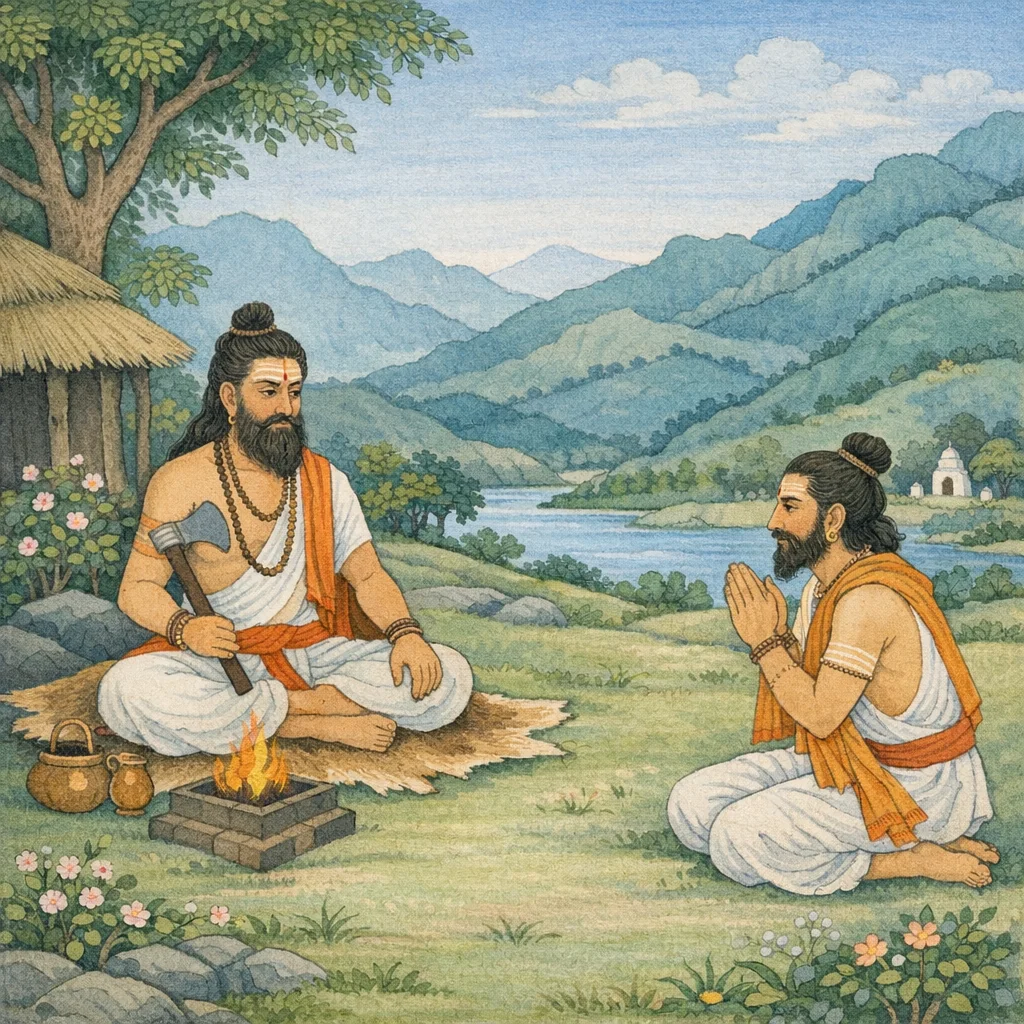
ततो महेन्द्रमासाद्य भारद्वाजो महातपा: । क्षान्तं दान्तममित्रघ्नमपश्यद् भूगुनन्दनम्,महेन्द्र पर्वतपर पहुँचकर महान् तपस्वी द्रोणने क्षमा एवं शम-दम आदि गुणोंसे युक्त शत्रुनाशक भृगुनन्दन परशुरामजीका दर्शन किया
Then the great ascetic Bhāradvāja, having reached Mount Mahendra, beheld Bhṛgu’s illustrious descendant Paraśurāma—patient and self-restrained, a destroyer of foes—endowed with forbearance and the disciplines of calm and control. The scene frames martial power as ethically grounded in inner mastery.
Verse 55
ततो द्रोणो वृत: शिष्यैरुपगम्य भगूद्धहम् । आचर्ख्यावात्मनो नाम जन्म चाजड्डिरस: कुले,तत्पश्चात् शिष्योंसहित द्रोणने भृगुश्रेष्ठ परशुरामजीके समीप जाकर अपना नाम बताया और यह भी कहा कि “मेरा जन्म आंगिरस कुलमें हुआ है'
Then Droṇa, surrounded by his disciples, approached the foremost of the Bhṛgus (Paraśurāma). He declared his own name and also stated his lineage, saying that he was born in the line of Aṅgiras—thus formally introducing himself in accordance with the respectful etiquette of approaching a revered teacher.
Verse 56
निवेद्य शिरसा भूमौ पादौ चैवाभ्यवादयत् । ततस्तं सर्वमुत्सृूज्य वनं जिगमिषुं तदा
Having bowed with his head to the ground and duly saluted the feet (of the elders), he then, casting aside all those worldly ties and arrangements, set out at that time with the intention of going to the forest—an act that signals humility, reverence, and a deliberate turning toward a life of restraint.
Verse 57
जामदग्न्यं महात्मानं भारद्वाजोडब्रवीदिदम् | भरद्वाजात् समुत्पन्नं तथा त्वं मामयोनिजम्
Vaiśampāyana said: Bhāradvāja addressed the great-souled Jāmadagnya, saying: “You are born from Bhāradvāja; and likewise I am not womb-born.” The statement underscores the sanctity of spiritual lineage and extraordinary birth, grounding authority not merely in biology but in ascetic power and dharmic transmission.
Verse 58
आगतं वित्तकामं मां विद्धि द्रोणं द्विजर्षभ । इस प्रकार नाम और गोत्र बताकर उन्होंने पृथ्वीपर मस्तक टेक दिया और परशुरामजीके चरणोंमें प्रणाम किया। तदनन्तर सर्वस्व त्यागकर वनमें जानेकी इच्छा रखनेवाले महात्मा जमदग्निकुमारसे द्रोणने इस प्रकार कहा--दद्विजश्रेष्ठ! मैं महर्षि भरद्वाजसे उत्पन्न उनका अयोनिज पुत्र हूँ। आपको यह ज्ञात हो कि मैं धनकी इच्छासे आया हूँ। मेरा नाम द्रोण है” || ५६-५७ $ || तमब्रवीन्महात्मा स सर्वक्षत्रियमर्दन:,यह सुनकर समस्त क्षत्रियोंका संहार करनेवाले महात्मा परशुराम उनसे यों बोले --
Drona said: “Know me to be Drona, O best of Brahmins. I have come here desiring wealth.” In this encounter, Drona openly declares his need and identity before Paraśurāma (the son of Jamadagni), approaching with humility and formal self-disclosure. The moment frames a moral tension: a Brahmin-born man, driven by material necessity, seeks resources from a formidable warrior-ascetic—setting the stage for how need, pride, and the pursuit of means can shape later destinies in the epic.
Verse 59
स्वागतं ते द्विजश्रेष्ठ यदिच्छसि वदस्व मे । एवमुक्तस्तु रामेण भारद्वाजोडब्रवीद् वच:,द्विजश्रेष्ठ! तुम्हारा स्वागत है। तुम जो कुछ भी चाहते हो, मुझसे कहो।” उनके इस प्रकार पूछनेपर भरद्वाजकुमार द्रोणने नाना प्रकारके धन-रत्नोंका दान करनेकी इच्छावाले, योद्धाओंमें श्रेष्ठ परशुरामसे कहा--“महान् व्रतका पालन करनेवाले महर्षे! मैं आपसे ऐसे धनकी याचना करता हूँ, जिसका कभी अन्त न हो”
Vaiśampāyana said: “Welcome to you, best of Brahmins. Tell me whatever you desire.” Thus addressed by Rāma (Paraśurāma), Bhāradvāja’s son (Droṇa) spoke these words—signaling a request to the warrior-sage famed for gifts and austerity, and setting the ethical tension between rightful asking, generous giving, and the consequences of wealth and power.
Verse 60
राम॑ प्रहरतां श्रेष्ठ दित्सन्तं विविध वसु । अहं धनमनन्तं हि प्रार्थये विपुलव्रत,द्विजश्रेष्ठ! तुम्हारा स्वागत है। तुम जो कुछ भी चाहते हो, मुझसे कहो।” उनके इस प्रकार पूछनेपर भरद्वाजकुमार द्रोणने नाना प्रकारके धन-रत्नोंका दान करनेकी इच्छावाले, योद्धाओंमें श्रेष्ठ परशुरामसे कहा--“महान् व्रतका पालन करनेवाले महर्षे! मैं आपसे ऐसे धनकी याचना करता हूँ, जिसका कभी अन्त न हो”
Vaiśampāyana said: “O Rāma, best among those who strike down foes, you who wish to bestow many kinds of wealth—O great observer of vows, foremost of Brahmins, I ask of you for wealth that has no end.” In the narrative setting, Droṇa, seeking a means to secure lasting resources and standing, approaches Paraśurāma—renowned both for martial supremacy and for generosity—to request inexhaustible wealth, raising the ethical tension between rightful need, dependence on patronage, and the proper use of gifts.
Verse 61
राम उवाच हिरण्यं मम यच्चान्यद् वसु किंचिदिह स्थितम् | ब्राह्मणेभ्यो मया दत्तं सर्वमेतत् तपोधन,परशुरामजी बोले--तपोधन! मेरे पास यहाँ जो कुछ सुवर्ण तथा अन्य प्रकारका धन था, वह सब मैंने ब्राह्मणोंको दे दिया। इसी प्रकार ग्राम और नगरोंकी पंक्तियोंसे सुशोभित होनेवाली समुद्रपर्यन्त यह सारी पृथ्वी महर्षि कश्यपको दे दी है
Rama said: “Whatever gold I had, and whatever other wealth was here in my possession—all of it, O ascetic rich in austerity, I have given away to the Brahmins.” The statement underscores Rama’s deliberate renunciation and the ethical ideal of relinquishing personal riches through sanctioned gifting, presenting charity (dāna) as a dharmic act that purifies ownership and redirects power toward religious and social order.
Verse 62
तथैवेयं धरा देवी सागरान्ता सपत्तना । कश्यपाय मया दत्ता कृत्स्ना नगरमालिनी,परशुरामजी बोले--तपोधन! मेरे पास यहाँ जो कुछ सुवर्ण तथा अन्य प्रकारका धन था, वह सब मैंने ब्राह्मणोंको दे दिया। इसी प्रकार ग्राम और नगरोंकी पंक्तियोंसे सुशोभित होनेवाली समुद्रपर्यन्त यह सारी पृथ्वी महर्षि कश्यपको दे दी है
Rama (Paraśurāma) said: “In the same way, this divine Earth—bounded by the ocean and adorned with a garland of towns and cities—has been given by me in its entirety to the sage Kaśyapa.” The statement underscores the ethic of complete renunciation and the ideal of transferring worldly sovereignty and wealth to a worthy Brahmin sage as an act of dharma and expiation.
Verse 63
शरीरमात्रमेवाद्य ममेदमवशेषितम् | अस्त्राणि च महाहाणि शस्त्राणि विविधानि च,अब मेरा यह शरीरमात्र बचा है। साथ ही नाना प्रकारके बहुमूल्य अस्त्र-शस्त्रोंका ज्ञान अवशिष्ट है
Rāma said: “Today, for me, nothing remains except this body itself; yet there still remains the knowledge of many kinds of mighty weapons—missiles and arms of diverse forms.” In context, the statement underscores a stark ethical tension: when worldly supports are exhausted and life is reduced to bare survival, one may still possess formidable power through martial knowledge—raising the question of how such power should be governed by dharma rather than desperation or pride.
Verse 64
अस्त्राणि वा शरीरं वा वरयैतन्मयोद्यतम् | वृणीष्व किं प्रयच्छामि तुभ्यं द्रोण वदाशु तत्,अतः तुम अस्त्र-शस्त्रोंका ज्ञान अथवा यह शरीर माँग लो। इसे देनेके लिये मैं सदा प्रस्तुत हूँ। द्रोण! बोलो, मैं तुम्हें क्या दूँ? शीघ्र उसे कहो
Rāma said: “Choose—either my weapons (the martial lore and arms) or even my own body, which I hold ready for your sake. Decide what you wish. O Droṇa, tell me at once: what shall I grant you?” The verse frames a teacher–student exchange in which the giver binds himself by honor and generosity, offering even life itself to fulfill a pledged gift.
Verse 65
द्रोण उदाच अस्त्राणि मे समग्राणि ससंहाराणि भार्गव | सप्रयोगरहस्यानि दातुमर्हस्यशेषत:,द्रोणगने कहा--भूगुनन्दन! आप मुझे प्रयोग, रहस्य तथा संहारविधिसहित सम्पूर्ण अस्त्र-शस्त्रोंका ज्ञान प्रदान करें
Droṇa said: “O Bhārgava, please grant me, without omission, the complete knowledge of weapons—together with their modes of withdrawal and neutralization, and with the secret principles of their proper application.” In the ethical frame of the epic, this request highlights that mastery of force is not merely acquisition of power, but also responsibility: knowing how to deploy a weapon must be matched by knowing how to restrain and recall it.
Verse 66
तथेत्युक्त्वा ततस्तस्मै प्रादादस्त्राणि भार्गव: । सरहस्यव्रतं चैव धनुर्वेदमशेषत:,तब “तथास्तु” कहकर भृगुवंशी परशुरामजीने द्रोणको सम्पूर्ण अस्त्र प्रदान किये तथा रहस्य और व्रतसहित सम्पूर्ण धनुर्वेदका भी उपदेश किया
Saying, “So be it,” the Bhārgava (Paraśurāma) then bestowed upon him the weapons. He also taught him, in full, the science of archery—together with its secret disciplines and the vows that govern its right use—thereby framing martial power within restraint and rule.
Verse 67
प्रतिगृहा तु तत्सवव कृतास्त्रो द्विजसत्तम: | प्रियं सखायं सुप्रीतो जगाम द्रुपदं प्रति,वह सब ग्रहण करके द्विजश्रेष्ठ द्रोण अस्त्र-विद्याके पूरे पण्डित हो गये और अत्यन्त प्रसन्न हो अपने प्रिय सखा ट्रपदके पास गये
Having accepted all that (instruction and training), the best of Brahmins, Droṇa, became fully accomplished in the science of weapons. Deeply pleased, he set out to meet his dear friend Drupada—an action that foreshadows how personal bonds and expectations can later become entangled with questions of honor, obligation, and dharma.
Verse 128
इस प्रकार श्रीमह्याभारत आदिपर्वके अन्तर्गत सम्भवपर्वमें भीमसेनके लौटनेसे सम्बन्ध रखनेवाला एक सौ अद्ठाईसवाँ अध्याय पूरा हुआ
Thus concludes the one hundred and twenty-eighth chapter of the Sambhava Parva, within the Ādi Parva of the revered Mahābhārata, dealing with Bhīmasena’s return. The closing formula signals a completed narrative unit and invites the listener to reflect on the moral weight of actions and their consequences as the lineage-story proceeds.
Verse 129
इति श्रीमहाभारते आदिपर्वणि सम्भवपर्वणि द्रोणस्य भार्गवादस्त्रप्राप्तौ ऊनत्रिंशदधिकशततमो<ध्याय:
Thus, in the Śrī Mahābhārata, within the Ādi Parva—specifically the Sambhava Parva—ends the one-hundred-and-twenty-ninth chapter, concerning Droṇa’s obtaining of weapons from the Bhārgava (Paraśurāma). This colophon signals the close of a narrative unit that frames martial power as something acquired through lineage, discipline, and the favor of a formidable teacher—raising ethical questions about how such power will later be used.
Verse 2336
वृष्णयश्च नृपाश्चान्ये नानादेशसमागता: । वृष्णिवंशी तथा भिन्न-भिन्न देशोंसे आये हुए अन्य नरेश भी उनसे धरनुर्वेदकी शिक्षा लेते थे
Vaiśampāyana said: The Vṛṣṇis, and other kings as well—having assembled from many different lands—used to receive from him instruction in the science of archery. Thus, rulers from diverse regions sought disciplined training in arms, reflecting the ideal that royal power should be grounded in skill, order, and proper tutelage rather than mere birth or ambition.
Frequently Asked Questions
The dilemma is whether state authority may be used to engineer a rival’s displacement under a lawful-looking administrative measure, despite awareness that the intent is ethically compromised and risks violating norms of equal kin-treatment.
Legitimacy is a moral-political asset: a ruler’s stability depends on public trust, prior benefaction, and credible fairness; policies motivated by internal fear or factional desire tend to require escalating rationalizations and institutional manipulation.
No explicit phalaśruti appears in this passage; its meta-function is diagnostic rather than devotional, illustrating how counsel, reputation, and ethical self-awareness interact in high-stakes governance decisions.