Adhyaya 4
वेदव्यासः, चातुर्होत्रम्, ऋग्वेदशाखाः (Vyāsa’s Veda-division and Ṛgveda lineages)
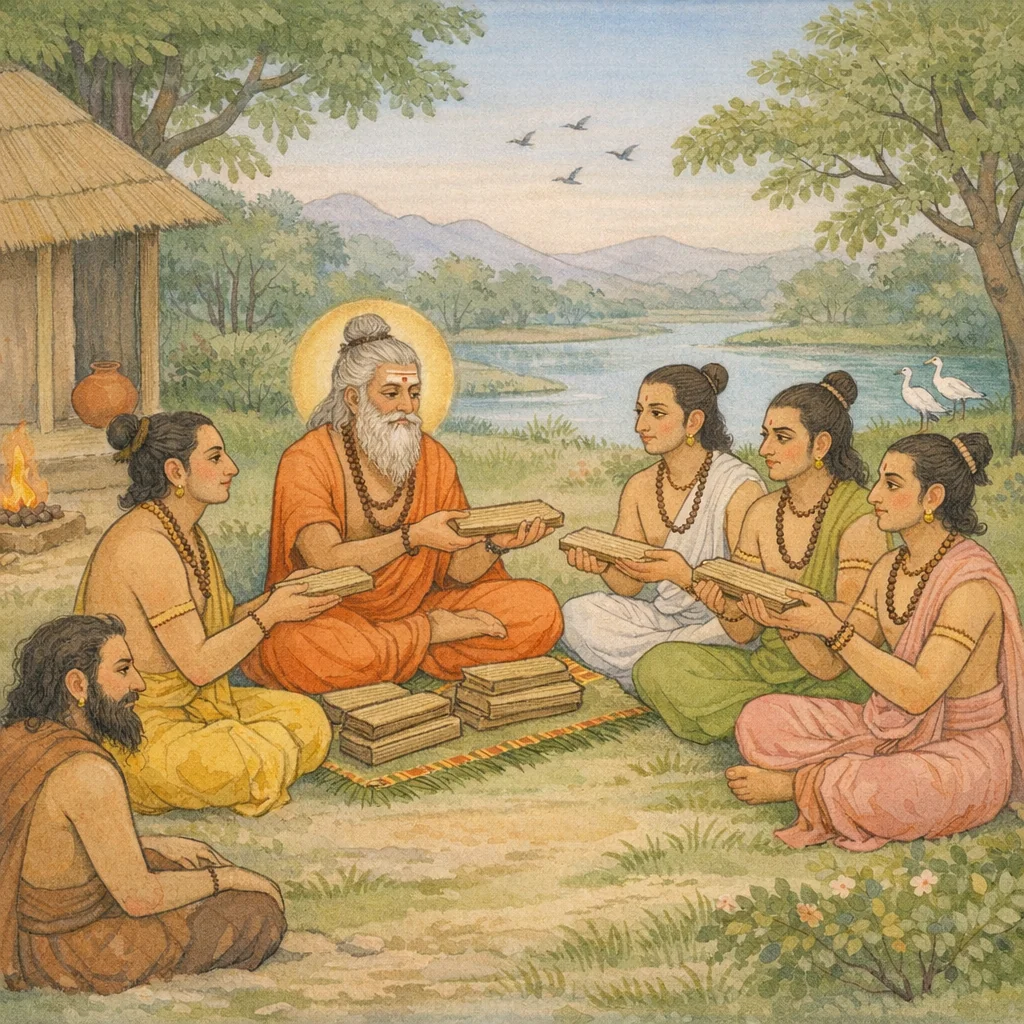
Parāśara teaches Maitreyā that the primal Veda is “four-footed,” yet yajña, the cosmic sustaining principle, is even more expansive. In the 28th interval, Vyāsa—declared to be Nārāyaṇa—divides the single Veda into four to preserve its transmission through changing ages. At Brahmā’s urging he appoints Paila for the Ṛgveda, Vaiśampāyana for the Yajurveda, Jaimini for the Sāmaveda, Sumantu for the Atharvaveda, and Romaharṣaṇa for Itihāsa–Purāṇa. Parāśara explains the cāturhotra (four priestly functions) and aligns them with the Vedic corpora: Adhvaryu–Yajus, Hotṛ–Ṛk, Udgātṛ–Sāman, Brahman–Atharvan. The chapter then traces Ṛgvedic lineages: Paila’s two saṃhitās to Indrapramati and Bāṣkala; Bāṣkala’s fourfold division and subsidiary lines (Baudhya, Agni, Māṭhara, Yājñavalkya, Parāśara); Indrapramati’s transmission to Māṇḍūkeya and beyond; and Śākalya’s five saṃhitās to Mudgala, Galava, Vātsya, Śālīya, and Śiśira, with sub-branches such as Kālāyani, Gārgya, and Java—concluding the Bahvṛca recensions.
Shlokas
Verse 1
आद्यो वेदश् चतुष्पादः शतसाहस्रसंमितः ततो दशगुणः कृत्स्नो यज्ञो ऽयं सर्वकामधुक्
The primal Veda is four-footed and measures a hundred thousand; yet this entire yajña is tenfold greater—like Kāmadhenu, the cow of plenty that grants every worthy desire.
Verse 2
ततो ऽत्र मत्सुतो व्यासो ऽष्टाविंशतितमे ऽन्तरे वेदम् एकं चतुष्पादं चतुर्धा व्यभजत् प्रभुः
Then, in this cycle, my son Vyāsa—the mighty sage—at the twenty-eighth interval divided the one Veda, complete in four parts, into four distinct portions.
Verse 3
यथा तु तेन वै व्यस्ता वेदव्यासेन धीमता वेदास् तथा समस्तैस् तैर् व्यस्ता व्यासैस् तथा मया
Just as the wise Vedavyāsa once set the Vedas in order, so later did all the Vyāsas in their own times—and in the same way, I as well.
Verse 4
तद् अनेनैव वेदानां शाखाभेदान् द्विजोत्तम चतुर्युगेषु रचितान् समस्तेष्व् अवधारय
Therefore, O best of the twice-born, grasp from this very account the full divisions of the Vedas into their branches, as set forth through the four Yugas.
Verse 5
कृष्णद्वैपायनं व्यासं विद्धि नारायणं प्रभुम् को ऽन्यो हि भुवि मैत्रेय महाभारतकृद् भवेत्
Know Kṛṣṇa-Dvaipāyana Vyāsa to be Nārāyaṇa Himself, the Sovereign Lord. For who else, O Maitreya, on this earth could compose the Mahābhārata?
Verse 6
तेन व्यस्ता यथा वेदा मत्पुत्रेण महात्मना द्वापरे ह्य् अत्र मैत्रेय तन् मे शृणु यथार्थतः
O Maitreya, in this Dvāpara age the Vedas were set in order by that great-souled one—my son. Now hear from me the matter as it truly is.
Verse 7
ब्रह्मणा चोदितो व्यासो वेदान् व्यस्तुं प्रचक्रमे अथ शिष्यान् स जग्राह चतुरो वेदपारगान्
Urged by Brahmā, Vyāsa began the great work of arranging and dividing the Vedas. Then he chose four disciples, perfected in Vedic learning, to bear and transmit that sacred heritage.
Verse 8
ऋग्वेदश्रावकं पैलं जग्राह स महामुनिः वैशम्पायननामानं यजुर्वेदस्य चाग्रहीत्
That great sage accepted Paila as the reciter and transmitter of the Ṛgveda, and appointed Vaiśampāyana as the custodian of the Yajurveda.
Verse 9
जैमिनिं सामवेदस्य तथैवाथर्ववेदवित् सुमन्तुस् तस्य शिष्यो ऽभूद् वेदव्यासस्य धीमतः
The wise Veda‑Vyāsa appointed Jaimini as master of the Sāma‑Veda; likewise Sumantu, knower of the Atharva‑Veda, became his disciple.
Verse 10
रोमहर्षणनामानं महाबुद्धिं महामुनिः सूतं जग्राह शिष्यं स इतिहासपुराणयोः
That great sage accepted as his disciple the Sūta named Romaharṣaṇa, of vast intelligence, appointing him as the bearer and expounder of Itihāsa and Purāṇa.
Verse 11
एक आसीद् यजुर्वेदस् तं चतुर्धा व्यकल्पयत् चातुर्होत्रम् अभूद् यस्मिंस् तेन यज्ञम् अथाकरोत्
The Yajurveda was once a single, undivided whole; then it was arranged into four divisions. From it arose the fourfold priestly function (cāturhotra), and by that ordered ministry the sacrifice was duly performed.
Verse 12
आध्वर्यवं यजुर्भिस् तु ऋग्भिर् होत्रं तथा मुनिः औद्गात्रं सामभिश् चक्रे ब्रह्मत्वं चाप्य् अथर्वभिः
That sage duly set the Adhvaryu’s office by the Yajur mantras, the Hotṛ’s office by the Ṛk verses, the Udgātṛ’s office by the Sāman chants, and likewise established the Brahman-priesthood by the Atharva hymns.
Verse 13
ततः स ऋच उद्धृत्य ऋग्वेदं कृतवान् मुनिः यजूंषि च यजुर्वेदं सामवेदं च सामभिः
Then that sage, drawing forth the ṛc verses, fashioned the Ṛgveda; from the yajus formulas he constituted the Yajurveda, and from the sāman chants he formed the Sāmaveda.
Verse 14
राज्ञस् त्व् अथर्ववेदेन सर्वकर्माणि स प्रभुः कारयाम् आस मैत्रेय ब्रह्मत्वं च यथास्थितिः
As for the king, that sovereign had all rites and royal acts performed in accordance with the Atharva-Veda; and, O Maitreya, the sacred order of brahminhood remained established in its proper station.
Verse 15
सो ऽयम् एको महावेदतरुस् तेन पृथक्कृतः चतुर्धा तु ततो जातं वेदपादपकाननम्
Thus that one, single Great Veda—like a vast living tree—was separated by him into four; from that division arose the Veda as a forest of branches and offshoots spreading in every direction.
Verse 16
बिभेद प्रथमं विप्र पैल ऋग्वेदपादपम् इन्द्रप्रमतये प्रादाद् बाष्कलाय च संहिते
First, O brāhmaṇa, Paila divided the great tree of the Ṛgveda, and bestowed its two Saṃhitās—one upon Indrapramati and the other upon Bāṣkala—so the Veda might be transmitted in due order.
Verse 17
चतुर्धा स बिभेदाथ बाष्कलो निजसंहिताम् बौध्यादिभ्यो ददौ तास् तु शिष्येभ्यः स महामतिः
Then the great-minded Bāṣkala divided his own Saṃhitā into four parts and bestowed those portions upon his disciples, beginning with Baudhya.
Verse 18
बौध्याग्निमाठरौ तद्वद् याज्ञवल्क्यपराशरौ प्रतिशाखास् तु शाखायास् तस्यास् ते जगृहुर् मुने
So too, O sage, Baudhya, Agni, and Māṭhara—as also Yājñavalkya and Parāśara—became subsidiary branches of that school, receiving its transmission in their own lines.
Verse 19
इन्द्रप्रमतिर् एकां तु संहितां स्वसुतं ततः माण्डुकेयं महात्मानं मैत्रेयाध्यापयत् तदा
Then Indrapramati transmitted one recension of the Saṃhitā to his own son; and at that time he instructed the great-souled Mānḍūkeya, who in turn taught it to Maitreya.
Verse 20
तस्य शिष्यप्रशिष्येभ्यः पुत्रशिष्यान् क्रमाद् ययौ
From him, in due succession, the tradition passed onward—from disciples to grand-disciples, and then, step by step, to the disciples of his sons.
Verse 21
वेदमित्रस् तु शाकल्यः संहितां ताम् अधीतवान् चकार संहिताः पञ्च शिष्येभ्यः प्रददौ च ताः
But Vedamitra Śākalya, having thoroughly mastered that Saṃhitā, arranged it into five Saṃhitās and bestowed those five upon his disciples.
Verse 22
तस्य शिष्यास् तु ये पञ्च तेषां नामानि मे शृणु मुद्गलो गालवश् चैव वात्स्यः शालीय एव च शिशिरः पञ्चमश् चासीत् मैत्रेय सुमहामुनिः
O Maitreya, hear from me the names of his five disciples: Mudgala and Galava, Vātsya and Śālīya; and as the fifth there was Śiśira, a great sage.
Verse 23
संहितात्रितयं चक्रे शाकपूणिर् अथेतरः निरुक्तम् अकरोत् तद्वच् चतुर्थं मुनिसत्तम
O best of sages, Śākapūṇi composed three Saṃhitās; and another seer likewise produced the discipline of Nirukta as a fourth.
Verse 24
क्रौञ्चो वैतालकिस् तद्वद् बलाकश् च महामुनिः निरुक्तश् च चतुर्थो ऽभूद् वेदवेदाङ्गपारगः
Krauñca, and likewise Vaitālaki; and Balāka, that great sage—Nirukta was the fourth among them, a master who had crossed to the far shore of the Veda and all its auxiliary sciences.
Verse 25
इत्य् एताः प्रतिशाखाभ्यो ऽप्य् अनुशाखा द्विजोत्तम बाष्कलश् चापरास् तिस्रः संहिताः कृतवान् द्विज शिष्यः कालायनिर् गार्ग्यस् तृतीयश् च तथा जवः
Thus, O best of the twice-born, from those branch-traditions (pratiśākhās) there arose further sub-branches (anuśākhās). And the Brahmin Bāṣkala composed three other distinct Saṃhitās; his disciples were Kālāyani, Gārgya (the third), and likewise Java.
Verse 26
इत्य् एते बह्वृचाः प्रोक्ताः संहिता यैः प्रवर्तिताः
Thus have these Bahvṛcas been declared—those by whom the sacred Saṃhitās were set in motion and made to flourish in the world.
Frequently Asked Questions
Cāturhotra is the fourfold priestly ministry of yajña. Parāśara aligns each office with a Vedic corpus: Adhvaryu with Yajus-mantras, Hotṛ with Ṛk-verses, Udgātṛ with Sāman-chants, and the Brahman-priest with Atharvan hymns—showing yajña as a single ordered body.
Paila gives two saṃhitās to Indrapramati and Bāṣkala. Bāṣkala further divides and transmits to disciples beginning with Baudhya; Śākalya systematizes into five saṃhitās and hands them to Mudgala, Galava, Vātsya, Śālīya, and Śiśira, with later sub-branches including Kālāyani, Gārgya, and Java.