Adhyaya 5
मेरु-प्रमाणम्, सप्त-पाताल-वर्णनम्, तथा अनन्त-शेष-तत्त्वम्
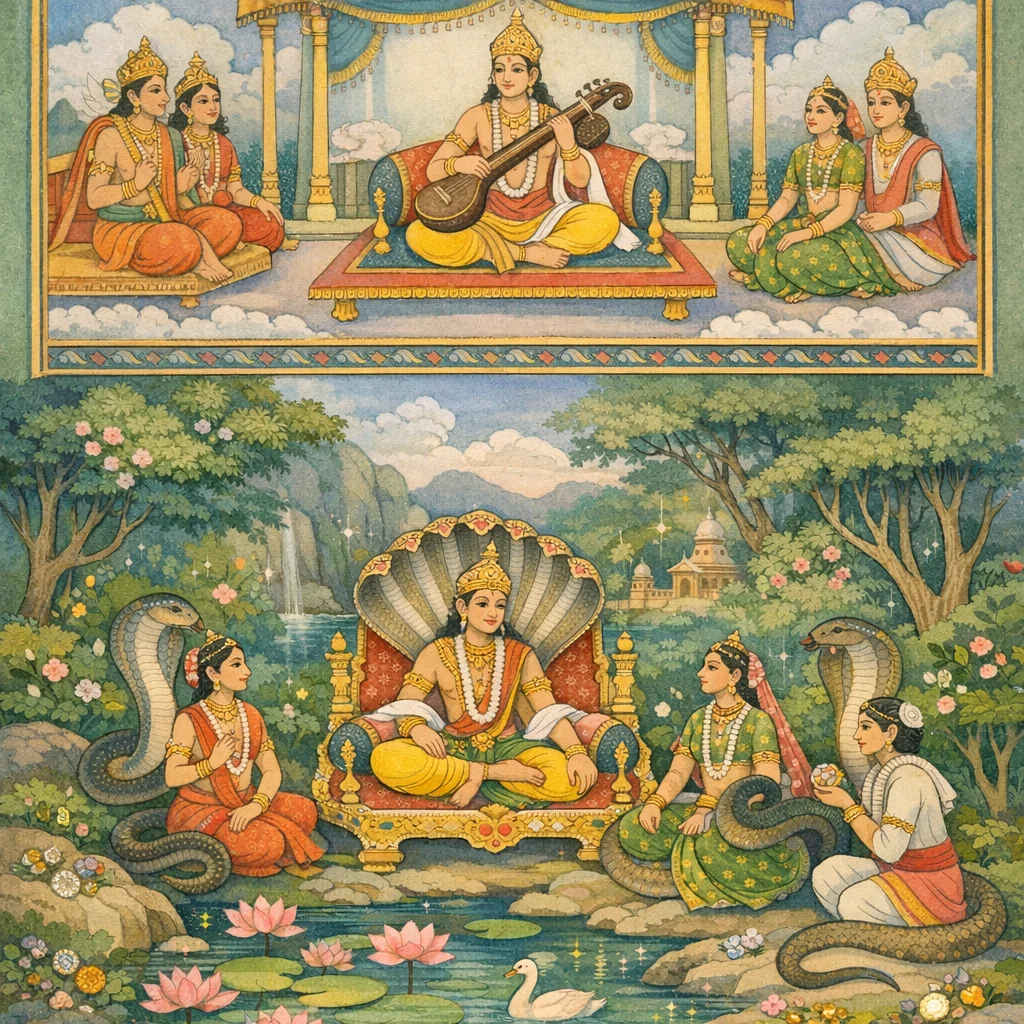
Parāśara continues instructing Maitreya: he states Meru’s height and then lists the seven Pātālas, each spreading ten thousand yojanas. These nether realms are portrayed as dazzling—many-hued lands with mansions—inhabited by Dānavas, Daityas, and mighty Nāgas. Citing Nārada’s testimony, Parāśara stresses that Pātāla can seem more delightful than Svarga, rich with jewels, music, forests, rivers, and pleasures where time is scarcely felt. The account then descends beneath Pātāla to Viṣṇu’s manifestation as Śeṣa/Ananta, praised by Siddhas and worshipped by gods and sages: thousand-headed, jewel-hooded, radiant, and bearing the whole earth at Pātāla’s root. Parāśara explains that Ananta’s power is beyond description; when He stirs, the earth trembles, and His endless qualities make the name “Ananta” true. Thus the chapter grounds cosmography in theology: the world rests on divine support, ultimately in Viṣṇu’s śakti and presence.
Shlokas
Verse 1
विस्तार एष कथितः पृथिव्या भवतो मया सप्ततिस् तु सहस्राणि द्विजोच्छ्रायो ऽपि कथ्यते
Thus I have explained to you the extent of the earth. Now the height of Mount Meru—the lofty ‘twice-born’ among mountains—is also declared to be seventy thousand (yojanas).
Verse 2
दशसाहस्रम् एकैकं पातालं मुनिसत्तम अतलं वितलं चैव नितलं च गभस्तिमत् महाख्यं सुतलं चाग्र्यं पातालं चापि सप्तमम्
Each of the nether realms, O best of sages, extends for ten thousand (yojanas). They are Atala, Vitala, Nitala, and Gabhastimat; then Mahākhya and the excellent Sutala; and the seventh is also called Pātāla.
Verse 3
शुक्लकृष्णारुणाः पीताः शर्कराः शैलकाञ्चनाः भूमयो यत्र मैत्रेय वरप्रासादशोभिताः
There, O Maitreya, are lands adorned with splendid mansions; and there are gravels and soils of many hues—white, black, ruddy, and yellow—some gleaming like mountain-gold itself.
Verse 4
तेषु दानवदैतेयजातयः शतसंघशः निवसन्ति महानागजातयश् च महामुने
In those realms dwell, in hundreds of clusters, the many tribes of the Dānavas and Daiteyas; and there too abide the mighty races of the great Nāgas—O great sage.
Verse 5
स्वर्लोकाद् अपि रम्याणि पातालानीति नारदः प्राह स्वर्गसदां मध्ये पातालाभ्यागतो दिवि
Having visited Pātāla and then risen to heaven, Nārada proclaimed among the dwellers of Svarga: “More delightful even than the heavenly world are the realms of Pātāla.”
Verse 6
आह्लादकारिणः शुभ्रा मणयो यत्र सुप्रभाः नागाभरणभूषासु पातालं केन तत्समम्
There, in Pātāla, radiant white jewels shine with delight-bestowing splendor; amid the ornaments and adornments of the Nāgas—what realm could ever be compared with that Pātāla?
Verse 7
दैत्यदानवकन्याभिर् इतश् चेतश् च शोभिते पाताले कस्य न प्रीतिर् विमुक्तस्यापि जायते
In Pātāla—adorned on every side by the maidens of the Daityas and Dānavas—whose heart would not be stirred to delight, even if he were one who has already attained liberation?
Verse 8
दिवार्करश्मयो यत्र प्रभां तन्वन्ति नातपम् शशिनश् च न शीताय निशि द्योताय केवलम्
In that realm, the sun’s rays spread only radiance—never scorching heat; and the moon, by night, shines purely to illumine, not to cast cold.
Verse 9
भक्ष्यभोज्यमहापानमुदितैर् अतिभोगिभिः यत्र न ज्ञायते कालो गतो ऽपि दनुजादिभिः
There, amid abundant delicacies, feasts, and mighty draughts, the excessively pleasure-seeking rejoice in their enjoyments and do not perceive the passage of Kāla (Time), though ages have slipped away even for the Dānavas and the like.
Verse 10
वनानि नद्यो रम्याणि सरांसि कमलाकराः पुंस्कोकिलाभिलापाश् च मनोज्ञान्य् अम्बराणि च
There were lovely forests and rivers, lakes that were treasure-houses of lotuses, the enchanting calls of male cuckoos, and skies that delighted the mind.
Verse 11
भूषणान्य् अतिशुभ्राणि गन्धाढ्यं चानुलेपनम् वीणावेणुमृदङ्गानां स्वनास् तूर्याणि च द्विज
There were ornaments of dazzling brilliance and fragrant unguents rich with perfume; and, O twice-born one, the resonant sounds of the vīṇā, flute, and mṛdaṅga—along with other instruments—filled the scene.
Verse 12
एतान्य् अन्यानि चोदारभाग्यभोग्यानि दानवैः दैत्योरगैश् च भुज्यन्ते पातालान्तरगोचरैः
These and many other splendid delights—fruits of exalted fortune—are enjoyed by the Dānavas, the Daityas, and the serpent-races, who move and dwell within the inner realms of Pātāla.
Verse 13
पातालानाम् अधश् चास्ते विष्णोर् या तामसी तनुः शेषाख्या यद्गुणान् वक्तुं न शक्ता दैत्यदानवाः
Beneath the regions of Pātāla abides that Tamas-clad manifestation of Lord Viṣṇu—known as Śeṣa—whose attributes and excellences even the Daityas and Dānavas are powerless to describe.
Verse 14
यो ऽनन्तः पठ्यते सिद्धैर् देवदेवर्षिपूजितः सहस्रशिरसा व्यक्तस्वस्तिकामलभूषणः
He whom the perfected Siddhas hymn as Ananta—revered by the gods and the god-sages—thousand-headed, manifest in auspicious emblems, adorned with garlands and lotus-like ornaments.
Verse 15
फणामणिसहस्रेण यः स विद्योतयन् दिशः सर्वान् करोति निर्वीर्यान् हिताय जगतो ऽसुरान्
He whose thousand serpent-hood jewels blaze forth, illuminating every direction—he drains the strength of the Asuras, rendering them powerless, and does so for the welfare of the world.
Verse 16
मदाघूर्णितनेत्रो ऽसौ यः सदैवैककुण्डलः किरीटी स्रग्धरो भाति साग्निः श्वेत इवाचलः
His eyes roll with intoxication; he ever wears a single earring. Crowned and garlanded, he shines like a white mountain lit by fire.
Verse 17
नीलवासा मदोत्सिक्तः श्वेतहारोपशोभितः साभ्रगङ्गाप्रपातो ऽसौ कैलासाद्रिर् इवोन्नतः
Clad in deep-blue garments, uplifted with proud exhilaration and splendid with a white garland, he stood lofty—like Mount Kailāsa, with the Gaṅgā cascading down its cloud-wreathed slopes.
Verse 18
लाङ्गलासक्तहस्ताग्रो बिभ्रन् मुसलम् उत्तमम् उपास्यते स्वयं कान्त्या यो वारुण्या च मूर्तया
With the tip of his hand set upon the plough, bearing the excellent pestle as his weapon, he is worshipped by his own radiant splendour—and also in the form of Vāruṇī, the watery, ocean-born manifestation.
Verse 19
कल्पान्ते यस्य वक्त्रेभ्यो विषानलशिखोज्ज्वलः संकर्षणात्मको रुद्रो निष्क्रम्यात्ति जगत्त्रयम्
At the end of a kalpa, from His mouths bursts forth Rudra—of the very nature of Saṅkarṣaṇa—blazing with tongues of fire like venomous flame; emerging, he consumes the three worlds.
Verse 20
स बिभ्रच् छेखरीभूतम् अशेषं क्षितिमण्डलम् आस्ते पातालमूलस्थः शेषो ऽशेषसुरार्चितः
There, at the very root of Pātāla, abides Śeṣa—revered by all the gods—bearing the entire sphere of the earth, which rests upon him like a cresting diadem.
Verse 21
तस्य वीर्यं प्रभावश् च स्वरूपं रूपम् एव च न हि वर्णयितुं शक्यं ज्ञातुं वा त्रिदशैर् अपि
His might and sovereign majesty—His very essential nature and even His manifest form—cannot truly be described, nor can they be fully known, not even by the Thirty-three gods.
Verse 22
यस्यैषा सकला पृथ्वी फणामणिशिखारुणा आस्ते कुसुममालेव कस् तद्वीर्यं वदिष्यति
He upon whom this entire Earth rests—glowing red with the radiance of the jewels upon the hoods of the serpent—like a garland of flowers laid upon a body: who could ever fully declare the measure of His might?
Verse 23
यदा विजृम्भते ऽनन्तो मदाघूर्णितलोचनः तदा चलति भूर् एषा साद्रितोया सकानना
Whenever Ananta stirs—his eyes rolling as though intoxicated with his own immeasurable power—then this Earth begins to tremble: with her mountains and waters, with all her forests, the whole world is set in motion.
Verse 24
गन्धर्वाप्सरसः सिद्धाः किंनरोरगचारणाः नान्तं गुणानां गच्छन्ति तेनानन्तो ऽयम् अव्ययः
Gandharvas and Apsarases, the Siddhas, the Kiṃnaras, the Nāgas, and the Cāraṇas—none can reach the end of His qualities; therefore He is called Ananta, the Endless, and Avyaya, the Imperishable.
Verse 25
यस्य नागवधूहस्तैर् लेपितं हरिचन्दनम् मुहुः श्वासानिलापास्तं याति दिक्षूदवासताम्
His body is anointed again and again with Hari-sandal by the hands of Nāga maidens; its fragrance, borne ceaselessly on the breeze of His own breath, spreads to every quarter and reaches even those who dwell far away.
Verse 26
यम् आराध्य पुराणर्षिर् गर्गो ज्योतींषि तत्त्वतः ज्ञातवान् सकलं चैव निमित्तपठितं फलम्
Having worshipped Him, the ancient seer Garga came to know the science of the luminaries in its true principles, and also the entire fruit that arises from reading and interpreting omens.
Verse 27
तेनेयं नागवर्येण शिरसा विधृता मही बिभर्ति मालां लोकानां सदेवासुरमानुषाम्
By that foremost of Nāgas, the Earth is borne aloft upon his head; and thus upheld, she sustains the entire garland of worlds—together with gods, asuras, and humankind.
Frequently Asked Questions
Atala, Vitala, Nitala, Gabhastimat, Mahākhya, Sutala, and Pātāla—each described as extending ten thousand yojanas.
Because no class of exalted beings—Gandharvas, Apsarases, Siddhas, Kiṃnaras, Nāgas, or Cāraṇas—can reach the end of His qualities; His attributes are presented as inexhaustible (an-anta).
It places the ultimate support of the earth not in impersonal mechanics but in Viṣṇu’s manifestation as Śeṣa/Ananta, making the physical world’s stability a direct expression of Bhagavān’s sustaining power.