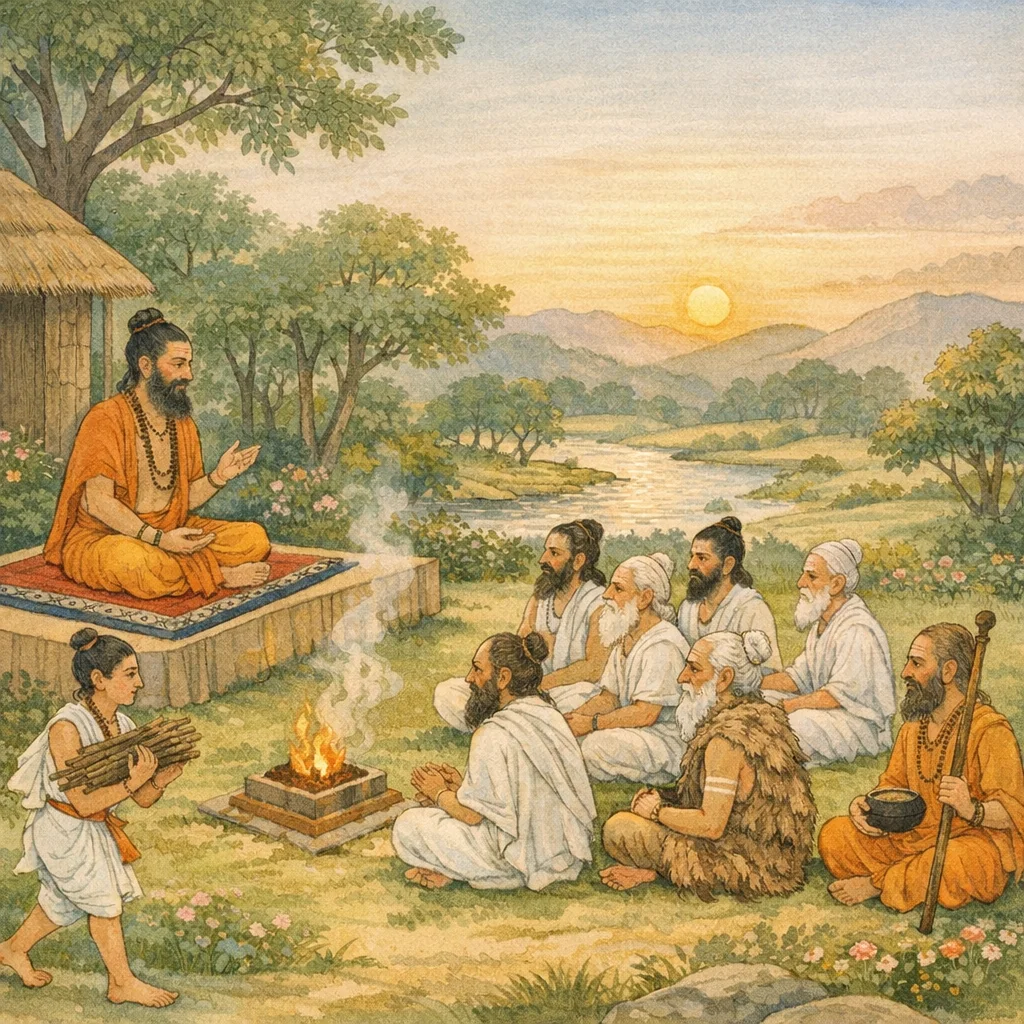
अग्नियज्ञ-देवयज्ञ-ब्रह्मयज्ञ-गुरुपूजा-क्रमनिरूपणम् / Ordering and Definitions of Agniyajña, Devayajña, Brahmayajña, and Guru-Pūjā
This adhyāya unfolds as a didactic dialogue: the ṛṣis ask for a step-by-step account of agniyajña, devayajña, brahmayajña, and guru-pūjā, together with the idea of brahma-tṛpti. Sūta defines agniyajña as offering substances into the sacred fire, and explains it according to āśrama: for brahmacārins it includes samid-ādhāna and upāsanā-related observances; for vānaprasthins and yatis it becomes the “internalized/carried fire,” fulfilled by taking pure, measured food at proper times as a functional homa. The text distinguishes evening and morning offerings and presents agniyajña as a daytime rite aligned with the sun’s course, with oblations to Indra and other devas. Devayajña is described through rites such as sthālīpāka and domestic, saṃskāra-linked acts (e.g., cūḍā/caula) established in the laukika household fire. Brahmayajña is defined succinctly as Veda-adhyayana performed for the devas’ “tṛpti,” making sacred study itself a formal yajña. Overall, the chapter serves as a ritual-lexicon that harmonizes household and renunciant disciplines within a single graded system.
Shlokas
Verse 1
ऋषय ऊचुः । अग्नियज्ञं देवयज्क्तं ब्रह्मयज्क्तं तथैव च । गुरुपूजां ब्रह्मतृप्तिं क्रमेण ब्रूहि नः प्रभो
The sages said: “O Lord, explain to us in due order the Agni-sacrifice, the worship offered to the gods, the Brahma-yajña as well, the honoring of the Guru, and the means by which Brahman (the Supreme Reality) is satisfied.”
Verse 2
सूत उवाच । अग्नौ जुहोति यद्द्रव्यमग्नियज्ञः स उच्यते । ब्रह्मचर्याश्रमस्थानां समिदाधानमेव हि
Sūta said: “Whatever substance is offered into the sacred fire is called Agni-yajña, the fire-sacrifice. Indeed, for those established in the brahmacarya-āśrama, the essential observance is the placing of samidh, the fuel-sticks, into the fire.”
Verse 3
समिदग्रौ व्रताद्यं च विशेषयजनादिकम् । प्रथमाश्रमिणामेवं यावदौपासनं द्विजाः
O twice-born ones, for those in the first āśrama, brahmacarya, the offering of samidh into the fire, the observance of vows (vrata) and related disciplines, and special sacrificial rites—thus far—constitute their prescribed daily worship, aupāsana.
Verse 4
आत्मन्यारोपिताग्नीनां वनिनां यतिनां द्विजाः । हितं च मितमेध्यान्नं स्वकाले भोजनं हुतिः
O twice-born ones, for the forest-dwelling ascetics and the yatis, the renunciants, who have established the sacred fire within themselves, eating wholesome, measured, and pure food at the proper time is itself a huti, a sacrificial offering.
Verse 5
औपासनाग्निसंधानं समारभ्य सुरक्षितम् । कुंडे वाप्यथ भांडे वा तदजस्रं समीरितम्
Having begun the proper kindling and establishment of the domestic sacred fire (aupāsana), one should protect it carefully—whether it is kept in a fire-pit (kuṇḍa) or in a vessel—maintaining it continuously without interruption.
Verse 6
अग्निमात्मन्यरण्यां वा राजदैववशाद्ध्रुवम् । अग्नित्यागभयादुक्तं समारोपितमुच्यते
When, under the compelling force of the king’s decree or of fate, one speaks of ‘placing fire’ either upon oneself or in a forest—this statement, uttered from fear of abandoning the sacred fire, is called a superimposed (figurative) attribution.
Verse 7
संपत्करी तथा ज्ञेया सायमग्न्याहुतिर्द्विजाः । आयुष्करीति विज्ञेया प्रातः सूर्याहुतिस्तथा
O twice-born ones, know that the evening oblation into the sacred fire is a giver of prosperity; likewise, understand that the morning oblation offered to the Sun is a giver of longevity.
Verse 8
अग्नियज्ञो ह्ययं प्रोक्तो दिवा सूर्यनिवेशनात् । इंद्रा दीन्सकलान्देवानुद्दिश्याग्नौ जुहोतियत्
This is called the Agni-yajña, because it is performed in the daytime, when the Sun is established in the sky. In it, one offers oblations into the sacred fire, dedicating them to Indra and to all the other Devas—while understanding that such rites are ultimately fulfilled only by Śiva, the Lord of all.
Verse 9
देवयज्ञं हि तं विद्यात्स्थालीपाकादिकान्क्रतून् । चौलादिकं तथा ज्ञेयं लौकिकाग्नौ प्रतिष्ठितम्
Know that as the deva-yajña: the sacrificial rites such as the sthālīpāka and other kratus. Likewise, the rites beginning with the child’s tonsure (cūḍā/caula) are to be understood as worldly (laukika) observances, established in the domestic fire.
Verse 10
ब्रह्मयज्ञं द्विजः कुर्याद्देवानां तृप्तये सकृत् । ब्रह्मयज्ञ इति प्रोक्तो वेदस्याऽध्ययनं भवेत्
A twice-born person (dvija) should perform the Brahma-yajña once, for the satisfaction of the gods. This is declared to be ‘Brahma-yajña’: it consists in the study of the Veda—its recitation and contemplation.
Verse 11
नित्यानंतरमासोयं ततस्तु न विधीयते । अनग्नौ देवयजनं शृणुत श्रद्धयादरात्
This month, which follows the daily observances, is not prescribed again beyond that. Now listen with faith and reverence to the worship of the Deity that is performed without fire.
Verse 12
आदिसृष्टौ महादेवः सर्वज्ञः करुणाकरः । सर्वलोकोपकारार्थं वारान्कल्पितवान्प्रभुः
At the very beginning of creation, Mahādeva—the omniscient Lord, the very source of compassion—devised the sacred disciplines and observances (vāra) for the welfare of all worlds.
Verse 13
संसारवैद्यः सर्वज्ञः सर्वभेषजभेषजम् । आदावारोग्यदं वारं स्ववारं कृतवान्प्रभुः
The Lord—physician of saṃsāra, all-knowing, the remedy of all remedies—first established His own sacred day (svavāra), a day that bestows health and freedom from affliction.
Verse 14
इति श्रीशिवमहापुराणे विद्येश्वरसंहितायां चतुर्दशोऽध्यायः
Thus ends the Fourteenth Chapter in the Vidyeśvara-saṃhitā of the Śrī Śiva Mahāpurāṇa.
Verse 15
आलस्यदुरितक्रांत्यै वारं कल्पितवान्प्रभुः । रक्षकस्य तथा विष्णोर्लोकानां हितकाम्यया
Wishing the welfare of the worlds, the Lord ordained the “Varāha” (Boar) incarnation to overcome the evil arising from sloth, and likewise established Viṣṇu as the protector of creation.
Verse 16
पुष्ट्यर्थं चैव रक्षार्थं वारं कल्पितवान्प्रभुः । आयुष्करं ततो वारमायुषां कर्तुरेव हि
For the sake of nourishment and for protection, the Lord ordained the sacred observance on that particular weekday. Therefore that weekday itself becomes a giver of longevity, because it is established by the very Maker and Lord of life-spans.
Verse 17
त्रैलोक्यसृष्टिकर्त्तुर्हि ब्रह्मणः परमेष्ठिनः । जगदायुष्यसिद्ध्यर्थं वारं कल्पितवान्प्रभुः
For Brahmā, the Supreme Ordainer and creator of the three worlds, the Lord established the division of time into “days” (vāras), so that the lifespan and orderly continuance of the universe might be fulfilled.
Verse 18
आदौ त्रैलोक्यवृद्ध्यर्थं पुण्यपापे प्रकल्पिते । तयोः कर्त्रोस्ततो वारमिंद्र स्य च यमस्य च
In the beginning, for the increase and orderly growth of the three worlds, merit and sin were instituted. Thereafter their administrators were appointed—Indra for merit and Yama for sin.
Verse 19
भोगप्रदं मृत्युहरं लोकानां च प्रकल्पितम् । आदित्यादीन्स्वस्वरूपान्सुखदुःखस्य सूचकान्
It has been ordained for the worlds as that which grants the experience of enjoyment (bhoga) and removes death; and the Sun and the other celestial powers are established in their own forms as indicators of joy and sorrow.
Verse 20
वारेशान्कल्पयित्वादौ ज्योतिश्चक्रेप्रतिष्ठितान् । स्वस्ववारे तु तेषां तु पूजा स्वस्वफलप्रदा
After first fashioning the Lords of the weekdays (Vāreśas) and establishing them in the Wheel of Lights (jyoti-cakra), their worship on their respective days bestows the particular fruit belonging to each.
Verse 21
आरोग्यं संपदश्चैव व्याधीनां शांतिरेव च । पुष्टिरायुस्तथा भोगो मृतेर्हानिर्यथाक्रमम्
Health and prosperity, the pacification of diseases, nourishment, longevity, and the capacity to enjoy life—thus, in due order, there is also the warding off of untimely death.
Verse 22
वारक्रमफलं प्राहुर्देवप्रीतिपुरःसरम् । अन्येषामपि देवानां पूजायाः फलदः शिवः
They declare that the fruit attained in due order (according to the prescribed sequence of worship) is preceded by the satisfaction of the gods; yet even for worship offered to other deities, it is Śiva alone who bestows the resulting reward.
Verse 23
देवानां प्रीतये पूजापंचधैव प्रकल्पिता । तत्तन्मंत्रजपो होमो दानं चैव तपस्तथा
For the satisfaction of the Devas, worship has indeed been established as fivefold: the repetition (japa) of the appropriate mantras, the offering into the sacred fire (homa), charitable giving (dāna), and austerity (tapas) as well.
Verse 24
स्थंडिले प्रतिमायां च ह्यग्नौ ब्राह्मणविग्रहे । समाराधनमित्येवं षोडशैरुपचारकैः
Thus, true worship (samārādhana) is performed with the sixteen offerings—whether Śiva is worshipped on a consecrated ground-maṇḍala, in an image, in the sacred fire, or in the embodied presence of a Brāhmaṇa.
Verse 25
उत्तरोत्तरवैशिष्ट्यात्पूर्वाभावे तथोत्तरम् । नेत्रयोः शिरसो रोगे तथा कुष्ठस्य शांतये
Because each succeeding means is progressively more distinguished, if the former is unavailable one should adopt the next. It is prescribed for the relief of diseases of the eyes and head, and likewise for the pacification of leprosy (kuṣṭha).
Verse 26
आदित्यं पूजयित्वा तु ब्राह्मणान्भोजयेत्ततः । दिनं मासं तथा वर्षं वर्षत्रयमथवापि वा
Having worshipped Āditya (the Sun) first, one should then feed the Brāhmaṇas—doing so for a day, or for a month, or for a year, or even for three years.
Verse 27
प्रारब्धं प्रबलं चेत्स्यान्नश्येद्रो गजरादिकम् । जपाद्यमिष्टदेवस्य वारादीनां फलं विदुः
When the momentum of prārabdha-karma (destined results already set in motion) grows exceedingly strong, even remedies such as medicines and similar means for destroying disease and affliction may fail. But the wise know that observances beginning with sacred vows (vratas) and practices beginning with japa—performed for one’s chosen Lord—bear their fruit unfailingly.
Verse 28
पापशांतिर्विशेषेण ह्यादिवारे निवेदयेत् । आदित्यस्यैव देवानां ब्राह्मणानां विशिष्टदम्
For the special pacification of sins, one should present the prescribed offering, especially on Ādivāra (Sunday). For among the gods it is the day of Āditya, the Sun, and among Brāhmaṇas it is held to be especially potent in bestowing distinguished merit.
Verse 29
सोमवारे च लक्ष्म्यादीन्संपदर्थं यजेद्बुधः । आज्यान्नेन तथा विप्रान्सपत्नीकांश्च भोजयेत्
On a Monday, a wise devotee should perform worship for the sake of prosperity—beginning with Lakṣmī and the other auspicious powers—and then he should feed brāhmaṇas along with their wives, offering them food prepared with ghee.
Verse 30
काल्यादीन्भौम वारे तु यजेद्रो गप्रशांतये । माषमुद्गाढकान्नेन ब्रह्मणांश्चैव भोजयेत्
For the pacification of disease, one should perform worship on a Tuesday, beginning from the early hours; and one should also feed brāhmaṇas with a meal prepared from black gram, green gram, and grains measured by an āḍhaka. Thus, by disciplined ritual action offered to Śiva, the affliction is calmed.
Verse 31
सौम्यवारे तथा विष्णुं दध्यन्नेन यजेद्बुधः । पुत्रमित्रकलत्रादिपुष्टिर्भवति सर्वदा
Likewise, on Soma’s day (Monday), a wise devotee should worship Viṣṇu with curd and cooked rice; thereby, the flourishing of one’s son, friends, spouse, and other supports of life arises always.
Verse 32
आयुष्कामो गुरोर्वारे देवानां पुष्टिसिद्धये । उपवीतेन वस्त्रेण क्षीराज्येन यजेद्बुधः
Desiring longevity, a wise devotee should worship on the day of Guru (Bṛhaspati/Thursday). For the nourishment and strengthening of the deities, he should perform the rite wearing the sacred thread and cloth, offering milk and ghee.
Verse 33
भोगार्थं भृगवारे तु यजेद्देवान्समाहितः । षड्रसोपेतमन्नं च दद्याद्ब्राह्मणतृप्तये
Seeking wholesome worldly enjoyment (bhoga), one should on Friday worship the deities with a collected mind; and one should also offer food endowed with the six tastes, for the satisfaction of the brāhmaṇas.
Verse 34
स्त्रीणां च तृप्तये तद्वद्देयं वस्त्रादिकं शुभम् । अपमृत्युहरे मंदे रुद्रा द्री श्चं यजेद्बुधः
Likewise, for the satisfaction of women, auspicious gifts such as garments and the like should be given. When Saturn’s influence is to be pacified—especially to ward off untimely death—the wise should worship Rudrādriśa, the Lord of Rudra’s mountain, that is, Śiva.
Verse 35
तिलहोमेन दानेन तिलान्नेन च भोजयेत् । इत्थं यजेच्च विबुधानारोग्यादिफलं लभेत्
By offering sesame into the sacred fire, by giving sesame in charity, and by feeding others with food prepared with sesame—worshipping the gods in this way, one attains the fruits beginning with health and freedom from disease.
Verse 36
देवानां नित्ययजने विशेषयजनेपि च । स्नाने दाने जपे होमे ब्राह्मणानां च तर्पणे
In the daily worship of the gods and also in special sacrificial rites; in purificatory bathing, in charitable giving, in mantra-recitation (japa), in fire-offerings (homa), and in the satiating offerings (tarpaṇa) made to Brāhmaṇas—these are the prescribed sacred acts.
Verse 37
तिथिनक्षत्रयोगे च तत्तद्देवप्रपूजने । आदिवारादिवारेषु सर्वज्ञो जगदीश्वरः
In observances connected with lunar days (tithi), constellations (nakṣatra), and auspicious yogas—and in the worship duly offered to the respective deities on their appointed occasions and weekdays such as Sunday and the rest—it is Jagadīśvara, the all-knowing Lord of the universe, Śiva, who is truly present as the inner ruler and fulfiller.
Verse 38
तत्तद्रू पेण सर्वेषामारोग्यादिफलप्रदः । देशकालानुसारेण तथा पात्रानुसारतः
Assuming that very form, he bestows upon all the fruits such as health and the rest—according to place and time, and also in accordance with the fitness of the recipient.
Verse 39
द्र व्यश्रद्धानुसारेण तथा लोकानुसारतः । तारतम्यक्रमाद्देवस्त्वारोग्यादीन्प्रयच्छति
According to the measure of one’s faith—and also in keeping with the person’s worldly condition—the Lord bestows results such as health and other benefits, in a graded order of greater and lesser.
Verse 40
शुभादावशुभांते च जन्मर्क्षेषु गृहे गृही । आरोग्यादिसमृद्ध्यर्थमादित्यादीन्ग्रहान्यजेत्
At the beginning of auspicious undertakings and at the close of inauspicious periods, and on one’s birth-star days, the householder should perform worship to the Grahas beginning with Āditya (the Sun), for the sake of health and other prosperities.
Verse 41
तस्माद्वै देवयजनं सर्वाभीष्टफलप्रदम् । समंत्रकं ब्राह्मणानामन्येषां चैव तांत्रिकम्
Therefore, worship in the form of deva-yajña (ritual worship of the Divine) bestows all desired fruits. For Brahmins it is to be performed together with Vedic mantras, while for others it is to be performed according to the Tantric method.
Verse 42
यथाशक्त्यानुरूपेण कर्तव्यं सर्वदा नरैः । सप्तस्वपि च वारेषु नरैः शुभफलेप्सुभिः
Men should always perform these Śaiva duties in a manner suited to their capacity; and on all the seven days of the week as well—by those who seek auspicious results.
Verse 43
दरिद्र स्तपसा देवान्यजेदाढ्यो धनेन हि । पुनश्चैवंविधं धर्मं कुरुते श्रद्धया सह
A poor man should worship the Devas through austerity (tapas), while a wealthy man should worship through his wealth. And again, he should practice this very form of dharma together with faith (śraddhā).
Verse 44
पुनश्च भोगान्विविधान्भुक्त्वा भूमौ प्रजायते । छायां जलाशयं ब्रह्मप्रतिष्ठां धर्मसंचयम्
After enjoying various worldly pleasures, one is born again upon the earth. Therefore one should establish a place of shade, a water-reservoir, a sacred foundation for Brahmanic worship, and a store of dharma—deeds that gather merit and uphold the soul’s upward path under Śiva’s ordinance.
Verse 45
सर्वं च वित्तवान्कुर्यात्सदा भोगप्रसिद्धये । कालाच्च पुण्यपाकेन ज्ञानसिद्धिः प्रजायते
A person endowed with wealth should always employ it for the proper fulfillment of worldly enjoyments; and, in due course of time, by the ripening of meritorious deeds, the attainment of true knowledge arises.
Verse 46
य इमं शृणुतेऽध्यायं पठते वा नरो द्विजाः । श्रवणस्योपकर्त्ता च देवयज्ञफलं लभेत्
O twice-born ones, whoever hears this chapter, or recites it, and whoever assists in its hearing, attains the fruit of a Deva-yajña, a sacrifice offered to the gods.
Frequently Asked Questions
It argues by definition and classification: multiple forms of ‘yajña’ (fire-offering, devatā rites, and Vedic study) are legitimate and systematically ordered, with their correct performance varying by āśrama while remaining continuous in intent—fulfillment (tṛpti) and disciplined religiosity.
The chapter encodes an internalization principle: when external fires are ‘carried’ or ritually interiorized, disciplined consumption (pure, measured, time-appropriate) becomes homologous to offering—preserving the yajña-structure as an ethic of self-regulation rather than mere external ritualism.
No distinct Śiva/Gaurī form is foregrounded in the sampled portion; the emphasis is procedural and dharma-ritual. Śiva’s presence is implicit through the saṃhitā’s Śaiva framing, but the adhyāya primarily names Vedic deities (Agni, Indra, Sūrya) in the context of yajña.