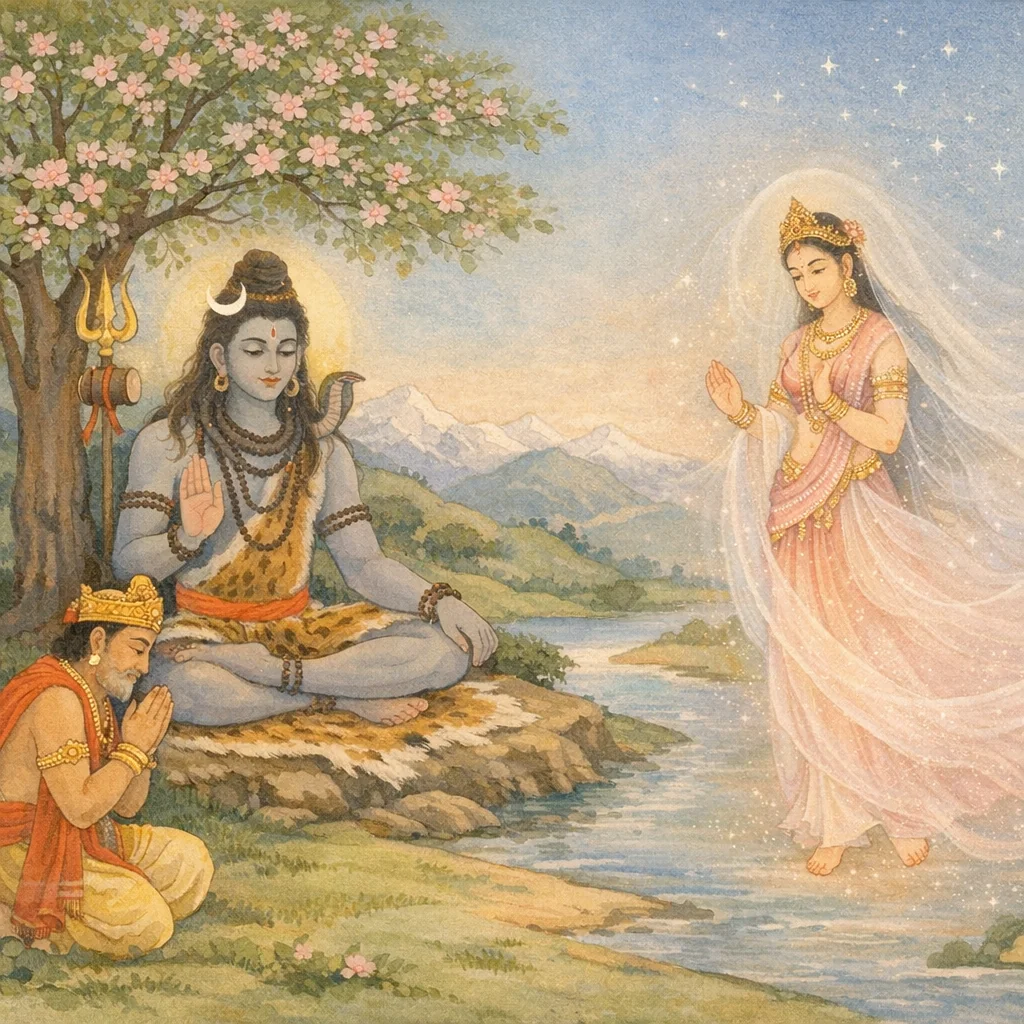
Śiva’s Boon to Viśvakarman and the Manifestation of Devī (Bhavānī/Parāśakti)
Adhyāya 16 portrays a solemn divine exchange: Śiva (Mahādeva/Hara) addresses Viśvakarman with affectionate honorifics, acknowledging the weight of his request and the tapas performed for the increase and welfare of beings (prajā-vṛddhi). Pleased, Śiva grants the desired boon. The narrative then shifts from the act of granting to an ontological manifestation: from a portion of His own body Śiva emanates/creates Devī, whom the wise proclaim as the supreme Śakti of the supreme Self (Bhava/Paramātman). She is beyond birth, death, and decay—where speech, mind, and senses fall back—yet she wondrously appears in form and pervades the entire universe by majesty. Thus the chapter unites Purāṇic myth with Śākta-Śaiva metaphysics: Devī is both transcendent beyond cognition and the immanent power through which cosmic presence becomes experientially accessible.
Shlokas
Verse 1
वायुरुवाच । अथ देवो महादेवो महाजलदनादया । वाचा मधुरगंभीरशिवदश्लक्ष्णवर्णया
Vāyu said: Then that God—Mahādeva—began to speak in a voice like a great rain-cloud: sweet and deep, bearing auspiciousness, and marked by the noble signs of perfected utterance.
Verse 2
अर्थसंपन्नपदया राजलक्षणयुक्तया । अशेषविषयारंभरक्षाविमलदक्षया
She spoke with words rich in meaning, endowed with the marks of royal dignity; and she was spotless and capable in safeguarding the undertaking of every affair in full.
Verse 3
मनोहरतरोदारमधुरस्मितपूर्वया । संबभाषे सुसंपीतो विश्वकर्माणमीश्वरः
With an even more captivating, generous, and sweet smile, the Lord Īśvara, well pleased, spoke to Viśvakarmā.
Verse 4
ईश्वर उवाच । वत्स वत्स महाभाग मम पुत्र पितामह । ज्ञातमेव मया सर्वं तव वाक्यस्य गौरवम्
Īśvara said: “Dear one, dear one—O greatly fortunate one, my son and also my forefather—indeed, I already know everything, and I fully understand the weight and dignity of your words.”
Verse 5
प्रजानामेव बृद्ध्यर्थं तपस्तप्तं त्वयाधुना । तपसा ऽनेन तुष्टोस्मि ददामि च तवेप्सितम्
“Indeed, you have now performed tapas (austerity) for the increase and welfare of beings. By this very tapas I am pleased; therefore I grant you what you desire.”
Verse 6
इत्युक्त्वा परमोदारं स्वभावमधुरं वचः । ससर्ज वपुषो भागाद्देवीं देववरो हरः
Having spoken these words—supremely noble and naturally sweet—Hara, the best among the gods, manifested the Goddess from a portion of his own body.
Verse 7
यामाहुर्ब्रह्मविद्वांसो देवीं दिव्यगुणान्विताम् । परस्य परमां शक्तिं भवस्य परमात्मनः
The knowers of Brahman declare Her to be the Goddess endowed with divine qualities—the supreme Śakti of the Transcendent, of Bhava (Śiva), the Supreme Self.
Verse 8
यस्यां न खलु विद्यंते जन्म मृत्युजरादयः । या भवानी भवस्यांगात्समाविरभवत्किल
In her, indeed, there are no conditions such as birth, death, old age, and the like. She—Bhavānī—manifested, it is said, from the very body (limb) of Bhava (Lord Śiva).
Verse 9
यस्या वाचो निवर्तन्ते मनसा चेंद्रियैः सह । सा भर्तुर्वपुषो भागाज्जातेव समदृश्यत
She—whom speech, along with the mind and the senses, cannot reach and therefore falls back from—was seen as though she had been born from a portion of her Lord’s own body.
Verse 10
या सा जगदिदं कृत्स्नं महिम्ना व्याप्य तिष्ठति । शरीरिणीव स देवी विचित्रं समलक्ष्यत
That Goddess—who by the power of her own glory pervades and upholds this entire universe—was then beheld wondrously, as though she possessed a distinct embodied form.
Verse 11
सर्वं जगदिदं चैषा संमोहयति मायया । ईश्वरात्सैव जाताभूदजाता परमार्थतः
This very Māyā deludes the entire universe by her power of illusion. She is said to have arisen from the Lord, yet in the highest truth she is unborn.
Verse 12
न यस्या परमो भावः सुराणामपि गोचरः । विश्वामरेश्वरी चैव विभक्ता भर्तुरंगतः
Her supreme inner reality lies beyond the reach even of the gods. She is indeed the sovereign Lady of the universe and of the immortals, and yet she is manifested as distinct from the very body of her Lord.
Verse 13
तां दृष्ट्वा परमेशानीं सर्वलोकमहेश्वरीम् । सर्वज्ञां सर्वगां सूक्ष्मां सदसद्व्यक्तिवर्जिताम्
Seeing Her—Parameśānī, the Supreme Goddess, the Great Sovereign Lady of all the worlds—he beheld the all-knowing, all-pervading, subtle Reality, transcending being and non-being, and free from the limits of manifest individuality.
Verse 14
परमां निखिलं भासा भासयन्तीमिदं जगत् । प्रणिपत्य महादेवीं प्रार्थयामास वै विराट्
Beholding the Supreme Goddess, whose radiance illumines this entire universe, Virāṭ bowed down in reverence and then humbly entreated Mahādevī.
Verse 15
ब्रह्मोवाच । देवि देवेन सृष्टो ऽहमादौ सर्वजगन्मयि । प्रजासर्गे नियुक्तश्च सृजामि सकलं जगत्
Brahmā said: O Goddess, O You who pervade the entire universe—at the beginning I was created by the Lord (Śiva). Appointed to the work of generating beings, I bring forth this whole world.
Verse 16
मनसा निर्मिताः सर्वे देवि देवादयो मया । न वृद्धिमुपगच्छन्ति सृज्यमानाः पुनः पुनः
O Goddess, all these—beginning with the gods—have been fashioned by me through the mind alone; yet, though created again and again, they do not attain true growth or unfoldment.
Verse 17
मिथुनप्रभवामेव कृत्वा सृष्टिमतः परम् । संवर्धयितुमिच्छामि सर्वा एव मम प्रजाः
“Having thereafter established creation as arising through pairs (male and female), I now desire to nourish and expand all these beings who are my progeny.”
Verse 18
न निर्गतं पुरा त्वत्तो नारीणां कुलमव्ययम् । तेन नारीकुलं स्रष्टुं शक्तिर्मम न विद्यते
Previously, from you there has not issued forth the imperishable lineage of women. Therefore, I do not possess the power to create the race of women.
Verse 19
सर्वासामेव शक्तीनां त्वत्तः खलु समुद्भवः । तस्मात्सर्वत्र सर्वेषां सर्वशक्तिप्रदायिनीम्
Truly, the very source of all powers (śaktis) arises from You. Therefore, everywhere and for all beings, You are the Bestower of every power.
Verse 20
त्वामेव वरदां मायां प्रार्थयामि सुरेश्वरीम् । चराचरविवृद्ध्यर्थमंशेनैकेन सर्वगे
O all-pervading Goddess, boon-bestowing Māyā, Sovereign of the gods—You alone I implore: for the increase and flourishing of all moving and unmoving beings, manifest with but a single portion of Yourself.
Verse 21
दक्षस्य मम पुत्रस्य पुत्री भव भवार्दिनि । एवं सा याचिता देवी ब्रह्मणा ब्रह्मयोनिना
“O Bhavārdinī, become the daughter of Dakṣa, my son.” Thus the Goddess was entreated by Brahmā, the self-born Lord who arises from the Supreme Source.
Verse 22
शक्तिमेकां भ्रुवोर्मध्यात्ससर्जात्मसमप्रभाम् । तामाह प्रहसन्प्रेक्ष्य देवदेववरो हरः
From the space between His eyebrows, Hara—the most excellent Lord of the gods—manifested a single Śakti, radiant with splendor equal to His own; then, smiling as He looked upon her, He addressed her.
Verse 23
ब्रह्माणं तपसाराध्य कुरु तस्य यथेप्सितम् । तामाज्ञां परमेशस्य शिरसा प्रतिगृह्य सा
“Having propitiated Brahmā through austerity, do what he desires.” Accepting that command of the Supreme Lord with bowed head, she gladly received it.
Verse 24
ब्रह्मणो वचनाद्देवी दक्षस्य दुहिताभवत् । दत्त्वैवमतुलां शक्तिं ब्रह्मणे ब्रह्मरूपिणीम्
By Brahmā’s command, the Goddess became Dakṣa’s daughter; and that Goddess—whose very nature is Brahman—bestowed upon Brahmā an incomparable Power.
Verse 25
विवेश देहं देवस्य देवश्चांतरधीयत । तदा प्रभृति लोके ऽस्मिन् स्त्रियां भोगः प्रतिष्ठितः
He entered the body of that deity, and the god himself vanished from sight. From that time onward in this world, enjoyment with a woman became established.
Verse 26
प्रजासृष्टिश्च विप्रेंद्रा मैथुनेन प्रवर्तते । ब्रह्मापि प्राप सानन्दं सन्तोषं मुनिपुंगवाः
O best of brāhmaṇas, the creation and continuance of progeny proceeds through union. Even Brahmā attained joyful contentment, O foremost of sages.
Verse 27
एतद्वस्सर्वमाख्यातं देव्याः शक्तिसमुद्भवम् । पुण्यवृद्धिकरं श्राव्यं भूतसर्गानुपंगतः
Thus, all this has been explained to you—the manifestation arising from the Goddess’s Power. It is worthy to be heard, for it increases merit and is connected with the account of the creation of beings.
Verse 28
य इदं कीर्तयेन्नित्यं देव्याः शक्तिसमुद्भवम् । पुण्यं सर्वमवाप्नोति पुत्रांश्च लभते शुभान्
Whoever daily recites this account born of the Goddess’s divine Power attains every kind of merit, and also gains auspicious sons.
Frequently Asked Questions
Śiva, pleased by Viśvakarman’s tapas performed for the growth of beings, grants a boon and then manifests Devī from a portion of His own body, identifying her as the supreme Śakti.
It signals an apophatic register: Devī (as Śakti of the supreme) is ultimately beyond conceptualization and linguistic capture, even while she can appear in a form for cosmic and devotional accessibility.
Devī is presented as Bhavānī and Parāśakti—transcendent (free from birth/death/age) and immanent (pervading the entire universe by her mahimā), emerging directly from Śiva’s own being.
Read Shiva Purana in the Vedapath app
Scan the QR code to open this directly in the app, with audio, word-by-word meanings, and more.