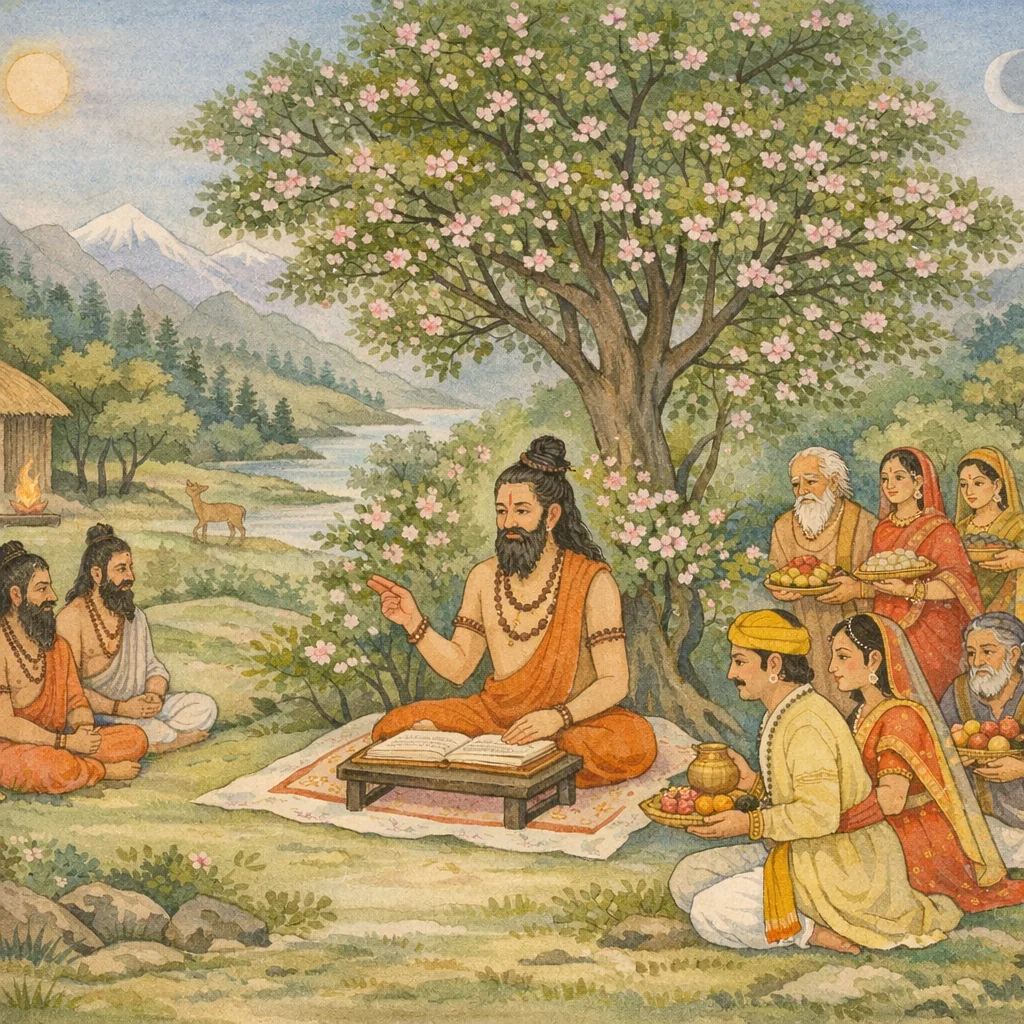
पुराणविदः महिमा तथा अध्ययन-अध्यापन-दानफलम् (The Glory of the Purāṇa-Knower and the Fruits of Study, Teaching, and Giving)
This chapter presents Sanatkumāra’s instruction on a hierarchy of merit: ascetic hardship and forest austerities are praised, yet even studying a single ṛc (Vedic verse) bears fruit, and teaching sacred learning yields a result twice that of private study. It then asserts the indispensability of the Purāṇa—without it the world is like a cosmos without sun and moon—so Purāṇic study should be pursued continually. The Purāṇa-knower (purāṇavit/purāṇajña) is exalted as the foremost worthy recipient, to be worshipped, for such a teacher saves others from the “hell” of ignorance through śāstric instruction; one must not regard him as merely human, for his status is linked with Brahmā, Viṣṇu, and Hara. Finally, it lays down a dāna ethic: wealth, grain, gold, garments, land, cattle, vehicles, elephants, and horses—given with devotion to a worthy Purāṇa-knower—grant imperishable enjoyments and merit comparable to great Vedic sacrifices, joining knowledge-transmission with ritual economy and liberation.
Shlokas
Verse 1
सनत्कुमार उवाच । तपस्तपति योऽरण्ये वन्यमूलफलाशनः । योऽधीते ऋचमेकां हि फलं स्यात्तत्समं मुने
Sanatkumāra said: O sage, the fruit obtained by one who performs austerities in the forest, living on wild roots and fruits, is equal to the fruit obtained by one who studies even a single Vedic ṛc (hymn).
Verse 2
श्रुतेरध्ययनात्पुण्यं यदाप्नोति द्विजोत्तमः । तदध्यापनतश्चापि द्विगुणं फलमश्नुते
O best of the twice-born, whatever merit one gains by studying the Śruti, that very merit is doubled when one teaches it to others—thus one partakes of a twofold fruit.
Verse 3
जगद्यथा निरालोकं जायतेऽशशिभास्करम् । विना तथा पुराणं ह्यध्येयमस्मान्मुने सदा
O sage, just as the world would be without light if there were no moon and sun, so too this Purāṇa should always be studied with us; without it, understanding remains as if in darkness.
Verse 4
तप्यमानं सदाज्ञानान्निरये योऽपि शास्त्रतः । सम्बोधयति लोकं तं तस्मात्पूज्यः पुराणगः
Even one tormented in hell by constant ignorance—if, in accordance with the scriptures, he awakens and instructs the people—then for that very reason the knower of the Purāṇas is worthy of worship.
Verse 5
सर्वेषां चैव पात्राणां मध्ये श्रेष्ठः पुराणवित् । पतनात्त्रायते यस्मात्तस्मात्पात्रमुदाहृतम्
Among all worthy recipients, the knower of the Purāṇas is the best. Because he saves one from spiritual downfall, he is therefore declared to be a true ‘pātra’—a fit vessel for sacred giving and teaching.
Verse 6
मर्त्यबुद्धिर्न कर्तव्या पुराणज्ञे कदाचन । पुराणज्ञस्सर्ववेत्ता ब्रह्मा विष्णुर्हरो गुरुः
One should never entertain a merely human view of a knower of the Purāṇas. The Purāṇa-knower is truly all-knowing—Brahmā, Viṣṇu, and Hara (Śiva) in form—and is to be revered as the Guru.
Verse 7
धनं धान्यं हिरण्यं च वासांसि विविधानि च । देयं पुराणविज्ञाय परत्रेह च शर्म्मणे
One should offer wealth, grain, gold, and various garments to a knower of the Purāṇas, for well-being in this world and for peace in the world beyond.
Verse 8
यो ददाति महाप्रीत्या पुराणज्ञाय सज्जनः । पात्राय शुभवस्तूनि स याति परमां गतिम्
That virtuous person who, with great joy, gives auspicious gifts to a worthy recipient learned in the Purāṇas attains the supreme goal.
Verse 9
महीं गां वा स्यंदनांश्च गजानश्वांश्च शोभनान् । यः प्रयच्छति पात्राय तस्य पुण्यफलं शृणु
Listen to the meritorious fruit of one who gives to a worthy recipient land, cows, chariots, and fine elephants and horses.
Verse 10
अक्षयान्सर्वकामांश्च परत्रेह च जन्मनि । अश्वमेधमखस्यापि स फलं लभते पुमान्
That man attains imperishable fulfillment of all worthy desires—both in this life and hereafter—and receives the same merit as that gained by performing the Aśvamedha sacrifice.
Verse 11
मही ददाति यस्तस्मै कृष्टां फलवतीं शुभाम् । स तारयति वै वंश्यान्दश पूर्वान्दशापरान्
Whoever donates to a worthy recipient cultivated land—fertile and auspicious—indeed becomes a liberator of his lineage, delivering ten generations before him and ten generations after him.
Verse 12
इह भुक्त्वाखिलान्कामानंते दिव्यशरीरवान् । विमानेन च दिव्येन शिवलोकं स गच्छति
Having enjoyed in this world all desired blessings, at life’s end he attains a divine body; and, borne in a celestial vimāna, he goes to Śivaloka, the abode of Lord Śiva.
Verse 13
इति श्रीशिवमहापुराणे पञ्चम्यामुमासंहितायां पुराणमाहात्म्यवर्णनंनाम त्रयोदशोऽध्यायः
Thus ends the thirteenth chapter, entitled “The Description of the Glory of the Purāṇa,” in the fifth section of the Śrī Śiva Mahāpurāṇa, within the Umāsaṃhitā.
Verse 14
शंभोरायतने यस्तु कारयेद्धर्मपुस्तकम् । विष्णोरर्कस्य कस्यापि शृणु तस्यापि तत्फलम्
Whoever causes a sacred book of dharma to be prepared and installed in the shrine of Śambhu (Lord Śiva)—listen also to the fruit of doing the same in the temple of Viṣṇu, of Sūrya, or indeed of any deity.
Verse 15
राजसूयाश्वमेधानां फलमाप्नोति मानवः । सूर्यलोकं च भित्त्वाशु ब्रह्मलोकं स गच्छति
A human being attains merit equal to that of the Rājasūya and the Aśvamedha sacrifices. Swiftly passing beyond even the realm of the Sun, he goes to Brahmaloka.
Verse 16
स्थित्वा कल्पशतान्यत्र राजा भवति भूतले । भुंक्ते निष्कंटकं भोगान्नात्र कार्या विचारणा
Having remained there for hundreds of kalpas, one becomes a king upon the earth and enjoys pleasures without obstruction—about this, no further doubt or deliberation is necessary.
Verse 17
अश्वमेधसहस्रस्य यत्फलं समुदाहृतम् । तत्फलं समावाप्नोति देवाग्रे यो जपं चरेत्
Whatever fruit is proclaimed for performing a thousand Aśvamedha sacrifices—one who undertakes japa before the Deity attains that very same fruit.
Verse 18
इतिहासपुराणाभ्यां शम्भोरायतने शुभे । नान्यत्प्रीतिकरं शंभोस्तथान्येषां दिवौकसाम्
In the auspicious abode of Śambhu, nothing delights Śiva more than the recitation of the Itihāsas and Purāṇas; likewise, nothing else is so pleasing to the other gods who dwell in heaven.
Verse 19
तस्मात्सर्वप्रयत्नेन कार्यं पुस्तकवाचनम् । तथास्य श्रवणं प्रेम्णा सर्वकामफलप्रदम्
Therefore, with every effort one should undertake the reading of this sacred text; likewise, hearing it with loving devotion bestows the fruits of all desired aims.
Verse 20
पुराणश्रवणाच्छंभोर्निष्पापो जायते नरः । भुक्त्वा भोगान्सुविपुलाञ्छिवलोकमवाप्नुयात्
By hearing the Purāṇa of Śambhu (Lord Śiva), a person becomes free from sin. Having enjoyed abundant and excellent blessings, he ultimately attains Śiva’s world (Śivaloka).
Verse 21
राजसूयेन यत्पुण्यमग्निष्टोमशतेन च । तत्पुण्यं लभते शंभोः कथाश्रवणमात्रतः
The merit gained by performing the Rājasūya sacrifice, and even by a hundred Agniṣṭoma sacrifices—that very merit is attained merely by listening to the sacred narrative of Śambhu (Lord Śiva).
Verse 22
सर्वतीर्थावगाहेन गां कोटिप्रदानतः । तत् फलं लभते शंभोः कथाश्रवणतो मुने
O sage, by listening to the sacred narrative of Śambhu (Lord Śiva), one attains that very fruit gained by bathing in all holy tīrthas and by gifting a crore of cows.
Verse 23
ये शृण्वंति कथां शंभोस्सदा भुवनपावनीम् । ते मनुष्या न मंतव्या रुद्रा एव न संशयः
Those who continually listen to Śambhu’s world-purifying sacred narrative should not be regarded as mere humans; without doubt, they are Rudras themselves.
Verse 24
शृण्वतां शिवसत्कीर्तिं सतां कीर्तयतां च ताम् । पदाम्बुजरजांस्येव तीर्थानि मुनयो विदुः
The sages know that those who listen to Śiva’s holy fame—and the virtuous who sing that fame—become themselves like sacred tīrthas, as sanctifying as the dust of the Lord’s lotus-feet.
Verse 25
गंतुं निःश्रेयसं स्थानं येऽभिवांछन्ति देहिनः । कथां पौराणिकीं शैवीं भक्त्या शृण्वंतु ते सदा
Those embodied beings who long to reach the supremely auspicious abode of final liberation should always listen with devotion to the Śaiva Purāṇic sacred narrative.
Verse 26
कथां पौराणिकीं श्रोतुं यद्यशक्तस्सदा भवेत् । नियतात्मा प्रतिदिनं शृणुयाद्वा मुहूर्तकम्
If one is not always able to listen to the Purāṇic sacred narrative, then, with a disciplined and self-restrained mind, one should at least listen to it every day—even for a single muhūrta (a short, fixed period of time).
Verse 27
यदि प्रतिदिनं श्रोतुमशक्तो मानवो भवेत् । पुण्यमासादिषु मुने शृणुयाच्छांकरीं कथाम्
If a person is unable to listen every day, then, O sage, let him at least listen to the sacred Śaṅkara-related narration during holy months and other auspicious times.
Verse 28
शैवीं कथां हि शृण्वानः पुरुषो हि मुनीश्वर । स निस्तरति संसारं दग्ध्वा कर्ममहाटवीम्
O lord among sages, one who listens to the sacred Śaiva narrative crosses beyond saṃsāra, having burned up the great forest of karma.
Verse 29
कथां शैवीं मुहूर्तं वा तदर्द्धं क्षणं च वा । ये शृण्वति नरा भक्त्या न तेषां दुर्गतिर्भवेत्
Men who listen with devotion to Śiva’s sacred narrative—whether for a muhūrta, half of that, or even for a single moment—never fall into an evil end; for them, misfortune and downward destiny do not arise.
Verse 30
यत्पुण्यं सर्वदानेषु सर्वयज्ञेषु वा मुने । शंभोः पुराणश्रवणात्तत्फलं निश्चलं भवेत्
O sage, whatever merit is gained from all gifts and from all sacrifices—by listening to the Purāṇa of Śambhu, that very fruit becomes steady and unfailing.
Verse 31
विशेषतः कलौ व्यास पुराणश्रवणादृते । परो धर्मो न पुंसां हि मुक्तिध्यानपरः स्मृतः
Especially in the Kali age, O Vyāsa, apart from hearing the Purāṇas, no higher dharma for human beings is remembered—one devoted to meditation upon liberation (mokṣa).
Verse 32
पुराणश्रवणं शम्भोर्नामसंकीर्तनं तथा । कल्पद्रुमफलं रम्यं मनुष्याणां न संशयः
Hearing the Purāṇa and likewise singing the sacred Names of Śambhu bestow upon human beings the delightful fruit of the wish-fulfilling tree (kalpadruma)—of this there is no doubt.
Verse 33
कलौ दुर्मेधसां पुंसां धर्माचारोझ्झितात्मनाम् । हिताय विदधे शम्भुः पुराणाख्यं सुधारसम्
In the age of Kali, for the welfare of people of dull understanding whose lives have fallen away from the practice of dharma, Śambhu ordained a nectar-like essence known as the Purāṇa.
Verse 34
एकोऽजरामरस्याद्वै पिबन्नेवामृतं पुमान् । शम्भोः कथामृतापानात्कुलमेवाजरामरम्
A man becomes free from decay and death—just as if he were drinking nectar—by drinking the ambrosial narrative of Śambhu. Indeed, through imbibing the nectar of Lord Śiva’s sacred story, even one’s whole lineage becomes free from decay and death.
Verse 35
या गतिः पुण्यशीलानां यज्वनां च तपस्विनाम् । सा गतिस्सहसा तात पुराणश्रवणात्खलु
O dear one, the very same exalted state attained by the virtuous, by sacrificers (yajña-performers), and by ascetics is indeed gained at once through the hearing of the Purāṇa.
Verse 36
ज्ञानवाप्तिर्यदा न स्याद्योगशास्त्राणि यत्नतः । अध्येतव्यानि पौराणं शास्त्रं श्रोतव्यमेव च
When, even with diligent effort in the scriptures of Yoga, true knowledge is not attained, then one should study the Purāṇic śāstra and also listen to it—so that right understanding may arise through Śiva’s revealed teaching.
Verse 37
पापं संक्षीयते नित्यं धर्म्मश्चैव विवर्द्धते । पुराणश्रवणाज्ज्ञानी न संसारं प्रपद्यते
Through the constant hearing of the Purāṇa, sins are steadily worn away and dharma indeed increases; by such Purāṇa-listening the wise one does not fall again into saṁsāra.
Verse 38
अतएव पुराणानि श्रोतव्यानि प्रयत्नतः । धर्मार्थकामलाभाय मोक्षमार्गाप्तये तथा
Therefore, the Purāṇas should be listened to with sincere effort—for the attainment of dharma, artha, and kāma, and also for reaching the path that leads to mokṣa.
Verse 39
यज्ञैर्दानैस्तपोभिस्तु यत्फलं तीर्थसेवया । तत्फलम समवाप्नोति पुराणश्रवणान्नरः
Whatever merit is gained through sacrifices, gifts, austerities, and the devoted service of sacred pilgrimage places—that very fruit a person attains by listening to the Purāṇa.
Verse 40
न भवेयुः पुराणानि धर्ममार्गे क्षणानि तु । यद्यत्र यद्व्रती स्थाता चात्र पारत्रकी कथाम्
If the Purāṇas did not exist, even a moment on the path of dharma would not be possible. For wherever a person devoted to a vow abides, there (by the Purāṇic teaching) the discourse concerning the next world is established.
Verse 41
षड्विंशतिपुराणानां मध्येऽप्येकं शृणोति यः । पठेद्वा भक्तियुक्तस्तु स मुक्तो नात्र संशयः
Among the twenty-six Purāṇas, whoever listens even to a single one—or reads it with devotion—becomes liberated; of this there is no doubt.
Verse 42
अन्यो न दृष्टस्सुखदो हि मार्गः पुराणमार्गो हि सदा वरिष्ठः । शास्त्रं विना सर्वमिदं न भाति सूर्य्येण हीना इव जीवलोकाः
No other path is seen to bestow true happiness; the Purāṇic path is ever the most excellent. Without scripture, all this fails to shine forth—like the worlds of living beings when deprived of the sun.
Frequently Asked Questions
It argues for Purāṇa as an essential instrument of illumination and right knowledge—comparing a world without Purāṇa to a world without sun and moon—thereby asserting that Purāṇic study must be continuous and central to religious life.
The chapter sacralizes pedagogy: the teacher is not merely a transmitter of information but a salvific agent who rescues beings from ignorance. Reverence to the Purāṇa-knower encodes the idea that knowledge (jñāna) itself functions as a liberating power within Shaiva order.
No distinct iconographic form (svarūpa) is foregrounded in the sampled verses; instead, Śiva is invoked via the epithet Hara in a doctrinal comparison that elevates the Purāṇa-knower to a guru-status aligned with Brahmā, Viṣṇu, and Hara.