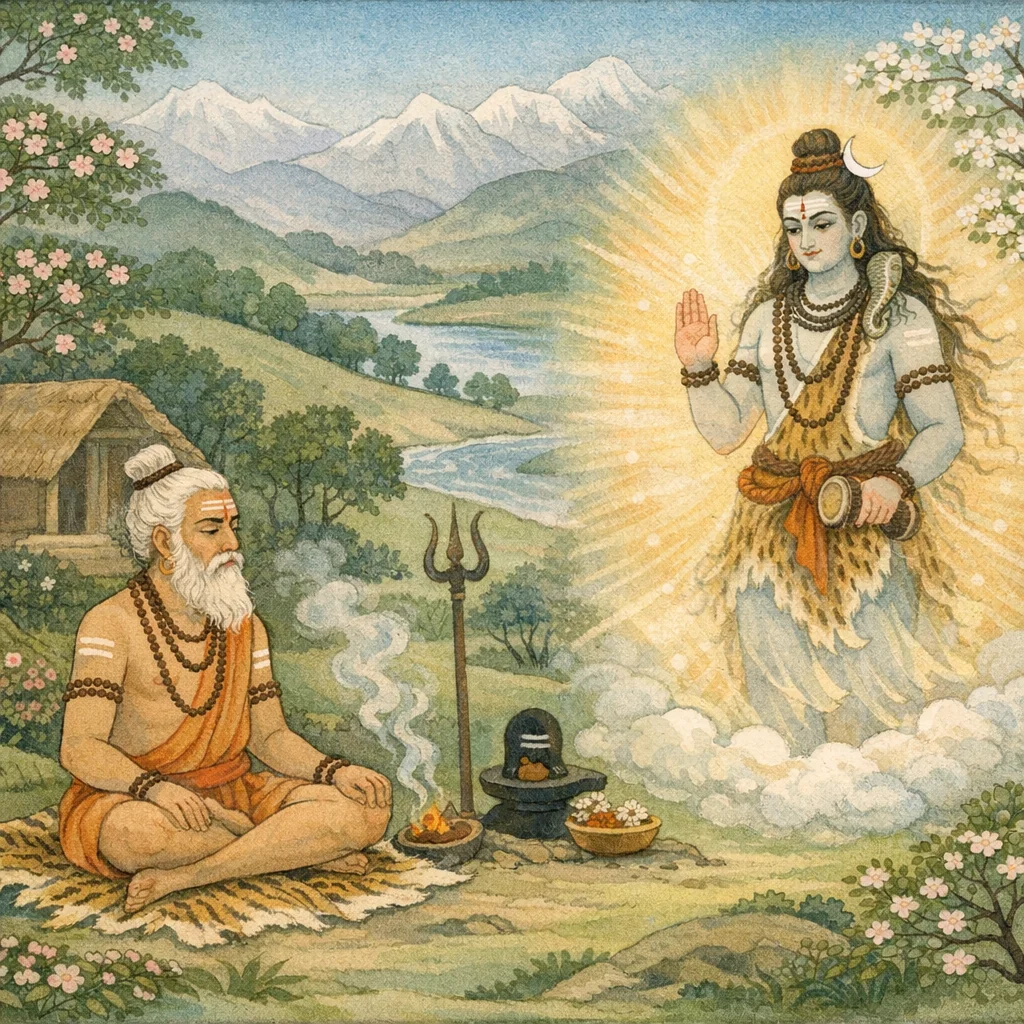
Droṇācārya’s Tapas and the Manifestation of Śiva: The Birth-Grant of Aśvatthāmā (अश्वत्थामा-अवतार-प्रसङ्गः)
This Adhyāya is taught through a sage-to-sage transmission: Nandīśvara speaks to Sanatkumāra and introduces an avatāra context connected with Aśvatthāmā, revealing Śiva’s supreme agency. It then portrays Droṇa—born of Bharadvāja, traced as an aṃśa of Bṛhaspati—skilled in dhanurveda and Vedic learning, and serving as the Kauravas’ ācārya. The theological pivot is Droṇa’s severe tapas for the Kauravas’ support and especially for a son, directing his austerity to Śaṅkara. Śiva, the bhaktavatsala who cherishes devotees, appears before Droṇa, receives his praise, and grants a boon. Droṇa asks for a son who is Śiva’s own partial manifestation (svāṃśaja), unconquerable and immensely powerful. The chapter’s inner teaching presents the Purāṇic Śaiva causal model: tapas and stuti offered to Śiva bring direct theophany and a boon that places divine power into epic lineage, making avatāra not only cosmic but also genealogical and functional (for dharma and the order of war).
Shlokas
Verse 1
नन्दीश्वर उवाच । सनत्कुमार सर्वज्ञ शिवस्य परमात्मनः । अवतारं शृणु विभोरश्वत्थामाह्वयं परम्
Nandīśvara said: “O all-knowing Sanatkumāra, listen to the sublime incarnation of Śiva—the Supreme Self—the all-pervading Lord, known by the exalted name ‘Aśvatthāmā.’”}]}
Verse 2
बृहस्पतेर्महाबुद्धेर्देवर्षेरंशतो मुने । भरद्वाजात्समुत्पन्नो द्रोणोऽयोनिज आत्मवान्
O sage, Droṇa—self-possessed and of mighty inner strength—was born without a womb from Bharadvāja, as a partial manifestation of the divine seer Bṛhaspati, the supremely intelligent preceptor of the gods.
Verse 3
धनुर्भृतां वरः शूरो विप्रर्षिस्सर्वशास्त्रवित् । बृहत्कीर्तिर्महातेजा यः सर्वास्त्रविदुत्तमः
He was the foremost among bow-bearers—valiant and heroic; a brahmin-sage who knew all the śāstras. Vast was his fame and great his radiance; indeed, he was the best of all who understand weapons and divine missiles.
Verse 4
धनुर्वेदे च वेदे च निष्णातं यं विदुर्बुधाः । वरिष्ठं चित्रकर्माणं द्रोणं स्वकुलवर्धनम्
The wise knew Droṇa to be profoundly accomplished both in the science of archery and in the Vedas—pre-eminent, skilled in wondrous arts, and a true enhancer of his lineage.
Verse 5
कौरवाणां स आचर्य्यं आसीत्स्वबलतो द्विज । महारथिषु विख्यातः षट्सु कौरवमध्यतः
O brāhmaṇa, by the strength of his own prowess he became the preceptor of the Kauravas. He was renowned among the great chariot-warriors, standing foremost among the six eminent Kaurava champions.
Verse 6
साहाय्यार्थं कौरवाणां स तेपे विपुलन्तपः । शिवमुद्दिश्य पुत्रार्थं द्रोणाचार्य्यो द्विजोत्तमः
To aid the Kauravas, the eminent Brahmin Droṇācārya undertook abundant austerities, fixing his intent on Lord Śiva and seeking the boon of a son.
Verse 7
ततः प्रसन्नो भगवाच्छंकरो भक्तवत्सलः । आविर्बभूव पुरतो द्रोणस्य मुनिसत्तम
Then the Blessed Lord Śaṅkara, ever tender to His devotees, became pleased and manifested Himself directly before Droṇa, O best of sages.
Verse 8
तन्दृष्ट्वा स द्विजो द्रोणस्तुष्टावाशु प्रणम्य तम् । महाप्रसन्नहृदयो नतकस्सुकृताञ्जलिः
Seeing Him, the twice-born Droṇa at once bowed down and praised Him. With a heart greatly gladdened, he stood humbly with palms joined in reverent devotion.
Verse 9
तस्य स्तुत्या च तपसा सन्तुष्टः शंकर प्रभुः । वरम्ब्रूहीति चोवाच द्रोणन्तं भक्तवत्सलः
Pleased by his hymn of praise and his austerities, the Lord Śaṅkara—the sovereign Master, tender to His devotees—spoke to Droṇa: “Ask for a boon.”
Verse 10
तच्छ्रुत्वा शम्भुवचनं द्रोणः प्राहाथ सन्नतः । स्वांशजन्तनयन्देहि सर्वाजेयम्महाबलम्
Hearing the words of Śambhu (Lord Śiva), Droṇa, bowing in reverence, said: “Grant me a son born of Your own divine portion—of great might, unconquerable by all.”
Verse 11
तच्छ्रुत्वा द्रोणवचनं शम्भुः प्रोचे तथास्त्विति । अभूदन्तर्हितस्तात कौतुकी सुखकृन्मुने
Hearing Droṇa’s words, Śambhu (Lord Śiva) replied, “So be it.” Then, O dear one, the playful Lord—bestower of happiness, O sage—became invisible and vanished from sight.
Verse 12
द्रोणोऽपगच्छत्स्वन्धाम महाहृष्टो गतभ्रमः । स्वपत्न्यै कथयामास तद्वृतं सकलं मुदा
Then Droṇa returned to his own home, greatly delighted and freed from confusion. With joy he narrated to his wife the entire account of what had occurred.
Verse 13
अथावसरमासाद्य रुद्रः सर्वान्तकः प्रभुः । स्वांशेन तनयो जज्ञे द्रोणस्य स महाबलः
Then, when the right occasion arrived, Rudra—the Lord who brings all things to their end—was born as the son of Droṇa, manifesting by His own partial divine power; that son was exceedingly mighty.
Verse 14
अश्वत्थामेति विख्यातस्तस्य बभूव क्षितौ मुने । प्रवीरः कंजपत्राक्षश्शत्रुपक्षक्षयङ्करः
O sage, on earth there was born to him a heroic son renowned by the name Aśvatthāma—lotus-eyed, a foremost warrior, and a fearsome destroyer of the enemy’s ranks.
Verse 15
यो भारते रणे ख्यातः पितुराज्ञामवाप्य च । सहायकृद्बभूवात कौरवाणां महाबलः
He became renowned in the Bhārata battle; and, having received his father’s command, he grew into a mighty helper and steadfast support of the Kauravas.
Verse 16
यमाश्रित्य महावीरं कौरवास्सुम हाबलाः । भीष्मादयो बभूवुस्तेऽजेया अपि दिवौकसाम्
Taking refuge in the great hero Yama, the Kauravas became exceedingly mighty; Bhīṣma and the others, thus upheld, became unconquerable—even by the gods of heaven.
Verse 17
यद्भयात्पाण्डवास्सर्वे कौरवाञ्जेतुमक्षमाः । आसन्नष्टामहावीरा अपि सर्वे च कोविदाः
Out of fear of him, all the Pāṇḍavas were unable to conquer the Kauravas; though they were great heroes, skilled and discerning, they were nonetheless brought to ruin.
Verse 18
कृष्णोपदेशतश्शम्भोस्तपः कृत्वातिदारुणम् । प्राप्य चास्त्रं शम्भुवराज्जिग्ये तानर्जुनस्ततः
Following Kṛṣṇa’s instruction, Arjuna performed exceedingly severe austerities to Lord Śambhu. Having obtained a divine weapon from the boon-giving Śambhu, Arjuna then conquered his foes thereafter.
Verse 19
अश्वत्थामा महावीरो महादेवांशजो मुने । तदापि तद्भक्तिवशः स्वप्रतापमदर्शयत्
O sage, Aśvatthāmā—though a mighty hero and even an emanated portion of Mahādeva—still, being governed by devotion to Him, manifested his own sacred prowess.
Verse 20
विनाश्य पाण्डवसुताञ्छिक्षितानपि यत्नतः । कृष्णादिभिर्महावीरैरनिवार्य्यबलः परैः
Though the sons of the Pāṇḍavas were carefully trained, he slew them; and even by great heroes such as Kṛṣṇa and others, his superior force could not be checked.
Verse 21
पुत्रशोकेन विकलमापतन्तं तमर्जुनम् । रथेनाच्युतवंतं हि दृष्ट्वा स च पराद्रवत्
Seeing Arjuna—overwhelmed and collapsing under grief for his son—mounted in a chariot driven by Acyuta (Śrī Kṛṣṇa), he too fled away in haste.
Verse 22
अस्त्रं ब्रह्मशिरो नाम तदुपर्य्यसृजत्स हि । ततः प्रादुरभूत्तेजः प्रचण्डं सर्वतो दिशम्
Then he indeed discharged the weapon called Brahmaśira upon it. From that act there manifested a fiercely blazing radiance, raging in every direction.
Verse 23
प्राणापदमभिप्रेक्ष्य सोर्जुनः क्लेशसंयुतः । उवाच कृष्णं विक्लान्तो नष्टतेजा महाभयः
Seeing the peril to his very life, Arjuna—overcome with distress—spoke to Kṛṣṇa. Exhausted, his radiance diminished, and seized by great fear, he addressed Him.
Verse 24
अर्जुन उवाच । किमिदं स्वित्कुतो वेति कृष्ण कृष्ण न वेद्म्यहम् । सर्वतोमुखमायाति तेजश्चेदं सुदु्स्सहम्
Arjuna said: “O Kṛṣṇa, O Kṛṣṇa—what indeed is this, and from where has it come? I do not understand. This radiance rushes toward me with faces on every side, and its blazing power is unbearable.”
Verse 25
नन्दीश्वर उवाच । श्रुत्वार्जुनवचश्चेदं स कृष्णश्शैवसत्तमः । दध्यौ शिवं सदारं च प्रत्याहार्जुनमादरात्
Nandīśvara said: Having heard these words of Arjuna, Krishna—foremost among the devotees of Śiva—meditated upon Lord Śiva together with His divine Consort, and then respectfully replied to Arjuna.
Verse 26
कृष्ण उवाच । वेत्थेदन्द्रोणपुत्रस्य ब्राह्ममस्त्रं महोल्बणम् । न ह्यस्यान्यतमं किञ्चिदस्त्रं प्रत्यवकर्शनम्
Krishna said: “You know the exceedingly dreadful Brahmā-weapon (Brahmāstra) of Droṇa’s son. Indeed, there is no other weapon whatsoever that can draw it back or counteract its force.”
Verse 27
शिवं स्मर द्रुतं शम्भुं स्वप्रभुम्भक्तरक्षकम् । येन दत्तं हि ते स्वास्त्रं सर्वकार्य्यकरम्परम्
Quickly remember Śiva—Śambhu—your own Lord, the Protector of devotees; for it is He who bestowed upon you your own weapon, supreme and able to accomplish every task.
Verse 28
जह्यस्त्रतेज उन्नद्धन्त्वन्तच्छैवास्त्रतेजसा । इत्युक्त्वा च स्वयं कृष्णश्शिवन्दध्यौ तदर्थकः
Having said, “Abandon the fierce power of your weapon—let it be restrained and brought to its end by the radiance of Śiva’s missile,” Kṛṣṇa himself then meditated upon Lord Śiva, with his mind fixed on that very purpose.
Verse 29
तच्छ्रुत्वा कृष्णवचनं पार्थस्स्मृत्वा शिवं हृदि । स्पृष्ट्वापस्तं । प्रणम्याशु चिक्षेपास्त्रन्ततो मुने
Hearing Kṛṣṇa’s words, Pārtha (Arjuna) inwardly remembered Lord Śiva in his heart. Having touched the water for purification and bowed in reverence, he then swiftly discharged the weapon—O sage.
Verse 30
यद्यप्यस्त्रं ब्रह्मशिरस्त्वमोघञ्चाप्रतिक्रियम् । शैवास्त्रतेजसा सद्यस्समशाम्यन्महामुने
O great sage, although the Brahmaśiras weapon is unfailing and admits of no countermeasure, it was instantly quenched by the blazing power of Śiva’s missile.
Verse 31
मंस्था मा ह्येतदाश्चर्य्यं सर्वचित्रमये शिवे । यस्स्वशक्त्याखिलं विश्वं सृजत्यवति हन्त्यजः
O child, do not regard this as wondrous concerning Śiva, who is the very source of all manifold marvels. For He—the Unborn (aja)—by His own Śakti creates the entire universe, sustains it, and also withdraws it (destroys it).
Verse 32
अश्वत्थामा ततो ज्ञात्वा वृत्तमेतच्छिवांशजः । शैवन्न विव्यथे किञ्चिच्छिवेच्छातुष्टधीर्मुने
Then Aśvatthāmā—born of a portion of Śiva—having understood what had occurred, did not waver in the least. O sage, truly devoted to Śiva, his mind remained satisfied with Śiva’s will.
Verse 33
अथ द्रौणिरिदं विश्वं कृत्स्नं कर्तुमपाण्डवम् । उत्तरागर्भगं बालं नाशितुम्मन आदधे
Then Droṇa’s son (Aśvatthāman) resolved in his mind to make the entire world bereft of the Pāṇḍavas, and to destroy the child dwelling in Uttarā’s womb.
Verse 34
ब्रह्मास्त्रमनिवार्य्यं तदन्यैरस्त्रैर्महाप्रभम् । उत्तरागर्भमुद्दिश्य चिक्षेप स महाप्रभुः
That Brahmā-weapon, irresistible and blazing with great power, could not be checked by other missiles. Therefore the mighty one hurled it, aiming at the womb of Uttarā.
Verse 35
ततश्च सोत्तरा जिष्णुवधूर्विकलमानसा । कृष्णन्तुष्टाव लक्ष्मीशन्दह्यमाना तदस्त्रतः
Then Uttara, the wife of Arjuna (Jishnu), her mind shaken and distressed, praised Lord Kṛṣṇa; and Lakṣmī too, being scorched by that weapon, lauded Him.
Verse 36
इति श्रीशिवमहापुराणे तृतीयायां शतरुद्रसंहितायामश्वत्थामशिवावतारवर्णनं नाम षट्त्रिंशोऽध्यायः
Thus, in the Śrī Śiva Mahāpurāṇa, in the Third—Śatarudra Saṃhitā—ends the thirty-sixth chapter, entitled “The Description of Aśvatthāmā as an Incarnation of Śiva.”
Verse 37
स्वरक्षार्थेन्द्रदत्तेन तदस्त्रेण सुवर्चसा । सुदर्शनेन तस्याश्च व्यधाद्रक्षां शिवाज्ञया
For his own protection, by Śiva’s command, Suvarcas employed that weapon bestowed by Indra—Sudarśana—and thereby established a protective ward for her as well.
Verse 38
स्वरूपं शंकरादेशात्कृतं शैववरेण ह । कृष्णेन चरितं ज्ञात्वा विमनस्कः शनैरभूत्
That sacred form, fashioned by the foremost of Śaivas in accordance with Śaṅkara’s command—when Kṛṣṇa came to know its account, he gradually became inwardly unsettled and pensive.
Verse 39
ततस्स कृष्णः प्रीतात्मा पाण्डवान्सकलानपि । अपातयत्तदंघ्र्योस्तु तुष्टये तस्य शैवराट्
Then Kṛṣṇa, his heart filled with joy, made all the Pāṇḍavas bow down at the feet of that sovereign devotee of Śiva, in order to please him.
Verse 40
अथ द्रौणिः प्रसन्नात्मा पाण्डवान्कृष्णमेव च । नानावरान्ददौ प्रीत्या सोऽश्वत्थामानुगृह्य च
Then Drauṇi (Aśvatthāmā), his mind made serene, lovingly bestowed many boons upon the Pāṇḍavas and upon Kṛṣṇa as well—thus, as Aśvatthāmā, he showed favor and grace.
Verse 41
इत्थं महेश्वरस्तात चक्रे लीलाम्पराम्प्रभुः । अवतीर्य्य क्षितौ द्रौणिरूपेण मुनिसत्तम
Thus, O dear one, the Lord Maheśvara—the Supreme Master—performed His transcendent līlā, His divine play; and descending upon the earth, He assumed the form of Drauṇi, O best of sages.
Verse 42
शिवावतारोऽश्वत्थामा महाबलपराक्रमः । त्रैलोक्यमुखदोऽद्यापि वर्तते जाह्नवीतटे
Aśvatthāmā is a manifestation (avatāra) of Lord Śiva, endowed with immense strength and valor. Even today he abides on the bank of the Jāhnavī (Gaṅgā), bestowing grace and beneficence upon the three worlds.
Verse 43
अश्वत्थामावतारस्ते वर्णितश्शंकर प्रभोः । सर्वसिद्धिकरश्चापि भक्ताभीष्टफलप्रदः
Thus has been described to you the incarnation of Lord Śaṅkara as Aśvatthāmā—bestower of every siddhi and granter of the fruits that devotees truly desire.
Verse 44
य इदं शृणुयाद्भक्त्या कीर्तयेद्वा समाहितः । स सिद्धिम्प्राप्नुयादिष्टामन्ते शिवपुरं व्रजेत्
Whoever listens to this with devotion, or recites it with a collected and focused mind, attains the desired siddhi; and in the end goes to Śivapura, the abode of Lord Śiva.
Frequently Asked Questions
Droṇa performs austerities aimed at Śiva for progeny and strategic support; Śiva appears (theophany), invites a boon, and Droṇa requests a son who is Śiva’s own aṃśa—establishing a theology of avatāra-by-boon in which divine power is genealogically transmitted for historical function.
Tapas and stuti operate as ritual-symbolic technologies: they signify interior concentration and intentionality (uddeśa) toward Śiva, while the direct appearance of Śaṅkara encodes the Shaiva claim that the Absolute is personally accessible through disciplined practice; the ‘aṃśa-son’ motif symbolizes controlled descent of transcendence into embodied agency.
Śiva appears explicitly as Śaṅkara—bhaktavatsala and boon-giver—whose ‘aṃśa’ is requested for birth as Aśvatthāmā, highlighting Śiva’s manifestation not primarily as iconographic form but as a transferable portion of divine potency (aṃśa) instantiated through grace.