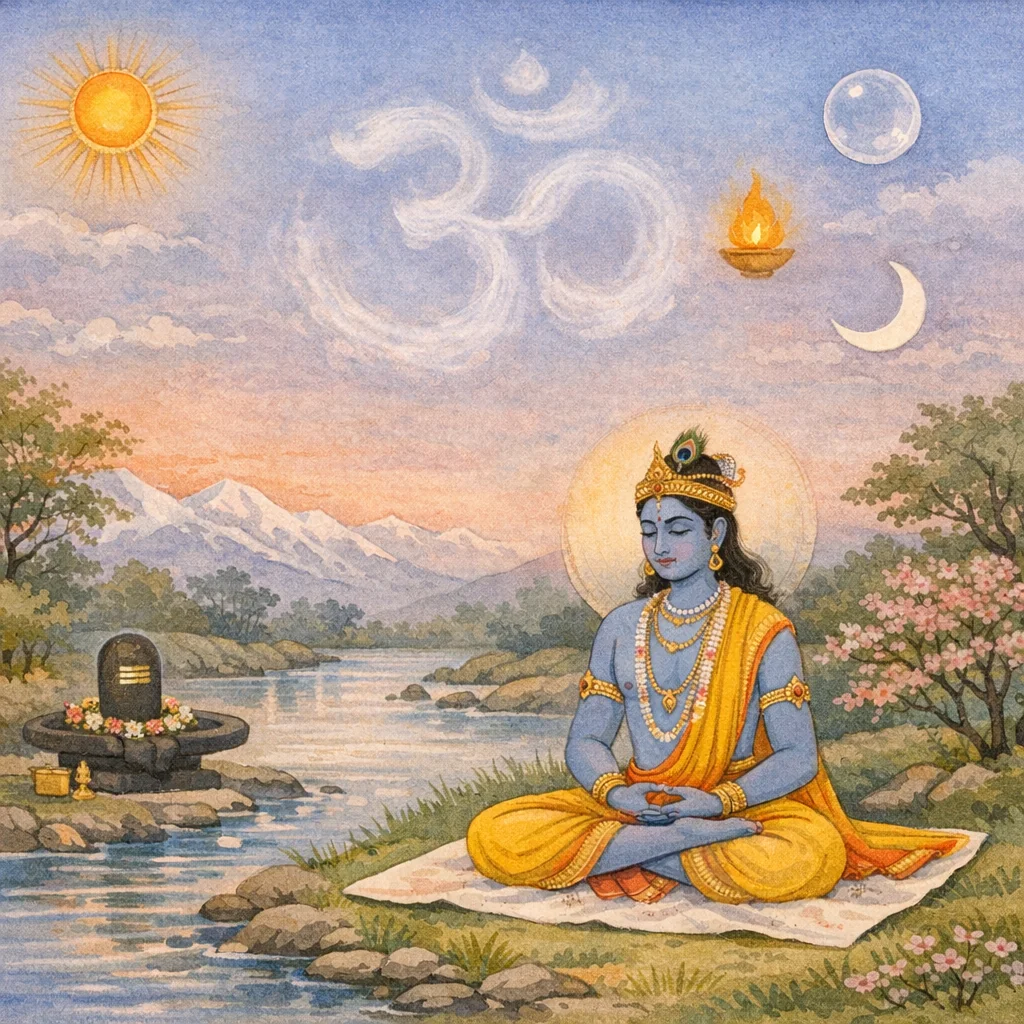
शब्दब्रह्मतनुवर्णनम् — Description of the Form of Śabda-Brahman
Adhyāya 8 presents a technical-theological account of śabda (sound) as a revelatory mode of Brahman/Śiva within a mythic, visionary setting. Brahmā relates that Śambhu, compassionate to the humble and the remover of arrogance, responds as exalted beings seek divine darśana. A distinct nāda arises, heard as the clear, prolonged “oṃ” (pluta). Viṣṇu, contemplatively attentive to this great resonance, traces its source and perceives—connected with the liṅga—the phonemic structure of Oṃ: a-kāra, u-kāra, m-kāra, and the terminal nāda. Luminous cosmological images—sun-disc, fire-like brilliance, moon-like cool radiance, and crystal purity—map phoneme, direction, and ontological gradation. The chapter culminates in a stainless, partless, disturbance-free reality beyond the fourth (turīyātīta), then offers an apophatic profile: non-dual, like sheer emptiness, beyond outer/inner dichotomies, yet present as the ground of both. Thus it unites mantra-phonology, liṅga symbolism, and non-dual metaphysics in a single explanatory scheme.
Shlokas
Verse 1
ब्रह्मोवाच । एवं तयोर्मुनिश्रेष्ठ दर्शनं कांक्षमाणयोः । विगर्वयोश्च सुरयोः सदा नौ स्थितयोर्मुने
Brahmā said: “Thus, O best of sages, while those two gods—puffed up with pride—were longing for the vision (of the Supreme), and while we remained there, ever present, O sage,”
Verse 2
दयालुरभवच्छंभुर्दीनानां प्रतिपालकः । गर्विणां गर्वहर्ता च सवेषां प्रभुरव्ययः
Compassionate was Śambhu—protector of the distressed; the remover of the pride of the arrogant; and the imperishable Lord of all.
Verse 3
तदा समभवत्तत्र नादो वै शब्दलक्षणः । ओमोमिति सुरश्रेष्ठात्सुव्यक्तः प्लुतलक्षणः
Then, there arose there the nāda—sound in its essential nature. From the foremost of the gods, the syllable “Om, Om” became clearly manifest, resonant and prolonged in utterance.
Verse 4
किमिदं त्विति संचिंत्य मया तिष्ठन्महास्वनः । विष्णुस्सर्वसुराराध्यो निर्वैरस्तुष्टचेतसा
Thinking, “What indeed is this?”, I remained there as that mighty resonance continued. Viṣṇu—revered by all the gods—stood free from hostility, with a mind serene and content.
Verse 5
लिंगस्य दक्षिणे भागे तथापश्यत्सनातनम् । आद्यं वर्णमकाराख्यमुकारं चोत्तरं ततः
Then, on the southern side of the Liṅga, he beheld the eternal reality: first the syllable known as “A,” and thereafter, above it, the syllable “U.”
Verse 6
मकारं मध्यतश्चैव नादमंतेऽस्य चोमिति । सूर्यमंडलवद्दृष्ट्वा वर्णमाद्यं तु दक्षिणे
One should contemplate the syllable “ma” abiding in the middle, and its subtle resonance (nāda) at the end—thus as “Oṃ”. Seeing it like a radiant solar orb, one should place the first letter on the right (southern) side.
Verse 7
उत्तरे पावकप्रख्यमुकारमृषि सत्तम । शीतांशुमण्डलप्रख्यं मकारं तस्य मध्यतः
O best of sages, in the northern part is the syllable “U,” radiant like fire; and in its very middle is the syllable “Ma,” shining like the orb of the cool-rayed moon.
Verse 8
इति श्रीशिवमहापुराणे द्वितीयायां रुद्रसंहितायां प्रथमखण्डे सृष्ट्युपाख्याने शब्दब्रह्मतनुवर्णनो नामाष्टमोऽध्यायः
Thus, in the Śrī Śiva Mahāpurāṇa—within the Second Saṃhitā, the Rudra-saṃhitā—here in the First section, in the Sṛṣṭi (Creation) narrative, concludes the Eighth Chapter named “The Description of the Form of Śabda-Brahman.”
Verse 9
निर्द्वंद्वं केवलं शून्यं बाह्याभ्यंतरवर्जितम् । स बाह्यभ्यंतरे चैव बाह्याभ्यंतरसंस्थितम्
He is free from all dualities—pure, solitary, and beyond all categories, like the ‘void’ that eludes description—devoid of both outer and inner distinctions. Yet that very Lord abides as the inner and the outer alike, established in both the external and the internal realms.
Verse 10
आदिमध्यांतरहितमानंदस्यापिकारणम् । सत्यमानन्दममृतं परं ब्रह्मपरायणम्
He is without beginning, middle, or end; He is the very cause even of bliss. He is Truth itself—Bliss, Deathless, the Supreme Brahman—whose essence and final refuge is that Transcendent Reality (Śiva).
Verse 11
कुत एवात्र संभूतः परीक्षावोऽग्निसंभवम् । अधोगमिष्याम्यनलस्तंभस्यानुपमस्य च
“From where has this arisen here—this test born of the mystery of fire? I shall go downward to examine the incomparable pillar of flame.”
Verse 12
वेदशब्दोभयावेशं विश्वात्मानं व्यचिंतयत् । तदाऽभवदृषिस्तत्र ऋषेस्सारतमं स्मृतम्
He contemplated the Universal Self, pervaded on both sides by the resonance of Vedic sound. Then, in that very moment, a Ṛṣi arose there—remembered as the most excellent essence among seers.
Verse 13
तेनैव ऋषिणा विष्णुर्ज्ञातवान्परमेश्वरम् । महादेवं परं ब्रह्म शब्दब्रह्मतनुं परम्
Through that very sage, Viṣṇu came to know the Supreme Lord—Mahādeva, the transcendent Brahman—whose very form is the supreme Śabda-Brahman (the Absolute as sacred sound).
Verse 14
चिंतया रहितो रुद्रो वाचो यन्मनसा सह । अप्राप्य तन्निवर्तंते वाच्यस्त्वेकाक्षरेण सः
Rudra is free from all mental constructions; words, along with the mind, turn back without attaining Him. Yet He is to be indicated through the single imperishable syllable (Oṁ).
Verse 15
एकाक्षरेण तद्वाक्यमृतं परमकारणम् । सत्यमानन्दममृतं परं ब्रह्म परात्परम्
That utterance, voiced in a single syllable, is the immortal Word and the supreme Cause. It is Truth, Bliss, and Deathlessness—the Supreme Brahman, transcending even the highest.
Verse 16
एकाक्षरादकाराख्याद्भगवान्बीजकोण्डजः । एकाक्षरादुकाराख्याद्धरिः परमकारणम्
From the single syllable known as “A” arose the Blessed One, Brahmā—born from the cosmic seed and egg. From the single syllable known as “U” arose Hari (Viṣṇu), the supreme causal principle for sustenance.
Verse 17
एकाक्षरान्मकाराख्याद्भगवान्नीललोहितः । सर्गकर्ता त्वकाराख्यो ह्युकाराख्यस्तु मोहकः
From the single syllable designated as “ma” arises the Blessed Lord Nīlalohita. From the syllable “ta” comes the maker of manifestation; and the syllable “hu” is known as the deluder—he who veils beings through māyā.
Verse 18
मकाराख्यस्तु यो नित्यमनुग्रहकरोऽभवत् । मकाराख्यो विभुर्बीजी ह्यकारो बीज उच्यते
That eternal principle, known as “Ma,” became the ever-gracious bestower of divine favor. The all-pervading Lord, designated as “Ma,” is the seed-bearing source (bīja); and the syllable “A” is also declared to be a seed (bīja).
Verse 19
उकाराख्यो हरिर्योनिः प्रधानपुरुषेश्वरः । बीजी च बीजं तद्योनिर्नादाख्यश्च महेश्वरः
The syllable “U,” known as Hari, is the womb (source), the Lord over Pradhāna and Puruṣa. He is the bearer of the seed and the seed itself; and that very womb is Lord Maheśvara, called Nāda, the primordial sound.
Verse 20
बीजी विभज्य चात्मानं स्वेच्छया तु व्यवस्थितः । अस्य लिंगादभूद्बीजमकारो बीजिनः प्रभोः
The Seeded Lord, by His own free will, divided Himself and became established in manifestation. From His Liṅga arose the seed—the syllable “A”—belonging to the Supreme Lord, the source of all seeds.
Verse 21
उकारयोनौ निःक्षिप्तमवर्द्धत समंततः । सौवर्णमभवच्चांडमावेद्य तदलक्षणम्
Cast into the womb of the syllable “U,” it expanded on every side. Then a golden cosmic egg came into being, revealing the characteristic marks of That primeval principle.
Verse 22
अनेकाब्दं तथा चाप्सु दिव्यमंडं व्यवस्थितम् । ततो वर्षसहस्रांते द्विधाकृतमजोद्भवम्
For many years that divine orb—the cosmic egg—remained stationed within the waters. Then, at the completion of a thousand years, that unborn-yet-born principle manifested by splitting into two.
Verse 23
अंडमप्सु स्थितं साक्षाद्व्याघातेनेश्वरेण तु । तथास्य सुशुभं हैमं कपालं चोर्द्ध्वसंस्थितम्
The cosmic Egg lay directly upon the waters; then, by the Lord’s own decisive impact, it was struck. Thereupon, its splendid golden upper shell rose and remained above.
Verse 24
जज्ञे सा द्यौस्तदपरं पृथिवी पंचलक्षणा । तस्मादंडाद्भवो जज्ञे ककाराख्यश्चतुर्मुखः
From that cosmic principle the heaven came into being, and thereafter the five-charactered earth arose. From that cosmic egg, Bhava (the Lord) brought forth the four-faced one known by the syllable “ka” (i.e., Brahmā), for the work of creation.
Verse 25
स स्रष्टा सर्वलोकानां स एव त्रिविधः प्रभुः । एवमोमोमिति प्रोक्तमित्याहुर्यजुषां वराः
He alone is the Creator of all the worlds; He alone is the Lord, threefold in manifestation. Thus, the foremost seers of the Yajurveda declare that He is spoken of as “Om, Om.”
Verse 26
यजुषां वचनं श्रुत्वा ऋचः समानि सादरम् । एवमेव हरे ब्रह्मन्नित्याहुश्चावयोस्तदा
Hearing the statement of the Yajur-veda, the Ṛk-verses and the Sāma-hymns respectfully replied: “Yes—so indeed it is, O Hari. O Brahman, thus do we ever speak of the two of you.”
Verse 27
ततो विज्ञाय देवेशं यथावच्छक्तिसंभवैः । मंत्रं महेश्वरं देवं तुष्टाव सुमहोदयम्
Then, having rightly understood the Lord of the gods—arisen through the due manifestation of His Śakti—he praised that great-souled, highly auspicious Deva Maheśvara, who is Himself the sacred Mantra.
Verse 28
एतस्मिन्नंतरेऽन्यच्च रूपमद्भुतसुन्दरम् । ददर्श च मया सार्द्धं भगवान्विश्वपालकः
Meanwhile, the Blessed Lord—the Protector of the universe—beheld, together with me, yet another form, wondrous and exceedingly beautiful.
Verse 29
पंचवक्त्रं दशभुजं गौरकर्पूरवन्मुने । नानाकांति समायुक्तं नानाभूषणभूषितम्
O sage, he beheld Śiva in a gracious manifest form—five-faced and ten-armed, radiant and fair like camphor—endowed with many kinds of splendor and adorned with diverse divine ornaments.
Verse 30
महोदारं महावीर्यं महापुरुषलणम् । तं दृष्ट्वा परमं रूपं कृतार्थोऽभून्मया हरिः
He was most magnanimous, of immense valor, and marked with the characteristics of the Supreme Person. Upon beholding that unsurpassed, highest form, I—Hari (Viṣṇu)—became fulfilled, my purpose accomplished.
Verse 31
अथ प्रसन्नो भगवान्महेशः परमेश्वरः । दिव्यं शब्दमयं रूपमाख्याय प्रहसन्स्थितः
Then Bhagavān Maheśa, the Supreme Lord, became gracious. Declaring His divine form that is constituted of sacred sound (śabda), He remained, smiling.
Verse 32
अकारस्तस्य मूर्द्धा हि ललाटो दीर्घ उच्यते । इकारो दक्षिणं नेत्रमीकारो वामलोचनम्
“The syllable ‘A’ is indeed His head; the broad forehead is said to be its extended form. The syllable ‘I’ is His right eye, and the syllable ‘Ī’ is His left eye.”
Verse 33
उकारो दक्षिणं श्रोत्रमूकारो वाम उच्यते । ऋकारो दक्षिणं तस्य कपोलं परमेष्ठिनः
‘U’ is said to be the right ear, and ‘Ū’ the left; and ‘Ṛ’ is declared to be the right cheek of that Supreme Lord, Parameṣṭhin.
Verse 34
वामं कपोलमूकारो लृ लॄ नासापुटे उभे । एकारश्चोष्ठ ऊर्द्ध्वश्च ह्यैकारस्त्वधरो विभोः
The syllable “U” is the left cheek; the syllables “Lṛ” and “Lṝ” are the two nostrils. The syllable “E” is the upper lip, and the syllable “Ai” is the lower lip of the all-pervading Lord.
Verse 35
ओकारश्च तथौकारो दन्तपंक्तिद्वयं क्रमात् । अमस्तु तालुनी तस्य देवदेवस्य शूलिनः
In due order, the sounds “o” and “au” are to be understood as the two rows of teeth; and the sound “aṃ” is said to be the two palates—thus (these phonetic forms) pertain to that Trident-bearing Lord, the God of gods.
Verse 36
कादिपंचाक्षराण्यस्य पञ्च हस्ताश्च दक्षिणे । चादिपंचाक्षराण्येवं पंच हस्तास्तु वामतः
In this sacred arrangement, the five syllables beginning with “ka” are placed upon the five hands on the right side; likewise, the five syllables beginning with “ca” are placed upon the five hands on the left side.
Verse 37
टादिपंचाक्षरं पादास्तादिपंचाक्षरं तथा । पकार उदरं तस्य फकारः पार्श्व उच्यते
The group of five syllables beginning with “ṭa” are placed in the feet; likewise, the group of five syllables beginning with “ta” are placed there. The syllable “pa” is declared to be His belly, and the syllable “pha” is said to be His side (flank).
Verse 38
बकारो वामपार्श्वस्तु भकारः स्कंध उच्यते । मकारो हृदयं शंभोर्महादेवस्य योगिनः
“Ba” denotes the left side; “bha” is said to be the shoulder; and “ma” is the heart of Śambhu—of Mahādeva, the great Yogin. Thus the sacred syllables are contemplated as the very limbs of the Lord.
Verse 39
यकारादिसकारान्ता विभोर्वै सप्तधातवः । हकारो नाभिरूपो हि क्षकारो घ्राण उच्यते
From the syllable “ya” up to the syllable “sa” are indeed spoken of as the seven vital constituents of the all-pervading Lord. The syllable “ha” is said to be in the form of the navel, and the syllable “kṣa” is declared to be the nose, the organ of smell.
Verse 40
एवं शब्दमयं रूपमगुणस्य गुणात्मनः । दृष्ट्वा तमुमया सार्द्धं कृतार्थोऽभून्मया हरिः
Thus, beholding that form made of sacred sound—of the Lord who is beyond attributes yet also the very essence of all attributes—together with Umā, I, Hari (Viṣṇu), became fulfilled and my purpose was accomplished.
Verse 41
एवं दृष्ट्वा महेशानं शब्दब्रह्मतनुं शिवम् । प्रणम्य च मया विष्णुः पुनश्चापश्यदूर्द्ध्वतः
Thus, having beheld Maheśāna—Śiva whose very form is the Brahman of sacred sound—Viṣṇu bowed down. Then, once again, he looked upward.
Verse 42
ओंकारप्रभवं मंत्रं कलापंचकसंयुतम् । शुद्धस्फटिकसंकाशं शुभाष्टत्रिंशदक्षरम्
Born of the sacred syllable Oṃ, this mantra—endowed with the five kalās—shines with the purity of flawless crystal and consists of thirty-eight auspicious syllables.
Verse 43
मेधाकारमभूद्भूयस्सर्वधर्मार्थसाधकम् । गायत्रीप्रभवं मंत्रं सहितं वश्यकारकम्
Then again there arose a wisdom-bestowing power, becoming a means to accomplish all dharma and rightful aims. Born of the Gāyatrī, that mantra—when duly employed—grants mastery over mind and senses, making what is to be guided receptive.
Verse 44
चतुर्विंशतिवर्णाढ्यं चतुष्कालमनुत्तमम् । अथ पंचसितं मंत्रं कलाष्टक समायुतम्
It is endowed with twenty-four syllables and is unsurpassed, being applied in the four sacred times. Next comes the mantra of five hundred (syllables/letters), conjoined with the eight kalās, the divine phases and powers.
Verse 45
आभिचारिकमत्यर्थं प्रायस्त्रिंशच्छुभाक्षरम् । यजुर्वेदसमायुक्तं पञ्चविंशच्छुभाक्षरम्
For ābhicārika rites—meant for forceful pacification or for countering hostile influences—the mantra is generally of thirty auspicious syllables. When conjoined with Yajurvedic formulae, it is of twenty-five auspicious syllables.
Verse 46
कलाष्टकसमा युक्तं सुश्वेतं शांतिकं तथा । त्रयोदशकलायुक्तं बालाद्यैस्सह लोहितम्
Endowed with eight kalās, it is exceedingly white and śāntika, bestowing peace. Endowed with thirteen kalās, it is red—together with the attendant deities beginning with Bāla.
Verse 47
बभूवुरस्य चोत्पत्तिवृद्धिसंहारकारणम् । वर्णा एकाधिकाः षष्टिरस्य मंत्रवरस्य तु
This supreme mantra became the cause of creation, growth (preservation/expansion), and dissolution. Indeed, the letters of this most excellent mantra are sixty-one in number.
Verse 48
पुनर्मृत्युंजयं मन्त्रं पञ्चाक्षरमतः परम् । चिंतामणिं तथा मंत्रं दक्षिणामूर्ति संज्ञकम्
Again, there is the Mṛtyuñjaya mantra; and after that, the supreme five-syllabled Pañcākṣarī mantra. Likewise, the Cintāmaṇi mantra, and the mantra known as “Dakṣiṇāmūrti.”
Verse 49
ततस्तत्त्वमसीत्युक्तं महावाक्यं हरस्य च । पञ्चमंत्रांस्तथा लब्ध्वा जजाप भगवान्हरिः
Then the great utterance “Tat tvam asi” — “Thou art That” — was spoken (to him), and the five mantras of Hara were also obtained. Having thus received them, the Blessed Hari (Viṣṇu) began to repeat them in japa.
Verse 50
अथ दृष्ट्वा कलावर्णमृग्यजुस्सामरूपिणम् । ईशानमीशमुकुटं पुरुषाख्यं पुरातनम्
Then, beholding Īśāna—the Lord whose very form is the Vedas (Ṛk, Yajus, and Sāman), the One of all arts and hues, the ancient Eternal Person (Puruṣa), the crown of all sovereigns—he contemplated Him with reverent devotion.
Verse 51
अघोरहृदयं हृद्यं सर्वगुह्यं सदाशिवम् । वामपादं महादेवं महाभोगीन्द्रभूषणम्
His left foot is the very heart of Aghora—most delightful, the supreme mystery, Sadāśiva Himself; it is Mahādeva, adorned with the great serpent-king, the emblem of His majestic sovereignty.
Verse 52
विश्वतः पादवन्तं तं विश्वतोक्षिकरं शिवम् । ब्रह्मणोऽधिपति सर्गस्थितिसंहारकारणम्
I contemplate that Śiva whose feet are everywhere and whose eyes and hands are everywhere—the Lord even over Brahmā—who is the very cause of creation, preservation, and dissolution.
Verse 53
तुष्टाव वाग्भिरिष्टाभिस्साम्बं वरदमीश्वरम् । मया च सहितो विष्णुर्भगवांस्तुष्टचेतसा
With chosen and beloved words, I praised Śiva—Sāmba, the boon-bestowing Lord. And Bhagavān Viṣṇu too, together with me, praised Him with a heart made glad.
Frequently Asked Questions
A revelatory nāda arises as the sound “oṃ,” prompting Viṣṇu to investigate; he perceives the phonemic constituents of Oṃ in relation to the liṅga, framed within Brahmā’s narration of Śiva’s responsive grace.
A-kāra, u-kāra, m-kāra, and the concluding nāda are treated as a graded manifestation of śabda-brahman—linking phoneme, luminous imagery, and ontological levels that culminate in the partless (niṣkala) reality beyond turīya.
Śiva is emphasized as dayālu (compassionate), as the guardian of the humble, and as the remover of pride; metaphysically, the chapter highlights nāda/Oṃ and a crystal-pure, turīyātīta, non-dual ground beyond inner/outer distinctions.