Viṣṇoḥ Sahasranāma-stotreṇa Śiva-prasādaḥ (Vishnu’s Thousand-Name Hymn and Shiva’s Grace)
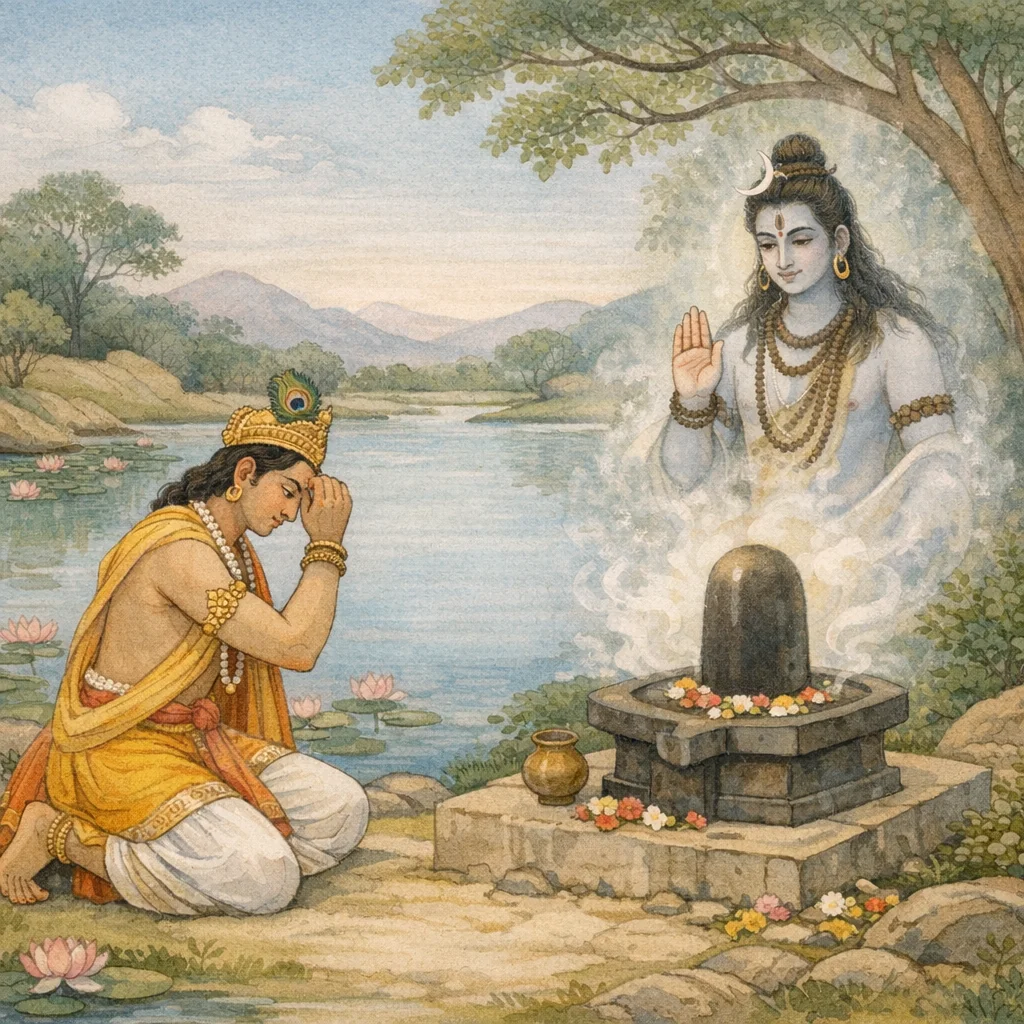
Narrated by Sūta, this chapter recounts how Viṣṇu, having installed an earthen liṅga (pārthiva-liṅga), worships Śiva with a thousand lotus offerings (sahasra-kamala) while reciting a sahasranāma-stotra. To test the purity of the rite, Śiva hides one lotus, creating a deliberate shortfall in the count. Grieved that the prescribed completeness is broken, Viṣṇu reflects that his own eye is lotus-like and thus a valid substitute, and he resolves to offer it—turning bodily sacrifice into the supreme offering of self-surrender (ātma-samarpaṇa). At that very moment Śiva intervenes with “mā mā” (“do not”) and manifests from the liṅga, affirming that true worship is measured by bhāva—inner intent and readiness to relinquish the self—and then bestows grace. The teaching is subtle: ritual precision matters, yet its summit is total inward devotion that draws divine epiphany and prasāda.
Shlokas
Verse 1
सूत उवाच । श्रुत्वा विष्णुकृतं दिव्यं परनामविभूषितम् । सहस्रनामस्वस्तोत्रं प्रसन्नोऽभून्महेश्वरः
Sūta said: Having heard the divine auspicious hymn—the Thousand-Name auspicious stotra composed by Viṣṇu and adorned with the supreme Names (of Śiva)—Maheśvara became pleased.
Verse 2
परीक्षार्थं हरेरीशः कमलेषु महेश्वरः । गोपयामास कमलं तदैकं भुवनेश्वरः
To test Hari (Viṣṇu), the Great Lord—Maheśvara, Lord of the worlds—hid one lotus among the lotuses.
Verse 3
पंकजेषु तदा तेषु सहस्रेषु बभूव च । न्यूनमेकं तदा विष्णुर्विह्वलश्शिवपूजने
Then, among those thousand lotuses, one was found to be missing. At that moment, Viṣṇu became deeply distressed in his worship of Lord Śiva.
Verse 4
हृदा विचारितं तेन कुतो वै कमलं गतम् । यातं यातु सुखेनैव मन्नेत्रं कमलं न किम्
Reflecting within his heart, he thought: “Where indeed has the lotus gone? Let it go—let it depart in peace. Is not my own eye itself a lotus?”
Verse 5
ज्ञात्वेति नेत्रमुद्धृत्य सर्वसत्त्वावलम्बनात् । पूजयामास भावेन स्तवयामास तेन च
Having understood thus, he lifted up his gaze—taking refuge in the support of all beings, Lord Śiva. With heartfelt devotion he worshipped Him, and with that very feeling he also praised Him in hymns.
Verse 6
ततः स्तुतमथो दृष्ट्वा तथाभूतं हरो हरिम् । मा मेति व्याहरन्नेव प्रादुरासीज्जगद्गुरुः
Then Hara (Lord Śiva), seeing Hari (Viṣṇu) thus bowed in praise, spoke the words “Do not grieve, do not,” and at that very utterance the Jagadguru—the World-Teacher, Lord Śiva Himself—manifested.
Verse 7
तस्मादवतताराशु मण्डलात्पार्थिवस्य च । प्रतिष्ठितस्य हरिणा स्वलिंगस्य महेश्वरः
“Therefore, Mahādeva—Mahēśvara—quickly descended from that earthen sacred circle, to grace His own Liṅga which had been duly established by Hari (Viṣṇu).”
Verse 8
यथोक्तरूपिणं शम्भुं तेजोराशिसमुत्थितम् । नमस्कृत्य पुरः स्थित्वा स तुष्टाव विशेषतः
Beholding Śambhu in the very form that had been described—manifested from a mass of divine radiance—he bowed down, stood before Him, and then praised Him with particular devotion.
Verse 9
तदा प्राह महादेवः प्रसन्नः प्रहसन्निव । सम्प्रेक्ष्य कृपया विष्णुं कृतांजलिपुटं स्थितम्
Then Mahādeva, pleased and as though gently smiling, looked with compassion upon Viṣṇu who stood there with folded hands, and spoke.
Verse 10
शङ्कर उवाच । ज्ञातं मयेदं सकलं तव चित्तेप्सितं हरे । देवकार्यं विशेषेण देवकार्य्यरतात्मनः
Shankara said: O Hari, I have fully understood all that your heart desires—especially the divine mission, for your very nature is devoted to the work of the gods.
Verse 11
देवकार्य्यस्य सिद्ध्यर्थं दैत्यनाशाय चाश्रमम् । सुदर्शनाख्यं चक्रं च ददामि तव शोभनम्
“For the successful accomplishment of the gods’ purpose and for the destruction of the Daityas, I grant you this splendid discus known as Sudarśana, together with a sacred hermitage (āśrama).”
Verse 12
यद्रूपं भवता दृष्टं सर्वलोकसुखावहम् । हिताय तव देवेश धृतं भावय तद्ध्रुवम्
That form which you have beheld—bestowing happiness upon all the worlds—has been assumed by the Lord of gods for your welfare. Therefore, contemplate that very form with steady certainty.
Verse 13
रणाजिरे स्मृतं तद्वै देवानां दुःखनाशनम् । इदं चक्रमिदं रूपमिदं नामसहस्रकम्
When remembered on the field of battle, it indeed becomes the destroyer of the gods’ sorrow. “This is the discus; this is the form; and this is the thousand names.”
Verse 14
ये शृण्वन्ति सदा भक्त्या सिद्धि स्यादनपायिनी । कामानां सकलानां च प्रसादान्मम सुव्रत
O noble-vowed one, those who always listen with devotion attain unfailing spiritual accomplishment; and, by My grace, all their rightful desires are fulfilled.
Verse 15
सूत उवाच । एवमुक्त्वा ददौ चक्रं सूर्यायुतसमप्रभम् । सुदर्शनं स्वपादोत्थं सर्वशत्रुविनाशनम्
Sūta said: Having spoken thus, he bestowed upon Sūrya the discus Sudarśana—radiant like ten thousand suns, sprung from his own foot, and able to destroy every enemy.
Verse 16
विष्णुश्चापि सुसंस्कृत्य जग्राहोदङ्मुखस्तदा । नमस्कृत्य महादेवं विष्णुर्वचनमब्रवीत्
Then Viṣṇu also, having duly purified and composed himself, took his seat facing north. Having bowed in reverence to Mahādeva, Viṣṇu spoke these words.
Verse 17
विष्णुरुवाच । शृणु देव मया ध्येयं पठनीयं च किं प्रभो । दुःखानां नाशनार्थं हि वद त्वं लोकशंकर
Viṣṇu said: “O Deva, hear me. O Lord, what should I meditate upon, and what should I recite? For the very purpose of destroying sorrows, tell me, O Śaṅkara, benefactor of the worlds.”
Verse 18
सूत उवाच । इति पृष्टस्तदा तेन सन्तुष्टस्तु शिवोऽब्रवीत् । प्रसन्नमानसो भूत्वा विष्णुं देवसहायकम्
Sūta said: Thus questioned by him, Lord Śiva—well pleased—spoke. With a serene and gracious mind, He addressed Viṣṇu, the helper of the gods.
Verse 19
शिव उवाच । रूपं ध्येयं हरे मे हि सर्वानर्थप्रशान्तये । अनेकदुःखनाशार्थं पठ नामसहस्रकम्
Śiva said: “O Hari, meditate upon My form indeed, for the pacification of all misfortunes. And for the destruction of many kinds of sorrow, recite the Thousand Names.”
Verse 20
धार्य्यं चक्रं सदा मे हि सवार्भीष्टस्य सिद्धये । त्वया विष्णो प्रयत्नेन सर्वचक्रवरं त्विदम्
“This discus should indeed be borne by Me always, for the accomplishment of all that I desire. O Viṣṇu, through your earnest effort this has become the most excellent of all discs.”
Verse 21
अन्ये च ये पठिष्यन्ति पाठयिष्यन्ति नित्यशः । तेषां दुःखं न स्वप्नेऽपि जायते नात्र संशयः
And others too—who will recite this regularly, or cause it to be recited daily—for them, sorrow does not arise even in a dream; of this there is no doubt.
Verse 22
राज्ञा च संकटे प्राप्ते शतावृत्तिं चरेद्यदा । साङ्गः च विधिसंयुक्तं कल्याणं लभते नरः
When a king is overtaken by calamity, if a man performs the śatāvṛtti observance in that time of distress—complete in all its limbs and joined with the prescribed rite—he attains auspicious welfare and well-being.
Verse 23
रोगनाशकरं ह्येतद्विद्यावित्तदमुत्तमम् । सर्वकामप्रदं पुण्यं शिवभक्तिप्रदं सदा
Indeed, this observance destroys diseases and is the supreme bestower of knowledge and prosperity. It grants every worthy desire, is meritorious, and ever bestows devotion to Lord Śiva.
Verse 24
यदुद्दिश्य फलं श्रेष्ठं पठिष्यन्ति नरास्त्विह । सप्स्यन्ते नात्र संदेहः फलं तत्सत्यमुत्तमम्
Keeping in view that supreme reward, people in this world will recite this sacred account. They will surely obtain that fruit—there is no doubt. That promised result is true and most excellent.
Verse 25
यश्च प्रातस्समुत्थाय पूजां कृत्वा मदीयिकाम् । पठते मत्समक्षं वै नित्यं सिद्धिर्न दूरतः
Whoever rises in the early morning, performs worship offered to Me, and then recites this regularly as though in My very presence—his siddhi, spiritual attainment, is never far away.
Verse 26
ऐहिकीं सिद्धिमाप्नोति निखिलां सर्वकामिकाम् । अन्ते सायुज्यमुक्तिं वै प्राप्नोत्यत्र न संशयः
He attains, in this very world, complete success that fulfills all rightful desires; and in the end he surely obtains sāyujya-mukti—union with Lord Śiva. Of this there is no doubt.
Verse 27
सूत उवाच । एवमुक्त्वा तदा विष्णुं शंकरः प्रीतमानसः । उपस्पृश्य कराभ्यां तमुवाच गिरिशः पुनः
Sūta said: Having thus addressed Viṣṇu, Śaṅkara—his heart filled with delight—touched him with both hands, and the Lord of the Mountain (Giriśa) spoke to him again.
Verse 28
शिव उवाच । वरदोऽस्मि सुरश्रेष्ठ वरान्वृणु यथेप्सितान् । भक्त्या वशीकृतो नूनं स्तवेनानेन सुव्रतः
Śiva said: “O best among the gods, I am the giver of boons—choose the blessings you desire. Truly, by devotion I have been won over by this hymn; O you of noble vows.”
Verse 29
सूत उवाच । इत्युक्तो देवदेवेन देवदेवं प्रणम्य तम् । सुप्रसन्नतरो विष्णुस्सांजलिर्वाक्यमब्रवीत्
Sūta said: Thus addressed by the God of gods, Viṣṇu bowed to that divine Lord. Becoming even more delighted, he joined his palms in reverence and spoke these words.
Verse 30
विष्णुरुवाच । यथेदानीं कृपानाथ क्रियते चान्यतः परा । कार्य्या चैव विशेषेण कृपालुत्वात्त्वया प्रभो
Viṣṇu said: “O Lord of compassion, just as a higher (saving) act is being undertaken now, so too it should be carried out elsewhere as well—indeed, it ought to be performed especially by you, O Lord, for you are compassion itself.”
Verse 31
त्वयि भक्तिर्महादेव प्रसीद वरमुत्तमम् । नान्यमिच्छामि भक्तानामार्त्तयो नैव यत्प्रभो
“O Mahādeva, let my devotion rest in You—be gracious and grant me the highest boon. I desire nothing else, O Lord; for devotees there is no distress at all when You are their refuge.”
Verse 32
सूत उवाच । तच्छ्रुत्वा वचनं तस्य दया वान्सुतरां भवः । पस्पर्श च तदंगं वै प्राह शीतांशुशेखरः
Sūta said: Having heard his words, Bhava (Lord Śiva), filled with even greater compassion, touched his body; then the Moon-crested Lord spoke.
Verse 33
शिव उवाच । मयि भक्तिस्सदा ते तु हरे स्यादनपायिनी । सदा वन्द्यश्च पूज्यश्च लोके भव सुरैरपि
Śiva said: “O Hari, may your devotion to Me be ever constant and never failing. In this world, be always worthy of reverence and worship—even by the gods.”
Verse 34
विष्वंभरेति ते नाम सर्वपापहरं परम् । भविष्यति न संदेहो मत्प्रसादात्सुरोत्तम
“Your name shall be ‘Viśvambhara’, the supreme remover of all sins. Of this there is no doubt—by My grace, O best among the gods.”
Verse 35
सूत उवाच । इत्युक्त्वांतर्दधे रुद्रस्सर्वदेवेश्वरः प्रभुः । पश्यतस्तस्य विष्णोस्तु तत्रैव च मुनीश्वराः
Sūta said: Having spoken thus, Rudra—the Lord, the sovereign of all the gods—vanished from sight. And as Viṣṇu looked on, the great sages also disappeared there itself.
Verse 36
जनार्दनोऽपि भगवान्वचनाच्छङ्करस्य च । प्राप्य चक्रं शुभं तद्वै जहर्षाति स्वचेतसि
Even Lord Janārdana (Viṣṇu), following the word of Śaṅkara, obtained that auspicious discus; and within his own heart he rejoiced greatly.
Verse 37
कृत्वा ध्यानं च तच्छम्भोः स्तोत्रमेतन्निरन्तरम् । पपाठाध्यापयामास भक्तेभ्यस्तदुपादिशत्
Having first meditated upon the auspicious Lord Śambhu, he then recited this hymn without ceasing; he also had it taught to others and instructed the devotees in it.
Verse 38
इति पृष्टं मयाख्यातं शृण्वताम्पापहारकम् । अतःपरं च किं श्रेष्ठाः प्रष्टुमिच्छथ वै पुनः
Thus, what you asked has been explained by me; for those who listen, it becomes a remover of sins. Now then, O noble ones, what else do you wish to ask again?
Frequently Asked Questions
Śiva tests Viṣṇu’s worship by concealing one lotus from the thousand-lotus offering; Viṣṇu resolves to substitute his own lotus-like eye to preserve ritual completeness, prompting Śiva to manifest and halt the sacrifice, thereby validating devotion and self-offering as the highest form of pūjā.
The missing lotus signifies the inevitable insufficiency of merely external ritual; the eye symbolizes consciousness and personal identity, so offering it encodes ātma-nivedana (total self-surrender). The pārthiva-liṅga represents a consecrated focal point where transcendence becomes immanent—Śiva’s grace emerges precisely when inner intent becomes complete.
Śiva appears as Jagadguru and compassionate examiner (kṛpālu-parīkṣaka), manifesting directly from the installed liṅga; the emphasis is on Śiva as the responsive Lord whose anugraha is drawn forth by perfected bhakti rather than by ritual mechanics alone.