Sarga 21
सागरप्रतीक्षा-क्रोधप्रादुर्भावः (Rama’s Vigil at the Ocean and the Rise of Wrath)
युद्धकाण्ड
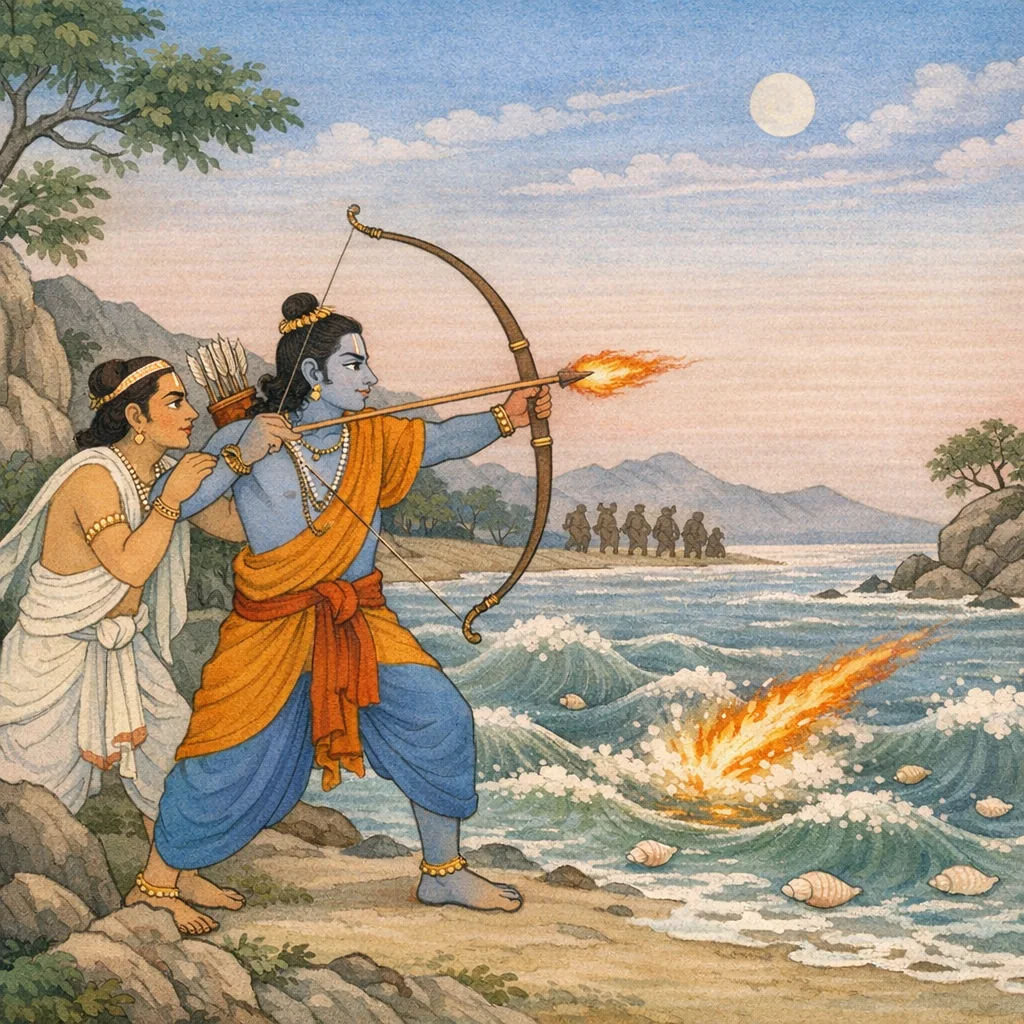
At the seashore, Rāma undertakes a disciplined approach: he spreads kuśa grass, faces east, offers añjali to the Ocean, and lies down in a vigil bound by vow. Three nights pass as he waits upon Sāgara, “lord of rivers,” yet the sea does not manifest any responsive “form,” though duly honored. This silence turns self-restraint into righteous wrath. Rāma voices a political-ethical warning: calmness, forbearance, straightforwardness, and courteous speech can be mistaken for weakness before the “attribute-less” (nirguṇa) or the proud. He cautions Lakṣmaṇa that fame and victory are not won by conciliation alone, and resolves to dry up or torment the ocean with serpent-like arrows so the Vānara host may cross on foot. As he bends the terrible bow, the narrative swells to cosmic consequence—blazing arrows strike the waters, waves surge like mountains, conchs and shells churn, smoke rises, and underworld nāgas and dānavas are distressed—until Saumitrī restrains him, seizing the bow and urging, “Enough.”
Shlokas
Verse 1
ततस्सागरवेलायांदर्भानास्तीर्यराघवः ।अञ्जलिंप्राङ्मुखःकृत्वाप्रतिशिश्येमहोदधेः ।।6.21.1।।बाहुंभुजगभोगाभमुपधायारिसूदनः ।
Then on the seashore Rāghava spread darbha-grass; facing east, he joined his palms in reverent añjali and lay down by the great ocean, resting upon his arm coiled like a serpent—he, the slayer of foes.
Verse 2
वरकाञ्चनकेयूरमुक्ताप्रवरभूषणैः ।।6.21.2।।भुजैःपरमनारीणामभिमृष्टमनेकदा ।।6.21.3।।
Those shoulders—adorned with superb armlets and ornaments of fine gold and pearls—had been caressed many times by noble women.
Verse 3
वरकाञ्चनकेयूरमुक्ताप्रवरभूषणैः ।।6.21.2।।भुजैःपरमनारीणामभिमृष्टमनेकदा ।।6.21.3।।
Those shoulders—adorned with superb armlets and ornaments of fine gold and pearls—had been caressed many times by noble women.
Verse 4
चन्दनागुरुभिश्चैवपुरस्तादधिवासितम् ।बालसूर्यप्रकाशैश्चन्दनैरुपशोभितम् ।।6.21.4।।
It had earlier been perfumed with sandalwood and agaru, and made radiant by sandal-paste shining like the light of the rising sun.
Verse 5
शयनेचोत्तमाङ्गेनसीतायाश्शोभितंपुरा ।तक्षकस्येवसम्भोगगङ्गाजलनिषेचितम् ।।6.21.5।।
Formerly, upon the bed, it was graced by Sītā’s noble presence, as though bathed in Gaṅgā-water in a union like that of Takṣaka, the great serpent.
Verse 6
संयुगेयुगसङ्काशंशत्रूणांशोकवर्धनम् ।सुहृदानन्दनंदीर्घंसागरान्तव्यपाश्रयम् ।।6.21.6।।
In battle he was like a yuga in might; he increased the enemies’ grief, delighted friends, and stood vast—like the earth bounded by the encircling ocean.
Verse 7
असत्याचपुनस्सव्यंज्याघातविगतत्वचम् ।दक्षिणोदक्षिणंबाहुंमहापरिघसन्निभम् ।।6.21.7।।गोसहस्रप्रदारंमुपधायमहत्भुजम् ।अद्यमेमरणंवादतरणंसागरस्यवा ।।6.21.8।।तिरामोमतिंकृत्वामहाबाहुर्महोदधिम् ।अधिशिश्येचविधिवत्प्रयतोनियतोमुनिः ।।6.21.9।।
His left arm had grown calloused by the repeated snap of the bowstring, and his right arm—like a massive iron bar—had been worn by the giving of thousands of cows. Resolving, “Today let there be either my death or the crossing of the ocean,” the mighty-armed Rāma lay down before the great sea, in due rite—self-restrained and disciplined like a sage.
Verse 8
असत्याचपुनस्सव्यंज्याघातविगतत्वचम् ।दक्षिणोदक्षिणंबाहुंमहापरिघसन्निभम् ।।6.21.7।।गोसहस्रप्रदारंमुपधायमहत्भुजम् ।अद्यमेमरणंवादतरणंसागरस्यवा ।।6.21.8।।तिरामोमतिंकृत्वामहाबाहुर्महोदधिम् ।अधिशिश्येचविधिवत्प्रयतोनियतोमुनिः ।।6.21.9।।
Bracing his great arm—wearied as though by the giving away of thousands of cows—Rāma resolved: “Let it be either my death today, or the crossing of the ocean.”
Verse 9
असत्याचपुनस्सव्यंज्याघातविगतत्वचम् ।दक्षिणोदक्षिणंबाहुंमहापरिघसन्निभम् ।।6.21.7।।गोसहस्रप्रदारंमुपधायमहत्भुजम् ।अद्यमेमरणंवादतरणंसागरस्यवा ।।6.21.8।।तिरामोमतिंकृत्वामहाबाहुर्महोदधिम् ।अधिशिश्येचविधिवत्प्रयतोनियतोमुनिः ।।6.21.9।।
Having fixed his mind upon the mighty ocean, the great-armed Rāma lay down in due observance—self-restrained and disciplined, like a sage.
Verse 10
तस्यरामस्यसुप्तस्यकुशास्तीर्णेमहीतले ।नियमादप्रमत्तस्यनिशास्तिस्रोऽतिचक्रमुः ।।6.21.10।।
As Rāma lay on the ground upon a bed of kuśa grass—ever vigilant through his vowed observance—three nights swiftly passed.
Verse 11
सत्रिरात्रोषितस्तत्रनयज्ञोधर्मवत्सलः ।उपासततदारामस्सागरंसरितांपतिम् ।।6.21.11।।
There, after staying three nights, Rāma—politically discerning and devoted to dharma—continued to wait upon the ocean, lord of rivers.
Verse 12
नचदर्शयतेरूपंमन्दोरामस्यसागरः ।प्रयतेनापिरामेणयथार्हमभिपूजितः ।।6.21.12।।
Yet the dull ocean did not reveal itself to Rāma; though self-restrained, Rāma honored it duly and with proper reverence, it still did not appear.
Verse 13
समुद्रस्यततःक्रुद्धोरामोरक्तान्तलोचनः ।समीपस्थमुवाचेदंलक्ष्मणंशुभलक्ष्मणम् ।।6.21.13।।
Then Rāma, angered at the ocean, the corners of his eyes reddened, spoke these words to Lakṣmaṇa standing nearby, marked with auspicious signs.
Verse 14
अवलेपस्समुद्रस्यनदर्शयतियत्स्वयम् ।प्रशमश्चक्षमाचैवआर्जवंप्रियवादिता ।।6.21.14।।असामर्थ्यंफल्नात्येतेनिर्गुणेषुसतांगुणाः ।
“The ocean’s arrogance is such that it does not present itself of its own accord. Calmness, forbearance, straightforwardness, and gentle speech—these virtues of the good, when shown to the unworthy, are taken as mere weakness.”
Verse 15
आत्मप्रशंसिनंदृष्टंधृष्टंविपरिथावकम् ।सर्वत्रोत्सृष्टदण्डंचलोकस्सत्कुरुतेनरम् ।।6.21.15।।
“One sees the world honoring a man who boasts of himself—bold to the point of insolence, acting perversely, and brandishing punishment everywhere.”
Verse 16
नसाम्नाशक्यतेकीर्तिर्नसाम्नाशक्यतेयशः ।प्राप्तुंलक्ष्मण लोकेऽस्मिन् ञ्जयोवारणमूर्धनि ।।6.21.16।।
“Lakṣmaṇa, in this world neither fame nor renown is gained merely by conciliation; nor is victory at the head of battle won by it alone.”
Verse 17
अद्यमद्बाणनिर्भग्नैर्मकरैर्मकरानिलयम् ।निरुद्धतोयंसौमित्रेप्लवभदिःपश्यसर्वतः ।।6.21.17।।
“Saumitri, look: today the ocean—abode of the makaras—has its makaras shattered by my arrows; they leap and float about, while the waters surge and splash on every side.”
Verse 18
महाभोगानिमत्स्यानांकरिणांचकराह ।भोगिनांपश्यनागानांमयाछिन्नानिलक्ष्मण ।।6.21.18।।
“Lakṣmaṇa, see: great fishes, sea-elephants, and mighty serpents with huge coils—cut apart by me—are strewn here.”
Verse 19
सशङ्खशुक्तिजालंसमीनमकरंतथा ।अद्ययुद्धेनमहतासमुद्रंपरिशोषये ।।6.21.19।।
“Today, by this great assault, I will dry up the ocean—along with its nets of conches and shells, and with its fishes and makaras as well.”
Verse 20
क्षमयाहिसमायुक्तंमामयंमकरालयः ।असमर्थंविजानातिधिक् क्षमामीदृशेजने ।।6.21.20।।
“Because I have remained forbearing, this ocean—home of the makaras—takes me to be powerless. Shame on such forbearance, when it is mistaken by such a one as weakness!”
Verse 21
नदर्शयतिसाम्नामेसागरोरूपमात्मनः ।।6.21.21।।चापमानयसौमित्रेशरांश्चाशीविषोपमान् ।सागरंशोषयिष्यामिपद् भ्यांयान्तुप्लवङ्गमाः ।।6.21.22।।
“The Ocean does not reveal his true disposition to me, even when addressed with conciliation. O Saumitrī, bring the bow and the arrows like venomous serpents; I shall dry up the ocean—let the vānaras then go on foot.”
Verse 22
नदर्शयतिसाम्नामेसागरोरूपमात्मनः ।।6.21.21।।चापमानयसौमित्रेशरांश्चाशीविषोपमान् ।सागरंशोषयिष्यामिपद् भ्यांयान्तुप्लवङ्गमाः ।।6.21.22।।
“The Ocean does not reveal his true disposition to me, even when addressed with conciliation. O Saumitrī, bring the bow and the arrows like venomous serpents; I shall dry up the ocean—let the vānaras then go on foot.”
Verse 23
अद्याक्षोभ्यमपिक्रुद्धःक्षोभयिष्यामिसागरम् ।वेलासुकृतमर्यादंसहस्रोर्मिसमाकुलम् ।।6.21.23।।निर्मर्यादंकरिष्यामिसायायिकैर्वरुणालयम् ।महार्णवंक्षोभयिष्येमहादानवसङ्कुलम् ।।6.21.24।।
Today, in wrath, I shall shake the ocean—though he is said to be unshakable—he who keeps within the bounds set by the shore, teeming with thousands of waves. With my arrows I will drive Varuṇa’s abode beyond its limits; I will churn that vast sea, crowded with mighty beings.
Verse 24
अद्याक्षोभ्यमपिक्रुद्धःक्षोभयिष्यामिसागरम् ।वेलासुकृतमर्यादंसहस्रोर्मिसमाकुलम् ।।6.21.23।।निर्मर्यादंकरिष्यामिसायायिकैर्वरुणालयम् ।महार्णवंक्षोभयिष्येमहादानवसङ्कुलम् ।।6.21.24।।
Today, in wrath, I shall shake the ocean—though he is said to be unshakable—he who keeps within the bounds set by the shore, teeming with thousands of waves. With my arrows I will drive Varuṇa’s abode beyond its limits; I will churn that vast sea, crowded with mighty beings.
Verse 25
एवमुक्त्वाधनुष्पाणिःक्रोधविस्फारितेक्षणः ।बभूवरामोदुर्धर्षोयुगान्तानगिरिवज्वलन् ।।6.21.25।।
Having spoken thus, Rāma—bow in hand, eyes widened in wrath—became unassailable, blazing like the fire of the world’s end.
Verse 26
सम्पीड्यचधनुर्घोरंकम्पयित्वाशरैर्जगत् ।मुमोचविशिखानुग्रान्वज्रानिवशतक्रतुः ।।6.21.26।।
Bending that dreadful bow and making the world tremble with his arrows, he loosed fierce shafts—like Śatakratu (Indra) hurling thunderbolts.
Verse 27
तेज्वलन्तोमहावेगास्तेजसासायकोत्तमाः ।प्रविशन्तिसमुद्रस्यसलिलंत्रस्तपन्नगम् ।।6.21.27।।
Blazing with radiance and rushing with great speed, those superb arrows plunged into the ocean’s waters, terrifying the serpents within.
Verse 28
तोयवेगस्समुद्रस्यसनक्रमकरोमहान् ।सम्बभूवमहाघोरस्समारुतरवस्तदा ।।6.21.28।।
Then the ocean’s surge became immense and dreadful—filled with crocodiles and makaras—roaring with the wind as it heaved in turmoil.
Verse 29
महोर्मिकुलाविततश्शङ्खजालसमावृतः ।सधूमःपरिवृत्तोर्मिस्सहसासीन्महोदधिः ।।6.21.29।।
All at once the great ocean—its vast billows spread out and its waters strewn with conches and shells—became smoke-laden, with its waves swirling and heaving in agitation.
Verse 30
व्यथिताःपन्नगाश्चासदनीप्तास्यादीप्तलोचनाः ।दानवाश्चमहावीर्याःपाताळतलवासिनः ।।6.21.30।।
The serpents too were distressed—blazing-hooded, bright-eyed—and the mighty Dānavas who dwell in the levels of Pātāla were likewise shaken.
Verse 31
ऊर्मयस्सिन्धुराजस्यसनक्रमकरास्तथा ।विन्द्यमन्दरसङ्काशास्समुत्पेतुस्सहस्रशः ।।6.21.31।।
Then thousands of waves of the ocean, bearing crocodiles and makaras, surged up—like the peaks of Vindhya and Mandara.
Verse 32
आघूर्णिततरङ्गौघस्सम्भ्रान्तोरगराक्षसः ।उद्वर्तितमहाग्राहस्संवृत्तस्सलिलाशयः ।।6.21.32।।
The watery expanse became a tumult: its mass of waves whirled, nāgas and rākṣasas were thrown into confusion, and great crocodiles were churned up and cast about.
Verse 33
ततस्तुतंराघवमुग्रवेगंप्रकर्षमाणंधनुरप्रमेयम् ।सौमित्रिरुत्पत्यसमुच्छवसन्तंमामेतिचोक्त्वादनुराललम्बे ।।6.21.33।।
Then Saumitri sprang up toward Rāghava, who—moving with fierce speed—was drawing his immeasurable bow, breathing hard; and saying, “Enough—come back to yourself,” he seized hold of the bow.
Frequently Asked Questions
The dilemma is how a dharmic leader should respond when respectful conciliation and ritual propriety receive no reciprocal acknowledgment: Rāma shifts from patient waiting (three nights under vow) to a threatened coercive act (drying/tormenting the ocean) to secure passage for the allied force.
The chapter frames restraint as a virtue that must be paired with discernment (naya): calmness and forbearance can be socially misread as incompetence, so ethical governance requires knowing when to escalate—yet also accepting corrective counsel, as shown when Lakṣmaṇa intervenes to prevent disproportionate destruction.
Key landmarks include the seashore (sāgara-velā) as a liminal boundary requiring negotiated passage, and the ocean as Varuṇa’s domain; culturally, the kuśa-grass bed, east-facing añjali, and vow-observance evoke ritual protocol, while Vindhya–Mandara comparisons provide a classical geographic-poetic scale for the surging waves.