Sarga 56
अकम्पनवधः — The Slaying of Akampana (Hanuman’s rout of the Rakshasa host)
युद्धकाण्ड
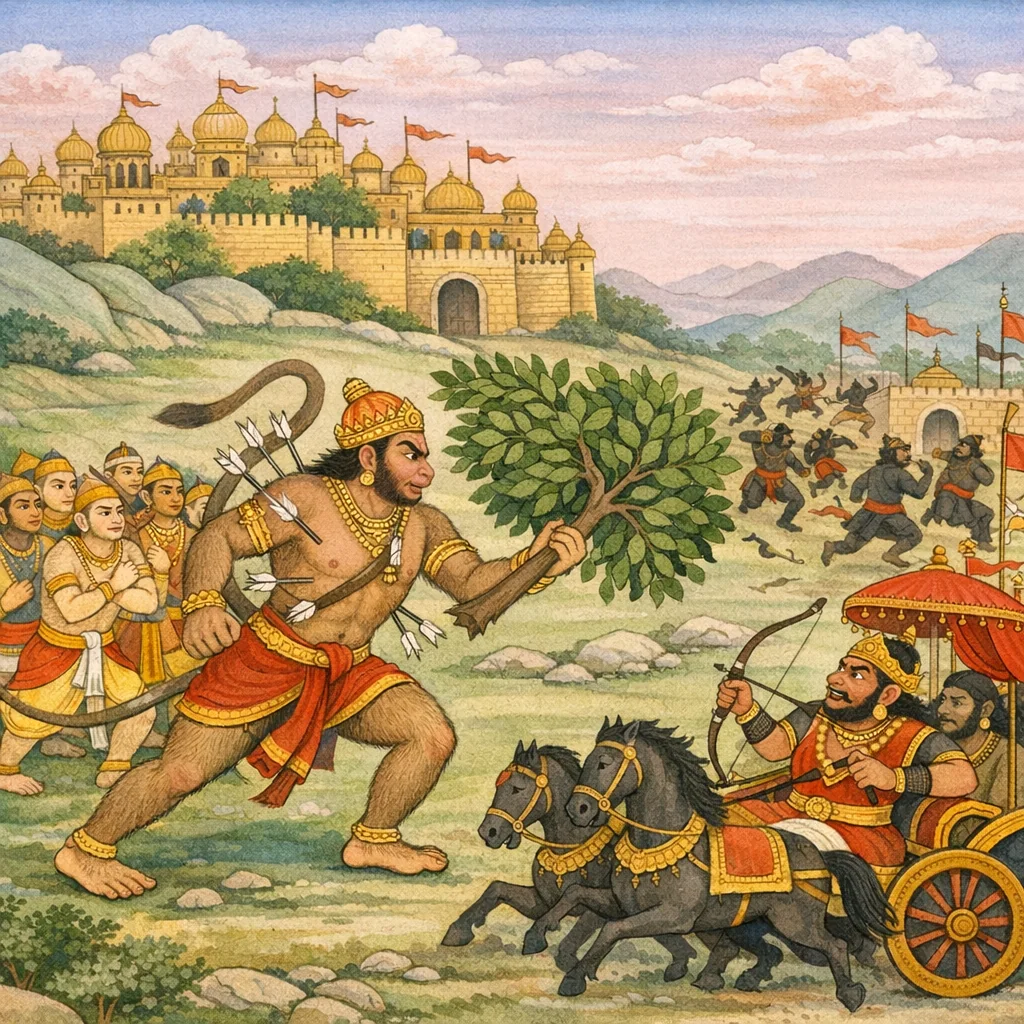
In this sarga, Akampana beholds the vānaras’ “great accomplishment,” flares up in wrath, and orders his charioteer to drive to the forefront where the rākṣasas are being cut down. From his swift chariot he casts a dense net of arrows upon the vānaras, and many fall while others break and flee. Seeing his kin and allies overwhelmed and near death, Hanumān advances as a steadying refuge. The vānar leaders gather around him and regain strength by taking shelter under his command. A duel takes shape: Akampana pours forth arrow-showers, while Hanumān endures them, intent on a single aim—the destruction of Akampana. Weaponless, Hanumān uproots a mountain and then an Aśvakarṇa tree as improvised arms; Akampana cleaves the mountain-peak in midair with half-moon arrows, further kindling Hanumān’s righteous fury. Hanumān charges, shatters the enemy ranks, and strikes Akampana on the head with the uprooted tree, slaying him. Panic seizes the rākṣasa host; they cast away their weapons and flee into Laṅkā, while the vānaras rejoice and honor Hanumān, and praise rises also to Rāma, Lakṣmaṇa, Sugrīva, and Vibhīṣaṇa—affirming the power of “shelter” (āśraya) and of a single champion as the very support of an army’s heart.
Shlokas
Verse 1
तद्दृष्टवासुमहत्कर्मकृतंवानरतस्तमैः ।क्रोधमाहारयामासयुधितीव्रमकम्पनः ।।6.56.1।।
Seeing the mighty deed accomplished in battle by the foremost of the Vānara warriors, Akampana was seized by intense rage.
Verse 2
क्रोधमूर्चितरूपस्तुधून्वन्परमकार्मुकम् ।दृष्टवातुकर्मशत्रूणांसारथिंवाक्यमब्रवीत् ।।6.56.2।।
Overcome by wrath, shaking his mighty bow, and having observed the enemies’ actions, Akampana spoke words to his charioteer.
Verse 3
तत्त्त्वैतावत्त्वरितंरथंप्रापयसारथे ।यत्रैतेबहवोघ्नन्तिसुबहून्राक्षसान्रणे ।।6.56.3।।
“Charioteer, drive the chariot quickly to that very place where these warriors are felling great numbers of rakshasas in battle.”
Verse 4
एतेऽत्रबलवन्तोहिभीमकोपाश्चवानराः ।द्रुमशैलप्रहरणास्तिष्ठन्तिप्रमुखेमम ।।6.56.4।।
“Here stand those mighty Vānaras, terrible in their wrath, wielding trees and boulders as weapons. Take me to where their leaders are stationed.”
Verse 5
एतान्निहन्तुमिच्छामिसमरश्लाघिनोह्यहम् ।एतैःप्रमथितंसर्वंदृश्यतेराक्षसांबलम् ।।6.56.5।।
“I desire to slay these Vānaras, for I am one who prides himself on war. By them the entire Rākṣasa host is seen to be shattered.”
Verse 6
ततःप्रजवनाश्वेनरथेनरथिनांवरः ।हरीनभ्यहनत्क्रोधाच्छरजालैकम्पनः ।।6.56.6।।
Then Akampana, foremost among chariot-warriors, mounted a chariot drawn by swift horses and, in anger, assailed the Vānaras with a dense net of arrows.
Verse 7
नस्थातुंवानराश्शेकुःकिंपुनर्योद्धुमाहवे ।अकम्पनशरैर्भग्नास्सर्वएवविदुद्रुवुः ।।6.56.7।।
The Vānaras could not even hold their ground—how then could they fight in battle? Shattered by Akampana’s arrows, they all fled.
Verse 8
तान्मृत्युवशमापन्नानकम्पनवंशगतान् ।समीक्ष्यहनुमान्ज्ञातीनुपतस्थेमहाबलः ।।6.56.8।।
Seeing his kinsmen brought under the very sway of death by Akampana, the mighty Hanumān stepped forward to stand by them.
Verse 9
तंमहाप्लवगंदृष्टवासर्वेतेप्लवगयूथपा: ।समेत्यसमरेवीरास्सहिताःपर्यवारयन् ।।6.56.9।।
Seeing that mighty monkey, all the Vānara troop-leaders—valiant in battle—gathered together and, united, surrounded him.
Verse 10
अवस्थितंहनूमन्तंतेदृष्टवाहरियूथपा: ।बभूवुर्बलवन्तोहिबलवन्तंसमाश्रिताः ।।6.56.10।।
Seeing Hanumān standing firm, the leaders of the monkey-troops took refuge in that mighty one; and, relying on the strong, they themselves became strong.
Verse 11
अकम्पनस्तुशैलाभंहनूमन्तमवस्थितम् ।महेन्द्रइवदाराभिश्शरैरभिववर्षह ।।6.56.11।।
But Akampana showered Hanumān—standing like a mountain—with torrents of arrows, as Mahendra (Indra) pours down streams of rain.
Verse 12
अचिन्तयित्वाबाणौघान् शरीरेपतितान्शितान् ।अकम्पनवधार्थायमनोदध्रेमहाबलः ।।6.56.12।।
Ignoring the sharp volleys of arrows lodged in his body, the mighty one fixed his mind solely on slaying Akampana.
Verse 13
सप्रहस्यमहातेजाहनुमान् मारुतात्मजः ।अभिदुद्रावतद्रक्षःकम्पयन्निवमेदिनीम् ।।6.56.13।।
Laughing, the radiant Hanumān—son of the Wind—rushed straight at that rākṣasa, as though shaking the earth itself.
Verse 14
तस्याभिनर्दमानस्यदीप्यमानस्यतेजसा ।बभूवरूपंदुर्धर्षंदीप्तस्येवविभावसोः ।।6.56.14।।
As he roared and blazed with radiance, his form became unassailable—like flaming fire.
Verse 15
आत्मानंमप्रहरणंज्ञात्वाक्रोधसमन्वितः ।शैलमुत्पाटयामासवेगेनहरिपुङ्गवः ।।6.56.15।।
Knowing himself to be without a weapon, the foremost of the Vānaras, filled with wrath, swiftly tore up a mountain to serve as his means of attack.
Verse 16
गृहीत्वातंमहाशैलंपाणिनैकेनमारुतिः ।सविनद्यमहानादंभ्रामयामासवीर्यवान् ।।6.56.16।।
Grasping that massive mountain with a single hand, the heroic Māruti let out a thunderous roar and whirled it around.
Verse 17
ततस्तमभिदुद्रावराक्षसेन्द्रमकम्पनम् ।पुराहिनमुचिंसङ् ख्येवज्रेणेवपुरन्दरः ।।6.56.17।।
Then Hanumān rushed upon Akampana, lord among the Rākṣasas, assailing him as Indra (Purandara) once struck Namuci in battle with his thunderbolt.
Verse 18
अकम्पनस्तुतद्दृष्टवागिरिशृङ्गंसमुद्यतम् ।दूरादेवमहाबाणैरर्धचन्द्रैर्व्यदारयत् ।।6.56.18।।
But Akampana, seeing the mountain-peak raised aloft, split it apart from a distance with great half-moon–shaped arrows.
Verse 19
तत्पर्वताग्रमाकाशेरक्षोबाणविदारितम् ।विकीर्णंपतितंदृष्टवाहनुमान्क्रोधमूर्छितः ।।6.56.19।।
Seeing that mountain-peak in the sky shattered by the Rākṣasa’s arrows, scattered into fragments and fallen down, Hanumān was overcome by a surge of wrath.
Verse 20
सोऽश्वकर्णंसमासाद्यरोषदर्पान्वितोहरिः ।तूर्णमुत्पाटयामासमहागिरिमिवोच्छ्रितम् ।।6.56.20।।
Then the monkey-warrior, filled with rage and pride, reached an aśvakarṇa tree and quickly uprooted it—towering like a great mountain.
Verse 21
तंगृहीत्वामहास्कन्धंसोऽश्वकर्णंमहाद्युतिः ।प्रहस्यपरयाप्रीत्याभ्रामयामासभूतले ।।6.56.21।।
Seizing that aśvakarṇa tree with its enormous trunk, the radiant Hanumān laughed in fierce delight and whirled it about upon the ground.
Verse 22
प्रधावन्नूरुवेगेनप्रभञ्जंस्तरसाद्रुमान् ।हनूमान्परमक्रुद्धश्चरणैर्दारयत्क्षितम् ।।6.56.22।।
Hanumān, raging with extreme fury, ran with tremendous speed, smashing trees in his rush and tearing the earth with his feet.
Verse 23
गजांश्चसगजारोहान्सरथान्रथिनस्तथा ।जघानहनुमान् भीमान् राक्षसांश्चपदातिगान् ।।6.56.23।।
Hanumān struck down elephants along with their riders, chariots along with their charioteers, and also the fearsome Rākṣasas fighting on foot.
Verse 24
तमन्तकमिवक्रुद्धंसद्रुमंप्राणहारिणम् ।हनूमन्तमभिप्रेक्ष्यराक्षसाविप्रदुद्रुवुः ।।6.56.24।।
Beholding Hanumān—wrathful like Death itself, bearing a life-snatching tree—the Rākṣasas fled in panic.
Verse 25
तमापतन्तंसङ्कृद्धंराक्षसानांभयावहम् ।ददर्शाकम्पनोवीरश्चुक्षोधचननादच ।।6.56.25।।
The hero Akampana saw him charging in—furious and fearsome to the Rākṣasas—and he too blazed with anger and roared.
Verse 26
सचतुर्दशभिर्बाणैश्शितैर्देहविदारणैः ।निर्बिभेदहनूमन्तंमहावीर्यमकम्पनः ।।6.56.26।।
Then Akampana, a warrior of great might, pierced Hanumān with fourteen sharp arrows that tore the flesh.
Verse 27
सतदाप्रतिविद्धस्तुबह्वीभिश्शरवृष्टभिः ।हनूमान्ददृशेवीरःप्ररूढइवसानुमान् ।।6.56.27।।
Though struck again and again by showers of arrows, the valiant Hanumān appeared unmoved, like a mountain rising with wooded slopes.
Verse 28
विरराजमहाकायोमहावीर्योमहामना: ।पुष्पिताशोकसङ्काशोविधूमइवपावकः ।।6.56.28।।
Gigantic in form, great in valor and lofty in spirit, he shone—like a blossoming aśoka tree, like a smokeless fire.
Verse 29
ततोऽन्यंवृक्षमुत्पाट्यकृत्वावेगमनुत्तमम् ।शिरस्यभिजघानाशुराक्षसेन्द्रमकम्पनम् ।।6.56.29।।
Then, uprooting another tree and gathering unsurpassed momentum, he swiftly struck Akampana, chief among the rakshasas, upon the head.
Verse 30
सवृक्षेणहतस्तेनसक्रोधेनमहात्मना ।राक्षसोवानरेन्द्रेणपपातचममारच ।।6.56.30।।
Struck with that tree by the great-souled vanara lord—angered in the moment—the rakshasa fell and died.
Verse 31
तंदृष्टवानिहतंभूमौराक्षसेन्द्रमकम्पनम् ।व्यथिताराक्षसास्सर्वेक्षितिकम्पइवद्रुमाः ।।6.56.31।।
Seeing Akampana, lord of the rakshasas, slain upon the ground, all the rakshasas were shaken with distress—like trees trembling in an earthquake.
Verse 32
त्यक्तप्रहरणास्सर्वेराक्षसास्तेपराजिताः ।लङ्कामभिययुस्त्रस्तावानरास्तैभिद्रुताः ।।6.56.32।।
Defeated, all those rakshasas abandoned their weapons and fled in terror toward Lanka, pursued by the vanaras.
Verse 33
तेमुक्तकेशाःसम्भ्रान्ताभग्नमानाःपराजिताः ।स्रवच्छ्रमजलैरङ्गैश्श्वसन्तोविप्रदुद्रुवुः ।।6.56.33।।
Defeated, bewildered, and broken in spirit—with hair disheveled, bodies streaming with sweat, and breath coming hard—they fled in frantic haste.
Verse 34
अन्योन्यंप्रममन्थुस्तेविविशुर्नगरंभयात् ।पृष्ठतस्तेतुसम्मूढाःप्रेक्षमाणामुहुर्मुहुः ।।6.56.34।।
In fear they crowded and crushed into one another as they entered the city; bewildered, they kept looking back again and again over their shoulders.
Verse 35
तेषुलङ्कांप्रविष्टेषुराक्षसेषुमहाबलाः ।समेत्यहरयस्सर्वेहनूमन्तमपूजयन् ।।6.56.35।।
When those mighty Rākṣasas had entered Laṅkā, all the Vānara warriors gathered together and honoured Hanumān with reverence.
Verse 36
सोऽपिप्रहृष्टस्तान् सर्वान् हरीन् सम्प्रत्यपूजयत् ।हनुमान्सत्त्वसम्पन्नोयथार्हमनुकूलतः ।।6.56.36।।
Hanumān too, delighted and endowed with noble character, duly honoured all those Vānara warriors in return—each according to his worth, with gracious goodwill.
Verse 37
विनेदुश्चयथाप्राणंहरयोजितकाशिनः ।चकर्षुश्चपुनस्तत्रसप्राणानपिराक्षसान् ।।6.56.37।।
In the glow of victory the Vānaras roared to their hearts’ content, and there again they dragged about even living Rākṣasas as captives.
Verse 38
सवीरशोभामभजन्महाकपिःसमेत्यरक्षांसिनिहत्यमारुतिः ।महासुरंभीमममित्रनाशनःयथैवविष्णुर्बलिनंचमूमुखे ।।6.56.38।।
Having joined battle and slain the Rākṣasas, Māruti—the great Vānara, destroyer of foes—shone with heroic splendour, like Viṣṇu on the battlefield after striking down mighty and fearsome Asuras.
Verse 39
अपूजयन्देवगणास्तदाकपिंस्वयंचरामोऽतिबलश्चलक्ष्मणः ।तथैवसुग्रीवमुखाःप्लवङ्गमाविभीषणश्चैवमहाबलस्तथा ।।6.56.39।।
Then the hosts of the gods honoured that great monkey-hero; and Rāma himself, with mighty Lakṣmaṇa, likewise Sugrīva and the Vānara leaders—and also the immensely powerful Vibhīṣaṇa—praised Hanumān.
Frequently Asked Questions
The pivotal action is Hanumān’s choice to convert personal anger into protective duty: despite being pierced by volleys of arrows, he remains focused on stopping Akampana—the immediate source of mass vānar casualties—thereby prioritizing collective safety over personal injury.
The sarga frames “shelter” (taking refuge under a worthy leader) as a practical dharmic strategy: when the vānar leaders rally around Hanumān, strength and order return. Anger becomes legitimate only when disciplined toward restoring protection and moral balance.
Laṅkā appears as the strategic rear into which the defeated rākṣasas retreat; culturally, the episode highlights battlefield improvisation (trees and mountain-peaks as weapons) and the epic’s simile-tradition linking events to Indra’s thunderbolt and Viṣṇu’s demon-slaying archetypes.