Sarga 17
विभीषणागमनम् (Vibhīṣaṇa’s Arrival and the Debate on Refuge)
युद्धकाण्ड
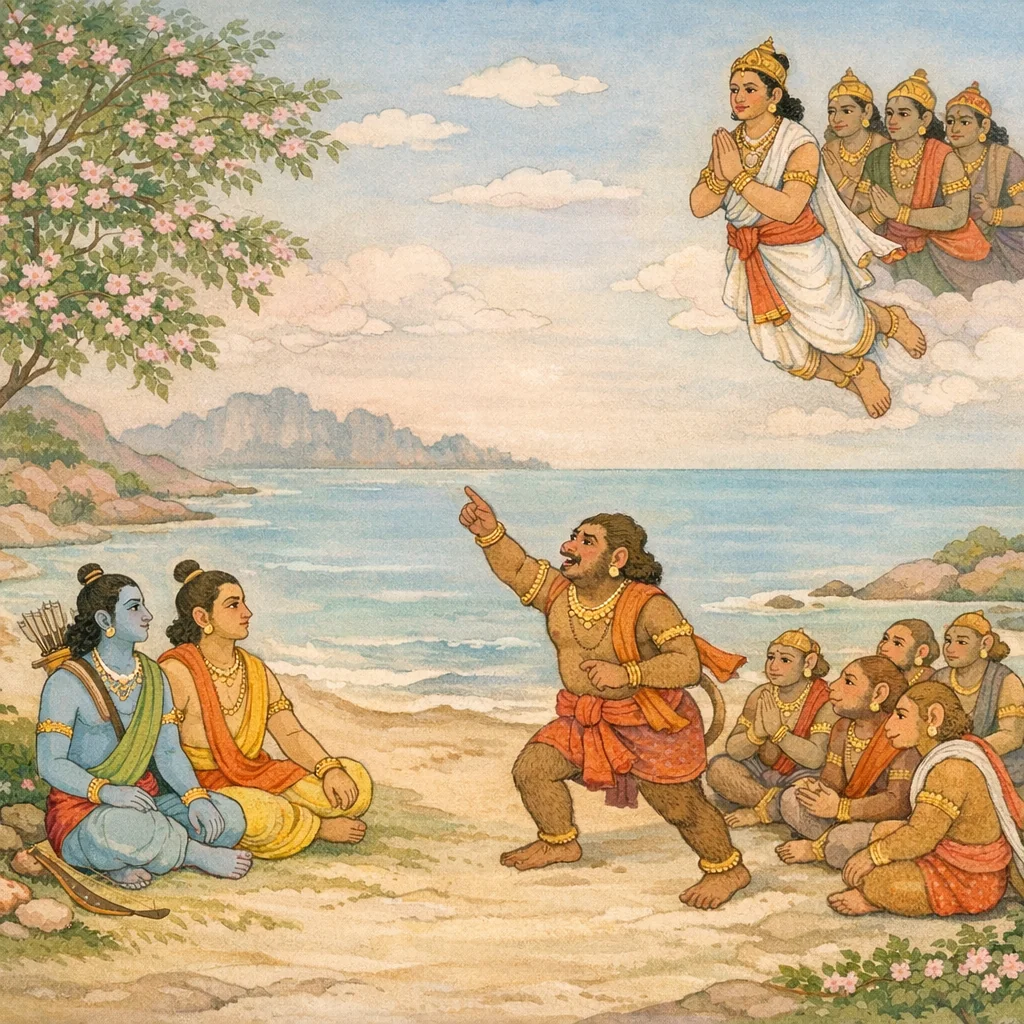
Sarga 17 is a counsel-driven episode that weighs the dharma of granting refuge against the danger of deception. After rebuking Rāvaṇa and urging him to return Sītā, Vibhīṣaṇa leaves Laṅkā with four companions and reaches Rāma’s vicinity, hovering near the northern shore. He introduces himself as Rāvaṇa’s younger brother, recounts Sītā’s abduction and confinement, and asks that Rāghava be told he has come seeking protection. Sugrīva views the arrival through the lens of statecraft: shape-shifting Rākṣasas may be spies, so he urges strict measures—even execution—and vigilance in council, formations, and intelligence. Rāma acknowledges the sound warning and seeks the views of leading Vānara ministers; Aṅgada, Śarabha, Jāmbavān, and Mainda advise suspicion, surveillance, and careful interrogation. Hanumān counters by reading conduct and speech: intent is not known at once, and Vibhīṣaṇa’s words, bearing, and composure show no sign of malice, for tone and demeanor often betray hidden motives. The chapter thus serves as a practical lesson in political prudence joined to an ethical inquiry into when and how refuge should be granted.
Shlokas
Verse 1
इत्युक्त्वापरुषंवाक्यंरावणंरावणानुजः ।आजगाममुहूर्तेनयत्ररामस्सलक्ष्मणः ।।6.17.1।।
Having thus spoken harsh words to Rāvaṇa, his younger brother arrived in a short while at the place where Rāma stood with Lakṣmaṇa.
Verse 2
तंमेरुशिखराकारंदीप्तामिवशतह्रदाम् ।गगनस्थंमहीस्थास्तेददृशुसर्ववानराः ।।6.17.2।।
All the vānaras standing on the ground beheld him in the sky—vast as a peak of Mount Meru, radiant like a flash of lightning.
Verse 3
येचाप्यनुचरास्तस्य चत्वारो भीमविक्रमा: ।तेsपि सर्वायुधोपेता भूषणैश्चापि भूषिता ।।6.17.3।।
His four attendants too—men of dreadful prowess—were present; fully equipped with every weapon and also adorned with ornaments.
Verse 4
स च मेघाचलप्रख्यो वज्रायुधसमप्रभः ।वरायुधधरो वीरो दिव्याभरणभूषितः ।।6.17.4।।
And he (Vibhīṣaṇa) appeared like a cloud-crowned mountain, radiant like the wielder of the thunderbolt; a valiant warrior bearing excellent weapons and adorned with divine ornaments.
Verse 5
तमात्मपञ्चमंदृष्टवासुग्रीवोवाहिनीपति: ।वानरैस्सहदुर्धर्षचिन्तयामासबुद्धिमान् ।।6.17.5।।
Seeing him—Vibhīṣaṇa, as the fifth companion apart from the four—Sugrīva, the wise and formidable lord of the vānara host, began to deliberate together with the vānara leaders.
Verse 6
चिन्तयित्वामुहूर्तंतुवानरांस्तानुवाचह ।हनुमत्प्रमुखान्सर्वानिदंवचनमुत्तमम् ।।6.17.6।।
After reflecting for a moment, he addressed those Vānara leaders—Hanumān foremost among them—with these excellent words.
Verse 7
एषसर्वायुधोपेतश्चतुर्भिस्सहराक्षसैः ।राक्षसोऽभ्येतिपश्यध्वमस्मान्हन्तुंनसंशयः ।।6.17.7।।
Look—this Rākṣasa, armed with every kind of weapon, is approaching along with four other Rākṣasas. He is coming to strike us; there is no doubt.
Verse 8
सुग्रीवस्यवचश्रुत्वासर्वेतेवानरोत्तमाः ।सालानुद्यम्यशैलांश्चइदंवचनमब्रुवन् ।।6.17.8।।
Hearing Sugrīva’s words, all those foremost among the Vānaras, lifting up sāla trees and great boulders, spoke these words in reply.
Verse 9
शीघ्रंव्यादिशनोराजन्वधायैषांदुरात्मनाम् ।निपतन्तुहताश्चैतेधरण्यामल्पतेजसः ।।6.17.9।।
O King, command us swiftly to slay these evil-minded ones; once struck down, these men of paltry power will fall dead upon the earth.
Verse 10
तेषासम्भाषमाणानामन्योन्यंसविभीषणः ।उत्तरंतीरमासाद्यखस्थएवव्यतिष्ठत ।।6.17.10।।
While they were conversing with one another, Vibhīṣaṇa, having reached the northern shore, remained stationed in the sky.
Verse 11
उवाचमहाप्राज्ञस्स्वरेणमहतामहान् ।सुग्रीवंतांश्चसम्प्रेक्ष्यसर्वान्वानरयूथपान् ।।6.17.11।।
Then the great and highly discerning Vibhīṣaṇa, raising his mighty voice, looked upon Sugrīva and all the leaders of the Vānara hosts and addressed them.
Verse 12
रावणोनामदुर्वृत्तोराक्षसोराक्षसेश्वरः ।तस्याहमनुजोभ्राताविभीषणइतिश्रुतः ।।6.17.12।।
‘Rāvaṇa, of evil conduct, is the lord of the Rākṣasas. I am his younger brother, known by the name Vibhīṣaṇa.’
Verse 13
तेनसीताजनस्थानाद्धृताहत्वाजटायुषम् ।रुद्दाचविवशादीनाराक्षसीभिस्सुरक्षिता ।।6.17.13।।
By him (Rāvaṇa), Sītā was carried off from Jana-sthāna after Jatāyu was slain; she remains confined—helpless and distressed—kept under tight guard by the rākṣasī women.
Verse 14
तमहंहेतुभिर्वाक्यैर्विविधैश्चन्यदर्शयम् ।साधुनिर्यात्यतांसीतारामायेतिपुनःपुनः ।।6.17.14।।
Again and again I sought to make him understand through many reasoned words: “It is right—let Sītā be returned to Rāma,” I urged repeatedly.
Verse 15
सचनप्रतिजग्राहरावणःकालचोदितः ।उच्यमानंहितंवाक्यंविपरीतइवौषधम् ।।6.17.15।।
But Rāvaṇa, driven onward by the summons of death, would not accept the wholesome counsel spoken to him—like a doomed man who rejects the medicine that could heal him.
Verse 16
सोऽहंपरुषितस्तेनदासवच्चावमानितः ।त्यक्त्वापुत्रांश्चदारांश्चराघवंशरणंगतः ।।6.17.16।।
He spoke to me harshly and humiliated me, treating me like a slave; therefore, abandoning even my sons and wife, I have come to Rāghava seeking refuge.
Verse 17
सर्वलोकशरण्यायराघवायमहात्मने ।निवेदयतमांक्षिप्रंविभीषणमुपस्थितम् ।।6.17.17।।
Quickly inform the great-souled Rāghava, refuge of all the worlds, that I, Vibhīṣaṇa, am here, standing before you.
Verse 18
एतत्तुवचनंश्रुत्वासुग्रीवोलघुविक्रमः ।लक्ष्मणस्याग्रतोरामंसम्रब्धमिदमब्रवीत् ।।6.17.18।।
Hearing these words, Sugrīva—swift in valor—spoke thus to Rāma in Lakṣmaṇa’s presence, with urgent intensity.
Verse 19
रावणस्यानुजोभ्राताविभीषणइतिश्रुतः ।चतुर्भिस्सहरक्षोभिर्भवन्तंशरणंगतः ।।6.17.19।।
Vibhīṣaṇa, the younger brother of Rāvaṇa, renowned by that name, has come to you seeking refuge, together with four rākṣasas.
Verse 20
मन्त्रेव्यूहेनयेचारेयुक्तोभवितुमर्हसि ।वानराणांचभद्रंतेपरेषांचपरन्तप ।।6.17.20।।
O scorcher of foes, you should remain well-prepared—in counsel, in battle formation, and in intelligence through spies—for the welfare of the vānaras and vigilance against the enemy.
Verse 21
अन्तर्धानगताह्येतेराक्षसाःकामरूपिणः ।शूराश्चनिकृतिज्ञाश्चतेषांजातुनविश्वसेत् ।।6.17.21।।
These rākṣasas can vanish from sight and assume forms at will; they are valiant and skilled in deceit—therefore one should never place trust in them.
Verse 22
प्रणिधीराक्षसेन्द्रस्यरावणस्यभवेदयम् ।अनुप्रविश्यसोऽस्मासुभेदंकुर्यान्नसंशयः ।।6.17.22।।
He may be a spy of Rāvaṇa, lord of the rākṣasas; having slipped into our camp, he would sow division among us—of that there is no doubt.
Verse 23
अथवास्वयमेवैषछिद्रमासाद्यबुद्धिमान् ।अनुप्रविश्यविश्वस्तेकदाचित्प्रहरेदपि ।।6.17.23।।
Or else, being clever, he may have found a weakness on his own and entered; once trusted, he might even strike at some moment.
Verse 24
मित्राटवीबलंचैवमौलभृत्यबलंतथा ।सर्वमेतद्बलंग्राह्यंवर्जयित्वाद्विषद्बलम् ।।6.17.24।।
The forces of allies, the forces from the forest, and the hereditary royal troops—indeed all such forces may be accepted, except troops belonging to an enemy.
Verse 25
प्रकृत्याराक्षसेन्द्रस्यभ्राताऽमित्रस्यतेप्रभो: ।आगतश्चरिपोस्साक्षात्कथमस्मिन्हिविश्वसेत् ।।6.17.25।।
O lord, by nature he is kin to the rākṣasa-lord—indeed the very brother of your enemy; he has come from the foe himself. How, then, can one trust him?
Verse 26
रावणेनप्रणिहितंतमवेहिविभीषणम् ।तस्याहंनिग्रहंमन्येक्षमंक्षमवतांवर ।।6.17.26।।
Know Vibhīṣaṇa to be sent by Rāvaṇa; I consider it proper that he be restrained—O best among the forbearing.
Verse 27
राक्षसोजिह्मयाबुद्ध्यासंदिष्टोऽयमुपागतः ।प्रहर्तुंमाययाच्छन्नोविश्वस्तेत्वयिराघव ।।6.17.27।।
O Rāghava, this rākṣasa has come on a mission with crooked intent; veiled by deception, he seeks your trust in order to strike.
Verse 28
प्रविष्टश्शत्रुसैन्यंहिप्राप्तश्शत्रुरतर्कितः ।निहन्यादन्तरंलब्ध्वाउलूकवायसानिव ।।6.17.28।।
For an enemy who enters the opposing army unnoticed, once he finds an opening, can destroy them—like an owl that, gaining access, kills crows.
Verse 29
वध्यतामेषतीव्रेणदण्डेनसचिवैस्सह ।रावणस्यनृशंसस्यभ्राताह्येषविभीषणः ।।6.17.29।।
“Let this Vibhīṣaṇa be put to death with harsh punishment, along with his companions; for he is the brother of the cruel Rāvaṇa.”
Verse 30
एवमुक्त्वातुतंरामंसम्रब्धोवाहिनीपतिः ।वाक्यज्ञोवाक्यकुशलंततोमौनमुपागमत् ।।6.17.30।।
Having spoken thus to Rāma, the army-chief—skilled in speech and knowing what is fitting to say—then fell silent.
Verse 31
सुग्रीवस्यतुतद्वाक्यंश्रुत्वारामोमहायशाः ।समीपस्थानुवाचेदंहनुमत्प्रमुखान्हरीन् ।।6.17.31।।
Hearing Sugrīva’s words, the illustrious Rāma addressed the nearby vānaras, with Hanumān at their head.
Verse 32
यदुक्तंकपिराजेनरावणावरजंप्रति ।वाक्यंहेतुमदत्यर्थंचभवद्भिरपितच्छ्रुतम् ।।6.17.32।।
“The words spoken by the king of vānaras concerning Rāvaṇa’s younger brother—words rich in reasoning and of great weight—have been heard by you as well.”
Verse 33
सुहृदामर्थकृच्छेषुयुक्तंबुद्धिमतासदा ।समर्थेनोपनिर्देष्टुंशाश्वतींभूतिमिच्छता ।।6.17.33।।
“In times of difficult decisions, it is always fitting for a wise one—seeking enduring welfare—to be guided by the counsel of a capable friend.”
Verse 34
इत्येवंपरिपृष्टास्तेस्वंस्वंमतमतन्द्रिताः ।सोपचारंतदाराममूचुर्हितचिकीर्षवः ।।6.17.34।।
Thus questioned, they—alert and intent on what was beneficial—then spoke to Rāma with due respect, each offering his own considered opinion.
Verse 35
अज्ञातंनास्तितेकिंचित्त्रिषुलोकेषुराघव: ।आत्मानंसूचयन्राम: पृच्छस्यस्मान् सुहृत्तया ।।6.17.35।।
“O Rāghava, nothing is unknown to you in the three worlds. Yet out of friendship you ask us, honoring us and drawing forth our views.”
Verse 36
त्वंहिसत्यव्रतश्शूरोधार्मिकोदृढविक्रमः ।परीक्ष्यकारीस्मृतिमान्निसृष्टात्मासुहृत्सुच ।।6.17.36।।
For you are steadfast in the vow of truth—heroic and righteous, firm in valor; you act only after due examination, remember the ancient ordinances, and are wholly devoted to your friends.
Verse 37
तस्मादेकैकशस्तावद्ब्रुवन्तुसचिवास्तव ।हेतुतोमतिसम्पन्नास्समर्थाश्चपुन: पुनः ।।6.17.37।।
Therefore, let your counsellors—wise and capable—speak one by one, setting forth their reasons, and repeating them again and again as needed.
Verse 38
इत्युक्तेराघवायाऽथमतिमानङ्गदोऽग्रतः ।विभीषणपरीक्षार्थमुवाचवचनंहरिः ।।6.17.38।।
Having spoken thus, Angada—the intelligent Vānara—stepped forth and addressed Rāghava (Rāma), speaking with the intent to test Vibhīṣaṇa.
Verse 39
शत्रोस्सकाशात्सम्प्राप्तस्सर्वथाशङ् क्यएवहि ।विश्वासयोग्यस्सहसानकर्तव्योविभीषणः ।।6.17.39।।
Since Vibhīṣaṇa has come from the enemy’s side, he must indeed be regarded with suspicion in every way; he should not be trusted all at once.
Verse 40
छादयित्वाऽत्मभावंहिचरन्तिशठबुद्धयः ।प्रहरन्तिचरन्ध्रेषुसोऽनर्थस्सुमहान्भवेत् ।।6.17.40।।
Those of deceitful intellect move about concealing their true intent and strike at vulnerabilities; from this a very great calamity may arise.
Verse 41
अर्थानर्थौविनिश्चित्यव्यवसायंभजेतह ।गुणतस्सङ्ग्रहंकुर्याद्दोषतस्तुविसर्जयेत् ।।6.17.41।।
Having ascertained benefit and harm, one should adopt a firm course of action: accept on the basis of virtues, but reject on account of faults.
Verse 42
यदिदोषोमहांस्तस्मिंस्त्यज्वतामविशङ्कितम् ।गुणान्वापिबहून् ज्ञात्वासङ्ग्रहःक्रियतांनृप ।।6.17.42।।
O king, if great faults are found in him, let him be rejected without hesitation; but if many virtues are known, then let him be accepted on that basis.
Verse 43
शरभस्त्वथनिश्चित्यसार्थंवचनमब्रवीत् ।क्षिप्रमस्मिन्नरव्याघ्र चारःप्रतिविधीयताम् ।।6.17.43।।
Then Śarabha too, having decided, spoke meaningful words: “O tiger among men, let a spy be assigned to observe him at once.”
Verse 44
प्रणिधायहिचारेणयथावत्सूक्ष्मबुद्धिना ।परीक्ष्यचततःकार्योयथान्यायंपरिग्रहः ।।6.17.44।।
Indeed, by deploying a discerning spy and examining the matter properly, only then should acceptance be made, in accordance with what is just and appropriate.
Verse 45
जाम्बवांस्त्वथसम्प्रेक्ष्यशास्त्रबुध्याविचक्षणः ।वाक्यंविज्ञापयामासगुणवद्दोषवर्जितम् ।।6.17.45।।
Then Jāmbavān, discerning and guided by the wisdom of the śāstras, considered the matter and submitted words that were virtuous and free from fault.
Verse 46
बद्धवैराच्चपापाच्चराक्षेसेन्द्राद्विभीषणः ।अदेशकालेसम्प्राप्तस्सर्वथाशङ् क्यतामयम् ।।6.17.46।।
Vibhīṣaṇa has come from the sinful lord of the Rākṣasas with enmity newly bound; arriving at an improper time and place, he should be suspected in every way.
Verse 47
ततोमैन्दस्तुसम्प्रेक्ष्यनयापनयकोविदः ।वाक्यंवचनसम्पन्नोबभाषेहेतुमत्तरम् ।।6.17.47।।
Then Mainda—skilled in discerning right policy and mispolicy—having considered the matter, spoke a statement rich in expression and fully grounded in reason.
Verse 48
वजनंनामतस्यैषरावणस्यविभीषणः ।पृच्छयतांमधुरेणायंशनैर्नरपतीश्वर ।।6.17.48।।
O lord of men, this one is indeed Vibhīṣaṇa, Rāvaṇa’s brother. Let him be questioned gently and slowly, with measured sweetness, and for as long as needed.
Verse 49
भावमस्यतुविज्ञायतत्त्वतस्त्वंकरिष्यसि ।यदिदुष्टोनदुष्टोवाबुद्धिपूर्वंनरर्षभ ।।6.17.49।।
O best of men, having truly discerned his intention—whether he is wicked or not—act with deliberate wisdom, O bull among men.
Verse 50
अथसंस्कारसम्पन्नोहनुमान् सचिवोत्तमः ।उवाचवचनंश्लक्ष्णमर्थवन्मधुरंलघु ।।6.17.50।।
Then Hanumān, the foremost of ministers, perfected by culture and discipline, spoke words that were gentle, meaningful, sweet, and brief.
Verse 51
नभवन्तंमतिश्रेष्ठंसमर्थंवदतांवरम् ।अतिशाययितुंशक्तोबृहस्पतिरपिब्रुवन् ।।6.17.51।।
Even Bṛhaspati himself, famed for wisdom, could not surpass you in speech—so excellent are your intellect, capability, and mastery of words.
Verse 52
नवादान्नपिसङ्घर्षान्नाधिक्यान्नचकामतः ।वक्ष्यामिवचनंराजन्यथार्थंरामगौरवात् ।।6.17.52।।
O king, I shall speak what is true—not for the sake of debate, nor to provoke conflict, nor from pride of superiority, nor from personal desire—but out of reverence for Rāma.
Verse 53
अर्थानर्थनिमित्तंहियदुक्तंसचिवैस्तव ।तत्रदोषंप्रपश्यामिक्रियानह्युपपद्यते ।।6.17.53।।
As for what your counsellors have proposed—deciding on the basis of anticipated benefit or harm—I see a flaw in it, for such a course of action cannot be properly carried out.
Verse 54
ऋतेनियोगात्सामर्थ्यमवबोद्धुंनशक्यते ।सहसाविनियोगोहिदोषवान्प्रतिभातिमे ।।6.17.54।।
Without a definite charge, a person’s strength cannot be known. To appoint or test someone suddenly, without due reflection, seems faulty to me.
Verse 55
चारप्रणिहितंयुक्तंयदुक्तंसचिवैस्तव ।अर्थस्यासम्भवात्तत्रकारणंनोपयुज्यते ।।6.17.55।।
What your counsellors proposed—verifying him by deploying spies—may sound proper; yet here it is not feasible, and therefore that reasoning does not serve the purpose.
Verse 56
अदेशकालेसम्प्राप्तइत्ययंयद्विभीषणः ।विवक्षातत्रमेऽस्तीयंतांनिबोधयथामति ।।6.17.56।।
“That this Vibhīṣaṇa has come here at an untimely and unsuitable place—about this I have something to say. Consider my view as I understand it.”
Verse 57
सएषदेश: कालश्चभवतीतियथातथा ।पुरुषात्पुरुषंप्राप्यतथादोषगुणावपि ।।6.17.57।।
“In this situation, the place and the time are indeed fitting; and that one man should come to a greater man is likewise fitting—especially when faults are seen on one side and virtues on the other.”
Verse 58
त्म्यंरावणेदृष्टवाविक्रमंचतथात्वयि ।युक्तमागमनंह्यत्रसदृशंतस्यबुद्धितः ।।6.17.58।।
Seeing Rāvaṇa’s wickedness, and seeing your valor as well, his coming here is fitting—fully in accord with his judgment.
Verse 59
अज्ञातरूपैःपुरुषैस्सराजन्पृच्छ् यतामिति ।यदुक्तमत्रमेप्रेक्षाकाचिदस्तिसमीक्षिता ।।6.17.59।।
“Let him be questioned by men of unknown identity, O King”—so it was said. Yet, having considered it, I hold a different view.
Verse 60
पृच्छयमानोविशङ्केतसहसाबुद्धिमान्वचः ।तत्रमित्रंप्रदुष्येतमिथ्यापृष्टंसुखागतम् ।।6.17.60।।
If questioned abruptly, even a wise man may grow wary in his speech; and thus a friend who has come in goodwill may be made to seem tainted by needless interrogation.
Verse 61
अशक्यस्सहसाराजन्भावोबोद्धुंपरस्यवै ।अन्तस्स्वभावैर्गीतैस्तैर्नैपुण्यंपश्यतांभृशम् ।।6.17.61।।
O King, it is impossible to know another’s true intention all at once. Only those of great skill can discern it from the inner disposition revealed through the tone and manner of speech.
Verse 62
नत्वस्यब्रुवतोजातुलक्ष्यतेदुष्टभावता ।प्रसन्नंवदनंचापितस्मान्मेनास्तिसंशयः ।।6.17.62।।
Yet, as he speaks, no wicked intent is discernible; even his face appears serene. Therefore, I have no doubt about him.
Verse 63
अशङ्कितमतिस्स्वस्थोनशठःपरिसर्पति ।नचास्यदुष्टावाक्चापितस्मान्नास्तीहसंशयः ।।6.17.63।।
A deceitful man does not move about at ease with an untroubled mind; and his speech too would be tainted. Since neither is seen in him, there is no doubt here.
Verse 64
आकारश्चाद्यमानोऽपिनशक्योविनिगूहितम् ।बलाद्धिविवृणोत्येवभावमन्तर्गतंनृणाम् ।।6.17.64।।
Even if one tries to cover it, outward appearance cannot be fully concealed; for a person’s inner feeling inevitably reveals itself.
Verse 65
O Rāma, best among those skilled in action: when a course of action is fitted to the right place and time, and is applied in a manner consistent with what is intended, it quickly brings its proper result.
Verse 66
इत्युक्त्वापरुषंवाक्यंरावणंरावणानुजः ।आजगाममुहूर्तेनयत्ररामस्सलक्ष्मणः ।।6.17.1।।
Considering your resolve and effort, and seeing Rāvaṇa’s false conduct; hearing too of Vālin’s death and of Sugrīva’s consecration—he has come here deliberately, seeking a share in rightful rule. With this much kept in view, it is fitting to accept him into alliance.
Verse 67
इत्युक्त्वापरुषंवाक्यंरावणंरावणानुजः ।आजगाममुहूर्तेनयत्ररामस्सलक्ष्मणः ।।6.17.1।।
Having thus spoken harsh words to Rāvaṇa, his younger brother reached, within a short while, the place where Rāma stood with Lakṣmaṇa.
Verse 68
इत्युक्त्वापरुषंवाक्यंरावणंरावणानुजः ।आजगाममुहूर्तेनयत्ररामस्सलक्ष्मणः ।।6.17.1।।
As best as I could, I have stated what I think regarding that Rākṣasa’s sincerity. Having heard this, you—best among the wise—alone are the final authority to decide the rest.
Verse 69
इत्युक्त्वापरुषंवाक्यंरावणंरावणानुजः ।आजगाममुहूर्तेनयत्ररामस्सलक्ष्मणः ।।6.17.1।।
Look—this Rākṣasa, armed with every kind of weapon, is approaching along with four other Rākṣasas. He is coming to strike us; there is no doubt.
Verse 70
इत्युक्त्वापरुषंवाक्यंरावणंरावणानुजः ।आजगाममुहूर्तेनयत्ररामस्सलक्ष्मणः ।।6.17.1।।
Having spoken such harsh words to Rāvaṇa, his younger brother [Vibhīṣaṇa] arrived within a moment at the place where Rāma was present with Lakṣmaṇa.
Verse 71
इत्युक्त्वापरुषंवाक्यंरावणंरावणानुजः ।आजगाममुहूर्तेनयत्ररामस्सलक्ष्मणः ।।6.17.1।।
Having spoken these harsh words to Rāvaṇa, his younger brother [Vibhīṣaṇa] arrived in a moment at the place where Rāma was staying, accompanied by Lakṣmaṇa.
Verse 72
इत्युक्त्वापरुषंवाक्यंरावणंरावणानुजः ।आजगाममुहूर्तेनयत्ररामस्सलक्ष्मणः ।।6.17.1।।
Having spoken those harsh words to Rāvaṇa, his younger brother (Vibhīṣaṇa) arrived in a moment at the place where Rāma was, together with Lakṣmaṇa.
Verse 73
इत्युक्त्वापरुषंवाक्यंरावणंरावणानुजः ।आजगाममुहूर्तेनयत्ररामस्सलक्ष्मणः ।।6.17.1।।
Having spoken those harsh words to Rāvaṇa, his younger brother (Vibhīṣaṇa) arrived in an instant at the place where Rāma was staying, accompanied by Lakṣmaṇa.
Verse 74
इत्युक्त्वापरुषंवाक्यंरावणंरावणानुजः ।आजगाममुहूर्तेनयत्ररामस्सलक्ष्मणः ।।6.17.1।।
After speaking those harsh words to Rāvaṇa, his younger brother (Vibhīṣaṇa) quickly went to the place where Rāma stood with Lakṣmaṇa.
Verse 75
इत्युक्त्वापरुषंवाक्यंरावणंरावणानुजः ।आजगाममुहूर्तेनयत्ररामस्सलक्ष्मणः ।।6.17.1।।
After speaking those harsh words to Rāvaṇa, his younger brother (Vibhīṣaṇa) quickly went to the place where Rāma stood with Lakṣmaṇa.
Verse 76
इत्युक्त्वापरुषंवाक्यंरावणंरावणानुजः ।आजगाममुहूर्तेनयत्ररामस्सलक्ष्मणः ।।6.17.1।।
After speaking those harsh words to Rāvaṇa, his younger brother (Vibhīṣaṇa) quickly went to the place where Rāma stood with Lakṣmaṇa.
Verse 77
इत्युक्त्वापरुषंवाक्यंरावणंरावणानुजः ।आजगाममुहूर्तेनयत्ररामस्सलक्ष्मणः ।।6.17.1।।
Having spoken those harsh words to Rāvaṇa, his younger brother (Vibhīṣaṇa) swiftly went, in a moment, to the place where Rāma stood with Lakṣmaṇa.
Verse 78
इत्युक्त्वापरुषंवाक्यंरावणंरावणानुजः ।आजगाममुहूर्तेनयत्ररामस्सलक्ष्मणः ।।6.17.1।।
Having spoken those harsh words to Rāvaṇa, his younger brother (Vibhīṣaṇa) swiftly went, in a moment, to the place where Rāma stood with Lakṣmaṇa.
Verse 79
इत्युक्त्वापरुषंवाक्यंरावणंरावणानुजः ।आजगाममुहूर्तेनयत्ररामस्सलक्ष्मणः ।।6.17.1।।
Having spoken those harsh words to Rāvaṇa, his younger brother (Vibhīṣaṇa) swiftly went, in a moment, to the place where Rāma stood with Lakṣmaṇa.
Verse 80
इत्युक्त्वापरुषंवाक्यंरावणंरावणानुजः ।आजगाममुहूर्तेनयत्ररामस्सलक्ष्मणः ।।6.17.1।।
Having spoken those harsh words to Rāvaṇa, his younger brother (Vibhīṣaṇa) swiftly went, in a moment, to the place where Rāma stood with Lakṣmaṇa.
Verse 81
इत्युक्त्वापरुषंवाक्यंरावणंरावणानुजः ।आजगाममुहूर्तेनयत्ररामस्सलक्ष्मणः ।।6.17.1।।
Having spoken those harsh words to Rāvaṇa, his younger brother Vibhīṣaṇa swiftly went to the place where Rāma stood with Lakṣmaṇa.
Verse 82
इत्युक्त्वापरुषंवाक्यंरावणंरावणानुजः ।आजगाममुहूर्तेनयत्ररामस्सलक्ष्मणः ।।6.17.1।।
After speaking those harsh words to Rāvaṇa, his younger brother Vibhīṣaṇa quickly went to the place where Rāma stood with Lakṣmaṇa.
Verse 83
इत्युक्त्वापरुषंवाक्यंरावणंरावणानुजः ।आजगाममुहूर्तेनयत्ररामस्सलक्ष्मणः ।।6.17.1।।
Thus, having spoken harsh words to Rāvaṇa, his younger brother Vibhīṣaṇa reached, in a short while, the place where Rāma stood with Lakṣmaṇa.
Verse 84
इत्युक्त्वापरुषंवाक्यंरावणंरावणानुजः ।आजगाममुहूर्तेनयत्ररामस्सलक्ष्मणः ।।6.17.1।।
Having thus spoken harsh words to Rāvaṇa, his younger brother Vibhīṣaṇa reached, in a short while, the place where Rāma stood with Lakṣmaṇa.
Verse 85
इत्युक्त्वापरुषंवाक्यंरावणंरावणानुजः ।आजगाममुहूर्तेनयत्ररामस्सलक्ष्मणः ।।6.17.1।।
Having thus spoken harsh words to Rāvaṇa, his younger brother Vibhīṣaṇa reached, in a short while, the place where Rāma stood with Lakṣmaṇa.
Verse 86
इत्युक्त्वापरुषंवाक्यंरावणंरावणानुजः ।आजगाममुहूर्तेनयत्ररामस्सलक्ष्मणः ।।6.17.1।।
Having thus spoken harsh words to Rāvaṇa, his younger brother Vibhīṣaṇa reached, in a short while, the place where Rāma stood with Lakṣmaṇa.
Verse 87
इत्युक्त्वापरुषंवाक्यंरावणंरावणानुजः ।आजगाममुहूर्तेनयत्ररामस्सलक्ष्मणः ।।6.17.1।।
Having thus spoken harsh words to Rāvaṇa, his younger brother Vibhīṣaṇa reached, in a short while, the place where Rāma stood with Lakṣmaṇa.
Verse 88
इत्युक्त्वापरुषंवाक्यंरावणंरावणानुजः ।आजगाममुहूर्तेनयत्ररामस्सलक्ष्मणः ।।6.17.1।।
Having thus spoken harsh words to Rāvaṇa, his younger brother Vibhīṣaṇa reached, in a short while, the place where Rāma stood with Lakṣmaṇa.
Verse 89
इत्युक्त्वापरुषंवाक्यंरावणंरावणानुजः ।आजगाममुहूर्तेनयत्ररामस्सलक्ष्मणः ।।6.17.1।।
Having thus spoken harsh words to Rāvaṇa, his younger brother Vibhīṣaṇa reached, in a short while, the place where Rāma stood with Lakṣmaṇa.
Verse 90
इत्युक्त्वापरुषंवाक्यंरावणंरावणानुजः ।आजगाममुहूर्तेनयत्ररामस्सलक्ष्मणः ।।6.17.1।।
Having thus spoken harsh words to Rāvaṇa, his younger brother Vibhīṣaṇa reached, in a short while, the place where Rāma stood with Lakṣmaṇa.
Verse 91
इत्युक्त्वापरुषंवाक्यंरावणंरावणानुजः ।आजगाममुहूर्तेनयत्ररामस्सलक्ष्मणः ।।6.17.1।।
Having thus spoken harsh words to Rāvaṇa, his younger brother Vibhīṣaṇa reached, in a short while, the place where Rāma stood with Lakṣmaṇa.
Verse 92
इत्युक्त्वापरुषंवाक्यंरावणंरावणानुजः ।आजगाममुहूर्तेनयत्ररामस्सलक्ष्मणः ।।6.17.1।।
Having thus spoken harsh words to Rāvaṇa, his younger brother Vibhīṣaṇa quickly went to the place where Rāma stood with Lakṣmaṇa.
Verse 93
इत्युक्त्वापरुषंवाक्यंरावणंरावणानुजः ।आजगाममुहूर्तेनयत्ररामस्सलक्ष्मणः ।।6.17.1।।
Having thus spoken harsh words to Rāvaṇa, his younger brother Vibhīṣaṇa quickly went to the place where Rāma stood with Lakṣmaṇa.
Verse 94
इत्युक्त्वापरुषंवाक्यंरावणंरावणानुजः ।आजगाममुहूर्तेनयत्ररामस्सलक्ष्मणः ।।6.17.1।।
Having thus spoken harshly to Rāvaṇa, his younger brother Vibhīṣaṇa swiftly went to where Rāma was, together with Lakṣmaṇa.
Verse 95
इत्युक्त्वापरुषंवाक्यंरावणंरावणानुजः ।आजगाममुहूर्तेनयत्ररामस्सलक्ष्मणः ।।6.17.1।।
Having spoken harsh words to Rāvaṇa, Vibhīṣaṇa—Rāvaṇa’s younger brother—soon arrived at the place where Rāma stood with Lakṣmaṇa.
Verse 96
इत्युक्त्वापरुषंवाक्यंरावणंरावणानुजः ।आजगाममुहूर्तेनयत्ररामस्सलक्ष्मणः ।।6.17.1।।
Thus, having spoken harshly to Rāvaṇa, Vibhīṣaṇa quickly went to the place where Rāma was with Lakṣmaṇa.
Verse 97
इत्युक्त्वापरुषंवाक्यंरावणंरावणानुजः ।आजगाममुहूर्तेनयत्ररामस्सलक्ष्मणः ।।6.17.1।।
Having spoken those harsh words to Rāvaṇa, his younger brother Vibhīṣaṇa soon arrived where Rāma stood with Lakṣmaṇa.
Verse 98
इत्युक्त्वापरुषंवाक्यंरावणंरावणानुजः ।आजगाममुहूर्तेनयत्ररामस्सलक्ष्मणः ।।6.17.1।।
Thus, after speaking harshly to Rāvaṇa, Vibhīṣaṇa quickly came to where Rāma and Lakṣmaṇa were.
Verse 99
इत्युक्त्वापरुषंवाक्यंरावणंरावणानुजः ।आजगाममुहूर्तेनयत्ररामस्सलक्ष्मणः ।।6.17.1।।
Having spoken those severe words to Rāvaṇa, Vibhīṣaṇa soon reached the place where Rāma stood with Lakṣmaṇa.
Verse 100
इत्युक्त्वापरुषंवाक्यंरावणंरावणानुजः ।आजगाममुहूर्तेनयत्ररामस्सलक्ष्मणः ।।6.17.1।।
Having spoken those harsh words to Ravana, Ravana’s younger brother Vibhishana arrived in a moment at the place where Rama was, together with Lakshmana.
Verse 101
इत्युक्त्वापरुषंवाक्यंरावणंरावणानुजः ।आजगाममुहूर्तेनयत्ररामस्सलक्ष्मणः ।।6.17.1।।
Having spoken those harsh words to Ravana, his younger brother Vibhishana arrived in a moment at the place where Rama was staying, accompanied by Lakshmana.
Verse 102
इत्युक्त्वापरुषंवाक्यंरावणंरावणानुजः ।आजगाममुहूर्तेनयत्ररामस्सलक्ष्मणः ।।6.17.1।।
Having spoken such harsh words to Ravana, Ravana’s younger brother Vibhishana arrived in a moment at the place where Rama was present along with Lakshmana.
Verse 103
इत्युक्त्वापरुषंवाक्यंरावणंरावणानुजः ।आजगाममुहूर्तेनयत्ररामस्सलक्ष्मणः ।।6.17.1।।
Having spoken those harsh words to Ravana, Ravana’s younger brother Vibhishana arrived in a moment at the place where Rama was staying with Lakshmana.
Verse 104
इत्युक्त्वापरुषंवाक्यंरावणंरावणानुजः ।आजगाममुहूर्तेनयत्ररामस्सलक्ष्मणः ।।6.17.1।।
Having spoken those harsh words to Ravana, Ravana’s younger brother Vibhishana arrived in a moment at the place where Rama was staying with Lakshmana.
Verse 105
इत्युक्त्वापरुषंवाक्यंरावणंरावणानुजः ।आजगाममुहूर्तेनयत्ररामस्सलक्ष्मणः ।।6.17.1।।
Having spoken those harsh words to Rāvaṇa, his younger brother Vibhīṣaṇa arrived in a moment at the place where Rāma was with Lakṣmaṇa.
Verse 106
इत्युक्त्वापरुषंवाक्यंरावणंरावणानुजः ।आजगाममुहूर्तेनयत्ररामस्सलक्ष्मणः ।।6.17.1।।
Having spoken those harsh words to Rāvaṇa, his younger brother Vibhīṣaṇa arrived in a mere moment at the place where Rāma was with Lakṣmaṇa.
Verse 107
इत्युक्त्वापरुषंवाक्यंरावणंरावणानुजः ।आजगाममुहूर्तेनयत्ररामस्सलक्ष्मणः ।।6.17.1।।
Having thus spoken harsh words to Rāvaṇa, his younger brother Vibhīṣaṇa quickly went to the place where Rāma stood with Lakṣmaṇa.
Verse 108
इत्युक्त्वापरुषंवाक्यंरावणंरावणानुजः ।आजगाममुहूर्तेनयत्ररामस्सलक्ष्मणः ।।6.17.1।।
Having thus spoken harshly to Rāvaṇa, his younger brother Vibhīṣaṇa soon came to where Rāma was with Lakṣmaṇa.
Verse 109
इत्युक्त्वापरुषंवाक्यंरावणंरावणानुजः ।आजगाममुहूर्तेनयत्ररामस्सलक्ष्मणः ।।6.17.1।।
After speaking those severe words to Rāvaṇa, Vibhīṣaṇa quickly went to the place where Rāma stood with Lakṣmaṇa.
Verse 110
इत्युक्त्वापरुषंवाक्यंरावणंरावणानुजः ।आजगाममुहूर्तेनयत्ररामस्सलक्ष्मणः ।।6.17.1।।
Having spoken harsh words to Rāvaṇa, Rāvaṇa’s younger brother soon reached the place where Rāma was with Lakṣmaṇa.
Verse 111
इत्युक्त्वापरुषंवाक्यंरावणंरावणानुजः ।आजगाममुहूर्तेनयत्ररामस्सलक्ष्मणः ।।6.17.1।।
Thus, after addressing Rāvaṇa with severe words, Vibhīṣaṇa quickly came to where Rāma stood with Lakṣmaṇa.
Verse 112
इत्युक्त्वापरुषंवाक्यंरावणंरावणानुजः ।आजगाममुहूर्तेनयत्ररामस्सलक्ष्मणः ।।6.17.1।।
Having spoken those harsh words to Rāvaṇa, Vibhīṣaṇa soon arrived where Rāma was together with Lakṣmaṇa.
Verse 113
इत्युक्त्वापरुषंवाक्यंरावणंरावणानुजः ।आजगाममुहूर्तेनयत्ररामस्सलक्ष्मणः ।।6.17.1।।
After speaking harshly to Rāvaṇa, Vibhīṣaṇa quickly went to where Rāma and Lakṣmaṇa were.
Verse 114
इत्युक्त्वापरुषंवाक्यंरावणंरावणानुजः ।आजगाममुहूर्तेनयत्ररामस्सलक्ष्मणः ।।6.17.1।।
Thus, having spoken harsh words to Rāvaṇa, his younger brother swiftly came to the place where Rāma stood with Lakṣmaṇa.
Verse 115
इत्युक्त्वापरुषंवाक्यंरावणंरावणानुजः ।आजगाममुहूर्तेनयत्ररामस्सलक्ष्मणः ।।6.17.1।।
Having thus spoken harshly to Rāvaṇa, Vibhīṣaṇa soon came to where Rāma was with Lakṣmaṇa.
Verse 116
इत्युक्त्वापरुषंवाक्यंरावणंरावणानुजः ।आजगाममुहूर्तेनयत्ररामस्सलक्ष्मणः ।।6.17.1।।
Having thus spoken harsh words to Rāvaṇa, his younger brother (Vibhīṣaṇa) soon went to the place where Rāma stood together with Lakṣmaṇa.
Verse 117
इत्युक्त्वापरुषंवाक्यंरावणंरावणानुजः ।आजगाममुहूर्तेनयत्ररामस्सलक्ष्मणः ।।6.17.1।।
‘Rāvaṇa, of evil conduct, is the lord of the Rākṣasas. I am his younger brother, known by the name Vibhīṣaṇa.’
Verse 118
इत्युक्त्वापरुषंवाक्यंरावणंरावणानुजः ।आजगाममुहूर्तेनयत्ररामस्सलक्ष्मणः ।।6.17.1।।
Having spoken these harsh words to Rāvaṇa, his younger brother, Vibhīṣaṇa, arrived in a moment at the place where Rāma was accompanied by Lakṣmaṇa.
Verse 119
इत्युक्त्वापरुषंवाक्यंरावणंरावणानुजः ।आजगाममुहूर्तेनयत्ररामस्सलक्ष्मणः ।।6.17.1।।
Having spoken those harsh words to Ravana, his younger brother Vibhishana arrived in a moment at the place where Rama was with Lakshmana.
Verse 120
इत्युक्त्वापरुषंवाक्यंरावणंरावणानुजः ।आजगाममुहूर्तेनयत्ररामस्सलक्ष्मणः ।।6.17.1।।
Having spoken these harsh words to Ravana, Vibhishana, Ravana’s younger brother, arrived in a moment at the place where Rama was staying with Lakshmana.
Verse 121
इत्युक्त्वापरुषंवाक्यंरावणंरावणानुजः ।आजगाममुहूर्तेनयत्ररामस्सलक्ष्मणः ।।6.17.1।।
Having spoken these harsh words to Ravana, Ravana’s younger brother Vibhishana arrived in a moment at the place where Rama was with Lakshmana.
Verse 122
इत्युक्त्वापरुषंवाक्यंरावणंरावणानुजः ।आजगाममुहूर्तेनयत्ररामस्सलक्ष्मणः ।।6.17.1।।
Having spoken such harsh words to Ravana, his younger brother Vibhishana arrived in a moment at the place where Rama was with Lakshmana.
Verse 123
इत्युक्त्वापरुषंवाक्यंरावणंरावणानुजः ।आजगाममुहूर्तेनयत्ररामस्सलक्ष्मणः ।।6.17.1।।
Having spoken those harsh words to Rāvaṇa, his younger brother Vibhīṣaṇa came in a moment to the place where Rāma stood with Lakṣmaṇa.
Verse 124
इत्युक्त्वापरुषंवाक्यंरावणंरावणानुजः ।आजगाममुहूर्तेनयत्ररामस्सलक्ष्मणः ।।6.17.1।।
Having spoken harshly to Rāvaṇa, his younger brother Vibhīṣaṇa arrived in an instant where Rāma was with Lakṣmaṇa.
Verse 125
इत्युक्त्वापरुषंवाक्यंरावणंरावणानुजः ।आजगाममुहूर्तेनयत्ररामस्सलक्ष्मणः ।।6.17.1।।
Having thus spoken harsh words to Rāvaṇa, his younger brother Vibhīṣaṇa quickly went to the place where Rāma stood together with Lakṣmaṇa.
Verse 126
इत्युक्त्वापरुषंवाक्यंरावणंरावणानुजः ।आजगाममुहूर्तेनयत्ररामस्सलक्ष्मणः ।।6.17.1।।
By him (Rāvaṇa), Sītā was carried off from Jana-sthāna after Jatāyu was slain; she remains confined—helpless and distressed—kept under tight guard by the rākṣasī women.
Verse 127
इत्युक्त्वापरुषंवाक्यंरावणंरावणानुजः ।आजगाममुहूर्तेनयत्ररामस्सलक्ष्मणः ।।6.17.1।।
Having spoken these harsh words to Rāvaṇa, Rāvaṇa’s younger brother Vibhīṣaṇa arrived in a moment at the place where Rāma was, accompanied by Lakṣmaṇa.
Verse 128
इत्युक्त्वापरुषंवाक्यंरावणंरावणानुजः ।आजगाममुहूर्तेनयत्ररामस्सलक्ष्मणः ।।6.17.1।।
Having spoken such harsh words to Ravana, his younger brother (Vibhishana) arrived in a moment at the place where Rama was staying, accompanied by Lakshmana.
Verse 129
इत्युक्त्वापरुषंवाक्यंरावणंरावणानुजः ।आजगाममुहूर्तेनयत्ररामस्सलक्ष्मणः ।।6.17.1।।
Having spoken these harsh words to Ravana, Ravana’s younger brother (Vibhishana) arrived in a moment at the place where Rama was accompanied by Lakshmana.
Verse 130
इत्युक्त्वापरुषंवाक्यंरावणंरावणानुजः ।आजगाममुहूर्तेनयत्ररामस्सलक्ष्मणः ।।6.17.1।।
Having spoken such harsh words to Ravana, Ravana’s younger brother (Vibhishana) arrived in a moment at the place where Rama was accompanied by Lakshmana.
Verse 131
इत्युक्त्वापरुषंवाक्यंरावणंरावणानुजः ।आजगाममुहूर्तेनयत्ररामस्सलक्ष्मणः ।।6.17.1।।
Having spoken these harsh words to Ravana, the younger brother of Ravana (Vibhishana) arrived in a moment at the place where Rama was present along with Lakshmana.
Verse 132
इत्युक्त्वापरुषंवाक्यंरावणंरावणानुजः ।आजगाममुहूर्तेनयत्ररामस्सलक्ष्मणः ।।6.17.1।।
Having spoken harsh words to Rāvaṇa, his younger brother Vibhīṣaṇa arrived in a moment at the place where Rāma was, together with Lakṣmaṇa.
Verse 133
इत्युक्त्वापरुषंवाक्यंरावणंरावणानुजः ।आजगाममुहूर्तेनयत्ररामस्सलक्ष्मणः ।।6.17.1।।
Having spoken harsh words to Rāvaṇa, Rāvaṇa’s younger brother Vibhīṣaṇa arrived in a moment at the place where Rāma was, together with Lakṣmaṇa.
Verse 134
इत्युक्त्वापरुषंवाक्यंरावणंरावणानुजः ।आजगाममुहूर्तेनयत्ररामस्सलक्ष्मणः ।।6.17.1।।
Thus, having spoken harsh words to Rāvaṇa, his younger brother Vibhīṣaṇa quickly went to the place where Rāma stood together with Lakṣmaṇa.
Verse 135
इत्युक्त्वापरुषंवाक्यंरावणंरावणानुजः ।आजगाममुहूर्तेनयत्ररामस्सलक्ष्मणः ।।6.17.1।।
Thus, having spoken harsh words to Rāvaṇa, his younger brother Vibhīṣaṇa quickly went to the place where Rāma stood together with Lakṣmaṇa.
Verse 136
इत्युक्त्वापरुषंवाक्यंरावणंरावणानुजः ।आजगाममुहूर्तेनयत्ररामस्सलक्ष्मणः ।।6.17.1।।
Thus, having spoken harsh words to Rāvaṇa, his younger brother Vibhīṣaṇa quickly went to the place where Rāma stood together with Lakṣmaṇa.
Verse 137
इत्युक्त्वापरुषंवाक्यंरावणंरावणानुजः ।आजगाममुहूर्तेनयत्ररामस्सलक्ष्मणः ।।6.17.1।।
Having thus spoken harsh words to Rāvaṇa, his younger brother Vibhīṣaṇa swiftly went to the place where Rāma stood together with Lakṣmaṇa.
Verse 138
इत्युक्त्वापरुषंवाक्यंरावणंरावणानुजः ।आजगाममुहूर्तेनयत्ररामस्सलक्ष्मणः ।।6.17.1।।
Having thus spoken harsh words to Rāvaṇa, his younger brother Vibhīṣaṇa swiftly went to the place where Rāma stood together with Lakṣmaṇa.
Verse 139
इत्युक्त्वापरुषंवाक्यंरावणंरावणानुजः ।आजगाममुहूर्तेनयत्ररामस्सलक्ष्मणः ।।6.17.1।।
Having thus spoken harsh words to Rāvaṇa, his younger brother Vibhīṣaṇa swiftly went to the place where Rāma stood together with Lakṣmaṇa.
Verse 140
इत्युक्त्वापरुषंवाक्यंरावणंरावणानुजः ।आजगाममुहूर्तेनयत्ररामस्सलक्ष्मणः ।।6.17.1।।
Having thus spoken harsh words to Rāvaṇa, his younger brother Vibhīṣaṇa swiftly went to the place where Rāma stood together with Lakṣmaṇa.
Verse 141
इत्युक्त्वापरुषंवाक्यंरावणंरावणानुजः ।आजगाममुहूर्तेनयत्ररामस्सलक्ष्मणः ।।6.17.1।।
Having thus spoken harsh words to Rāvaṇa, his younger brother Vibhīṣaṇa swiftly went to the place where Rāma stood together with Lakṣmaṇa.
Verse 142
इत्युक्त्वापरुषंवाक्यंरावणंरावणानुजः ।आजगाममुहूर्तेनयत्ररामस्सलक्ष्मणः ।।6.17.1।।
Having thus spoken harsh words to Rāvaṇa, his younger brother Vibhīṣaṇa quickly went to the place where Rāma stood together with Lakṣmaṇa.
Verse 143
इत्युक्त्वापरुषंवाक्यंरावणंरावणानुजः ।आजगाममुहूर्तेनयत्ररामस्सलक्ष्मणः ।।6.17.1।।
Having thus spoken harshly to Rāvaṇa, his younger brother Vibhīṣaṇa quickly went to the place where Rāma stood with Lakṣmaṇa.
Verse 144
इत्युक्त्वापरुषंवाक्यंरावणंरावणानुजः ।आजगाममुहूर्तेनयत्ररामस्सलक्ष्मणः ।।6.17.1।।
Having thus addressed Rāvaṇa with stern words, Vibhīṣaṇa swiftly went to where Rāma was, together with Lakṣmaṇa.
Verse 145
इत्युक्त्वापरुषंवाक्यंरावणंरावणानुजः ।आजगाममुहूर्तेनयत्ररामस्सलक्ष्मणः ।।6.17.1।।
Having spoken those stern words to Rāvaṇa, his younger brother soon went to the place where Rāma stood with Lakṣmaṇa.
Verse 146
इत्युक्त्वापरुषंवाक्यंरावणंरावणानुजः ।आजगाममुहूर्तेनयत्ररामस्सलक्ष्मणः ।।6.17.1।।
So saying, and speaking sternly to Rāvaṇa, Vibhīṣaṇa soon arrived where Rāma was with Lakṣmaṇa.
Verse 147
इत्युक्त्वापरुषंवाक्यंरावणंरावणानुजः ।आजगाममुहूर्तेनयत्ररामस्सलक्ष्मणः ।।6.17.1।।
Having spoken thus in harsh words to Rāvaṇa, Vibhīṣaṇa quickly went to the place where Rāma and Lakṣmaṇa were.
Verse 148
इत्युक्त्वापरुषंवाक्यंरावणंरावणानुजः ।आजगाममुहूर्तेनयत्ररामस्सलक्ष्मणः ।।6.17.1।।
After speaking those severe words to Rāvaṇa, Vibhīṣaṇa reached in a short time the place where Rāma stood with Lakṣmaṇa.
Verse 149
इत्युक्त्वापरुषंवाक्यंरावणंरावणानुजः ।आजगाममुहूर्तेनयत्ररामस्सलक्ष्मणः ।।6.17.1।।
Thus, having spoken harshly to Rāvaṇa, his younger brother soon came to where Rāma was with Lakṣmaṇa.
Verse 150
इत्युक्त्वापरुषंवाक्यंरावणंरावणानुजः ।आजगाममुहूर्तेनयत्ररामस्सलक्ष्मणः ।।6.17.1।।
Having spoken those harsh words to Rāvaṇa, Vibhīṣaṇa, his younger brother, soon came to the place where Rāma stood with Lakṣmaṇa.
Verse 151
इत्युक्त्वापरुषंवाक्यंरावणंरावणानुजः ।आजगाममुहूर्तेनयत्ररामस्सलक्ष्मणः ।।6.17.1।।
Thus, after addressing Rāvaṇa in stern language, Vibhīṣaṇa quickly went to where Rāma was, accompanied by Lakṣmaṇa.
Verse 152
इत्युक्त्वापरुषंवाक्यंरावणंरावणानुजः ।आजगाममुहूर्तेनयत्ररामस्सलक्ष्मणः ।।6.17.1।।
Having spoken those harsh words to Rāvaṇa, his younger brother Vibhīṣaṇa quickly went to the place where Rāma stood with Lakṣmaṇa.
Verse 153
इत्युक्त्वापरुषंवाक्यंरावणंरावणानुजः ।आजगाममुहूर्तेनयत्ररामस्सलक्ष्मणः ।।6.17.1।।
Having spoken those harsh words to Rāvaṇa, his younger brother Vibhīṣaṇa quickly went to the place where Rāma stood with Lakṣmaṇa.
Verse 154
इत्युक्त्वापरुषंवाक्यंरावणंरावणानुजः ।आजगाममुहूर्तेनयत्ररामस्सलक्ष्मणः ।।6.17.1।।
Having spoken those harsh words to Rāvaṇa, his younger brother Vibhīṣaṇa quickly reached the place where Rāma stood with Lakṣmaṇa.
Verse 155
इत्युक्त्वापरुषंवाक्यंरावणंरावणानुजः ।आजगाममुहूर्तेनयत्ररामस्सलक्ष्मणः ।।6.17.1।।
Having spoken those harsh words to Rāvaṇa, his younger brother Vibhīṣaṇa quickly went to the place where Rāma stood with Lakṣmaṇa.
Verse 156
इत्युक्त्वापरुषंवाक्यंरावणंरावणानुजः ।आजगाममुहूर्तेनयत्ररामस्सलक्ष्मणः ।।6.17.1।।
Having spoken those harsh words to Rāvaṇa, his younger brother Vibhīṣaṇa quickly went to the place where Rāma stood with Lakṣmaṇa.
Verse 157
इत्युक्त्वापरुषंवाक्यंरावणंरावणानुजः ।आजगाममुहूर्तेनयत्ररामस्सलक्ष्मणः ।।6.17.1।।
Having spoken those harsh words to Rāvaṇa, his younger brother Vibhīṣaṇa quickly went to the place where Rāma stood with Lakṣmaṇa.
Frequently Asked Questions
The dilemma is whether to grant refuge to Vibhīṣaṇa—an enemy’s brother arriving with armed companions—balancing the duty to protect a suppliant against the strategic risk of infiltration and betrayal.
The Upadeśa is that righteous governance requires both compassion and discernment: decisions about trust must be reasoned, evidence-sensitive, and free from panic, yet never naïve about deception and security.
The episode is situated at Rāma’s coastal camp context, marked by the uttara-tīra (northern shore) where Vibhīṣaṇa hovers in the sky; it recalls Janasthāna (site connected to Sītā’s abduction) and Laṅkā as the political center of Rāvaṇa’s power.