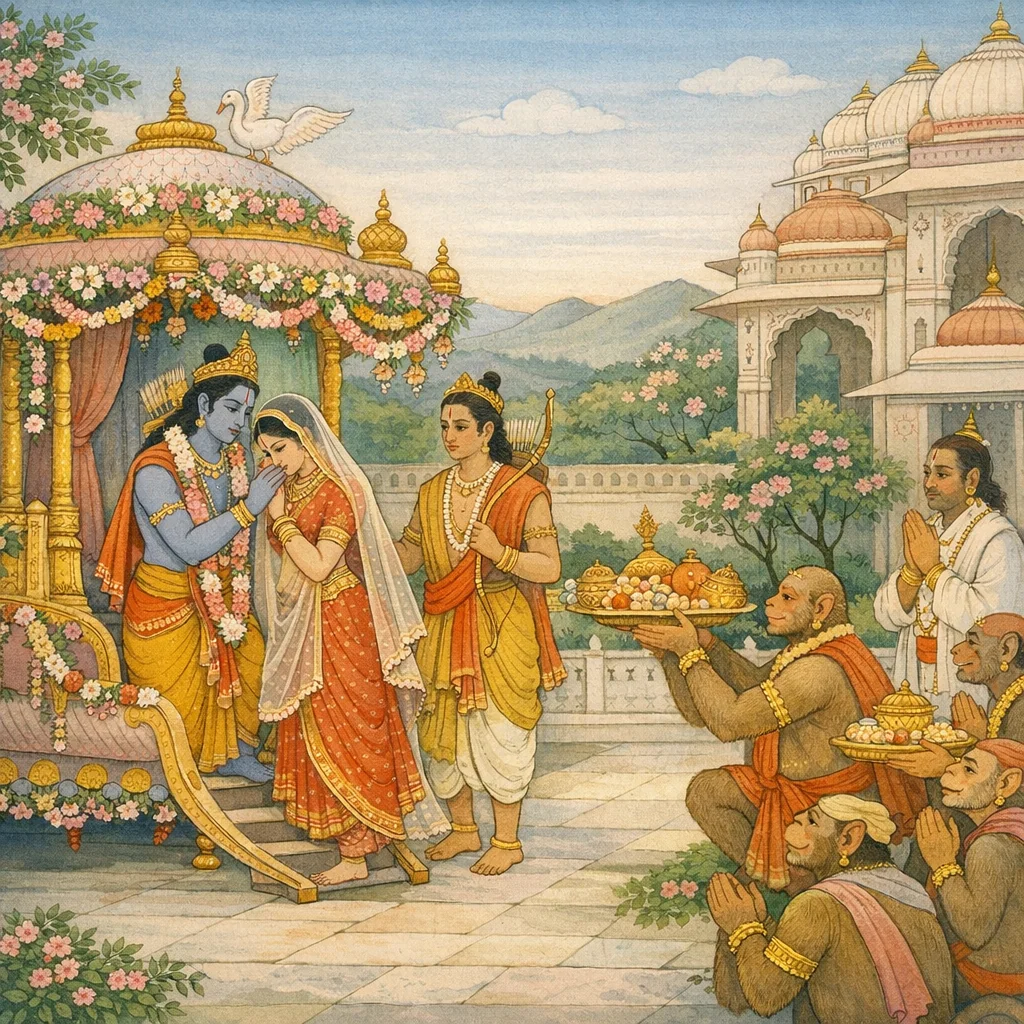
Sarga 125
पुष्पकारोहणम् (Boarding the Puṣpaka; Honoring the Allies and Departure for Ayodhyā)
युद्धकाण्ड
This sarga marks the ceremonial passage from conquest to reconciliation and departure. Vibhīṣaṇa, standing at a respectful distance, presents to Rāma the Puṣpaka adorned with flowers and asks for instruction. After reflection, with Lakṣmaṇa listening, Rāma issues a ruler’s directive: the forest-ranging allies—Vānaras and others—who bore the burden of war must be honored with wealth and gems, for gratitude upholds rightful authority and prevents the moral decay by which armies forsake a virtue-less lord. Vibhīṣaṇa distributes the treasures, and Rāma, seeing the troops duly honored, ascends the excellent aerial car. Sītā, modest before the assembled hosts, is received into Rāma’s embrace as they board. Rāma then grants leave to the Vānaras—especially Sugrīva—to return to Kiṣkindhā with their forces, while blessing Vibhīṣaṇa with secure rule in Laṅkā. The allies ask to accompany Rāma to Ayodhyā to witness his consecration and to greet Kauśalyā; Rāma consents, and all embark. With Rāma’s permission the Kubera-owned Puṣpaka rises into the sky, and Rāma shines like Kubera—an image of radiant, rightful sovereignty after war.
Shlokas
Verse 1
उपस्थितंतुतंकृत्वापुष्पकंपुष्पभूषितम् ।अविदूरेस्थितोराममित्युवाचविभीषणः ।।6.125.1।।
Having made the Puṣpaka ready, adorned with flowers, Vibhīṣaṇa stood nearby and spoke to Rāma.
Verse 2
स तुबद्धाञ्जलि: प्रह्वोविनीतोराक्षसेश्वरः ।अब्रवीत्त्वरयोपेतःकिंकरोमीतिराघवम् ।।6.125.2।।
Then the lord of the rākṣasas, humble and bowed, with palms joined in reverence, hastened forward and said to Rāghava: “What shall I do?”
Verse 3
तमब्रवीन्महातेजालक्ष्मणस्योपशृण्वतः ।विमृश्यराघवोवाक्यमिदंस्नेहपुरस्कृतम् ।।6.125.3।।
After due reflection, the greatly radiant Rāghava spoke these words, prefaced by affection, while Lakṣmaṇa listened attentively.
Verse 4
कृतप्रयत्नकर्माणःसर्वएववनेचराः ।रत्नैरर्थैश्चविविधैस्सम्पूज्यन्तांविभीषण ।।6.125.4।।
“O Vibhīṣaṇa, let all the forest-dwellers—each of them who exerted themselves and accomplished the work—be duly honored with jewels, wealth, and diverse gifts.”
Verse 5
सहामीभिस्त्वयालङ्कानिर्जिताराक्षसेश्वर ।हृष्टैःप्राणभयंत्यक्त्वासङ्ग्रामेष्वनिवर्तिभिः ।।6.125.5।।
“O lord of the rākṣasas, with these heroes—joyful, casting aside fear for their very lives, and never turning back in battle—Laṅkā was conquered by you.”
Verse 6
त इमेकृतकर्माणस्सर्वएववनौकसः ।धनरत्नप्रदानेनकर्मैषांसफलंकुरु ।।6.125.6।।
All these forest-dwellers have fulfilled their task; make their deeds bear fruit by granting them wealth and jewels.
Verse 7
एवंसम्मानिताश्चेतेमानार्हमानदात्वया ।भविष्यन्तिकृतज्ञेननिर्वृताहरियूथपाः ।।6.125.7।।
When you, bestower of honor, honor these honor-worthy leaders of the monkey hosts in this way, they will be satisfied—grateful and content.
Verse 8
त्यागिनंसङ्ग्रहीतारंसानुक्रोशंजितेन्द्रियम् ।सर्वेततःअवगच्छन्तिसम्बोधयामिते ।।6.125.8।।
Then everyone will understand you to be generous, compassionate, self-controlled, and one who does not grasp at possessions; therefore I counsel you thus.
Verse 9
हीनंरतिगुणैस्सर्वैरभिहन्तारमाहवे ।सेनात्यजतिसम्विग्नानृपतिंतंनरेश्वरा ।।6.125.9।।
O lord among kings, an army, distressed, abandons that king who lacks all virtues and becomes a mere destroyer in war.
Verse 10
एवमुक्तस्तुरामेणवानरांस्तान्विभीषणः ।रत्नार्थसंविभागेनसर्वानेवाभ्यपूजयत् ।।6.125.10।।
Thus instructed by Rāma, Vibhīṣaṇa honored all those Vānara leaders by distributing gems and precious wealth.
Verse 11
ततस्तान्पूजितान्दृष्टवारत्नार्थैर्हरियूथपान् ।आरुरोहतदारामस्तद्विमानमनुत्तमम् ।।6.125.11।।
Then, seeing the monkey chieftains honored with gems and wealth, Rāma at that time ascended that unsurpassed aerial car.
Verse 12
अङ्केनादायवैदेहींलज्जमानांयशस्विनीम् । लक्ष्मणेनसहभ्रात्राविक्रान्तेवधनुष्मता ।।6.125.12।।
Taking Vaidehī—illustrious and shy—into his arms, and with his brother Lakṣmaṇa, the valiant bearer of the bow, Rāma prepared to depart in the aerial car.
Verse 13
अब्रवीत्सविमानस्थःपूजयन्सर्वावानरान् ।सुग्रीवं च महावीर्यंकाकुत्स्थसविभीषणम् ।।6.125.13।।
Seated in the aerial car, Kakutstha (Rāma), while honoring all the Vānaras, spoke to mighty Sugrīva and to Vibhīṣaṇa.
Verse 14
मित्रकार्यंकृतमिदंभवद्भिद्वानरर्षभाः ।अनुज्ञातामयासर्वेयथेष्टंप्रतिगच्छत ।।6.125.14।।
O best of Vānaras, you have fulfilled this deed for a friend. By my leave, all of you may now depart—return as you wish.
Verse 15
यत्तुकार्यंवयस्येनस्निग्धेन च हितेन च ।कृतंसुग्रीवतत्सर्वंभवताधर्मभीरुणा ।।6.125.15।।किष्किन्धांप्रतियाह्यावुस्वसैन्येनाभिसम्वृतः ।
Sugrīva, all that a friendly elder—affectionate and well-wishing—ought to do has been done by you, who fear to stray from dharma. Now go swiftly to Kiṣkindhā, surrounded by your own army.
Verse 16
स्वराज्येवसलङ्कायांमयादत्तेविभीषण ।।6.125.16।।न त्वांधर्षयितुंशक्तास्सेन्द्राअपिदिवौकसः ।
Vibhīṣaṇa, in Laṅkā I have bestowed upon you a sovereign kingdom as your own. Even the gods of heaven—Indra included—will not be able to assail you.
Verse 17
योध्यांप्रतियास्यामिराजधानींपितुर्मम ।।6.125.17।।अभ्यनुज्ञातुमिच्छामिसर्वानामन्त्रयामिवः ।
I shall now set out for Ayodhyā, my father’s capital. I seek your permission; I take leave of you all—be well.
Verse 18
वमुक्तास्तुरामेणहरीन्द्राहरयस्तथा ।।6.125.18।।ऊचुःप्राञ्जलयस्सर्वेराक्षसश्चविभीषणः ।
Thus addressed by Rāma, Sugrīva and the vānaras, and Vibhīṣaṇa among the rākṣasas, all with joined palms, spoke as follows.
Verse 19
अयोध्यांगन्तुमिच्छामःसर्वन्नयतुनोभवान् ।।6.125.19।।मुद्युक्ताविचरिष्यामोवनान्युपननानि च ।
We too desire to go to Ayodhyā; may you lead us all. Gladly accompanying you, we shall roam the forests and the groves.
Verse 20
दृष्टवात्वामभिषेकार्ध्रंकौसल्यामभिवाद्य च ।।6.125.20।।अचिरादगमिष्यामःस्वगृहान्नृपसत्तम ।
O best of kings, after seeing you consecrated and after paying our respects to Kausalyā, we shall soon return to our own homes.
Verse 21
एवमुक्तस्सधर्मात्मावानरैस्सविभीषणैः ।।6.125.21।।अब्रवीद्वानरान्रामस्ससुग्रीवविभीषणान् ।
Thus addressed by the vānaras and by Vibhīṣaṇa, righteous-souled Rāma replied—to the vānaras, and to Sugrīva and Vibhīṣaṇa.
Verse 22
प्रिययतरंलब्दंयदहंससुहृज्जनः ।।6.125.22।।सर्वैर्भवद्भिःसहितःप्रीतिंलप्स्येपुरींगतः ।
It is a greater joy gained that I—together with my dear companions—shall go to the city with all of you and there attain gladness.
Verse 23
क्षिप्रम् सुग्रीवविमानंवानरैस्सह ।।6.125.23।।त्वमप्यारोहसामात्योराक्षसेन्द्रविभीषण ।
Sugrīva, together with the vānaras, quickly mount the aerial car. You too, O Vibhīṣaṇa—lord of the rākṣasas—ascend with your ministers.
Verse 24
ततः स पुष्पकंदिव्यंसुग्रीवस्सहवानरैः ।।6.125.24।।आरुरोहमुदायुक्तःसामात्यश्चविभीषणः ।
Then Sugrīva, together with the vānaras, joyfully ascended the divine Puṣpaka; Vibhīṣaṇa too ascended, along with his ministers.
Verse 25
तेष्वारूढेषुसर्वेषुकौबेरंपरमासनम् ।।6.125.25।।राघवणाभ्यनुज्ञातमुत्पपातविहायसम् ।
When all had boarded Kubera’s supreme seat—the Puṣpaka—upon Rāghava’s permission it rose up and leapt into the sky.
Verse 26
गतेनविमानेनहंसयुक्तेनभास्वता ।।6.125.26।।प्रहृष्टश्चप्रतीतश्चबभौरामःकुबेरवत् ।
As the radiant aerial car, yoked with swans, moved through the sky, Rāma—delighted and fulfilled—shone like Kubera himself.
Verse 27
All of them—the Vānaras, the bears, and the mighty Rākṣasas as well—sat in that wondrous aerial car at ease, uncramped and comfortably spaced.
Frequently Asked Questions
The pivotal action is Rāma’s insistence that allies who endured the war be materially honored; the implied dilemma is whether a new regime can claim legitimacy without gratitude—Rāma frames reward as a moral and political necessity.
Virtue-based leadership is sustained by kṛtajñatā (recognizing service) and dāna (generous recompense); a ruler lacking guṇas loses the loyalty of the army, whereas compassionate restraint and gratitude stabilize sovereignty.
Laṅkā and Kiṣkindhā mark the war’s theater and the ally-kingdom’s return, while Ayodhyā and Kauśalyā signal the homecoming and forthcoming consecration; the Puṣpaka (Kubera’s vimāna) functions as a cultural emblem of divine-sanctioned transit and royal radiance.