Sarga 38
सुवेलारोहणम् (The Ascent of Suvela and the First Full View of Laṅkā)
युद्धकाण्ड
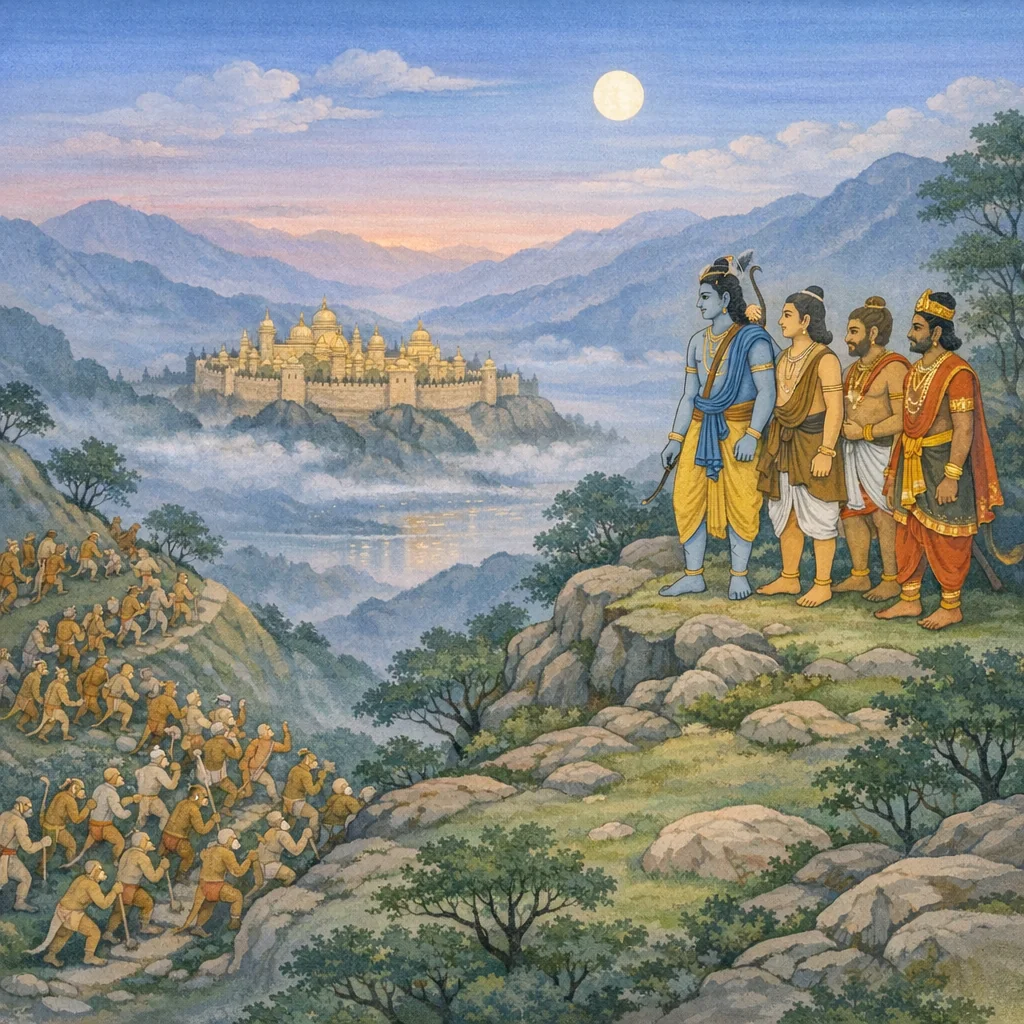
In Sarga 38, Rāma resolves to climb Suvela mountain and to halt there for the night so that Laṅkā—the rākṣasas’ fortified abode—may be clearly observed. Speaking to Sugrīva, he acknowledges Vibhīṣaṇa as dharma-jña, mantra-jña, and vidhi-jña: one who knows righteousness, is skilled in counsel, and understands proper procedure. Rāma frames the campaign as a dharmic answer to Sītā’s abduction and to Rāvaṇa’s moral inversion; his anger is shown as principled wrath, stirred by the very name “rākṣasādhama,” and he warns that a single person’s wrongdoing can endanger an entire lineage. The ascent proceeds in coordinated order: Lakṣmaṇa follows with bow and arrows; Sugrīva, the ministers, and Vibhīṣaṇa accompany; and the Vānara leaders—Hanumān, Aṅgada, Nīla, Mainda, Dvivida, Jāmbavān, Suṣeṇa, Ṛṣabha, and others—climb in hundreds with wind-like speed. From Suvela’s summit they behold Laṅkā as if suspended against the sky, adorned with splendid gates and walls, and lined with ranks of dark rākṣasas standing like a second living rampart. Eager for battle, the Vānara host raises varied cries in Rāma’s presence. As sunset yields to a moonlit night, Rāma rests upon Suvela’s ridge, ritually honored by Vibhīṣaṇa and attended by Lakṣmaṇa and the assembled yūthapas—ending the chapter in a calm before war, grounded in watchfulness, alliance, and moral purpose.
Shlokas
Verse 1
सतुकृत्वासुवेलस्यमतिमारोहणंप्रति ।लक्ष्मणानुगतोरामःसुग्रीवमिदमब्रवीत् ।।।।विभीषणंचधर्मज्ञमनुरक्तंनिशाचरम् ।मन्त्रज्ञंचविधिज्ञंचश्लक्क्ष्णयापरयागिरा ।।।।
Having resolved to ascend Suvela, Rāma—accompanied by Lakṣmaṇa—spoke these words to Sugrīva, and also to Vibhīṣaṇa: a knower of dharma, deeply devoted; a rākṣasa by birth, yet skilled in counsel and in right procedure—addressing them in polished and reverent speech.
Verse 2
सतुकृत्वासुवेलस्यमतिमारोहणंप्रति ।लक्ष्मणानुगतोरामःसुग्रीवमिदमब्रवीत् ।।6.38.1।।विभीषणंचधर्मज्ञमनुरक्तंनिशाचरम् ।मन्त्रज्ञंचविधिज्ञंचश्लक्क्ष्णयापरयागिरा ।।6.38.2।।
And he addressed Vibhīṣaṇa—the night-ranging rākṣasa who knew dharma, was devoted to their cause, and was skilled in counsel and proper procedure—speaking in refined and excellent words.
Verse 3
सुवेलंसाधुशैलेन्द्रमिमंधातुशतैश्चितम् ।अध्यारोहामहेसर्वेवत्स्यामोऽत्रनिशामिमाम् ।।।।
Let us all climb this excellent mountain-lord Suvela, richly adorned with hundreds of minerals, and stay here for this night.
Verse 4
लङ्कांचालोकयिष्यामोनिलयंतस्यरक्षसः ।येनमेमरणान्तायहृताभार्यादुरात्मना ।।।।येनधर्मोनविज्ञातोनतद्वृत्तंनकुलंतथा ।राक्षस्यानीचयाबुद् ध्यायेनतद्गर्हितंकृतम् ।।।।
And we shall look upon Laṅkā, the dwelling of that rākṣasa—he of evil soul who stole my wife as though to bring me to death; who understood neither dharma, nor right conduct, nor the honor of lineage; who, with a base rākṣasa-minded intellect, committed that shameful deed.
Verse 5
लङ्कांचालोकयिष्यामोनिलयंतस्यरक्षसः ।येनमेमरणान्तायहृताभार्यादुरात्मना ।।6.38.4।।येनधर्मोनविज्ञातोनतद्वृत्तंनकुलंतथा ।राक्षस्यानीचयाबुद् ध्यायेनतद्गर्हितंकृतम् ।।6.38.5।।
We shall look upon Laṅkā, the dwelling of that rākṣasa—the evil-minded one who stole my wife as though to bring me to death; who understood neither dharma nor proper conduct nor the honor of lineage, and who, with base rākṣasa-minded intellect, committed that disgraceful deed.
Verse 6
तस्मिन्मेवर्ततेरोषःकीर्तितेराक्षसाधमे ।यस्यापराधाननीचस्यवधंद्रक्ष्यामिरक्षसाम् ।।।।
At the very mention of that vile rākṣasa, my wrath rises; because of the offenses of that base one, I shall witness the destruction of the rākṣasas.
Verse 7
एकोहिकुरुतेपापंकालपाशवशंगतः ।नीचेनात्मापचारेणकुलंतेनविनश्यति ।।।।
Indeed, one man commits a sin and falls under the noose of Death; through that base person’s own misconduct, an entire lineage may perish because of him.
Verse 8
एवंसम्मन्त्रयन्नेवसक्रोधोरावणंप्रति ।रामःसुवेलमासाद्यचित्रसानुमुपारुहत् ।।।।
Thus, while speaking in this manner—his anger directed toward Rāvaṇa—Rāma reached Suvela and climbed up its beautiful slopes.
Verse 9
पृष्ठतोलक्ष्मणश्चैवमन्वगच्छत्समाहितः ।सशरंचापमुद्यम्यसुमहद्विक्रमेरतः ।।।।अन्वारोहत्सुग्रीवस्सामात्यस्सविभीषणः ।
Close behind, the composed Lakṣmaṇa followed, lifting his bow with arrows, intent on mighty valor; and Sugrīva too climbed after him, along with his ministers and Vibhīṣaṇa.
Verse 10
हनुमानङ्गदोनीलोमैन्दोद्विविदएवच ।।।।गजोगवाक्षोगवयश्शरभोगन्धमादनः ।पनसःकुमुदश्चैवहरोरम्भश्चयूथपः ।।।।जाम्बवांश्चसुषेणश्चऋषभश्चमहामतिः ।दुर्मुखश्चमहातेजास्तथाशतवलिःकपिः ।।।।एतेचान्येचबहवोवानराशशीघ्रगामिनः ।तेवायुवेगप्रवणास्तंगिरिगिरिचारिणः ।।।।अध्यारोहन्तशतशस्सुवेलंयत्रराघवः ।
Hanumān, Aṅgada, Nīla, Mainda, and Dvivida; Gaja, Gavākṣa, Gavaya, Śarabha, and Gandhamādana; Panasa, Kumuda, Hara, and Rambha—leaders of troops; Jāmbavān, Suṣeṇa, the wise Ṛṣabha; mighty Durmukha and Śatavali the monkey—these and many other swift-moving vānaras, borne along by the speed of the wind and roaming from mountain to mountain, ascended Suvela in hundreds, to where Rāghava was.
Verse 11
हनुमानङ्गदोनीलोमैन्दोद्विविदएवच ।।6.38.10।।गजोगवाक्षोगवयश्शरभोगन्धमादनः ।पनसःकुमुदश्चैवहरोरम्भश्चयूथपः ।।6.38.11।।जाम्बवांश्चसुषेणश्चऋषभश्चमहामतिः ।दुर्मुखश्चमहातेजास्तथाशतवलिःकपिः ।।6.38.12।।एतेचान्येचबहवोवानराशशीघ्रगामिनः ।तेवायुवेगप्रवणास्तंगिरिगिरिचारिणः ।।6.38.13।।अध्यारोहन्तशतशस्सुवेलंयत्रराघवः ।
Gaja, Gavākṣa, Gavaya, Śarabha, Gandhamādana; Panasa, Kumuda, Hara, and Rambha—these too were vanara leaders, yūthapas.
Verse 12
हनुमानङ्गदोनीलोमैन्दोद्विविदएवच ।।6.38.10।।गजोगवाक्षोगवयश्शरभोगन्धमादनः ।पनसःकुमुदश्चैवहरोरम्भश्चयूथपः ।।6.38.11।।जाम्बवांश्चसुषेणश्चऋषभश्चमहामतिः ।दुर्मुखश्चमहातेजास्तथाशतवलिःकपिः ।।6.38.12।।एतेचान्येचबहवोवानराशशीघ्रगामिनः ।तेवायुवेगप्रवणास्तंगिरिगिरिचारिणः ।।6.38.13।।अध्यारोहन्तशतशस्सुवेलंयत्रराघवः ।
Jāmbavān and Suṣeṇa, and the great-minded Ṛṣabha; Durmukha of mighty energy, and likewise Śatavali the monkey—(these too were among the chiefs).
Verse 13
हनुमानङ्गदोनीलोमैन्दोद्विविदएवच ।।6.38.10।।गजोगवाक्षोगवयश्शरभोगन्धमादनः ।पनसःकुमुदश्चैवहरोरम्भश्चयूथपः ।।6.38.11।।जाम्बवांश्चसुषेणश्चऋषभश्चमहामतिः ।दुर्मुखश्चमहातेजास्तथाशतवलिःकपिः ।।6.38.12।।एतेचान्येचबहवोवानराशशीघ्रगामिनः ।तेवायुवेगप्रवणास्तंगिरिगिरिचारिणः ।।6.38.13।।अध्यारोहन्तशतशस्सुवेलंयत्रराघवः ।
These and many other vānaras—swift in movement—accustomed to the speed of the wind and roaming from mountain to mountain, advanced together.
Verse 14
तेत्वदीर्घेणकालेनगिरिमारुह्यसर्वतः ।।।।ददृशुशशिखरेतस्यविषक्तामिवखेपुरीम् ।
Then, in a short time, having climbed the mountain from every side, they beheld upon its summit the city—seeming as though it clung to the sky.
Verse 15
तांशुभांप्रवरद्वारांप्राकारपरिशोभिताम् ।।।।लङ्कांराक्षससम्पूर्णांददृशुर्हरियूथपाः ।
The vanara commanders beheld Laṅkā—splendid, with excellent gateways, adorned by ramparts and walls, yet filled throughout with rākṣasas.
Verse 16
प्राकारवरसंस्थैश्चतथानीलैश्चराक्षसैः ।।।।ददृशुस्तेहरिश्रेष्ठाःप्राकारमपरंकृतम् ।
Those foremost of vanaras saw dark rākṣasas stationed along the excellent ramparts—forming, as it were, yet another living wall of defense.
Verse 17
तेदृष्टवावानराःसर्वेराक्षसान् युद्धकाङ् क्षिणः ।।।।मुमुचुर्विविधान्नादांतत्ररामस्यपश्यतः ।
Seeing the rākṣasas, all the vanaras—longing for battle—let out many kinds of war-cries there, even as Rāma looked on.
Verse 18
ततोऽस्तमगमत्पूर्यःसन्ध्ययाप्रतिरञ्जितः ।।।।पूर्णचन्द्रप्रदीप्ताचक्षपासमभिवर्तते ।
Then the sun set, reddened by twilight; and the night advanced, illumined by the full moon.
Verse 19
ततस्सरामोहरिवाहिनीपतिर्विभीषणेनप्रतिनन्द्यसत्कृतः ।सलक्ष्मणोयूथपयूथसम्वृतस्सुवेलपृष्ठेन्यवसद्यथासुखम् ।।।।
Then Rāma, lord of the vanara host—honoured and duly welcomed by Vibhīṣaṇa—together with Lakṣmaṇa and surrounded by companies of troop-leaders, took rest upon the slopes of Suvela as he pleased.
Frequently Asked Questions
Rāma articulates a dharma-grounded justification for war: the abduction of Sītā is framed as a moral rupture warranting corrective action, while his wrath is presented as principled and directed toward restoring order rather than mere vengeance.
The chapter teaches collective accountability in political ethics: “one person’s wrongdoing can destroy a lineage,” underscoring how adharmic conduct by a leader or member can endanger an entire community and invite lawful retribution.
Suvela mountain functions as a reconnaissance vantage point; Laṅkā is depicted as sky-clinging and heavily fortified with splendid gates and prākāras, while ranks of rākṣasas appear like an additional living boundary—an architectural-cum-military portrait of the city.