Sarga 122
दशरथदर्शनम् — Dasharatha’s Epiphany and Benedictions (Sarga 122)
युद्धकाण्ड
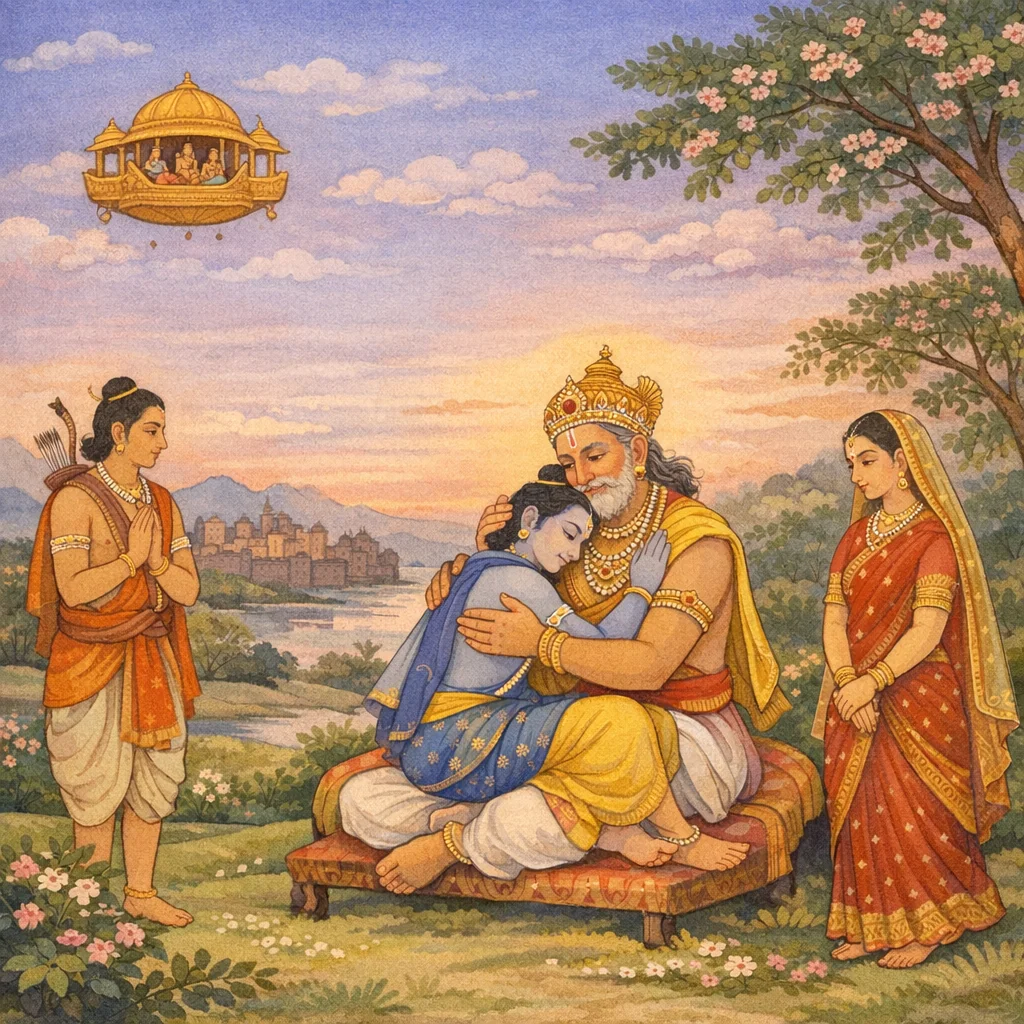
After the war is settled, Maheśvara answers Rāghava’s auspicious words with a sacred directive: Rāma should return to Ayodhyā, console Bharata and the queens—Kauśalyā, Kaikeyī, and Sumitrā—stabilize the Ikṣvāku realm, perform royal rites including the aśvamedha, and practice dāna by giving to brāhmaṇas. Thus the dharma of the battlefield is completed in the dharma of kingship and civic order. Maheśvara then reveals Daśaratha seated in a radiant vimāna. Rāma and Lakṣmaṇa offer salutations; Daśaratha embraces Rāma, seats him upon his lap, and speaks with paternal assurance that heaven’s honors are joyless without him, and that today he is fulfilled seeing the exile ended and the enemies slain. Though he acknowledges the lingering pain caused by Kaikeyī’s demand for banishment, he urges grace toward Bharata and Kaikeyī, and Rāma prays that the dreadful curse not touch them. Daśaratha blesses Lakṣmaṇa for devoted service and gently counsels Sītā on endurance and marital dharma, naming Rāma her supreme refuge. He then departs in the vimāna to Indra’s world, ritually closing the father–son rupture and turning the narrative toward Ayodhyā’s restoration.
Shlokas
Verse 1
एतच्छ्रुत्वाशुभंवाक्यंराघवेणानुभाषितम् ।ततश्शुभतरंवाक्यंव्याजहारमहेश्वरः ।।।।
Hearing Rāghava’s gracious and auspicious reply, Maheśvara then spoke words even more auspicious.
Verse 2
पुष्कराक्ष महाबाहो महावक्ष परन्तप ।दिष्ट्याकृतमिदंकर्मत्वयाधर्मभृतांवर ।।।।
O lotus-eyed one—mighty-armed, broad-chested, subduer of foes—by good fortune this deed has been accomplished by you, best among upholders of dharma.
Verse 3
दिष्ट्यासर्वस्यलोकस्यप्रवृद्धंदारुणंतमः ।अपावृत्तंत्वयासङ्ख्येरामरावणजंभयम् ।।।।
By good fortune, in the battle you have dispelled the fierce darkness that had grown over all the worlds—the fear born of Rāvaṇa, from the conflict of Rāma and Rāvaṇa.
Verse 4
आश्वास्यभरतंदीनंकौसल्यां च यशस्विनीम् ।कैकेयीं च सुमित्रां च दृष्टवालक्ष्मणमातरम् ।।।।प्राप्यराज्यमयोध्यायांनन्दयित्वासुहृज्जनम् ।इक्ष्वाकूणांकुलेवंशंस्थापयित्वामहाबल ।।।।इष्टवातुरगमेधेनप्राप्यचानुत्तमंयशः ।ब्राह्मणेभ्योधनंदत्त्वात्रिदिवंगन्तुमर्हसि ।।।।
Comforting the sorrowing Bharata, and Kausalyā of noble renown, and also Kaikeyī and Sumitrā—Lakṣmaṇa’s mother—after seeing them all,
Verse 5
आश्वास्यभरतंदीनंकौसल्यां च यशस्विनीम् ।कैकेयीं च सुमित्रां च दृष्टवालक्ष्मणमातरम् ।।6.122.4।।प्राप्यराज्यमयोध्यायांनन्दयित्वासुहृज्जनम् ।इक्ष्वाकूणांकुलेवंशंस्थापयित्वामहाबल ।।6.122.5।।इष्टवातुरगमेधेनप्राप्यचानुत्तमंयशः ।ब्राह्मणेभ्योधनंदत्त्वात्रिदिवंगन्तुमर्हसि ।।6.122.6।।
Having attained sovereignty in Ayodhyā, gladdening friends and well-wishers, and firmly establishing the Ikṣvāku lineage in its royal tradition, O mighty one,
Verse 6
आश्वास्यभरतंदीनंकौसल्यां च यशस्विनीम् ।कैकेयीं च सुमित्रां च दृष्टवालक्ष्मणमातरम् ।।6.122.4।।प्राप्यराज्यमयोध्यायांनन्दयित्वासुहृज्जनम् ।इक्ष्वाकूणांकुलेवंशंस्थापयित्वामहाबल ।।6.122.5।।इष्टवातुरगमेधेनप्राप्यचानुत्तमंयशः ।ब्राह्मणेभ्योधनंदत्त्वात्रिदिवंगन्तुमर्हसि ।।6.122.6।।
And having performed the Ragamedha sacrifice, attaining unsurpassed renown, and giving wealth to the brāhmaṇas, you will be worthy to depart to the heavenly worlds.
Verse 7
एषराजादशरथोविमानस्थःपितातव ।काकुत्स्थमानुषेलोकेगुरुस्तवमहायशाः ।।।।
O Kākutstha, here is King Daśaratha—your father—seated in the aerial car; in the human world he was your revered teacher, renowned and illustrious.
Verse 8
इन्द्रलोकंगतःश्रीमांस्त्वयापुत्रेणतारितः ।लक्ष्मणेनसहभ्रात्रात्वमेममभिवादय ।।।।
Freed by you—his son—the glorious king has reached Indra’s world. With your brother Lakṣmaṇa, offer him your reverent salutations.
Verse 9
महदेववच्श्रुत्वाराघवःसहलक्ष्मणः ।लक्ष्मणेनसहभ्रात्राददर्शपितरंप्रभुः ।।।।
Hearing Mahādeva’s words, Rāghava, the Lord, together with Lakṣmaṇa, beheld his father.
Verse 10
दीप्यमानंस्वयालक्ष्मविरजोऽम्भरधारिणम् ।लक्ष्मणेनसहभ्रात्राददर्शपितरंप्रभुः ।।।।
Then the Lord (Rāma), together with his brother Lakṣmaṇa, beheld his father—radiant with his own splendor and clad in spotless white garments.
Verse 11
हर्षेणमहताविष्टोविमनस्थोमहीपतिः ।प्राणैःप्रियतरंदृष्टवापुत्रंदशरथस्तदा ।।।।आरोप्याङ्केमहबाहुर्वरासनगतःप्रभुः ।बाहुभ्यांसम्परिष्वज्यततोवाक्यंसमाददे ।।।।
Then Daśaratha, the lordly king seated in the celestial car, was filled with immense joy on seeing his son, dearer to him than life itself. Seating the mighty-armed Rāma upon his lap and embracing him with both arms, he began to speak.
Verse 12
हर्षेणमहताविष्टोविमनस्थोमहीपतिः ।प्राणैःप्रियतरंदृष्टवापुत्रंदशरथस्तदा ।।6.122.11।।आरोप्याङ्केमहबाहुर्वरासनगतःप्रभुः ।बाहुभ्यांसम्परिष्वज्यततोवाक्यंसमाददे ।।6.122.12।।
Overwhelmed with great joy, the earth’s lord Daśaratha—once downcast—beheld his son dearer than life, set Rāma upon his lap, embraced him with both arms, and then began to speak.
Verse 13
न मेस्वर्गोबहुमतस्सम्मानश्चसुरर्षभैः ।त्वयारामविहीनस्यसत्यंप्रतिशृणोमिते ।।।।
“For me, even heaven held no worth, nor honors from the foremost among the gods, so long as I was bereft of you, O Rāma. This is the truth; I pledge it to you.”
Verse 14
अद्यत्वांनिहतामित्रंदृष्टवासम्पूर्णमानसम् ।निस्तीर्णवनवासं च प्रीतिरासीत्परामम ।।।।
“Today, seeing you with your foes destroyed, your heart fulfilled, and your forest-exile completed, I am filled with the highest joy.”
Verse 15
कैकेय्यायानिचोक्तानिवाक्यानिवदतांवर ।तवप्रव्राजनार्थानिस्थितानिहृदयेमम ।।।।
“O best of speakers, those words that Kaikeyī spoke—intended to send you away into exile—still remain lodged in my heart.”
Verse 16
त्वांतुदृष्टवाकुशलिनंपरिष्वज्यसलक्ष्मणम् ।अद्यदुःखाद्विमुक्तोऽस्मिनीहारादिवभास्करः ।।।।
“But today—seeing you safe, and embracing you together with Lakṣmaṇa—I am freed from sorrow, like the sun released from a veil of mist.”
Verse 17
तारितोऽहंत्वयापुत्र सुपुत्रेणमहात्मना ।अष्टावक्रेणधर्मात्माकहोलोब्राह्मणोयथा ।।।।
My son, I have been delivered by you—by a noble son of great soul—just as the righteous brāhmaṇa Kahola was delivered by Aṣṭāvakra.
Verse 18
इदानीं च विजानामियथासौम्य सुरेश्वरैः ।वधार्थंरावणस्येहविहितंपुरुषोत्तम ।।।।
Only now do I understand, gentle one: you were ordained here by the lords of the gods for the purpose of slaying Rāvaṇa—O best among men.
Verse 19
सिद्धार्थाखलुकौसल्यायात्वांराम गृहंगतम् ।वनान्निवृत्तंसंहृष्टाद्रक्ष्यतेशत्रुसूदनम् ।।।।
Rāma, when you return home from the forest—your purpose fulfilled, destroyer of foes—Kausalyā will behold you with great joy.
Verse 20
सिद्धार्थाःखलुतेराम नरायेत्वांपुरींगतम् ।राज्येचावाभिषिक्तं च द्रक्ष्यन्तेवसुधाधिपम् ।।।।
Indeed, O Rāma, when people see you enter the city and be consecrated to the kingdom as lord of the earth, they will deem your purpose fully achieved.
Verse 21
अनुरक्तेनबलिनाशुचिनाधर्मचारिणा ।इच्छेयंत्वामहंद्रष्टुंभरतेनसमागतम् ।।।।
I long to see you reunited with Bharata—devoted, strong, pure, and steadfast in the ways of dharma.
Verse 22
चतुर्दशसमास्सौम्यवनेनिर्यातितास्त्वया ।वसतासीतयासार्धंलक्ष्मणेन च धीमता ।।।।
O gentle one, fourteen years have been passed by you in the forest, dwelling together with Sītā and with wise Lakṣmaṇa.
Verse 23
निवृत्तवनवासोऽसिप्रतिज्ञापूरितात्वया ।रावणं च रणेहत्वादेवताःपरितोषिताः ।।।।
Your forest-exile has ended, and the vow has been fulfilled by you; having slain Rāvaṇa in battle, you have also satisfied the gods.
Verse 24
कृतंकर्मयशश्श्लाघ्यंप्राप्तंतेशत्रुसूदन ।भ्रातृभिःसहराज्यस्थोदीर्घमायुरवाप्नुहि ।।6.122.24।।
The deed has been done, worthy of fame, O slayer of foes. Established in the kingdom together with your brothers, attain a long life.
Verse 25
इतिब्रुवाणंराजानंरामःप्राञ्जलिरब्रवीत् ।कुरुप्रसादंधर्मज्ञकैकेय्याभरतस्य च ।।।।
As the king spoke thus, Rāma—with palms joined—replied: “O knower of dharma, show grace also toward Kaikeyī and toward Bharata.”
Verse 26
सपुत्रांत्वांत्यजामीतियदुक्ताकेकयीत्वया ।स शापःकेकयींघोरस्सपुत्रां न स्पृशेत्प्रभो ।।।।
O Lord, since you once said to Kaikeyī, “I renounce you, along with your son,” may that dreadful curse not touch Kaikeyī, nor her son.
Verse 27
तथेति स महाराजोराममुक्त्वाकृताञ्जलिम् ।लक्ष्मणं च परिष्वज्यपुनर्वाक्यमुवाच ह ।।।।
“So be it,” said that great king; having spoken to Rāma who stood with joined palms, and embracing Lakṣmaṇa, he spoke again.
Verse 28
रामंशुश्रूषताभक्त्यावैदेह्यासहसीतया ।कृतमममहाप्रीतिःप्राप्तंधर्मफलं च ते ।।।।
By serving Rāma with devotion—together with Vaidehī Sītā—you have made me deeply glad; and through this service you have attained the rightful fruit of dharma.
Verse 29
धर्मंप्राप्स्यसिधर्मज्ञ यशश्चविपुलंभुवि ।रामेप्रसन्नेस्वर्गं च महिमानंतथोत्तमाम् ।।।।
O knower of dharma, you will attain dharma and broad fame upon the earth; and when Rāma is pleased, you will gain heaven as well, along with the highest glory.
Verse 30
रामंशुश्रूषभद्रंतेसुमित्रानन्दवर्धन ।रामस्सर्वस्यलोकस्यसुभेष्वभिरतःसदा ।।।।
Serve Rāma—may good be yours, O enhancer of Sumitrā’s joy. Rāma is ever engaged in what is auspicious for all the worlds.
Verse 31
एतेसेन्द्रास्त्रयोलोकास्सिद्धाश्चपरमर्षयः ।अभिगम्यमहात्मानमर्चन्तिपुरुषोत्तमम् ।।।।
These three worlds with Indra, along with the Siddhas and the supreme sages—approaching that great-souled Supreme Person—honor and worship him.
Verse 32
एतत्तदुक्तमव्यक्तमक्षरंब्रह्मनिर्मितम् ।देवानांहृदयंसौम्य गुह्यंरामःपरन्तप ।।।।
This is that very truth spoken of: Rāma—O gentle one, O tormentor of foes—is the unmanifest, the imperishable, fashioned by Brahmā; he is the secret, the very heart of the gods.
Verse 33
अवाप्तंधर्मचरणंयशश्चविपुलंत्वया ।एनंशुश्रूषताभक्त्यावैदेह्यासहसीतया ।।।।
Through devoted service to him—together with Vaidehī Sītā—you have attained the practice of dharma and great renown.
Verse 34
इत्युक्त्वालक्ष्मणंराजास्नुषांबद्धाञ्जलिंस्थिताम् ।पुत्रीत्याभाष्यमधुरंशनैरेनामुवाच ह ।।।।
Having thus spoken to Lakṣmaṇa, the king then addressed his daughter-in-law, who stood with joined palms; calling her “Daughter,” he spoke to her gently and sweetly.
Verse 35
कर्तव्यो न तुवैदेहीमन्युस्त्यागमिमंप्रति ।रामेणेत्वद्विशुध्यर्थंकृतमेतद्धितैषिणा ।।।।
O Vaidehī, do not harbor resentment over this seeming abandonment; Rāma, seeking your welfare, did this to establish the purity of your name.
Verse 36
सुदुष्करमिदंपुत्रितवचारित्रलक्षणम् ।कृतंयत्तेऽन्यनारीणांयशोह्यभिभविष्यति ।।।।
Daughter, what you have done—this mark of your noble character—is exceedingly hard; indeed, in times to come your fame will surpass that of other women.
Verse 37
न त्वंकामंसमाधेयाभर्तृशुश्रूषणंप्रति ।अवश्यंतुमयावाच्यमेषतेदैवतंपरम् ।।।।
You need no urging in devoted service to your husband; yet I must speak this as instruction: for you, he—Rāma—is the highest divine authority.
Verse 38
इतिप्रतिसमादिश्यपुत्रौसीतां च राघवः ।इन्द्रलोकंविमानेनययौदशरथोज्वलन् ।।।।
Thus instructing the two sons and Sītā, the radiant Daśaratha departed in the vimāna to Indra’s world.
Verse 39
विमानमास्थायमहानुभावःश्रिया च सम्हृष्टतन्नुर्नृपोत्तमः ।आमन्त्यपुत्रौसहसीतया च जगामदेवप्रवरस्यलोकम् ।।।।
The best of kings—majestic, blessed with splendor, and filled with joy—mounted the vimāna; after taking leave of the two sons and of Sītā, he went to the realm of the foremost of the gods.
Frequently Asked Questions
The sarga reframes post-war governance as a dhārmic obligation: Rāma must convert battlefield victory into social healing—consoling Bharata and the queens, restoring the Ikṣvāku polity, and practicing ritual and charity—while also responding to the moral residue of Kaikeyī’s exile-demand through grace rather than retaliation.
The dialogue teaches that dharma is continuous across domains: divine validation and paternal blessing do not end duty; instead, they redirect it from destruction of adharma (Rāvaṇa) to constructive order (rājadharma), where forgiveness, restraint, and public responsibility become the mature form of heroism.
Key landmarks include Ayodhyā as the locus of political restoration and Indra-loka as the celestial destination of Daśaratha; culturally, the vimāna motif marks divine transit, while aśvamedha/turagamedha and brāhmaṇa-dāna index the ritual economy of ideal kingship.