Sarga 26
वानरमुख्य-परिचयः (Catalogue of Principal Vānara Leaders)
युद्धकाण्ड
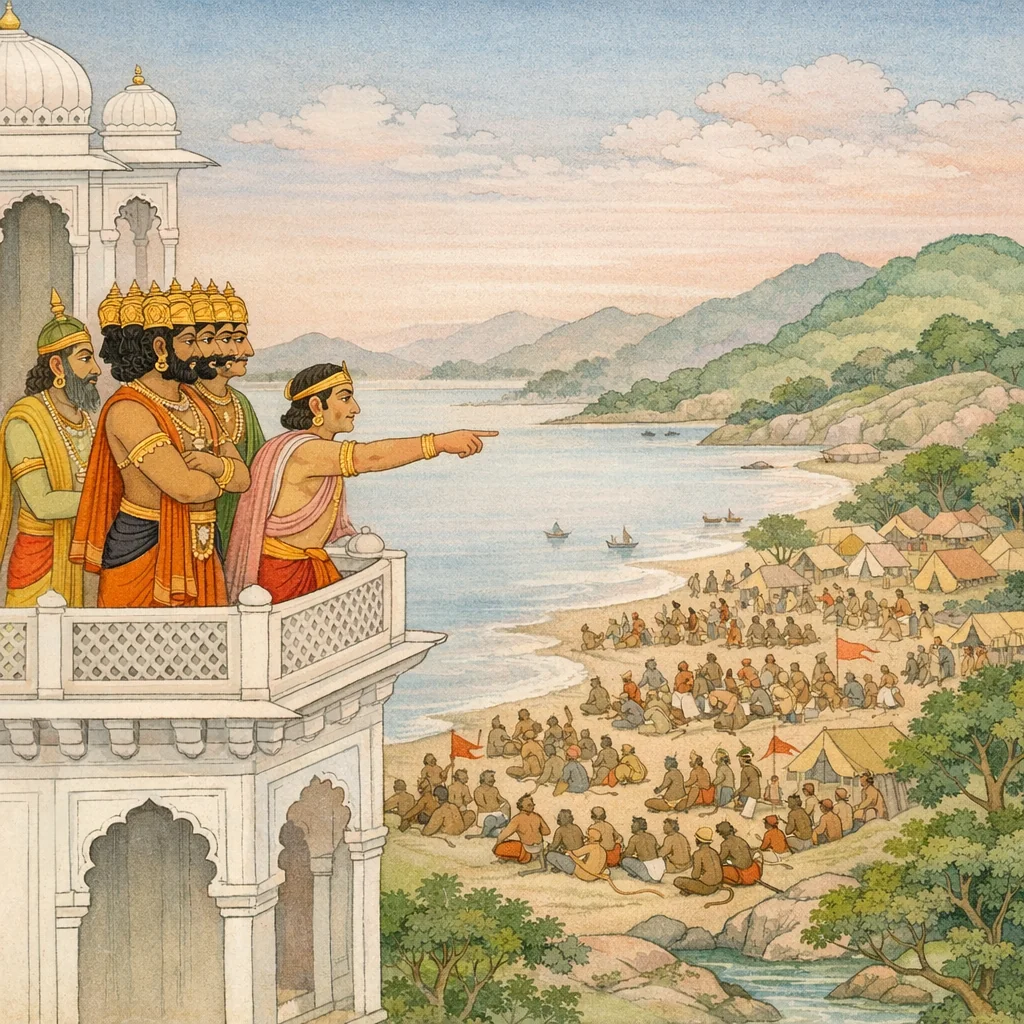
Sarga 26 presents an intelligence exchange within Laṅkā. After Sāraṇa offers frank and beneficial counsel, Rāvaṇa answers with defiant resolve, refusing to surrender Sītā even against opposition of cosmic scope. Seeking a direct appraisal, Rāvaṇa ascends a lofty, snow-white palace with the spies Śuka and Sāraṇa and surveys the vast Vānara host spread along the coastal terrain. Confronted by an innumerable army, he questions Sāraṇa: who among the Vānaras are foremost, who are Sugrīva’s chief advisers, and which leaders are most to be feared. Sāraṇa then delivers a structured catalogue of prominent commanders and their martial traits: Nīla at the head of Sugrīva’s forces; Aṅgada, Vāli’s son and crowned heir, issuing a direct challenge; Nala, linked to the enterprise of the setu; and other troop-leaders—Śveta, Kumuda, Rambha, Śarabha, Panasa, Vinata, Krodhana, and Gavaya—each characterized by appearance, mountain or habitat associations, troop numbers, and fierce intent toward Laṅkā. The chapter functions as a strategic “enemy order of battle,” blending epic poetics with statecraft-minded threat assessment.
Shlokas
Verse 1
तद्वचःपथ्यमक्लीबंसारणेनाभिभाषितम् ।निशम्यरावणोराजाप्रत्यभाषतसारणम् ।।।।
Hearing Sāraṇa’s frank words—sound and beneficial—King Rāvaṇa replied to him.
Verse 2
यदिमामभियुञ्जीरन्देवगन्धर्वदानवाः ।नैवसीतांप्रदास्यामिसर्वलोकभयादपि ।।।।
Even if Devas, Gandharvas, and Dānavas were to assail me together, I would not give Sītā back—not even out of fear of the whole world.
Verse 3
त्वंतुसौम्यपरित्रस्तोहरिभिर्निर्जितोभृशम् ।प्रतिप्रदानमद्यैवसीतायास्साधुमन्यसे ।।।।
But you, noble one—soundly defeated by the Vānaras and now afraid—think that returning Sītā this very day is the right course.
Verse 4
कोहिनामसपत्नोमांसमरेजेतुमर्हति ।इत्युक्त्वापरुषंवाक्यंरावणोराक्षसाधिपः ।।।।आरुरोहततश्रशीमान् प्रासादंहिमपाण्डुरम् ।बहुतालसमुत्सेधंरावणोऽथदिदृक्ष्या ।।।।
“Who indeed could be my rival and defeat me in war?”—having spoken these harsh words, Rāvaṇa, lord of the Rākṣasas, then climbed a splendid, snow-white palace, towering like many palm-trees in height, in order to look out upon the approaching forces.
Verse 5
कोहिनामसपत्नोमांसमरेजेतुमर्हति ।इत्युक्त्वापरुषंवाक्यंरावणोराक्षसाधिपः ।।6.26.4।।आरुरोहततश्रशीमान् प्रासादंहिमपाण्डुरम् ।बहुतालसमुत्सेधंरावणोऽथदिदृक्ष्या ।।6.26.5।।
“Who indeed is there as my rival who could defeat me in war?”—having spoken these harsh words, Rāvaṇa, lord of the Rākṣasas, then climbed his splendid palace, white as snow and towering like many palm-trees, wishing to look out upon the approaching host.
Verse 6
ताभ्यांचराभ्यांसहितोरावणःक्रोधमूर्छितः ।पश्यमानस्समुद्रंचपर्वतांश्चवनानिच ।।।।ददर्शपृथिवीदेशंसुसम्पूर्णंप्लवङ्गमैः ।
Accompanied by those two spies, Rāvaṇa—his mind clouded by anger—looked upon the sea, the mountains, and the forests, and saw the whole region of the land completely filled with Vanaras.
Verse 7
तदपारमसंख्ख्येयंवानराणांमहद्बलं ।अलोक्यरावणोराजापरिपप्रच्छसारणम् ।।।।
Seeing that vast Vanara force—boundless and impossible to count—King Rāvaṇa questioned Sāraṇa further.
Verse 8
एषांवानरमुख्यानांकेशूराःकेमहाबलाः ।केपूर्वमभिवर्तन्तेमहोत्साहास्समन्ततः ।।।।
Among these foremost Vānara leaders, who are the truly valiant—who the great in strength and highest in ardour? And who among them can be named as peers to those proven earlier in battle? Tell me in proper order.
Verse 9
केषांशृणोतिसुग्रीवःकेवायूथपयूथपाः ।सारणाचक्ष्वतत्त्वेनकेप्रधानाःप्लवङ्गमाः ।।।।
Whose counsel does Sugrīva heed? And who among them are the commanders over commanders? O Sāraṇa, tell me truthfully—who are the principal leaders of the monkey host?
Verse 10
सारणोराक्षसेन्द्रस्यवचनंपरिपृच्छतः ।आचचक्षेऽथमुख्यज्ञोमुख्यांस्तांस्तुवनौकसः ।।।।
When the lord of the Rākṣasas questioned him, Sāraṇa—well-versed in who mattered most—began to describe the foremost leaders among the forest-dwellers (the Vānaras).
Verse 11
एषयोऽभिमुखोलङ्कांनर्दंस्तिष्ठतिवानरः ।यूथपानांसहस्राणांशतेनपरिवारितः ।।।।यस्यघोषेणमहतासप्राकारासतोरणा ।लङ्काप्रवेपतेसर्वासशैलवनकानना ।।।।सर्वशाखामृगेन्द्रस्यसुग्रीवस्यमहात्मनः ।बलाग्रेतिष्ठतेवीरोनीलोनामैषयूथपः ।।।।
“See that Vānara there, standing and roaring toward Laṅkā—surrounded by a hundred thousand troop-commanders.”
Verse 12
एषयोऽभिमुखोलङ्कांनर्दंस्तिष्ठतिवानरः ।यूथपानांसहस्राणांशतेनपरिवारितः ।।6.26.11।।यस्यघोषेणमहतासप्राकारासतोरणा ।लङ्काप्रवेपतेसर्वासशैलवनकानना ।।6.26.12।।सर्वशाखामृगेन्द्रस्यसुग्रीवस्यमहात्मनः ।बलाग्रेतिष्ठतेवीरोनीलोनामैषयूथपः ।।6.26.13।।
“At the thunder of his mighty roar, all of Laṅkā trembles—its ramparts and gateways, its hills and its groves.”
Verse 13
एषयोऽभिमुखोलङ्कांनर्दंस्तिष्ठतिवानरः ।यूथपानांसहस्राणांशतेनपरिवारितः ।।6.26.11।।यस्यघोषेणमहतासप्राकारासतोरणा ।लङ्काप्रवेपतेसर्वासशैलवनकानना ।।6.26.12।।सर्वशाखामृगेन्द्रस्यसुग्रीवस्यमहात्मनः ।बलाग्रेतिष्ठतेवीरोनीलोनामैषयूथपः ।।6.26.13।।
At the very forefront of the host stands the hero Nīla, a troop-commander, serving the great-souled Sugrīva, lord of all the Vānara clans.
Verse 14
बाहूप्रगृह्ययःपद् भ्यांमहींगच्छतिवीर्यवान् ।लङ्कामभिमुखःक्रोधादभीक्ष्णंचविजृम्भते ।।।।गिरिशृङ्गप्रतीकाशःपद्मकिञ्जल्कसन्निभः ।स्पोटयत्यभिसंरब्धोलाङ्गूलंचपुनःपुनः ।।।।यस्यलाङ्गूलशब्देनस्वनन्तिप्रदिशोदश ।एषवानरराजेनसुग्रीवेणाभिषेचितः ।।।।यौवराज्येऽङ्गदोनामत्वामाह्वयतिसंयुगे ।।।।
That valiant one—arms raised and stamping the earth with his feet—faces Laṅkā in wrath, again and again swelling with fierce might. In stature he is like a mountain peak, in hue like the filaments of a lotus; in agitation he lashes his tail repeatedly, and by the sound of that tail the ten directions resound. He is Aṅgada, consecrated by Sugrīva, king of the Vānaras, as crown prince—now challenging you in battle.
Verse 15
बाहूप्रगृह्ययःपद् भ्यांमहींगच्छतिवीर्यवान् ।लङ्कामभिमुखःक्रोधादभीक्ष्णंचविजृम्भते ।।6.26.14।।गिरिशृङ्गप्रतीकाशःपद्मकिञ्जल्कसन्निभः ।स्पोटयत्यभिसंरब्धोलाङ्गूलंचपुनःपुनः ।।6.26.15।।यस्यलाङ्गूलशब्देनस्वनन्तिप्रदिशोदश ।एषवानरराजेनसुग्रीवेणाभिषेचितः ।।6.26.16।।यौवराज्येऽङ्गदोनामत्वामाह्वयतिसंयुगे ।।6.26.17।।
Resembling a mountain peak in stature and radiant like the filaments of a lotus, he—utterly enraged—keeps striking his tail again and again.
Verse 16
बाहूप्रगृह्ययःपद् भ्यांमहींगच्छतिवीर्यवान् ।लङ्कामभिमुखःक्रोधादभीक्ष्णंचविजृम्भते ।।6.26.14।।गिरिशृङ्गप्रतीकाशःपद्मकिञ्जल्कसन्निभः ।स्पोटयत्यभिसंरब्धोलाङ्गूलंचपुनःपुनः ।।6.26.15।।यस्यलाङ्गूलशब्देनस्वनन्तिप्रदिशोदश ।एषवानरराजेनसुग्रीवेणाभिषेचितः ।।6.26.16।।यौवराज्येऽङ्गदोनामत्वामाह्वयतिसंयुगे ।।6.26.17।।
By the sound of whose tail the ten directions resound—this is the one who has been consecrated by Sugrīva, king of the Vānaras.
Verse 17
बाहूप्रगृह्ययःपद् भ्यांमहींगच्छतिवीर्यवान् ।लङ्कामभिमुखःक्रोधादभीक्ष्णंचविजृम्भते ।।6.26.14।।गिरिशृङ्गप्रतीकाशःपद्मकिञ्जल्कसन्निभः ।स्पोटयत्यभिसंरब्धोलाङ्गूलंचपुनःपुनः ।।6.26.15।।यस्यलाङ्गूलशब्देनस्वनन्तिप्रदिशोदश ।एषवानरराजेनसुग्रीवेणाभिषेचितः ।।6.26.16।।यौवराज्येऽङ्गदोनामत्वामाह्वयतिसंयुगे ।।6.26.17।।
Aṅgada by name—installed as crown prince—now challenges you to battle.
Verse 18
वालिनस्सदृशःपुत्रस्सुग्रीवस्यसदाप्रियः ।राघवार्थेपराक्रान्तश्शक्रार्थेवरुणोयथा ।।।।
Vali’s son—like his father in prowess and ever dear to Sugrīva—advances for Rāghava’s cause, as Varuṇa would for Śakra (Indra).
Verse 19
एतस्यसामतिस्सर्वायद्दृष्टाजनकात्मजा ।हनूमतावेगवताराघवस्यहितैषिणा ।।।।
All this is the fruit of his counsel: that Sītā, Janaka’s daughter, was seen by swift Hanūmān, devoted to Rāghava’s good.
Verse 20
बहूनिवानरेन्द्राणामेषयूथानिवीर्यवान् ।परिगृह्याभियातित्वांस्वेनानीकेनमर्दितुम् ।।।।
This valiant one, taking with him many troops of the Vānara kings, marches against you with his own divisions—intent on crushing you.
Verse 21
अनुवालिसुतस्यापिबलेनमहताऽवृतः ।वीरस्तिष्ठतिसङ्ग्रामेसेतुहेतुरयंनलः ।।।।
And behind Vāli’s son stands the hero Nala, surrounded by a vast force—he whose work brought forth the bridge—steadfast in battle.
Verse 22
येतुविष्टभ्यगात्राणिक्ष्वेलयन्तिनदन्तिच ।उत्थायचविजृम्भन्तेक्रोधेनहरिपुङ्गवाः ।।।।एतेदुष्प्रसहाघोराश्चण्डाश्चण्डपराक्रमाः ।अष्टौशतसहस्राणिदशकोटिशतानिच ।।।।यएनमनुगच्छन्तिवीराश्चन्दनवासिनः ।एषैवाशंसतेलङ्कांस्वेनानीकेनमर्दितुम् ।।।।
Those foremost of Vānaras, bracing their limbs, shake them and roar; rising up, they stretch themselves in wrath.
Verse 23
येतुविष्टभ्यगात्राणिक्ष्वेलयन्तिनदन्तिच ।उत्थायचविजृम्भन्तेक्रोधेनहरिपुङ्गवाः ।।6.26.22।।एतेदुष्प्रसहाघोराश्चण्डाश्चण्डपराक्रमाः ।अष्टौशतसहस्राणिदशकोटिशतानिच ।।6.26.23।।यएनमनुगच्छन्तिवीराश्चन्दनवासिनः ।एषैवाशंसतेलङ्कांस्वेनानीकेनमर्दितुम् ।।6.26.24।।
They are unassailable, dreadful and fierce, of terrible prowess; their number is said to be eight hundred thousand, and also ten hundreds of crores.
Verse 24
येतुविष्टभ्यगात्राणिक्ष्वेलयन्तिनदन्तिच ।उत्थायचविजृम्भन्तेक्रोधेनहरिपुङ्गवाः ।।6.26.22।।एतेदुष्प्रसहाघोराश्चण्डाश्चण्डपराक्रमाः ।अष्टौशतसहस्राणिदशकोटिशतानिच ।।6.26.23।।यएनमनुगच्छन्तिवीराश्चन्दनवासिनः ।एषैवाशंसतेलङ्कांस्वेनानीकेनमर्दितुम् ।।6.26.24।।
The heroic Vānaras who dwell in the sandalwood forests follow him; and he himself longs to crush Laṅkā with his own division of troops.
Verse 25
श्वेतोरजतसङ्काशश्चपलोभीमविक्रमः ।बुद्धिमान्वानरश्शूरस्त्रिषुलोकेषुविश्रुतः ।।।।तूर्णंसुग्रीवमागम्यपुनर्गच्छतिसत्वरः ।विभजन्वानरींसेनामनीकानिप्रहर्षयन् ।।।।
Śveta—silver-bright in appearance—swift and of fearsome prowess, intelligent and heroic among the Vānaras, was renowned across the three worlds.
Verse 26
श्वेतोरजतसङ्काशश्चपलोभीमविक्रमः ।बुद्धिमान्वानरश्शूरस्त्रिषुलोकेषुविश्रुतः ।।6.26.25।।तूर्णंसुग्रीवमागम्यपुनर्गच्छतिसत्वरः ।विभजन्वानरींसेनामनीकानिप्रहर्षयन् ।।6.26.26।।
Hastening to Sugrīva and then moving on again at speed, he arranged the Vānara army into divisions, heartening the units as he went.
Verse 27
यःपुरागोमतीतीरेरम्यंपर्येतिपर्वतम् ।नाम्नासङ्कोचनोनामनानानगयुतोगिरिः ।।।।तत्रराज्यंप्रशास्त्येषकुमुदोनामयूथपः ।योऽसौशतसहस्राणिसहस्रंपरिकर्षति ।।।।यस्यवालाबहुव्यामादीर्घलाङ्गूलमाश्रिता ।ताम्रापीतास्सीताश्श्वेताःप्रकीर्णाघोरदर्शना ।।।।अदीनोरोषणश्चण्डस्सङ्ग्राममभिकाङ् क्षति ।एषोऽप्याशंसतेलङ्कांस्वेनानीकेनमर्दितुम् ।।।।
Long ago, on the banks of the Gomati, there stretched a delightful mountain range, called Saṅkocana, adorned with many peaks.
Verse 28
यःपुरागोमतीतीरेरम्यंपर्येतिपर्वतम् ।नाम्नासङ्कोचनोनामनानानगयुतोगिरिः ।।6.26.27।।तत्रराज्यंप्रशास्त्येषकुमुदोनामयूथपः ।योऽसौशतसहस्राणिसहस्रंपरिकर्षति ।।6.26.28।।यस्यवालाबहुव्यामादीर्घलाङ्गूलमाश्रिता ।ताम्रापीतास्सीताश्श्वेताःप्रकीर्णाघोरदर्शना ।।6.26.29।।अदीनोरोषणश्चण्डस्सङ्ग्राममभिकाङ् क्षति ।एषोऽप्याशंसतेलङ्कांस्वेनानीकेनमर्दितुम् ।।6.26.30।।
There, a troop-leader named Kumuda ruled that realm; he could muster a host numbering a thousand times a hundred thousand.
Verse 29
यःपुरागोमतीतीरेरम्यंपर्येतिपर्वतम् ।नाम्नासङ्कोचनोनामनानानगयुतोगिरिः ।।6.26.27।।तत्रराज्यंप्रशास्त्येषकुमुदोनामयूथपः ।योऽसौशतसहस्राणिसहस्रंपरिकर्षति ।।6.26.28।।यस्यवालाबहुव्यामादीर्घलाङ्गूलमाश्रिता ।ताम्रापीतास्सीताश्श्वेताःप्रकीर्णाघोरदर्शना ।।6.26.29।।अदीनोरोषणश्चण्डस्सङ्ग्राममभिकाङ् क्षति ।एषोऽप्याशंसतेलङ्कांस्वेनानीकेनमर्दितुम् ।।6.26.30।।
His followers, thick-haired and long-tailed, were of many hues—coppery, yellow, pale, and white; spread out in multitude, they appeared formidable.
Verse 30
यःपुरागोमतीतीरेरम्यंपर्येतिपर्वतम् ।नाम्नासङ्कोचनोनामनानानगयुतोगिरिः ।।6.26.27।।तत्रराज्यंप्रशास्त्येषकुमुदोनामयूथपः ।योऽसौशतसहस्राणिसहस्रंपरिकर्षति ।।6.26.28।।यस्यवालाबहुव्यामादीर्घलाङ्गूलमाश्रिता ।ताम्रापीतास्सीताश्श्वेताःप्रकीर्णाघोरदर्शना ।।6.26.29।।अदीनोरोषणश्चण्डस्सङ्ग्राममभिकाङ् क्षति ।एषोऽप्याशंसतेलङ्कांस्वेनानीकेनमर्दितुम् ।।6.26.30।।
Unfainting, fierce in wrath and grim, he longed for battle; he too desired to crush Laṅkā with his own troops.
Verse 31
यस्त्वेषसिंहसङ्काशःकपिलोदीर्घलोचनः ।निभृतःप्रेक्षतेलङ्कांदिधक्षन्निवचक्षुषा ।।।।विन्ध्यंकृष्णगिरिंसह्यंपर्वतंचसुदर्शनम् ।राजन्सततमध्यास्तेरम्भोनामयूथपः ।।।।शतंशतसहास्राणांत्रिंशच्चहरिपुङ्गवाः ।यमेतेवानराश्शूराश्चण्डाश्चण्डपराक्रमाः ।।।।परिवार्यानुगच्छन्तिलङ्कांमर्दितुमोजसा ।
But this one—lion-like, tawny, and long-eyed—steadily gazed upon Laṅkā, as though he would set it ablaze with his very eyes.
Verse 32
यस्त्वेषसिंहसङ्काशःकपिलोदीर्घलोचनः ।निभृतःप्रेक्षतेलङ्कांदिधक्षन्निवचक्षुषा ।।6.26.31।।विन्ध्यंकृष्णगिरिंसह्यंपर्वतंचसुदर्शनम् ।राजन्सततमध्यास्तेरम्भोनामयूथपः ।।6.26.32।।शतंशतसहास्राणांत्रिंशच्चहरिपुङ्गवाः ।यमेतेवानराश्शूराश्चण्डाश्चण्डपराक्रमाः ।।6.26.33।।परिवार्यानुगच्छन्तिलङ्कांमर्दितुमोजसा ।
O king, the troop-leader named Rambha continually dwelt among the Vindhya, Kṛṣṇagiri, Sahya, and Sudarśana mountains.
Verse 33
यस्त्वेषसिंहसङ्काशःकपिलोदीर्घलोचनः ।निभृतःप्रेक्षतेलङ्कांदिधक्षन्निवचक्षुषा ।।6.26.31।।विन्ध्यंकृष्णगिरिंसह्यंपर्वतंचसुदर्शनम् ।राजन्सततमध्यास्तेरम्भोनामयूथपः ।।6.26.32।।शतंशतसहास्राणांत्रिंशच्चहरिपुङ्गवाः ।यमेतेवानराश्शूराश्चण्डाश्चण्डपराक्रमाः ।।6.26.33।।परिवार्यानुगच्छन्तिलङ्कांमर्दितुमोजसा ।
Thirty times a hundred thousand foremost Vānara warriors—fierce, heroic, and of dreadful might—surround him and march behind him, intent on crushing Laṅkā by sheer force.
Verse 34
यस्तुकर्णौविवृणुतेजृम्बतेचपुनःपुनः ।नचसंविजतेमृत्योर्नचयुद्धाद्विधावति ।।।।प्रकम्पतेचरोषेणतिर्यक्चपुनरीक्षते ।पश्यन् लाङ्गूलमपिचक्ष्वेळतेचमहाबलः ।।।।महाजवोवीतभयोरम्यंसाल्वेयपर्वतम् ।राजन्सततमध्यास्तेशरभोनामयूथपः ।।।।
But he—who stiffens and flares his ears, yawns again and again, and yet neither trembles at death nor retreats from battle—
Verse 35
यस्तुकर्णौविवृणुतेजृम्बतेचपुनःपुनः ।नचसंविजतेमृत्योर्नचयुद्धाद्विधावति ।।6.26.34।।प्रकम्पतेचरोषेणतिर्यक्चपुनरीक्षते ।पश्यन् लाङ्गूलमपिचक्ष्वेळतेचमहाबलः ।।6.26.35।।महाजवोवीतभयोरम्यंसाल्वेयपर्वतम् ।राजन्सततमध्यास्तेशरभोनामयूथपः ।।6.26.36।।
—he quivers with rage, glances sideways again and again, and, watching even his own tail, the mighty one springs about in power.
Verse 36
यस्तुकर्णौविवृणुतेजृम्बतेचपुनःपुनः ।नचसंविजतेमृत्योर्नचयुद्धाद्विधावति ।।6.26.34।।प्रकम्पतेचरोषेणतिर्यक्चपुनरीक्षते ।पश्यन् लाङ्गूलमपिचक्ष्वेळतेचमहाबलः ।।6.26.35।।महाजवोवीतभयोरम्यंसाल्वेयपर्वतम् ।राजन्सततमध्यास्तेशरभोनामयूथपः ।।6.26.36।।
O King, the troop-commander named Śarabha—swift and free from fear—dwells always upon the lovely Sālvēya mountain.
Verse 37
एतस्यबलिनस्सर्वेविहारानामयूथपाः ।राजन् शतसहस्राणिचत्वारिंशस्तथैवच ।।।।
O King, under this mighty one are all the troop-leaders called the Vihāras—forty hundred-thousands in number.
Verse 38
यस्तुमेघइवाकाशंमहानावृत्यतिष्ठति ।मध्येवानरवीराणांसूराणामिववासवः ।।।।भेरीणामिवसन्नादोयस्यैषश्रूयतेमहान् ।घोषश्शाखामृगेन्द्राणांसङ्ग्राममभिकाङ्क्षिताम् ।।।।एषपर्वतमध्यास्तेपारियात्रमनुत्तमम् ।युद्धेदुष्प्रसहोनित्यंपनसोनामयूथपः ।।।।
And he who, vast like a cloud, seems to cover the sky as he stands—like Vāsava (Indra) among the gods—amid the heroic Vānara warriors:
Verse 39
यस्तुमेघइवाकाशंमहानावृत्यतिष्ठति ।मध्येवानरवीराणांसूराणामिववासवः ।।6.26.38।।भेरीणामिवसन्नादोयस्यैषश्रूयतेमहान् ।घोषश्शाखामृगेन्द्राणांसङ्ग्राममभिकाङ्क्षिताम् ।।6.26.39।।एषपर्वतमध्यास्तेपारियात्रमनुत्तमम् ।युद्धेदुष्प्रसहोनित्यंपनसोनामयूथपः ।।6.26.40।।
His mighty cry is heard like the roll of war-drums—the roar of those lordly tree-dwelling monkeys, longing for battle.
Verse 40
यस्तुमेघइवाकाशंमहानावृत्यतिष्ठति ।मध्येवानरवीराणांसूराणामिववासवः ।।6.26.38।।भेरीणामिवसन्नादोयस्यैषश्रूयतेमहान् ।घोषश्शाखामृगेन्द्राणांसङ्ग्राममभिकाङ्क्षिताम् ।।6.26.39।।एषपर्वतमध्यास्तेपारियात्रमनुत्तमम् ।युद्धेदुष्प्रसहोनित्यंपनसोनामयूथपः ।।6.26.40।।
This troop-leader, named Panasa, ever hard to withstand in battle, dwells upon the unsurpassed Pāriyātra mountain.
Verse 41
एनंशतसहस्राणांशतार्धंपर्युपासते ।यूथपायूथपश्रेष्ठंयेषांयूथानिभागशः ।।।।
Fifty hundred-thousands attend upon him—the best of troop-leaders—while their forces stand arranged in distinct divisions.
Verse 42
यस्तुभीमांप्रवल्गन्तींचमूंतिष्ठतिशोभयन् ।स्थितांतीरेसमुद्रस्यद्वितीयइवसागरः ।।।।एषदर्दरसङ्काशोविनतोनामयूथपः ।पिबंश्चरतिपर्णासांनदीनामुत्तमांनदीम् ।।।।षष्टिश्शतसहस्राणिबलमस्यप्लवङ्गमाः ।।।।
He who stands on the ocean’s shore, enhancing the splendour of that fearsome, surging host—like a second sea risen beside the sea itself—
Verse 43
यस्तुभीमांप्रवल्गन्तींचमूंतिष्ठतिशोभयन् ।स्थितांतीरेसमुद्रस्यद्वितीयइवसागरः ।।6.26.42।।एषदर्दरसङ्काशोविनतोनामयूथपः ।पिबंश्चरतिपर्णासांनदीनामुत्तमांनदीम् ।।6.26.43।।षष्टिश्शतसहस्राणिबलमस्यप्लवङ्गमाः ।।6.26.44।।
This one, resembling Mount Dardara, is the troop-leader named Vinata; he moves about drinking from the Parnāsā, the finest among rivers.
Verse 44
यस्तुभीमांप्रवल्गन्तींचमूंतिष्ठतिशोभयन् ।स्थितांतीरेसमुद्रस्यद्वितीयइवसागरः ।।6.26.42।।एषदर्दरसङ्काशोविनतोनामयूथपः ।पिबंश्चरतिपर्णासांनदीनामुत्तमांनदीम् ।।6.26.43।।षष्टिश्शतसहस्राणिबलमस्यप्लवङ्गमाः ।।6.26.44।।
Sixty hundred-thousands of Vānaras make up his force.
Verse 45
त्वामाह्वयतियुद्धायक्रोधनोनामयूधपः ।विक्रान्ताबलवन्तश्चयथायूथानिभागशः ।।।।
A troop-commander named Krodhana challenges you to battle; his units are arrayed in divisions, filled with valiant and powerful warriors.
Verse 46
यस्तुगैरिकवर्णाभंवपुःपुष्यतिवानरः ।अवमत्यसदासर्वान्वानरान्बलदर्पितान् ।।।।गवयोनामतेजस्वीत्वांक्रोधादभिवर्तते ।
That Vanara whose body is of ochre hue—ever scorning all other Vanaras proud of their strength—he, the radiant one named Gavaya, advances upon you in anger.
Verse 47
एनंशतसहस्राणिसप्ततिःपर्युपासते ।एषैवाशंसतेलङ्कांस्वेनानीकेनमर्दितुम् ।।।।
Seventy hundred-thousands attend upon him; and he even expects to crush Laṅkā with his own force.
Verse 48
एतेदुष्प्रसहाघोराबलिनःकामरूपिणः ।यूथपायूथपश्रेष्ठामेषांयूथानिभागशः ।।।।
These leaders are hard to withstand—fierce, strong, and able to assume forms at will; they are the best of troop-commanders, and their troops are arrayed in divisions.
Frequently Asked Questions
Rāvaṇa’s pivotal action is his explicit refusal to return Sītā, declaring that even universal fear or a combined assault by divine beings will not compel surrender—an ethical stance framed as obstinate pride set against counsel and impending consequences.
The chapter contrasts truthful counsel (satyam–pathyām) with sovereign hubris: accurate intelligence and prudent advice are shown as instruments of rājadharma, while refusal to heed them accelerates self-destruction in political and moral terms.
Laṅkā’s palace vantage point and the coastal theatre of war are foregrounded, alongside named landscapes used for identity-mapping of Vānara polities and routes: Gomatī and Parṇāsā rivers; Vindhya, Kṛṣṇagiri, Sahya, Sudarśana, Sālvēya, and Pāriyātra mountains; and the sandalwood forest (candanavana).