Sarga 25
शुकसारण-चारप्रवेशः (Suka and Sāraṇa’s Espionage and Release)
युद्धकाण्ड
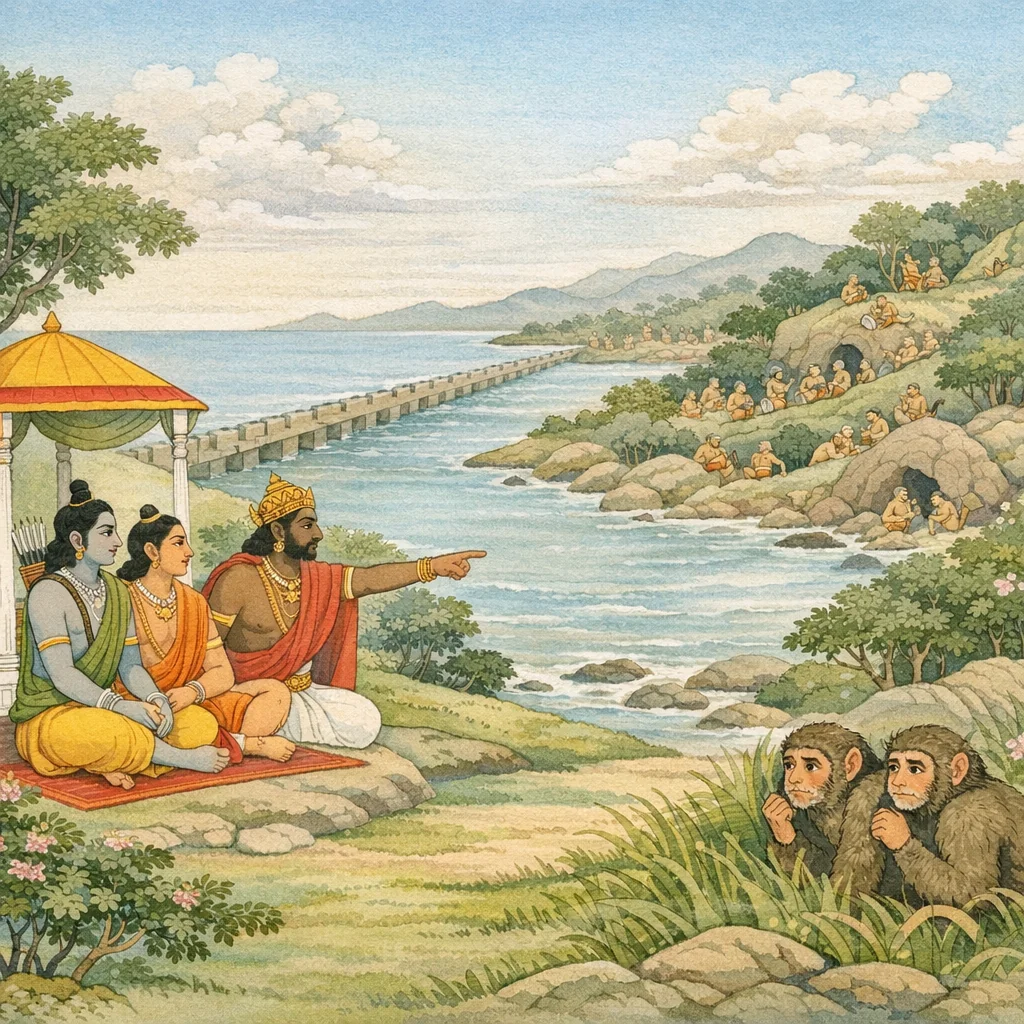
Learning that Rāma, Daśaratha’s son, has crossed the ocean with the vānar host and that a sea-bridge has been completed, Rāvaṇa is stirred to action and sends his minister-spies, Śuka and Sāraṇa, to slip unseen into the enemy camp. They are charged to gauge the army’s strength, identify the foremost vānar chiefs and effective commanders, inspect the bridge’s construction, locate encampments across mountains, caves, shores, forests, and gardens, and assess the resolve, valor, and weapons of Rāma and Lakṣmaṇa. Disguised as vānaras, they enter the host but are overwhelmed by its seemingly countless numbers and thunderous war-cries. Vibhīṣaṇa detects the hidden spies, seizes them, and brings them before Rāma. Though they fear death, Rāma answers with calm, principled restraint: their reconnaissance is complete, so they may return freely; if anything remains unseen, Vibhīṣaṇa can show them the forces in full. Declaring a rule of war—that envoys and the unarmed must not be slain—he orders their release. Rāma instructs them to tell Rāvaṇa: let him display the strength by which he abducted Sītā, and at dawn witness how Laṅkā’s defenses and rākṣasa power will be shattered. Back in Laṅkā, Śuka and Sāraṇa testify to Rāma’s righteousness and to the terrifying capability of the four leaders—Rāma, Lakṣmaṇa, Vibhīṣaṇa, and Sugrīva—urging conciliation and the return of Maithilī as the prudent course.
Shlokas
Verse 1
सबलेसागरंतीर्णेरामेदशरथात्मजे ।अमात्यौरावणश्रीमानब्रवीच्छुकसारणौ ।।।।
When Rama, Dasaratha’s son, had crossed the ocean together with his army, the splendid Ravana addressed his two ministers, Shuka and Sarana.
Verse 2
समग्रंसागरंतीर्णंदुस्तरंवानरंबलम् ।अभूतपूर्वंरामेणसागरेसेतुबन्धनम् ।।।।
The entire Vānara host has crossed the formidable ocean; and Rāma has achieved what was unheard of before—building a causeway in the sea.
Verse 3
सागरेसेतुबन्दंतुनश्रद्दध्यांकथञ्चन ।अवश्यंचापिसङ् ख्येयंतन्मयावानरंबलम् ।।।।
I could not, by any means, believe that a bridge had been built across the sea. Yet I must surely ascertain the strength and the numbers of that Vānara host.
Verse 4
भवन्तौवानरंसैन्यंप्रविश्यानुपलक्षितौ ।परिमाणंचवीर्यंचयेचमुख्याःप्लवङ्घमाः ।।।।मन्त्रिणोयेचरामस्यसुग्रीवस्यचसम्मता: ।येपूर्वमभिवर्तन्तेयेचशूराःप्लवङ्गमाः ।।।।सचसेतुर्यथाबद्धस्सागरेसलिलार्णवे ।निवेशंचयधातेषांवानराणांमहात्मनाम् ।।।।रामस्यव्यवसायंचवीर्यंप्रहरणानिच ।लक्ष्मणस्यचवीर्यंतत्त्वतोज्ञातुमर्हथः ।।।।
You two should enter the Vānara army without being noticed and learn its full measure—its numbers, its power, and who among the plavaṅgamas are the foremost leaders.
Verse 5
भवन्तौवानरंसैन्यंप्रविश्यानुपलक्षितौ ।परिमाणंचवीर्यंचयेचमुख्याःप्लवङ्घमाः ।।6.25.4।।मन्त्रिणोयेचरामस्यसुग्रीवस्यचसम्मता: ।येपूर्वमभिवर्तन्तेयेचशूराःप्लवङ्गमाः ।।6.25.5।।सचसेतुर्यथाबद्धस्सागरेसलिलार्णवे ।निवेशंचयधातेषांवानराणांमहात्मनाम् ।।6.25.6।।रामस्यव्यवसायंचवीर्यंप्रहरणानिच ।लक्ष्मणस्यचवीर्यंतत्त्वतोज्ञातुमर्हथः ।।6.25.7।।
Find out also which counselors are trusted by Rāma and by Sugrīva, and which Vānara heroes stand in the vanguard—those valiant plavaṅgamas who lead from the front.
Verse 6
भवन्तौवानरंसैन्यंप्रविश्यानुपलक्षितौ ।परिमाणंचवीर्यंचयेचमुख्याःप्लवङ्घमाः ।।6.25.4।।मन्त्रिणोयेचरामस्यसुग्रीवस्यचसम्मता: ।येपूर्वमभिवर्तन्तेयेचशूराःप्लवङ्गमाः ।।6.25.5।।सचसेतुर्यथाबद्धस्सागरेसलिलार्णवे ।निवेशंचयधातेषांवानराणांमहात्मनाम् ।।6.25.6।।रामस्यव्यवसायंचवीर्यंप्रहरणानिच ।लक्ष्मणस्यचवीर्यंतत्त्वतोज्ञातुमर्हथः ।।6.25.7।।
“Find out how that bridge has been built across the ocean—this vast expanse of waters—and also learn the encampment and dispositions of those great-souled Vānaras.”
Verse 7
भवन्तौवानरंसैन्यंप्रविश्यानुपलक्षितौ ।परिमाणंचवीर्यंचयेचमुख्याःप्लवङ्घमाः ।।6.25.4।।मन्त्रिणोयेचरामस्यसुग्रीवस्यचसम्मता: ।येपूर्वमभिवर्तन्तेयेचशूराःप्लवङ्गमाः ।।6.25.5।।सचसेतुर्यथाबद्धस्सागरेसलिलार्णवे ।निवेशंचयधातेषांवानराणांमहात्मनाम् ।।6.25.6।।रामस्यव्यवसायंचवीर्यंप्रहरणानिच ।लक्ष्मणस्यचवीर्यंतत्त्वतोज्ञातुमर्हथः ।।6.25.7।।
“You must also learn, as it truly is, Rāma’s resolve, his prowess, and his weapons—and likewise the real measure of Lakṣmaṇa’s valor.”
Verse 8
कश्चसेनापतिस्तेषांवानराणांमहौजसाम् ।तच्चज्ञात्वायथातत्त्वंशीघ्रमगन्तुमर्हथः ।।।।
“And who among those mighty Vānaras is their commander-in-chief? Having learned all this correctly, you should return swiftly.”
Verse 9
इतिप्रतिसमादिष्टौराक्षसौशुकसारणौ ।हरिरूपधरौवीरौप्रविष्टौवानरंबलम् ।।।।
Thus instructed, the two Rākṣasa warriors, Śuka and Sāraṇa, assumed the form of Vānaras and entered the Vānara host.
Verse 10
ततस्तद्वानरंसैन्यमचिन्त्यंरोमहर्षणम् ।सङ् ख्यातुंनाध्यगच्छेतांतदातौशुकसारणौ ।।।।
Then Shuka and Sarana found that monkey-host beyond imagining and hair-raising; at that time they could not even arrive at a count of its numbers.
Verse 11
संस्थितंपर्वताग्रेषुनिर्दरेषुगुहासुच ।समुद्रस्यचतीरेषुवनेषूपवनेषुच ।।।।तरमाणंचतीर्णंचतर्तुकामंचसर्वशः ।निविष्टंनिविश्चैवभीमनादंमहाबलम् ।।।।तद्बलार्णवमक्षोभ्यंददृशातेनिशाचरौ ।
They saw that ocean-like host of troops—unshakable and of great might—spread everywhere: stationed on mountain peaks, in ravines and caves, along the sea-shore, and in forests and groves. Some were still crossing, some had crossed, and some were eager to cross in every direction; others had settled in place, raising a dreadful roar. Thus the two night-rangers beheld that unstirrable sea of strength.
Verse 12
संस्थितंपर्वताग्रेषुनिर्दरेषुगुहासुच ।समुद्रस्यचतीरेषुवनेषूपवनेषुच ।।6.25.11।।तरमाणंचतीर्णंचतर्तुकामंचसर्वशः ।निविष्टंनिविश्चैवभीमनादंमहाबलम् ।।6.25.12।।तद्बलार्णवमक्षोभ्यंददृशातेनिशाचरौ ।
Upon mountain peaks, in ravines and caves, along the ocean’s shore, in forests and in groves, the host stood spread out. Some were crossing, some had crossed, and some everywhere were preparing to cross; some were seated in position and others still taking their places, roaring with dreadful sound. That unshakable, ocean-like flood of might was beheld by the two Rākṣasa spies.
Verse 13
तौददर्शमहातेजाःप्रतिच्छन्नौचविभीषणः ।आचचक्षेऽथरामायगृहीत्वाशुकसारणौ ।।।।
Vibhīṣaṇa, radiant with great splendor, saw the two hiding; seizing Śuka and Sāraṇa, he reported it to Rāma.
Verse 14
तस्यैमौराक्षसेन्द्रस्यमन्त्रिणौशुकसारणौ ।लङ्कायस्समनुप्राप्तौचारौपरपुरञ्जय:।। ।।
“O conqueror of enemy strongholds, these two—Śuka and Sāraṇa—are ministers of the lord of the Rākṣasas; they have come from Laṅkā as spies.”
Verse 15
तौदृष्टवाव्यथितौरामंनिराशौजीवितेतथा ।कृताञ्जलिपुटौभीतौवचनंचेदमूचतुः ।।।।
Seeing Rāma, the two were shaken and, despairing even of their lives, they stood in fear with joined palms and spoke these words.
Verse 16
आवामिहागतौसौम्य रावणप्रहितावुभौ ।परिज्ञातुंबलंसर्वंतवेदंरघुनन्दन:।। ।।
“O gentle lord, we both have come here, sent by Rāvaṇa. O delight of the Raghu line, we have arrived to ascertain the full strength of your forces.”
Verse 17
तयोस्तद्वचनंश्रुत्वारामोदशरथात्मजः ।अब्रवीत्प्रहसन्वाक्यंसर्वभूतहितेरतः ।।।।
Hearing their words, Rāma—Daśaratha’s son, devoted to the welfare of all beings—spoke to them with a gentle smile.
Verse 18
यदिदृष्टंबलंसर्वंवयंवासुपरिक्षिताः ।यथोक्तंवाकृतंकार्यछन्दतःप्रतिगम्यताम् ।।।।
“If you have seen the entire army, or have examined us well; if you have carried out the task as instructed—then return freely, as you wish.”
Verse 19
अथकिञ्चिददृष्टंवाभूयस्तद्द्रष्टुमर्हथः ।विभीषणोवाकात्स्नर्येनभूयस्सन्दर्शयिष्यति ।।।।
Now, if there is anything you have not yet seen, you should look again; otherwise Vibhīṣaṇa will show you the host in its entirety.
Verse 20
नचेदंग्रहणंप्राप्यभेत्तव्यंजीवितंप्रति ।न्यस्तशस्त्रौगृहतौवानदूतौवधमर्हतः ।।।।
Since you have been seized, you need not fear for your lives. Those who have laid down their weapons, or those taken captive—and especially envoys—do not deserve to be slain.
Verse 21
प्रच्छमानौविमुञ्चैतौचारौरात्रिंचरावुभौ ।शत्रुपक्षस्यसततंविभीषण: विकर्षिणौ ।।।।
They are spies—both roamers of the night—seeking tidings and ever striving to weaken the enemy’s side; yet, O Vibhīṣaṇa, release them, for they plead.
Verse 22
प्रविश्यनगरींलङ्कांभवद् भ्यांधनदानुजः ।वक्तव्योरक्षसांराजायथोक्तंवचनंमम ।।।।
When you enter the city of Laṅkā, you must convey my words exactly as spoken to the king of the Rākṣasas—Kubera’s younger brother.
Verse 23
यद्बलंचसमाश्रित्यसीतांमेहृतवानपि ।तद्दर्शययथाकामंससैन्यस्सहबान्धवः ।।।।
Let him display, at his own pleasure, with his army and kinsmen, the very strength on which he relied when he abducted my Sītā.
Verse 24
श्वःकाल्येनगरींलङ्कांसप्राकारांसतोरणाम् ।रक्षसंचबलंपश्यशरैर्विध्वंसितंमया ।।।।
At dawn tomorrow, behold Laṅkā—with its ramparts and gateways—and the Rākṣasa forces, shattered by my arrows.
Verse 25
क्रोधंभीममहंमोक्ष्येससैन्येत्वयिरावण: ।श्वःकाल्येवज्रवान्वज्रंदानवेष्विववासवः ।।।।
O Rāvaṇa, tomorrow at dawn I shall unleash my dreadful wrath upon you and your forces, as Vāsava (Indra), wielder of the vajra, once hurled the thunderbolt upon the Dānavas.
Verse 26
इतिप्रतिसमादिष्टौराक्षसौशुकसारणौ ।।।।जयेतिप्रतिनन्द्यैतौराघवंधर्मवत्सलम् ।आगम्यनगरींलङ्कामब्रूतांराक्षसाधिपम् ।।।।
Thus, having been instructed in reply, the two rākṣasas—Śuka and Sāraṇa—praised Rāghava, devoted to dharma, crying “Victory!”; and upon reaching the city of Laṅkā, they spoke to the lord of the rākṣasas.
Verse 27
इतिप्रतिसमादिष्टौराक्षसौशुकसारणौ ।।6.25.26।।जयेतिप्रतिनन्द्यैतौराघवंधर्मवत्सलम् ।आगम्यनगरींलङ्कामब्रूतांराक्षसाधिपम् ।।6.25.27।।
Thus, having been instructed in reply, the two rākṣasas—Śuka and Sāraṇa—praised Rāghava, devoted to dharma, crying “Victory!”; and upon reaching the city of Laṅkā, they spoke to the lord of the rākṣasas.
Verse 28
विभीषणगृहीतौतुवधार्तौराक्षसेश्वर: ।दृष्टवाधर्मात्मनामुक्तौरामेणामिततेजसा ।।।।
O lord of the Rākṣasas, Vibhīṣaṇa had seized us for execution; but Rāma—righteous-souled and of immeasurable splendor—released us when he saw us.
Verse 29
एकस्थानगतायत्रचत्वारःपुरुषर्षभाः ।लोकपालसमाश्शूराःकृतास्त्रादृढविक्रमा ।।।।रामोदाशरथि्शीमान् लक्ष्मणश्चविभीषणः ।सुग्रीवश्चमहातेजामहेन्द्रसमविक्रमः ।।।।एतेशक्ताःपुरीलङ्कांसप्राकारांसतोरणाम् ।उत्पाट्यसङ्क्रमयितुंसर्वेतिष्ठन्तुवानराः ।।।।
Where those four bulls among men stand together—heroes like the very guardians of the worlds—armed and steadfast in valor,
Verse 30
एकस्थानगतायत्रचत्वारःपुरुषर्षभाः ।लोकपालसमाश्शूराःकृतास्त्रादृढविक्रमा ।।6.25.29।।रामोदाशरथि्शीमान् लक्ष्मणश्चविभीषणः ।सुग्रीवश्चमहातेजामहेन्द्रसमविक्रमः ।।6.25.30।।एतेशक्ताःपुरीलङ्कांसप्राकारांसतोरणाम् ।उत्पाट्यसङ्क्रमयितुंसर्वेतिष्ठन्तुवानराः ।।6.25.31।।
—Rāma, the illustrious son of Daśaratha; Lakṣmaṇa; Vibhīṣaṇa; and the mighty Sugrīva, whose valor rivals great Indra—
Verse 31
एकस्थानगतायत्रचत्वारःपुरुषर्षभाः ।लोकपालसमाश्शूराःकृतास्त्रादृढविक्रमा ।।6.25.29।।रामोदाशरथि्शीमान् लक्ष्मणश्चविभीषणः ।सुग्रीवश्चमहातेजामहेन्द्रसमविक्रमः ।।6.25.30।।एतेशक्ताःपुरीलङ्कांसप्राकारांसतोरणाम् ।उत्पाट्यसङ्क्रमयितुंसर्वेतिष्ठन्तुवानराः ।।6.25.31।।
These men are capable of tearing up Laṅkā itself—walls and gateways included—and carrying it away; let all the Vānaras stand aside.
Verse 32
यादृश्यंतस्यरामस्यरूपंप्रहरणानिच ।वधिष्यतिपुरींलङ्कामेकस्तिष्ठन्तुतेत्रयः ।।।।
Such is Rāma’s very presence—and such are his weapons—that he alone can destroy the city of Laṅkā, even if the other three stand aside.
Verse 33
रामलक्ष्मणगुप्तासासुग्रीवेणचवाहिनी ।बभूवदुर्दर्षतरासर्वैरपिसुरासुरैः ।।।।
That host—guarded by Rāma and Lakṣmaṇa and led also by Sugrīva—became exceedingly formidable, hard to face even for all the gods and asuras together.
Verse 34
प्रहृष्टरूपाध्वजिनीवनौकसां ।महात्मनाम् सम्प्रतियोद्धुमिच्छताम् ।अलंविरोधेनशमोविधीयतांप्रदीयतांदाशरथायमैदिली ।।।।
The bannered army of the forest-dwellers, those great-souled warriors, is exultant and eager to fight. Enough of hostility—let peace be established; let Maithilī be returned to Daśaratha’s son.
Frequently Asked Questions
The pivotal action is Rāma’s decision to spare captured enemy spies/envoys. Despite being infiltrators, they are treated under a dharmic rule of war: those who are envoys or unarmed are not to be executed, reinforcing restraint amid siege conditions.
Power is subordinated to principle: righteous leadership demonstrates confidence through restraint, transparency, and adherence to norms (dharma), using moral authority as strategic strength rather than relying solely on punitive violence.
The ocean (sāgara) and the setu-bandhana (sea-bridge) frame the campaign’s logistical breakthrough; Laṅkā’s fortifications (prākāra, toraṇa) define the impending siege; troop dispersal across mountains, caves, shores, forests, and groves maps the encampment ecology of the invading host.