Sarga 117
सीतासमीपगमनम् / Sītā Brought Near to Rāma (Public Witness and Protocol)
युद्धकाण्ड
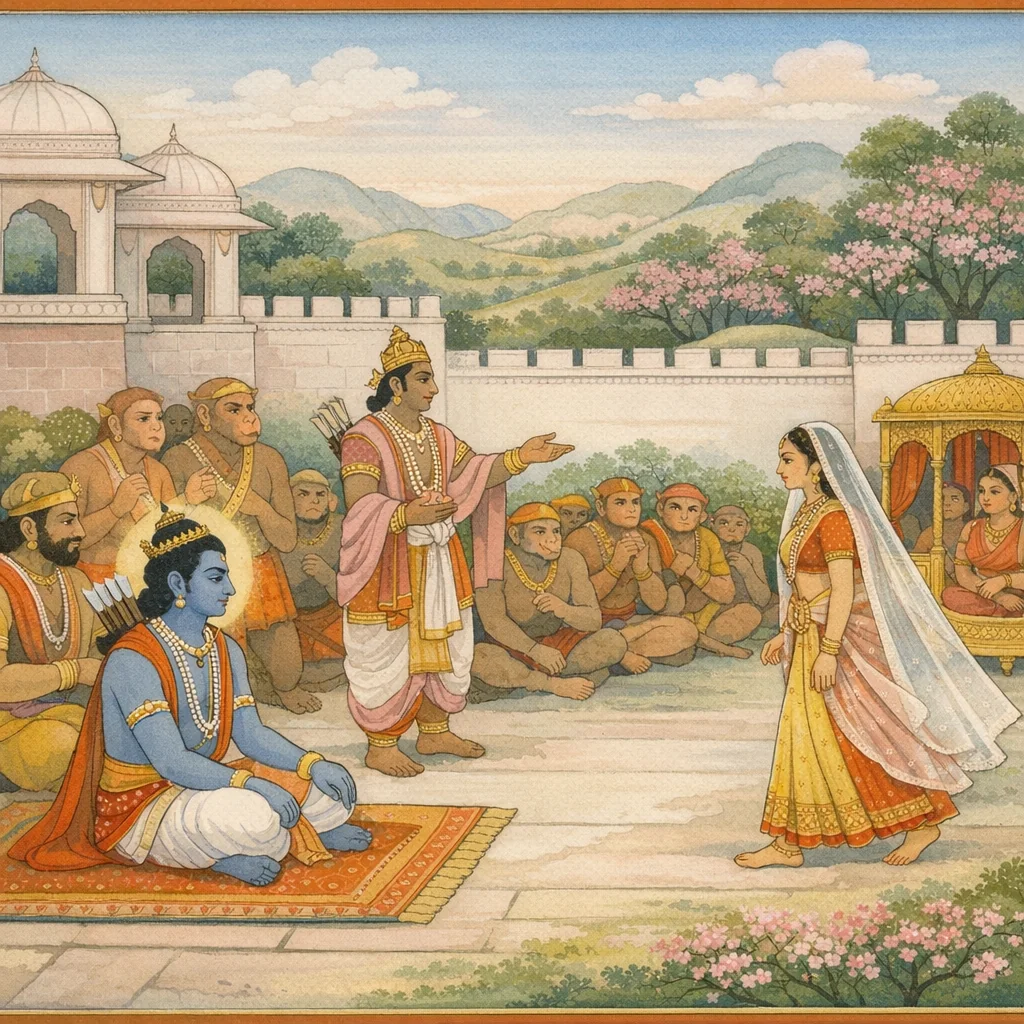
This sarga shifts from martial victory to moral adjudication through a carefully controlled meeting. Hanumān, praised as highly learned, reports to Rāma and urges him to see the grief-stricken Maithilī, for whose sake the entire campaign was waged. Rāma, tearful and contemplative, then commands Vibhīṣaṇa to present Sītā bathed, anointed, and adorned according to proper protocol. Sītā at first wishes to see Rāma without bathing, but Vibhīṣaṇa insists on obeying Rāma’s order, and she agrees. She is brought in a radiant palanquin guarded by many rākṣasas. Hearing of her arrival, Rāma feels joy, indignation, and anger together, revealing the ethical tension between private reunion and public legitimacy. Rāma asks that Sītā be brought near. When Vibhīṣaṇa tries to disperse the crowd, Rāma stops him, declaring them “his own people,” and states a norm: in crisis, conflict, or ritual contexts, a woman’s public appearance is not inherently blameworthy, and Sītā’s coming near bears no fault. He then has the palanquin set aside so she may approach on foot, visible to the vānaras, intensifying communal witnessing. Lakṣmaṇa, Sugrīva, and Hanumān are distressed by Rāma’s harsh demeanor, fearing displeasure toward Sītā. Sītā approaches modestly, gazes upon Rāma’s face, and her long-held sorrow is dispelled—ending the chapter in emotional release while foreshadowing further ethical scrutiny.
Shlokas
Verse 1
स उवाचमहाप्रामस्सोऽभिवाद्यप्लवङ्गमः ।रामंवचनमर्थज्ञोवरंसर्वधनुष्मताम् ।।।।
That vanara, greatly wise and skilled in discerning meaning, bowed in reverence and then spoke to Rāma—the foremost of all archers—with words of weight.
Verse 2
यन्निमित्तोऽयमारम्बःकर्मणांयःफलोदयः ।तांदेवींशोकसन्तप्तांद्रष्टुमर्हसिमैथिलीम् ।।।।
You should behold that noble Maithilī, scorched by grief—she for whose sake this undertaking began, and for whom these deeds have now borne their fruit.
Verse 3
साहिशोकसमाविष्टाबाष्पपर्याकुलेक्षणा ।मैथिलीविजयंश्रुत्वाद्रष्टुंत्वामभिकाङ्क्षति ।।।।
For Maithilī, overcome with grief and her eyes clouded with tears, has heard of your victory and longs to see you.
Verse 4
पूर्वकात्प्रत्ययाच्चाहमुक्तोविश्वस्तयातया ।भर्तारंद्रष्टुमिच्छामिकृतार्थंसहलक्ष्मणम् ।।।।
And earlier too, trusting in me, she told me: “I wish to see my husband—fulfilled in purpose—together with Lakṣmaṇa.”
Verse 5
एवमुक्तोहनुमतारामोधर्मभृतांवरः ।आगच्छत्सहसाध्यानमीषद्भाष्पपरिप्लुतः ।।।।
Thus addressed by Hanumān, Rāma—foremost among upholders of dharma—was suddenly drawn into deep thought, his eyes lightly washed with tears.
Verse 6
दीर्घमुष्णंविनिःश्वस्यजगतीमवलोकयन् ।उवाचमेघसङ्काशंविभीषणमुपस्थितम् ।।।।
Drawing a long, heated breath and casting his gaze down to the earth, Rāma spoke to Vibhīṣaṇa, who stood nearby, dark-hued like a rain-cloud.
Verse 7
दिव्याङ्गरागांवैदेहींदिव्याभरणभूषिताम् ।इहसीतांशिरःस्नातामुपस्थापयमाचिरम् ।।6.117.7।।
“Bring Sītā here without delay—Vaidehī, bathed and refreshed, anointed with fine unguents, adorned with splendid ornaments.”
Verse 8
एवमुक्तस्तुरामेणत्वरमाणोविभीषणः ।प्रविश्यान्तःपुरंसीतांस्त्रीभिस्स्वाभिरोचदयत् ।।।।
Thus addressed by Rāma, Vibhīṣaṇa hurried into the inner palace and, through his attendant women, sent word to Sītā.
Verse 9
ततस्सीतांमहाभागांदृष्टवोवाचविभीषणः ।मूर्ध्निबद्धाञ्जलिश्रीमान्विनीतोराक्षसेश्वरः ।।।।
Then Vibhīṣaṇa—the illustrious lord of the Rākṣasas—beholding the noble Sītā, spoke with humility, his joined palms raised to his head in reverent salutation.
Verse 10
दिव्याङ्गरागावैदेहीदिव्याभरणभूषिता ।यानमारोहभद्रंतेभर्तात्वांद्रष्टुमिच्छति ।।।।
“Vaidehī, anointed with divine fragrance and adorned with celestial ornaments—mount the conveyance; may auspiciousness attend you. Your husband wishes to see you.”
Verse 11
एवमुक्तातुवैदेहीप्रत्युवाचविभीषणम् ।अस्नात्वाद्रष्टुमिच्छामिभर्तारंराक्षसेश्वर ।।।।
Thus addressed, Vaidehī replied to Vibhīṣaṇa: “O lord of the rākṣasas, I wish to see my husband without first bathing.”
Verse 12
तस्यास्तद्वचनंश्रुत्वाप्रत्युवाचविभीषणः ।यथाहरामोभहर्तातेतत्तथाकर्तुमार्हसिमार्हसि ।।।।
Hearing her words, Vibhīṣaṇa replied: “As your husband Rāma has directed, so you should do exactly that.”
Verse 13
तस्यतद्वचनंश्रुत्वामैथिलीपतिदेवता ।भर्तृभक्त्यावृतासाध्वीतथेतिप्रत्यभाषत ।।।।
Hearing his words, Maithilī—who revered her husband as her very deity—she, the virtuous one, wrapped in devotion to her lord, replied: “So be it.”
Verse 14
ततस्सीतांशिरःस्नातांसंयुक्तांप्रतिकर्मणा ।महार्हाभरणोपेतांमहार्हाम्बरधारिणीम् ।।।।आरोप्यशिबिकांदीप्तांपरार्घ्याम्बरसम्वृताम् ।राक्षसैर्भहुभिर्गुप्तामाजहारविभीषणः ।।।।
Then Vibhīṣaṇa had Sītā bathe and be duly adorned; arrayed in precious ornaments and costly garments, he placed her in a splendid palanquin draped with rich cloth, guarded by many rākṣasas, and brought her to Rāma.
Verse 15
ततस्सीतांशिरःस्नातांसंयुक्तांप्रतिकर्मणा ।महार्हाभरणोपेतांमहार्हाम्बरधारिणीम् ।।6.117.14।।आरोप्यशिबिकांदीप्तांपरार्घ्याम्बरसम्वृताम् ।राक्षसैर्भहुभिर्गुप्तामाजहारविभीषणः ।।6.117.15।।
Then Vibhīṣaṇa had Sītā bathe and be duly adorned; arrayed in precious ornaments and costly garments, he placed her in a splendid palanquin draped with rich cloth, guarded by many rākṣasas, and brought her to Rāma.
Verse 16
सोऽभिगम्यमहात्मानंज्ञातावपिध्यानमास्थितम् ।प्रणतश्चप्रहृष्टश्चप्राप्तांसीतांन्यवेदयत् ।।।।
Approaching the great-souled one and seeing him absorbed in contemplation, he—bowing in reverence and filled with joy—announced that Sītā had arrived.
Verse 17
तामागतामुपश्रुत्यरक्षोगृहचिरोषिताम् ।हर्षोदैन्यंच रोषश्चत्रयंराघवमाविशत् ।।।।
Hearing that she had come—she who had long dwelt in the rākṣasa’s house—three feelings seized Rāghava at once: joy, dejection, and anger.
Verse 18
ततःपार्श्वगतंदृष्टवासविमर्शंविचारयन् ।विभीषणमिदंवाक्यमहृष्टोराघवोऽब्रवीत् ।।।।
Then Rāghava, displeased and weighing the matter with deliberation, seeing Vibhīṣaṇa standing nearby, spoke these words to him.
Verse 19
राक्षसाधिपतेसौम्यनित्यंमद्विजयेरत ।वैदेहीसंनिकर्षंमेशीघ्रंसमुपगच्छतु ।।।।
O gentle lord of the rākṣasas, ever intent on my victory—let Vaidehī be brought swiftly into my presence.
Verse 20
तस्यतद्वचनंश्रुत्वाराघवस्यविभीषणः ।तूर्णमुत्सारणंतत्रकारयामासधर्मवित् ।।।।
Hearing Rāghava’s words, Vibhīṣaṇa—knower of dharma—at once had the place there cleared.
Verse 21
कञ्चुकोष्णीषिणस्तत्रवेत्रजर्जरपाणयः ।उत्सारयन्तस्तान्योधान्समन्तात् परिचक्रमुः ।।।।
There, men wearing tunics and turbans, staffs in hand, moved all around, driving the warriors back and clearing the space.
Verse 22
ऋक्षाणांवानराणां च राक्षसानां च सर्वशः ।वृन्दान्युत्सार्यमाणानिदूरमुत्तस्थुरन्ततः ।।।।
Bands of bears, vānaras, and rākṣasas everywhere were made to withdraw, and at last they moved away to a distance from that spot.
Verse 23
तेषामुत्सार्यमाणानांनिःस्वनःसुमहानभूत् ।वायुनोद्धूयामानस्यसागरस्येवनिःस्वनः ।।।।
As they were being driven back, a tremendous roar arose—like the roar of the ocean when whipped up by the wind.
Verse 24
उत्सार्यमाणान् दृष्टवाथजगत्यांजातसम्भ्रमान् ।दाक्षिण्यात्तदमर्षाच्चवारयामासराघवः ।।।।
Seeing the people being driven away—stirred and agitated—Rāghava checked the dispersal, both out of kindness and out of displeasure at the manner of it.
Verse 25
संरम्बश्चाब्रवीद्रामश्चक्षुषाप्रदहन्निव ।विभीषणंमहाप्राज्ञंसोपालम्बमिदंवचः ।।।।
With indignation, Rāma spoke—his eyes as though burning—addressing the wise Vibhīṣaṇa with these reproachful words.
Verse 26
किमर्थंमामनादृत्यक्लिश्यतेऽयंत्वयाजनः ।निवर्तयैनमुद्योगंजनोऽयंस्वजनोमम ।।।।
“For what reason is this people being made to suffer, disregarding me? Put an end to this commotion—these are my own people.”
Verse 27
न गृहाणि न वस्त्राणि न प्राकारास्तिरस्क्रिया ।नेदृशाराजसत्कारावृत्तमावरणंस्त्रियाः ।।।।
“For a woman, neither houses nor garments, nor walls, nor veils—nor even such royal honor and enclosure—are truly her protection.”
Verse 28
व्यसनेषु न कृच्छ्रेषु न युद्धेषुस्वयंवरे ।न क्रतौनोविवाहेवादर्शनंदूष्यतेस्त्रियाः ।।।।
In calamity or grievous hardship, in war, in a svayaṃvara, in a sacrifice, or at a wedding—there is no blame in a woman being seen in public.
Verse 29
सैषाविपद्गताचैवकृच्छ्रेव च महतिस्थिता ।दर्शनेनास्तिदोषोऽस्यामत्समीपेविशेषतः ।।।।
She has indeed fallen into misfortune and stands in great hardship; there is no fault in her being seen—especially in my presence.
Verse 30
विसृज्यशिबिकांतस्मात्पद्भ्यामेवोपसर्पतु ।समीपेममवैदेहींपश्यन्त्वेतेवनौकसः ।।।।
Therefore, setting aside the palanquin, let Vaidehī approach on foot; and let these forest-dwellers behold her in my presence.
Verse 31
एवमुक्तस्तुरामेणसविमर्शोविभीषणम् ।रामस्योपानयसतीतांसन्निकर्षंविनीतवत् ।।।।
Thus commanded by Rāma, Vibhīṣaṇa—after due consideration—reverently led Sītā and brought her near into Rāma’s presence.
Verse 32
ततोलक्ष्मणसुग्रीवौहनूमांश्चप्लवङ्गमः ।निशम्यवाक्यंरामस्यबभूवुर्व्यथिताभृशम् ।।।।
Thereupon Lakṣmaṇa and Sugrīva, and Hanumān the Vānara too—having heard Rāma’s words—became deeply distressed.
Verse 33
कलत्रनिरपेक्ष्षैश्चइङ्गितैरस्यदारुणैः ।अप्रीतमिवसीतायांतर्कयन्तिस्मराघवम् ।।।।
By his harsh gestures, seeming indifferent to his wife, they inferred that Rāghava might be displeased with Sītā.
Verse 34
लज्जयात्ववलीयन्तीस्वेषुगात्रेषुमैथिली ।विभीषणेनानुगताभर्तारंसाभ्यवर्तत ।।।।
Maithilī, shrinking within herself out of modesty, approached her husband, followed by Vibhīṣaṇa.
Verse 35
विस्मयाच्छप्रहर्षाच्चस्नेहाच्चपतिदेवता ।उदैक्षतमुखंभर्तुःसौम्यंसौम्यतरानना ।।।।
With wonder, joy, and tender love, Sītā—who revered her husband as her very deity—gazed upon her lord’s gentle face, while her own countenance was gentler still.
Verse 36
अथसमपनुदन्मनःक्लमंसासुचिरमदृष्टमुदीक्ष्यवैप्रियस्य ।वदनमुदितचन्द्रपूर्णकान्तंविमलशशाङ्कनिभाननातदानीम् ।।।।
Then, as she gazed upon her beloved’s face—long unseen, radiant like the newly risen full moon—the weariness of her heart was dispelled; and at that moment her own face shone like the spotless moon.
Frequently Asked Questions
The key action is Rāma’s management of Sītā’s return as a publicly witnessed approach: he halts crowd dispersal, calls the onlookers ‘my own people,’ and orders Sītā to leave the palanquin and walk forward—balancing personal reunion with social legitimacy and scrutiny.
Rāma articulates a norm that women’s public appearance is not intrinsically condemnable in contexts of crisis, warfare, or ritual, and that protection is not merely architectural or ceremonial. The episode frames dharma as situationally reasoned, with governance requiring both compassion and accountability before the community.
Culturally salient markers include Laṅkā’s antaḥpura (gynaeceum), the śibikā (palanquin) as royal conveyance, and the formalities of anointing, bathing, and ornamentation. The crowd-control scene (guards with staffs, dispersal of vānaras/bears/rākṣasas) underscores a public-assembly setting where communal witnessing becomes a narrative instrument.