Sarga 16
विभीषणोपदेशे रावणस्य परुषवाक्यम् (Ravana’s Harsh Reply to Vibhishana’s Counsel)
युद्धकाण्ड
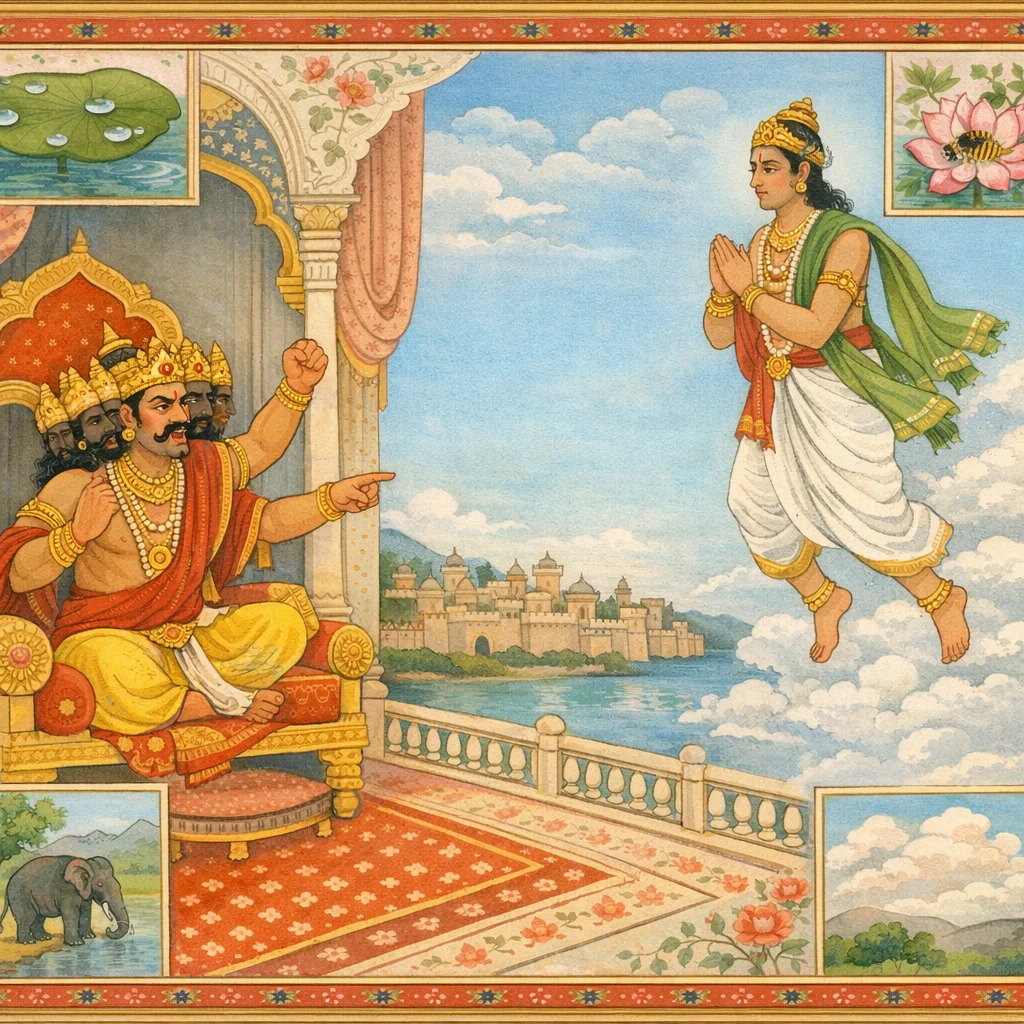
Sarga 16 depicts a rupture in the royal court as an episode on the ethics of counsel. Vibhīṣaṇa offers hit—wholesome, well-meant advice for Rāvaṇa’s welfare—but Rāvaṇa, described as kāla-codita (impelled by fate/death), answers with parūṣa-vākya, harsh speech. Rāvaṇa’s retort unfolds through didactic similes on the futility of friendship with an anārya (unworthy, unrighteous person): water on lotus leaves that will not cling, bees that show no gratitude after tasting sweetness, an elephant that soils itself after bathing, and autumn clouds that thunder yet do not moisten. He thus asserts moral barrenness where virtue is absent, and he threatens Vibhīṣaṇa, implying that another would have been punished at once. Vibhīṣaṇa, a nyāya-vādī (speaker of just reasoning), rises with a mace and four rākṣasas, ascends into the sky, and rebukes Rāvaṇa: an elder brother deserves honor, yet you have strayed from dharma. He states a core political-ethical maxim—pleasant speakers are many, but those who speak and those who hear unpleasant yet beneficial truth are rare. He warns that Rāvaṇa is bound by death’s noose and will be struck by Rāma’s fiery arrows; even the mighty fall when seized by kāla. Taking formal leave, he asks pardon for speaking as an elder’s well-wisher, urges Rāvaṇa to safeguard himself and Laṅkā, and departs. The narrator concludes that those nearing death do not accept the good counsel of friends.
Shlokas
Verse 1
सुनिविष्टंहितंवाक्यमुक्तवन्तंविभीषणम् ।अब्रवीत्परुषंवाक्यंरावणःकालचोदितः ।।।।
Though Vibhīṣaṇa had spoken words well-founded and beneficial, Rāvaṇa—driven by fate and nearing death—replied with harsh speech.
Verse 2
वसेत्सहसपत्नेनक्रुद्धेऽनाशीविषेणवा ।नतुमित्रप्रवादेनसंवसेच्छत्रुसेविना ।।।।
One may live even with a known rival, or with an angry venomous serpent; but one should not live alongside a person who claims friendship while serving one’s enemy.
Verse 3
जानामिशीलंज्ञातीनांसर्वलोकेषुराक्षस: ।हृष्यन्तिव्यसनेष्वेतेज्ञातीनाज्ञातयस्सदा ।।।।
O Rākṣasa, I know the way of kinsmen in every world: these relatives, again and again, take delight when their own kin fall into distress.
Verse 4
प्रथानंसाधनंवैद्यंधर्मशीलंचराक्षस: ।ज्ञातयोह्यवमन्यन्तेशूरंपरिभवन्तिच ।।।।
O Rākṣasa, even if a chief is a foremost support—capable, learned, and devoted to dharma—indeed even if he is heroic, his own relatives may still slight him and treat him with contempt.
Verse 5
नित्यमन्योन्यसम्हृष्टाव्यसनेष्वाततायिनः ।प्रच्छन्नहृदयाघोराज्ञातयस्तुभयावहाः ।।।।
Relatives can be dreadful: ever pretending mutual joy, they exult in another’s calamity—like aggressors, hiding their hearts and bringing fear.
Verse 6
श्रूयन्तेहस्तिभिर्गीताश्श्लोकाःपद्मवनेक्वचित् ।पाशहस्तान्नरान्द्रुष्टवाशृणुतान्गदतोमम ।।।।
It is said that once, in a lotus-grove, elephants sang ślokas when they saw men holding snares. Listen as I recount those verses.
Verse 7
नाग्निर्नान्यानिशस्त्राणिननःपाशाभयावहाः ।घोरास्स्वार्थप्रयुक्तास्तुज्ञातयोनोभयावहाः ।।।।
Neither fire, nor other weapons, nor nooses are truly frightful to us; rather, it is kinsmen driven by self-interest—terrible in their selfishness—who are fearsome.
Verse 8
उपायमेतेवक्ष्यन्तिग्रहणेनात्रसंशयः ।कृत्स्नाद्भयाद् ज्ञातिभयंसुकष्टंविदितंचन ।।।।
There is no doubt: they will teach the methods to seize us. Of all fears, fear arising from one’s own kinsmen is the hardest—this is well known to us.
Verse 9
विद्यतेगोषुसम्पन्नंविद्यतेब्राह्मणेदमः ।विद्यतेस्त्रीषुचापल्यंविद्यतेज्ञातितोभयम् ।।।।
Among cattle there is wealth; in a brāhmaṇa there is self-restraint; in women there is fickleness; and from one’s own kin there arises fear.
Verse 10
ततोनेष्टमिदंसौम्ययदहंलोकसत्कृतः ।ऐश्वर्यमभिजातश्चज्ञातीनांमूर्ध्न्यवस्थितः ।।।।
Therefore, gentle one, you cannot bear this: that I am honored by the world, possess sovereignty, am of noble birth, and stand at the head of our kin.
Verse 11
यथापुष्करपत्रेषुपतितास्तोयबिन्दवः ।नश्लेषमभिगच्छन्तितथाऽनार्येषुसङ्गतम् ।।।।
As water-drops fallen upon lotus leaves do not cling, so too association with the ignoble yields no true bonding or lasting friendship.
Verse 12
यथामधुकरस्तर्षाद्रसंविन्दन्नविद्यते ।तथात्वमपितत्रैवतथानार्येषुसौहृदम् ।।।।
As a bee, in its thirst, having obtained the sweet juice, shows no true regard thereafter, so too—he implies—there is no genuine friendship among the ignoble.
Verse 13
यथापूर्वंगजस्स्नात्वागृह्यहस्तेनवैरजः ।दूषयत्यात्मनोदेहंतथानार्येषुसङ्गतम् ।।।।
Just as an elephant, after bathing, takes up dust with its trunk and soils its own body, so too association with the ignoble defiles one’s own good state.
Verse 14
यथाशरदिमेघानांसिञ्चतामपिगर्जताम् ।नभवत्यम्बुसंक्लेदस्तथाऽनार्येषुसौहृदम् ।।।।
As autumn clouds, though they thunder and even pour rain, do not produce lasting dampness, so too among the ignoble there is no enduring warmth of friendship.
Verse 15
यथामधुकरस्तर्षात्काशपुष्पंपिबन्नपि ।रसमत्रनविन्देततथानार्वेषुसौहृदम् ।।।।
Just as a bee, though it drinks at the kāśa flower in its thirst, finds no true sweetness there, so too among the ignoble no real friendship is found.
Verse 16
अन्यस्त्वेवंविधंब्रूयाद्वाक्यमेतन्निशाचर: ।अस्मिन्मुहूर्तेनभवेत्त्वांतुधिक्कुलपांसन ।।।।
O night-ranger! If anyone else had spoken words of this kind, I would have ended his life this very moment. But as for you—shame on you, disgrace of the clan!
Verse 17
इत्युक्तःपरुषंवाक्यंन्यायवादीविभीषणः ।उत्पपातगदापाणिश्चतुर्भिस्सहराक्षसैः ।।।।
Thus addressed with harsh words, Vibhīṣaṇa—steadfast in justice—sprang up, mace in hand, accompanied by four rākṣasas.
Verse 17
इत्युक्तःपरुषंवाक्यंन्यायवादीविभीषणः ।उत्पपातगदापाणिश्चतुर्भिस्सहराक्षसैः ।।।।
Thus addressed with harsh words, Vibhīṣaṇa—steadfast in justice—sprang up, mace in hand, accompanied by four rākṣasas.
Verse 18
अब्रवीच्चतदावाक्यंजातक्रोधोविभीषणः ।अन्तरिक्षगत्शीमान्भ्रातरंराक्षसाधिपम् ।।।।
Then Vibhīṣaṇa, his wrath kindled, rose into the sky and spoke these words to his brother—the lord of the rākṣasas.
Verse 19
सत्वंभ्राताऽसिमेराजन्ब्रूहिमांयद्यदिच्छसि ।ज्येष्टोमान्यःपितृसमोनचधर्मपथेस्थितः ।।।।इदंतुपरुषंवाक्यंनक्षमाम्यग्रजस्यते ।
You are my brother, O King—say to me whatever you wish. As the elder, you are worthy of honor, like a father; yet you do not stand on the path of dharma. But this harsh speech of yours—I will not forgive, even coming from an elder brother.
Verse 20
सुनीतंहितकामेनवाक्यमुक्तंदशानन: ।नगृह्णन्त्यकृतात्मानःकालस्यवशमागताः ।।।।
O Daśānana! Those undisciplined in spirit, having come under the sway of Kāla (Time, death), do not accept the well-guided, beneficial words spoken by one who seeks their welfare.
Verse 21
सुलभाःपुरुषराजन् सततंप्रियवादिनः ।अप्रियस्यचपथ्यस्यवक्ताश्रोताचदुर्लभः ।।।।
O King, people who always speak pleasing words are easy to find; but one who speaks what is unpleasant yet wholesome—and one who can listen to it—are both rare.
Verse 22
बद्धंकालस्यपाशेनसर्वभूतापहारिणा ।ननश्यन्तमुपेक्षेत्वांप्रदीप्तंशरणंयथा ।।।।
Bound by the noose of Kāla, who carries off all beings, you are headed for ruin; one should not ignore you—like a blazing house one cannot disregard.
Verse 23
दीप्तपावकसङ्काशैश्शितैःकाञ्चनभूषणैः ।नत्वामिच्छाम्यहंद्रष्टुंरामेणनिहतंशरैः ।।।।
I do not wish to see you slain by Rāma’s sharp arrows—you who are adorned with gold and blaze like fire.
Verse 24
शूराश्चबलवन्तश्चकृतास्त्राश्चरणाजिरे ।कालाभिपन्नास्सीदन्तियथावालुकसेतव ।।।।
On the battlefield, even heroes—mighty and skilled in weapons—sink when seized by Time, like embankments made of sand.
Verse 25
तन्मर्षयतुयच्चोक्तंगुरुत्वाद्धितमिच्छता ।।।।अत्मानंसर्वथारक्षपुरींचेमांसराक्षसाम् ।स्वस्तितेऽस्तुगमिष्यामिसुखीभवमयाविना ।।।।
Forgive whatever I said: because you are my elder, I spoke seeking your welfare. Protect yourself in every way, and protect this city along with the rākṣasas. May well-being be yours; I shall depart—be happy without me.
Verse 26
तन्मर्षयतुयच्चोक्तंगुरुत्वाद्धितमिच्छता ।।6.16.25।।अत्मानंसर्वथारक्षपुरींचेमांसराक्षसाम् ।स्वस्तितेऽस्तुगमिष्यामिसुखीभवमयाविना ।।6.16.26।।
O Rākṣasa, even if a chief is a foremost support—capable, learned, and devoted to dharma—indeed even if he is heroic, his own relatives may still slight him and treat him with contempt.
Verse 27
निवार्यमाणस्यमयाहितैषिणानरोचतेतेवचनंनिशाचर: ।परीतकालाहिगतायुषोनराहितंनगृह्णन्तिसुहृद्भिरीरितम् ।।।।
O night-roamer, my words—spoken in goodwill to restrain you—do not please you. For when the final hour has come and one’s life is spent, people do not accept the wholesome counsel spoken by friends.
Frequently Asked Questions
The dilemma is whether a ruler will accept हित (beneficial but unwelcome counsel) from a well-wisher. Rāvaṇa rejects Vibhīṣaṇa’s advice, equating the counselor with an unworthy associate, and escalates to threat—turning a governance moment into a moral and political fracture.
Truth that benefits (pathya) is often unpleasant; therefore both the truthful advisor and the receptive listener are rare. The sarga also teaches that when kāla (death/time) dominates one’s judgment, even well-formed counsel is not grasped, accelerating self-destruction.
The immediate setting is the rākṣasa polity centered on Laṅkā (implied court context), while cultural-literary landmarks appear as didactic similes—lotus leaves, honeybees, elephants, and autumn clouds—used as classical Sanskrit imagery to encode political ethics.