Sarga 23
निमित्तदर्शनम् (Portents Before the March to Laṅkā)
युद्धकाण्ड
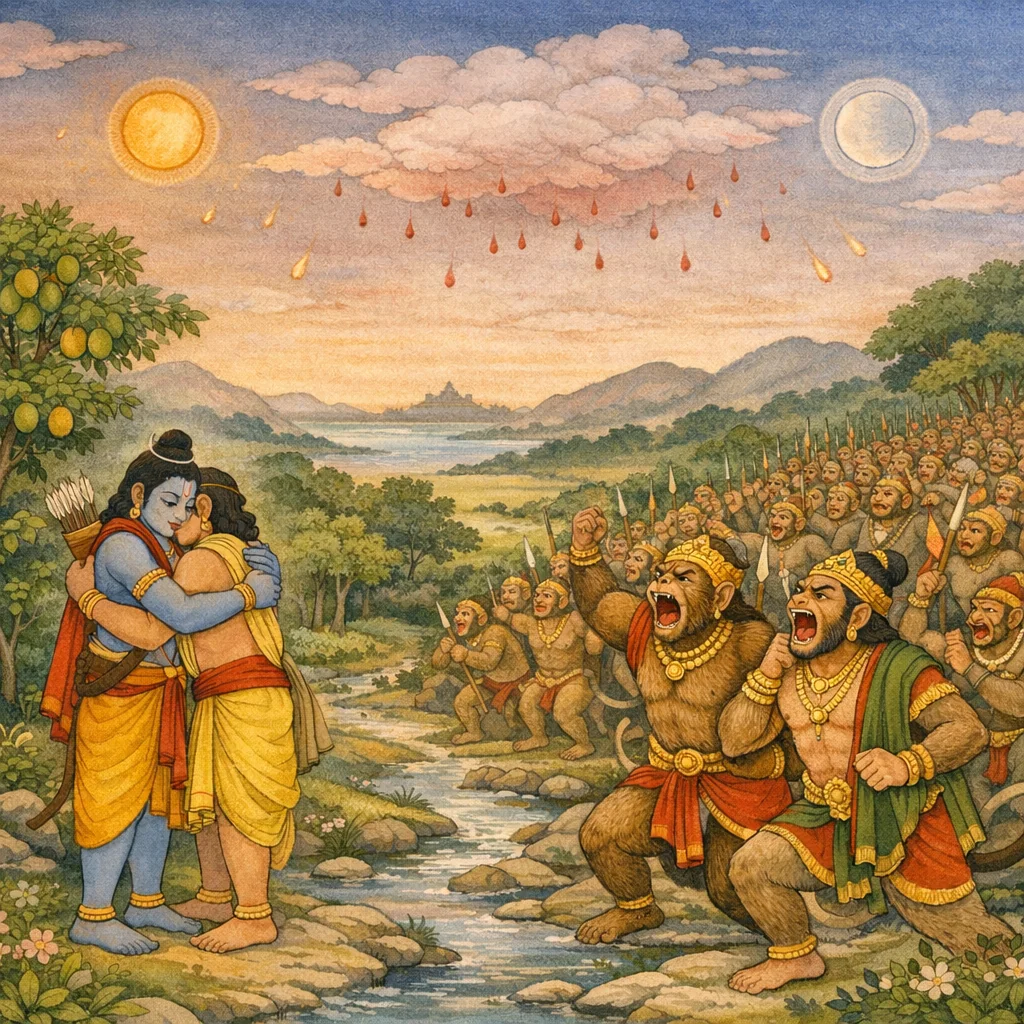
Sarga 23 unfolds as a discourse of command and omens. Śrī Rāma, portrayed as one who perceives nimittas, embraces Saumitri (Lakṣmaṇa) and issues clear instructions: prepare a secure forest halt with cool water and fruit, divide the battalions, and stand in vigilant battle formation (vyūha). He then interprets a cascade of dreadful signs—dust-laden winds, trembling earth and mountains, falling trees, flesh-hued clouds raining blood-like drops, a terrifying twilight, fiery masses seeming to fall from the sun, distressed animals crying toward the sun, and the sun and moon showing abnormal colors and halos. These portents are not to induce paralysis, but to forewarn of heavy casualties among bears, Vānara, and Rākṣasas, and of imminent, decisive violence. The chapter closes with immediate mobilization: the Vānara host turns toward Rāvaṇa’s city; Rāma advances at the front with bow in hand; Sugrīva and Vibhīṣaṇa proceed roaring; and the Vānara warriors perform exuberant acts to hearten Rāma, joining morale with dharmic resolve in war.
Shlokas
Verse 1
निमित्तानिनिमित्ताज्ञोदृष्टवालक्ष्मणपूर्वजः ।सौमित्रिंसम्परिष्वज्यइदंवचनमब्रवीत् ।।6.23.1।।
Rāma, Lakṣmaṇa’s elder brother, skilled in reading portents, having observed the signs, embraced Saumitrī and spoke these words.
Verse 2
निमित्तानिपरिगृह्योदकंशीतंवनानिफलवन्तिच ।बलौघंसंविभज्येमंव्यूह्यतिष्ठेमलक्ष्मण ।।6.23.2।।
“Lakṣmaṇa, taking note of these portents, arrange a position where there is cool water and fruit-bearing forests. Then divide this mass of troops, form them into battle-array, and let us stand ready.”
Verse 3
लोकक्षयकरंभीमंभयंपश्याम्युपस्थितम् ।निबर्हणंप्रवीराणामृक्षवानररक्षसाम् ।।6.23.3।।
“I foresee a dreadful fear approaching—one that brings ruin upon peoples—and the slaughter of mighty warriors among bears, vānaras, and rākṣasas.”
Verse 4
वाताश्चकलुषावान्तिकम्पतेचवसुन्धराः ।पर्वताग्राणिवेपन्तेपतन्तिचमहीरुहाः ।।6.23.4।।
“Dust-laden winds blow; even the earth trembles; mountain-peaks quiver, and great trees snap and fall.”
Verse 5
मेघाःक्रव्यादसङ्काशाःपरुषाःपरुषस्वनाः ।क्रूराःक्रूरंप्रवर्षन्तिमिश्रंशोणितबिन्दुभिः ।।6.23.5।।
Clouds, the color of raw flesh, roar with harsh and dreadful sounds, and pour down a terrifying rain mixed with drops like blood—an omen of impending ruin.
Verse 6
रक्तचन्दनसङ्काशासन्ध्यापरमदारुणा ।ज्वलतःप्रपतत्येतदादित्यादग्निमण्डलम् ।।6.23.6।।
The twilight, red like sandalwood paste, turns exceedingly dreadful; and from the blazing sun there seems to fall a circle-mass of fire—another fearful portent.
Verse 7
दीनादीनस्वराःक्रूरास्सर्वतोमृगपक्षिणः ।प्रत्यादित्यंविनर्धन्तिजनयन्तोमहाद्भयम् ।।6.23.7।।
All around, beasts and birds, cruel in aspect, utter wretched, wailing cries, roaring as if facing the sun, and they stir up great fear—a sign that danger is at hand.
Verse 8
रजन्यामप्रकाशस्तुसन्तापयतिचन्द्रमाः ।कृष्णरक्तांशुपर्यन्तोलोकक्षयइवोदितः ।।6.23.8।।
Even at night the moon is without radiance and brings distress; ringed with black and red rays, it rises like a luminary at the world’s dissolution—an omen of devastation.
Verse 9
ह्रस्वोरूक्षोऽप्रशस्तश्चपरिवेषस्सुलोहितः ।आदित्येविमलेनीलंलक्ष्मलक्ष्मणदृश्यते ।।6.23.9।।
O Lakṣmaṇa, on the bright, clear sun there appears a dark blemish, while its surrounding halo is intensely copper-red; the sun seems shrunken and dreary—an unprecedented and inauspicious sign.
Verse 10
रजसामहताचापिनक्षत्राणिहतानिच ।युगान्तमिवलोकानांपश्यशंसन्तीवलक्ष्मण ।।6.23.10।।
And see, Lakṣmaṇa: beneath this heavy haze the stars seem bereft of their light, as though proclaiming to the worlds the yugānta, the end-time of dissolution.
Verse 11
काकाश्श्येनास्तथानीचागृध्राःपरिपतन्तिच ।शिवाश्चाप्यशिवान्नादान्नदन्तिसुमहाभयान् ।।6.23.11।।
Crows, hawks, and even low-flying vultures are tumbling down; and jackals, too, cry out with inauspicious, terrifying calls.
Verse 12
शैलैश्शूलैश्चखढगैश्चविसृष्टैःकपिराक्षसैः ।भविष्यत्यावृताभूमिर्मांसशोणितकर्दमा ।।6.23.12।।
With mountains, tridents, and swords hurled by vānaras and rākṣasas, the earth will be covered over—turned into mire of flesh and blood.
Verse 13
क्षिप्रमद्यैवदुर्दर्षांपुरींरावणपालिताम् ।अभियामजनेनैवसर्वतोहरिभिर्ववृताः ।।6.23.13।।
Swiftly—this very day—we shall advance at speed upon that formidable city ruled by Rāvaṇa, as the vānaras spread out and surround it on every side.
Verse 14
इत्येवमुक्त्वाधर्मात्माधनवीसङ्ग्रामहर्षणः ।प्रतस्थेपुरतोरामोलङ्कामभिमुखोविभुः ।।6.23.14।।
Having spoken thus, righteous-souled Rāma—bow in hand, a source of dread in battle—set out at the front, turning his face toward Laṅkā, the mighty one leading the way.
Verse 15
सविभीषणसुग्रीवास्ततस्तेवानरर्षभाः ।प्रतस्थिरेविनर्दन्तोनिश्चिताद्विषतांवधे ।।6.23.15।।
Then those best of the vānaras—together with Vibhīṣaṇa and Sugrīva—set forth with roaring cries, firmly resolved to slay their foes.
Verse 16
राघवस्यप्रियार्थंतुसुतरांवीर्यशालिनाम् ।हरीणांकर्मचेष्टाभिस्तुतोषरघुपुङ्गवः ।।6.23.16।।
And those exceedingly valiant vānaras, wishing to please Rāghava, displayed spirited deeds and gestures; seeing them, the foremost of the Raghu line was delighted.
Frequently Asked Questions
The action is dharmic mobilization under ominous forecasts: despite signs suggesting mass casualties, Rāma chooses disciplined preparedness—resting and provisioning the army, dividing forces, and forming a vyūha—rather than either panic or reckless assault.
Foreknowledge of suffering does not negate duty; nimittas sharpen responsibility. The text models leadership that acknowledges fearsome outcomes, yet converts that awareness into orderly action, morale, and commitment to restoring moral order.
Laṅkā is the strategic destination, while the forest halt with cool water and fruits functions as an operational landmark. Culturally, the chapter foregrounds nimitta-tradition (reading cosmic and ecological anomalies) as part of classical war-time decision-making.