Sarga 66
कुम्भकर्णप्रस्थानम् तथा अङ्गदप्रेरणा (Kumbhakarna’s sortie and Angada’s rallying of the Vanaras)
युद्धकाण्ड
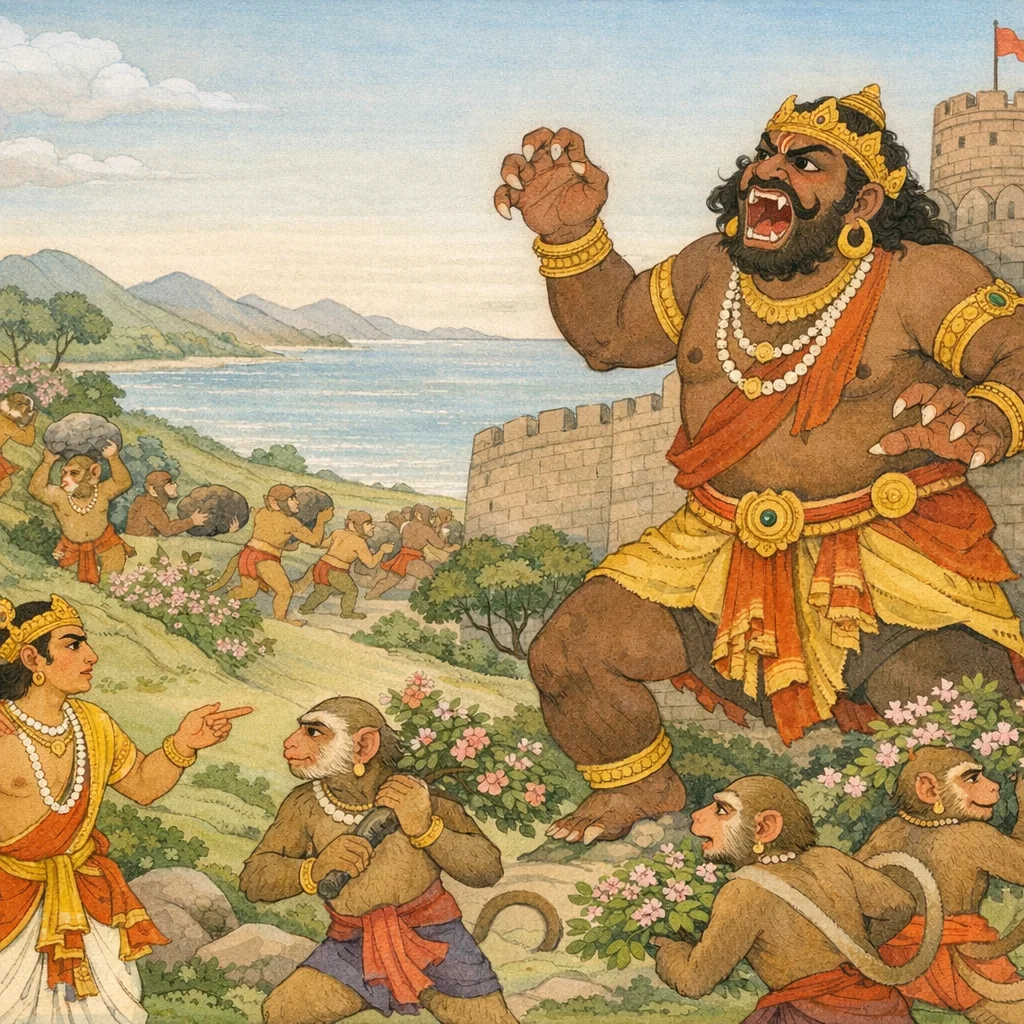
Sarga 66 portrays a collapse of morale and its recovery. Kumbhakarṇa, vast as a mountain peak, swiftly crosses Laṅkā’s boundary and roars until the ocean echoes, asserting terrifying psychological dominance. The Vānara host, deeming him “unassailable” even by great deities, breaks in panic: some flee without looking back, some tumble into the sea, others hide in caves, mountains, or trees, and some fall senseless as if dead. Aṅgada, Vāli’s son, then stands forth as a battlefield leader. He commands the troops to return, declaring that flight without weapons brings shame, while death in dharmic combat is higher—victory yields fame, and if slain one attains Brahmaloka. He also rebukes their earlier boasts now contradicted by fear. Though the routed Vānaras protest that Kumbhakarṇa has wrought dreadful havoc and that life is dear, Aṅgada—supported by Hanumān’s persuasive counsel and exempla—restores their unity. Re-formed, the commanders Ṛṣabha, Śarabha, Mainda, Dhūmra, Nīla, Kumuda, Suṣeṇa, Gavākṣa, Rambha, Tārā, Dvivida, Panasa, and Hanumān rush back to the रण, the field of battle. Rocks and blossoming trees hurled at Kumbhakarṇa shatter upon his limbs, underscoring his fearsome durability as the fight resumes.
Shlokas
Verse 1
स लङ्घयित्वाप्राकारंगिरिकूटोपमोमहान् ।निर्ययौनगरात्तूर्णंकुम्भकर्णोमहाबलः ।।।।
That mighty Kumbhakarṇa—huge like a mountain peak—leapt over the city rampart and swiftly marched out from the city.
Verse 2
ननाद च महानादंसमुद्रमभिनादयन् ।विजयन्निवनिर्घातन्विधमन्निवपर्वतान् ।।।।
He roared a mighty roar, making the ocean resound—like thunder proclaiming victory, like a force that shatters mountains.
Verse 3
तमवध्यंमघवतायमेनवरुणेनवा ।प्रेक्ष्यभीमाक्षमायान्तंवानराविप्रदुद्रुवुः ।।।।
Seeing him advance—terrible-eyed and deemed unkillable even by Indra, Yama, or Varuṇa—the Vānaras fled in panic.
Verse 4
तांस्तुविप्रद्रुतान् दृष्टवाराजपुत्रोऽङ्गदोऽब्रवीत् ।नलंनीलंगवाक्षं च कुमुदं च महाबलम् ।।।।
Seeing the Vānara troops fleeing in panic, the prince Aṅgada addressed Nala, Nīla, Gavākṣa, and the mighty Kumuda.
Verse 5
आत्मानमत्रविस्मृत्यवीर्याण्यभिजनानि च ।क्वगच्छतभयत्रस्ताःप्राकृताहरयोयथा ।।।।
Have you forgotten yourselves here—your valour and your noble lineage? Where are you running in fear, like mere ordinary monkeys?
Verse 6
साधुसौम्या निवर्तध्वंकिप्राणान्परिरक्षथ ।नालंयुद्धायवैरक्षोमहतीयंबिभीषका ।।।।
Good sirs, calm yourselves—turn back. Why cling so anxiously to life? This Rākṣasa is not truly fit to face battle; he is only a great terror to behold.
Verse 7
महतीमुथतितामेनांराक्षसानांबिभीषिकाम् ।विक्रमाद्विधमिष्यामोनिवर्तध्वंप्लवङ्गमाः ।।।।
O Plavaṅgamas, fall back! By our valour we shall shatter this towering terror raised by the Rākṣasas; withdraw, O monkey-warriors.
Verse 8
कृच्छ्रेणतुसमाश्वस्यसङ्गम्य च ततस्ततः ।वृक्षाद्रिहस्ताहरयस्सम्प्रतस्थूरणाजिरम् ।।।।
With effort they regained their composure and gathered again from various places; with trees and rocks in their hands, the Vānara warriors set out for the battlefield.
Verse 9
तेनिवृत्यतुसङ्कृद्धाःकुम्भकर्णंवनौकसः ।निर्जघ्नुःपरमक्रुद्धास्समदाइवकुञ्जराः ।।।।
Turning back in wrath, those forest-dwellers struck at Kumbhakarṇa—furious and forceful like rutting elephants.
Verse 10
प्रांशुभिर्गिरिशृङ्गैश्चशिलाभिश्चमहाबलः ।पादपैःपुष्पिताग्रैश्चहन्यमानो न कम्पते ।।।।
Though struck with lofty mountain-peaks, rocks, and trees whose tops were in bloom, the mighty one did not tremble.
Verse 11
तस्यगात्रेषुपतिताभिद्यन्तेशतशश्शिलाः ।पादपाःपुष्पिताग्राश्चभग्नाःपेतुर्महीतले ।।।।
As they fell upon his limbs, hundreds of rocks shattered; and flowering-topped trees too broke apart and crashed down upon the earth.
Verse 12
सोऽपिसैन्यानिसङ्क्रुद्धोवानराणांमहौजसाम् ।ममन्थपरमायत्तोवनान्यग्निरिवोत्थितः ।।।।
He too, enraged, crushed the armies of the mighty vānara warriors—like a blazing fire risen up to consume forests.
Verse 13
लोहितार्द्रास्तुबहवश्शेरतेवानरर्षभाः ।निरस्तांपतिताभूमौताम्रपुष्पाइवद्रुमाः ।।।।
Many bull-like vānara champions lay there, drenched in blood—flung down upon the ground like trees with copper-red blossoms felled and cast down.
Verse 14
लङ्घयन्तःप्रधावन्तोवानरानावलोकयन् ।केचित्समुद्रेपतिताःकेचिद्गगनमास्थिताः ।।।।
Leaping and running, the vānara troops did not even look back; some fell into the ocean, and some sprang up into the sky.
Verse 15
वध्यमानास्तुतेवीराराक्षसेन च लीलया ।सागरंयेनतेतीर्णाःपथातेनदुद्रुवुः ।।।।
Though they were heroes, struck down almost playfully by that rākṣasa, they fled along the very route by which they had crossed the ocean.
Verse 16
तेस्थलानितदानिम्नंविवर्णमानाभयात् ।ऋक्षावृक्षान् समारूढाःकेचित्पर्वतमाश्रिताः ।।।।
Then, pale-faced with fear, they rushed to low-lying ground; some bears climbed up into trees, and some sought refuge in the mountains.
Verse 17
ममज्जुरर्णवेकेचिद्गुहाःकेचित्समाश्रिताः ।निपेतुःकेचिदपरेकेचिन्नैवावतस्थिरे ।।।।केचिद्भूमौनिपतिताःकेचित्सुप्तामृताइव ।
Some sank and drowned in the sea; some took refuge in caves. Some others collapsed helplessly, some could not even hold their ground; some fell upon the earth, and some lay as though dead in sleep.
Verse 18
तान्समीक्ष्याङ्गदोभग्नान्वानरानिदमब्रवीत् ।।।।अवतिष्ठतयुध्यामोनिवर्तध्वंप्लवङ्गमाः ।
Seeing the Vānaras broken and in flight, Aṅgada said: “Stand fast—turn back, O monkeys; let us fight.”
Verse 19
भग्नानांवो न पश्यामिपरिगम्यमहीमिमाम् ।।।।स्थानंसर्वेनिवर्तध्वंकिंप्राणान् परिरक्षथ ।
For those who flee in defeat, I see no safe refuge—even if you roam the whole earth. Turn back, all of you: why cling to life at the cost of honour and duty?
Verse 20
निरायुधानांद्रवतामसङ्गगतिपौरुषाः ।।।।दाराह्युपहसिष्यन्ति स वैघातस्तुजीवताम् ।
O warriors of irresistible valour—if you flee unarmed, your own wives will mock you. For one who lives after such disgrace, that blow is worse than death.
Verse 21
कुलेषुजातास्सर्वेस्मविस्तीर्णेषुमहत्सु च ।।।।क्वगच्छतभयत्रस्ताःहरयःप्राकृतायथा ।अनार्याःखलुयद्भीतास्त्यक्त्वावीर्यंप्रधावत ।।।।
All of you are born in great and far-spread clans—why then do you run in fear like common monkeys? To flee terrified, casting away your valour, is truly unworthy of the noble.
Verse 22
कुलेषुजातास्सर्वेस्मविस्तीर्णेषुमहत्सु च ।।6.66.21।।क्वगच्छतभयत्रस्ताःहरयःप्राकृतायथा ।अनार्याःखलुयद्भीतास्त्यक्त्वावीर्यंप्रधावत ।।6.66.22।।
(Repetition of the rebuke) All of you are born in great and far-spread clans—why do you flee in fear like common monkeys? To run away terrified, casting aside your valour, is truly unworthy of the noble.
Verse 23
विकत्थनानिवोयानि तदावैजनसंसदि ।तानिवःक्वनुयातानिसोदग्राणिम हितानि च ।।।।
Those boasts of yours—spoken earlier in the public assembly, bold and loudly celebrated—where have they gone now?
Verse 24
भीरुप्रवादाश्श्रूयन्तेयस्तुजीवतिधिक्कृतः ।मार्गस्सत्पुरुषैर्जष्टःसेव्यतांत्यज्यतांभयम् ।।।।
Men speak the reproach of cowardice of one who lives on after disgrace. Walk the path cherished by the righteous; serve it—cast away fear.
Verse 25
शयामहेऽनिहताःपृथिव्यामल्पजीविताः ।दुष्प्रापंब्रह्मलोकंवाप्राप्नुयामोयुधिसूदिता ।।।।
Even if our allotted life is short and we fall slain upon the earth, killed in battle, by such a warrior’s death we may attain Brahmaloka—the hard-to-reach realm.
Verse 26
सम्प्राप्नुयामःकीर्तिंवानिहत्वाशत्रुमाहवे ।जीवितंवीरलोकस्यमोक्ष्यामोवसुवानराः ।।।।
If we slay the enemy in battle, we shall win fame; and if we lay down our lives, we shall be released to the heroes’ world—O Vānara warriors.
Verse 27
न कुम्भकर्णःकाकुत्स्थंदृष्टवाजीवन् गमिष्यति ।दीप्यमानमिवासाद्यपतङ्गोज्वलनंयथा ।।।।
Kumbhakarṇa will not depart alive once he has faced the Kakutstha—just as a moth, reaching a blazing fire, cannot escape.
Verse 28
लायनेनचोद्धिष्टाःप्राणान् रक्षामहेवयम् ।एकेनबहवोभग्नायशोनाशंगमिष्यति ।।।।
Though we are famed and chosen warriors, if we save our lives by fleeing—even if many are shattered by a single foe—our honor will be ruined.
Verse 29
एवंब्रुवाणंतंशूरमङ्गदंकनकाङ्गदम् ।द्रवमाणास्ततोवाक्यमूचुःशूरुविगर्हितम् ।।।।
As the hero Aṅgada, wearing golden armlets, spoke thus, the Vānaras who were fleeing answered him with words that a true hero would condemn.
Verse 30
कृतंनःकदनंघोरंकुम्भकर्णेनरक्षसा ।न स्थानकालोगच्छामोदयितंजीवितंहिनः ।।।।
Kumbhakarṇa the Rākṣasa has wrought dreadful slaughter upon us. This is no time to stand—let us go, for life is dear to us.
Verse 31
एतावदुक्त्वावचनंसर्वेतेभेजिरेदिशः ।भीमंभीमाक्षमायान्तंदृष्टवावानरयूथपाः ।।।।
Having said only that, all those Vānara chiefs scattered in every direction, on seeing the dreadful, terrible-eyed one advancing.
Verse 32
द्रवमाणस्तुतेवीराअङ्गदेनवलीमुखाः ।सान्त्वैश्चैहनुमानैश्चततस्सर्वेनिवर्तिताः ।।।।
Though those heroes were fleeing, Aṅgada—along with Hanūmān—turned the Vānara warriors back by reassurance and by reasoned examples, bringing them all to return.
Verse 33
प्रहर्षमुपनीताश्चवालिपुत्रेणधीमता ।आज्ञाप्रतीक्षास्तस्थुश्चसर्वेवानरयूथपाः ।।।।
Brought back to confidence by the wise son of Vāli, all the Vānara commanders stood ready, awaiting orders.
Verse 34
ऋषभशरभमैन्दधूम्रनीलाःकुमुदसुषेणगवाक्षरम्भताराः ।द्विविदपनसवायुपुत्रमुख्यास्त्वरिततराभिमुखंरणं ।।।।
Ṛṣabha, Śarabha, Mainda, Dhūmra, Nīla; Kumuda, Suṣeṇa, Gavākṣa, Rambha, and Tārā—led chiefly by Dvivida, Panasa, and the Son of the Wind—advanced swiftly toward the battlefield.
Frequently Asked Questions
The dilemma is battlefield flight versus steadfast duty: the Vānara troops abandon formation under fear of Kumbhakarṇa, and Aṅgada confronts the dharmic cost of retreat—loss of honor, social ridicule, and betrayal of collective responsibility.
Aṅgada teaches that courage is a moral discipline: preserve dignity by returning to rightful action, accept death in dharma-yuddha as meaningful (fame or higher attainment), and treat fear as a condition to be mastered through reasoned exhortation and communal resolve.
Laṅkā’s प्राकार (defensive boundary) and the समुद्र/सागर (ocean crossed by the Vānara host) frame the episode, while caves, mountains, and trees function as flight-shelters that map the troops’ dispersal and subsequent reassembly.