Sarga 43
द्वन्द्वयुद्धप्रवृत्तिः (Dvandva-Yuddha: The Onset of Single Combats)
युद्धकाण्ड
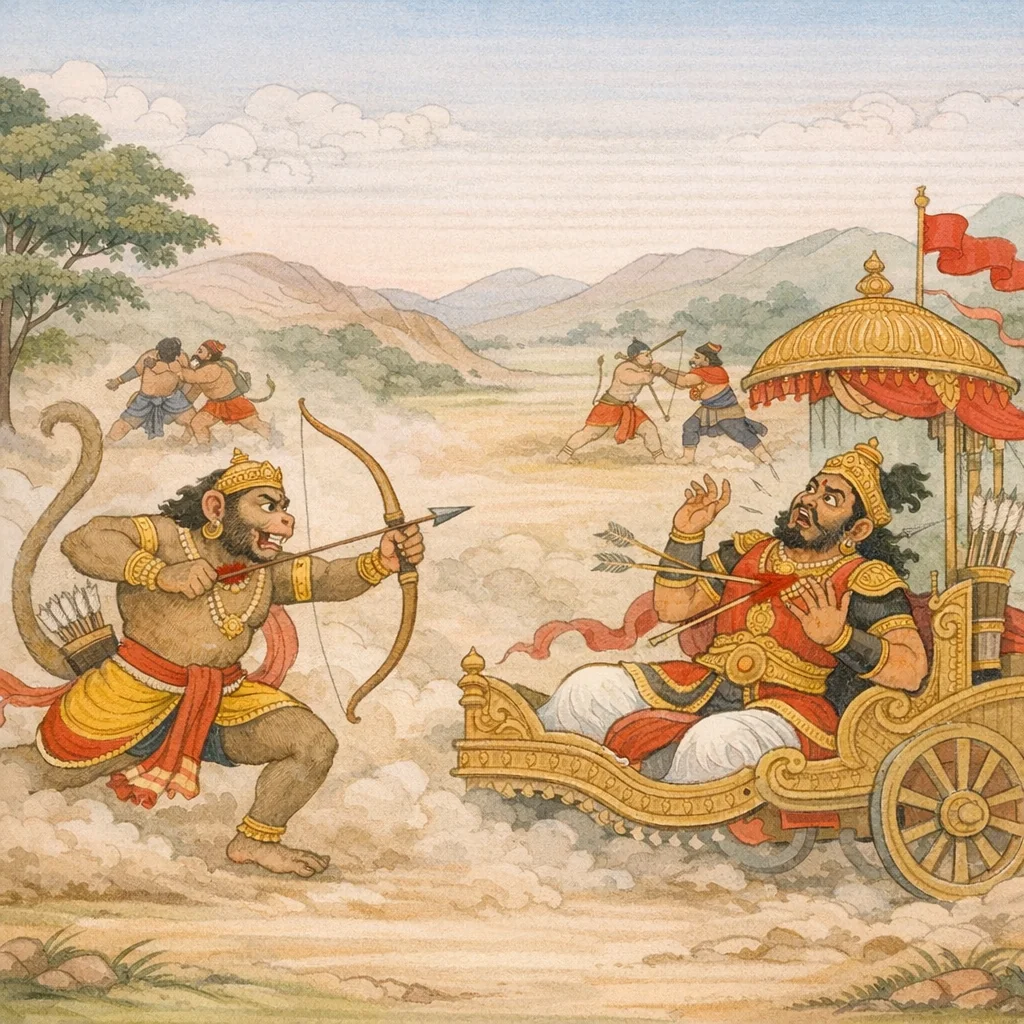
In Sarga 43, the battlefield of Laṅkā grows fiercer and takes on the form of ordered single combats (dvandva-yuddha), as vānaras and rākṣasas pair off one after another. Enraged beyond bearing at the vānaras’ advance, Rāvaṇa’s victory-seeking forces surge forth with a roar, while chariots, horses, and war-gear resound in every direction. Named duels unfold: Sugrīva meets Praghasa/Praghana, and Lakṣmaṇa confronts Virūpākṣa. Rāma is assailed by Agniketu, Raśmiket(u), Suptaghna/Mitraghna, and Yajñakopa, and He answers by severing their heads with blazing, razor-sharp arrows. Hanumān is pierced in the chest by Jambumālī’s ratha-śakti, yet he counters decisively—mounting the chariot and killing him with a single palm-strike. Nala duels Pratapana and gouges out his eyes; Mainda fells Vajramuṣṭi with a fist; and Dwivida, though wounded by lightning-like arrows, kills Aśaniprabha with a sāla tree. Nīla withstands Nikumbha’s arrow-storm and then kills him and the charioteer with a chariot wheel, while Suṣeṇa crushes Vidyunmālī with a great rock after enduring a mace blow. The sarga closes on a grim topography of war—broken weapons, shattered chariots, dead elephants and horses, severed bodies, blood-streams, and jackals—casting the conflict as deva-asura-like in scale and moral intensity.
Shlokas
Verse 1
युध्यतांतुततस्तेषांवानराणांमहात्मनाम् ।रक्षसांसम्बभूवाथबलकोपस्सुदारुणः ।।6.43.1।।
As those great-souled Vānaras fought on, there arose among the Rākṣasas a most dreadful surge of wrath and martial fury.
Verse 2
तेहयैःकाञ्चनापीडैर्ध्वश्चाग्निशिखोपमैः ।रथैश्चादित्यसङ्काशैःकवचैश्चमनोरमैः ।।6.43.2।।निर्ययूराक्षसव्याघ्रानादयन्तोदिशोदश ।राक्षसाभीमकर्माणोरावणस्यजयैषिणः ।।6.43.3।।
Seeking victory for Rāvaṇa, tiger-like rākṣasas of dreadful deeds sallied forth—mounted on horses with golden trappings, bearing banners like tongues of fire, with chariots shining like the sun and splendid armor—roaring so that the ten directions resounded.
Verse 3
तेहयैःकाञ्चनापीडैर्ध्वश्चाग्निशिखोपमैः ।रथैश्चादित्यसङ्काशैःकवचैश्चमनोरमैः ।।6.43.2।।निर्ययूराक्षसव्याघ्रानादयन्तोदिशोदश ।राक्षसाभीमकर्माणोरावणस्यजयैषिणः ।।6.43.3।।
Those tiger-like rākṣasas—doers of dreadful deeds—marched out seeking victory for Rāvaṇa, their horses adorned with golden trappings, their banners like tongues of fire, their chariots radiant as the sun, and their armor splendid; and as they advanced, they made all ten directions resound.
Verse 4
वानराणामपिचमूर्बृहतीजयमिच्छताम् ।अभ्यधावततांसेनांरक्षसांकामरूपिणम् ।।6.43.4।।
Eager for victory, even the mighty and vast army of the Vānaras surged forward, charging the host of the Rākṣasas—beings able to assume forms at will.
Verse 5
एतस्मिन्नन्तरेतेषामन्योन्यमभिधावताम् ।रक्षसांवानराणांचद्वन्द्वयुद्धमवर्तत ।।6.43.5।।
Meanwhile, as they rushed at one another, the Rākṣasas and the Vānaras fell into one-on-one duels across the field.
Verse 6
अङ्गदेन्द्रजित्सार्धंवालिपुत्रेणराक्षसः ।आयुध्यतमहातेजास्त्ऱ्यम्बकेणयथाऽन्तकः ।।6.43.6।।
Then Indrajit, that radiant Rākṣasa, fought with Aṅgada, Vāli’s son—like Antaka (Death) contending with Tryambaka (Śiva).
Verse 7
प्रजङ्घेनचसम्पातिर्नित्यंदुर्मर्षणोरणे ।जम्बुमालिनमारब्धोहनुमानपिवानरः ।।6.43.7।।
Sampāti—ever hard to withstand in battle—met Prajaṅgha; and Hanumān, the Vānara hero, likewise began his combat with Jambumālī.
Verse 8
संगतस्तुमहाक्रोधोराक्षसोरावणानुजः ।समरेतीक्ष्णवेगेनमित्रघ्नेनविभीषणः ।।6.43.8।।
Then Vibhīṣaṇa—Rāvaṇa’s brother, a rākṣasa blazing with fury—closed in upon Mitraghna in battle and fought him with swift force.
Verse 9
तपनेनगजस्सार्धंराक्षसेनमहाबलः ।निकुम्भेनमहातेजानीलोऽपिसमयुध्यत ।।6.43.9।।
Gaja, a warrior of great strength, fought the rākṣasa Tapana; and Nīla too, radiant in prowess, battled Nikumbha.
Verse 10
वानरेन्द्रस्तुसुग्रीवःप्रघसेनसमागतः ।सङ्गतःसमरेश्रीमान्विरूपाक्षेणलक्ष्मणः ।।6.43.10।।
Sugrīva, lord of the Vānaras, engaged Praghāsa; and in that battle the illustrious Lakṣmaṇa met Virūpākṣa in combat.
Verse 11
अग्निकेतुश्चसुदुर्धर्षोरश्मिकेतुश्चराक्षसः ।सुप्तघ्नोयज्ञकोपश्चरामेणसहसङ्गताः ।।6.43.11।।
Agniketu—hard to overcome—along with the rākṣasa Raśmiketu, and also Suptaghna and Yajñakopa, all closed in to fight with Rāma.
Verse 12
वज्रमुष्टिस्तुमैन्देनद्विविदेनाशनिप्रभः ।राक्षसाभ्यांसुघोराभ्यांकपिमुख्यौसमागतौ ।।6.43.12।।
Vajramuṣṭi, together with Mainda, and Aśaniprabha, together with Dvivida—those chiefs among the monkeys—closed in to fight the two exceedingly fearsome rākṣasas.
Verse 13
वीरःप्रतपनोघोरोराक्षसोरणदुर्धरः ।समरेतीक्ष्णवेगेननळेनसमयुध्यत ।।6.43.13।।
Pratapana—the heroic, dreadful rākṣasa, hard to withstand in war—fought in battle with Nala, who charged with piercing speed.
Verse 14
धर्मस्यपुत्रोबलवान्सुषेणइतिविश्रुतः ।सविद्युन्मालिनासार्धमयुध्यतमहाकपिः ।।6.43.14।।वानराश्चापरेभीमाराक्षसैरपरैस्सह ।द्वन्द्वंसमीयुस्सहसायुद्धायबहुभिस्सह ।।6.43.15।।
Suṣeṇa—mighty and famed as “the son of Dharma”—that great vānarā fought in close combat together with Vidyunmālin.
Verse 15
धर्मस्यपुत्रोबलवान्सुषेणइतिविश्रुतः ।सविद्युन्मालिनासार्धमयुध्यतमहाकपिः ।।6.43.14।।वानराश्चापरेभीमाराक्षसैरपरैस्सह ।द्वन्द्वंसमीयुस्सहसायुद्धायबहुभिस्सह ।।6.43.15।।
And other fearsome vānaras as well, with many companions, suddenly rushed into duel-combat against other rākṣasas, each pair seeking battle face to face.
Verse 16
तत्रासीत्सुमहद्युद्धंतुमुलंरोमहर्षणम् ।रक्षसांवानराणांचवीराणांजयमिच्छताम् ।।6.43.16।।
There arose a vast, tumultuous, hair-raising battle between the heroic rākṣasas and vānaras, all longing for victory.
Verse 17
हरिराक्षसदेहेभ्यःप्रभूताःकेशशाद्वलाः ।शरीरसङ्घाटावहाःप्रसुस्रुश्शोणितापगाः ।।6.43.17।।
From the bodies of vānaras and rākṣasas, torrents of blood streamed forth, bearing heaps of corpses like floating logs and thick with hair like matted weeds.
Verse 18
अजघानेन्द्रजित्क्रुद्धोवज्रेणेवशतक्रतुः ।अङ्गदंगदयावीरंशत्रुसैन्यविदारणम् ।।6.43.18।।
Enraged, Indrajit struck the heroic Aṅgada with a mace—Aṅgada, the cleaver of hostile armies—just as Śatakratu (Indra) would strike with his thunderbolt.
Verse 19
तस्यकाञ्चनचित्राङ्गंरथंसाश्वंससारथिम् ।जघानसमरेश्रीमानङ्गदोवेगवान्कपिः ।।6.43.19।।
In the fray, swift and splendid Aṅgada struck down the golden, richly adorned chariot—together with its horses and charioteer.
Verse 20
सम्पातिस्तुत्रिभिर्भाणैःप्रजङ्घेनसमाहतः ।निजघानश्वकर्णेनप्रजङ्घंरणमूर्धनि ।।6.43.20।।
Sampāti, wounded by Prajaṅgha with three arrows, struck down Prajaṅgha in the thick of battle with an aśvakarṇa tree.
Verse 21
जम्बुमालीरथस्थस्तुरथशक्त्यामहाबलः ।बिबेदसमरेक्रुद्धोहनूमन्तंस्तनान्तरे ।।6.43.21।।
Jambumālī, mighty and standing upon his chariot, enraged in battle, pierced Hanūmān in the chest with a javelin.
Verse 22
तस्यतंरथमास्थायहनूमान् मारुतात्मजः ।प्रममाथतलेनाशुसहतेनैवरक्षसा ।।6.43.22।।
Hanūmān, son of the Wind-god, sprang onto his chariot and with a swift blow of his palm crushed both the chariot and that very rākṣasa.
Verse 23
नदन् प्रतपनोघोरोनलंसोप्यन्वधावत ।नलःप्रतपनस्याशुपातयामासचक्षुषी ।।6.43.23।।
Roaring, the dreadful Pratapana rushed at Nala; but Nala swiftly struck him, making his eyes fall and blinding him.
Verse 24
भिन्नगात्रश्शरैस्तीक्ष्णैःक्षिप्रहस्तेनरक्षसा ।ग्रसन्तमिवसैन्यानिप्रघसंवानराधिपः ।।6.43.24।।सुग्रीवस्सप्तपर्णेननिर्भिभेदजघानच ।
As the swift-handed rākṣasa Praghasa, his limbs rent by sharp arrows, seemed as though he would devour the armies, Sugrīva—the lord of the Vānara hosts—split him open and slew him with a saptaparṇa tree.
Verse 25
अग्निकेतुश्चदुर्धर्षोरश्मिकेतुश्चराक्षसः ।।6.43.25।।सुप्तघ्नोयज्ञकोपश्चरामंनिर्भिभिदुश्शरैः ।
Agniketu, hard to assail, and the rākṣasa Raśmiketu, along with Suptaghna and Yajñakopa, struck Rāma repeatedly with their arrows.
Verse 26
तेषांचतुर्णांरामस्तुशिरांसिनिशितैश्शरैः ।क्रुद्धश्चतुर्भिश्चिच्छेदघोरैरग्निशिखोपमैः ।।6.43.26।।
Then Rāma, enraged, severed the heads of those four with four sharp and dreadful arrows, blazing like tongues of fire.
Verse 27
वज्रमुष्टिस्तुमैन्देनमुष्टिनानिहतोरणे ।पपातसरथस्साश्वःपुराट्टइवभूतले ।।6.43.27।।
Vajramuṣṭi, struck down in battle by Mainda’s fist, fell to the ground—along with chariot and horses—like a shattered rampart.
Verse 28
निकुम्बस्तुरणेनीलंनीलाञ्जनचयप्रभम् ।निर्बिभेदशरैस्तीक्ष्णैःकरैर्मेघमिवांशुमान् ।।6.43.28।।
In the battle, Nikumbha pierced Nīla—dark as a heap of collyrium—with sharp arrows, as the sun’s rays pierce through a cloud.
Verse 29
पुनश्शरशतेनाथक्षिप्रहस्तोनिशाचरः ।बिभेदसमरेनीलंनिकुम्भःप्रजहासच ।।6.43.29।।
Once more, the swift-handed night-ranger Nikumbha struck Nīla in battle with a hundred arrows—and laughed aloud.
Verse 30
तस्यैवरथचक्रेणनीलोविष्णुरिवाहवे ।शिरश्चिच्छेदसमरेनिकुम्भस्यचसारथेः ।।6.43.30।।
In the thick of battle, Nīla—like Viṣṇu in war—severed the head of Nikumbha’s charioteer using the very wheel of his chariot.
Verse 31
वज्राशनिसमस्पर्शोद्विविदोऽप्यशनिप्रभम् ।जघानगिरिशृङ्गेणमिषतांसर्वरक्षसाम् ।।6.43.31।।
Dvividha, whose body felt like a thunderbolt, struck down Aśaniprabha with a mountain-peak, while all the Rākṣasas looked on.
Verse 32
द्विदिधंवानरेन्द्रंतुनगयोधिनमाहवे ।शरैरशनिसङ्काशैस्सविव्याधाशनिप्रभः ।।6.43.32।।
But in that battle, Aśaniprabha pierced Dvividha—the lord of Vānaras, fighting with mountains and trees—with arrows that flashed like lightning.
Verse 33
सशरैरभिविद्धाङ्गोद्विविदःक्रोधमूर्छितः ।सालेनसरथंसाश्वंनिजघानाशनिप्रभम् ।।6.43.33।।
Dvividha, his limbs pierced by arrows and maddened with wrath, struck down Aśaniprabha with a śāla tree—along with his chariot, horses, and charioteer.
Verse 34
विद्युन्मालीरथस्थस्तुशरैःकाञ्चनभूषणैः ।सुषेणंताडयामासननादचमुहुर्मुहुः ।।6.43.34।।
Vidyunmālī, stationed on his chariot, battered Suṣeṇa with arrows adorned in gold, and again and again he roared aloud.
Verse 35
तंरथस्थमथोदृष्टवासुषेणोवानरोत्तमः ।गिरिशृङ्गेणमहतारथमाशुन्यपातयत् ।।6.43.35।।
Seeing him on the chariot, Suṣeṇa—the best of the Vānaras—swiftly brought that chariot down with a massive mountain-peak.
Verse 36
लाघवेनतुसंयुक्तोविद्युन्मालीनिशाचरः ।अपक्रम्यरथात्तूर्णंगदापाणिःक्षितौस्थितः ।।6.43.36।।
Endowed with agility, the night-roaming Vidyunmālī quickly withdrew from his chariot and stood upon the ground, mace in hand.
Verse 37
ततःक्रोधसमाविष्टःसुषेणोहरिपुङ्गवः ।शिलांसुमहतींगृह्यनिशाचरमभिद्रवत् ।।6.43.37।।
Then Suṣeṇa, the foremost of monkeys, seized a very large rock—angered to the core—and charged at the night-roamer.
Verse 38
तमापतन्तंगदयाविद्युन्मालीनिशाचरः ।वक्षस्यभिजघानाशुसुषेणंहरिपुङ्गवः ।।6.43.38।।
As Suṣeṇa charged in, Vidyunmālī, the night-roaming Rākṣasa, swiftly struck that foremost of Vānaras on the chest with his mace.
Verse 39
गदाप्रहारंतंघोरमच्नित्यप्लवगोत्तमः ।तांशिलांपातयामासतस्योरसिमहामृधे ।।6.43.39।।
In that great melee, the best of the Vānaras, disregarding the dreadful mace-blow, made the rock crash down upon Vidyunmālī’s chest.
Verse 40
शिलाप्रहारभिहतोविद्युन्मालीनिशाचरः ।निष्पिष्टहृदयोभूमौगतासुर्निपपातह ।।6.43.40।।
Struck by a blow of rock, Vidyunmālī, the night-roaming Rākṣasa, fell upon the ground—his heart crushed, his life departed.
Verse 41
एवंतैर्वानरैश्शूरैश्शूरास्तेरजनीचराः ।द्वन्द्वेविमृदितास्तत्रदैत्याइवदिवौकसैः ।।6.43.41।।
Thus, in single combats, those heroic Vānaras crushed the heroic night-roaming Rākṣasas there—like Dānavas struck down by the gods.
Verse 42
भग्नैखडगैर्गदाभिश्चशक्तितोमरपट्टसै: ।अपविद्धैश्चाभिन्नैश्चरथैस्साङ्ग्रामिकैर्हयैः ।।6.43.42।।निहतैःकुञ्जरैर्मत्स्सैस्तथावानरराक्षसैः ।चक्राक्षयुगदण्डैश्चभग्नैर्धरणिसंश्रितैः ।।6.43.43।।बभूवायोधनंघोरंगोमायुगणसेवितम् ।
The battlefield grew dreadful—strewn with broken swords and maces, spears, javelins, and axes; with shattered and overturned chariots and war-horses; with heaps of fallen elephants, and of Vānaras and Rākṣasas; and with broken wheels, axles, and yokes scattered upon the earth—so that packs of jackals came to haunt it.
Verse 43
भग्नैखडगैर्गदाभिश्चशक्तितोमरपट्टसै: ।अपविद्धैश्चाभिन्नैश्चरथैस्साङ्ग्रामिकैर्हयैः ।।6.43.42।।निहतैःकुञ्जरैर्मत्स्सैस्तथावानरराक्षसैः ।चक्राक्षयुगदण्डैश्चभग्नैर्धरणिसंश्रितैः ।।6.43.43।।बभूवायोधनंघोरंगोमायुगणसेवितम् ।
The battlefield grew dreadful—strewn with broken swords and maces, spears, javelins, and axes; with shattered and overturned chariots and war-horses; with heaps of fallen elephants, and of Vānaras and Rākṣasas; and with broken wheels, axles, and yokes scattered upon the earth—so that packs of jackals came to haunt it.
Verse 44
कबन्धानिसमुत्पेतुर्दिक्षुवानररक्षसाम् ।।6.43.44।।विमर्देतुमुलेतस्मिन्देवासुररणोपमे ।
In that tumultuous crush—like the war of Devas and Asuras—severed trunks of Vānaras and Rākṣasas sprang up and lay scattered in every direction.
Verse 45
विदार्यमाणाहरिपुङ्गवैस्तदानिशाचराश्शोणितदिग्धगात्राः ।पुनःसुयुद्धंतरसासमास्थितादिवाकरस्यास्तमयाभिकाङ्क्षिणः ।।6.43.45।।
Then the night-roaming rākṣasas, torn by the leaders of the Vānaras and smeared all over with blood, yearned for the sun’s setting; yet, gathering their strength again, they rushed back into the fierce battle.
Frequently Asked Questions
The sarga formalizes violence into dvandva-yuddha (paired single combats), implying an epic norm of ordered engagement amid chaos. The pivotal actions include counterblows after injury (e.g., Hanumān responding to a chest-wound; Rāma responding to arrow-mangling) that frame retaliation as duty-bound defense rather than indiscriminate slaughter.
There is minimal dialogue; the instruction is conveyed through action: steadfastness under harm, disciplined execution of one’s role in an alliance, and the principle that adharmic aggression meets proportionate, decisive resistance. The repeated motif of endurance followed by lawful counteraction models controlled power under dharma.
The primary ‘landmark’ is the ayodhana (battlefield) itself, mapped through objects and terrain: chariots, wheels, broken weapons, trees used as improvised arms (saptaparṇī, aśvakarṇa, sāla), and a mountain peak as a projectile. The closing imagery—blood-streams, severed trunks, and jackals—functions as a cultural-epic marker of battlefield aftermath in Itihāsa narration.