Sarga 120
रामस्तवः — ब्रह्मणा रामस्य नारायणत्वप्रकाशनम् (Rama-Stava: Brahma Reveals Rama’s Nārāyaṇa Identity)
युद्धकाण्ड
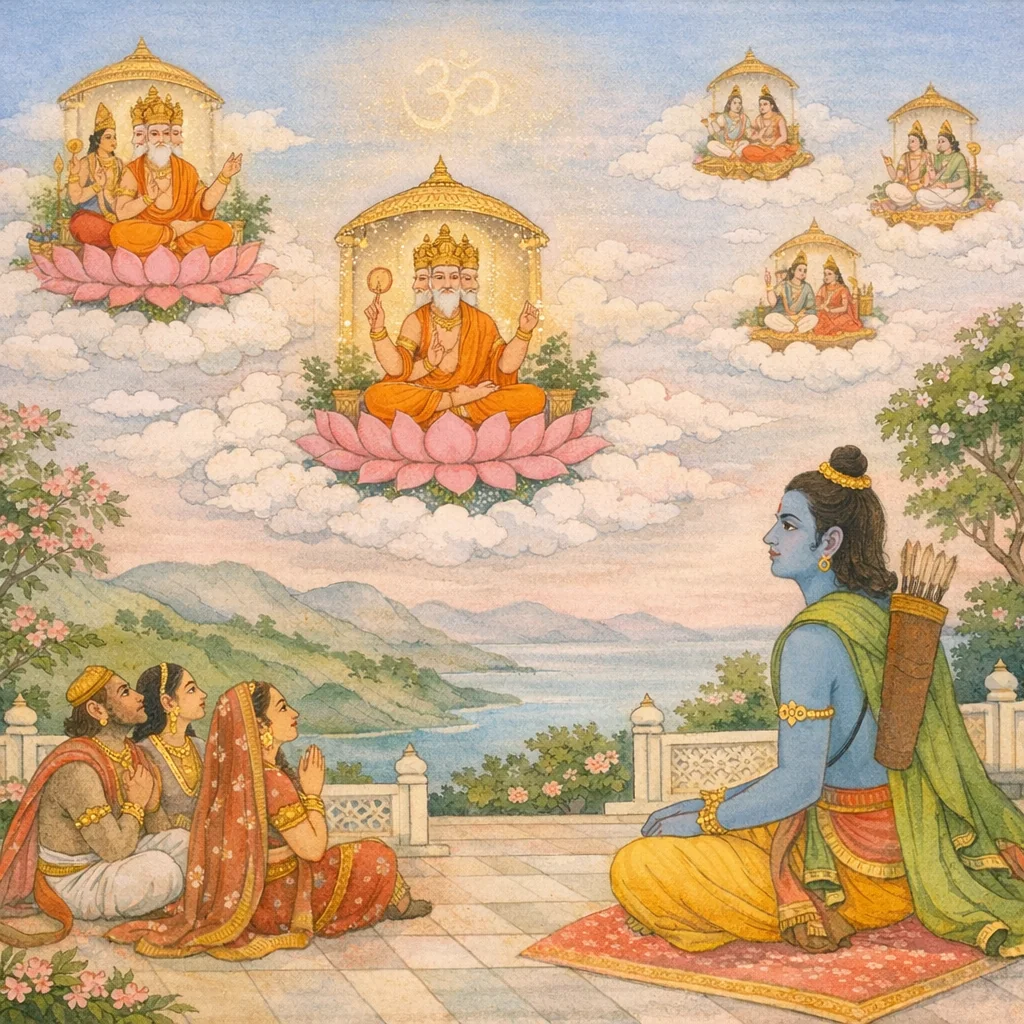
Sarga 120 turns from post-war human grief to a theological unveiling. Hearing the people’s lamentation, Rāma pauses with tear-dimmed eyes, underscoring the epic’s concern for public feeling and royal responsibility. The great deities arrive at Laṅkā in sun-bright vimānas—Kubera (Vaiśravaṇa), Yama with the Pitṛs, Indra, Varuṇa, Maheśvara (six-eyed, bull-bannered), and Brahmā—forming a cosmic assembly. They ask how Rāma, hailed as creator and lord, could seem to allow Sītā’s ordeal in the fire, bringing out the tension between divine omniscience and conduct within a human role. Rāma replies that he understands himself as Daśaratha’s human son and requests Brahmā to clarify his true origin. Brahmā then offers an extended stava proclaiming Rāma as Nārāyaṇa/Viṣṇu: the sacrifice and the Oṃkāra, beginning and end, the sustaining principle present in all beings and directions, and Trivikrama/Vāmana who bound Bali. The chapter concludes that Rāvaṇa’s death fulfills the purpose of the incarnation, and that reciting this ancient hymn grants success and protection from dishonor, making the sarga both narrative resolution and liturgical warrant.
Shlokas
Verse 1
ततोहिदुर्मनाराम्श्रुत्वैवंवदतांगिरः ।दध्यौमुहूर्तंधर्मात्माबाष्पव्याकुललोचनः ।।।।
Then righteous-souled Rāma, distressed on hearing the people speak thus, paused for a moment—his eyes troubled and clouded with tears.
Verse 2
ततोवैश्रवणोराजायमश्चपितृभिःसह ।सहस्राक्षश्चदेवेशोवरुणश्चजलेश्वरः ।।।।षडर्धनयन्श्रीमान्महादेवोवृषध्वजः ।कर्तासर्वस्यलोकस्यब्रह्माब्रह्मविदांवरः ।।।।एतेसर्वेसमागम्यविमानैस्सूर्यसन्निभैः ।आगम्यनगरींलङ्कामभिजग्मुश्चराघवम् ।।।।
Then King Vaiśravaṇa (Kubera), Yama with the Pitṛs, thousand-eyed Indra—the lord of the Devas—Varuṇa, lord of the waters, the glorious Mahādeva with the bull-banner and six eyes, and Brahmā, maker of all the worlds and foremost among knowers of Brahman—all assembled and came in vimānas radiant like the sun; reaching the city of Laṅkā, they went to Rāghava.
Verse 3
ततोवैश्रवणोराजायमश्चपितृभिःसह ।सहस्राक्षश्चदेवेशोवरुणश्चजलेश्वरः ।।6.120.2।।षडर्धनयन्श्रीमान्महादेवोवृषध्वजः ।कर्तासर्वस्यलोकस्यब्रह्माब्रह्मविदांवरः ।।6.120.3।।एतेसर्वेसमागम्यविमानैस्सूर्यसन्निभैः ।आगम्यनगरींलङ्कामभिजग्मुश्चराघवम् ।।6.120.4।।
Glorious Mahādeva, bearing the bull as his banner and described here as six-eyed, also came; and Brahmā—the creator of all the worlds, foremost among the knowers of Brahman—came as well.
Verse 4
ततोवैश्रवणोराजायमश्चपितृभिःसह ।सहस्राक्षश्चदेवेशोवरुणश्चजलेश्वरः ।।6.120.2।।षडर्धनयन्श्रीमान्महादेवोवृषध्वजः ।कर्तासर्वस्यलोकस्यब्रह्माब्रह्मविदांवरः ।।6.120.3।।एतेसर्वेसमागम्यविमानैस्सूर्यसन्निभैः ।आगम्यनगरींलङ्कामभिजग्मुश्चराघवम् ।।6.120.4।।
All of them assembled and, arriving in sun-bright aerial chariots, came to the city of Laṅkā and approached Rāghava.
Verse 5
ततःसहस्ताभरणान्प्रगृह्यविपुलान्भुजान् ।अब्रुवंस्त्रिदशश्रेष्ठाराघवंप्राञ्जलिंस्थितम् ।।।।
Then the foremost among the gods, lifting their mighty arms adorned with ornaments, spoke to Rāghava as he stood with joined palms in reverence.
Verse 6
कर्तासर्वस्यलोकस्यश्रेष्ठोज्ञानवतांप्रभुः ।उपेक्षसेकथंसीतांपतन्तींहव्यवाहने ।।।।कथंदेवगणश्रेष्ठमात्मानंनावबुद्ध्यसे ।
You are the maker of the whole world, the foremost among the wise, the Lord. How could you look on as Sītā entered the fire of Havyavāhana? How is it that you do not recognize your own supreme status among the hosts of gods?
Verse 7
ऋतधामावसुःपूर्वंवसूनां च प्रजापतिः ।।।।त्रयाणामपिलोकानामादिकर्तास्वयंप्रभुः ।
Formerly you are known as Ṛtadhāmā among the Vasus, and as their Prajāpati; indeed, you are the prime originator of the three worlds—the self-luminous Lord.
Verse 8
रुद्राणामष्टमोरुद्रस्साध्यानामपिपञ्चमः ।।।।अश्विनौचापिकर्णौतेसूर्यचन्द्रामसौदृशौ ।
Among the Rudras you are the eighth Rudra; among the Sādhyas you are the fifth. The twin Aśvins are your ears, and the Sun and the Moon are your eyes.
Verse 9
अन्तेचादौ च लोकानांदृश्यसे च परन्तप ।।।।उपेक्षसे च वैदेहींमानुषःप्राकृतोयथा ।
O scorcher of foes, you are seen at the beginning and at the end of worlds; yet you looked on at Vaidehī as though you were merely an ordinary human.
Verse 10
इत्युक्तोलोकपालैस्तैस्स्वामीलोकस्यराघवः ।।।।अब्रवीत्त्रिदशश्रेष्ठान्रामधर्मभृतांवरः ।
Thus addressed by those Lokapālas, Rāghava—lord of the world, Rāma, foremost among upholders of dharma—spoke to the best of the gods.
Verse 11
आत्मानंमानुषंमन्येरामंदशरथात्मजम् ।।।।सोऽहंयस्ययतश्चाहंभगववंस्तद्भ्रवीतुमे ।
I regard myself as human—Rāma, the son of Daśaratha. Therefore, O Blessed One, tell me truly: whose am I, and from where have I come?
Verse 12
इतिब्रुवाणंकाकुत्स्थंब्रह्माब्रह्मविदांवरः ।।।।अब्रवीच्छ्रुणुमेवाक्यंसत्यंसत्यपराक्रम ।
To Kākutstha who spoke thus, Brahmā—foremost among the knowers of Brahman—replied: “Hear my words, O one of truthful valor; they are true.”
Verse 13
भवान्नारायणोदेवःश्रीमांश्चक्रायुधःप्रभुः ।।।।एकशृङ्गोवराहस्त्वंभूतभव्यसपत्नजित् ।
You are Nārāyaṇa himself—the divine Lord, glorious, bearing the discus as your weapon. You are the primeval Boar, single-horned, conqueror of all foes, knowing what has been and what is to come.
Verse 14
अक्षरंब्रह्मसत्यं च मध्येचान्ते च राघव ।।।।लोकानांत्वंपरोधर्मोविष्वक्सेनश्चतुर्भुजः ।
O Rāghava, you are the imperishable Brahman—truth itself—present in the middle and at the end. For the worlds, you are the highest Dharma, the all-pervading Lord (Viṣvaksena), four-armed.
Verse 15
शार्ङ्गधन्वाहृषीकेशःपुरुषःपुरुषोत्तमः ।।।।अजितःखङ्गदृग्विष्णुःकृष्णश्चैवमहाबलः ।
You are the wielder of the Śārṅga bow, Hṛṣīkeśa, the Person and the Supreme Person; unconquered, sword-bearing, Viṣṇu—Kṛṣṇa too—of mighty strength.
Verse 16
सेनानीर्ग्रामणीश्चत्वंत्वंबुद्धिस्त्वंक्षमादमः ।।।।प्रभवश्चाप्ययश्चत्वमुपेन्द्रोमधुसूदनः ।
You are the leader of hosts and the guide of communities; you are intellect, forbearance, and self-restraint. You are both origin and dissolution; you are Upendra (Vāmana) and Madhusūdana (slayer of Madhu).
Verse 17
इन्द्रकर्मामहेन्द्रस्त्वंपद्मनाभोरणान्तकृत् ।।।।शरण्यंशरणं च त्वामाहुर्दिव्यामहर्षयः ।
You are the power behind Indra’s works; you are Mahendra; you are Padmanābha, the ender of battle. The radiant great seers call you both “the worthy refuge” and the very “Refuge” itself.
Verse 18
सहस्रशृङ्गोवेदात्माशरशीर्षोमहर्षभः ।।।।त्वंत्रयाणांहिलोकानामादिकर्तास्वयम्प्रभुः ।सिद्धानामपिसाध्यानामाश्रयश्चासिपूर्वजः ।।।।
You are the very self of the Vedas—thousand-branched, hundred-headed—O great bull among beings. You are the primordial creator of the three worlds, self-luminous and self-sovereign; and you are the refuge and first source even of the Siddhas and Sādhyas.
Verse 19
सहस्रशृङ्गोवेदात्माशरशीर्षोमहर्षभः ।।6.120.18।।त्वंत्रयाणांहिलोकानामादिकर्तास्वयम्प्रभुः ।सिद्धानामपिसाध्यानामाश्रयश्चासिपूर्वजः ।।6.120.19।।
You are the very self of the Vedas—thousand-branched, hundred-headed—O pre-eminent One. You are the primordial creator of the three worlds, self-sovereign; and you are the refuge and primeval source even of the Siddhas and Sādhyas.
Verse 20
त्वम्यज्ञस्त्वंवषटकारस्त्वमोङ्कारःपरात्परः ।।।।प्रभवंनिधनंवातेनोविदुःकोभवानिति ।
You are the sacrifice (yajña); you are the vaṣaṭ-utterance; you are the syllable Oṃ, higher than the highest. They do not know your beginning or your end—who you truly are.
Verse 21
दृश्यसेसर्वभूतेषुगोषु च ब्राह्मणेषु च ।।।।दिक्षुसर्वासुगगनेपर्वतेषुनदीषु च ।
You are beheld in all beings—in cows and in brāhmaṇas; in every direction, in the sky, in mountains, and in rivers.
Verse 22
सहस्रचरण्श्रीमान् शतशीर्षस्सहस्रदृक् ।।।।त्वंधारयसिभूतानिपृथिवीं च सपर्वताम् ।
Glorious, with a thousand feet, a hundred heads, and a thousand eyes—you uphold all beings, and the earth with all its mountains.
Verse 23
अन्तेपृथिव्याःसलिलेदृश्यसेत्वंमहोरगः ।।।।त्रीन्लोकान्धारयन् राम देवगन्धर्वदानवान् ।
O Rāma, at the earth’s dissolution you are seen upon the waters as the mighty serpent, sustaining the three worlds—Devas, Gandharvas, and Dānavas.
Verse 24
अहंतेहृदयंरामजिह्वादेवीसरस्वती ।।।।देवारोमाणिगात्रेषुब्रह्मणानिर्मिताःप्रभो ।
O Rāma, I am your heart; Devī Sarasvatī is your tongue; and the gods created by Brahmā are the hairs upon your limbs, O Lord.
Verse 25
निमेषस्तेस्मृतारात्रिरुन्मेषोदिवसस्तथा ।।।।संस्कारास्त्वभवन्वेदानैतदस्तित्वयाविना ।
Your closing of the eyes is remembered as night, and your opening as day. The Vedas and the sacred rites arise from you; without you, none of this exists.
Verse 26
जगत्सर्वंशरीरंतेस्थैर्यंतेवसुथातलम् ।।।।अग्निःकोपःप्रसादस्तेसोम्श्रीवत्सलक्षणः ।
The whole universe is Your body; the face of the earth is Your steadfastness. Fire is Your wrath; Your grace is Soma; and You bear the sacred mark of Śrīvatsa.
Verse 27
त्वयालोकास्त्रयःक्रान्ताःपुरास्वैर्विक्रमैस्त्रिभिः ।।।।महेन्ध्रश्चकृतोराजाबलिंबद्ध्वासुदारुणम् ।
Formerly, by Your own three strides, You traversed the three worlds; and after binding the fearsome Bali, You made Mahendra king.
Verse 28
सीतालक्ष्मीर्भवान् विष्णुर्देवःकृष्णःप्रजापतिः ।।।।वधार्थंरावणस्येहप्रविष्टोमानुषींतनुम् ।
Sītā is Lakṣmī, and You are Viṣṇu—indeed the divine Kṛṣṇa, Lord of all creatures. For the slaying of Rāvaṇa, You entered here in a human body.
Verse 29
तदिदंनस्त्वयाकार्यंकृतंधर्मभृतांवर ।।।।निहतोरावणोरामप्रहृष्टोदिवमाक्रम ।
O best of the upholders of dharma, this task on our behalf has been accomplished by You. Rāvaṇa is slain, O Rāma—go now to heaven rejoicing.
Verse 30
अमोघंदेववीर्यंते न तेमोघाःपराक्रमाः ।।।।अमोघंदर्शनंरामअमोघस्तवसंस्तवः ।
O divine Rāma, your might is unfailing; your deeds of valor are never fruitless. Your very sight is efficacious, and so too is praise of you—never in vain.
Verse 31
अमोघास्तेभविष्यन्तिभक्तिमन्तोनराभुवि ।।।।येत्वांदेवंध्रुवंभक्ताःपुराणंपुरुषोत्तमम् ।प्राप्नुवन्तिसदाकामनिहलोकेपरत्र च ।।।।
On earth, those men who are devoted to you will not be thwarted. Those devotees who worship you—the steadfast God, the ancient Supreme Person—attain their desired aims always, both here and hereafter.
Verse 32
अमोघास्तेभविष्यन्तिभक्तिमन्तोनराभुवि ।।6.120.31।।येत्वांदेवंध्रुवंभक्ताःपुराणंपुरुषोत्तमम् ।प्राप्नुवन्तिसदाकामनिहलोकेपरत्र च ।।6.120.32।।
Those who are devoted to you—O steadfast and divine Puruṣottama, the eternal one—always obtain their rightful desires and fulfilments, both in this world and in the world beyond.
Verse 33
इममार्षंस्तवंदिव्यमितिहासंपुरातनम् ।।।।येनराःकीर्तयिष्यन्तिनास्तितेषांपराभवः ।
This noble and divine hymn—an ancient sacred narrative—whoever among people will recite and proclaim it, for them there will be no downfall.
Frequently Asked Questions
The chapter foregrounds the apparent dilemma of Rāma ‘overlooking’ Sītā’s entry into fire (Agni), contrasting public perception with Rāma’s role-bound conduct; it frames the episode as an ethical stress-test of kingship and legitimacy rather than a private domestic scene.
The dialogue teaches that Itihāsa can simultaneously operate on human and cosmic registers: Rāma self-identifies as human (Daśaratha’s son) while Brahmā articulates his Nārāyaṇa identity, implying that dharma may require divine agency to work through human norms (maryādā) for the world’s instruction.
Laṅkā is the immediate setting, reimagined as a cosmic auditorium via radiant vimānas; culturally, the sarga highlights Vedic-ritual markers (yajña, vaṣaṭ, Oṃkāra, Vedas) and pan-Indian avatāra motifs (Varāha, Vāmana/Trivikrama, Bali), mapping the war narrative onto a broader sacred geography of tradition.