Sarga 93
Sarga 93: Rāvaṇa’s Grief and Fury after Indrajit’s Fall; Move to Slay Vaidehī and Ministerial Restraint
युद्धकाण्ड
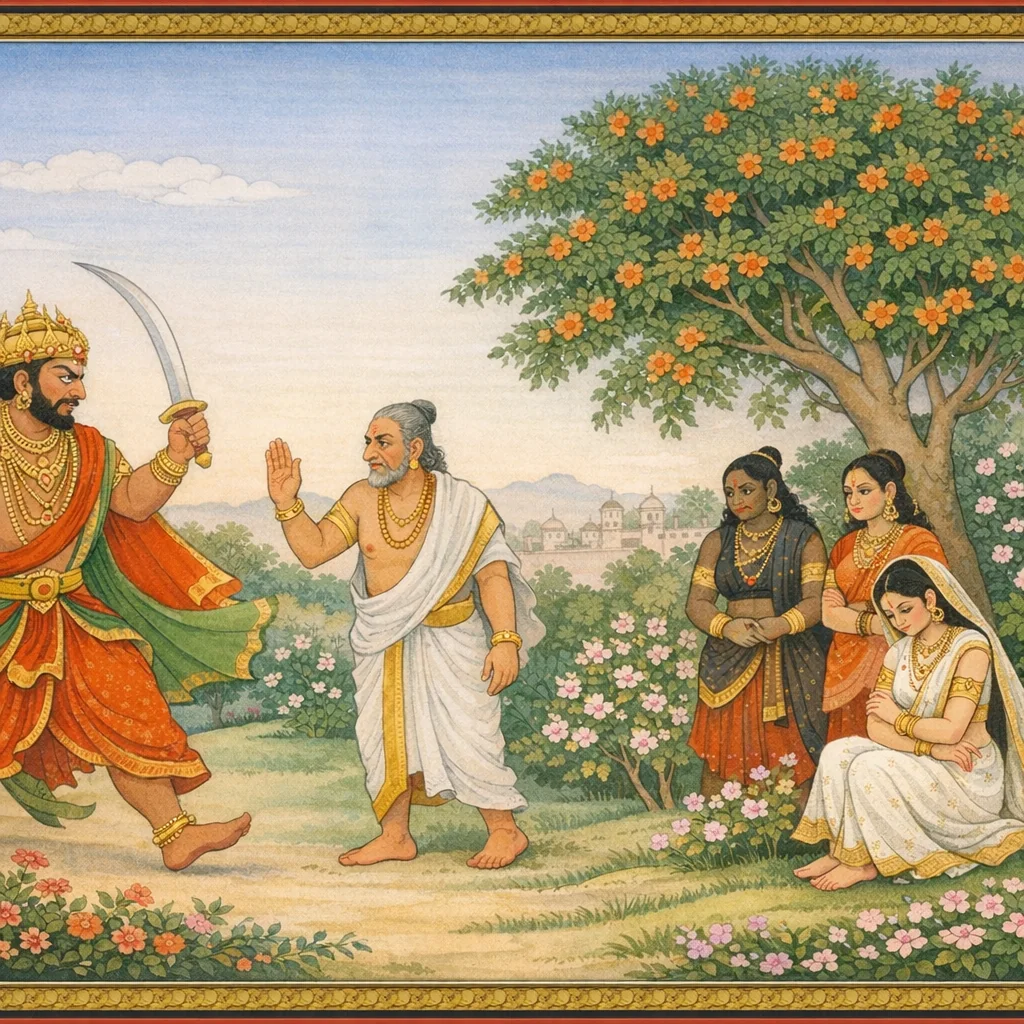
This sarga opens with Paulastya (Rāvaṇa)’s ministers reporting the grievous death of Indrajit/Meghanāda, slain by Lakṣmaṇa with Vibhīṣaṇa’s aid. Rāvaṇa first swoons, then laments, and then erupts in mounting fury, portrayed through cosmic similes—his brows like an apocalyptic ocean, fire and smoke bursting from his mouth, and tears falling like oil from blazing lamps. He proclaims the security of his boons and divine weapons—Brahmā’s gift of an unbreakable kavaca and a formidable bow—to harden the rākṣasa war-spirit and announce renewed aggression against Rāma and Lakṣmaṇa. Yet grief turns into misdirected retaliation: he resolves to kill Vaidehī (Sītā), draws his sword, and rushes toward Aśoka-vana, while the rākṣasas exult in his supposed invincibility. The narrative then shifts to Sītā’s fear and self-reproach for refusing Hanumān’s earlier rescue, and her anxiety for Rāma and Kausalyā. The moral counterweight comes through the upright minister Suparśva, who restrains Rāvaṇa: killing a woman violates dharma; anger must be spent in battle, not upon Sītā. Rāvaṇa accepts the counsel, turns back, and proceeds again to the assembly, temporarily realigning from private vengeance to public war conduct.
Shlokas
Verse 1
ततःपौलस्त्यसचिवा्श्रुत्वाचेन्द्रजितोवधम् ।आचचक्षुरभिज्ञायदशग्रीवायसव्यथा: ।।।।
Then the ministers of the Paulastya king, having heard of Indrajit’s death and grasped its grave import, reported in distress the sorrowful news to Daśagrīva, the ten-headed Rāvaṇa.
Verse 2
युद्धेहतोमहाराजलक्ष्मणेनतवात्मजः ।विभीषणसहायेनमिषतांनोमहाद्युतिः ।।।।
“O King! Your illustrious son has been slain in battle by Lakṣmaṇa, aided by Vibhīṣaṇa—while we all stood watching.”
Verse 3
शूरंशूरेणसम्गम्यसम्युगेष्वपराजितः ।लक्ष्मणेनहतश्शूरःपुत्रस्तेमहेन्द्रजित् ।।।।गतस्सपरमान्लोकान्शरैस्सन्ताप्यलक्ष्मणम् ।
When hero met hero in battle, your valiant son—Mahendrajit, never defeated in war—was slain by Lakṣmaṇa. Having grievously wounded Lakṣmaṇa with his arrows, he has gone to the highest worlds.
Verse 4
स तंप्रतिभयंश्रुत्वावधंपुत्रस्यदारुणम् ।।।।घोरमिन्द्रजितःसङ्ख्येकश्मलंप्राविशन्महत् ।
Hearing of his son Indrajit’s dreadful, terrifying, and ghastly death in battle, he was overwhelmed by a great swoon of anguish.
Verse 5
उपलभ्यचिरात्संज्ञां राजाराक्षसपुङ्गव ।।।।पुत्रशोकाकुलोदीनोविललापाकुलेन्द्रियः ।
After a long while, the rākṣasa-king, foremost among his kind, regained consciousness. Overwhelmed by grief for his son, dejected and with senses in turmoil, he cried out in lamentation.
Verse 6
हाराक्षसचमूमुख्यममवत्समहाबल ।।।।जित्वेन्द्रंकथमद्यत्वंलक्ष्मणस्यवशंगतः ।
Alas, O foremost of the Rākṣasa host—my child, mighty in strength! You who once conquered even Indra—how have you today fallen under Lakṣmaṇa’s power?
Verse 7
ननुत्वमिषुभिःक्रुद्धोभिन्द्याःकालान्तकावपि ।।।।मन्दरस्यापिशृङ्गाणिकिंपुनर्लक्ष्मणंयुधि ।
Surely, when enraged, you could pierce even Kāla, Death, with your arrows—even the very peaks of Mount Mandara; how much more, then, Lakṣmaṇa in battle?
Verse 8
अद्यवैनस्वतोराजाभूयोबहुमतोमम ।।।।येनाद्यत्वंमहाबाहो संयुक्तःकालधर्मणा ।
Today indeed I esteem Yama, king of the departed, all the more—for today, O mighty-armed one, you have been joined to the law of Time, the ordinance of death.
Verse 9
एषपन्थाःसुयोधानांसर्वामरगणेष्वपि ।।।।यःकृतेहन्यतेभर्तुस्सपुमान्स्वर्गमृच्छति ।
This is the path of noble warriors—even among the hosts of immortals: the man who is slain for his lord’s cause attains heaven.
Verse 10
अद्यदेवगणास्सर्वेलोकपालामहर्षयः ।।।।हतमिन्द्रजितंदृष्टवासुखंस्वप्स्यन्तिनिर्भयाः ।
Today, seeing Indrajit slain, all the hosts of the gods, the guardians of the worlds, and the great rishis will sleep in peace, free from fear.
Verse 11
अद्यलोकास्त्रय: कृत्स्नापृथिवी च सकानना ।।।।एकेनेन्द्रजिताहीनाशून्येवप्रतिभातिमे ।
Today, with Indrajit alone gone, the three worlds—and even the earth with all its forests—seem to me empty, darkened, and without splendor.
Verse 12
अद्यनैरृतकन्यानांश्रोष्याम्यन्तःपुरेरवम् ।।।।करेणुसङ्घस्ययथानिनादंगिरिगह्वरे ।
Today I shall hear, within the inner chambers, the cries of the rākṣasa maidens—like the trumpeting of a herd of she-elephants echoing through mountain caves.
Verse 13
यौवराज्यं च लङ्कां च रक्षांसि च परन्तप ।।।।मातरंमां च भार्याश्चक्वगतोऽसिविहायनः ।
O scorcher of foes! Abandoning the regency, Laṅkā, the rākṣasas, your mother, me, and your wives—where have you gone, leaving us behind?
Verse 14
ममनामत्वयावीरगतस्ययमसादनम् ।।।।प्रेतकार्याणिकार्याणिविपरीतेहिवर्तसे ।
O hero! You should have performed the funeral rites for me when I went to Yama’s abode; yet it has turned the other way—now I must perform the rites for you.
Verse 15
स त्वंजीवतिसुग्रीवेलक्ष्मणेन च राघवे ।।।।ममशल्यमनुद्धृत्यक्वगतोऽसिविहायनः ।
While Sugrīva lives, and while Rāghava and Lakṣmaṇa live, you have gone—leaving us—without first drawing out the dart that torments me. Where have you gone?
Verse 16
एवमादिविलापार्तंरावणंराक्षसाधिपम् ।।।।आविवेशमहान् कोपःपुत्रव्यसनसम्भवः ।
As Rāvaṇa, lord of the rākṣasas, lamented thus in anguish, a mighty wrath—born of the calamity of losing his son—entered him and seized him.
Verse 17
प्रकृत्याकोपनंह्येनंपुत्रस्यपुनराधयः ।।।।दीप्तंसन्दीपयामासुर्घर्मेऽर्कमिवरश्मयः ।
Anger was natural to him; and now the fresh torment of his son’s loss made him blaze still more—like the sun in summer, kindled brighter by its own rays.
Verse 18
ललाटेभ्रुकुटीभिश्चसङ्गताभिर्व्यरोचत ।।।।युगान्तेसहनक्रैस्तुमहोर्मिभिरिवोदधिः ।
With his brows tightly knit upon his forehead, he shone in terror and fury—like the ocean at the end of an age, heaving with vast waves amid crocodiles.
Verse 19
कोपाद्विजृम्भमाणस्यवक्त्राद्व्यक्तमिवज्वलन् ।।।।उत्पपातसधूमानगिर्वृत्रस्यवदनादिव ।
As he yawned in anger, a smoky, blazing fire seemed to leap from his mouth—like flame bursting from Vṛtra’s jaws.
Verse 20
स पुत्रवधसन्तप्तश्शूरःक्रोधवशंगतः ।।।।समीक्ष्यरावणोबुद्ध्यावैदेह्यारोचयद्वधम् ।
Burning over his son’s death, the warrior Rāvaṇa fell under the sway of wrath; and, turning his mind upon it, he resolved upon Vaidehī’s killing.
Verse 21
तस्यप्रकृत्यारक्ते च रक्तेक्रोथानगिनापि च ।।।।रावणस्यमहाघोरेदीप्तेनेत्रेबभूवतुः ।
Rāvaṇa’s eyes—red by nature—grew still redder under the fire of anger, blazing forth in dreadful intensity.
Verse 22
घोरंप्रकृत्यारूपंतत्तस्यक्रोधाग्निमूर्छितम् ।।।।बभूवरूपंक्रुद्धस्यरुद्रस्येवदुरासदम् ।
That form of his—dreadful by nature and now stupefied by the fire of wrath—became unapproachable, like Rudra himself when enraged.
Verse 23
तस्यक्रुद्धस्यनेत्राभ्यांप्रापतन्नाश्रृबिन्दवः ।।।।दीपाभ्यामिवदीप्ताभ्यांसार्चिषस्स्नेहबिन्दवः ।
From his enraged eyes, tears fell—like drops of oil dripping from two blazing lamps with bright flames.
Verse 24
दन्तावनिदशतस्तस्यश्रूयतेदशनस्वनः ।।।।यन्त्रस्यावेष्ट्यमाणस्य महतो दानवैरिव ।
As he ground his teeth, the sound of his biting was heard—like the harsh noise of a huge machine being wound and worked by Dānavas.
Verse 25
कालानगिरिवसङ्क्रुद्धोयांयांदिशमवैक्षत ।।।।तस्यांतस्यांभयत्रस्ताराक्षसास्सन्विलियलिरे ।
Enraged like the fire of cosmic dissolution, whichever direction he cast his gaze toward—rākṣasas, terrified in that very quarter, shrank away and hid.
Verse 26
तमन्तकमिवक्रुद्धंचराचरचिखादिषुम् ।।।।वीक्षमाणंदिशस्सर्वाराक्षसानोपचक्रमुः ।
Seeing him raging like Death itself and scanning all directions, the rākṣasas could not bring themselves to approach him.
Verse 27
ततःपरमसङ्क्रुद्धोरावणोराक्षसाधिपः ।।।।अब्रवीद्रक्षसांमध्येसंस्तम्भयिषुराहवे ।
Then Rāvaṇa, the lord of the rākṣasas, furious beyond measure, spoke in their midst—intent on stiffening their resolve for battle.
Verse 28
मयावर्षसहस्राणिचरित्वापरमंतपः ।।।।तेषुतेष्ववकाशेषुस्वयम्भूःपरितोषितः ।
I practiced supreme austerities for thousands of years, again and again on fitting occasions—until the Self-born (Brahmā) was pleased.
Verse 29
तस्यैवतपसोव्युष्ट्याप्रसादाच्छस्वयम्भुवः ।।।।नासुरेभ्यो न देवेभ्योभयंममकदाचन ।
By the fruition of that very austerity, and by the favor of the Self-born (Svayambhū), I have never known fear—neither from asuras nor from devas.
Verse 30
कवचंब्रह्मदत्तंमेयदादित्यसमप्रभम् ।।।।देवासुरविमर्धेषु न भिन्नंवज्रमुष्टिभिः ।
I bear a cuirass granted to me by Brahmā, radiant like the sun—one that, in the clashes of devas and asuras, was not shattered even by thunderbolt blows.
Verse 31
तेनमामद्यसम्युक्तंरथस्थमिहसम्युगे ।।।।प्रतीयात्कोऽद्यमामाजौसाक्षादपिपुरन्दरः ।
With that armor upon me today, mounted on my chariot here in battle—who could face me in combat? Not even Purandara (Indra), though he stood before my very eyes.
Verse 32
त्तदातिप्रसन्नेनसशरंकार्मुकंमहत् ।।।।देवासुरविमर्धेषुममदत्तंस्वयम्भुवा ।अद्यतूर्यशतैर्भीमंधनुरुत्थाप्यतांमम ।।।।रामलक्ष्मणयोरेववधायपरमाहवे ।
Today, amid the blare of hundreds of trumpets, let my dreadful bow be raised—great and furnished with arrows: the very bow that Svayambhū (Brahmā), greatly pleased, bestowed on me in the wars of devas and asuras, for the slaying of Rāma and Lakṣmaṇa in this supreme battle.
Verse 33
त्तदातिप्रसन्नेनसशरंकार्मुकंमहत् ।।6.93.32।।देवासुरविमर्धेषुममदत्तंस्वयम्भुवा ।अद्यतूर्यशतैर्भीमंधनुरुत्थाप्यतांमम ।।6.93.33।।रामलक्ष्मणयोरेववधायपरमाहवे ।
When hero met hero in battle, your valiant son—Mahendrajit, never defeated in war—was slain by Lakṣmaṇa. Having grievously wounded Lakṣmaṇa with his arrows, he has gone to the highest worlds.
Verse 34
स पुत्रवधसन्तप्तःक्रूरःक्रोधवशंगतः ।।।।समीक्ष्यरावणोबुद्ध्यासीतांहन्तुंव्यवस्यत ।
Burning with grief over his son’s death, cruel Rāvaṇa—overpowered by anger—turned his mind and resolved to kill Sītā.
Verse 35
प्रत्यवेक्ष्यताम्राक्षस्सुघोरोघोरदर्शनः ।।।।दीनोदीनस्वरान्सर्वांस्तानुवाचनिशाचरान् ।
Red-eyed Rāvaṇa—most dreadful, with a fearsome visage—looked around and, in a broken, low voice, addressed all those Rākṣasas.
Verse 36
माययाममवत्सेनवञ्चनार्थंवनौकसाम् ।।।।किञ्चिदेवहतंतत्रसीतेयमितिदर्शितम् ।
“By māyā, my son, to deceive the Vānaras, displayed there something as though slain, saying, ‘This is Sītā.’”
Verse 37
तदिदंतथ्यमेवाहंकरिष्येप्रियमात्मनः ।।।।वैदेहींनाशयिष्यामिक्षत्रबन्धुमनुव्रताम् ।इत्येवमुक्त्वासचिवान्खङ्गमाशुपरामृशत् ।।।।
Now I myself will make that deception ‘true’ and gratify my own heart: I will destroy Vaidehī—so devoted to that base kṣatriya. Saying so to his ministers, he swiftly seized his sword.
Verse 38
तदिदंतथ्यमेवाहंकरिष्येप्रियमात्मनः ।।6.93.37।।वैदेहींनाशयिष्यामिक्षत्रबन्धुमनुव्रताम् ।इत्येवमुक्त्वासचिवान्खङ्गमाशुपरामृशत् ।।6.93.38।।
Now I myself will make that deception ‘true’ and gratify my own heart: I will destroy Vaidehī—so devoted to that base kṣatriya. Saying so to his ministers, he swiftly seized his sword.
Verse 39
उत्प्लुत्यगुणसम्पन्नंविमलाम्बरवर्चसम् ।निष्पपात स वेगेनसभार्यःसचिवैर्वृतः ।।।।रावणःपुत्रशोकेनभृशमाकुलचेतनः ।सङ्क्रुद्धःखडगमादायसहसायत्रमैथिली ।।।।
Rāvaṇa—his mind utterly shaken by grief for his son—leapt up at once and rushed forth with speed, taking up a splendid sword that shone like the spotless sky; enraged, accompanied by his wife and surrounded by ministers, he hurried to where Maithilī was.
Verse 40
उत्प्लुत्यगुणसम्पन्नंविमलाम्बरवर्चसम् ।निष्पपात स वेगेनसभार्यःसचिवैर्वृतः ।।6.93.39।।रावणःपुत्रशोकेनभृशमाकुलचेतनः ।सङ्क्रुद्धःखडगमादायसहसायत्रमैथिली ।।6.93.40।।
Today, on seeing him, those two brothers will tremble. Even the four world-guardians, threatened by his wrath, would be shaken; and many other enemies besides have been struck down by him in battles.
Verse 41
व्रजन्तंराक्षसंप्रेक्ष्यसिंहनादंविचक्रुशुः ।ऊचुश्चान्योन्यमालिङ्ग्यसङ्क्रुद्धंप्रेक्ष्यराक्षसम् ।।।।
Seeing the Rākṣasa king marching forth in fury, the Rākṣasas in the palace roared like lions; embracing one another, they spoke among themselves as they watched him.
Verse 42
अद्यैनंतावुभौदृष्टवाभ्रातरौप्रव्यधिष्यतः ।लोकपालाहिचत्वारःक्रुद्धेनानेनतर्जिताः ।।।।बहवःशत्रवश्चान्येसम्युगेष्वभिपातिताः ।
Today, on seeing him, those two brothers will tremble. Even the four world-guardians, threatened by his wrath, would be shaken; and many other enemies besides have been struck down by him in battles.
Verse 43
त्रिषुलोकेषुरत्नानिभुङक्तेचाहृत्यरावणः ।।।।विक्रमे च बलेचैवनास्त्यस्यसदृशोभुवि ।
Rāvaṇa exacts and enjoys gems gathered from the three worlds; in valor and in strength there is none on earth equal to him.
Verse 44
तेषांसञ्जल्पमानामशोकवनिकांगताम् ।।।।अभिदुद्राववैदेहींरावणःक्रोधमूर्छितः ।
As they were speaking thus and had come to the Aśoka-grove, Rāvaṇa—his mind clouded by anger—rushed at Vaidehī.
Verse 45
वार्यमाणःसुसङ्क्रुद्धःसुहृद्भिर्हितबुद्धिभिः ।।।।अभ्यधावतसङ्क्रुद्धःखेग्रहोरोहिणीमिव ।
Though restrained by well-intentioned friends of sound counsel, Rāvaṇa, blazing with fury, rushed forward—like the planet Mars in the heavens charging toward Rohiṇī.
Verse 46
मैथिलीरक्ष्यमाणातुराक्षसीरनिन्दिता ।।।।ददर्शराक्षसंक्रुद्धंनिस्त्रिंशवरधारिणम् ।तंनिशाम्यसविस्त्रिंशंव्यथिताजनकात्मजा ।।।।निवार्यमाणंबहुशःसुहृद्भिरनिवर्तिनम् ।
Sita of Mithila—blameless, though guarded by rākṣasī women—saw the rākṣasa approaching in fury, bearing an excellent sword. Seeing him with blade drawn, Janaka’s daughter grew distressed: though repeatedly checked by his friends, he would not turn back.
Verse 47
मैथिलीरक्ष्यमाणातुराक्षसीरनिन्दिता ।।6.93.46।।ददर्शराक्षसंक्रुद्धंनिस्त्रिंशवरधारिणम् ।तंनिशाम्यसविस्त्रिंशंव्यथिताजनकात्मजा ।।6.93.47।।निवार्यमाणंबहुशःसुहृद्भिरनिवर्तिनम् ।
Sita of Mithila—blameless, though guarded by rākṣasī women—saw the rākṣasa approaching in fury, bearing an excellent sword. Seeing him with blade drawn, Janaka’s daughter grew distressed: though repeatedly checked by his friends, he would not turn back.
Verse 48
सीतादुःखसमाविष्टाविलपन्तीदमब्रवीत् ।।।।यथायंमामभिक्रुद्धःसमभिद्रवतिस्वयम् ।वधिष्यतिसनाथांमामनाथामिवदुर्मतिः ।।।।
Sita, overwhelmed with sorrow and weeping, said: “See how this evil-minded one, enraged, rushes at me of his own accord—he means to kill me, as though I were helpless and without refuge, even though I have a protector.”
Verse 49
सीतादुःखसमाविष्टाविलपन्तीदमब्रवीत् ।।6.93.48।।यथायंमामभिक्रुद्धःसमभिद्रवतिस्वयम् ।वधिष्यतिसनाथांमामनाथामिवदुर्मतिः ।।6.93.49।।
“Again and again he urged me—though I am devoted to my husband—‘Be my wife; take your pleasure with me.’ I firmly rejected him. Now, because I would not yield, he has plainly fallen into despair; seized by anger and delusion, he is ready to kill me.”
Verse 50
बहुशश्चोदयामासभर्तारंमामनुव्रताम् ।भार्याभवरमस्वेतिप्रत्याख्यातोध्रुवंमया ।।।।सोऽयंमामनुपस्थानेव्यक्तंनैराश्यमागतः ।क्रोधमोहसमाविष्टोनिहन्तुंमांसमुद्यतः ।।।।
“Again and again he urged me—though I am devoted to my husband—‘Be my wife; take your pleasure with me.’ I firmly rejected him. Now, because I would not yield, he has plainly fallen into despair; seized by anger and delusion, he is ready to kill me.”
Verse 51
बहुशश्चोदयामासभर्तारंमामनुव्रताम् ।भार्याभवरमस्वेतिप्रत्याख्यातोध्रुवंमया ।।6.93.50।।सोऽयंमामनुपस्थानेव्यक्तंनैराश्यमागतः ।क्रोधमोहसमाविष्टोनिहन्तुंमांसमुद्यतः ।।6.93.51।।
Again and again he urged me—though I am devoted to my husband—saying, “Be my wife; take your pleasure with me.” But I certainly rejected him. Now, because I would not yield to him, he has plainly fallen into despair; seized by anger and delusion, he is prepared to kill me.
Verse 52
अथवातौनरव्याघ्रौभ्रातरौरामलक्ष्मणौ ।मन्निमित्तमनार्येणसमरेऽद्यनिपातितौ ।।।।
“Or else—have those two tiger-like men, the brothers Rāma and Lakṣmaṇa, been struck down today in battle by that ignoble one, because of me?”
Verse 53
भैरवोहिमहान्नादोराक्षसानांश्रुतोमया ।बहूनामिहहृष्टानांतथाविक्रोशतांप्रियम् ।।।।
I heard here a dreadful, immense uproar of many Rākṣasas—rejoicing and loudly calling out to their dear ones.
Verse 54
अहोधिङ्मन्निमित्तोऽयंविनाशोराजपुत्रयोः ।अथवापुत्रशोकेनअहत्यारामलक्ष्मणौ ।।।।विधमिष्यतिमांरौद्रोराक्षसःपापनिश्चयः ।
Alas—shame! Is this ruin of the two princes happening because of me? Or else, grieving for his son, unable to kill Rāma and Lakṣmaṇa, has that fierce Rākṣasa—fixed in sinful resolve—decided to destroy me?
Verse 55
हनूमतस्तुतद्वाक्यं न कृतंक्षुद्रयामया ।।।।यद्यहंतस्यपृष्ठेवतदायासमनिर्जिता ।नाद्यैवमनुशोचेयंभर्तुरङ्कगतासती ।।।।
Foolish as I was, I did not follow Hanumān’s words. Had I then gone, seated upon his back, I would surely have reached unvanquished; I would not be lamenting thus today, but would be resting upon my husband’s lap.
Verse 56
हनूमतस्तुतद्वाक्यं न कृतंक्षुद्रयामया ।।6.93.55।।यद्यहंतस्यपृष्ठेवतदायासमनिर्जिता ।नाद्यैवमनुशोचेयंभर्तुरङ्कगतासती ।।6.93.56।।
I think Kauśalyā’s heart will break when she hears that her son—her only one—has perished in battle.
Verse 57
मन्येतुहृदयंतस्याःकौसल्यायाःफलिष्यति ।एकपुत्रायदापुत्रंविनष्टंश्रोष्यतेयुधि ।।।।
I think Kauśalyā’s heart will break when she hears that her son—her only one—has perished in battle.
Verse 58
साहिजन्म च बाल्यं च यौवनं च महात्मनः ।धर्मकार्याणिरूपं च रुदतीसंस्मरिष्यति ।।।।
She will weep and keep recalling the great-souled one—his birth, his childhood, his youth, his deeds of righteousness, and his very form.
Verse 59
निराशानिहतेपुत्रेदत्त्वाश्राद्धमचेतना ।अग्निमावेक्ष्यतेनूनमापोवापिप्रवेक्ष्यति ।।।।
Hopeless after her son is slain, senseless with grief, she will offer the funeral rites—and surely will look toward the fire, or else enter the waters.
Verse 60
धिगस्तुकुब्जामसतींमन्थरांपापनिश्चयाम् ।यन्निमित्तमिमंशोकंकौसल्याप्रतिपत्स्यते ।।।।
Shame upon that hunchback, that wicked Mantharā, fixed in sinful intent—because of whom Kauśalyā has come to this sorrow.
Verse 61
इत्येवंमैथिलींदृष्टवाविलपन्तींतपस्विनीम् ।रोहिणीमिवचन्द्रेणविनाग्रहवशंगताम् ।।।।एतस्मिन्नन्तरेतस्यअमात्यःशीलवान् शुचिः ।सुपार्श्वोनाममेधावीरावणंरक्षसेश्वरम् ।।।।निवार्यमाणःसचिवैरिदंवचनमब्रवीत् ।
Seeing Maithilī lamenting in this way—an austere woman, like Rohiṇī fallen under a planet’s sway when the moon is absent—at that moment Suparśva, a pure and upright, wise minister, addressed Rāvaṇa, the lord of the Rākṣasas; though restrained by the other counselors, he spoke these words.
Verse 62
इत्येवंमैथिलींदृष्टवाविलपन्तींतपस्विनीम् ।रोहिणीमिवचन्द्रेणविनाग्रहवशंगताम् ।।6.93.61।।एतस्मिन्नन्तरेतस्यअमात्यःशीलवान् शुचिः ।सुपार्श्वोनाममेधावीरावणंरक्षसेश्वरम् ।।6.93.62।।निवार्यमाणःसचिवैरिदंवचनमब्रवीत् ।
Just then, his minister Supārśva—upright in conduct, pure, and wise—addressed Rāvaṇa, lord of the Rākṣasas. Though restrained by the other counsellors, he spoke these words.
Verse 63
कथंनामदशग्रीव साक्षद्वैश्रवणानुज ।।।।हन्तुमिच्छसिवैदेहींक्रोधाद्धर्ममपास्य च ।
How can you, O Daśagrīva—indeed the younger brother of Vaiśravaṇa—wish, out of anger, to kill Vaidehī, casting aside righteousness (dharma)?
Verse 64
वेदविद्याव्रतस्नातःस्वकर्मनिरतस्तथा ।।।।स्त्रियःकस्माद्वधंवीरमन्यसेराक्षसेश्वर ।
You who have completed the disciplines and vows of Vedic learning and are devoted to your appointed duties—why, O hero, lord of the Rākṣasas, do you even contemplate the killing of a woman?
Verse 65
मैथिलींरूपसम्पन्नांप्रत्यवेक्षस्वपार्थिव ।।।।तस्मिन्नेवसहास्माभिराहेवक्रोधमुत्सृज ।
Behold Maithilī, O king, so richly endowed with beauty. In battle, together with us, cast your wrath upon him alone—upon Rāma.
Verse 66
अभ्युत्थानंत्वमद्यैवकृष्णपक्षचतुर्धशीम् ।।।।कृत्वानिर्याह्यमावास्यांविजयायबलैर्वृतः ।
Make your preparations this very day, on the fourteenth of the dark fortnight; then, on the day of amāvasyā (new moon), set out surrounded by your forces, for victory.
Verse 67
शूरःधीमान् रथीखडगीरथप्रवमास्थितः ।।।।हत्वादाशरथिंरामंभवान् प्राप्स्यसिमैथिलीम् ।
You are a hero and a man of understanding—a chariot-warrior with sword in hand. Mounted on your finest chariot, slay Rāma, son of Daśaratha; then you will obtain Maithilī.
Verse 68
स तद्दुरात्मासुहृदानिवेदितंवचःसुधर्म्यंप्रतिगृह्यरावणः ।गृहंजगामथततश्चवीर्यवान् पुनःसभां च प्रययौसुहृद्वृतः ।।।।
Evil-minded Rāvaṇa accepted the righteous, dharma-aligned words offered by his friend. He went to his dwelling, and then, heroic and surrounded by friends, proceeded again to the council hall.
Frequently Asked Questions
Rāvaṇa, overwhelmed by grief and rage after Indrajit’s death, decides to kill Vaidehī (Sītā)—a non-combatant—raising a direct dharma breach: retaliatory violence against the protected and powerless versus lawful conduct in war.
The sarga teaches that ungoverned krodha distorts judgment and targets the innocent; therefore, nīti and dharma function as corrective forces. Suparśva’s counsel frames moral limits as essential to legitimate power, even for a ruler in crisis.
Aśoka-vana (Aśoka grove) is foregrounded as Sītā’s guarded enclosure and a moral theater of vulnerability; the antaḥpura is referenced through the expected lamentation of rākṣasa women, while Laṅkā and the sabhā (council) situate the episode within royal and military institutions.
Read Valmiki Ramayana in the Vedapath app
Scan the QR code to open this directly in the app, with audio, word-by-word meanings, and more.