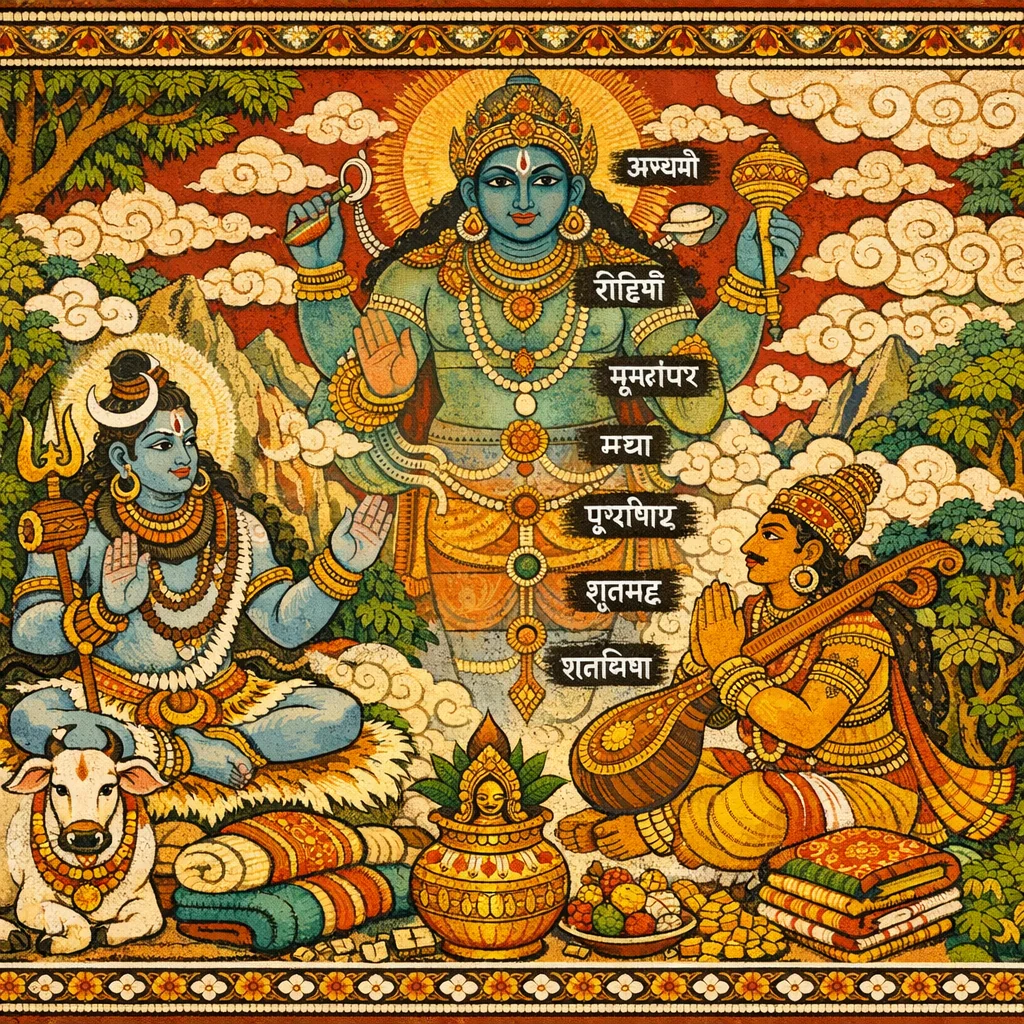
Adhyaya 54: The Nakṣatra-Puruṣa Vrata: Worship of Viṣṇu’s Cosmic Body through the Lunar Mansions
नक्षत्रपुरुषव्रतविधानम्
Speaker: Sūta (narrator), Nārada (questioner), Mahādeva/Īśvara/Śiva (teacher)
Sūta presents a focused teaching on dāna-dharma joined with vows and fasting, as an exact account from the Mahādeva–Nārada dialogue that yields dharma, artha, and kāma. On Kailāsa, Nārada asks Śiva for a practice that makes one a devoted worshipper of Viṣṇu, grants auspicious worldly benefits, and also bestows mokṣa on women, whether married or widowed. Śiva praises the welfare-bringing question and teaches the Nakṣatra-Puruṣa Vrata: on nakṣatra-days beginning with Mūla, worship Vāsudeva’s image in sequence from the feet upward, each limb linked to a lunar mansion and invoked with a specific divine name/mantra, including avatāra forms. In the month of Caitra, arrange brāhmaṇa recitation, keep strict fasting discipline, and conclude by honoring brāhmaṇas and giving the prescribed gifts (a kalaśa with arcā, a cow, a bed, garments, vessels; and a golden Puruṣottama with Lakṣmī). Its fruit is fulfillment of desires, destruction of sins, and honor in Viṣṇu’s world.
Key Concepts
Shlokas in Adhyaya 54
Verse 1
*सूत उवाच अतः परं प्रवक्ष्यामि दानधर्मानशेषतः व्रतोपवाससंयुक्तान् यथामत्स्योदितानिह //
Sūta said: “Now, hereafter, I shall expound in full the religious disciplines of giving (dāna)—together with vows (vrata) and fasts (upavāsa)—exactly as they were taught here by Lord Matsya.”
Verse 2
महादेवस्य संवादे नारदस्य च धीमतः यथावृत्तं प्रवक्ष्यामि धर्मकामार्थसाधकम् //
In the dialogue of Mahādeva and the wise Nārada, I shall relate the account exactly as it occurred—an account that accomplishes Dharma, Kāma, and Artha.
Verse 3
कैलासशिखरासीनम् अपृच्छन्नारदः पुरा विनयनमनङ्गारिम् अनङ्गाङ्गहरं हरम् //
Long ago, Nārada respectfully questioned Hara—seated upon the summit of Kailāsa—who is the foe of Kāma (Ananga) and the destroyer of Ananga’s body (the one who burned Love).
Verse 4
*नारद उवाच भगवन्देवदेवेश ब्रह्मविष्ण्विन्द्रनायक श्रीमदारोग्यरूपायुर् भाग्यसौभाग्यसम्पदा संयुक्तस्तव विष्णोर्वा पुमान्भक्तः कथं भवेत् //
Nārada said: “O Blessed Lord, Lord of the gods, leader of Brahmā, Viṣṇu, and Indra—by what means does a man become a devotee of you (O Viṣṇu), endowed with prosperity, health, beauty, long life, good fortune, auspiciousness, and wealth?”
Verse 5
नारी वा विधवा सर्वगुणसौभाग्यसंयुता क्रमान्मुक्तिप्रदं देव किंचिद्व्रतमिहोच्यताम् //
O Lord, whether a woman is married or widowed—endowed with all virtues and auspicious fortune—please teach here some sacred vow (vrata) which, practiced in proper order, bestows liberation (mokṣa).
Verse 6
*ईश्वर उवाच सम्यक्पृष्टं त्वया ब्रह्मन् सर्वलोकहितावहम् श्रुतमप्यत्र यच्छान्त्यै तद्व्रतं शृणु नारद //
The Lord said: “O Brahmin, you have asked rightly—a question that brings welfare to all the worlds. Even if it has been heard before, for the sake of peace (śānti) listen, O Nārada, to that sacred vow (vrata).”
Verse 7
नक्षत्रपुरुषं नाम व्रतं नारायणात्मकम् पादादि कुर्याद्विधिवद् विष्णुनामानुकीर्तनम् //
One should undertake the vow called “Nakṣatra-Puruṣa,” which is of the very nature of Nārāyaṇa; and, beginning with the feet and proceeding in due order, one should perform it according to rule, accompanied by repeated chanting of the names of Viṣṇu.
Verse 8
प्रतिमां वासुदेवस्य मूलर्क्षादिषु चार्चयेत् चैत्रमासं समासाद्य कृत्वा ब्राह्मणवाचनम् //
One should worship the image of Vāsudeva on auspicious lunar-asterism days beginning with Mūla; and when the month of Caitra arrives, one should arrange for Brāhmaṇas to perform the sacred recitation (vācana).
Verse 9
मूले नमो विश्वधराय पादौ गुल्फावनन्ताय च रोहिणीषु जङ्घे ऽभिपूज्ये वरदाय चैव द्वे जानुनी वाश्विकुमारऋक्षे //
At Mūla, salutations to the Upholder of the Universe (Viśvadhara): the feet are to be worshipped. In Rohiṇī, the ankles are to be adored as Ananta. The shanks are to be duly honored as Varada, and the two knees in the asterism of the Aśvinī-Kumāras.
Verse 10
पूर्वोत्तराषाढयुगे तथोरू नमः शिवायेत्यभिपूजनीयौ पूर्वोत्तराफल्गुनियुग्मके च मेढ्रं नमः पञ्चशराय पूज्यम् //
At the pair (junction) of Pūrvāṣāḍhā and Uttarāṣāḍhā, the two thighs are to be specially worshipped with the mantra “namaḥ śivāya”. And at the pair of Pūrvaphalgunī and Uttaraphalgunī, the generative organ is to be worshipped with the salutation “namaḥ pañcaśarāya” (obeisance to the Five-arrowed one, Kāma).
Verse 11
कटिं नमः शार्ङ्गधराय विष्णोः सम्पूजयेन्नारद कृत्तिकासु तथार्चयेद्भाद्रपदाद्वये च पार्श्वे नमः केशिनिषूदनाय //
With the mantra, “Homage at the waist to Viṣṇu, the bearer of the Śārṅga bow,” one should duly worship that limb. O Nārada, one should likewise perform worship in the Kṛttikā asterism, and also offer worship in the two Bhādrapadas; and at the sides (flanks) one should say, “Homage to Keśiniṣūdana (the slayer of Keśin).”
Verse 12
कुक्षिद्वयं नारद रेवतीषु दामोदरायेत्यभिपूजनीयम् ऋक्षे ऽनुराधासु च माधवाय नमस्तथोरःस्थलमेव पूज्यम् //
O Nārada, under Revatī one should specially worship the two sides of the belly, reverently invoking (Viṣṇu) as “Dāmodara.” Likewise, under Anurādhā one should bow to “Mādhava,” and worship specifically the region of the chest.
Verse 13
पृष्ठं धनिष्ठासु च पूजनीयम् अघौघविध्वंसकराय तच्च श्रीशङ्खचक्रासिगदाधराय नमो विशाखासु भुजाश्च पूज्याः //
On Dhaniṣṭhā, the Lord’s back should be worshipped—He who destroys the multitude of sins, the glorious bearer of conch, discus, sword, and mace. And on Viśākhā, His arms should be worshipped.
Verse 14
हस्ते तु हस्ता मधुसूदनाय नमो ऽभिपूज्या इति कैटभारेः पुनर्वसावङ्गुलिपूर्वभागाः साम्नामधीशाय नमो ऽभिपूज्याः //
Upon the hands: “Hastā—salutations to Madhusūdana,” thus they are to be duly worshipped for the Slayer of Kaiṭabha. Upon the foremost joints of the fingers: “Punarvasu—salutations to the Lord of the Sāmans,” thus they too are to be duly worshipped.
Verse 15
भुजंगनक्षत्रदिने नखानि सम्पूजयेन्मत्स्यशरीरभाजः कूर्मस्य पादौ शरणं व्रजामि ज्येष्ठासु कण्ठे हरिरर्चनीयः //
On the day of the Bhujanga nakṣatra, one should reverently tend and trim the nails, for one who bears the form of Matsya. To the feet of Kūrma I go for refuge; and under the Jyeṣṭhā nakṣatra, Hari is to be worshipped in the region of the throat.
Verse 16
श्रोत्रे वराहाय नमो ऽभिपूज्या जनार्दनस्य श्रवणेन सम्यक् पुष्ये मुखं दानवसूदनाय नमो नृसिंहाय च पूजनीयम् //
Salutations—worthy of reverent worship—to Varāha in the ears. By rightly hearing the praise of Janārdana, one becomes firmly established. In the Puṣya nakṣatra, worship the mouth for Dānavasūdana; and offer worshipful homage to Nṛsiṃha as well.
Verse 17
नमो नमः कारणवामनाय स्वातीषु दन्ताग्रमथार्चनीयम् आस्यं हरेर्भार्गवनन्दनाय संपूजनीयं द्विज वारुणे तु //
Salutations again and again to Kāraṇa-Vāmana, Vāmana as the Supreme Cause. On the Svātī nakṣatra day, the tips of the teeth are to be worshipped; and, O twice-born one, under the Vāruṇa nakṣatra, Hari’s mouth is to be worshipped with full reverence, for Bhārgava’s son (the descendant of Bhṛgu).
Verse 18
नमो ऽस्तु रामाय मघासु नासा संपूजनीया रघुनन्दनस्य मृगोत्तमाङ्गे नयने ऽभिपूज्ये नमो ऽस्तु ते राम विघूर्णिताक्ष //
Salutations to Rāma! In the Maghā nakṣatra, the nose of Raghunandana is to be duly worshipped; and upon that noble visage, the eyes are to be especially adored. Salutations to you, O Rāma, whose eyes whirl and flash with divine power.
Verse 19
बुद्धाय शान्ताय नमो ललाटं चित्रासु संपूज्यतमं मुरारेः शिरो ऽभिपूज्यं भरणीषु विष्णोर् नमो ऽस्तु विश्वेश्वर कल्किरूपिणे //
Homage to the Buddha-form, the tranquil one. In the Citrā nakṣatra, Murāri’s forehead is most worthy of worship. In the Bharaṇī nakṣatra, Viṣṇu’s head is to be specially worshipped. Salutations to the Lord of the universe, who takes the form of Kalki.
Verse 20
आर्द्रासु केशाः पुरुषोत्तमस्य संपूजनीया हरये नमस्ते उपोषितेनर्क्षदिनेषु भक्त्या संपूजनीया द्विजपुंगवाः स्युः //
On the days of the Ārdrā nakṣatra, the hair (locks) of Puruṣottama should be worshipped—salutations to Hari. And on the days marked by the nakṣatras, when one has fasted with devotion, the foremost Brāhmaṇas should likewise be duly honored and worshipped.
Verse 21
पूर्णे व्रते सर्वगुणान्विताय वाग्रूपशीलाय च सामगाय हैमीं विशालायतबाहुदण्डां मुक्ताफलेन्दूपलवज्रयुक्ताम् //
For one who is perfect in sacred observance (vrata), endowed with every virtue—refined in speech, form, and conduct, and skilled in chanting the Sāman hymns—one should fashion a golden image with broad, well-proportioned arms, adorned with pearls, moonstone, gems, and diamonds.
Verse 22
जलस्य पूर्णे कलशे निविष्टाम् अर्चां हरेर्वस्त्रगवा सहैव शय्यां तथोपस्करभाजनादियुक्तां प्रदद्याद्द्विजपुंगवाय //
One should present to an eminent Brāhmaṇa a water-filled pot (kalaśa) in which an image for the worship of Hari has been placed, along with garments and a cow; and also a bed (śayyā) furnished with its accessories, together with vessels and other household requisites.
Verse 23
यद्यस्ति यत्किंचिदिहास्ति देयं दद्याद्द्विजायात्महिताय सर्वम् मनोरथान्नः सफलीकुरुष्व हिरण्यगर्भाच्युतरुद्ररूपिन् //
Whatever is available here and fit to be given—let all of it be given to a dvija (Brāhmaṇa) for one’s own spiritual welfare. O Lord who manifests as Hiraṇyagarbha, as Acyuta, and as Rudra, make our wishes bear fruit.
Verse 24
सलक्ष्मीकं सभार्याय काञ्चनं पुरुषोत्तमम् शय्यां च दद्यान्मन्त्रेण ग्रन्थिभेदविवर्जिताम् //
With the proper mantra, he should donate a golden image of Puruṣottama together with Lakṣmī, and also present a bed (śayyā) to a married couple—one free from knots, seams, or defects caused by binding and joining.
Verse 25
यथा न विष्णुभक्तानां वृजिनं जायते क्वचित् तथा सुरूपतारोग्यं केशवे भक्तिमुत्तमाम् //
Just as no misfortune ever arises for devotees of Viṣṇu, so too do they attain fair form and sound health—through supreme devotion to Keśava.
Verse 26
यथा न लक्ष्म्या शयनं तव शून्यं जनार्दन शय्या ममाप्यशून्यास्तु कृष्ण जन्मनि जन्मनि //
Just as Your couch is never without Lakṣmī, O Janārdana, so too may my resting-place never be bereft of Your presence, O Kṛṣṇa—birth after birth.
Verse 27
एवं निवेद्य तत्सर्वं वस्त्रमाल्यानुलेपनम् नक्षत्रपुरुषज्ञाय विप्रायाथ विसर्जयेत् //
Having thus presented all of that—garments, garlands, and unguents—one should then respectfully dismiss the Brahmin who is skilled in the knowledge of the Nakṣatra-Puruṣa.
Verse 28
भुञ्जीतातैललवणं सर्वर्क्षेष्वप्युपोषितः भोजनं च यथाशक्ति वित्तशाठ्यविवर्जितः //
He should partake only of oil and salt, remaining in a state of fasting on all lunar asterism-days as well; and when he does take food, he should do so according to his capacity, free from any deceit or stinginess regarding wealth.
Verse 29
इति नक्षत्रपुरुषम् उपास्य विधिवत्स्वयम् सर्वान्कामानवाप्नोति विष्णुलोके महीयते //
Thus, having duly worshipped the Nakṣatra-Puruṣa in accordance with the prescribed rite, one attains all desired aims and is honored in the world of Viṣṇu.
Verse 30
ब्रह्महत्यादिकं किंचिद् इह वामुत्र वा कृतम् आत्मना वाथ पितृभिस् तत्सर्वं क्षयमाप्नुयात् //
Whatever sin—beginning with brahmin-slaying—has been committed, whether in this world or the next, whether by oneself or by one’s forefathers, all of it would be brought to destruction, fully exhausted.
Verse 31
इति पठति शृणोति वातिभक्त्या पुरुषवरो व्रतमङ्गनाथ कुर्यात् कलिकलुषविदारणं मुरारेः सकलविभूतिफलप्रदं च पुंसाम् //
Thus, the best of men—reciting and listening with devoted faith—should undertake this sacred observance (vrata) of Lord Murāri, the cleaver of the defilements of the Kali age; for it grants people the fruits of every kind of prosperity and attainment.
Frequently Asked Questions
Adhyāya 54 teaches the Nakṣatra-Puruṣa Vrata: a Viṣṇu-centered vow in which the devotee worships Vāsudeva as the cosmic person by honoring specific limbs on specific nakṣatra-days, reciting appropriate divine names/mantras, observing fasting discipline, and completing the rite with brāhmaṇa-honoring and substantial dāna. The chapter frames it as a practice that grants prosperity and health while also leading toward purification and Viṣṇu-loka.
This chapter is primarily Dharma (vrata-upavāsa and dāna-dharma). It does not treat Vāstu-śāstra, Rājadharma, creation, or genealogy directly; instead it presents ritual timing (nakṣatra observance), bhakti theology of Viṣṇu’s forms/avatāras, and charity prescriptions as the core disciplines.
The rite proceeds from feet upward, assigning worship of particular limbs to particular nakṣatras (e.g., feet at Mūla; ankles at Rohiṇī; chest at Anurādhā; back at Dhaniṣṭhā; arms at Viśākhā; hands at Hastā; forehead at Citrā; head at Bharaṇī; hair at Ārdrā), with each limb invoked by a corresponding name/mantra of Viṣṇu or an avatāra-identification.
The chapter prescribes major gifts to a worthy brāhmaṇa: a water-filled pot (kalasha) containing Hari’s worship-image, garments, a cow, a bed with accessories, and household vessels; additionally, a golden image of Puruṣottama with Lakṣmī is to be donated, and a defect-free bed is given to a married couple, alongside offerings such as garlands and unguents.
It promises fulfillment of desired aims, honor in Viṣṇu-loka, and the destruction/exhaustion of sins—including grave sins such as brahmahatyā—whether committed by oneself or associated with one’s forefathers, emphasizing the vrata as a Kali-age purifier centered on Murāri.