Adhyaya 6: Genealogy of Kaśyapa: Ādityas, Daityas, Dānavas, Nāgas, Birds, and Cosmic Lineages
कश्यपवंशवर्णनम्
Speaker: Sūta (narrator), Ṛṣis (listeners/inquirers)
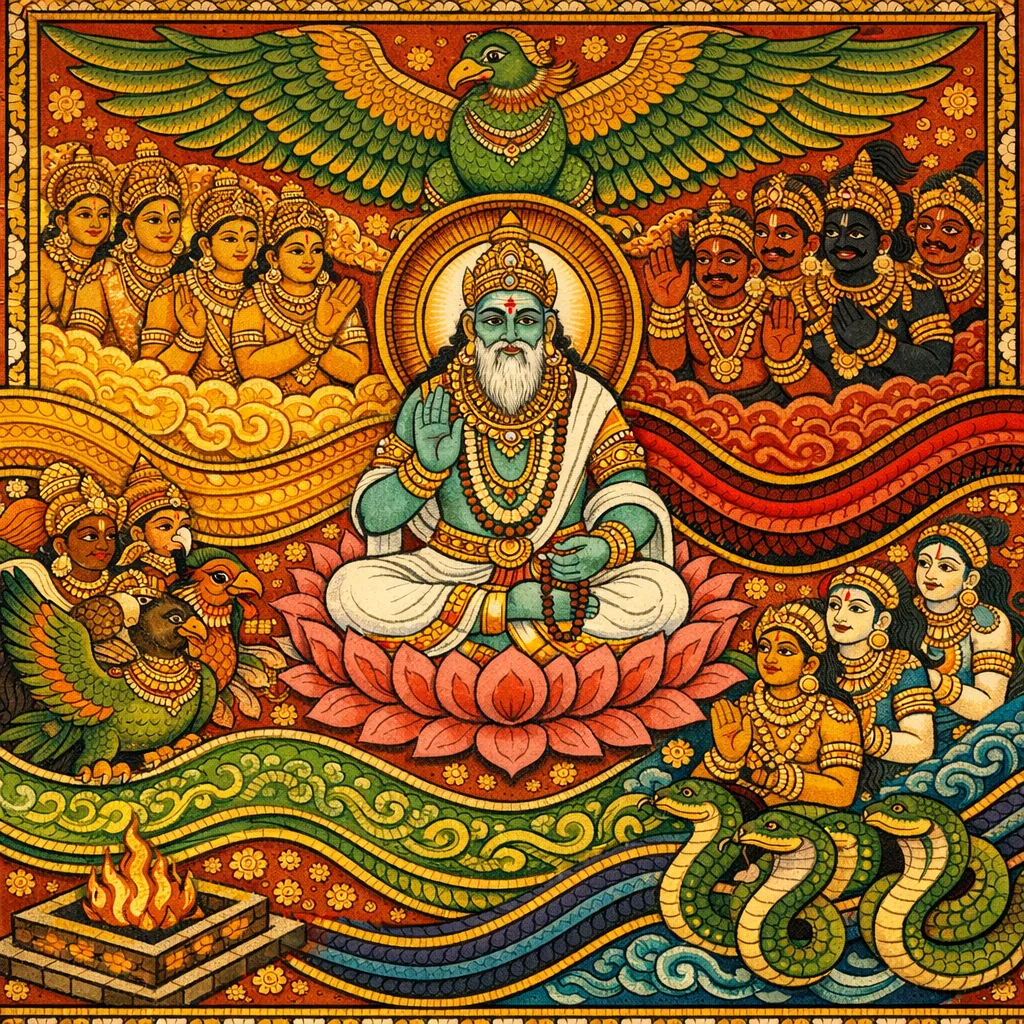
Continuing the cosmological catalogue, Sūta declares he will recount Kaśyapa’s sons and grandsons through his many wives. He first places Aditi’s children as the Twelve Ādityas remembered across the Manvantaras, then turns to Diti’s Daitya line (Hiraṇyakaśipu, Hiraṇyākṣa, and their descendants) and to Danu’s Dānava hosts, noting key names and marriage links. The account widens from divine clans to species-origins: Tāmra’s daughters generate kinds of birds; Vinatā’s line culminates in Garuḍa and Aruṇa and their progeny; Surasā and Kadrū bring forth serpent multitudes, with a canonical list of principal Nāgas. The chapter closes by mentioning other creations (Rudra-gaṇas, cows/buffaloes, sages, apsarases, yakṣas/rākṣasas, vegetation) and Diti’s forty-nine Maruts, tying genealogy to recurring cycles of creation and dissolution.
Key Concepts
Shlokas in Adhyaya 6
Verse 1
कश्यपस्य प्रवक्ष्यामि पत्नीभ्यः पुत्रपौत्रकान् अदितिर्दितिर्दनुश्चैव अरिष्टा सुरसा तथा //
I shall now recount the sons and grandsons born to Kaśyapa through his wives—Aditi, Diti, Danu, as well as Ariṣṭā and Surasā.
Verse 2
सुरभिर् विनता तद्वत् ताम्रा क्रोधवशा इरा कद्रूर्विश्वा मुनिस् तद्वत् तासां पुत्रान् निबोधत //
Surabhī and Vinatā likewise (became mothers); so too Tāmrā, Krodhavaśā, Irā, Kadrū, and Viśvā; and Muni as well. Now, learn of the sons born to them.
Verse 3
तुषिता नाम ये देवाश् चाक्षुषस्यान्तरे मनोः वैवस्वते ऽन्तरे चैते आदित्या द्वादश स्मृताः //
Those gods known as the Tuṣitas—during the Manvantara of Cākṣuṣa Manu—and likewise in the Manvantara of Vaivasvata Manu, are remembered as the Twelve Ādityas.
Verse 4
इन्द्रो धाता भगस् त्वष्टा मित्रो ऽथ वरुणो यमः विवस्वान्सविता पूषा अंशुमान् विष्णुर् एव च //
Indra; Dhātṛ; Bhaga; Tvaṣṭṛ; then Mitra, Varuṇa, and Yama; Vivasvān, Savitṛ, Pūṣan, Aṁśumān—and Viṣṇu as well—(these are the deities being enumerated).
Verse 5
एते सहस्रकिरणा आदित्या द्वादश स्मृताः मारीचात्कश्यपादाप पुत्रानदितिरुत्तमान् //
These radiant deities, thousand-rayed, are remembered as the twelve Ādityas. From Marīci came Kaśyapa, and from Kaśyapa the noble Aditi obtained these excellent sons.
Verse 6
भृशाश्वस्य ऋषेः पुत्रा देवप्रहरणाः स्मृताः एते देवगणा विप्राः प्रतिमन्वन्तरेषु च //
The sons of the sage Bhṛśāśva are remembered as the Devapraharaṇas. These divine hosts, O brāhmaṇa, appear in each Manvantara.
Verse 7
उत्पद्यन्ते प्रलीयन्ते कल्पे कल्पे तथैव च दितिः पुत्रद्वयं लेभे कश्यपाद् इति नः श्रुतम् //
They arise and they dissolve—so it is in every kalpa, again and again. And we have heard that Diti obtained two sons from Kaśyapa.
Verse 8
हिरण्यकशिपुं चैव हिरण्याक्षं तथैव च हिरण्यकशिपोस्तद्वज् जातं पुत्रचतुष्टयम् //
And (there were) Hiraṇyakaśipu as well, and likewise Hiraṇyākṣa; and from Hiraṇyakaśipu, in that same manner, a set of four sons was born.
Verse 9
प्रह्लादश् चानुह्लादश्च संह्लादो ह्लाद एव च प्रह्लादपुत्र आयुष्मान् शिबिर् बाष्कल एव च //
And (there were) Prahlāda, and Anuhlāda, and Saṃhlāda, and also Hlāda. And (from) Prahlāda’s son (came) Āyuṣmān; and (then) Śibir and Bāṣkala as well.
Verse 10
विरोचनश् चतुर्थश्च स बलिं पुत्रमाप्तवान् बलेः पुत्रशतं त्व् आसीद् बाणज्येष्ठं ततो द्विजाः //
Virocana was the fourth; he obtained a son named Bali. And Bali had a hundred sons—of whom Bāṇa was the eldest, O twice-born sages.
Verse 11
धृतराष्ट्रस् तथा सूर्यश् चन्द्रश्चन्द्रांशुतापनः निकुम्भनाभो गुर्वक्षः कुक्षिभीमो विभीषणः //
Also (are named) Dhṛtarāṣṭra; Sūrya (the Sun); Candra (the Moon); Candrāṃśu-tāpana, “the heater by moon-rays”; Nikumbha-nābha, “he whose navel is like Nikumbha”; Gurv-akṣa, “heavy-eyed”; Kukṣi-bhīma, “terrible in the belly”; and Vibhīṣaṇa.
Verse 12
एवमाद्यास् तु बहवो बाणज्येष्ठा गुणाधिकाः बाणः सहस्रबाहुश् च सर्वास्त्रगणसंयुतः //
Thus there were many others of that kind—pre-eminent with Bāṇa as the eldest—surpassing in virtues. And Bāṇa, the thousand-armed one, was endowed with hosts of every weapon.
Verse 13
तपसा तोषितो यस्य पुरे वसति शूलभृत् महाकालत्वम् अगमत् साम्यं यश्च पिनाकिनः //
In that city, the Trident-bearer (Śiva), pleased by austerity, dwells; and he attained the state of Mahākāla, becoming equal in glory to the wielder of the Pināka bow.
Verse 14
हिरण्याक्षस्य पुत्रो ऽभूद् उलूकः शकुनिस्तथा भूतसंतापनश् चैव महानाभस्तथैव च //
Hiraṇyākṣa had sons—Ulūka, Śakuni, Bhūtasaṃtāpana, and also Mahānābha.
Verse 15
एतेभ्यः पुत्रपौत्राणां कोटयः सप्तसप्ततिः महाबला महाकाया नानारूपा महौजसः //
From these ancestors arose seventy-seven crores of sons and grandsons—mighty in strength, vast in stature, of many forms, and radiant with great energy.
Verse 16
दनुः पुत्रशतं लेभे कश्यपाद् बलदर्पितम् विप्रचित्तिः प्रधानो ऽभूद् येषां मध्ये महाबलः //
Danu obtained a hundred sons from Kaśyapa—sons intoxicated with their own might. Among them, the great and powerful Vipracitti became the foremost.
Verse 17
द्विमूर्धा शकुनिश्चैव तथा शङ्कुशिरोधरः अयोमुखः शम्बरश् च कपिशो नामतस्तथा //
Dvimūrdhā, Śakuni, and also Śaṅkuśirodhara; Ayomukha, Śambara, and likewise Kapiśa—these are their names as they are known.
Verse 18
मारीचिर् मेघवांश्चैव इरा गर्भशिरास् तथा विद्रावणश्च केतुश्च केतुवीर्यः शतह्रदः //
Marīci, Meghavān, and also Irā; likewise Garbhaśiras; and Vidrāvaṇa, Ketu, Ketuvīrya, and Śatahrada—these are the names enumerated here.
Verse 19
इन्द्रजित् सप्तजिच्चैव वज्रनाभस्तथैव च एकचक्रो महाबाहुर् वज्राक्षस् तारकस् तथा //
Indrajit, Saptajit, and also Vajranābha; likewise Ekacakra, the mighty-armed one; Vajrākṣa, and also Tāraka—these are the names enumerated here in sequence.
Verse 20
असिलोमा पुलोमा च बिन्दुर्बाणो महासुरः स्वर्भानुर्वृषपर्वा च एवमाद्या दनोः सुताः //
Asilomā, Pulomā, Bindu, Bāṇa the great Asura, and also Svarbhānu and Vṛṣaparvā—these were the principal sons of Danu.
Verse 21
स्वर्भानोस्तु प्रभा कन्या शची चैव पुलोमजा उपदानवी मयस्यासीत् तथा मन्दोदरी कुहूः //
Svarbhānu’s daughter was Prabhā; and Śacī was the daughter of Puloman. Upadānavī became the wife of Maya; likewise there were Mandodarī and Kuhū.
Verse 22
शर्मिष्ठा सुन्दरी चैव चन्द्रा च वृषपर्वणः पुलोमा कालका चैव वैश्वानरसुते हि ते //
Śarmiṣṭhā, Sundarī, and Candrā—these were daughters of Vṛṣaparvan; and Pulomā and Kālakā—these indeed were the two daughters of Vaiśvānara.
Verse 23
बह्वपत्ये महासत्त्वे मारीचस्य परिग्रहे तयोः षष्टिसहस्राणि दानवानामभूत्पुरा //
In the household of Marīci—abounding in offspring and great vitality—there were, from those two spouses, formerly sixty thousand Dānava descendants.
Verse 24
पौलोमान्कालकेयांश्च मारीचो ऽजनयत्पुरा अवध्या ये ऽमराणां वै हिरण्यपुरवासिनः //
In ancient times Marīci begot the Paulomas and the Kālakeyas—those dwellers of Hiraṇyapura who were indeed invincible to the gods.
Verse 25
चतुर्मुखाल्लब्धवरास् ते हता विजयेन तु विप्रचित्तिः सैंहिकेयान् सिंहिकायाम् अजीजनत् //
Though they had obtained boons from the four-faced Brahmā, they were nonetheless slain by Vijaya. Vipracitti, however, begot the Saiṃhikeyas upon Siṃhikā.
Verse 26
हिरण्यकशिपोर्ये वै भागिनेयास् त्रयोदश व्यंसः कल्पश्च राजेन्द्र नलो वातापिरेव च //
O king, the nephews of Hiraṇyakaśipu were thirteen in number—among them Vyaṃsa, Kalpa, Nala, and Vātāpi.
Verse 27
इल्वलो नमुचिश्चैव श्वसृपश् चाजनस् तथा नरकः कालनाभश्च सरमाणस् तथैव च //
Ilvala and Namuci, and also Śvasṛpa and Ajana; Naraka and Kālanābha, and likewise Saramāṇa—these too are named among them.
Verse 28
कालवीयेश् च विख्यातो दनुवंशविवर्धनाः संह्रादस्य तु दैत्यस्य निवातकवचाः स्मृताः //
Kālavīya too is renowned as one who expanded the lineage of Danu. And the Nivātakavacas are remembered as the descendants of the Daitya Saṃhrāda.
Verse 29
अवध्याः सर्वदेवानां गन्धर्वोरगरक्षसाम् ये हता भर्गम् आश्रित्य त्व् अर्जुनेन रणाजिरे //
Those who were deemed ‘unslayable’ by all the gods—Gandharvas, Nāgas, and Rākṣasas—were nonetheless slain by Arjuna on the battlefield, after he took refuge in Bharga, the blazing divine power.
Verse 30
षट्कन्या जनयामास ताम्रा मारीचबीजतः शुकी श्येनी च भासी च सुग्रीवी गृध्रिका शुचिः //
From Marīci’s seed, Tāmra gave birth to six daughters—Śukī, Śyenī, Bhāsī, Sugrīvī, Gṛdhrikā, and Śuci.
Verse 31
शुकी शुकानुलूकांश्च जनयामास धर्मतः श्येनी श्येनांस्तथा भासी कुररानप्यजीजनत् //
In accordance with the ordained order (dharma), Śukī bore parrots and owls; likewise Śyenī bore hawks, and Bhāsī also gave birth to kuraras, raptors akin to the osprey.
Verse 32
गृध्री गृध्रान्कपोतांश्च पारावतविहंगमान् हंससारसक्रौञ्चांश् च प्लवाञ्छुचिरजीजनत् //
Then the creative power brought forth Gṛdhrī and the vultures, pigeons and doves (and other birds), along with swans, cranes, and krauñca-birds, and also the plava-birds—pure in their kind—into existence.
Verse 33
अजाश्वमेषोष्ट्रखरान् सुग्रीवी चाप्यजीजनत् एष ताम्रान्वयः प्रोक्तो विनतायां निबोधत //
Sugrīvī also gave birth to goats, horses, sheep, camels, and donkeys. Thus has the lineage of Tāmra been declared—understand it as it is recounted in the account connected with Vinatā.
Verse 34
गरुडः पततां नाथः अरुणश्च पतत्रिणाम् सौदामनी तथा कन्या येयं नभसि विश्रुता //
Garuḍa is the lord of those that fly, and Aruṇa is the chief of birds; likewise Saudāmanī—this maiden famed in the sky—is lightning.
Verse 35
सम्पातिश् च जटायुश्च अरुणस्य सुताव् उभौ सम्पातिपुत्रो बभ्रुश्च शीघ्रगश्चापि विश्रुतः //
Sampāti and Jaṭāyu were both sons of Aruṇa. Sampāti’s son was Babhru; Śīghraga too is renowned.
Verse 36
जटायुषः कर्णिकारः शतगामी च विश्रुतौ सारसो रज्जुवालश्च भेरुण्डश्चापि तत्सुताः //
Of Jaṭāyuṣa, these were the sons: Karṇikāra; and the two renowned ones, Śatagāmī and Viśruta; also Sārasa, Rajjuvāla, and Bheruṇḍa.
Verse 37
तेषामनन्तमभवत् पक्षिणां पुत्रपौत्रकम् सुरसायाः सहस्रं तु सर्पाणाम् अभवत्पुरा //
From them there arose an endless lineage of birds—sons and grandsons without limit; and from Surasā, in former times, a thousand serpents came into being.
Verse 38
सहस्रशिरसां कद्रूः सहस्रं चापि सुव्रत प्रधानास्तेषु विख्याताः षड्विंशतिर् अरिंदम //
Kadrū, O noble one, gave birth to a thousand serpent-lords of a thousand heads; among them, O subduer of foes, twenty-six are famed as the principal ones.
Verse 39
शेषवासुकिकर्कोटशङ्खैरावतकम्बलाः धनंजयमहानीलपद्माश्वतरतक्षकाः //
Śeṣa, Vāsuki, Karkoṭa, Śaṅkha, Airāvata, and Kambala; likewise Dhanaṃjaya, Mahānīla, Padma, Aśvatara, and Takṣaka—these are the eminent Nāgas (serpent-lords).
Verse 40
एलापत्त्रमहापद्मधृतराष्ट्रबलाहकाः शङ्खपालमहाशङ्खपुष्पदंष्ट्रशुभाननाः //
Elāpattra, Mahāpadma, Dhṛtarāṣṭra, Balāhaka, Śaṅkhapāla, Mahāśaṅkha, Puṣpadaṃṣṭra, and Śubhānana—these are among the renowned Nāga lords.
Verse 41
शङ्कुरोमा च बहुलो वामनः पाणिनस्तथा कपिलो दुर्मुखश्चापि पतञ्जलिरिति स्मृताः //
Śaṅkuromā, Bahula, Vāmana, and likewise Pāṇini; also Kapila, Durmukha, and Patañjali—these are remembered in the tradition.
Verse 42
एषामनन्तमभवत् सर्वेषां पुत्रपौत्रकम् प्रायशो यत्पुरा दग्धं जनमेजयमन्दिरे //
For these royal lineages, the succession of sons and grandsons became, as it were, unending—though much of it was formerly burned (lost) in King Janamejaya’s palace.
Verse 43
रक्षोगणं क्रोधवशा स्वनामानम् अजीजनत् दंष्ट्रिणां नियुतं तेषां भीमसेनादगात्क्षयम् //
Overpowered by wrath, they brought forth a host of rākṣasas, each bearing its own name; and of those tusked ones, a full myriad met destruction at the hands of Bhīmasena.
Verse 44
रुद्राणां च गणं तद्वद् गोमहिष्यो वराङ्गनाः सुरभिर्जनयामास कश्यपात्संयतव्रता //
Likewise, Surabhī—the noble-limbed lady of restrained vows—bore, from Kaśyapa, the hosts of the Rudras, and also cows and buffaloes.
Verse 45
मुनिर्मुनीनां च गणं गणमप्सरसां तथा तथा किंनरगन्धर्वान् अरिष्टाजनयद् बहून् //
The sage named Ariṣṭa brought forth many groups—companies of sages, as well as companies of Apsarases, and likewise many Kiṃnaras and Gandharvas.
Verse 46
तृणवृक्षलतागुल्मम् इरा सर्वम् अजीजनत् विश्वा तु यक्षरक्षांसि जनयामास कोटिशः //
Irā brought forth all grasses, trees, creepers, and shrubs; and Viśvā, in countless numbers, generated the Yakṣas and the Rākṣasas.
Verse 47
तत एकोनपञ्चाशन् मरुतः कश्यपाद्दितिः जनयामास धर्मज्ञान् सर्वानमरवल्लभान् //
Then Diti, by Kaśyapa, gave birth to forty-nine Maruts—each a knower of dharma, and all beloved of the immortals (the gods).
Frequently Asked Questions
The chapter’s primary purpose is genealogical-cosmological: it teaches how the universe’s major divine and non-human communities (Ādityas, Maruts, Daityas, Dānavas, Nāgas, birds, animals, vegetation, yakṣas/rākṣasas) are organized through Kaśyapa’s progeny, and how these lineages recur across Manvantaras and kalpa cycles of creation and dissolution.
This adhyāya is predominantly Genealogy and Sṛṣṭi (creation taxonomy). It touches Dharma indirectly through the idea of ordained order (dharma) in species-propagation and through the moral-historical backdrop of later conflicts (e.g., Daitya/Dānava lines). It does not teach Vāstu-śāstra or architectural measurements in this chapter.
The text enumerates: Indra, Dhātṛ, Bhaga, Tvaṣṭṛ, Mitra, Varuṇa, Yama, Vivasvān, Savitṛ, Pūṣan, Aṁśumān, and Viṣṇu—identified as the Twelve Ādityas.
Among the principal Nāgas named are Śeṣa, Vāsuki, Karkoṭa, Śaṅkha, Airāvata, Kambala, Dhanaṃjaya, Mahānīla, Padma, Aśvatara, Takṣaka, Elāpattra, Mahāpadma, Dhṛtarāṣṭra, Balāhaka, Śaṅkhapāla, Mahāśaṅkha, Puṣpadaṃṣṭra, Śubhānana, Śaṅkuromā, Bahula, Vāmana, Pāṇini, Kapila, Durmukha, and Patañjali.