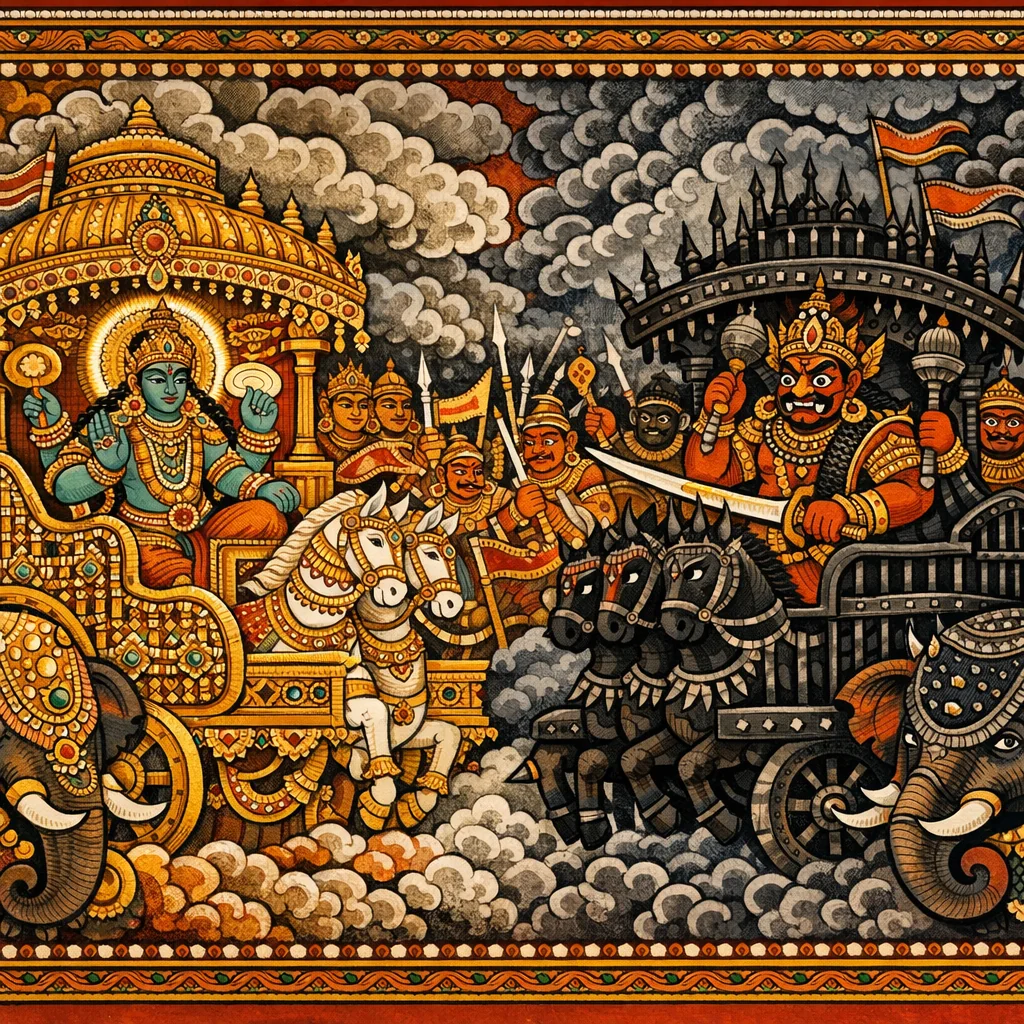
Adhyaya 173: Description of the Daitya–Dānava War Preparations and Maya’s Divine Chariots
दानवदैत्यसैन्यरथनिर्माणवर्णनम्
Speaker: Lord Matsya
Matsya relates that, after hearing Viṣṇu’s reassuring words, the Daityas and Dānavas intensify their preparations for war and victory. Maya builds an immense golden chariot, enduring to the end of the age, adorned with bells, skins, lattices of gems and gold, banners, and a domed superstructure, its grandeur likened to the ocean and Mount Mandara. A second, darker chariot of divine black iron is then described, with metal-bound beams, iron lattices, barred openings, spikes, and defensive throw-weapons. The narrative turns to mobilization as the chief Dānava leaders take their stations—Virocana, Hayagrīva, Varāha, Khara, Tvaṣṭā (mounted on a named elephant), Śveta, Ariṣṭa, Variṣṭha, Kiśora, and Lamba—while the host arms itself with maces, clubs, nooses, spears, axes, śataghnīs, and discs. The chapter ends with the army standing against the gods, swelling like storm-clouds, an omen of the battle-flood about to rise.
Key Concepts
Shlokas in Adhyaya 173
Verse 1
*मत्स्य उवाच ततो ऽभयं विष्णुवचः श्रुत्वा दैत्याश्च दानवाः उद्योगं विपुलं चक्रुर् युद्धाय विजयाय च //
Lord Matsya said: Then, having heard the fearless, assuring words of Viṣṇu, the Daityas and the Dānavas undertook vast preparations—both for battle and for victory.
Verse 2
मयस्तु काञ्चनमयं त्रिनल्वायतमक्षयम् चतुश्चक्रं सुविपुलं सुकल्पितमहायुगम् //
But Maya (the master architect) fashioned an imperishable structure made of gold—measuring three nalvas in length—very spacious, fitted with four wheels, and excellently designed to endure for a great age (mahāyuga).
Verse 3
किङ्किणीजालनिर्घोषं द्वीपिचर्मपरिष्कृतम् रुचिरं रत्नजालैश्च हेमजालैश्च शोभितम् //
Resounding with the tinkling of nets of little bells, refined with leopard-skin coverings, and pleasing to behold—adorned with lattices of gems as well as lattices of gold.
Verse 4
ईहामृगगणाकीर्णं पक्षिपङ्क्तिविराजितम् दिव्यास्त्रतूणीरधरं पयोधरविनादितम् //
It was thronged with herds of īhā‑deer, adorned by rows of birds, furnished with quivers bearing divine missiles, and resonant with the rumbling of rain-bearing clouds.
Verse 5
स्वक्षं रथवरोदारं सूपस्थं गगनोपमम् गदापरिघसम्पूर्णं मूर्तिमन्तमिवार्णवम् //
With well-made axles, a splendid and spacious chariot—well-seated and vast like the sky—fully furnished with mace and iron club, it appeared like the ocean itself given bodily form.
Verse 6
हेमकेयूरवलयं स्वर्णमण्डलकूबरम् सपताकध्वजोपेतं सादित्यमिव मन्दरम् //
Adorned with golden armlets and circlets, furnished with a golden domed/arched superstructure, and equipped with banners and flags—(it appeared) like Mandara mountain, radiant as the sun.
Verse 7
गजेन्द्राभोगवपुषं क्वचित्केसरिवर्चसम् युक्तमृक्षसहस्रेण समृद्धाम्बुदनादितम् //
In one form it has the massive, expansive body of a lordly elephant; in another, the splendour of a lion. It is attended by a thousand bears, and it resounds like a sky filled with swelling thunderclouds.
Verse 8
दीप्तमाकाशगं दिव्यं रथं पररथारुजम् अध्यतिष्ठद्रणाकाङ्क्षी मेरुं दीप्त इवांशुमान् //
Yearning for battle, the radiant hero mounted that divine, sky-moving chariot—one that shattered the chariots of foes—like the blazing sun alighting upon Mount Meru.
Verse 9
तारमुत्क्रोशविस्तारं सर्वं हेममयं रथम् शैलाकारमसंबाधं नीलाञ्जनचयोपमम् //
He described a chariot of vast extent, wholly made of gold—mountain-like in form, unobstructed and spacious, and resembling a mass of dark blue collyrium.
Verse 10
कार्ष्णायसमयं दिव्यं लोहेषाबद्धकूबरम् तिमिरोद्गारिकिरणं गर्जन्तमिव तोयदम् //
Made of divine black iron, with its fittings and cross-beams firmly bound in metal, it sends forth rays as though dispelling darkness—like a rain-cloud that seems to thunder.
Verse 11
लोहजालेन महता सगवाक्षेण दंशितम् आयसैः परिघैः पूर्णं क्षेपणीयैश्च मुद्गरैः //
It should be fitted with a great iron lattice, furnished with barred openings, and made bristling—fully stocked with iron crossbars, with throw-able clubs and hammers for defence.
Verse 12
प्रासैः पाशैश्च विततैर् असंयुक्तैश्च कण्टकैः शोभितं त्रासयानैश्च तोमरैश्च परश्वधैः //
It was adorned with spears and with outstretched nooses, and with barbed spikes set apart; and also with fearsome weapons—javelins and battle-axes—meant to strike terror.
Verse 13
उद्यन्तं द्विषतां हेतोर् द्वितीयमिव मन्दरम् युक्तं खरसहस्रेण सो ऽध्यारोहद्रथोत्तमम् //
To rise up against the cause (and threat) of hostile foes—like a second Mandara mountain—he mounted that excellent chariot, harnessed with a thousand asses (strong draught-animals).
Verse 14
विरोचनस्तु संक्रुद्धो गदापाणिरवस्थितः प्रमुखे तस्य सैन्यस्य दीप्तशृङ्ग इवाचलः //
Virocana, enraged, stood firm with his mace in hand at the forefront of that army—like a mountain with blazing peaks.
Verse 15
युक्तं रथसहस्रेण हयग्रीवस्तु दानवः स्यन्दनं वाहयामास सपत्नानीकमर्दनः //
Then Hayagrīva, that Dānava—crusher of the enemy host—had his chariot conveyed, harnessed with a thousand chariots (in support/escort).
Verse 16
व्यायतं किष्कुसाहस्रं धनुर्विस्फारयन्महत् वराहः प्रमुखे तस्थौ सप्ररोह इवाचलः //
Stretching a mighty bow to the span of a thousand kiṣkus and twanging it with force, Varāha stood at the very front—motionless and towering, like a mountain with its ridges and outgrowths.
Verse 17
खरस्तु विक्षरन्दर्पान् नेत्राभ्यां रोषजं जलम् स्फुरद्दन्तोष्ठनयनः सङ्ग्रामं सो ऽभ्यकाङ्क्षत //
But Khara—his pride overflowing—shed from his eyes the water born of wrath; with flashing teeth, lips, and eyes, he longed for battle.
Verse 18
त्वष्टा त्वष्टगजं घोरं यानमास्थाय दानवः व्यूहितुं दानवव्यूहं परिचक्राम वीर्यवान् //
The mighty Dānava Tvaṣṭā, mounting the fearsome elephant named Tvaṣṭa-gaja, moved about to arrange the battle-formation of the Dānavas.
Verse 19
विप्रचित्तिसुतः श्वेतः श्वेतकुण्डलभूषणः श्वेतशैलप्रतीकाशो युद्धायाभिमुखे स्थितः //
Śveta, the son of Vipracitti—adorned with white earrings and radiant like a white mountain—stood facing forward, ready for battle.
Verse 20
अरिष्टो बलिपुत्रश्च वरिष्ठो ऽद्रिशिलायुधः युद्धायाभिमुखस्तस्थौ धराधरविकम्पनः //
Ariṣṭa, the son of Bali, and Variṣṭha—whose weapon was a rock from the mountain—stood facing the battle, causing the very earth and its supporting mountains to tremble.
Verse 21
किशोरस्त्वतिसंहर्षात् किशोर इति चोदितः सबला दानवाश्चैव संनह्यन्ते यथाक्रमम् //
And Kiśora, thrilled with great excitement, was urged on with the cry “Kiśora!”; and the Dānavas too—together with their forces—began to arm themselves in due order.
Verse 22
अभवद्दैत्यसैन्यस्य मध्ये रविरिवोदितः लम्बस्तु नवमेघाभः प्रलम्बाम्बरभूषणः //
In the midst of the Daitya army, Lamba arose like the sun at dawn—dark as a fresh rain-cloud, adorned with long garments and ornaments.
Verse 23
दैत्यव्यूहगतो भाति सनीहार इवांशुमान् स्वर्भानुरास्ययोधी तु दशनोष्ठेक्षणायुधः //
Set within the Daityas’ battle-formation, he shone like the sun veiled by mist; and that warrior of the lineage of Svarbhānu bore teeth, lips, and eyes as his weapons.
Verse 24
हसंस्तिष्ठति दैत्यानां प्रमुखे स महाग्रहः अन्ये हयगतास्तत्र गजस्कन्धगताः परे //
Laughing, that mighty seizer stood at the very front of the Daityas. Some others were mounted on horses there, while still others sat upon the shoulders (backs) of elephants.
Verse 25
सिंहव्याघ्रगताश्चान्ये वराहर्क्षेषु चापरे केचित्खरोष्ट्रयातारः केचिच्छ्वापदवाहनाः //
Some are shown riding lions and tigers; others, again, upon boars and bears. Some are depicted as mounted on donkeys or camels, and some as having wild beasts as their vehicles.
Verse 26
पत्तिनस्त्वपरे दैत्या भीषणा विकृताननाः एकपादार्धपादाश्च ननृतुर्युद्धकाङ्क्षिणः //
Other Daityas, serving as foot-soldiers, were dreadful, with grotesque faces; some were one-legged and some half-legged, and, longing for battle, they danced about.
Verse 27
आस्फोटयन्तो बहवः क्ष्वेडन्तश्च तथा परे हृष्टशार्दूलनिर्घोषा नेदुर्दानवपुंगवाः //
Many of the Danavas clapped and slapped their arms in challenge; others whistled and whooped. Exultant, roaring like thrilled tigers, those foremost among the Danavas bellowed aloud.
Verse 28
ते गदापरिघैरुग्रैः शिलामुसलपाणयः बाहुभिः परिघाकारैस् तर्जयन्ति स्म देवताः //
Wielding fierce maces and iron clubs, with stones and pestles in their hands—and with arms shaped like heavy bars—they threatened the gods.
Verse 29
पाशैः प्रासैश्च परिघैस् तोमराङ्कुशपट्टिशैः चिक्रीडुस्ते शतघ्नीभिः शतधारैश्च मुद्गरैः //
They sported in battle with nooses and spears, with iron clubs and lances, with goads and battle-axes; and they played on with śataghnīs (missile-weapons) and with many-bladed weapons, and with heavy maces.
Verse 30
गण्डशैलैश्च शैलैश्च परिघैश्चोत्तमायसैः चक्रैश्च दैत्यप्रवराश् चक्रुर् आनन्दितं बलम् //
With massive boulders, with mountain-rocks, with iron clubs of the finest metal, and with discus-weapons too, the foremost among the Dāityas made their army exultant (and eager for battle).
Verse 31
एतद्दानवसैन्यं तत् सर्वं युद्धमदोत्कटम् देवानभिमुखे तस्थौ मेघानीकमिवोद्धतम् //
That entire host of the Dānavas—fierce with the intoxication of battle—stood facing the gods, swelling up like a mass of storm-clouds.
Verse 32
तदद्भुतं दैत्यसहस्रगाढं वाय्वग्निशैलाम्बुदतोयकल्पम् बलं रणौघाभ्युदये ऽभ्युदीर्णं युयुत्सयोन्मत्तम् इवाबभासे //
That wondrous force—packed tight with thousands of Dānavas—seemed like wind and fire, like mountains and storm-clouds, like the surge of waters; and as the flood of battle rose, it swelled up, appearing as though maddened with the desire to fight.
Frequently Asked Questions
Adhyaya 173 is primarily descriptive rather than prescriptive: it showcases how the Asura host prepares for war, using the construction of extraordinary chariots (especially by Maya) and the cataloging of leaders, mounts, and weapons to convey the scale, organization, and hubris of the Daitya–Dānava forces before confronting the gods.
The chapter is not a Vastu-śāstra or Rajadharma instruction section, nor a genealogical list. Its main topics are Purāṇic battle narrative (Deva–Asura conflict), martial material culture (chariot engineering, armaments, mounts), and battle-formation organization (vyūha), framed within Matsya’s narration.
Maya is presented as the master builder who fashions an ‘imperishable’ golden chariot of vast dimensions, richly ornamented and engineered to endure for a mahāyuga—highlighting supernatural craftsmanship and the Asuras’ capacity for grand, technically sophisticated war equipment.
The text emphasizes iron-bound construction, iron lattices and barred openings, spikes, and defensive throw-weapons (clubs/hammers), along with spears, nooses, javelins (tomara), battle-axes (paraśvadha), heavy maces, śataghnīs, and cakra-like disc weapons—portraying the chariots as both mobile platforms and fortified engines.