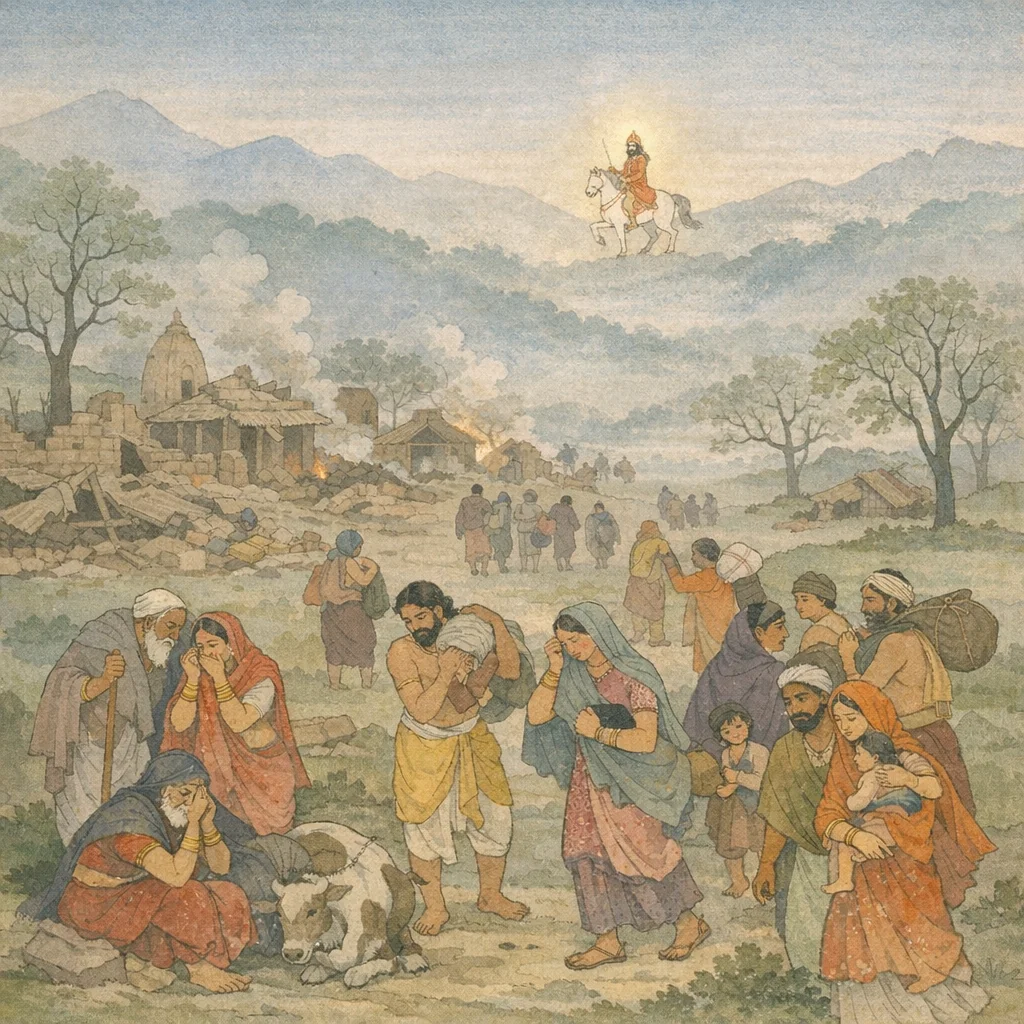
Adhyaya 191
इन्द्रद्युम्नोपाख्यानम् (Indradyumna Upākhyāna: On Kīrti, Smṛti, and Restoration)
Upa-parva: Mārkaṇḍeya–Indradyumna Upākhyāna (Kīrti–Smṛti Inquiry Episode)
Vaiśaṃpāyana reports that the Pāṇḍavas and ṛṣis ask Mārkaṇḍeya whether anyone is older than he. Mārkaṇḍeya recounts the case of the rājarṣi Indradyumna, fallen from the heavenly realm due to exhausted merit and facing the claim that his fame has lapsed. Seeking confirmation of his identity, Indradyumna is directed to Himavat to consult the owl Prākārakarṇa; the owl cannot recognize him but refers him to the crane Nāḍījaṅgha at Indradyumna Lake. The crane likewise cannot recognize him and points to the tortoise Akūpāra as older. Summoned, Akūpāra, after reflection and emotional agitation, recognizes Indradyumna and recalls repeated sacrificial contexts and the lake’s association with the king’s gifts (notably cows given as dakṣiṇā). Upon this testimony, a divine chariot manifests, and didactic verses state that the ‘sound’ of meritorious action reaches heaven and earth; as long as that sound persists one is regarded as a true person, whereas notorious speech leads to decline. Indradyumna then arranges proper placement for the aged witnesses and is restored to an appropriate celestial station. A closing reference recalls Kṛṣṇa’s rescue of King Nṛga, aligning the theme of restoration with divine mediation.
Chapter Arc: वैशम्पायन के वचन से प्रसंग खुलता है: युधिष्ठिर, मार्कण्डेय से युगान्त-काल, कलियुग के लक्षण और कल्कि-अवतार का रहस्य सुनने को उत्कंठित हैं। → युधिष्ठिर का कौतूहल कलियुग पर टिकता है—जब धर्म ही समाकुल हो जाए, तब शेष क्या रहेगा? उत्तर में कलियुग की सामाजिक-नैतिक उलटबाँसी, निर्दयता, लूट, स्त्री-धन पर आक्रमण, और देव-पूजा का क्षय क्रमशः गहराता जाता है। → युगान्त के निकट आते-आते संसार ‘अधरोत्तर’ हो उठता है—अयोग्य पूजित, योग्य तिरस्कृत; शूद्र धर्मोपदेशक, ब्राह्मण सेवक; लोग देश-नगर छोड़कर भटकते, ‘हा तात, हा सुते’ की करुण पुकारें गूँजतीं—और इसी अंधकार के बीच कल्कि का संक्षिप्त पर निर्णायक उदय: ब्राह्मणों से परिवेष्टित होकर म्लेच्छ-गणों का उत्सादन और युग-परिवर्तन। → कालान्तर में सूर्य-चन्द्र और तिष्य-बृहस्पति के अनुकूल होने पर देवमनुकूलता लौटती है; सत्ययुग का आरम्भ होता है और वर्ण-आश्रम तथा धर्म का क्रम पुनः स्थिर होने लगता है।
Shlokas
Verse 1
हि आय न () हि २ 7 नवर्त्याधेकशततमो<्ध्याय: युगान्तकालिक कलियुगके समयके बर्तावका तथा कल्कि- अवतारका वर्णन वैशम्पायन उवाच युधिष्ठिरस्तु कौन्तेयो मार्कण्डेयं महामुनिम् । पुन: पप्रच्छ साम्राज्ये भविष्यां जगतो गतिम्,वैशम्पायनजी कहते हैं--जनमेजय! तदनन्तर कुन्तीनन्दन युधिष्ठिरने महामुनि मार्कण्डेयसे अपने साम्राज्यमें जगत्की भावी गतिविधिके विषयमें पुनः इस प्रकार प्रश्न किया
Vaiśampāyana said: Then Yudhiṣṭhira, the son of Kuntī, once again questioned the great sage Mārkaṇḍeya about the future course of the world in relation to his kingship—seeking to understand what lies ahead and how a ruler should face coming times.
Verse 2
युधिष्ठिर उवाच आश्चर्यभूतं भवतः श्रुतं नो वदतां वर । मुने भार्गव यद् वृत्तं युगादौ प्रभवात्ययम्,युधिष्ठिर बोले--वक्ताओंमें श्रेष्ठ! भूगुवंशविभूषण महर्षे! हमने आपके मुखसे युगके आदिमें संघटित हुई उत्पत्ति और प्रलयके सम्बन्धमें बड़े आश्वर्यकी बातें सुनी हैं
Yudhiṣṭhira said: “O best of speakers! O Bhārgava sage, ornament of the Bhṛgu line! From your lips we have heard wondrous accounts of creation and dissolution (pralaya) as they occurred at the dawn of the age.”
Verse 3
अस्मिन् कलियुगे त्वस्ति पुनः: कौतूहलं मम । समाकुलेषु धर्मेषु कि नु शेषं भविष्यति,अब मुझे इस कलियुगके विषयमें पुनः विशेषरूपसे सुननेका कुतूहल हो रहा है। जब सारे धर्मोंका उच्छेद हो जायगा, उस समय क्या शेष रह जायगा?
Yudhiṣṭhira said: “In this Kali age, a fresh curiosity arises in me. When the duties and moral laws become utterly confused and disrupted, what, then, will remain as the last residue?”
Verse 4
किंवीर्या मानवास्तत्र किमाहारविहारिण: । किमायुष: किंवसना भविष्यन्ति युगक्षये,युगान्तकालमें कलियुगके मनुष्योंका बल-पराक्रम कैसा होगा? उनके आहार-विहार कैसे होंगे? उनकी आयु कितनी होगी और उनके परिधान--वस्त्राभूषण कैसे होंगे
Yudhiṣṭhira asked: “At the end of the age, what kind of strength and valor will people have? What will their food and daily conduct be like? How long will they live, and what sort of clothing and adornments will they wear?”
Verse 5
कां च काष्ठां समासाद्य पुन: सम्पत्स्यते कृतम् । विस्तरेण मुने ब्रूहि विचित्राणीह भाषसे,कलियुगके किस सीमातक पहुँच जानेपर पुनः सत्ययुग आरम्भ हो जायगा? मुने! इन सब बातोंका विस्तारपूर्वक वर्णन कीजिये; क्योंकि आपकी कथा बड़ी विचित्र होती है
Yudhiṣṭhira said: “Having reached what further limit or culminating point will the established order come to be restored again? O sage, tell me in detail—here you speak of matters most wondrous.”
Verse 6
इत्युक्त: स मुनिश्रेष्ठ: पुनरेवाभ्यभाषत । रमयन् वृष्णिशार्दूलं पाण्डवांश्व महानृषि:,युधिष्ठिरके इस प्रकार पूछनेपर मुनिश्रेष्ठ महर्षि मार्कण्डेयने वृष्णिप्रवर श्रीकृष्ण तथा पाण्डवोंको आनन्दित करते हुए पुनः इस प्रकार कहा--
Thus addressed, that foremost of sages spoke again. The great seer, delighting the tiger-like hero of the Vṛṣṇis (Śrī Kṛṣṇa) and the Pāṇḍavas, continued his discourse in answer to Yudhiṣṭhira’s inquiry.
Verse 7
मार्कण्डेय उवाच शृणु राजन मया दृष्ट॑ यत् पुरा श्रुतमेव च । अनुभूतं च राजेन्द्र देवदेवप्रसादजम्,मार्कण्डेय बोले--भरतश्रेष्ठ राजन! मैंने देवाधिदेव भगवान् बालमुकुन्दकी कृपासे पूर्वकालमें, निकृष्ट कलिकालके प्राप्त होनेपर सम्पूर्ण लोकोंके भावी वृत्तान्तके विषयमें जो कुछ देखा-सुना या अनुभव किया है, वह बताता हूँ, सुनो और समझो
Mārkaṇḍeya said: “Listen, O King. What I once saw, what I had heard of in ancient times, and what I myself experienced—granted through the grace of the God of gods—I shall now relate. Attend and understand.”
Verse 8
भविष्यं सर्वलोकस्य वृत्तान्तं भरतर्षभ | कलुषं कालमासाद्य कथ्यमानं निबोध मे,मार्कण्डेय बोले--भरतश्रेष्ठ राजन! मैंने देवाधिदेव भगवान् बालमुकुन्दकी कृपासे पूर्वकालमें, निकृष्ट कलिकालके प्राप्त होनेपर सम्पूर्ण लोकोंके भावी वृत्तान्तके विषयमें जो कुछ देखा-सुना या अनुभव किया है, वह बताता हूँ, सुनो और समझो
Mārkaṇḍeya said: “O bull among the Bharatas, I shall relate to you the future course of events for all the worlds. As the age becomes tainted and dark, listen carefully and understand what I am about to recount.”
Verse 9
कृते चतुष्पात् सकलो निर्व्याजोपाधिवर्जित: । वृष: प्रतिष्ितो धर्मो मनुष्ये भरतर्षभ,भरतश्रेष्ठ! सत्ययुगमें मनुष्योंके भीतर वृषरूप धर्म अपने चारों पादोंसे युक्त होनेके कारण सम्पूर्ण रूपमें प्रतिष्ठित होता है। उसमें छल-कपट या दम्भ नहीं होता
Markandeya said: “In the Kṛta (Satya) Yuga, O bull among the Bharatas, Dharma—likened to a mighty bull—stands firmly established among human beings in its complete form, supported by all four ‘feet’. In that age it is free from deceit, pretense, and any taint of ulterior motive.”
Verse 10
किंतु त्रेतामें वह धर्म अधर्मके एक पादसे अभिभूत होकर अपने तीन अंशोंसे ही प्रतिष्ठित होता है। द्वापरमें धर्म आधा ही रह जाता है। आधेमें अधर्म आकर मिल जाता है
But in the Tretā age, Dharma is overpowered by one quarter of Adharma and stands established only on three parts of its former strength. In the Dvāpara age, Dharma remains only half; into that half, Adharma also enters and becomes mixed with it.
Verse 11
त्रिभिरंशैरधर्मस्तु लोकानाक्रम्य तिष्ठति । तामसं युगमासाद्य तदा भरतसत्तम
Mārkaṇḍeya said: “When the age turns dark and inert—the Tāmasa Yuga—unrighteousness, with three parts of its power, spreads over the worlds and stands dominant, O best of the Bharatas.”
Verse 12
चतुर्थाशेन धर्मस्तु मनुष्यानुपतिष्ठति । आयुर्वीर्यमथो बुद्धिर्बलं तेजश्च॒ पाण्डव
Mārkaṇḍeya said: “In this age, Dharma abides among human beings only by a quarter. Along with it, O Pāṇḍava, lifespan, valor, intelligence, strength, and splendor also diminish.”
Verse 13
मनुष्याणामनुयुगं हसतीति निबोध मे । राजानो ब्राह्माणा वैश्या: शूद्राश्वैव युधिष्ठिर
Mārkaṇḍeya said: “Understand from me how, in each successive age, human society becomes a matter of ridicule and decline. O Yudhiṣṭhira—kings, brāhmaṇas, vaiśyas, and śūdras alike (all fall into that pattern).”
Verse 14
व्याजैर्धर्म चरिष्यन्ति धर्मवैतंसिका नरा: । सत्य॑ संक्षेप्स्यते लोके नरै: पण्डितमानिभि:
Markandeya said: “Men who are mere trimmers and manipulators of dharma will practice righteousness only through pretexts and contrived excuses. In the world, truth itself will be curtailed and compressed by people who merely pride themselves on being ‘learned’.”
Verse 15
परंतु भरतश्रेष्ठ, कलियुग आनेपर अधर्म अपने तीन अंशोंद्वारा सम्पूर्ण लोकोंको आक्रान्त करके स्थित होता है और धर्म केवल एक पादसे मनुष्योंमें प्रतिष्ठित होता है। पाण्डुनन्दन! प्रत्येक युगमें मनुष्योंकी आयु, वीर्य, बुद्धि, बल तथा तेज क्रमश: घटते जाते हैं। युधिष्ठिर अब कलियुगके समयका वर्णन सुनो। ब्राह्मण, क्षत्रिय, वैश्य और शूद्र सभी जातियोंके लोग कपट॒पूर्वक धर्मका आचरण करेंगे और धर्मका जाल बिछाकर दूसरे लोगोंको ठगते रहेंगे। अपनेको पण्डित माननेवाले लोग सत्यका त्याग कर देंगे ।। ११-- १४ || सत्यहान्या ततस्तेषामायुरल्पं भविष्यति । आयुष: प्रक्षयाद् विद्यां न शक्ष्यन्त्युपजीवितुम्,सत्यकी हानि होनेसे उनकी आयु थोड़ी हो जायगी और आयुकी कमी होनेके कारण वे अपने जीवन-निर्वाहके योग्य विद्या प्राप्त नहीं कर सकेंगे
O best of the Bhāratas! When the Kali age arrives, Adharma, with three of its parts, will overrun and cover all the worlds, and Dharma will stand among human beings on only a single foot. O son of Pāṇḍu, in every age the lifespan, vigor, intelligence, strength, and splendor of men steadily decline. O Yudhiṣṭhira, now hear of the time of Kali: brāhmaṇas, kṣatriyas, vaiśyas, and śūdras—people of every varṇa—will practice dharma with deceit, spreading a net of ‘righteousness’ to cheat others. Those who deem themselves learned will abandon truth. When truth is lost, their lives will be short; and because life is cut down, they will not be able to gain the learning by which one sustains one’s livelihood.
Verse 16
विद्याहीनानविज्ञानालल्लोभो<प्यभिभविष्यति । लोभक्रो धपरा मूढा: कामासक्ताश्न मानवा:
Markandeya said: When people are bereft of learning and true discernment, greed inevitably overpowers them. Deluded human beings, driven by greed and anger and clinging to sensual desire, lose their moral clarity and become easy prey to wrongdoing.
Verse 17
ब्राह्मणा: क्षत्रिया वैश्या: संकीर्यन्त: परस्परम्,ब्राह्मण, क्षत्रिय और वैश्य--से आपसमें संतानोत्पादन करके वर्णसंकर हो जायाँगे। वे सभी तपस्या और सत्यसे रहित हो शूद्रोंके समान हो जायँगे। अन्त्यज (चाण्डाल आदि) क्षत्रिय-वैश्य आदिके कर्म करेंगे और क्षत्रिय-वैश्य आदि चाण्डालोंके कर्म अपना लेंगे, इसमें संशय नहीं है
Mārkaṇḍeya said: “Brāhmaṇas, Kṣatriyas, and Vaiśyas, intermingling with one another, will beget offspring across boundaries and thus fall into social confusion (varṇa-saṅkara). Deprived of austerity and truthfulness, they will come to resemble Śūdras in conduct. Those deemed ‘outcast’ (such as Cāṇḍālas) will take up the duties of Kṣatriyas and Vaiśyas, while Kṣatriyas and Vaiśyas will adopt the occupations and practices associated with Cāṇḍālas—of this there is no doubt.”
Verse 18
शूद्रतुल्या भविष्यन्ति तप:सत्यविवर्जिता: । अन्त्या मध्या भविष्यन्ति मध्याश्चान्त्या न संशय:,ब्राह्मण, क्षत्रिय और वैश्य--से आपसमें संतानोत्पादन करके वर्णसंकर हो जायाँगे। वे सभी तपस्या और सत्यसे रहित हो शूद्रोंके समान हो जायँगे। अन्त्यज (चाण्डाल आदि) क्षत्रिय-वैश्य आदिके कर्म करेंगे और क्षत्रिय-वैश्य आदि चाण्डालोंके कर्म अपना लेंगे, इसमें संशय नहीं है
Mārkaṇḍeya said: “Devoid of austerity and truthfulness, people will come to resemble Śūdras in conduct. Those regarded as ‘lowest’ will take up the occupations of the ‘middle’ orders, and the ‘middle’ will adopt the works of the ‘lowest’—of this there is no doubt. The passage warns of a moral and social inversion driven by the loss of tapas (self-discipline) and satya (truth), resulting in confusion of duties and the erosion of dharma.”
Verse 19
ईदृशो भविता लोको युगान्ते पर्युपस्थिते । वस्त्राणां प्रवरा शाणी धान्यानां कोरदूषका:,युगान्तकाल आनेपर लोगोंकी ऐसी ही दशा होगी। वस्त्रोंमें सनके बने हुए वस्त्र अच्छे समझे जायँगे। धानोंमें कोदोका आदर होगा
Mārkaṇḍeya said: “When the end of the age draws near, the world will come to such a condition: among garments, linen made of hemp/flax will be regarded as the finest; and among grains, coarse millets such as kodrava will be held in esteem.”
Verse 20
भायमित्राश्व पुरुषा भविष्यन्ति युगक्षये । मत्स्यामिषेण जीवन्तो दुहन्तश्चाप्पजैडकम्,उस युगक्षयके समय पुरुष केवल स्त्रियोंसे ही मित्रता करनेवाले होंगे। कितने ही लोग मछलीके मांससे जीविका चलायेंगे। गायोंके नष्ट हो जानेके कारण मनुष्य भेड़ और बकरीका भी दूध दुहकर पीयेंगे। जो लोग सदा व्रत धारण करके रहनेवाले हैं, वे भी युगान्त कालमें लोभी हो जायँगे
Mārkaṇḍeya said: “At the dissolution of the age, men will treat their wives as their closest companions and allies. Many will sustain themselves by the flesh of fish, and when cows have disappeared, people will even milk goats and sheep for drink. Even those who once lived by constant vows will, in that end-time, become grasping.”
Verse 21
गोषु नष्टासु पुरुषा येडपि नित्यं धृतव्रता: । तेडपि लोभसमायुक्ता भविष्यन्ति युगक्षये,उस युगक्षयके समय पुरुष केवल स्त्रियोंसे ही मित्रता करनेवाले होंगे। कितने ही लोग मछलीके मांससे जीविका चलायेंगे। गायोंके नष्ट हो जानेके कारण मनुष्य भेड़ और बकरीका भी दूध दुहकर पीयेंगे। जो लोग सदा व्रत धारण करके रहनेवाले हैं, वे भी युगान्त कालमें लोभी हो जायँगे
Mārkaṇḍeya said: “When the cows have perished, even men who are ever steadfast in their vows will, at the end of the age, become possessed by greed. In that time of dissolution, human conduct will decline—people will form friendships driven chiefly by sensual attachment, many will live by fishing, and with cows gone they will draw and drink the milk of sheep and goats.”
Verse 22
अन्योन्यं परिमुष्णन्तो हिंसयन्तश्न॒ मानवा: । अजपा नास्तिका: स्तेना भविष्यन्ति युगक्षये,लोग एक-दूसरेको लूटेंगे और मारेंगे। युगान्तकालके मनुष्य जपरहित, नास्तिक और चोरी करनेवाले होंगे
Mārkaṇḍeya said: “At the end of the age, people will rob one another and inflict violence. In that time humans will be without japa (disciplined sacred recitation), will deny faith and moral order, and will live as thieves.”
Verse 23
सरित्तीरेषु कुद्दालैर्वापयिष्यन्ति चौषधी: । ताश्चाप्पल्पफलास्तेषां भविष्यन्ति युगक्षये,नदियोंके किनारेकी भूमिको कुदालोंसे खोदकर लोग वहाँ अनाज बोयेंगे। उन अनाजोंमें भी युगान्तकालके प्रभावसे बहुत कम फल लगेंगे
Mārkaṇḍeya said: “On the banks of rivers, people will dig up the ground with spades and sow crops. Yet, under the oppressive influence of the age’s end, even those crops will yield only scant fruit.”
Verse 24
श्राद्धे दैवे च पुरुषा येडपि नित्यं धृतव्रता: । तेडपि लोभसमायुक्ता भोक्ष्यन्तीह परस्परम्,जो सदा (परान्नका त्याग करके) व्रतका पालन करनेवाले लोग हैं, वे भी उस समय लोभवश देवयज्ञ तथा श्राद्धमें एक-दूसरेके यहाँ भोजन करेंगे
Mārkaṇḍeya said: “Even those men who are ever steadfast in their vows—who regularly observe the rites of offerings to the gods and the ancestral śrāddha—will, when that time comes, be seized by greed and will eat at one another’s houses.”
Verse 25
पिता पुत्रस्य भोक्ता च पितु: पुत्रस्तथैव च | अतिक्रान्तानि भोज्यानि भविष्यन्ति युगक्षये,कलियुगके अन्तिम भागमें पिता पुत्रकी और पुत्र पिताकी शय्या आदिका उपभोग करने लगेंगे। उस समय त्याज्य (अभक्ष्य) पदार्थ भी भोजनके योग्य समझे जायँगे
Markandeya said: “At the end of the age-cycle, moral order will be overturned: a father will consume what belongs to his son, and a son likewise what belongs to his father. Even things that have already become improper—indeed, what ought to be rejected—will be treated as fit for enjoyment and food.”
Verse 26
न व्रतानि चरिष्यन्ति ब्राह्मणा वेदनिन्दका: । न यक्ष्यन्ति न होष्यन्ति हेतुवादविमोहिता: । निम्नेष्वीहां करिष्यन्ति हेतुवादविमोहिता:,ब्राह्मगलोग व्रत और नियमोंका पालन तो करेंगे नहीं, उलटे वेदोंकी निन्दा करने लग जायँगे। कोरे तर्कवादसे मोहित होकर वे यज्ञ और होम छोड़ बैठेंगे। वे केवल तर्कवादसे मोहित होकर नीच-से-नीच कर्म करनेके लिये प्रयत्नशील रहेंगे
Mārkaṇḍeya said: “Brahmins, having turned into revilers of the Veda, will no longer observe vows and disciplines. Deluded by barren disputation, they will abandon sacrifice and the sacred fire-offerings. Bewildered by such sophistry alone, they will strive after ever-lower pursuits and actions.”
Verse 27
निम्ने कृषिं करिष्यन्ति योक्ष्यन्ति धुरि धेनुका: । एकहायनवत्सांशक्ष॒ योजयिष्यन्ति मानवा:,मनुष्य नीची भूमिमें (अर्थात् गायोंके जल पीने और चरनेकी जगहमें) खेती करेंगे। दूध देनेवाली गायोंको भी बोझ ढोनेके काममें लगा देंगे और सालभरके बछड़ोंको भी हलमें जोतेंगे
Men will till the low-lying places—even the grounds where cows drink and graze. They will yoke milk-giving cows to bear burdens, and they will harness even year-old calves to the plough.
Verse 28
पुत्र:पितृवरध॑ कृत्वा पिता पुत्रवधं तथा । निरुद्धेगो बृहद्वादी न निन्दामुपलप्स्यते,पुत्र पिताका और पिता पुत्रका वध करके भी उद्विग्न नहीं होंगे। अपनी प्रशंसाके लिये लोग बड़ी-बड़ी बातें बनायेंगे, किंतु समाजमें उनकी निन््दा नहीं होगी
Mārkaṇḍeya said: “A son, even after killing his father, and a father likewise after killing his son, will not be shaken with remorse. Speaking grandly in self-praise, such people will still not incur public censure.”
Verse 29
म्लेच्छभूतं जगत् सर्व निष्क्रियं यज्ञवर्जितम् । भविष्यति निरानन्दमनुत्सवमथो तथा,सारा संसार म्लेच्छोंकी भाँति शुभ कर्म और यज्ञ-यागादि छोड़ देगा तथा आनन्दशून्य और उत्सवरहित हो जायगा
Mārkaṇḍeya said: “The whole world will become like the mlecchas—bereft of sacred order—falling into inactivity and abandoning sacrifice. It will turn joyless and without festivals as well.”
Verse 30
अधर्मपाददविद्धस्तु त्रिभिरंशै: प्रतिष्ठित: । त्रेतायां द्वापरेडर्थेन व्यामिश्रो धर्म उच्यते,प्रायश: कृपणानां हि तथाबन्धुमतामपि । विधवानां च वित्तानि हरिष्यन्तीह मानवा: लोग प्राय: दीनों, असहायों तथा विधवाओंका भी धन हड़प लेंगे
Mārkaṇḍeya said: “When Dharma is pierced by the foot of Adharma, it stands only on three parts. In the Tretā and Dvāpara ages, Dharma is said to be mixed—tainted by the pursuit of wealth. In such times, people will commonly seize the property of the helpless and the poor, even of those who have relatives; and here, men will also take away the wealth of widows.”
Verse 31
स्वल्पवीर्यबला: स्तब्धा लोभमोहपरायणा: । तत्कथादानसंतुष्टा दुष्टानामपि मानवा:,उनके शारीरिक बल और पराक्रम क्षीण हो जायँगे। वे उद्ण्ड होकर लोभ और मोहमें डूबे रहेंगे। वैसे ही लोगोंकी चर्चा करने और उनसे दान लेनेमें प्रसन्नताका अनुभव करेंगे। कपटपूर्ण आचारको अपनाकर वे दुष्टोंके दिये हुए दानको भी ग्रहण कर लेंगे। कुन्तीनन्दन! पापबुद्धि राजा एक-दूसरेको युद्धके लिये ललकारते हुए परस्पर एक-दूसरेके प्राण लेनेको उतारू रहेंगे और मूर्ख होते हुए अपनेको पण्डित मानेंगे। इस प्रकार युगान्तकालके सभी क्षत्रिय जगतके लिये काँटे बन जायँगे
Mārkaṇḍeya said: “Men will become of little strength and diminished valor, hardened and arrogant, wholly given over to greed and delusion. They will take pleasure in gossiping about such people and in receiving their gifts; adopting deceitful conduct, they will even accept donations offered by the wicked.”
Verse 32
परिग्रहं करिष्यन्ति मायाचारपरिग्रहा: । समाह्दयन्त: कौन्तेय राजान: पापबुद्धयः,उनके शारीरिक बल और पराक्रम क्षीण हो जायँगे। वे उद्ण्ड होकर लोभ और मोहमें डूबे रहेंगे। वैसे ही लोगोंकी चर्चा करने और उनसे दान लेनेमें प्रसन्नताका अनुभव करेंगे। कपटपूर्ण आचारको अपनाकर वे दुष्टोंके दिये हुए दानको भी ग्रहण कर लेंगे। कुन्तीनन्दन! पापबुद्धि राजा एक-दूसरेको युद्धके लिये ललकारते हुए परस्पर एक-दूसरेके प्राण लेनेको उतारू रहेंगे और मूर्ख होते हुए अपनेको पण्डित मानेंगे। इस प्रकार युगान्तकालके सभी क्षत्रिय जगतके लिये काँटे बन जायँगे
Mārkaṇḍeya said: “O son of Kuntī, kings of sinful understanding—given to acquisitiveness and to the grasping of wealth through deceitful conduct—will become eager to seize possessions. They will challenge one another to conflict, driven by corrupt motives. In such a time, rulers abandon righteous restraint, and their leadership turns into a source of harm for the world rather than protection.”
Verse 33
परस्परवधोद्ुक्ता मूर्खा: पण्डितमानिन: । भविष्यन्ति युगस्यान्ते क्षत्रिया लोककण्टका:,उनके शारीरिक बल और पराक्रम क्षीण हो जायँगे। वे उद्ण्ड होकर लोभ और मोहमें डूबे रहेंगे। वैसे ही लोगोंकी चर्चा करने और उनसे दान लेनेमें प्रसन्नताका अनुभव करेंगे। कपटपूर्ण आचारको अपनाकर वे दुष्टोंके दिये हुए दानको भी ग्रहण कर लेंगे। कुन्तीनन्दन! पापबुद्धि राजा एक-दूसरेको युद्धके लिये ललकारते हुए परस्पर एक-दूसरेके प्राण लेनेको उतारू रहेंगे और मूर्ख होते हुए अपनेको पण्डित मानेंगे। इस प्रकार युगान्तकालके सभी क्षत्रिय जगतके लिये काँटे बन जायँगे
Mārkaṇḍeya said: “At the end of the age, the Kṣatriyas will become eager for mutual slaughter—deluded, yet imagining themselves learned. Thus, in the waning of the yuga, they will turn into thorns to the world: rulers who should protect will instead provoke conflict, glorify violence, and harm the very people they are meant to uphold.”
Verse 34
अरक्षितारो लुब्धाश्व॒ मानाहड्कारदर्पिता: । केवलं दण्डरुचयो भविष्यन्ति युगक्षये,कलियुगकी समाप्तिके समय वे प्रजाकी रक्षा तो करेंगे नहीं, उनसे रुपये ऐंठनेके लिये लोभ अधिक रखेंगे। सदा मान और अहंकारके मदमें चूर रहेंगे। वे केवल प्रजाको दण्ड देनेके कार्यमें ही रुचि रखेंगे
Mārkaṇḍeya said: “At the end of the age, rulers will cease to be protectors. Driven by greed, intoxicated with honor and ego, they will take pride in arrogance. Their only inclination will be toward punishment—using power not to safeguard the people, but to coerce and extract.”
Verse 35
आक्रम्याक्रम्य साधूनां दारांश्वापि धनानि च । भोक्ष्यन्ते निरनुक्रोशा रूवतामपि भारत,भारत! लोग इतने निर्दयी हो जायँगे कि सज्जन पुरुषोंपर भी बार-बार आक्रमण करके उनके धन और स्त्रियोंका बलपूर्वक उपभोग करेंगे तथा उनके रोने-बिलखनेपर भी दया नहीं करेंगे
Mārkaṇḍeya said: “O Bhārata, people will become so pitiless that, repeatedly attacking even the righteous, they will seize and violate their wives and plunder their wealth by force; and even when the victims cry and lament, they will show no compassion.”
Verse 36
न कन्यां याचते कक्षिन्नापि कन्या प्रदीयते । स्वयंग्राहा भविष्यन्ति युगान्ते समुपस्थिते
Mārkaṇḍeya said: “In that time, no one will go to seek a maiden in marriage, nor will a maiden be formally given away. When the end of the age draws near, unions will arise by self-choice and self-taking, outside the customary rites.”
Verse 37
कलियुगका अन्त आनेपर न तो कोई किसीसे कन्याकी याचना करेगा और न कोई कन्यादान ही करेगा। उस समयके वर-कन्या स्वयं ही एक-दूसरेको चुन लेंगे ।। राजानश्नाप्यसंतुष्टा: परार्थान् मूढचेतस: । सर्वोपायैहरिष्यन्ति युगान्ते पर्युपस्थिते,कलियुगकी समाप्तिके समय असंतोषी तथा मूढ़चित्त राजा भी सब तरहके उपायोंसे दूसरोंके धनका अपहरण करेंगे
Mārkaṇḍeya said: “When the end of the age draws near, even kings—restless with discontent and clouded in judgment—will, by every possible stratagem, seize the wealth of others.”
Verse 38
म्लेच्छी भूतं जगत् सर्व भविष्यति न संशय: । हस्तो हस्तं परिमुषेद् युगान्ते समुपस्थिते,उस समय सारा जगत् म्लेच्छ हो जायगा--इसमें संशय नहीं। एक हाथ दूसरे हाथको लूटेगा--सगा भाई भी भाईके धनको हड़प लेगा
Mārkaṇḍeya said: “There is no doubt that the whole world will become mleccha-like—fallen into barbarity and loss of right conduct. When the end of the age draws near, one hand will rob another; even a brother will seize his brother’s wealth.”
Verse 39
सत्य॑ संक्षिप्यते लोके नरै: पण्डितमानिभि: । स्थविरा बालमतयो बाला: स्थविरबुद्धयः,अपनेको पण्डित माननेवाले मुनष्य संसारमें सत्यको मिटा देंगे। बूढ़ोंकी बुद्धि बालकों- जैसी होगी और बालकोंकी बूढ़ों-जैसी
Markandeya said: “In the world, men who pride themselves on being learned will compress and efface the truth. The old will think like children, and children will possess the judgment of the old.”
Verse 40
भीरुस्तथा शूरमानी शूरा भीरुविषादिन: । न विश्वसन्ति चान्योन्यं युगान्ते पर्युपस्थिते,युगान्तकाल उपस्थित होनेपर कायर अपनेको शूर-वीर मानेंगे और शूर-वीर कायरोंकी भाँति विषादमें डूबे रहेंगे। कोई एक-दूसरेका विश्वास नहीं करेंगे
Mārkaṇḛya said: “When the end of the age draws near, the timid will fancy themselves heroes, while true heroes will sink into the dejection of cowards. Trust between people will collapse; none will have confidence in another.”
Verse 41
एकाहार्य युगं सर्व लोभमोहव्यवस्थितम् । अधर्मों वर्द्धते तत्र न तु धर्म: प्रवर्तते,युगके सब लोग लोभ और मोहमें फँसकर भक्ष्याभक्ष्यका विचार किये बिना ही एक साथ सम्मिलित होकर भोजन करने लगेंगे। अधर्म बढ़ेगा और धर्म विदा हो जायगा
Mārkaṇḍeya said: “In that age, everyone will become fixed in greed and delusion, living on a single indiscriminate meal. There, unrighteousness will grow, while righteousness will not find any footing or active practice.”
Verse 42
ब्राह्मणा: क्षत्रिया वैश्या न शिष्यन्ति जनाधिप । एकवर्णस्तदा लोको भविष्यति युगक्षये,नरेश्वर! ब्राह्मण, क्षत्रिय और वैश्योंका नाम भी नहीं रह जायगा। युगान्तकालमें सारा विश्व एक वर्ण, एक जातिका हो जायगा
Mārkaṇḍeya said: “O lord of men, the Brāhmaṇas, Kṣatriyas, and Vaiśyas will no longer endure as distinct orders. At the end of the age, O king, the whole world will become of a single varṇa—one undifferentiated social condition.”
Verse 43
न क्ष॑ंस्यति पिता पुत्र पुत्रश्न पितरं तथा । भार्याश्व पतिशुश्रूषां न करिष्यन्ति संक्षये,युगक्षय-कालमें पिता पुत्रके अपराधको क्षमा नहीं करेंगे और पुत्र भी पिताकी बात नहीं सहेगा। स्त्रियाँ अपने पतियोंकी सेवा छोड़ देंगी
Mārkaṇḍeya said: “At the time of the world’s decline, a father will not forgive his son’s offense, and a son likewise will not endure (or accept) his father. Wives, too, will abandon devoted service to their husbands. Thus, as the age deteriorates, the bonds of forbearance, respect, and household duty collapse.”
Verse 44
ये यवान्ञा जनपदा गोधूमान्नास्तथैव च । तान् देशान् संश्रयिष्यन्ति युगान्ते पर्युपस्थिते,युगान्तकाल आनेपर (लोग) उन प्रदेशोंमें चले जायँगे जहाँ जौ और गेहूँ आदि अनाज अधिक पैदा होते हैं (चाहे वह देश निषिद्ध ही क्यों न हो)
Mārkaṇḍeya said: “When the end of the age draws near, people will seek refuge in those regions where barley and wheat and other grains are plentiful—even if those lands are otherwise forbidden. In times of collapse, the pressure of survival drives communities to abandon customary restraints and migrate toward sustenance.”
Verse 45
स्वैराचाराश्न पुरुषा योषितश्न विशाम्पते । अन्योन्यं न सहिष्यन्ति युगान्ते पर्युपस्थिते,महाराज! युगान्तकाल आनेपर पुरुष और स्त्रियाँ स्वेच्छाचारी होकर एक-दूसरेके कार्य और विचारको नहीं सहेंगे
Mārkaṇḍeya said: “O lord of the people, when the end of the age draws near, men and women will become self-willed in conduct; and, O great king, they will no longer tolerate one another—neither each other’s actions nor their ways of thinking.”
Verse 46
म्लेच्छभूतं जगत् सर्व भविष्यति युधिष्ठिर । नश्राद्धैस्तर्पयिष्यन्ति दैवतानीह मानवा:,युधिष्ठि!| उस समय सारा जगत् म्लेच्छ हो जायगा। मनुष्य श्राद्ध और यज्ञ-कर्मोद्वारा पितरों और देवताओंको संतुष्ट नहीं करेंगे
Mārkaṇḍeya said: “O Yudhiṣṭhira, the whole world will in time become like the mlecchas—estranged from sacred order. People here will no longer satisfy the divine powers through śrāddha rites and sacrificial duties.”
Verse 47
न वश्चित् कस्यचिच्छोता न कश्चित् कस्यचिद् गुरु: । तमोग्रस्तस्तदा लोको भविष्यति जनाधिप,राजन! उस समय कोई किसीका उपदेश नहीं सुनेगा और न कोई किसीका गुरु ही होगा। सारा जगत् अज्ञानमय अन्धकारसे आच्छादित हो जायगा
Mārkaṇḍeya said: “O king, lord of men—at that time no one will heed anyone’s counsel, and no one will be anyone’s teacher. The whole world will be overwhelmed by darkness, shrouded in ignorance, so that guidance and discipline become impossible.”
Verse 48
परमायुश्च भविता तदा वर्षाणि षोडश । ततः प्राणान् विमोक्ष्यन्ति युगान्ते समुपस्थिते,उस समय युगान्तकाल उपस्थित होनेपर लोगोंकी आयु अधिक-से-अधिक सोलह वर्षकी होगी, उसके बाद वे प्राणत्याग कर देंगे। पाँचवें या छठे वर्षमें स्त्रियाँ बच्चे पैदा करने लगेंगी और सात-आठ वर्षके पुरुष संतानोत्पादनमें प्रवृत्त हो जायँगे
Mārkaṇḍeya said: “Then the maximum span of life will be only sixteen years. When the end of the age arrives, people will cast off their vital breaths and die. In that time, girls will begin bearing children in their fifth or sixth year, and boys will turn to begetting offspring by their seventh or eighth year.”
Verse 49
पज्चमे वाथ षष्ले वा वर्षे कन्या प्रसूयते । सप्तवर्षा्टवर्षाश्न॒ प्रजास्यन्ति नरास्तदा,उस समय युगान्तकाल उपस्थित होनेपर लोगोंकी आयु अधिक-से-अधिक सोलह वर्षकी होगी, उसके बाद वे प्राणत्याग कर देंगे। पाँचवें या छठे वर्षमें स्त्रियाँ बच्चे पैदा करने लगेंगी और सात-आठ वर्षके पुरुष संतानोत्पादनमें प्रवृत्त हो जायँगे
Mārkaṇḍeya said: “Then, in that time of decline, a girl will bear a child in her fifth or even sixth year; and men of seven or eight years will beget offspring. Thus, when the end-time approaches, human life and maturity will be unnaturally shortened, and the order of society will be overturned.”
Verse 50
पत्यौ स्त्री तु तदा राजन् पुरुषो वा स्त्रियं प्रति । युगान्ते राजशार्दूल न तोषमुपयास्यति,नृपश्रेष्ठ! युगान्तकाल आनेपर स्त्री अपने पतिसे और पति अपनी स्त्रीसे संतुष्ट नहीं होंगे
Mārkaṇḍeya said: “O King, at that time, a wife toward her husband—and likewise a husband toward his wife—will not attain contentment. O tiger among kings, when the end of the age draws near, mutual satisfaction within marriage will decline.”
Verse 51
अल्पद्रव्या वृथालिड्डा हिंसा च प्रभविष्यति । न कश्चित् कस्यचिद् दाता भविष्यति युगक्षये,कलियुगके अन्तभागमें लोगोंके पास धन थोड़ा रहेगा और लोग दिखावेके लिये साधुवेष धारण करेंगे। हिंसाका जोर बढ़ेगा और कोई किसीको कुछ देनेवाला नहीं रहेगा
Mārkaṇḍeya said: “At the end of the age, people will possess only scant wealth, and many will adopt the outward marks of holiness merely for show. Violence will gain strength, and no one will remain a giver to anyone.”
Verse 52
अट्टशूला जनपदा: शिवशूलाश्षतुष्पथा: । केशशूला: स्त्रियश्वापि भविष्यन्ति युगक्षये,युगक्षयकालमें सभी देशोंके लोग अन्न बेचेंगे। ब्राह्मण वेदविक्रय करेंगे और स्त्रियाँ वेश्या वृत्ति अपना लेंगी
Mārkaṇḍeya said: “At the dissolution of the age (yuga-kṣaya), the very life of society will turn into torment: the provinces will be as though pierced by spears; the crossroads will become places of dread and violence; and even women will be afflicted with ‘hair as a spear’—a sign of distress, disorder, and the collapse of modesty and household virtue. Such are the marks of moral decline when dharma wanes and livelihood, safety, and social restraint break down.”
Verse 53
म्लेच्छाचारा: सर्वभक्षा दारुणा: सर्वकर्मसु । भाविन: पश्चिमे काले मनुष्या नात्र संशय:,युगान्तकालके मनुष्य म्लेच्छों-जैसे आचारवाले और सर्वभक्षी यानी अभक्ष्यका भी भक्षण करनेवाले हो जायाँगे। वे प्रत्येक कर्ममें अपनी क्रूरताका परिचय देंगे, इसमें संशय नहीं है
Mārkaṇḍeya said: “In the later time, people will follow the ways of the mlecchas, eating everything—consuming even what should not be eaten. In every deed they will display their cruelty; of this there is no doubt.”
Verse 54
क्रयविक्रयकाले च सर्व: सर्वस्य वज्चनम् । युगान्ते भरतश्रेष्ठ वित्तलोभात् करिष्यति,भरतश्रेष्ठ।! युगान्तकालमें धनके लोभसे क्रय-विक्रयके समय सभी सबको ठगेंगे
Mārkaṇḍeya said: “At the time of buying and selling, everyone will deceive everyone. O best of the Bharatas, at the end of the age, driven by greed for wealth, people will commit such fraud.”
Verse 55
ज्ञानानि चाप्यविज्ञाय करिष्यन्ति क्रियास्तथा । आत्मच्छन्देन वर्तन्ते युगान्ते समुपस्थिते,क्रियाके तत््वको न जानकर भी लोग उसे करनेमें प्रवृत्त होंगे। युगानन््तकालके सभी मानव स्वेच्छाचारी हो जायँगे
Markandeya said: Even without truly understanding the principles of knowledge, people will still rush to perform rites and actions. And when the end of the age draws near, human beings will live by their own whim—self-willed, unrestrained, and indifferent to the inner meaning of what they do.
Verse 56
स्वभावात् क्रूरकर्माणश्वान्योन्यमभिशंसिन: । भवितारो जना: सर्वे सम्प्राप्ते तु युगक्षये,सभी स्वभावतः क्रूर और एक-दूसरेपर मिथ्या कलंक लगानेवाले होंगे। युगान्तकाल उपस्थित होनेपर सब लोग बगीचों और वृक्षोंको कटवा देंगे और ऐसा करते समय उनके मनमें पीड़ा नहीं होगी। प्रत्येक मनुष्यके जीवनधारणमें भी शंका हो जायगी। अर्थात् प्रत्येक मनुष्यका जीवन धारण करना कठिन हो जायगा
Mārkaṇḍeya said: “By their very nature, people will become doers of cruel deeds, and they will malign one another with accusations. When the end of the age arrives, all people will be such.”
Verse 57
आरामांश्वैव वृक्षांश्ष॒ नाशयिष्यन्ति निर्व्यथा: । भविता संशयो लोके जीवितस्य हि देहिनाम्,सभी स्वभावतः क्रूर और एक-दूसरेपर मिथ्या कलंक लगानेवाले होंगे। युगान्तकाल उपस्थित होनेपर सब लोग बगीचों और वृक्षोंको कटवा देंगे और ऐसा करते समय उनके मनमें पीड़ा नहीं होगी। प्रत्येक मनुष्यके जीवनधारणमें भी शंका हो जायगी। अर्थात् प्रत्येक मनुष्यका जीवन धारण करना कठिन हो जायगा
Mārkaṇḍeya said: “In the world’s decline, people will, without the least pang, destroy gardens and cut down trees. In such a time, even the continuance of embodied beings’ lives will become uncertain—life itself will be hard to sustain.”
Verse 58
तथा लोभाभिभूताश्न भविष्यन्ति नरा नूप । ब्राह्मणांश्व हनिष्यन्ति ब्राह्मणस्वोपभोगिन:
Mārkaṇḍeya said: “So too, O king, men will become overcome by greed. They will even kill Brahmins, and they will live by consuming what belongs to Brahmins—appropriating their wealth and livelihood.”
Verse 59
राजन्! सब लोग लोभके वशीभूत होंगे और ब्राह्मणोंका धन उपभोग करनेका जिनका स्वभाव पड़ गया है, वे धनके लिये ब्राह्मणोंको मार भी डालेंगे ।। हाहाकृता द्विजाश्वैव भयार्ता वृषलार्दिता: । त्रातारमलभन्तो वै भ्रमिष्यन्ति महीमिमाम्,शूद्रोंक सताये हुए ब्राह्मण भयसे पीड़ित हो हाहाकार करने लगेंगे और अपने लिये कोई रक्षक न मिलनेके कारण सारी पृथ्वीपर निश्चय ही भटकते फिरेंगे
Markandeya said: “O King, all people will fall under the sway of greed. Those whose habit has become to consume the wealth of Brahmins will, for the sake of money, even kill Brahmins. The twice-born, crying out in distress—tormented by śūdras and crushed by fear—finding no protector, will wander helplessly over this earth.”
Verse 60
जीवितान्तकरा: क्रूरा रौद्रा: प्राणिविहिंसका: । यदा भविष्यन्ति नरास्तदा संक्षेप्स्यते युगम्
Mārkaṇḍeya said: “When men become cruel, fierce, and violent—bringing life to its end and harming living beings—then the very age (yuga) will be shortened.”
Verse 61
जब दूसरोंके जीवनका विनाश करनेवाले क्रूर, भयंकर तथा जीवहिंसक मनुष्य पैदा होने लगें, तब समझ लेना चाहिये कि युगान्तकाल उपस्थित हो गया ।। आश्रयिष्यन्ति च नदी: पर्वतान् विषमाणि च | प्रधावमाना वित्रस्ता द्विजा: कुरुकुलोद्ह,कुरुकुलतिलक युधिष्ठिर! अत्याचारियोंसे डरे हुए ब्राह्मण इधर-उधर भागकर नदियों, पर्वतों तथा दुर्गम स्थानोंका आश्रय लेंगे
Markandeya said: “When cruel and terrifying men arise—people who delight in violence and bring about the destruction of others’ lives—know that the end-time of the age has drawn near. Then, O Yudhiṣṭhira, bearer of the Kuru line, jewel of the Kurus, frightened Brahmins, terrified by oppressors, will run in all directions and take refuge in rivers, mountains, and hard-to-reach places.”
Verse 62
दस्युभि: पीडिता राजन् काका इव द्विजोत्तमा: । कुराजभिश्न सततं करभारप्रपीडिता:,राजन! श्रेष्ठ ब्राह्मण भी लुटेरोंसे पीड़ित होकर कौओंकी तरह काँव-काँव करते फिरेंगे। दुष्ट राजाओंके लगाये हुए करोंके भारसे सदा पीड़ित होनेके कारण वे धैर्य छोड़कर चल देंगे और शूद्रोंकी सेवा-शुश्रूषामें लगे रहकर धर्मविरुद्ध कार्य करेंगे। भूपाल! भयंकर कलियुगके अन्तमें जगत्की यही दशा होगी
Mārkaṇḍeya said: “O King, the best of the twice-born will be harried by bandits and, like crows, will wander about crying out in distress. And continually oppressed by the burden of taxes imposed by wicked rulers, they will lose their steadiness, abandon their proper course, and—taking to service under Śūdras—fall into actions contrary to dharma. O protector of the earth, such will be the condition of the world at the dreadful end of the Kali age.”
Verse 63
धैर्य त्यक्त्वा महीपाल दारुणे युगसंक्षये । विकर्माणि करिष्यन्ति शूद्राणां परिचारका:,राजन! श्रेष्ठ ब्राह्मण भी लुटेरोंसे पीड़ित होकर कौओंकी तरह काँव-काँव करते फिरेंगे। दुष्ट राजाओंके लगाये हुए करोंके भारसे सदा पीड़ित होनेके कारण वे धैर्य छोड़कर चल देंगे और शूद्रोंकी सेवा-शुश्रूषामें लगे रहकर धर्मविरुद्ध कार्य करेंगे। भूपाल! भयंकर कलियुगके अन्तमें जगत्की यही दशा होगी
Mārkaṇḍeya said: “O king, when the dreadful end of the age arrives, people will abandon steadfastness. Those who ought to uphold higher duties will instead become attendants of the Śūdras and engage in actions contrary to dharma. Thus, at the fearful close of Kali, the world will fall into this condition—virtue weakened, social order inverted, and righteous conduct displaced by expediency and fear.”
Verse 64
शूद्रा धर्म प्रवक्ष्यन्ति ब्राह्मणा: पर्युपासका: । श्रोतारश्ष भविष्यन्ति प्रामाण्येन व्यवस्थिता:,शूद्र धर्मोपदेश करेंगे और ब्राह्मणलोग उनकी सेवामें रहकर उसे सुनेंगे तथा उसीको प्रामाणिक मानकर उसका पालन करेंगे। समस्त लोकका व्यवहार विपरीत और उलट-पुलट हो जायगा। ऊँच नीच और नीच ऊँच हो जायँगे। लोग हड्डी जड़ी हुई दीवारोंकी तो पूजा करेंगे और देवविग्रहोंको त्याग देंगे
Mārkaṇḍeya said: “Śūdras will begin to expound dharma, while brāhmaṇas will stand by as attendants; they will become mere listeners, accepting that teaching as authoritative and ordering their conduct by it.”
Verse 65
विपरीतश्न॒ लोको<यं भविष्यत्य धरोत्तर: । एड्कान् पूजयिष्यन्ति वर्जयिष्यन्ति देवता:,शूद्र धर्मोपदेश करेंगे और ब्राह्मणलोग उनकी सेवामें रहकर उसे सुनेंगे तथा उसीको प्रामाणिक मानकर उसका पालन करेंगे। समस्त लोकका व्यवहार विपरीत और उलट-पुलट हो जायगा। ऊँच नीच और नीच ऊँच हो जायँगे। लोग हड्डी जड़ी हुई दीवारोंकी तो पूजा करेंगे और देवविग्रहोंको त्याग देंगे
Mārkaṇḍeya said: “This world will become perverse in its conduct, with adharma rising above dharma. People will begin to worship bone-set walls and abandon the gods. Social order will be overturned: the low will be treated as high and the high as low; those unfit to teach will presume to instruct on dharma, and those meant to guide will submit and follow.”
Verse 66
शूद्रा: परिचरिष्यन्ति न द्विजान् युगसंक्षये । आश्रमेषु महर्षीणां ब्राह्मणावसथेषु च,युगान्तकालमें शूद्र द्विजातियोंकी सेवा नहीं करेंगे। वह समय आनेपर महर्षियोंके आश्रमोंमें, ब्राह्मणोंके घरोंमें, देवस्थानोंमें, चैत्यवृक्षोंके आस-पास और नागालयोंमें जो भूमि होगी, उसपर हड्डी जड़ी हुई दीवारोंका चिह्न तो उपलब्ध होगा; परंतु देवमन्दिर उस भूमिकी शोभा नहीं बढ़ायेंगे
Mārkaṇḍeya said: “At the dissolution of the age (yuga’s end), the Śūdras will no longer serve the twice-born. Even in the hermitages of the great seers and in the dwellings of Brāhmaṇas, the established order of reverence and service will wane.”
Verse 67
देवस्थानेषु चैत्येषु नागानामालयेषु च । एड्डकचिह्ना पृथिवी न देवगृहभूषिता,युगान्तकालमें शूद्र द्विजातियोंकी सेवा नहीं करेंगे। वह समय आनेपर महर्षियोंके आश्रमोंमें, ब्राह्मणोंके घरोंमें, देवस्थानोंमें, चैत्यवृक्षोंके आस-पास और नागालयोंमें जो भूमि होगी, उसपर हड्डी जड़ी हुई दीवारोंका चिह्न तो उपलब्ध होगा; परंतु देवमन्दिर उस भूमिकी शोभा नहीं बढ़ायेंगे
Mārkaṇḍeya said: “In the precincts of temples, near sacred shrines and holy trees, and even at the dwellings of the Nāgas, the earth will bear only the marks of grim, bone-like fortifications and desolate remnants; it will no longer be adorned by houses of the gods. This is spoken as a sign of the age’s decline—when reverence, service, and sacred order fade, even places once set apart for worship lose their beauty and protection.”
Verse 68
भविष्यति युगे क्षीणे तद् युगान्तस्य लक्षणम् । यदा रौद्रा धर्महीना मांसादा: पानपास्तथा
Markandeya said: “When the age has run down, these will be the signs of the end of the yuga: people will become fierce and devoid of dharma—given to eating flesh and to drinking intoxicants as well.”
Verse 69
भविष्यन्ति नरा नित्य॑ं तदा संक्षेप्स्यते युगम् । यह सब युगान्तका लक्षण समझना चाहिये। जब सब मानव सदा भयंकर स्वभाववाले, धर्महीन, मांसखोर और शराबी हो जायँगे, उस समय युगका संहार होगा ।। पुष्पं पुष्पे यदा राजन् फले वा फलमाश्रितम्,महाराज! जब फूलमें फूल, फलमें फल लगने लगेगा, उस समय युगका संहार होगा। युगान्तकालमें मेघ असमयमें ही वर्षा करेंगे
Mārkaṇḍeya said: “When people become continually so corrupted that the age itself is cut short, know that the end of the yuga is at hand. O king, when unnatural signs appear—when a flower bears another flower, or a fruit bears another fruit—then understand that dissolution is approaching.”
Verse 70
प्रजास्यति महाराज तदा संक्षेप्स्यते युगम् । अकालवर्षी पर्जन्यो भविष्यति गते युगे,महाराज! जब फूलमें फूल, फलमें फल लगने लगेगा, उस समय युगका संहार होगा। युगान्तकालमें मेघ असमयमें ही वर्षा करेंगे
Mārkaṇḍeya said: “O great king, when such unnatural signs appear, the age will contract toward its end. In the waning of the yuga, the rain-bearing clouds will pour out of season.”
Verse 71
अक्रमेण मनुष्याणां भविष्यन्ति तदा क्रिया: । विरोधमथ यास्यन्ति वृषला ब्राह्मणैः सह,मनुष्योंकी सारी क्रियाएँ क्रमसे विपरीत होंगी। शूद्र ब्राह्मणोंक साथ विरोध करेंगे
Mārkaṇḍeya said: “Then the actions and customary observances of people will no longer proceed in due order; they will become disordered. And the vṛṣalas (those of degraded conduct) will enter into conflict with the brāhmaṇas.”
Verse 72
मही म्लेच्छजनाकीर्णा भविष्यति ततो<5चिरात् । करभारभयाद् विप्रा भजिष्यन्ति दिशो दश,सारी पृथ्वी थोड़े ही समयमें म्लेच्छोंसे भर जायगी। ब्राह्मणलोग करोंके भारसे भयभीत होकर दसों दिशाओंकी शरण लेंगे
Mārkaṇḍeya said: “Before long, the earth will be crowded with mlecchas (foreign or non-Vedic peoples). Fearing the crushing burden of taxes, the brāhmaṇas will abandon their homes and seek refuge in all ten directions.”
Verse 73
निर्विशेषा जनपदास्तथा विषौ्टिकरार्दिता: । आश्रमानुपलप्स्यन्ति फलमूलोपजीविन:,सारे जनपद एक-जैसे आचार और वेशभूषा बना लेंगे। लोग बेगार लेनेवालों और कर लेनेवालोंसे पीड़ित हो एकान्त आश्रमोंमें चले जायँगे और फल-मूल खाकर जीवन-निर्वाह करेंगे
Mārkaṇḍeya said: “The provinces will become indistinguishable—uniform in conduct and outward appearance. Harassed by forced labour and oppressive taxation, people will seek out secluded hermitages, living on fruits and roots.”
Verse 74
एवं पर्याकुले लोके मर्यादा न भविष्यति । न स्थास्यन्त्युपदेशे च शिष्या विप्रियकारिण:,इस तरह उथल-पुथल मच जानेपर संसारमें कोई मर्यादा नहीं रह जायगी। शिष्य गुरुके उपदेशपर नहीं चलेंगे। वे उलटे उनका अहित करेंगे
When the world is thrown into such turmoil, no boundaries of propriety will remain. Disciples will no longer abide by their teacher’s instruction; instead, acting contrary to it, they will bring harm and displeasure upon their own guides.
Verse 75
आचार्योड्पनिधिश्रैव भर्त्स्यते तदनन्तरम् । अर्थयुक््त्या प्रवत्स्यन्ति मित्रसम्बन्धिबान्धवा:
Mārkaṇḍeya said: “After that, even one’s teacher and the keeper of one’s entrusted deposits will be reviled. Friends, relations, and kinsmen too will proceed by arguing from ‘expediency’—using clever reasoning about advantage—rather than by what is right.”
Verse 76
अपने कुलका आचार्य भी यदि निर्धन हो तो उसे निरन्तर शिष्योंकी डाँट-फटकार सुननी पड़ेगी। मित्र, सम्बन्धी या भाई-बन्धु धनके लालचसे ही अपने पास रहेंगे ।। अभाव: सर्वभूतानां युगान्ते सम्भविष्यति । दिश: प्रज्वलिता: सर्वा नक्षत्राण्यप्रभाणि च,युगान्तकाल आनेपर समस्त प्राणियोंका अभाव हो जायगा। सारी दिशाएँ प्रज्वलित हो उठेंगी और नक्षत्रोंकी प्रभा विलुप्त हो जायगी
Mārkaṇḍeya said: “At the end of the age, want and deprivation will befall all living beings. All the quarters will blaze as if on fire, and the stars will lose their radiance.”
Verse 77
ज्योतींषि प्रतिकूलानि वाता: पर्याकुलास्तथा । उल्कापाताश्षन बहवो महाभयनिदर्शका:,ग्रह उलटी गतिसे चलने लगेंगे। हवा इतनी जोरसे चलेगी कि लोग व्याकुल हो उठेंगे। महान् भयकी सूचना देनेवाले उल्कापात बार-बार होते रहेंगे
Mārkaṇḍeya said: “The heavenly lights will turn adverse, and the winds too will rage in turmoil. Many meteoric falls will repeatedly appear—portents that signal great fear and impending calamity.”
Verse 78
षड्भिरन्यैश्व सहितो भास्कर: प्रतपिष्यति । तुमुलाश्चापि निर्हादा दिग्दाहाश्वापि सर्वश:,एक सूर्य तो है ही, छ: और उदय होंगे और सातों एक साथ तपेंगे। सब ओर बिजलीकी भयानक गड़गड़ाहट होगी, सब दिशाओंमें आग लगेगी
Mārkaṇḍeya said: “Along with six other suns, the Sun will blaze forth; all seven will scorch together. Terrifying peals and roars will resound, and in every direction there will be conflagration.”
Verse 79
कबन्धान्तर्हितो भानुरुदयास्तमने तदा । अकालवर्षी भगवान् भविष्यति सहस्रदूक्ू
Mārkaṇḍeya said: “Then the Sun, hidden within the ‘kabandha’ (a headless, obscuring form), will no longer be seen at sunrise or at sunset. The Blessed Lord will send rain out of season, and the thousand-eyed one (Indra) will act in a distorted, ominous manner.”
Verse 80
उदय और अस्तके समय सूर्य राहुसे ग्रस्त दिखायी देगा। भगवान् इन्द्र समयपर वर्षा नहीं करेंगे ।। सस्यानि च न रोक्ष्यन्ति युगान्ते पर्युपस्थिते । अभीक्षणं क्रूरवादिन्य: परुषा रुदितप्रिया:,युगान्तकाल उपस्थित होनेपर बोयी हुई खेती उगेगी ही नहीं; स्त्रियाँ कठोर स्वभाववाली और सदा कटुवादिनी होंगी। उन्हें रोना ही अधिक पसंद होगा
Mārkaṇḍeya said: “At sunrise and at sunset the Sun will appear as though seized by Rāhu. Indra, the lord of rain, will not send showers at the proper time. When the end of the age draws near, crops will not sprout even when sown. Women will become harsh in disposition, constantly speaking cruel words, and will take a grim fondness in weeping.”
Verse 81
भर्तृणां वचने चैव न स्थास्यन्ति ततः स्त्रिय: । पुत्राश्न मातापितरौ हनिष्यन्ति युगक्षये,वे पतिकी अज्ञामें नहीं रहेंगी। युगान्तकालमें पुत्र माता-पिताकी हत्या करेंगे
Markandeya said: “Thereafter, women will no longer abide by the words of their husbands; and at the dissolution of the age, sons will even slay their own mother and father.”
Verse 82
सूदयिष्यन्ति च पतीन् स्त्रिय: पुत्रानपाश्चिता: । अपर्वणि महाराज सूर्य राहुरुपैष्यति,नारियाँ अपने बेटोंसे मिलकर पतिकी हत्या करा देंगी। महाराज! अमावस्याके बिना ही राहु सूर्यपर ग्रहण लगायेगा
Mārkaṇḍeya said: “And women, lacking discernment, will even have their husbands slain, acting in concert with their sons. O great king, Rāhu will assail the Sun and cause an eclipse at an unseasonal time—without the proper lunar day.”
Verse 83
युगान्ते हुतभुक् चापि सर्वतः प्रज्वलिष्यति । पानीयं भोजनं चापि याचमानास्तदाध्वगा:
Mārkaṇḍeya said: “At the end of the age, the all-consuming Fire will blaze up on every side. Then travelers on the roads, overcome by distress, will go about begging for water and for food.”
Verse 84
न लप्स्यन्ते निवासं च निरस्ता: पथि शेरते । युगान्तकाल आनेपर सब ओर आग भी जल उठेगी। उस समय पथिकोंको माँगनेपर कहीं अन्न, जल या ठहरनेके लिये स्थान नहीं मिलेगा। वे सब ओरसे कोरा जवाब पाकर निराश हो सड़कोंपर ही सो रहेंगे ।। निर्घातवायसा नागा: शकुना: समृगद्धिजा:
Mārkaṇḍeya said: “They will not obtain even a place to stay; turned away everywhere, they will lie down on the road. In that end-of-the-age-like time, when fire seems to rise on all sides, travelers who beg for food, water, or shelter will receive nothing—only refusal—and, disappointed, will sleep out in the open. Even the natural world will appear ominous: crows will cry harshly, serpents will be agitated, and birds will mingle fearlessly with beasts.”
Verse 85
रूक्षा वाचो विमोक्ष्यन्ति युगान्ते पर्युपस्थिते । मित्रसम्बन्धिनश्षापि संत्यक्ष्यन्ति नरास्तदा
Mārkaṇḍeya said: “When the end of the age draws near, people will let loose harsh and cruel speech. At that time even those bound by friendship and kinship will abandon one another—men will turn away despite their ties.”
Verse 86
जनं परिजन चापि युगान्ते पर्युपस्थिते । युगान्तकाल उपस्थित होनेपर बिजलीकी कड़कके समान कड़वी बोली बोलनेवाले कौवे, हाथी, शकुन, पशु और पक्षी आदि बड़ी कठोर वाणी बोलेंगे। उस समयके मनुष्य अपने मित्रों, सम्बन्धियों, सेवकों तथा कुट॒म्बीजनोंको भी अकारण त्याग देंगे || ८४-८५३ || अथ देशान् दिशश्वापि पत्तनानि पुराणि च,प्रायः लोग स्वदेश छोड़कर दूसरे देशों, दिशाओं, नगरों और गाँवोंका आश्रय लेंगे और हा तात! हा पुत्र! इत्यादि रूपसे अत्यन्त दुःखद वाणीमें एक-दूसरेको पुकारते हुए इस पृथ्वीपर विचरेंगे। युगान्तकालमें संसारकी यही दशा होगी। उस समय एक ही साथ समस्त लोकोंका भयंकर संहार होगा
Mārkaṇḍeya said: “When the end of the age draws near, people—even their own households and dependents—will be abandoned. At that time harsh, bitter cries, like the crack of lightning, will be heard among creatures: crows, elephants, birds of omen, beasts, and other birds will utter dreadful sounds. Then men, without cause, will cast off friends, relatives, servants, and family members. Thereafter, leaving their native lands, they will seek refuge in other regions and directions, in towns and villages, wandering over the earth and calling to one another in anguished voices—‘O father!’ ‘O son!’ Such will be the condition of the world at the age’s end, when a terrible destruction of all beings arises at once.”
Verse 87
क्रमश: संश्रयिष्यन्ति युगान्ते पर्युपस्थिते । हा तात हा सुतेत्येवं तदा वाच: सुदारुणा:,प्रायः लोग स्वदेश छोड़कर दूसरे देशों, दिशाओं, नगरों और गाँवोंका आश्रय लेंगे और हा तात! हा पुत्र! इत्यादि रूपसे अत्यन्त दुःखद वाणीमें एक-दूसरेको पुकारते हुए इस पृथ्वीपर विचरेंगे। युगान्तकालमें संसारकी यही दशा होगी। उस समय एक ही साथ समस्त लोकोंका भयंकर संहार होगा
Mārkaṇḍeya said: “When the end of the age draws near, people will, little by little, seek refuge elsewhere—abandoning their own homelands for other regions, directions, towns, and villages. Then, crying out to one another in voices of extreme anguish—‘Alas, father! Alas, my son!’—they will wander over the earth. Such will be the condition of the world at the age’s end, when a dreadful destruction overtakes all peoples at once.”
Verse 88
विक्रोशमानक्षान्योन्यं जनो गां पर्यटिष्यति । ततस्तुमुलसड्घाते वर्तमाने युगक्षये,प्रायः लोग स्वदेश छोड़कर दूसरे देशों, दिशाओं, नगरों और गाँवोंका आश्रय लेंगे और हा तात! हा पुत्र! इत्यादि रूपसे अत्यन्त दुःखद वाणीमें एक-दूसरेको पुकारते हुए इस पृथ्वीपर विचरेंगे। युगान्तकालमें संसारकी यही दशा होगी। उस समय एक ही साथ समस्त लोकोंका भयंकर संहार होगा
Markandeya said: “People will wander over the earth, crying out to one another in distress. When the age draws to its end and a tumultuous, crushing calamity spreads everywhere, most will abandon their own homelands and seek refuge in other regions—other directions, cities, and villages. Calling out in voices broken by grief—‘Alas, father! Alas, son!’—they will roam this world. Such will be the condition of the world at the end of the yuga; then, in a single sweep, a dreadful destruction of all peoples will occur.”
Verse 89
द्विजातिपूर्वको लोक: क्रमेण प्रभविष्यति । ततः कालान्तरे<न्यस्मिन् पुनर्लोकविवृद्धये,तदनन्तर कालान्तरमें सत्ययुगका आरम्भ होगा और फिर क्रमशः ब्राह्मण आदि वर्ण प्रकट होकर अपने प्रभावका विस्तार करेंगे। उस समय लोकके अभ्युदयके लिये पुनः अनायास दैव अनुकूल होगा। जब सूर्य, चन्द्रमा और बृहस्पति एक साथ पुष्य नक्षत्र एवं तदनुरूप एक राशि कर्कमें पदार्पण करेंगे, तब सत्ययुगका प्रारम्भ होगा। उस समय मेघ समयपर वर्षा करेगा। नक्षत्र शुभ एवं तेजस्वी हो जायँगे
Mārkaṇḍeya said: “In due order, the world will come forth again with the twice-born (the dharmic social order led by the Brahmins) appearing first. Then, after another interval of time, for the renewed increase and flourishing of the world, the cycle will turn again toward restoration.”
Verse 90
भविष्यति पुनर्देवमनुकूलं यदृच्छया । यदा सूर्यश्न चन्द्रश्न तथा तिष्यबृहस्पती,तदनन्तर कालान्तरमें सत्ययुगका आरम्भ होगा और फिर क्रमशः ब्राह्मण आदि वर्ण प्रकट होकर अपने प्रभावका विस्तार करेंगे। उस समय लोकके अभ्युदयके लिये पुनः अनायास दैव अनुकूल होगा। जब सूर्य, चन्द्रमा और बृहस्पति एक साथ पुष्य नक्षत्र एवं तदनुरूप एक राशि कर्कमें पदार्पण करेंगे, तब सत्ययुगका प्रारम्भ होगा। उस समय मेघ समयपर वर्षा करेगा। नक्षत्र शुभ एवं तेजस्वी हो जायँगे
Mārkaṇḍeya said: “In time, by its own course, fate will again become favorable. When the Sun and the Moon, and Jupiter as well, come together in Puṣya (Tiṣya)—in the sign suited to it—then the Satya Yuga will begin. Thereafter, the social orders such as the brāhmaṇas will manifest and extend their rightful influence, and the world’s welfare will rise again. In that age, clouds will rain in due season, and the constellations will appear auspicious and radiant.”
Verse 91
एकराशौ समेष्यन्ति प्रपत्स्यति तदा कृतम् | कालवर्षी च पर्जन्यो नक्षत्राणि शुभानि च,तदनन्तर कालान्तरमें सत्ययुगका आरम्भ होगा और फिर क्रमशः ब्राह्मण आदि वर्ण प्रकट होकर अपने प्रभावका विस्तार करेंगे। उस समय लोकके अभ्युदयके लिये पुनः अनायास दैव अनुकूल होगा। जब सूर्य, चन्द्रमा और बृहस्पति एक साथ पुष्य नक्षत्र एवं तदनुरूप एक राशि कर्कमें पदार्पण करेंगे, तब सत्ययुगका प्रारम्भ होगा। उस समय मेघ समयपर वर्षा करेगा। नक्षत्र शुभ एवं तेजस्वी हो जायँगे
Mārkaṇḍeya said: “When the heavenly bodies converge into a single sign, then the Kṛta (Satya) Yuga will set in. At that time the rain-bearing clouds will pour in due season, and the stars and constellations will become auspicious (bright and beneficent).”
Verse 92
प्रदक्षिणा ग्रहाश्चापि भविष्यन्त्यनुलोमगा: । क्षेमं सुभिक्षमारोग्यं भविष्यति निरामयम्,ग्रह प्रदक्षिणाभावसे अनुकूल गतिका आश्रय ले अपने पथपर अग्रसर होंगे। उस समय सबका मंगल होगा। देशमें सुकाल आ जायगा। आरोग्यका विस्तार होगा। तथा रोग- व्याधिका नाम भी नहीं रहेगा
Mārkaṇḍeya said: “The planets too will move in auspicious, rightward courses. Then there will be security and well-being; plentiful food and prosperity; health will spread everywhere, and the land will become free from disease.”
Verse 93
कल्की विष्णुयशा नाम द्विज: कालप्रचोदित: । उत्पत्स्यते महावीर्यों महाबुद्धिपराक्रम:,सम्भूत: सम्भलग्रामे ब्राह्मणावसथे शुभे । (महात्मा वृत्तसम्पन्न: प्रजानां हितकृन्नूप ।) राजन! युगान्तके समय कालकी प्रेरणासे सम्भल नामक ग्राममें किसी ब्राह्मणके मंगलमय गृहमें एक महान् शक्तिशाली बालक प्रकट होगा, जिसका नाम होगा विष्णुयशा कलल््की। वह महान् बुद्धि एवं पराक्रमसे सम्पन्न महात्मा, सदाचारी तथा प्रजावर्गका हितैषी होगा। (वह बालक ही भगवान्का कल्की अवतार कहलायेगा)
Mārkaṇḍeya said: “At the urging of Time, a twice-born Brahmin named Viṣṇuyaśā—Kalkī—will be born, a man of great valor, great intelligence, and mighty prowess. He will arise in the village called Sambhala, in the auspicious dwelling of a Brahmin. O king, he will be a noble-souled man, rich in right conduct, and devoted to the welfare of the people.”
Verse 94
मनसा तस्य सर्वाणि वाहनान्यायुधानि च,मनके द्वारा चिन्तन करते ही उसके पास इच्छानुसार वाहन, अस्त्र-शस्त्र, योद्धा और कवच उपस्थित हो जायँगे। वह धर्मविजयी चक्रवर्ती राजा होगा
Mārkaṇḍeya said: “By the mere act of thinking, all the vehicles and weapons he requires will come to him. Whatever he wills—mounts, arms, warriors, and armor—will appear at once. Thus endowed, he will become a dharma-conquering universal sovereign (cakravartin).”
Verse 95
उपस्थास्यन्ति योधाक्ष शस्त्राणि कवचानि च । स धर्मविजयी राजा चक्रवर्ती भविष्यति,मनके द्वारा चिन्तन करते ही उसके पास इच्छानुसार वाहन, अस्त्र-शस्त्र, योद्धा और कवच उपस्थित हो जायँगे। वह धर्मविजयी चक्रवर्ती राजा होगा
Mārkaṇḍeya said: “O warrior-eyed one, weapons and armours will present themselves before you. That king will become a universal sovereign (cakravartin), conquering in accordance with dharma—his victories grounded in righteous rule.”
Verse 96
स चेम॑ संकुलं लोकं प्रसादमुपनेष्यति । उत्थितो ब्राह्मणो दीप्त: क्षयान्तकृदुदारधी:,वह उदारबुद्धि, तेजस्वी ब्राह्मण, दुःखसे व्याप्त हुए इस जगत्को आनन्द प्रदान करेगा। कलियुगका अन्त करनेके लिये ही उसका प्रादुर्भाव होगा
And Mārkaṇḍeya said: “He will bring solace and clarity to this world, now fallen into turmoil. Rising forth as a radiant brahmin—noble in intellect and intent—he will become the agent who ends the age’s decline, appearing precisely to terminate Kali’s oppressive course and restore well-being.”
Verse 97
संक्षेपको हि सर्वस्य युगस्य परिवर्तक: । स सर्वत्र गतान क्षुद्रान् ब्राह्मणै: परिवारित: । उत्सादयिष्यति तदा सर्वम्लेच्छगणान् द्विज:,वही सम्पूर्ण कलियुगका संहार करके नूतन सत्ययुगका प्रवर्तक होगा। वह ब्राह्मणोंसे घिरा हुआ सर्वत्र विचरेगा और भूमण्डलमें सर्वत्र फैले हुए नीच स्वभाववाले सम्पूर्ण म्लेच्छोंका संहार कर डालेगा
Mārkaṇḍeya said: “He will be the decisive agent who brings about the turning of the entire age. Surrounded by brahmins, he will move everywhere, and then that twice-born one will utterly destroy all the bands of mlecchas—those of base disposition who have spread across the earth—thereby ending the Kali age and setting the course for a renewed Satya age.”
Verse 163
वैरबद्धा भविष्यन्ति परस्परवधैषिण: । विद्याके बिना ज्ञान न होनेसे उन सबको लोभ दबा लेगा। फिर लोभ और क्रोधके वशीभूत हुए मूढ़ मनुष्य कामनाओंमें फँसकर आपसमें वैर बाँध लेंगे और एक-दूसरेके प्राण लेनेकी घातमें लगे रहेंगे
Mārkaṇḍeya said: “They will become bound in mutual enmity, each intent on the other’s destruction.”
Verse 190
इति श्रीमहाभारते वनपर्वणि मार्कण्डेयसमास्यापर्वणि भविष्यकथने नवत्यधिकशततमो<ध्याय:
Thus, in the Śrī Mahābhārata, within the Vana Parva—specifically in the Markandeya-samāsya section—ends the chapter concerned with the narration of future events, being the one hundred and ninetieth chapter.
Frequently Asked Questions
The dilemma concerns how virtue is authenticated when public remembrance fades: Indradyumna’s merit exists, yet his identity and status depend on social memory and verifiable testimony, raising the question of what endures—acts alone or their recognized record.
The chapter frames kīrti as the transmissible residue of action: the ‘sound’ of puṇya reaches both earth and heaven, sustaining personhood and standing, whereas harmful notoriety drives descent; therefore one should adopt wholesome conduct and rely on dharma.
Rather than an explicit phalaśruti, it provides a normative meta-claim: moral action generates an enduring reputational trace that functions as consequence and evidence, positioning the episode as an interpretive key for karma, social remembrance, and restoration.