Adhyaya 334
नारायणीयमाख्यानम् (Nārāyaṇīyam Ākhyānam) — Nārada’s Return and Hymnic Consolidation
Upa-parva: Nārāyaṇīya (Nārāyaṇīyam Ākhyānam) — Śānti-parva theological-ascetic episode
Vaiśaṃpāyana reports that Nārada, having heard the teaching spoken by Nara-Nārāyaṇa, becomes intensely devoted and adopts an inwardly single-pointed stance (ekāntitva). After residing for a thousand years at the Nara-Nārāyaṇa āśrama—hearing the divine narrative and beholding Hari—he returns to Himavān where his own hermitage lies. The chapter reiterates the renowned austerities of the twin sages Nara and Nārāyaṇa, then pivots to an evaluative admonition: hostility toward the imperishable Viṣṇu is portrayed as self-destructive in moral and eschatological terms, since Viṣṇu is described as the very Self (ātman) of beings and thus not a legitimate object of animosity. The transmission chain is clarified: the greatness of the Supreme Self was taught by the lineage’s guru (the sage, son of Gandhavatī), heard by Vaiśaṃpāyana, and conveyed onward. A decisive theological identification follows—Kṛṣṇa Dvaipāyana Vyāsa is to be recognized as Nārāyaṇa, thereby grounding the Mahābhārata’s authorship and dharma-instruction in divine authority. The chapter then links the discourse to ritual closure (the king proceeds with acts to complete the sacrifice) and concludes with a compact hymn praising Hari/Nārāyaṇa as supreme teacher, cosmic witness, refuge of ekāntins, giver of fearlessness and final course (gati), transcendent to the guṇas, and known through disciplined insight by Sāṃkhya-Yoga practitioners.
Chapter Arc: भीष्म युधिष्ठिर को शुकदेव के परमपद-प्राप्ति का वृत्तान्त सुनाते हैं—कैसे व्यास का पुत्र देह-धर्म से परे होकर ब्रह्म में प्रतिष्ठित हुआ। → शुकदेव क्रमशः तम के आठ भेद और रज के पाँच भेद का परित्याग कर सत्त्व को भी त्यागते हैं; यह ‘गुणातीत’ यात्रा व्यास के भीतर पुत्र-वियोग का तीव्र शोक जगाती है, क्योंकि पुत्र अब किसी लौकिक बन्धन में लौटने वाला नहीं। → शुकदेव नित्य, निर्गुण, लिंग-रहित ब्रह्मपद में ‘धूमरहित अग्नि’ की भाँति तेजस्वी होकर स्थिर हो जाते हैं—यही उनकी परमगति का निर्णायक क्षण है। → व्यास पुत्र-शोक से व्याकुल होकर पर्वत-शिखर पर बैठते हैं; तब महादेव का आश्वासन मिलता है कि शुक ने वह गति पाई है जो अजितेन्द्रिय जनों और देवताओं के लिए भी दुर्लभ है—अतः शोक का आधार नहीं। भीष्म युधिष्ठिर से कहते हैं कि तुमने जो पूछा था, शुक की जन्म-कथा और गति विस्तार से कह दी।
Shlokas
Verse 1
अत-४-णका+ त्रयस्त्रिशर्दाधिकत्रिशततमो< ध्याय: शुकदेवजीकी परमपद-प्राप्ति तथा पुत्र-शोकसे व्याकुल व्यासजीको महादेवजीका आश्वासन देना भीष्म उवाच इत्येवमुक्त्वा वचन ब्रह्मूर्षि: सुमहातपा: । प्रातिष्ठत शुकः सिद्धि हित्वा दोषांश्नतुर्विधान्,भीष्मजी कहते हैं--युधिष्ठि!र[ यह वचन कहकर महातपस्वी शुकदेवजी सिद्धि पानेके उद्देश्यस्से आगे बढ़ गये। बुद्धिमान् शुकने चार प्रकारके दोषोंका, आठ प्रकारके तमोगुणका तथा पाँच प्रकारके रजोगुणका परित्याग करके सत्त्वगुणको भी त्याग दिया-; यह एक अद्भुत-सी बात हुई
Bhīṣma said: “Having spoken these words, the great ascetic Brahmarṣi (Vyāsa) concluded his statement. Then Śuka set forth, intent on attaining final perfection, abandoning the fourfold defects.”
Verse 2
तमो हााष्टविधं हित्वा जहौ पञ्चविध॑ रज: । ततः सत्त्वं जहौ धीमांस्तदद्भुतमिवाभवत्,भीष्मजी कहते हैं--युधिष्ठि!र[ यह वचन कहकर महातपस्वी शुकदेवजी सिद्धि पानेके उद्देश्यस्से आगे बढ़ गये। बुद्धिमान् शुकने चार प्रकारके दोषोंका, आठ प्रकारके तमोगुणका तथा पाँच प्रकारके रजोगुणका परित्याग करके सत्त्वगुणको भी त्याग दिया-; यह एक अद्भुत-सी बात हुई
Bhishma said: Having cast off the eightfold darkness (tamas), the wise one abandoned the fivefold passion (rajas). Thereafter he even relinquished goodness (sattva); and that seemed almost wondrous. The verse points to an ascetic culmination in which even the subtlest virtue is transcended, toward liberation beyond all three guṇas.
Verse 3
ततस्तस्मिन् पदे नित्ये निर्गुणे लिड्भवर्जिते । ब्रह्मणि प्रत्यतिष्ठत् स विधूमो5ग्निरिव ज्वलन्,तत्पश्चात् वे नित्य निर्गुण एवं लिंगरहित ब्रह्मपदमें स्थित हो गये। उस समय उनका तेज धूमहीन अग्निकी भाँति देदीप्यमान हो रहा था
Bhīṣma said: “Thereafter he became firmly established in that eternal state—attribute-less and free from all marks—namely, in Brahman. At that moment his radiance blazed like a smokeless fire.”
Verse 4
उल्कापाता दिशां दाहो भूमिकम्पस्तथैव च । प्रादुर्भूत: क्षणे तस्मिंस्तदद्भुतमिवा भवत्,उसी क्षण उल्काएँ टूटकर गिरने लगीं। दिशाओंमें दाह होने लगा और धरती डोलने लगी। यह सब आश्वर्यकी-सी घटना घटित हुई
Bhīṣma said: “At that very moment meteors began to fall; the quarters seemed to blaze, and the earth trembled. All of it arose in an instant, appearing like a portent—an event of uncanny wonder.”
Verse 5
ट्रुमा: शाखाश्न मुमुचु: शिखराणि च पर्वता: । निर्घातशब्दैश्व गिरिहिमवान् दीर्यतीव ह,वृक्षोंने अपनी शाखाएँ अपने-आप तोड़कर गिरा दीं। पर्वतोंने अपने शिखर भंग कर दिये। वज्रपातके शब्दोंसे गिरिराज हिमालय विदीर्ण-सा होता जान पड़ता था
Bhishma said: The trees seemed to shed their branches of their own accord, and the mountains broke off their peaks. With the thunderous crash, the king of mountains—Himālaya—appeared as though it were being split apart. The scene conveyed an ominous, world-shaking portent, as if nature itself recoils before a grave turning of events.
Verse 6
न बभासे सहस्रांशुर्न जज्वाल च पावक: । हृदाश्न सरितश्वैव चुक्षुभु:ः सागरास्तथा
Bhīṣma said: “The thousand-rayed Sun did not shine, nor did the fire blaze. Lakes and rivers were thrown into agitation, and the oceans too heaved in turmoil.”
Verse 7
सूर्यकी प्रभा फीकी पड़ गयी। आग प्रज्वलित नहीं होती थी। सरोवर, सरिता और समुद्र सभी क्षुब्ध हो उठे ।। ववर्ष वासवस्तोयं रसवच्च सुगन्धि च । ववौ समीरणश्चापि दिव्यगन्धवह: शुचि:
Bhīṣma said: Indra sent down rain—water rich and life-giving, fragrant as well. At the same time a pure breeze began to blow, bearing a divine perfume.
Verse 8
इन्द्रने सरस और सुगन्धित जलकी वर्षा की तथा दिव्य गन्ध फैलाती हुई परम पवित्र वायु चलने लगी ।। स शद्ले प्रथमे दिव्ये हिमवन्मेरुसम्भवे । संश्लिष्टे श्वेतपीते द्वे रुक्मरूप्यमये शुभे,भरतनन्दन! आगे बढ़नेपर श्रीशुकदेवजीने पर्वतके दो दिव्य एवं सुन्दर शिखर देखे, जो एक-दूसरेसे सटे हुए थे। उनमेंसे एक हिमालयका शिखर था और दूसरा मेरुपर्वतका। हिमालयका शिखर रजतमय होनेके कारण श्वेत दिखायी देता था और सुमेरुका स्वर्णमय शंंग पीले रंगका था। इन दोनोंकी लंबाई-चौड़ाई और ऊँचाई सौ-सौ योजनकी थी। उत्तरदिशाकी ओर जाते समय ये दोनों सुरम्य शिखर शुकदेवजीकी दृष्टिमें पड़े
Bhīṣma said: Indra sent down a shower of cool, fragrant water, and a supremely pure wind began to blow, spreading a divine perfume. Then, as Śukadeva proceeded northward, he beheld two heavenly and beautiful mountain-peaks standing close together—one of Himavat and the other of Meru. The Himavat peak shone white like silver, while the Meru peak gleamed yellow like gold; each was auspicious and vast, measuring a hundred yojanas.
Verse 9
शतयोजनवित्तारे तिर्यगूर्ध्व च भारत । उदीचीं दिशमास्थाय रुचिरे संददर्श ह,भरतनन्दन! आगे बढ़नेपर श्रीशुकदेवजीने पर्वतके दो दिव्य एवं सुन्दर शिखर देखे, जो एक-दूसरेसे सटे हुए थे। उनमेंसे एक हिमालयका शिखर था और दूसरा मेरुपर्वतका। हिमालयका शिखर रजतमय होनेके कारण श्वेत दिखायी देता था और सुमेरुका स्वर्णमय शंंग पीले रंगका था। इन दोनोंकी लंबाई-चौड़ाई और ऊँचाई सौ-सौ योजनकी थी। उत्तरदिशाकी ओर जाते समय ये दोनों सुरम्य शिखर शुकदेवजीकी दृष्टिमें पड़े
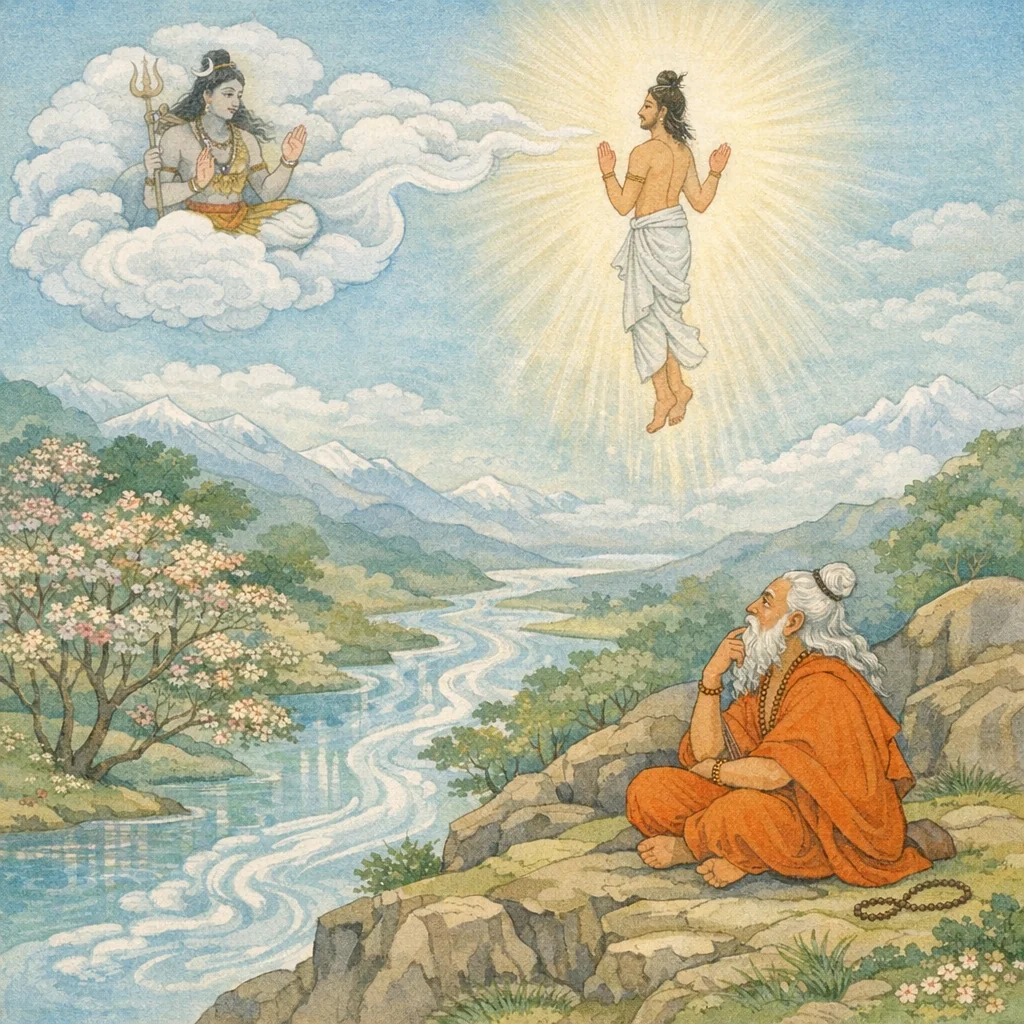
Bhīṣma said: “O Bhārata, proceeding northward, he beheld a splendid sight—two beautiful divine mountain-peaks set close together. One was a peak of Himālaya, shining white like silver, and the other a peak of Meru, gleaming yellow like gold. Each extended a hundred yojanas in breadth and rose likewise in height. Thus, as he journeyed toward the northern quarter, these enchanting summits came into his view.”
Verse 10
सो<5विशड्केन मनसा तदैवाभ्यपतच्छुक: । ततः पर्वतशड्ले द्वे सहसैव द्विधाकृते
Bhīṣma said: With a mind suddenly seized by doubt, the parrot at once darted forward. Then, in an instant, the two slabs of mountain-rock were split into two.
Verse 11
ततः पर्वतशृद्भाभ्यां सहसैव विनि:सृत:
Then, bursting forth at once with sudden force from between the mountain-peaks, he emerged.
Verse 12
न च प्रतिजघानास्य स गतिं पर्वतोत्तम: । तत्पश्चात् उन पर्वतशिखरोंसे वे सहसा आगे निकल गये। वह श्रेष्ठ पर्वत उनकी गतिको रोक न सका ।। ततो महानभूच्छब्दो दिवि सर्वदिवौकसाम्
Bhishma said: That foremost of mountains could not check his onward course; it neither struck back nor impeded his movement. Then, swiftly passing beyond those mountain-peaks, he surged ahead—so great was his momentum that even the best of mountains could not restrain him. Thereupon a mighty roar arose in the heavens among all the celestial beings.
Verse 13
दृष्टवा शुकमततिक्रान्तं पर्वत च द्विधाकृतम्
Bhishma said: “Having seen Śuka pass beyond all bounds, and having seen even a mountain split into two, one understands the extraordinary power born of spiritual attainment and the force of unwavering resolve.”
Verse 14
स पूज्यमानो देवैश्व गन्धर्वैक्रेषिभिस्तथा,आसीत् किल महाराज शुकाभिपतने तदा । महाराज! देवता, गन्धर्व, ऋषि, यक्ष, राक्षस और विद्याधरोंने उनका पूजन किया। वहाँसे शुकदेवजीके ऊपर उठते समय उनके चढ़ाये हुए दिव्य पुष्पोंकी वर्षसे वहाँ सब ओरका सारा आकाश छा गया
Bhishma said: “O great king, at that time, as Śuka was soaring upward, he was indeed being worshipped by the gods, the Gandharvas, and the seers. Honoured in this way, the sky in every direction seemed to be covered over by a shower of divine flowers offered in reverence.”
Verse 15
यक्षराक्षससंघैश्व विद्याधरगणैस्तथा । दिव्यै: पुष्पै: समाकीर्णमन्तरिक्षं समनन््तत:
Bhishma said: “The sky in every direction was filled—crowded with hosts of Yakṣas and Rākṣasas, and likewise with companies of Vidyādharas—while divine flowers were scattered everywhere, as though the very heavens were bearing witness to the moment.”
Verse 16
ततो मन्दाकिनीं रम्यामुपरिष्टादभिव्रजन्
Bhishma said: “Then, moving onward above, he came upon the lovely Mandākinī.”
Verse 17
तस्यां क्रीडन्त्यभिरतास्ते चैवाप्सरसां गणा:
Bhīṣma said: “There, those hosts of Apsarases—delighting in play—sport about, wholly absorbed in their enjoyment.”
Verse 18
शून्याकारं निराकारा: शुकं दृष्टवा विवासस: । उसमें बहुत-सी अप्सराएँ स्नान एवं जलक्रीड़ा कर रही थीं। यद्यपि वे नंगी थीं, तो भी शुकदेवजीको शून्याकार (बाह्ज्ञानसे रहित एवं आत्मनिष्ठ) देख अपने शरीरको ढकने या छिपानेके लिये उद्यत नहीं हुईं ।। त॑ प्रक्रामन्तमाज्ञाय पिता स्नेहसमन्वितः
Bhīṣma said: “Seeing Śuka—absorbed in the Self and thus ‘empty’ of outward, object-directed awareness—the formless-minded apsarases, though unclothed, did not feel compelled to cover themselves or hide. When his father, moved by affection, realized that Śuka was walking on…”
Verse 19
शुकस्तु मारुतादुर्ध्व गतिं कृत्वान्तरिक्षगाम्
Bhīṣma said: “But Śuka, having assumed a course higher than the wind, proceeded through the mid-region (the sky).”
Verse 20
दर्शयित्वा प्रभावं स्वं॑ ब्रह्मभूतो5$भवत् तदा । उधर शुकदेव वायुसे आकाशगामिनी ऊर्ध्वगतिका आश्रय ले अपना प्रभाव दिखाकर तत्काल ब्रह्मीभूत हो गये ।। महायोगगतिं त्वन्यां व्यासोत्थाय महातपा:,महातपस्वी व्यासजी दूसरी महायोगसम्बन्धिनी गतिका अवलम्बन करके ऊपरको उठे और पलक मारते-मारते उस स्थानपर जा पहुँचे, जहाँसे उन पर्वत-शिखरोंको दो भागोंमें विदीर्ण करके शुकदेवजी आगे बढ़े थे। वह स्थान शुकाभिपतनके नामसे प्रसिद्ध हो गया था। उन्होंने उस स्थानको देखा
Bhīṣma said: “Having revealed his own extraordinary power, he at once became one with Brahman. Then the great ascetic Vyāsa, rising up and adopting another supreme yogic mode of movement, ascended and swiftly reached the very place from which Śuka had earlier advanced—cleaving the mountain-peaks as he went. The spot became renowned as the ‘Śukābhipatana,’ and Vyāsa beheld it.”
Verse 21
निमेषान्तरमात्रेण शुकाभिपतनं ययौ । स ददर्श द्विधा कृत्वा पर्वताग्रं शुकं गतम्,महातपस्वी व्यासजी दूसरी महायोगसम्बन्धिनी गतिका अवलम्बन करके ऊपरको उठे और पलक मारते-मारते उस स्थानपर जा पहुँचे, जहाँसे उन पर्वत-शिखरोंको दो भागोंमें विदीर्ण करके शुकदेवजी आगे बढ़े थे। वह स्थान शुकाभिपतनके नामसे प्रसिद्ध हो गया था। उन्होंने उस स्थानको देखा
Bhīṣma said: “In no more than the space of a single blink, he reached the place known as Śukābhipatana. There he saw how Śuka had gone forward after splitting the mountain-peak into two.”
Verse 22
शशंसुर्ऋ्रषयस्तत्र कर्म पुत्रस्य तत् तदा | ततः शुकेति दीर्घेण शब्देनाक्रन्दितस्तदा,वहाँ रहनेवाले ऋषियोंने आकर व्यासजीसे उनके पुत्रका वह अलौकिक कर्म कह सुनाया। तब व्यासजीने शुकदेवका नाम लेकर बड़े जोरसे रोदन किया
Bhīṣma said: The sages dwelling there came and reported to Vyāsa, at that very time, the extraordinary deed performed by his son. Hearing it, Vyāsa cried out loudly and at length, calling again and again, “Śuka!”—a lament born of a father’s love and the shock of sudden separation.
Verse 23
स्वयं पित्रा स्वरेणोच्चैस्त्रील्लॉकाननुनाद्य वै । शुकः सर्वगतो भूत्वा सर्वात्मा सर्वतोमुख:
Bhīṣma said: “Then Śuka, using his father’s own voice and calling out loudly so that the three worlds resounded, became all-pervading—identifying with the Self of all beings and facing in every direction.”
Verse 24
तत एकाक्षरं नादं भोरित्येव समीरयन्
Bhīṣma said: “Then, uttering only the single-syllabled sound ‘bho’—a mere call—he sent forth that resonance.”
Verse 25
प्रत्याहरज्जगत् सर्वमुच्चै: स्थावरजड्भमम् | उसीके साथ-साथ सम्पूर्ण चराचर जगत्ने उच्च स्वरसे “भो:' इस एकाक्षर शब्दका उच्चारण करते हुए उत्तर दिया ।। ततः प्रभृति चाद्यापि शब्दानुच्चारितान् पृथक्
Bhīṣma said: Then the entire universe—both the immobile and the moving—responded in unison, loudly uttering the single syllable “bhoḥ.” From that moment onward, even to this day, distinct articulated sounds began to be expressed separately—marking the emergence of differentiated speech and address within the world-order.
Verse 26
गिरिगह्नरपृषछ्ेषु व्याहरन्ति शुकं प्रति । तभीसे आजतक पर्वतोंके शिखरपर अथवा गुफाओंके आस-पास जब-जब आवाज दी जाती है, तब-तब वहाँके चराचर निवासी प्रतिध्वनिके रूपमें उसका उत्तर देते हैं, जैसा कि उन्होंने शुकदेवजीके लिये किया था ।। अन्तर्हितः प्रभावं॑ तु दर्शयित्वा शुकस्तदा
Bhīṣma said: In mountain-caves and on the ridges, whenever a call is uttered, the beings that dwell there—moving and unmoving—return it as an echo, just as they once answered for Śuka. Then Śuka, having revealed his extraordinary power, became invisible at that time.
Verse 27
महिमान तु त॑ दृष्टवा पुत्रस्यामिततेजस:
Bhīṣma said: Having beheld that greatness—the extraordinary majesty of his son of immeasurable splendor—one’s mind is moved to reverence and reflection on the power of virtue and destiny.
Verse 28
ततो मन्दाकिनीतीरे क्रीडन्तो5प्सरसां गणा:
Then, on the bank of the Mandākinī, groups of Apsarases were sporting—an image of celestial ease and allure, reminding one how pleasure and beauty can captivate the mind even amid grave reflection on right conduct.
Verse 29
आसाद्य तमृषिं सर्वा: सम्भ्रान्ता गतचेतस: । जले निलिल्यिरे काश्रनित् काश्रनिद् गुल्मान् प्रपेदिरे
Bhīṣma said: Having reached that sage, all of them—overwhelmed and their minds unsteady—reacted in fear: some plunged into the water, while others fled and took refuge among thickets. The scene underscores how agitation and loss of composure can drive beings to impulsive, self-protective acts even in the presence of spiritual authority.
Verse 30
उस समय मन्दाकिनीके तटपर क्रीड़ा करती हुई समस्त अप्सराएँ महर्षि व्यासको अपने निकट पाकर बड़ी घबराहटमें पड़ गयीं, अचेत-सी हो गयीं। कोई जलमें छिप गयीं और कोई लताओंकी झुरमुटमें ।। वसनान्याददु: काश्ित् त॑ं दृष्टवा मुनिसत्तमम् | तां मुक्ततां तु विज्ञाय मुनि: पुत्रस्य वै तदा,कुछ अप्सराओंने मुनिश्रेष्ठ व्यासको देखकर अपने वस्त्र पहन लिये। उस समय अपने पुत्रकी मुक्तता जानकर मुनि बड़े प्रसन्न हुए और अपनी आसक्तिका विचार करके वे बहुत लज्जित भी हुए
Bhīṣma said: At that time, on the bank of the Mandakini, the Apsarases who were sporting saw the great sage Vyasa arrive near them. Struck with sudden alarm, they became as if senseless—some hid themselves in the water, while others slipped into thickets of creepers. A few, on seeing that foremost of sages, hastily put on their garments. Vyasa, realizing then that his son had been released, felt great joy; yet, reflecting on his own attachment, he was also overcome with shame.
Verse 31
सक्ततामात्मनश्रैव प्रीतो5भूद् ब्रीडितश्न॒ ह,कुछ अप्सराओंने मुनिश्रेष्ठ व्यासको देखकर अपने वस्त्र पहन लिये। उस समय अपने पुत्रकी मुक्तता जानकर मुनि बड़े प्रसन्न हुए और अपनी आसक्तिका विचार करके वे बहुत लज्जित भी हुए
Bhīṣma said: The sage was at once pleased and also ashamed. Some of the apsarases, on seeing the foremost of sages, Vyasa, put on their garments. At that moment, knowing that his son had been released, the great muni became deeply delighted; yet, reflecting on his own attachment, he felt genuine embarrassment.
Verse 32
त॑ देवगन्धर्ववृतों महर्षिगणपूजित: । पिनाकहस्तो भगवानभ्यागच्छत शंकर:,इसी समय देवताओं और गन्धर्वोंसे घिरे हुए तथा महर्षियोंसे पृूजित पिनाकधारी भगवान् शंकर वहाँ आ पहुँचे और पुत्र-शोकसे संतप्त वेदव्यासजीको सान्त्वना देते हुए कहने लगे--
Then Lord Śaṅkara, bearing the Pināka bow, arrived there—surrounded by gods and Gandharvas and honored by the host of great seers. He came to console Vyāsa, who was burning with grief for his son, and began to speak words of reassurance.
Verse 33
तमुवाच महादेव: सान्त्वपूर्वमिदं वच: । पुत्रशोकाभिसंतप्तं कृष्णद्वैपायनं तदा,इसी समय देवताओं और गन्धर्वोंसे घिरे हुए तथा महर्षियोंसे पृूजित पिनाकधारी भगवान् शंकर वहाँ आ पहुँचे और पुत्र-शोकसे संतप्त वेदव्यासजीको सान्त्वना देते हुए कहने लगे--
Bhishma said: Then Mahādeva (Śiva) addressed Kṛṣṇa Dvaipāyana Vyāsa, who was burning with grief for his son, speaking words of consolation and gentle reassurance—setting a compassionate, dharmic tone for what was to be taught next.
Verse 34
अनग्नेर्भूमेरपां वायोरन्तरिक्षस्य चैव ह । वीर्येण सदृशः पुत्र: पुरा मत्तस्त्वया वृत:,“ब्रह्मन! तुमने पहले अग्नि, भूमि, जल, वायु और आकाशके समान शक्तिशाली पुत्र होनेका मुझसे वरदान माँगा था; अतः तुम्हें तुम्हारी तपस्याके प्रभाव तथा मेरी कृपासे पालित वैसा ही पुत्र प्राप्त हुआ। वह ब्रह्मतेजसे सम्पन्न और परम पवित्र था
Bhishma said: “O Brahmin, you once sought from me a boon for a son whose power would be comparable to that of fire, earth, water, wind, and the very sky. Therefore, by the force of your austerities and by my favor, you obtained such a son—endowed with brahmanical radiance and supremely pure.”
Verse 35
स तथालक्षणो जातस्तपसा तव सम्भृत: । मम चैव प्रसादेन ब्रह्मतेजोमय: शुचि:,“ब्रह्मन! तुमने पहले अग्नि, भूमि, जल, वायु और आकाशके समान शक्तिशाली पुत्र होनेका मुझसे वरदान माँगा था; अतः तुम्हें तुम्हारी तपस्याके प्रभाव तथा मेरी कृपासे पालित वैसा ही पुत्र प्राप्त हुआ। वह ब्रह्मतेजसे सम्पन्न और परम पवित्र था
Bhishma said: “Thus was born a son bearing those very marks you had sought—nurtured by the power of your austerities and also by my favor. He was filled with the radiance of Brahman and was utterly pure.”
Verse 36
स गतिं परमां प्राप्तो दुष्प्रपामजितेन्द्रियै: । देवतैरपि विप्रर्षे तं त्वं किमनुशोचसि,“ब्रह्म! इस समय उसने ऐसी उत्तम गति प्राप्त की है, जो अजितेन्द्रिय पुरुषों तथा देवताओंके लिये भी दुर्लभ है, फिर भी तुम उसके लिये क्यों शोक कर रहे हो?
Bhishma said: “O best of Brahmins, he has attained the supreme state—one that is hard to reach even for those who have not conquered their senses, and even for the gods. Why, then, do you grieve for him?”
Verse 37
यावत् स्थास्यन्ति गिरयो यावत् स्थास्यन्ति सागरा: । तावत् तवाक्षया कीर्ति: सपुत्रस्य भविष्यति
Bhīṣma said: “So long as the mountains endure and so long as the oceans remain, for that very long your imperishable fame—together with that of your son—will continue.”
Verse 38
“जबतक इस संसारमें पर्वतोंकी सत्ता रहेगी और जबतक समुद्रोंकी स्थिति बनी रहेगी, तबतक तुम्हारी और तुम्हारे पुत्रकी अक्षय कीर्ति इस संसारमें छायी रहेगी ।। छायां स्वपुत्रसदृशीं सर्वतोडनपगां सदा । द्रक्ष्यसे त्वं च लोके5स्मिन् मत्प्रसादान्महामुने
“So long as, in this world, the mountains continue to stand and the oceans remain in their place, so long will your and your son’s imperishable fame spread over the earth. And, O great sage, by my grace you will always behold in this world a shadow-like presence resembling your son—seen everywhere, never slipping from your sight.”
Verse 39
“महामुने! तुम मेरे प्रसादसे इस जगत्में सदा अपने पुत्रसदृश छायाका दर्शन करते रहोगे। वह सब ओर दिखायी देगी, कभी तुम्हारी आँखोंसे ओझल न होगी” ।। सो5नुनीतो भगवता स्वयं रुद्रेण भारत । छायां पश्यन् समावृत्त: स मुनि: परया मुदा,भरतनन्दन! साक्षात् भगवान् शंकरके इस प्रकार आश्वासन देनेपर सर्वत्र अपने पुत्रकी छाया देखते हुए मुनिवर व्यास बड़ी प्रसन्नताके साथ अपने आश्रमपर लौट आये
Bhīṣma said: “O great sage! By my grace, in this world you will always behold the shadow-like presence of your son. It will appear everywhere and will never vanish from your sight.” Thus, O Bharata, the sage—having been consoled by the Lord himself, Rudra—returned, seeing that presence and filled with supreme joy. O delight of the Bharatas! After Lord Śaṅkara personally gave this reassurance, the great sage Vyāsa went back to his hermitage, everywhere perceiving the shadow of his son, deeply comforted and pleased.
Verse 40
इति जन्म गतिश्वैव शुकस्य भरतर्षभ । विस्तरेण समाख्याता यन्मां त्वं परिपृच्छसि,भरतश्रेष्ठ युधिष्ठिर! तुम मुझसे जिसके विषयमें पूछ रहे थे, वह शुकदेवजीके जन्म और परमपद-प्राप्तिकी कथा मैंने तुम्हें विस्तारसे सुनायी है
Bhīṣma said: “Thus, O bull among the Bharatas, I have explained in detail the birth and the onward course (destiny and final attainment) of Śuka—exactly as you asked me. O best of the Bharatas, Yudhiṣṭhira, I have narrated at length the account of Śukadeva’s birth and his reaching the supreme state.”
Verse 41
एतदाचरष्ट मे राजन् देवर्षिनारद: पुरा । व्यासश्वैव महायोगी संजल्पेषु पदे पदे,राजन! सबसे पहले देवर्षि नारदजीने यह वृत्तान्त मुझे बताया था। महायोगी व्यासजी भी बातचीतके प्रसंगमें पद-पदपर इस प्रसंगको दुहराया करते हैं
Bhīṣma said: “O King, long ago the divine seer Nārada related this very account to me. And the great yogin Vyāsa too, in the course of his conversations, would repeatedly recall this episode at every step.”
Verse 42
इतिहासमिमं पुण्यं मोक्षधर्मोपसंहितम् । धारयेद् यः शमपर: स गच्छेत् परमां गतिम्,जो पुरुष मोक्षधर्मसे युक्त इस परम पवित्र इतिहासको सुनकर या पढ़कर अपने हृदयमें धारण करेगा, वह शान्तिपरायण हो परमगति (मोक्ष) को प्राप्त होगा
Bhishma said: Whoever, devoted to inner peace, listens to or studies this sacred narrative grounded in the Dharma of liberation, and then holds it firmly in the heart, attains the highest goal—the supreme state of release.
Verse 103
अदृश्येतां महाराज तदद्भुतमिवा भवत् । उन्हें देखकर वे पूर्ववत् निःशंक मनसे उनके ऊपर चढ़ गये। फिर तो वे दोनों पर्ववशिखर सहसा दो भागोंमें बँट गये और बीचसे फटे हुए-से दिखायी देने लगे। महाराज! यह एक अद्भुत-सी बात हुई
Bhīṣma said: “O King, they became invisible; it was as though something wondrous had occurred. Seeing them, the others—now fearless in mind—climbed upon them as before. Then, suddenly, the two mountain-peaks split into two parts and appeared as if torn open from the middle. O King, this was indeed a marvel.”
Verse 126
गन्धर्वाणामृषीणां च ये च शैलनिवासिन: । यह देख सम्पूर्ण देवताओं, गन्धर्वों, ऋषियों तथा जो उस पर्वतपर रहनेवाले दूसरे लोग थे, उन सबने बड़े जोरसे हर्षनाद किया। उनकी हर्षध्वनि आकाशमें चारों ओर गूँज उठी
Bhīṣma said: “The Gandharvas, the sages, and all those other beings who dwelt upon that mountain—seeing this—raised a mighty cry of joy. Their exultant acclamation resounded through the sky in every direction.”
Verse 133
साधु साध्विति तत्रासीन्नाद: सर्वत्र भारत | भारत! शुकदेवजीको पर्वत लाँधकर आगे बढ़ते और उस पर्वतको दो टुकड़ोंमें विदीर्ण होते देख वहाँ सब ओर '“साधु-साधु” शब्द सुनायी पड़ने लगे
Bhishma said: “Then, O Bharata, a cry of ‘Well done! Well done!’ arose everywhere. As Śukadeva advanced, leaping over the mountain and seeing it split into two, voices on all sides resounded with praise.”
Verse 153
आसीत् किल महाराज शुकाभिपतने तदा । महाराज! देवता, गन्धर्व, ऋषि, यक्ष, राक्षस और विद्याधरोंने उनका पूजन किया। वहाँसे शुकदेवजीके ऊपर उठते समय उनके चढ़ाये हुए दिव्य पुष्पोंकी वर्षसे वहाँ सब ओरका सारा आकाश छा गया
Bhishma said: “O great king, it is said that at that time, when Śuka was about to depart, the gods, Gandharvas, sages, Yakṣas, Rākṣasas, and Vidyādharas honored him with worship. And as Śukadeva rose upward from that place, a rain of celestial flowers offered by them spread everywhere, so that the whole sky in every direction seemed covered.”
Verse 183
उत्तमां गतिमास्थाय पृष्ठतोडनुससार ह । उन्हें इस प्रकार सिद्धिके लिये उत्क्रण करते जान उनके पिता वेदव्यासजी भी स्नेहवश उत्तम गतिका आश्रय ले उनके पीछे-पीछे जाने लगे
Bhishma said: Having taken refuge in the highest course—the supreme state—he followed behind. Seeing him thus ascending for attainment, his father, the sage Vedavyasa, moved by affection, also resorted to that highest path and began to go after him.
Verse 236
प्रत्यभाषत धर्मात्मा भो शब्देनानुनादयन् । जब पिताने उच्च स्वरसे तीनों लोकोंको गुँजाते हुए पुकारा, तब सर्वव्यापी, सर्वात्मा एवं सर्वतोमुख होकर धर्मात्मा शुकने “भो:” शब्दसे सम्पूर्ण जगतको प्रतिध्वनित करते हुए पिताको उत्तर दिया
Bhishma said: When the father called out in a loud voice that seemed to make the three worlds resound, the righteous Shuka—said to be all-pervading, the Self of all, and facing in every direction—replied. With the single vocative “Ho!”, he sent an answering echo through the whole universe, returning his father’s call.
Verse 266
गुणान् संत्यज्य शब्दादीन् पदमभ्यगमत् परम् | इस प्रकार अपना प्रभाव दिखलाकर शुकदेवजी अन्तर्धान हो गये और शब्द आदि गुणोंका परित्याग करके परमपदको प्राप्त हुए
Bhishma said: Having renounced the sensory qualities beginning with sound, he attained the supreme state. Thus, after displaying his spiritual power, Śukadeva vanished from sight; abandoning qualities such as sound that bind the embodied being to sense-experience, he reached the highest goal.
Verse 332
इस प्रकार श्रीमह्ाभारत शान्तिपर्वके अन्तर्गत मोक्षधर्मपर्वमें शुकदेवजीका ऊर्ध्वगमनविषयक तीन सौ बत्तीसवाँ अध्याय पूरा हुआ
Thus concludes the three-hundred-and-thirty-second chapter of the Mokṣadharma section within the Śānti Parva of the Śrī Mahābhārata, describing Śuka’s upward ascent.
Verse 333
इति श्रीमहा भारते शान्तिपर्वणि मोक्षधर्मपर्वणि शुकोत्पतनसमाप्तिरनाम त्रयस्त्रिंशदधिकत्रिशततमो<5ध्याय:
Thus, in the revered Mahābhārata, within the Śānti Parva—specifically the Mokṣa-dharma section—ends the chapter entitled “The Conclusion of Śuka’s Departure (Flight/Ascent),” being the three-hundred-and-thirty-third chapter.
Verse 1636
शुको ददर्श धर्मात्मा पुष्पितद्रुमकाननाम् | राजन! धर्मात्मा शुकने ऊर्ध्वलोकमें जाते समय खिले हुए वृक्षों और वनोंसे सुशोभित रमणीय मन्दाकिनी (आकाशगंगा) का दर्शन किया
Bhīṣma said: The righteous Śuka beheld a woodland of blossoming trees. As he was proceeding upward to the higher worlds, he saw the delightful Mandākinī—adorned with flowering groves—signaling the auspicious, dharma-aligned passage of a purified soul toward transcendent realms.
Verse 2736
निषसाद गिरिप्रस्थे पुत्रमेवानुचिन्तयन् । अपने अमिततेजस्वी पुत्रकी यह महिमा देखकर व्यासजी उसीका चिन्तन करते हुए उस पर्वतके शिखरपर बैठ गये
Bhīṣma said: Having witnessed the extraordinary glory of his son, the sage Vyāsa—of immeasurable spiritual radiance—sat down upon a mountain summit, absorbed in contemplation of that very son. The scene underscores how even the wisest are drawn to reflect deeply when confronted with manifest greatness, and how contemplation (rather than haste) becomes the fitting response to revealed virtue and power.
Frequently Asked Questions
The chapter warns against cultivating hostility toward the imperishable Viṣṇu/Nārāyaṇa, framing such antagonism as ethically disorienting because Viṣṇu is presented as the ātman (Self) underlying all beings.
A synthesis of devotion and metaphysics: single-minded devotion is aligned with the insight that the divine is the inner Self and cosmic witness, approachable through disciplined understanding as emphasized in Sāṃkhya-Yoga idioms.
Yes. By instructing the audience to recognize Vyāsa (Kṛṣṇa Dvaipāyana) as Nārāyaṇa, the chapter supplies an explicit authorization frame for the epic’s dharma discourse and its theological orientation.