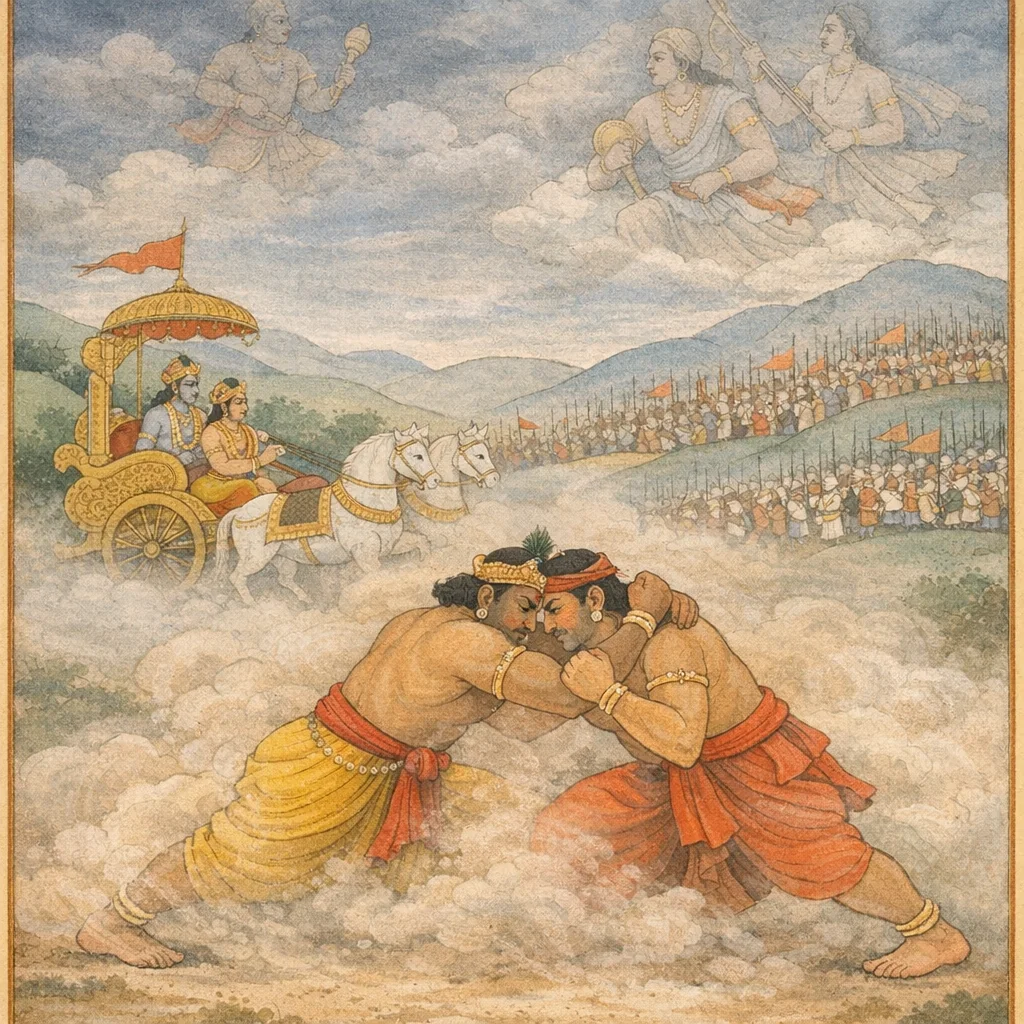
Adhyaya 58
Duryodhana-patana-anuśocana (The Fall of Duryodhana and the Contest of Restraint)
Upa-parva: Gadā-yuddha and Duryodhana-vadha Episode (Mace Duel Aftermath)
Saṃjaya reports that the Pāṇḍavas and Somakas react with exhilaration upon seeing Duryodhana felled, likened to a great tree brought down. Bhīmasena approaches the fallen Kaurava ruler and verbally frames the moment as retributive justice for earlier mockery and the sabhā humiliation connected with Draupadī; he performs a public gesture of dominance by placing his foot upon Duryodhana’s head and reiterates taunts about reversing prior derision. The narration then marks a moral dissonance: dharmically minded Somaka leaders do not approve of the humiliating act. Yudhiṣṭhira rebukes Bhīma, cautioning that crushing a fallen king’s head violates appropriate conduct, especially given kinship ties and the opponent’s already total devastation. Yudhiṣṭhira then turns to lamentation, interpreting the catastrophe as shaped by destiny while also attributing Duryodhana’s end to his own faults—greed, pride, and destructive choices that led to the deaths of friends, brothers, elders, and teachers. The chapter thus juxtaposes vengeance, public symbolism, and post-victory ethics, closing with Yudhiṣṭhira’s grief and moral accounting.
Chapter Arc: रणभूमि के कोलाहल के बीच अर्जुन जनार्दन से पूछता है—इन दो महावीरों के युद्ध में कौन श्रेष्ठ है, किसका गुण अधिक है—मानो शस्त्रों से पहले विवेक का निर्णय आवश्यक हो। → श्रीकृष्ण (वायुदेव-उपदेश की शैली में) दोनों की शिक्षा-समानता, पर भीम की प्रचण्ड बल-प्रधानता और धृतराष्ट्र-पुत्र के यत्न-कौशल का तुलनात्मक संकेत देते हैं; फिर मायावी उपायों का स्मरण कराते हैं—जैसे इन्द्र ने वृत्र का तेज माया से हर लिया था—और भीम को ‘मायामय पराक्रम’ धारण करने का संकेत मिलता है। → दोनों वृषभाक्ष, तरस्वी वीर बैलों-से भिड़ते हैं; घोर संघर्ष के साथ प्रकृति स्वयं विक्षुब्ध हो उठती है—आँधी-गर्जन, धूल-वर्षा, पृथ्वी का कम्पन, आकाश में यक्ष-राक्षस-पिशाचों का महानाद—और अंततः धृतराष्ट्र-पुत्र के धराशायी होते ही समस्त सेना काँप उठती है। → पुत्र के गिरते ही कौरव-पक्ष में भय और शोक की लहर दौड़ती है; अपशकुनों की श्रृंखला (रक्त-उफान, नदियों का उल्टा बहना) युद्ध के नैतिक-भाग्य-चक्र को और गाढ़ा करती है, जबकि पाण्डव-पाञ्चाल भी इन उत्पातों से मन-ही-मन उद्विग्न हो उठते हैं। → धृतराष्ट्र-पुत्र के पतन के बाद रण की दिशा किस ओर मुड़ेगी—और ये अपशकुन किस अगले महाविनाश का संकेत हैं—यह अनिश्चितता अगले अध्याय की देहरी पर छोड़ दी जाती है।
Shlokas
Verse 1
(दाक्षिणात्य अधिक पाठके २ श्लोक मिलाकर कुल ७२ श्लोक हैं।) अपन क्ाता छा 2 अष्टपञज्चाशत्तमो< ध्याय: श्रीकृष्ण और अर्जुनकी बातचीत तथा अर्नके के संकेतके अनुसार भीमसेनका गदासे दुर्योधनकी जाँघें तोड़कर उसे धराशायी करना एवं भीषण उत्पातोंका प्रकट होना संजय उवाच समुद्रीर्ण ततो दृष्ट्वा संग्रामं कुरुमुख्ययो: । अथाब्रवीदर्जुनस्तु वासुदेवं॑ यशस्विनम्
Sañjaya said: “O King, seeing that the battle between the two foremost heroes of the Kuru line was swelling ever more fiercely, Arjuna then addressed the illustrious Vāsudeva (Kṛṣṇa).”
Verse 2
अनयोर्वीरियोर्युद्धे को ज्यायानू भवतो मतः । कस्य वा को गुणो भूयानेतद् वद जनार्दन,“जनार्दन! आपकी रायमें इन दोनों वीरोंमेंसे इस युद्धस्थलमें कौन बड़ा है अथवा किसमें कौन-सा गुण अधिक है? यह मुझे बताइये”
“Janārdana, in this battle between these two heroes, who, in your judgment, is the greater? Or in whom does which excellence predominate? Tell me this.”
Verse 3
वायुदेव उवाच उपदेशो5नयोस्तुल्यो भीमस्तु बलवत्तर: । कृती यत्नपरस्त्वेष धार्तराष्ट्री वकोदरात्
Vāsudeva said: “The instruction given to these two was the same; yet Bhīma is the stronger in sheer might. This son of Dhṛtarāṣṭra, however, surpasses him in sustained practice and deliberate effort.”
Verse 4
भीमसेनस्तु धर्मेण युद्धयमानो न जेष्यति । अन्यायेन तु युध्यन् वै हन्यादेव सुयोधनम्
Vāsudeva said: “If Bhīmasena continues to fight strictly within the bounds of dharma, he will not be able to win. But if he fights by transgressing those bounds—by an unrighteous stratagem—then he will surely strike down Suyodhana (Duryodhana).”
Verse 5
मायया निर्जिता देवैरसुरा इति न: श्रुतम् । विरोचनस्तु शक्रेण मायया निर्जित: स वै,हमने सुना है कि देवताओंने पूर्वकालमें मायासे ही असुरोंपर विजय पायी थी और इन्द्रने मायासे ही विरोचनको परास्त किया था
Vāsudeva said: “We have heard that in former times the gods overcame the Asuras by means of māyā (strategic illusion). Likewise, Śakra (Indra) truly subdued Virocana through māyā.”
Verse 6
मायया चाक्षिपत् तेजो वृत्रस्य बलसूदन: । तस्मान्मायामयं भीम आतिष्ठतु पराक्रमम्,बलसूदन इन्द्रने मायासे वृत्रासुरके तेजको नष्ट कर दिया था, इसलिये भीमसेन भी यहाँ मायामय पराक्रमका ही आश्रय लें
Vāyu said: “By his own māyā, Indra—the slayer of Bala—cast down and nullified the fiery power of Vṛtra. Therefore, O Bhīma, let him here also take refuge in a māyā-born strategy of valor—meeting illusion with counter-illusion—so that strength is guided by discernment rather than mere force.”
Verse 7
प्रतिज्ञातं च भीमेन द्यूतकाले धनंजय । ऊरू भेत्स्यामि ते संख्ये गदयेति सुयोधनम्
Vāyudeva said: “O Dhanañjaya (Arjuna), in the time of the dice-game Bhīma made this vow to Suyodhana (Duryodhana): ‘In battle I shall shatter your thighs with my mace.’”
Verse 8
सो<यं प्रतिज्ञां तां चापि पालयत्वरिकर्षण: । मायाविन तु राजानं माययैव निकृन्ततु
Vāyu said: “Let this foe-subduing hero indeed keep that very vow. But as for the king who fights by deception, let him be cut down by deception alone.”
Verse 9
अतः शत्रुसूदन भीमसेन अपनी उस प्रतिज्ञाका पालन करें और मायावी राजा दुर्योधनको मायासे ही नष्ट कर डालें ।।
Vāyu-deva said: “Therefore, O Bhīmasena, slayer of foes, fulfill your vow and destroy the crafty king Duryodhana by craft itself. For if he, relying on strength, strikes according to strict fairness, then King Yudhiṣṭhira will again be driven into a grievously unequal and perilous situation.”
Verse 10
पुनरेव तु वक्ष्यामि पाण्डवेय निबोध मे । धर्मराजापराधेन भयं नः पुनरागतम्,पाण्डुनन्दन! मैं पुन: यह बात कहे देता हूँ, तुम उसे ध्यान देकर सुनो। धर्मराजके अपराधसे हमलोगोंपर फिर भय आ पहुँचा है
“Once again I shall speak—O descendant of the Pāṇḍus, attend to my words. Because of Dharmarāja’s transgression, fear has come upon us again, O son of Pāṇḍu.”
Verse 11
कृत्वा हि सुमहत् कर्म हत्वा भीष्ममुखान् कुरून् | जय: प्राप्तो यशः प्राग्रयं वैरं च प्रतियातितम्
Indeed, having accomplished a very great deed—having slain the Kurus led by Bhīṣma—victory has been attained, the highest renown has been won, and the enmity has been repaid in full.
Verse 12
अबुद्धिरेषा महती धर्मराजस्य पाण्डव
Vāyu said: “This is a grave lack of discernment on the part of Dharmarāja—the Pāṇḍava.”
Verse 13
सुयोधन: कृती वीर एकायनगतस्तथा
Suyodhana (Duryodhana) is a capable hero, skilled in the arts of war, and steadfast in a single, fixed resolve. In this matter, one hears an ancient śloka spoken by Uśanas (Śukrācārya), filled with the essential meaning of nīti-śāstra. I shall recite it—listen to that verse from my words.
Verse 14
अपि चोशनसा गीत: श्रूयते5यं पुरातन: । श्लोकस्तत्त्वार्थसहितस्तन्मे निगदत: शृणु
Vāyu said: “Moreover, an ancient verse composed by Uśanas (Śukrācārya) is heard of. It is a śloka rich with the essential meaning of true principles. Listen as I recite it—hear it from my words.”
Verse 15
पुनरावर्तमानानां भग्नानां जीवितैषिणाम् । भेतव्यमरिशेषाणामेकायनगता हिते
Vāyu said: “One should remain wary of enemies who, though broken and fleeing in search of life, turn back again toward battle. For such surviving foes have reached a single, fixed resolve; having chosen one course, they no longer shrink even from death.”
Verse 16
साहसोत्पतितानां च निराशानां च जीविते । न शक्यमग्रतः स्थातुं शक्रेणापि धनंजय,धनंजय! जो जीवनकी आशा छोड़कर साहसपूर्वक युद्धमें कूद पड़े हों, उनके सामने इन्द्र भी नहीं ठहर सकते
Vāyu said: “O Dhanañjaya, before those who have leapt into battle with sheer daring and have abandoned all hope of preserving their lives, it is impossible to stand—indeed, not even Indra could hold his ground against them.”
Verse 17
सुयोधनमिमं भग्नं हतसैन्यं हृदं गतम् । पराजित वनप्रेप्सुं निराशं राज्यलम्भने
Vāyu said: “This Suyodhana stands broken—his army destroyed, his spirit sunk within. Defeated, longing to flee to the forest, and bereft of hope of gaining the kingdom, he has reached a state of inner collapse.”
Verse 18
अपि नो निर्जितं राज्यं न हरेत सुयोधन:
Vāyu said: “May Suyodhana not seize again the kingdom we have already won—lest Duryodhana snatch back what has been conquered. For thirteen years he has pursued unbroken toil and practice in fighting with the mace. Look—driven by the desire to kill Bhīmasena, he is roaming about, moving here and there and even upward.”
Verse 19
यस्त्रयोदशवर्षाणि गदया कृतनिश्रम: । चरत्यूर्थध्व च तिर्यक्ू च भीमसेनजिघांसया
Vāyu said: “For thirteen years he has undergone unbroken toil and practice with the mace. Now, driven by the desire to slay Bhīmasena, he roams about—moving upward and sideways—seeking an opening.”
Verse 20
एनं चेन्न महाबाहुरन्यायेन हनिष्यति । एष व: कौरवो राजा धार्तराष्ट्रो भविष्यति,यदि महाबाहु भीमसेन इसे अन्यायपूर्वक नहीं मारेंगे तो यह धृतराष्ट्रका पुत्र दुर्योधन ही आपका तथा समस्त कुरुकुलका राजा होगा
“If that mighty-armed one (Bhīmasena) does not slay him by an unrighteous means, then this son of Dhṛtarāṣṭra—Duryodhana—will become your king and the king of the entire Kuru line.”
Verse 21
धनंजयस्तु श्रुत्वैतत् केशवस्य महात्मन: । प्रेक्षतो भीमसेनस्य सव्यमूरूमताडयत्,महात्मा भगवान् केशवका यह वचन सुनकर अर्जुनने भीमसेनके देखते हुए अपनी बायीं जाँघको ठोंका
Hearing these words of great-souled Keśava, Dhanañjaya (Arjuna), while Bhīmasena looked on, struck his left thigh—an emphatic sign of resolve and challenge.
Verse 22
गृह संज्ञां ततो भीमो गदया व्यचरद् रणे । मण्डलानि विचित्राणि यमकानीतराणि च,इससे संकेत पाकर भीमसेन रणभूमिमें गदाद्वारा यमक तथा अन्य प्रकारके विचित्र मण्डल दिखाते हुए विचरने लगे
Then Bhīma, taking the agreed signal, moved about the battlefield with his mace—tracing wondrous circles and paired (double) patterns, along with other varied maneuvers.
Verse 23
दक्षिणं मण्डलं सव्यं गोमूत्रकम थापि च । व्यचरत् पाण्डवो राजन्नरिं सम्मोहयज्निव,राजन! पाण्डुपुत्र भीमसेन आपके पुत्रको मोहित करते हुए-से दक्षिण, वाम और गोमूत्रक मण्डलसे विचरने लगे
Vāyu said: “O King, the Pāṇḍava Bhīmasena, as though bewildering the foe, moved about using the rightward circle, the leftward circle, and also the ‘gomūtraka’ maneuver—circling and feinting to confuse your son in battle.”
Verse 24
तथैव तव पुत्रोडपि गदामार्गविशारद: । व्यचरल्लघु चित्र च भीमसेनजिघांसया,इसी प्रकार गदायुद्धकी प्रणालीका विशेषज्ञ आपका पुत्र भी भीमसेनके वधकी इच्छासे शीघ्रतापूर्वक विचित्र पैंतरे देता हुआ विचरने लगा
So too, your son—skilled in the methods and tactics of mace-fighting—began to move about swiftly, displaying varied and artful maneuvers, intent on slaying Bhīmasena.
Verse 25
आधुन्वन्तो गदे घोरे चन्दनागरुरूषिते । वैरस्यान्तं परीप्सन्तौ रणे क्रुद्धाविवान्तकौ
Wielding their dreadful maces, anointed with sandal and aloe, the two heroes—intent on bringing their enmity to an end—whirled them on the battlefield, appearing like Death itself in wrath.
Verse 26
अन्योन्यं तौ जिघांसन्तौ प्रवीरौ पुरुषर्षभौ । युयुधाते गरुत्मन्तौ यथा नागामिषैषिणौ
Those two foremost heroes, bulls among men, intent on slaying one another, fought like a pair of Garuḍas contending for a serpent’s flesh. So did Bhīmasena and Duryodhana, the chief of warriors, grapple together with death in their hearts.
Verse 27
मण्डलानि विचित्राणि चरतोर्नृपभीमयो: । गदासम्पातजास्तत्र प्रजज्ञु: पावकार्चिष:,विचित्र मण्डलों (पैंतरों)-से विचरते हुए राजा दुर्योधन और भीमसेनकी गदाओंके टकरानेसे वहाँ आगकी लपटें प्रकट होने लगीं
As King Duryodhana and Bhīmasena moved in intricate circles, the violent collisions of their maces made tongues of fire flare up there on the field.
Verse 28
सम॑ प्रहरतोस्तत्र शूरयोर्बलिनोर्मथे । क्षुब्धयोर्वायुना राजन् द्वयोरिव समुद्रयो:
O King, in that press of battle the two mighty heroes struck each other with equal force; and the clash of their maces rang out like thunder, like two oceans churned by the wind crashing together.
Verse 29
तयो: प्रहरतोस्तुल्यं मत्तकुड्जरयोरिव । गदानिर्घातसंह्ाद: प्रहाराणामजायत
As they struck with equal force, like a pair of maddened elephants in combat, the crash of their maces—born of that exchange of blows—rang out like the roar of a thunderbolt, O King.
Verse 30
तस्मिंस्तदा सम्प्रहारे दारुणे संकुले भृशम् । उभावपि परिश्रान्तौ युध्यमानावरिंदमौ,उस समय उस अत्यन्त भयंकर घमासान युद्धमें शत्रुओंका दमन करनेवाले वे दोनों वीर परस्पर युद्ध करते हुए बहुत थक गये
Then, in that dreadful and tightly tangled clash, both heroes—subduers of foes—kept fighting on, yet each was greatly wearied by exhaustion.
Verse 31
तौ मुहूर्त समाश्वस्य पुनरेव परंतप । अभ्यहारयतां क्रुद्धौ प्रगृह्ा महती गदे
After pausing for a short while to regain their breath, the two combatants—still inflamed with anger—once again seized their massive maces and began striking at each other. The scene underscores how, in the heat of war, wrath can repeatedly override restraint, even after a momentary return to composure.
Verse 32
तयो: समभवद् युद्ध घोररूपमसंवृतम् । गदानिपातेै राजेन्द्र तक्षतोर्वै परस्परम्,राजेन्द्र! गदाकी चोटसे एक-दूसरेको घायल करते हुए उन दोनोंमें खुले तौरपर घोर युद्ध हो रहा था
Between those two there arose an openly fought, fearsome battle. O king, by the crashing blows of their maces they struck and wounded one another without restraint, displaying the grim candor of war where valor and violence stand face to face.
Verse 33
समरे प्रद्रुती तो तु वृषभाक्षौ तरस्विनौ । अन्योन्यं जष्नतुर्वीरी पड़कस्थौ महिषाविव
Vāyu said: In the thick of battle, those two mighty, bull-eyed warriors rushed at one another and struck back and forth—like two buffaloes standing in mud, locking in combat. The image underscores the raw, bodily ferocity of war, where valor expresses itself through direct confrontation and unyielding endurance.
Verse 34
जर्जरीकृतसर्वाड्री रुधिरेणाभिसम्प्लुतौ | ददृशाते हिमवति पुष्पिताविव किंशुकौ
Their bodies were shattered in every limb by the blows of the mace, and both were drenched in blood. In that condition, upon the Himālaya they appeared like two kiṃśuka (palāśa) trees in full bloom—vivid, striking, and terrible in beauty—an image that underscores how war can turn heroic prowess into a spectacle of suffering.
Verse 35
दुर्योधनस्तु पार्थेन विवरे सम्प्रदर्शिते ईषदुन्मिषमाणस्तु सहसा प्रससार ह,जब अर्जुनने छिद्रकी ओर संकेत किया, तब कनखियोंसे उसे देखकर दुर्योधन सहसा भीमसेनकी ओर बढ़ा
When Pārtha (Arjuna) pointed out the opening, Duryodhana, glancing toward it with half-opened eyes, suddenly sprang forward—driven by the urgency of battle and the will to seize advantage in the duel.
Verse 36
तमभ्याशगत प्राज्ञो रणे प्रेक्ष्य वृकोदर: । अवाक्षिपद् गदां तस्मिन् वेगेन महता बली,रणभूमिमें उसे निकट आया देख बुद्धिमान् एवं बलवान् भीमने उसपर बड़े वेगसे गदा चलायी
Seeing him draw near on the battlefield, the wise Vṛkodara (Bhīma), mighty in strength, hurled his mace at that opponent with tremendous speed.
Verse 37
आक्षिपन्तं तु त॑ दृष्टवा पुत्रस्तव विशाम्पते । अवासर्पत्तत: स्थानात् सा मोघा न्न्यपतद् भुवि,प्रजानाथ! उन्हें गदा चलाते देख आपका पुत्र सहसा उस स्थानसे हट गया और वह गदा व्यर्थ होकर पृथ्वीपर गिर पड़ी
Seeing him hurl the mace, your son, O lord of the people, swiftly slipped away from that spot; the mace, thus rendered fruitless, fell upon the earth.
Verse 38
मोक्षयित्वा प्रहारं त॑ सुतस्तव सुसम्भ्रमात् भीमसेनं च गदया प्राहरत् कुरुसत्तम,कुरुश्रेष्ठ! उस प्रहारसे अपनेको बचाकर आपके पुत्रने भीमसेनपर बड़े वेगसे गदाद्वारा आघात किया
O best of the Kurus, after evading that blow in swift alertness, your son struck Bhīmasena with his mace with great force.
Verse 39
तस्य विस्यन्दमानेन रुधिरेणामितौजस: । प्रहारगुरुपाताच्च मूच्छेंव समजायत,उसकी चोटसे अमिततेजस्वी भीमके शरीरसे रक्तकी धारा बह चली। साथ ही उस प्रहारके गहरे आघातसे उन्हें मूर्च्छा-सी आ गयी
As the mighty one was struck, blood began to stream from his body. And from the heavy, crushing force of that blow, he fell into a swoon, as though overcome by faintness.
Verse 40
दुर्योधनो न तं वेद पीडितं पाण्डवं रणे । धारयामास भीमो5पि शरीरमतिपीडितम्
Duryodhana did not realize that the Pāṇḍava (Bhīma) had been grievously afflicted on the battlefield. Though his body was in extreme pain, Bhīma nevertheless held himself together.
Verse 41
अमन्यत स्थित होन॑ प्रहरिष्यन्तमाहवे । अतो न प्राहरत् तस्मै पुनरेव तवात्मज:
Vāyu said: “He thought, ‘I am standing here, and in this battle Bhīmasena is about to strike me.’ Therefore, intent only on saving himself, your son did not strike him again.”
Verse 42
ततो मुहूर्तमाश्चस्य दुर्योधनमुपस्थितम् । वेगेनाभ्यपतद् राजन् भीमसेन: प्रतापवान्
Then, after a brief moment of astonishment at Duryodhana standing before him, mighty Bhīmasena—full of prowess—rushed upon him with irresistible speed, O King.
Verse 43
राजन! तदनन्तर दो घड़ी सुस्ताकर प्रतापी भीमसेनने निकट आये हुए दुर्योधनपर बड़े वेगसे आक्रमण किया ।।
Seeing Bhīma—of immeasurable might—charging in with blazing wrath, Duryodhana, O bull among the Bharatas, resolved to render that oncoming blow futile. In the thick of battle, he sought to neutralize the strike before it could land, meeting force with calculated defense.
Verse 44
अवस्थाने मतिं कृत्वा पुत्रस्तव महामना: । इयेषोत्पतितुं राजन् छलयिष्यन् वृकोदरम्
Vāyu said: “O King, your high-minded son first resolved to hold his ground firmly; then, intending to deceive Vṛkodara (Bhīma), he wished to spring up and leap away.”
Verse 45
अबुद्धयद् भीमसेनस्तु राज्ञस्तस्य चिकीर्षितम् । अथास्य समभिद्रुत्य समुत्क्तुश्य च सिंहवत्
Bhīmasena understood what the king (Duryodhana) intended to do. Then, rushing straight at him and roaring like a lion, Bhīma struck him with great force on the thighs with his mace.
Verse 46
सृत्या वज्चयतो राजन पुनरेवोत्पतिष्यत: । ऊरुभ्यां प्राहिणोद् राजन् गदां वेगेन पाण्डव:
Vāyu said: “O King, as he sought to deceive with a feint and was about to spring up again, the Pāṇḍava, with great force, hurled his mace toward his thighs.” In the grim ethics of single combat, the moment marks a decisive turn: Bhīma reads Duryodhana’s evasive tactic and answers with a targeted, overpowering strike that will end the duel, even as it raises questions about the propriety of aiming below the waist.
Verse 47
सा वज्निष्पेषसमा प्रहिता भीमकर्मणा । ऊरू दुर्योधनस्याथ बभज्ज प्रियदर्शनी
Hurled by Bhīma—whose deeds were fearsome—that mace fell like a thunderbolt. It shattered Duryodhana’s thighs, though they had been pleasing to behold. The moment underscores how, in the brutal logic of war, even what is admired in a warrior’s body becomes vulnerable to the consequences of pride, rivalry, and the hard unfolding of fate.
Verse 48
स पपात नरव्याप्रो वसुधामनुनादयन् । भग्नोरुर्भीमसेनेन पुत्रस्तव महीपते,पृथ्वीनाथ! इस प्रकार जब भीमसेनने उसकी जाँघें तोड़ डालीं, तब आपका पुत्र पुरुषसिंह दुर्योधन पृथ्वीको प्रतिध्वनित करता हुआ गिर पड़ा
Then the tiger among men—your son Duryodhana—fell to the ground, making the earth resound. His thighs had been shattered by Bhīmasena, and thus, O king, O lord of the earth, he collapsed—an image of how pride and adharma, even when backed by royal power, meet their destined end on the battlefield.
Verse 49
ववुर्वाता: सनिर्घाता: पांशुवर्ष पपात च | चचाल पृथिवी चापि सवृक्षक्षुपपर्वता
Vāyu-deva said: “Winds began to blow with thunderous crashes; a rain of dust fell. Even the earth shook—along with its trees, shrubs, and mountains.” In the war’s moral atmosphere, these violent portents signal a rupture of order: nature itself seems to recoil, mirroring the adharma and the catastrophic momentum of the battlefield.
Verse 50
महास्वना पुनर्दीप्ता सनिर्घाता भयंकरी
“Again it blazed forth—roaring with a mighty sound, accompanied by thunderous crashes, and terrifying to behold.” In the war-narrative setting, the line evokes a renewed surge of ominous force, suggesting how fear and awe can overwhelm the mind when destructive power reappears with greater intensity.
Verse 51
पपात चोल्का महती पतिते पृथिवीपतौ । पृथ्वीपति दुर्योधनके गिर जानेपर आकाशसे पुनः महान् शब्द और बिजलीकी कड़कके साथ प्रज्वलित, भयंकर एवं विशाल उल्का भूमिपर गिरी || ५० $ ।।
When the lord of the earth had fallen, a great meteor blazed and crashed down upon the ground—an ominous sign from the heavens, proclaiming the collapse of kingship and of the moral order that had been upheld only by force. The portent declares that power driven by adharma ends in ruin, and that nature itself seems to bear witness to the consequences of an unrighteous war.
Verse 52
यक्षाणां राक्षसानां च पिशाचानां तथैव च
“Of the Yakṣas, the Rākṣasas, and likewise of the Piśācas as well …” (Vāyu continues, invoking classes of non-human beings—often associated with guardianship, violence, and haunting—to show that his statement ranges across formidable supernatural orders, not merely human actors.)
Verse 53
तेन शब्देन घोरेण मृगाणामथ पक्षिणाम्
By that dreadful sound, the beasts and the birds were thrown into alarm—an ominous disturbance in nature that mirrors the war’s moral turbulence and signals fear spreading through all living beings.
Verse 54
जज्ञे घोरतर: शब्दो बहूनां सर्वतोदिशम् | उस घोर शब्दके साथ बहुत-से पशुओं और पक्षियों-कती भयानक आवाज भी सम्पूर्ण दिशाओंमें गूँज उठी ।। ५३ ह ।। ये तत्र वाजिन: शेषा गजाश्न मनुजै: सह
Vāyu-deva said: “A still more dreadful roar arose from the multitude, spreading in every direction. And there, the remaining horses and elephants—together with the men—were caught amid that fearful tumult.”
Verse 55
मुमुचुस्ते महानादं तव पुत्रे निपातिते । वहाँ जो घोड़े, हाथी और मनुष्य शेष रह गये थे, वे सभी आपके पुत्रके मारे जानेपर महान् कोलाहल करने लगे ।। भेरीशड्खमृदज्ञानाम भवच्च स्वनो महान्
When your son was struck down, those remaining—horses, elephants, and men—burst into a tremendous uproar. The battlefield resounded with a great din of kettledrums, conches (śaṅkha), and drums, giving voice to the shock and grief of the surviving host as the war’s violence consumed even its foremost figures.
Verse 56
बहुपादैर्बहुभुजै: कबन्धैर्घोरदर्शनै:
Vāyu-deva said: “(The battlefield is filled) with headless trunks—terrifying to behold—endowed with many feet and many arms.”
Verse 57
ध्वजवन्तो<स्त्रवन्तश्न शस्त्रवन्तस्तथैव च
“They were bearing banners; they were equipped with missiles, and likewise armed with weapons as well.”
Verse 58
हृदा: कूपाश्व रुधिरमुद्वेमुर्नूपसत्तम,इति श्रीमहाभारते शल्यपर्वणि गदापर्वणि दुर्योधनवधेडष्टपञ्चाशत्तमो5 ध्याय: ।।
“O best of kings, the hearts (of the warriors) and the wells, too, overflowed with blood.” With this, in the Śrī Mahābhārata, within the Śalya Parva—specifically the Gadā Parva—ends the fifty-eighth chapter concerning the slaying of Duryodhana.
Verse 59
पुल्लिज्जा इव नार्यस्तु स्त्रीलिड्रा पुरुषाभवन्
Vāyu said: “The women, as if seized by a strange frenzy, became like men—casting off ordinary feminine restraint and taking on a bold, forceful demeanor.”
Verse 60
दुर्योधने तदा राजन् पतिते तनये तव । राजन! आपके पुत्र दुर्योधनके धराशायी होनेपर स्त्रियोंमें पुरुषत्व और पुरुषोंमें स्त्रीत्वके सूचक लक्षण प्रकट होने लगे ।।
O King, when your son Duryodhana had fallen, wondrous and ominous portents began to appear—signs as though manliness had arisen among women and womanly traits among men. Seeing these extraordinary omens, the Pāñcālas, together with the Pāṇḍavas, took note of the fearful turn of events.
Verse 61
ययुर्देवा यथाकामं गन्धर्वाप्सरसस्तथा
Then the gods departed as they wished; likewise the Gandharvas and the Apsarases went on their way.
Verse 62
कथयन्तो<द्धुतं युद्ध सुतयोस्तव भारत । भारत! तदनन्तर देवता, गन्धर्व और अप्सराओंके समूह आपके दोनों पुत्रोंके अद्भुत युद्धकी चर्चा करते हुए अपने अभीष्ट स्थानको चले गये ।।
O Bhārata, after recounting the wondrous combat of your two sons, the hosts of gods, Gandharvas, and Apsarases departed to their desired abodes. In the same way, O king, the Siddhas and the wind-moving Cāraṇas, praising those two lion-like men, went back exactly as they had come.
Verse 113
तदेवं विजय: प्राप्त: पुन: संशयित: कृत: । महान् प्रयास करके भीष्म आदि कौरवोंको मारकर विजय एवं श्रेष्ठ यशकी प्राप्ति की गयी और वैरका पूरा-पूरा बदला चुकाया गया था। इस प्रकार जो विजय प्राप्त हुई थी
Vāyu said: “Thus a victory had indeed been won; yet it has been thrown back into doubt once again. Even after immense exertion—after slaying Bhīṣma and the other Kaurava champions—victory and the highest fame were secured and the feud was fully repaid. But that hard-won triumph has now been made uncertain again.”
Verse 126
यदेकविजये युद्ध पणितं घोरमीदृशम् । पाण्डुनन्दन! एककी ही हार-जीतसे सबकी हार-जीतकी शर्त लगाकर जो इन्होंने इस भयंकर युद्धको जूएका दाँव बना डाला, यह धर्मराजकी बड़ी भारी नासमझी है
Vāyu said: “O son of Pāṇḍu! To stake such a dreadful wager on a single victory in battle—making everyone’s defeat or triumph depend on one throw, as though this terrible war were a gambler’s stake—this is a grave folly on the part of Dharmarāja.”
Verse 173
को न्वेष संयुगे प्राज्ञ: पुनर्दन्द्धे समाह्नयेत् । इस दुर्योधनकी सेना मारी गयी थी। यह परास्त हो गया था और अब राज्य पानेसे निराश हो वनमें चला जाना चाहता था; इसीलिये भागकर पोखरेमें छिपा था
Vāyu said: “Who, being wise, would in battle summon again to a duel an enemy who has already been crushed? Duryodhana’s army had been slain; he was defeated, and, despairing of regaining the kingdom, wished to withdraw to the forest. Therefore he fled and hid in a pond. What prudent man would invite such a broken, hopeless foe to single combat on the battlefield?”
Verse 493
तस्मिन् निपतिते वीरे पत्यौ सर्वमहीक्षिताम् । फिर तो समस्त भूपालोंके स्वामी वीर राजा दुर्योधनके धराशायी होनेपर वहाँ बिजलीकी गड़गड़ाहटके साथ प्रचण्ड हवा चलने लगी
When that heroic king—the lord of all the earth’s rulers—fell to the ground, nature itself answered with ominous upheaval: thunder roared like the crash of lightning, fierce winds surged, dust rained down, and the whole earth trembled with its trees, forests, and mountains. Thus Duryodhana’s fall is framed not merely as a military event, but as a morally charged turning-point in the war, marked by cosmic disturbance at the collapse of a sovereign driven by adharma.
Verse 513
ववर्ष मघवांस्तत्र तव पुत्रे निपातिते । भरतनन्दन! आपके पुत्रके धराशायी हो जानेपर इन्द्रने वहाँ रक्त और धूलिकी वर्षा की
O scion of Bharata! When your son was struck down and lay fallen there, Maghavān (Indra) poured upon that place a strange rain—blood and dust. The omen declares that a warrior’s fall is not merely private grief, but a cosmic sign amid the war’s moral turbulence.
Verse 523
अन्तरिक्षे महानाद: श्रूयते भरतर्षभ । भरतश्रेष्ठ उस समय आकाशमें यक्षों, राक्षमों तथा पिशाचोंका महान् कोलाहल सुनायी देने लगा
Vāyu-deva said: “O bull among the Bharatas, a tremendous roar is heard in the mid-sky.” At that moment the heavens resounded with a vast tumult—the clamour of Yakṣas, Rākṣasas, and Piśācas—an ominous sign that the moral order around the battlefield was being shaken, and that unseen powers were reacting to the violence unfolding.
Verse 553
अन्तर्भूमिगतश्वैव तव पुत्रे निपातिते । राजन! जब आपका पुत्र मार गिराया गया, उस समय इस भूतलपर भेरी, शंखों और मृदंगोंका गम्भीर घोष होने लगा
Vāyu said: “O King, when your son was struck down and fell upon the earth, a deep, resounding clamour arose across the ground—drums, conches, and mṛdaṅgas sounding together. The moment marks not only a warrior’s death but the war’s grim ritual: victory is proclaimed by instruments even as dharma is tested by the cost in blood and life.”
Verse 563
नृत्यद्धिर्भयदैर्व्याप्ता दिशस्तत्रा भवन् नृप । नरेश्वर! वहाँ सम्पूर्ण दिशाओंमें नाचते हुए अनेक पैर और अनेक बाँहवाले घोर एवं भयंकर कबन्ध व्याप्त हो रहे थे
Vāyu said: “O king, in that place the quarters were filled with fearsome sights. O lord of men, in every direction dreadful, terrifying kabandhas—headless trunks—seemed to dance, with many feet and many arms, spread everywhere.”
Verse 576
प्राकम्पन्त ततो राजंस्तव पुत्रे निपातिते । राजन! आपके पुत्रके धराशायी हो जानेपर वहाँ अस्त्र-शस्त्र और ध्वजावाले सभी वीर काँपने लगे
O King, when your son had been struck down and lay fallen, the warriors there—bearing weapons and banners—began to tremble.
Verse 583
नद्यश्न सुमहावेगा: प्रतिस्रोतोवहा भवन् । नृपश्रेष्ठी तालाबों और कूपोंमें रक्तका उफान आने लगा और महान् वेगशालिनी नदियाँ उलटी अपने उद्गमकी ओर बहने लगीं
O best of kings, the rivers that once rushed with mighty force began to flow against their own current, turning back toward their sources; and in pools and wells there surged an upwelling of blood.
Verse 603
आविग्नमनस: सर्वे बभूवुर्भरतर्षभ । भरतश्रेष्ठ) उन अद्भुत उत्पातोंको देखकर पाण्डवोंसहित समस्त पाञ्चाल मन-ही-मन अत्यन्त उद्विग्न हो उठे
O bull among the Bharatas, seeing those astonishing portents, all the Pāñcālas—together with the Pāṇḍavas—became inwardly disturbed and deeply anxious.
Frequently Asked Questions
Whether a rightful victory permits public humiliation of a defeated adversary; the narrative presents Bhīma’s retaliatory impulse and Yudhiṣṭhira’s insistence that dharma constrains conduct even at the moment of triumph.
Victory does not nullify ethical limits: restraint, respect for kingship and kinship, and awareness of the opponent’s already-complete ruin are presented as stabilizing virtues that prevent moral degradation after success.
No explicit phalaśruti appears here; instead, the chapter functions as ethical meta-commentary through narrative contrast—public vengeance versus principled restraint—and through Yudhiṣṭhira’s reflective attribution of suffering to character faults and consequential action.
Read Mahabharata in the Vedapath app
Scan the QR code to open this directly in the app, with audio, word-by-word meanings, and more.