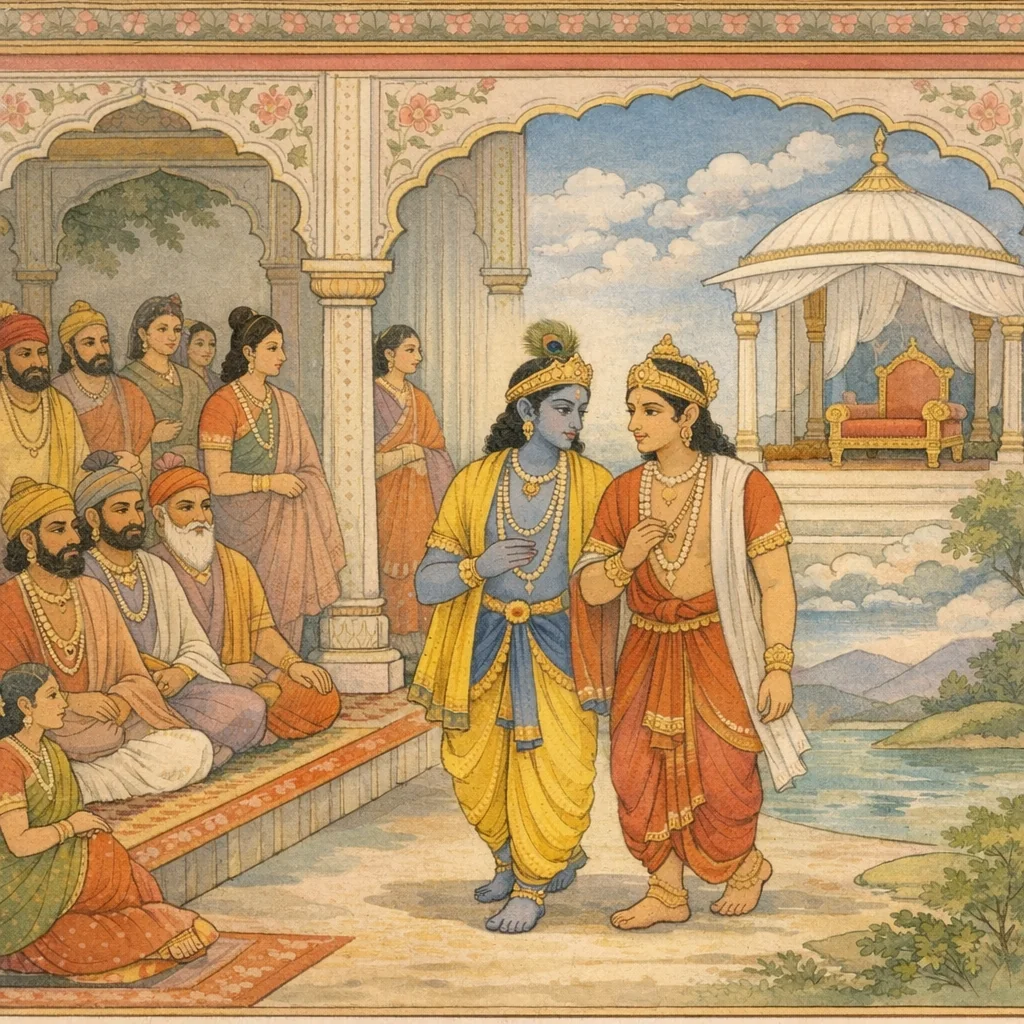
Adhyaya 16
Arjuna’s request to Krishna and the opening of the Kāśyapa–Brāhmaṇa mokṣa discourse (Āśvamedhika-parva 16)
Upa-parva: Mokṣa-dharma Upākhyāna (Krishna–Arjuna recollection and the Brāhmaṇa–Kāśyapa teaching frame)
Janamejaya asks what conversation arose between Krishna and Arjuna while they resided in a splendid assembly after regaining sovereignty. Vaiśaṃpāyana relates that Arjuna, observing the hall with Krishna, recalls Krishna’s earlier revelation in the context of conflict and admits that, due to mental disturbance, he has lost the details. With Krishna soon to depart for Dvārakā, Arjuna requests the teaching again. Krishna responds with a corrective tone: Arjuna had been taught the secret, eternal dharma and the enduring worlds, yet failed to retain it, which Krishna deems regrettable. Krishna asserts that the prior instruction concerned para-brahman and is not easily restated exhaustively in the same manner. He then proposes an alternative: an ancient narrative illustrating the same aim—how one may adopt the requisite understanding and attain the highest course. The chapter transitions into the embedded story: a brāhmaṇa of formidable origin is honored and questioned; the brāhmaṇa begins speaking on mokṣa-dharma, introducing Kāśyapa’s encounter with an accomplished teacher who describes repeated births, sufferings, and the resolve that leads beyond unstable attainments toward Brahman’s station.
Chapter Arc: जनमेजय सभामध्य में पूछते हैं—युद्ध के बाद राज्य-प्राप्ति के उपरान्त अर्जुन ने श्रीकृष्ण से पुनः गीता-विषय क्यों पूछा? उसी जिज्ञासा के साथ वैषम्पायन दिव्य सभा का दृश्य खोलते हैं, जहाँ कृष्ण सहित पार्थ आनंद से विहार कर रहे हैं। → अर्जुन के भीतर एक सूक्ष्म खेद उठता है—पहले उपदेश का सार तो मिला, पर वह दिव्य संवाद ज्यों-का-त्यों स्मृति में नहीं टिकता। वह कृष्ण से उसी ज्ञान को फिर सुनने की याचना करता है। कृष्ण संकेत करते हैं कि वही शब्दशः पुनरावृत्ति संभव नहीं; पर मोक्षधर्म के हितार्थ वे एक प्राचीन संवाद सुनाएँगे—सिद्ध महर्षि और काश्यप के बीच। → कथा के केंद्र में सिद्ध महर्षि का वचन उभरता है: काश्यप के शुद्ध आचरण, गुरु-वृत्ति और एकाग्र तप से प्रसन्न होकर सिद्ध उसे ‘उत्तम सिद्धि’ और लोक-तत्त्व के पारगामी ज्ञान की दिशा दिखाते हैं—और कहते हैं कि वे आगमन का उद्देश्य जानते हैं, अब प्रश्न पूछो; जो अभीष्ट है, वह कहा जाएगा। → सिद्ध काश्यप की बुद्धि और चरित्र की प्रशंसा करते हुए उसे आश्वस्त करते हैं कि मोक्षधर्म का यह मार्ग करुणा-प्रेरित है—भूतों के मोह-च्छेदन के लिए। कृष्ण-अर्जुन संवाद इस प्रकार ‘अनुगीता’ के प्रवाह में प्रवेश करता है: प्रत्यक्ष गीता के स्थान पर परंपरा-प्रमाणित ऋषि-संवाद द्वारा वही तत्त्वज्ञान पुनः प्रतिष्ठित होता है। → सिद्ध महर्षि काश्यप को प्रश्न करने के लिए आमंत्रित करते हैं—अब काश्यप कौन-सा निर्णायक प्रश्न उठाएगा, और मोक्ष का कौन-सा सूक्ष्म रहस्य उद्घाटित होगा?
Shlokas
Verse 1
/ (अनुगीतापर्व) षोडशो<ध्याय: अर्जुनका श्रीकृष्णसे गीताका विषय पूछना और श्रीकृष्णका अर्जुनसे सिद्ध, महर्षि एवं काश्यपका संवाद सुनाना जनमेजय उवाच सभायां वसतोस्तत्र निहत्यारीन् महात्मनो: | केशवार्जुनयो: का नु कथा समभवद् द्विज,जनमेजयने पूछा--्रह्मन्! शत्रुओंका नाश करके जब महात्मा श्रीकृष्ण और अर्जुन सभाभवनमें रहने लगे, उन दिनों उन दोनोंमें क्या-क्या बातचीत हुई?
Janamejaya said: “O twice-born one, after those two great-souled heroes—Keśava and Arjuna—had slain their enemies and were residing there in the assembly hall, what conversation, indeed, arose between them?”
Verse 2
वैशम्पायन उवाच कृष्णेन सहित: पार्थ: स्वं राज्यं प्राप्प केवलम् । तस्यां सभायां दिव्यायां विजहार मुदा युत:,वैशम्पायनजीने कहा--राजन्! श्रीकृष्णके सहित अर्जुनने जब केवल अपने राज्यपर पूरा अधिकार प्राप्त कर लिया, तब वे उस दिव्य सभाभवनमें आनन्दपूर्वक रहने लगे
Vaiśampāyana said: “O king, with Kṛṣṇa at his side, Arjuna obtained full sovereignty over his own realm. In that divine assembly hall, they dwelt and sported in gladness.”
Verse 3
तत्र कंचित् सभोद्देशं स्वर्गोद्दिशसमं नृप । यदृच्छया तौ मुदितौ जग्मतु: स्वजनावृतौ,नरेश्वरर एक दिन वहाँ स्वजनोंसे घिरे हुए वे दोनों मित्र स्वेच्छासे घूमते-घामते सभामण्डपके एक ऐसे भागमें पहुँचे, जो स्वर्गके समान सुन्दर था
There, O king, one day the two friends, joyful and surrounded by their own people, wandered at will and by chance came upon a certain part of the assembly hall—fair as a region of heaven.
Verse 4
ततः प्रतीत: कृष्णेन सहित: पाण्डवोड<र्जुन: । निरीक्ष्य तां सभां रम्यामिदं वचनमत्रवीत्,पाण्डुनन्दन अर्जुन भगवान् श्रीकृष्णके साथ रहकर बहुत प्रसन्न थे। उन्होंने एक बार उस रमणीय सभाकी ओर दृष्टि डालकर भगवान् श्रीकृष्णसे कहा--
Then Arjuna, the son of Pāṇḍu, feeling fully satisfied and accompanied by Kṛṣṇa, cast his gaze upon that delightful assembly-hall and spoke these words to Śrī Kṛṣṇa.
Verse 5
विदितं मे महाबाहो संग्रामे समुपस्थिते । माहात्म्यं देवकीमातस्तच्च ते रूपमैश्वरम्,“महाबाहो! देवकीनन्दन! जब संग्रामका समय उपस्थित था, उस समय मुझे आपके माहात्म्यका ज्ञान और ईश्वरीय स्वरूपका दर्शन हुआ था
Vaiśampāyana said: “O mighty-armed one, when the battle was at hand, I came to know your true greatness, O son of Devakī, and I beheld your sovereign, divine form.”
Verse 6
यत् तद् भगवता प्रोक्तं पुरा केशव सौह्ृदात् | तत् सर्व पुरुषव्याप्र नष्टं मे भ्रष्टचेतस:,“किंतु केशव! आपने सौहार्दवश पहले मुझे जो ज्ञानका उपदेश दिया था, मेरा वह सब ज्ञान इस समय विचलित-चित्त हो जानेके कारण नष्ट हो गया (भूल गया) है
Vaiśampāyana said: “O Keśava, out of friendship you once taught me that sacred instruction. But now, O tiger among men, as my mind has become unsettled, all of it has been lost to me—I have forgotten it.”
Verse 7
मम कौतूहल त्वस्ति तेष्वर्थेषु पुनः पुन: । भवांस्तु द्वारकां गन््ता नचिरादिव माधव,“माधव! उन विषयोंको सुननेके लिये मेरे मनमें बारंबार उत्कण्ठा होती है। इधर आप जल्दी ही द्वारका जानेवाले हैं; अतः पुनः वह सब विषय मुझे सुना दीजिये”
Vaiśampāyana said: “My curiosity about those matters keeps arising again and again. And since you, O Mādhava, are soon to depart for Dvārakā, please recount those very topics to me once more.”
Verse 8
वैशम्पायन उवाच एवमुक्तस्तु तं कृष्ण: फाल्गुन॑ प्रत्यभाषत । परिष्वज्य महातेजा वचन वदतां वर:,वैशम्पायनजी कहते हैं--राजन्! अर्जुनके ऐसा कहनेपर वक्ताओंमें श्रेष्ठ महातेजस्वी भगवान् श्रीकृष्णने उन्हें गलेसे लगाकर इस प्रकार उत्तर दिया
Vaiśampāyana said: When Arjuna had spoken thus, Kṛṣṇa—foremost among speakers and radiant with great splendor—embraced Phālguna and replied to him.
Verse 9
वायुदेव उवाच श्रावितस्त्वं मया गुह्ूं ज्ञापितश्न॒ सनातनम् | धर्म स्वरूपिणं पार्थ सर्वलोकांश्व शाश्वतान्,श्रीकृष्ण बोले--अर्जुन! उस समय मैंने तुम्हें अत्यन्त गोपनीय ज्ञानका श्रवण कराया था, अपने स्वरूपभूत धर्म-सनातन पुरुषोत्तमतत्त्वका परिचय दिया था और (शुक्ल-कृष्ण गतिका निरूपण करते हुए) सम्पूर्ण नित्य लोकोंका भी वर्णन किया था; किंतु तुमने जो अपनी नासमझीके कारण उस उपदेशको याद नहीं रखा, यह मुझे बहुत अप्रिय है। उन बातोंका अब पूरा-पूरा स्मरण होना सम्भव नहीं जान पड़ता
Vāyudeva said: “O Pārtha, I once made you hear the secret teaching and also caused you to understand the eternal truth—the Sanātana, the Supreme Reality that is itself the very form of dharma. I also described to you the everlasting worlds. Yet you did not retain that instruction because of your own lack of discernment; that is deeply displeasing to me. It seems impossible now for those matters to be recalled in full.”
Verse 10
अबुद्धया नाग्रहीर्यस्त्वं तन्मे सुमहदप्रियम् । न च साद्य पुनर्भूय: स्मृतिर्मे सम्भविष्यति,श्रीकृष्ण बोले--अर्जुन! उस समय मैंने तुम्हें अत्यन्त गोपनीय ज्ञानका श्रवण कराया था, अपने स्वरूपभूत धर्म-सनातन पुरुषोत्तमतत्त्वका परिचय दिया था और (शुक्ल-कृष्ण गतिका निरूपण करते हुए) सम्पूर्ण नित्य लोकोंका भी वर्णन किया था; किंतु तुमने जो अपनी नासमझीके कारण उस उपदेशको याद नहीं रखा, यह मुझे बहुत अप्रिय है। उन बातोंका अब पूरा-पूरा स्मरण होना सम्भव नहीं जान पड़ता
“Because of your lack of discernment you did not retain it; that is deeply displeasing to me. And now, once again, a complete recollection of it will not arise in me as it did before.”
Verse 11
नूनमश्रद्दधानोसि दुर्मेधा हासि पाण्डव । न च शकक््यं पुनर्वक्तुमशेषेण धनंजय,पाण्डुनन्दन! निश्चय ही तुम बड़े श्रद्धाहीन हो, तुम्हारी बुद्धि बहुत मन्द जान पड़ती है। धनंजय! अब मैं उस उपदेशको ज्यों-का-त्यों नहीं कह सकता
Vāyu said: “Surely you are lacking in faith, O Pāṇḍava, and your understanding seems dull. And, O Dhanañjaya, it is not possible for me to repeat that instruction again in its entirety, exactly as it was.”
Verse 12
स हि धर्म: सुपर्याप्तो ब्रह्मण: पदवेदने । न शक्यं तन््मया भूयस्तथा वक्तुमशेषत:,क्योंकि वह धर्म ब्रह्मपदकी प्राप्ति करानेके लिये पर्याप्त था, वह सारा-का-सारा धर्म उसी रूपमें फिर दुहरा देना अब मेरे वशकी बात भी नहीं है
That teaching of dharma was fully sufficient to lead one to the realization of Brahman’s supreme state. Yet to repeat that entire dharma again, in the same complete manner and without omission, is no longer within my power.
Verse 13
परं हि ब्रह्म कथितं योगयुक्तेन तन््मया । इतिहासं तु वक्ष्यामि तस्मिन्नर्थे पुरातनम्,उस समय योगयुक्त होकर मैंने परमात्मतत्त्वका वर्णन किया था। अब उस विषयका ज्ञान करानेके लिये मैं एक प्राचीन इतिहासका वर्णन करता हूँ
“Indeed, the Supreme Brahman was described by me while I was absorbed in yoga. Now, in order to convey understanding of that very truth, I shall recount an ancient historical account connected with that subject.”
Verse 14
यथा तां बुद्धिमास्थाय गतिमग्रयां गमिष्यसि । शृणु धर्मभृतां श्रेष्ठ गदितं सर्वमेव मे,जिससे तुम उस समत्वबुद्धिका आश्रय लेकर उत्तम गति प्राप्त कर लोगे। धर्मात्माओंमें श्रेष्ठ अर्जुन! अब तुम मेरी सारी बातें ध्यान देकर सुनो
By taking refuge in that balanced understanding, you will attain the highest course and goal. Therefore listen attentively, O best of the upholders of dharma: hear from me everything that I have to declare.
Verse 15
इस प्रकार श्रीमह्याभारत आश्वमेधिकपर्वके अन्तर्गत अश्वमेधपर्वमें पंद्रहवाँ अध्याय पूरा हुआ,आगच्छद् ब्राह्मण: वलश्चित् स्वर्गलोकादरिंदम । ब्रह्मलोकाच्च दुर्थर्ष: सो5स्माभि: पूजितो5भवत् शत्रुदमन! एक दिनकी बात है, एक दुर्धर्ष ब्राह्मण ब्रह्मलोकसे उतरकर स्वर्गलोकमें होते हुए मेरे यहाँ आये। मैंने उनकी विधिवत् पूजा की और मोक्षधर्मके विषयमें प्रश्न किया। भरतश्रेष्ठ! मेरे प्रश्नका उन्होंने सुन्दर विधिसे उत्तर दिया। पार्थ! वही मैं तुम्हें बतला रहा हूँ। कोई अन्यथा विचार न करके इसे ध्यान देकर सुनो
Vāyu said: “O subduer of foes, once a certain formidable Brahmin descended from the world of Brahmā and, passing through heaven, came to me. I received him with due rites and asked him about the dharma that leads to liberation. O best of the Bharatas, he answered my question in a beautiful and proper manner. O Pārtha, I shall now tell you that very teaching—listen with focused attention, without entertaining contrary doubts.”
Verse 16
अस्माभ्नि: परिपृष्टश्ष यदाह भरतर्षभ । दिव्येन विधिना पार्थ तच्छुणुष्वाविचारयन्,शत्रुदमन! एक दिनकी बात है, एक दुर्धर्ष ब्राह्मण ब्रह्मलोकसे उतरकर स्वर्गलोकमें होते हुए मेरे यहाँ आये। मैंने उनकी विधिवत् पूजा की और मोक्षधर्मके विषयमें प्रश्न किया। भरतश्रेष्ठ! मेरे प्रश्नका उन्होंने सुन्दर विधिसे उत्तर दिया। पार्थ! वही मैं तुम्हें बतला रहा हूँ। कोई अन्यथा विचार न करके इसे ध्यान देकर सुनो इति श्रीमहाभारते आश्वमेधिके पर्वणि अनुगीतापर्वणि षोडशोडथध्याय:
Vāyudeva said: “O bull among the Bharatas! What I was asked, and what I replied, I shall now recount. O Pārtha, listen without wavering, O subduer of foes. Once, a formidable brāhmaṇa descended from Brahmaloka; passing through Svarga, he came to my abode. I honored him according to sacred rule and questioned him about the dharma that leads to liberation. O best of the Bharatas, he answered my inquiry in a beautiful and proper manner. O Pārtha, I will now tell you that very teaching. Do not interpret it otherwise—listen with focused attention.”
Verse 17
ब्राह्मण उवाच मोक्षधर्म समाश्रित्य कृष्ण यन्मामपृच्छथा: । भूतानामनुकम्पार्थ यन्मोहच्छेदनं विभो,ब्राह्मणने कहा--श्रीकृष्ण! मधुसूदन! तुमने सब प्राणियोंपर कृपा करके उनके मोहका नाश करनेके लिये जो यह मोक्ष-धर्मसे सम्बन्ध रखनेवाला प्रश्न किया है, उसका मैं यथावत् उत्तर दे रहा हूँ। प्रभो! माधव! सावधान होकर मेरी बात श्रवण करो
The Brahmin said: “O Krishna, since you have asked me this question grounded in the dharma of liberation—out of compassion for all beings, and with the aim of cutting through delusion, O mighty one—I shall answer it exactly as it is. O Lord, O Madhava, listen attentively to my words.”
Verse 18
तत् ते5हं सम्प्रवक्ष्यामि यथावन्मधुसूदन । शृणुष्वावहितो भूत्वा गदतो मम माधव,ब्राह्मणने कहा--श्रीकृष्ण! मधुसूदन! तुमने सब प्राणियोंपर कृपा करके उनके मोहका नाश करनेके लिये जो यह मोक्ष-धर्मसे सम्बन्ध रखनेवाला प्रश्न किया है, उसका मैं यथावत् उत्तर दे रहा हूँ। प्रभो! माधव! सावधान होकर मेरी बात श्रवण करो
I shall now explain it to you exactly as it is, O Madhusūdana. Listen with full attention, O Mādhava, to what I am saying.
Verse 19
वश्िद् विप्रस्तपोयुक्त: काश्यपो धर्मवित्तम: । आससाद द्विजं कंचिद् धर्माणामागतागमम्,प्राचीन समयमें काश्यप नामके एक धर्मज्ञ और तपस्वी ब्राह्मण किसी सिद्ध महर्षिके पास गये; जो धर्मके विषयमें शास्त्रके सम्पूर्ण रहस्योंको जाननेवाले, भूत और भविष्यके ज्ञान-विज्ञानमें प्रवीण, लोक-तत्त्वके ज्ञानमें कुशल, सुख-दुःखके रहस्यको समझनेवाले, जन्म-मृत्युके तत्त्वज्ञ, पाप-पुण्यके ज्ञाता और ऊँच-नीच प्राणियोंको कर्मानुसार प्राप्त होनेवाली गतिके प्रत्यक्ष द्रष्टा थे
An aged Brahmin, Kāśyapa by name—endowed with austerity and foremost among knowers of dharma—approached a certain twice-born sage who had mastered the received tradition concerning righteousness. In the ancient time, Kāśyapa sought out this accomplished seer, renowned for penetrating the secrets of the śāstras on dharma and for discerning the deeper principles that govern worldly life, suffering and happiness, birth and death, and the moral consequences of action.
Verse 20
गतागते सुबहुशो ज्ञानविज्ञानपारगम् लोकतत्त्वार्थकुशलं ज्ञातार्थ सुखदु:खयो:,प्राचीन समयमें काश्यप नामके एक धर्मज्ञ और तपस्वी ब्राह्मण किसी सिद्ध महर्षिके पास गये; जो धर्मके विषयमें शास्त्रके सम्पूर्ण रहस्योंको जाननेवाले, भूत और भविष्यके ज्ञान-विज्ञानमें प्रवीण, लोक-तत्त्वके ज्ञानमें कुशल, सुख-दुःखके रहस्यको समझनेवाले, जन्म-मृत्युके तत्त्वज्ञ, पाप-पुण्यके ज्ञाता और ऊँच-नीच प्राणियोंको कर्मानुसार प्राप्त होनेवाली गतिके प्रत्यक्ष द्रष्टा थे
The Brāhmaṇa said: In ancient times, a dharma-knowing and ascetic Brāhmaṇa named Kāśyapa went to a perfected great sage—one who had crossed beyond mere learning into realized knowledge, who was skilled in discerning the principles that govern the world, who understood the meaning of pleasure and pain, who knew the truths of birth and death, who could distinguish sin and merit, and who directly perceived the destinations that beings—high and low—attain according to their deeds.
Verse 21
जातीमरणतत्त्वज्ञं कोविदं पापपुण्ययो: । द्रष्टारमुच्चनीचानां कर्मभिवदेहिनां गतिम्,प्राचीन समयमें काश्यप नामके एक धर्मज्ञ और तपस्वी ब्राह्मण किसी सिद्ध महर्षिके पास गये; जो धर्मके विषयमें शास्त्रके सम्पूर्ण रहस्योंको जाननेवाले, भूत और भविष्यके ज्ञान-विज्ञानमें प्रवीण, लोक-तत्त्वके ज्ञानमें कुशल, सुख-दुःखके रहस्यको समझनेवाले, जन्म-मृत्युके तत्त्वज्ञ, पाप-पुण्यके ज्ञाता और ऊँच-नीच प्राणियोंको कर्मानुसार प्राप्त होनेवाली गतिके प्रत्यक्ष द्रष्टा थे
The Brahmin said: “He was a knower of the true principles of birth and death, and expertly discerning in matters of sin and merit. He directly beheld the destinies that embodied beings—high and low—attain according to their deeds.”
Verse 22
चरन्तं मुक्तवत्सिद्धं प्रशान्तं संयतेन्द्रियम् । दीप्यमान श्रिया ब्राह्मया क्रममाणं च सर्वश:
The brāhmaṇa said: “I saw him moving about like one already liberated and perfected—calm, self-possessed, and with his senses restrained—radiant with the splendor born of brahminical spiritual power, proceeding everywhere in an orderly, unhurried way.”
Verse 23
अन्तर्धानगतिज्ञं च श्रुत्वा तत्त्वेन काश्यप: | तथैवान्तरहिति: सिद्धेर्यान्तं चक्रधरै: सह
Hearing, in truth, of the one who knew the course of disappearance (how beings vanish from sight), Kāśyapa likewise attained the perfected power of becoming invisible, and went forth together with the bearers of the discus—those divine attendants associated with the Sudarśana.
Verse 24
सम्भाषमाणमेकान्ते समासीनं च तै: सह । यद्च्छया च गच्छन्तमसक्त पवन यथा
The brāhmaṇa said: “I saw him conversing privately and sitting together with them; and I saw him also moving about by mere chance—unattached, like the wind. His conduct showed no clinging to company, place, or outcome, suggesting an inner freedom that does not depend on circumstance.”
Verse 25
वे मुक्तकी भाँति विचरनेवाले, सिद्ध, शान्तचित्त, जितेन्द्रिय, ब्रह्मतेजसे देदीप्यमान, सर्वत्र घूमनेवाले और अन्तर्धान विद्याके ज्ञाता थे। अदृश्य रहनेवाले चक्रधारी सिद्धोंके साथ वे विचरते, बातचीत करते और उन्हींके साथ एकान्तमें बैठते थे। जैसे वायु कहीं आसक्त न होकर सर्वत्र प्रवाहित होती है, उसी तरह वे सर्वत्र अनासक्त भावसे स्वच्छन्दतापूर्वक विचरा करते थे। महर्षि काश्यप उनकी उपर्युक्त महिमा सुनकर ही उनके पास गये थे ।| २२-- २४ ।। त॑ समासाद्य मेधावी स तदा द्विजसत्तम: । चरणोौ धर्मकामो<स्य तपस्वी सुसमाहितः: । प्रतिपेदे यथान्यायं दृष्टवा तन्महदद्भुतम्,निकट जाकर उन मेधावी, तपस्वी, धर्माभिलाषी और एकाग्रचित्त महर्षिने न्यायानुसार उन सिद्ध महात्माके चरणोंमें प्रणाम किया। वे ब्राह्मणोंमें श्रेष्ठ और बड़े अद्भुत संत थे। उनमें सब प्रकारकी योग्यता थी। वे शास्त्रके ज्ञाता और सच्चरित्र थे। उनका दर्शन करके काश्यपको बड़ा विस्मय हुआ। वे उन्हें गुरु मानकर उनकी सेवामें लग गये और अपनी शुश्रूषा, गुरुभक्ति तथा श्रद्धाभावके द्वारा उन्होंने उन सिद्ध महात्माको संतुष्ट कर लिया
They moved about like liberated beings—accomplished siddhas with tranquil minds and conquered senses, blazing with the radiance of brahman. Roaming everywhere, they knew the art of disappearance. Along with invisible, discus-bearing siddhas they would wander, converse, and sit together in secluded places. As the wind flows everywhere without clinging to anything, so they too ranged freely, unattached and self-directed. Hearing only of such greatness, the sage Kaśyapa went to them. Drawing near, that intelligent ascetic—foremost among the twice-born, intent on dharma and steady in concentration—bowed at the feet of that siddha in the proper manner, astonished at the extraordinary sight.
Verse 26
विस्मितश्ाद्भुतं दृष्टवा काश्यपस्तद् द्विजोत्तमम् । परिचारेण महता गुरुं त॑ पर्यतोषयत्,निकट जाकर उन मेधावी, तपस्वी, धर्माभिलाषी और एकाग्रचित्त महर्षिने न्यायानुसार उन सिद्ध महात्माके चरणोंमें प्रणाम किया। वे ब्राह्मणोंमें श्रेष्ठ और बड़े अद्भुत संत थे। उनमें सब प्रकारकी योग्यता थी। वे शास्त्रके ज्ञाता और सच्चरित्र थे। उनका दर्शन करके काश्यपको बड़ा विस्मय हुआ। वे उन्हें गुरु मानकर उनकी सेवामें लग गये और अपनी शुश्रूषा, गुरुभक्ति तथा श्रद्धाभावके द्वारा उन्होंने उन सिद्ध महात्माको संतुष्ट कर लिया
Seeing that foremost of twice-born men—marvelous and astonishing—Kāśyapa was filled with wonder. Accepting him as his teacher, Kāśyapa served him with great attentiveness and, through devoted attendance, fully pleased the guru.
Verse 27
उपपन्नं च तत्सव॑॑ श्रुतचारित्रसंयुतम् । भावेनातोषयच्चैनं गुरुवृत्त्या परंतप:,निकट जाकर उन मेधावी, तपस्वी, धर्माभिलाषी और एकाग्रचित्त महर्षिने न्यायानुसार उन सिद्ध महात्माके चरणोंमें प्रणाम किया। वे ब्राह्मणोंमें श्रेष्ठ और बड़े अद्भुत संत थे। उनमें सब प्रकारकी योग्यता थी। वे शास्त्रके ज्ञाता और सच्चरित्र थे। उनका दर्शन करके काश्यपको बड़ा विस्मय हुआ। वे उन्हें गुरु मानकर उनकी सेवामें लग गये और अपनी शुश्रूषा, गुरुभक्ति तथा श्रद्धाभावके द्वारा उन्होंने उन सिद्ध महात्माको संतुष्ट कर लिया
Seeing that the sage possessed every requisite—learning grounded in sacred hearing and a life of disciplined conduct—Kāśyapa, the scorcher of foes, approached him in the proper manner. With heartfelt devotion and the conduct due to a teacher, he served him and thereby pleased that accomplished great soul.
Verse 28
तस्मै तुष्ट: स शिष्याय प्रसन्नो वाक्यमत्रवीत् | सिद्धि परामभिप्रेक्ष्य शृणु मत्तो जनार्दन,जनार्दन! अपने शिष्य काश्यपके ऊपर प्रसन्न होकर उन सिद्ध महर्षिने परासिद्धिके सम्बन्धमें विचार करके जो उपदेश किया, उसे बताता हूँ, सुनो
Pleased and gracious toward his disciple, the sage spoke these words: “Keeping the highest attainment in view, listen to me, O Janārdana.”
Verse 29
सिद्ध उवाच विविधै: कर्मभिस्तात पुण्ययोगैश्व केवलै: । गच्छन्तीह गतिं मर्त्या देवलोके च संस्थितिम्,सिद्धने कहा--तात काश्यप! मनुष्य नाना प्रकारके शुभ कर्मोंका अनुष्ठान करके केवल पुण्यके संयोगसे इस लोकमें उत्तम फल और देवलोकमें स्थान प्राप्त करते हैं
The Siddha said: “Dear one, by performing many kinds of actions—actions that are meritorious—mortals attain, here in this world, a favorable course and result; and by the mere conjunction of merit they also gain a settled abode in the realm of the gods.”
Verse 30
न क्वचित् सुखमत्यन्तं न क्वचिच्छाश्वती स्थिति: । स्थानाच्च महतो भ्रंशो दुःखलब्धात् पुन: पुन:,जीवको कहीं भी अत्यन्त सुख नहीं मिलता। किसी भी लोकमें वह सदा नहीं रहने पाता। तपस्या आदिके द्वारा कितने ही कष्ट सहकर बड़े-से-बड़े स्थानको क्यों न प्राप्त किया जाय, वहाँसे भी बार-बार नीचे आना ही पड़ता है
The Siddha said: “Nowhere does a living being obtain happiness that is absolute; nowhere does one remain forever. Even if, through austerity and other disciplines, one attains the highest station after enduring great hardship, from that lofty place too one must again and again fall back down.”
Verse 31
अशुभा गतय: प्राप्ता: कष्टा मे पापसेवनात् । काममन्युपरीतेन तृष्णया मोहितेन च,मैंने काम-क्रोधसे युक्त और तृष्णासे मोहित होकर अनेक बार पाप किये हैं और उनके सेवनके फलस्वरूप घोर कष्ट देनेवाली अशुभ गतियोंको भोगा है
“Through indulgence in sin I have fallen into inauspicious destinies, grievous to endure. Overpowered by desire and anger, and deluded by craving, I committed evil again and again—and I have reaped its bitter, painful results.”
Verse 32
पुन: पुनश्न मरणं जन्म चैव पुन: पुन: । आहारा विविधा भुक्ता: पीता नानाविधा: सतना:,बार-बार जन्म और बार-बार मृत्युका क्लेश उठाया है। तरह-तरहके आहार ग्रहण किये और अनेक स्तनोंका दूध पीया है
Again and again one undergoes the pain of death, and again and again of birth. Again and again one has consumed many kinds of food, and again and again has drunk milk from countless different breasts—an image of the long, weary cycle of saṁsāra and the futility of mere bodily continuance without higher insight.
Verse 33
मातरो विविधा दृष्टा: पितरश्न पृथग्विधा: । सुखानि च विचित्राणि दुःखानि च मयानघ
The Siddha said: “I have seen many kinds of mothers and fathers, each of different dispositions. I have also experienced joys of many sorts, and likewise sorrows—O sinless one.”
Verse 34
अनघ! बहुत-से पिता और भाँति-भाँतिकी माताएँ देखी हैं। विचित्र-विचित्र सुख- दुःखोंका अनुभव किया है ।। प्रियैर्विवासो बहुश: संवासश्चाप्रियैः सह । धननाशकश्न सम्प्राप्तो लब्ध्वा दुःखेन तद् धनम्,कितनी ही बार मुझसे प्रियजनोंका वियोग और अप्रिय जनोंका संयोग हुआ है। जिस धनको मैंने बहुत कष्ट सहकर कमाया था, वह मेरे देखते-देखते नष्ट हो गया है
O sinless one, I have seen many fathers and mothers of many kinds, and I have undergone experiences of happiness and sorrow in countless forms. Many times I have been separated from those dear to me, and many times I have had to live in the company of those I did not like. And the wealth that I acquired only through hardship has, before my very eyes, been lost.
Verse 35
अवमाना: सुकष्टाश्न॒ राजत: स्वजनात् तथा | शारीरा मानसा वापि वेदना भृशदारुणा:,राजा और स्वजनोंकी ओरसे मुझे कई बार बड़े-बड़े कष्ट और अपमान उठाने पड़े हैं। तन और मनकी अत्यन्त भयंकर वेदनाएँ सहनी पड़ी हैं
From the king, and likewise from my own kinsmen, I have repeatedly had to endure many humiliations and severe hardships. I have borne agonizing pains—both bodily and mental—exceedingly dreadful in their intensity.
Verse 36
प्राप्ता विमाननाश्षोग्रा वधबन्धाक्ष दारुणा: । पतन निरये चैव यातनाक्षु यमक्षये,मैंने अनेक बार घोर अपमान, प्राणदण्ड और कड़ी कैदकी सजाएँ भोगी हैं। मुझे नरकमें गिरना और यमलोकमें मिलनेवाली यातनाओंको सहना पड़ा है
I have endured harsh humiliations, and dreadful punishments—death-sentences and the fetters of imprisonment. I have even fallen into hell and borne the torments that await in Yama’s realm.
Verse 37
जरा रोगाश्न सततं व्यसनानि च भूरिश: । लोकेडस्मिन्ननुभूतानि द्वन्द्धजानि भूशं मया,इस लोकमें जन्म लेकर मैंने बारंबार बुढ़ापा, रोग, व्यसन और रागदद्वेषादि द्वद्धोंके प्रचुर दुःख सदा ही भोगे हैं
In this world, I have repeatedly endured—again and again—old age and disease, and countless calamities as well. Having been born here, I have intensely experienced the many sufferings that arise from the pairs of opposites (such as attachment and aversion), which ceaselessly afflict embodied life.
Verse 38
ततः कदाचितन्निवेदान्निराकाराश्रितेन च । लोकतत्त्र॑ परित्यक्तं दुःखार्तेन भृशं॑ मया,इस प्रकार बारंबार क्लेश उठानेसे एक दिन मेरे मनमें बड़ा खेद हुआ और मैं दुखोंसे घबराकर निराकार परमात्माकी शरण ली तथा समस्त लोकव्यवहारका परित्याग कर दिया
Then, once—worn down by repeated afflictions—my heart was filled with deep remorse. Overwhelmed by suffering, I sought refuge in the formless Supreme, and I renounced the entire web of worldly dealings and conventions.
Verse 39
लोकेडस्मिन्ननुभूयाहमिमं मार्गमनुछित: । तत:ः सिद्धिरियं प्राप्ता प्रसादादात्मनो मया,इस लोकमें अनुभवके पश्चात् मैंने इस मार्गका अवलम्बन किया है और अब परमात्माकी कृपासे मुझे यह उत्तम सिद्धि प्राप्त हुई है
Having tested and experienced life in this world, I adopted this fitting path. Thereafter, by the grace of the Supreme Self, I have attained this excellent spiritual accomplishment.
Verse 40
नाहं पुनरिहागन्ता लोकानालोकयाम्यहम् | आसिद्धेराप्रजासर्गादात्मनो5पि गता: शुभा:,अब मैं पुनः इस संसारमें नहीं आऊँगा। जबतक यह सृष्टि कायम रहेगी और जबतक मेरी मुक्ति नहीं हो जायगी, तबतक मैं अपनी और दूसरे प्राणियोंकी शुभगतिका अवलोकन करूँगा
The Siddha said: “I shall not return here again. Until attainment is complete and for as long as the creation of beings continues, I will behold the worlds—and I will also observe the auspicious destinies attained by myself and by other living beings.”
Verse 41
उपलब्धा द्विजश्रेष्ठ तथेयं सिद्धिरुत्तमा । इतः परं गमिष्यामि ततः परतरं पुन:,द्विजश्रेष्ठ! इस प्रकार मुझे यह उत्तम सिद्धि मिली है। इसके बाद मैं उत्तम लोकमें जाऊँगा। फिर उससे भी परम उत्कृष्ट सत्यलोकमें जा पहुँचूँगा और क्रमश: अव्यक्त ब्रह्मपद (मोक्ष)-को प्राप्त कर लूँगा। इसमें तुम्हें संशय नहीं करना चाहिये। काम-क्रोध आदि शत्रुओंको संताप देनेवाले काश्यप! अब मैं पुनः इस मर्त्यलोकमें नहीं आऊँगा
The Siddha said: “O best of Brahmins, thus have I attained this supreme spiritual accomplishment. From here I shall depart to a higher realm, and then again to one still higher. Do not doubt it: having scorched the inner foes such as desire and anger, I shall not return again to this mortal world.”
Verse 42
ब्रह्मण: पदमव्यक्त मा ते5भूदत्र संशय: । नाहं पुनरिहागन्ता मर्त्यलोक॑ परंतप,द्विजश्रेष्ठ! इस प्रकार मुझे यह उत्तम सिद्धि मिली है। इसके बाद मैं उत्तम लोकमें जाऊँगा। फिर उससे भी परम उत्कृष्ट सत्यलोकमें जा पहुँचूँगा और क्रमश: अव्यक्त ब्रह्मपद (मोक्ष)-को प्राप्त कर लूँगा। इसमें तुम्हें संशय नहीं करना चाहिये। काम-क्रोध आदि शत्रुओंको संताप देनेवाले काश्यप! अब मैं पुनः इस मर्त्यलोकमें नहीं आऊँगा
The Siddha said: “The unmanifest state—Brahman’s supreme abode—is indeed the goal; do not entertain any doubt about this. O best of the twice-born, O scorcher of foes: I shall not return here again to the mortal world. Having attained this highest perfection, I will go to the excellent realms, reach the supreme Satyaloka, and in due order attain the unmanifest Brahman-state (liberation).”
Verse 43
प्रीतो5स्मि ते महाप्राज्ञ ब्रूहि किं करवाणि ते । यदीप्सुरुपपन्नस्त्वं तस्य कालोडयमागत:,महाप्राज्ञ! मैं तुम्हारे ऊपर बहुत प्रसन्न हूँ। बोलो, तुम्हारा कौन-सा प्रिय कार्य करूँ? तुम जिस वस्तुको पानेकी इच्छासे मेरे पास आये हो, उसके प्राप्त होनेका यह समय आ गया है
“O great sage, I am well pleased with you. Speak: what dear task shall I do for you? If you have come to me desiring to obtain something, the time for attaining it has now arrived.”
Verse 44
अभिजाने च तदहं यदर्थ मामुपागत: । अचिरात् तु गमिष्यामि तेनाहं त्वामचूचुदम्,तुम्हारे आनेका उद्देश्य क्या है, इसे मैं जानता हूँ और शीघ्र ही यहाँसे चला जाऊँगा। इसीलिये मैंने स्वयं तुम्हें प्रश्न करनेके लिये प्रेरित किया है
“I recognize the purpose for which you have come to me. But I shall depart from here before long; therefore I have prompted you to speak—to ask your question without hesitation.”
Verse 45
भृशं प्रीतो5स्मि भवतश्चारित्रेण विचक्षण । परिपृच्छस्व कुशलं भाषेयं यत् तवेप्सितम्,विद्वन! तुम्हारे उत्तम आचरणसे मुझे बड़ा संतोष है। तुम अपने कल्याणकी बात पूछो। मैं तुम्हारे अभीष्ट प्रश्नका उत्तर दूँगा
The Siddha said: “I am deeply pleased with your conduct, O discerning one. Ask about what is truly beneficial for your well-being; I shall explain whatever you desire to know, O learned man.”
Verse 46
बहु मन्ये च ते बुद्धि भूशं सम्पूजयामि च । येनाहं भवता बुद्धो मेधावी हाृसि काश्यप,काश्यप! मैं तुम्हारी बुद्धिकी सराहना करता और उसे बहुत आदर देता हूँ। तुमने मुझे पहचान लिया है, इसीसे कहता हूँ कि बड़े बुद्धिमान हो
The Siddha said: “I greatly esteem your intelligence and I honor it deeply. Since you have recognized and understood who I am, I say this: you are truly discerning, O Hṛṣi Kāśyapa, O Kāśyapa.”
Frequently Asked Questions
Arjuna’s dilemma is the loss of retained understanding after receiving confidential instruction: the chapter frames forgetfulness and insufficient assimilation as obstacles to dharma-knowledge, prompting a revised teaching approach.
The chapter emphasizes that ultimate teaching about para-brahman is not merely repeatable as information; it must be internalized through appropriate readiness, and is therefore reintroduced via an exemplum focused on impermanence and the pursuit of liberation.
No explicit phalaśruti is stated in the provided passage; the meta-commentary instead appears as Krishna’s instructional framing—positioning the forthcoming ancient narrative as a practical means to reattain correct understanding toward mokṣa.