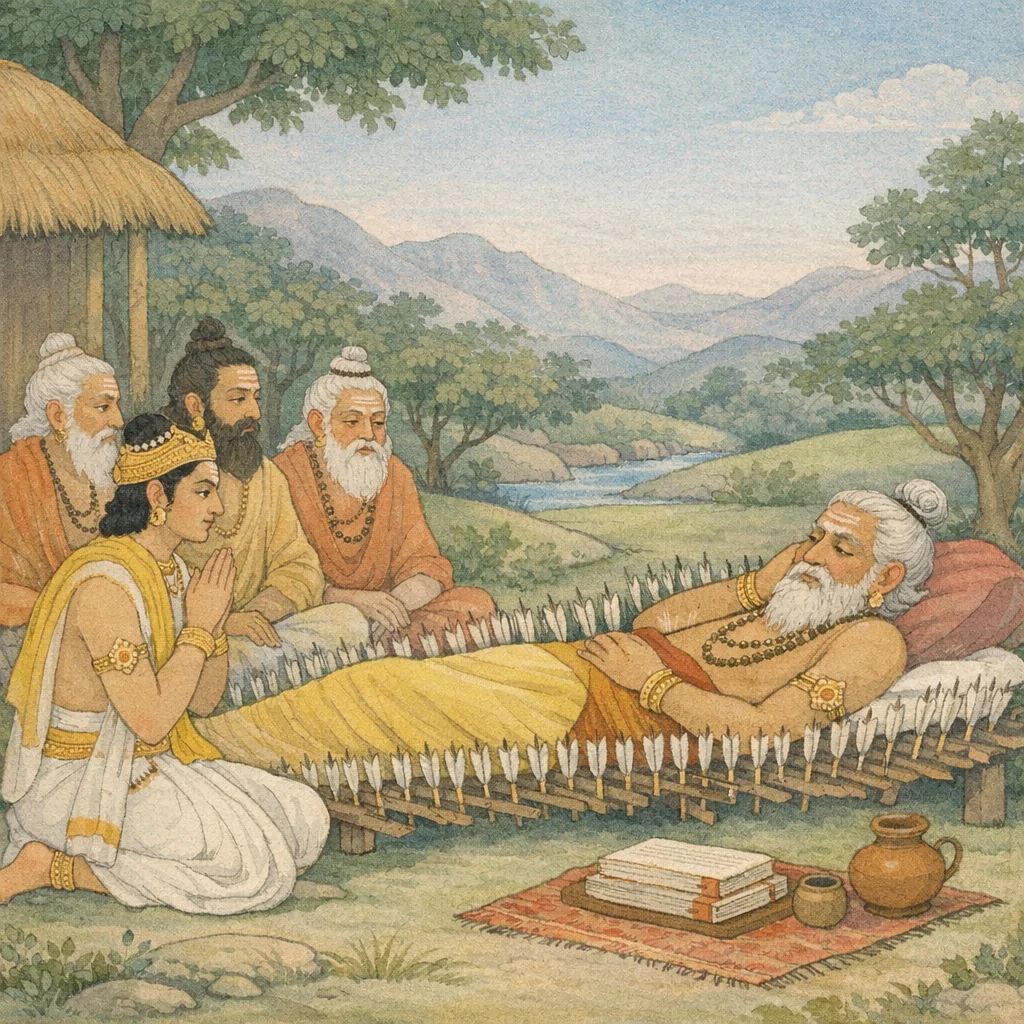
Adhyaya 50
Cyavana’s Water-Vow and the Ethics of Cohabitation (स्नेह-सम्वास-धर्मः)
Upa-parva: Dharma-anuśāsana (Exempla on affection, cohabitation, and compassion toward aquatic beings)
Yudhiṣṭhira asks Bhīṣma to define the nature of affection formed by seeing (darśana) and by living together (saṃvāsa), and to explain the auspicious status of cattle (gavāṃ mahābhāgyam). Bhīṣma answers by introducing an ancient account (purāvr̥tta) connected to King Nahuṣa and the sage Cyavana. Cyavana, a Bhārgava ascetic, undertakes a severe twelve-year water-dwelling vow between the Gaṅgā and Yamunā, subduing pride, anger, elation, and grief. The rivers and aquatic beings do not distress him; he becomes familiar and trusted among them. Later, fishermen arrive to cast extensive nets for fish; in the process, they inadvertently haul up Cyavana, encrusted with river growth and shells. The fishermen prostrate upon recognizing a Veda-knowing sage, while many fish are harmed by the dragging. Seeing the fish’s suffering, Cyavana is moved by compassion and declares he will not leave his aquatic co-inhabitants—he will accept death or sale along with the fish, refusing separation from those with whom he has shared residence. Terrified, the fishermen report the matter to Nahuṣa, setting up a royal adjudication of competing claims: livelihood versus non-harm and the obligations created by cohabitation.
Chapter Arc: युधिष्ठिर, पितामह भीष्म को ‘सर्वशास्त्रविधानज्ञ’ कहकर प्रणाम करता है और एक तीक्ष्ण संशय रखता है—पिता के धन में पुत्रों का दायभाग किस प्रकार निश्चित होता है, विशेषतः जब जन्म-वर्ण और मातृ-वर्ण भिन्न हों। → प्रश्न साधारण उत्तर से आगे बढ़कर वर्ण-संकर, अनुलोम-प्रतिलोम, और विभिन्न मातृ-गर्भों से उत्पन्न पुत्रों के अधिकार तक पहुँचता है; भीष्म स्मृति-नियमों के अनुसार हिस्सों की सीमा, पात्रता और अपात्रता का क्रमशः विधान करते हैं, जिससे न्याय और कठोरता का द्वंद्व उभरता है। → भीष्म निर्णायक रूप से दायभाग की मर्यादाएँ बताते हैं—विशेषकर शूद्रा से ब्राह्मण के पुत्र के लिए ‘अल्प’ और ‘दशमांश से अधिक नहीं’ जैसी सीमाएँ, तथा वर्ण-क्रम की असमानता (एक वर्ण का दूसरे के ‘सदृश’ न होना) को आधार बनाकर उत्तराधिकार का कठोर वर्गीकरण। → युधिष्ठिर के संशय का शास्त्रीय समाधान प्रस्तुत होता है: पिता के धन का विभाजन जन्म-स्थिति, मातृ-वर्ण, और स्वीकृत सामाजिक-धर्म-व्यवस्था के अनुसार होता है; अधिकार ‘समता’ पर नहीं, ‘विधि’ पर टिकता है। → भीष्म के विधान के बाद भी एक मौन प्रश्न शेष रहता है—क्या शास्त्र-सम्मत असमानता ही धर्म है, या धर्म का कोई उच्चतर मानदंड भी है?
Shlokas
Verse 1
अि-क्राछ सप्तचत्वारिशो< ध्याय: ब्राह्मण आदि वर्णोकी दायभाग-विधिका वर्णन युधिछिर उवाच सर्वशास्त्रविधानज्ञ राजधर्मविदुत्तम । अतीव संशयच्छेत्ता भवान् वै प्रथित: क्षितौ,युधिष्ठिरने पूछा--सम्पूर्ण शास्त्रोंके विधानके ज्ञाता तथा राजधर्मके दिद्वानोंमें श्रेष्ठ पितामह! आप इस भूमण्डलमें सम्पूर्ण संशयोंका सर्वथा निवारण करनेके लिये प्रसिद्ध हैं। मेरे हृदयमें एक संशय और है, उसका मेरे लिये समाधान कीजिये। राजन्! इस उत्पन्न हुए संशयके विषयमें मैं दूसरे किसीसे नहीं पूछूँगा
Yudhiṣṭhira said: “O grandsire, you who know the ordinances of all the śāstras and are foremost among those learned in the duties of kings—on this earth you are renowned as one who decisively cuts through doubts. Yet another doubt has arisen in my heart; resolve it for me. O King, regarding this doubt that has arisen, I will ask no one else.”
Verse 2
वक्षित्तु संशयो मे5स्ति तन्मे ब्रूहि पितामह । जाते5स्मिन् संशये राजन् नान्यं पृच्छेम कंचन,युधिष्ठिरने पूछा--सम्पूर्ण शास्त्रोंके विधानके ज्ञाता तथा राजधर्मके दिद्वानोंमें श्रेष्ठ पितामह! आप इस भूमण्डलमें सम्पूर्ण संशयोंका सर्वथा निवारण करनेके लिये प्रसिद्ध हैं। मेरे हृदयमें एक संशय और है, उसका मेरे लिये समाधान कीजिये। राजन्! इस उत्पन्न हुए संशयके विषयमें मैं दूसरे किसीसे नहीं पूछूँगा
Yudhiṣṭhira said: “I have a doubt that I wish to express; tell me the answer, O Grandfather. Now that this doubt has arisen, O King, I will not question anyone else about it.”
Verse 3
यथा नरेण कर्ताव्यं धर्ममार्गनिवर्तिना । एतत् सर्व महाबाहो भवान् व्याख्यातुमरहति,महाबाहो! धर्ममार्गका अनुसरण करनेवाले मनुष्यका इस विषयमें जैसा कर्तव्य हो, इस सबकी आप स्पष्टरूपसे व्याख्या करें
Yudhiṣṭhira said: “O mighty-armed one, please explain clearly all of this—what a person who follows the path of dharma ought to do, and how such duty should be understood and practiced.”
Verse 4
चतस्रो विहिता भार्या ब्राह्म॒णस्य पितामह । ब्राह्मणी क्षत्रिया वैश्या शूद्रा च रतिमिच्छत:,पितामह! ब्राह्मणके लिये चार स्त्रियाँ शास्त्र-विहित हैं--ब्राह्मणी, क्षत्रिया, वैश्या और शूद्रा। इनमेंसे शूद्रा केवल रतिकी इच्छावाले कामी पुरुषके लिये विहित है
“O Grandfather, for a Brahmin the śāstras prescribe four kinds of wives: a Brahmin woman, a Kshatriya woman, a Vaishya woman, and a Shudra woman. Of these, the Shudra wife is enjoined only for a man who seeks mere sensual pleasure.”
Verse 5
तत्र जातेषु पुत्रेषु सर्वासां कुरुसत्तम | आनुपूर्व्येण कस्तेषां पित्रयं दायादमर्हति,कुरुश्रेष्ठ! इन सबके गर्भसे जो पुत्र उत्पन्न हुए हों, उनमेंसे कौन क्रमश: पैतृक धनको पानेका अधिकारी है?
Yudhiṣṭhira said: “O best of the Kurus, among the sons born from all those wives, who, in due order, is entitled to the paternal inheritance—who is the rightful heir to the ancestral estate?”
Verse 6
केन वा किं ततो हार्य पितृवित्तात् पितामह । एतदिच्छामि कथितं विभागस्तेषु य: स्मृत:,पितामह! किस पुत्रको पिताके धनमेंसे कौन-सा भाग मिलना चाहिये? उनके लिये जो विभाग नियत किया गया है, उसका वर्णन मैं आपके मुहँसे सुनना चाहता हूँ
“O Grandfather, by what rule, and in what measure, should a share be taken from a father’s wealth? I wish to hear from your own lips the established apportionment that the Smṛti prescribes in such cases.”
Verse 7
भीष्म उवाच ब्राह्मण: क्षत्रियो वैश्यस्त्रयो वर्णा द्विजातय: । एतेषु विहितो धर्मों ब्राह्मणस्य युधिष्ठिर,भीष्मजीने कहा--युथिष्छिर! ब्राह्मण, क्षत्रिय और वैश्य--ये तीनों वर्ण द्विजाति कहलाते हैं; अतः इन तीन वर्णोमें ही ब्राह्मणका विवाह धर्मतः विहित है
Bhishma said: “O Yudhishthira, the Brahmin, the Kshatriya, and the Vaishya—these three classes are called ‘twice-born’ (dvija). Therefore, it is within these three that the Brahmin’s marriage is prescribed by dharma.”
Verse 8
वैषम्यादथवा लोभात् कामाद् वापि परंतप । ब्राह्मणस्य भवेच्छूद्रा न तु दृष्टान्तत: स्मृता,परंतप नरेश! अन्यायसे, लोभसे अथवा कामनासे शूद्र जातिकी कन्या भी ब्राह्मणकी भार्या होती है; परंतु शास्त्रोंमें इसका कहीं विधान नहीं मिलता
Bhīṣma said: “O scorcher of foes, whether from partiality, greed, or desire, a Śūdra woman may come to be the wife of a Brāhmaṇa; yet in the śāstras this is not remembered as a sanctioned precedent or rule.”
Verse 9
शूद्रां शयनमारोप्य ब्राह्मणो यात्यधोगतिम् । प्रायश्षित्तीयते चापि विधिदृष्टेन कर्मणा
Bhīṣma said: “If a brāhmaṇa places a Śūdra woman upon his bed (that is, enters a forbidden sexual union), he falls to a lower state. Yet he may be purified through expiation (prāyaścitta), by performing the rite prescribed according to rule.”
Verse 10
आपसट्यमानमृक्थं तु सम्प्रवक्ष्यामि भारत
Bhīṣma said: “O Bharata, I shall now explain the matter of inheritance that is wrongfully appropriated—property taken under false pretenses—so that its ethical and legal implications may be understood.”
Verse 11
लक्षण्यं गोवृषो यान॑ यत् प्रधानतमं भवेत् । ब्राह्माण्यास्तद्धरेत् पुत्र एकांशं वै पितुर्धनात्
Bhīṣma said: “Whatever is deemed the most eminent among the distinguishing gifts—such as a cow, a bull, or a conveyance—let the son set aside that foremost item for the Brāhmaṇa woman (Brāhmaṇī), taking it as her due share from the father’s wealth.”
Verse 12
शेष तु दशधा कार्य ब्राह्मणस्वं युधिष्ठिर । तत्र तेनैव हर्तव्याक्ष॒त्वारों3शा: पितुर्धनात्
Bhīṣma said: “As for the remainder, O Yudhiṣṭhira, it should be arranged in ten portions as property belonging to the Brāhmaṇas. From that, the same person should take four shares from the father’s wealth.”
Verse 13
भरतनन्दन! अब मैं ब्राह्मण आदि वर्णोकी कन्याओंके गर्भसे उत्पन्न होनेवाले पुत्रोंकी पैतृक धनका जो भाग प्राप्त होता है, उसका वर्णन करूँगा। ब्राह्मणकी ब्राह्मणी पत्नीसे जो पुत्र उत्पन्न होता है, वह उत्तम लक्षणोंसे सम्पन्न गृह आदि, बैल, सवारी तथा अन्य जो-जो श्रेष्ठटम पदार्थ हों, उन सबको अर्थात् पैतृक धनके प्रधान अंशको पहले ही अपने अधिकारमें कर ले। युधिष्ठिर! फिर ब्राह्मणका जो शेष धन हो, उसके दस भाग करने चाहिये। पिताके उस धनमेंसे पुनः चार भाग ब्राह्मणीके पुत्रको ही ले लेने चाहिये || १०-- १२ || क्षत्रियायास्तु यः पुत्रो ब्राह्मण: सो5प्यसंशय: । स तु मातुर्विशेषेण त्रीनंशान् हर्तुमहति,क्षत्रियाका जो पुत्र है, वह भी ब्राह्मण ही होता है--इसमें संशय नहीं है। वह माताकी विशिष्टताके कारण पैतृक धनका तीन भाग ले लेनेका अधिकारी है
Bhishma said: “O descendant of Bharata, I shall now set forth the shares in a father’s estate that fall to sons born of women of the different varṇas, beginning with the Brahmin. The son whom a Brahmin begets upon a Brahmin wife should first, by his own right, take the chief portion of the inheritance—such as the house and the like, oxen, conveyances, and whatever else is held to be the finest. Then, O Yudhishthira, the remaining wealth should be divided into ten parts; and from that paternal wealth the son of the Brahmin wife should again take four parts. As for a son born of a Kshatriya woman, he too is certainly a Brahmin, without doubt; and by reason of his mother’s distinct status, he is entitled to take three parts.”
Verse 14
वर्णे तृतीये जातस्तु वैश्यायां ब्राह्णादपि । द्विरंशस्तेन हर्तव्यो ब्राह्मणस्वाद् युधिष्ठिर,युधिष्ठिर! तीसरे वर्णकी कन्या वैश्यामें जो ब्राह्मणसे पुत्र उत्पन्न होता है, उसे ब्राह्मणके धनमेंसे दो भाग लेने चाहिये
Bhishma said: “O Yudhishthira, when a son is born to a woman of the third varna (a Vaishya) from a Brahmin father, he should receive a double share from the Brahmin’s property.”
Verse 15
शूद्रायां ब्राह्म॒णाज्जातो नित्यादेयधन: स्मृतः । अल्पं चापि प्रदातव्यं शूद्रापुत्राय भारत
Bhishma said: “A son born to a Brahmin from a Shudra woman is traditionally regarded as one whose property is subject to obligatory taking (that is, not fully protected by the usual claims of ownership). And, O Bharata, even to the son of a Shudra, only a small gift should be given.”
Verse 16
भारत! ब्राह्मणसे शूद्रामें जो पुत्र उत्पन्न होता है, उसे तो धन न देनेका ही विधान है तो भी शूद्राके पुत्रको पैतृक धनका स्वल्पतम भाग--एक अंश दे देना चाहिये ।। दशधा प्रविभक्तस्य धनस्यैष भवेत् क्रम: । सवर्णासु तु जातानां समान् भागान् प्रकल्पयेत्,दस भागोंमें विभक्त हुए बँटवारेका यही क्रम होता है। परंतु जो समान वर्णकी स्त्रियोंसे उत्पन्न हुए पुत्र हैं, उन सबके लिये बराबर भागोंकी कल्पना करनी चाहिये
Bhishma said: “O Bharata, when a son is born to a Brahmin from a Shudra woman, the rule is that he is not to be given property. Yet even so, the son of a Shudra should be granted the smallest portion of the paternal estate—one share. This is the order when wealth is divided into ten parts. But for sons born of women of the same varna, equal shares should be assigned to all.”
Verse 17
अब्राह्माणं तु मन्यन्ते शूद्रापुत्रमनैपुणात् । त्रिषु वर्णेषु जातो हि ब्राह्मणाद् ब्राह्मणो भवेत्,ब्राह्मणसे शूद्राके गर्भसे जो पुत्र उत्पन्न होता है, उसे ब्राह्मण नहीं मानते हैं; क्योंकि उसमें ब्राह्मणो-चित निपुणता नहीं पायी जाती। शेष तीन वर्णकी स्त्रियोंसे ब्राह्मणद्वारा जो पुत्र उत्पन्न होता है, वह ब्राह्मण होता है
Bhishma said: “They do not regard as a Brahmin the son born of a Shudra woman, for he is considered to lack the refinement and competence associated with Brahmin conduct. But a son begotten by a Brahmin upon a woman of any of the other three social orders is held to be a Brahmin.”
Verse 18
स्मृताश्न वर्णाक्षत्वार: पञचमो नाधिगम्यते । हरेच्च दशमं भागं शूद्रापुत्र: पितुर्धनात्,चार ही वर्ण बताये हैं, पाँचवाँ वर्ण नहीं मिलता। शूद्राका पुत्र ब्राह्मण पिताके धनसे उसका दसवाँ भाग ले सकता है
Bhishma said: “Tradition recognizes four social orders; a fifth is not admitted. If a son born of a Śūdrā woman is fathered by a Brāhmaṇa, he may take a tenth share of his father’s wealth.”
Verse 19
तत्तु दत्त हरेत् पित्रा नादत्तं हर्तुमहति । अवश्यं हि धन देयं शूद्रापुत्राय भारत,वह भी पिताके देनेपर ही उसे लेना चाहिये, बिना दिये उसे लेनेका कोई अधिकार नहीं है। भरतनन्दन! किंतु शूद्राके पुत्रको भी धनका भाग अवश्य दे देना चाहिये
Bhishma said: “Only what has been formally given by the father may be taken; what has not been given, one is not entitled to seize. Yet, O Bharata, a share of wealth must certainly be allotted to the son of a Shudra woman as well.”
Verse 20
आनुृशंस्यं परो धर्म इति तस्मै प्रदीयते । यत्र तत्र समुत्पन्नं गुणायैवोपपद्यते,दया सबसे बड़ा धर्म है। यह समझकर ही उसे धनका भाग दिया जाता है। दया जहाँ भी उत्पन्न हो, वह गुणकारक ही होती है
Bhishma said: “Compassion is the highest dharma”—understanding this, a share is granted to him. Wherever compassion arises, in whatever circumstance, it inevitably results in virtue and moral good.
Verse 21
यद्यप्येष सपुत्र: स्यादपुत्रो यदि वा भवेत् । नाधिकं दशमादू दद्याच्छूद्रापुत्राय भारत,भारत! ब्राह्मणके अन्य वर्णकी स्त्रियोंसे पुत्र हों या न हों, वह शूद्राके पुत्रको दसवें भागसे अधिक धन न दे
Bhīṣma said: “Even if a Brahmin has sons, or even if he happens to be without sons, O Bhārata, he should not give to the son of a Śūdra woman more than a tenth share.”
Verse 22
त्रैवार्षिकादू यदा भक्तादथिकं स्याद् द्विजस्य तु | यजेत तेन द्रव्येण न वृथा साधयेद् धनम्,जब ब्राह्मणके पास तीन वर्षतक निर्वाह होनेसे अधिक धन एकत्र हो जाय तब वह उस धनसे यज्ञ करे। धनका व्यर्थ संग्रह न करे
Bhīṣma said: “When a twice-born man finds that his provisions exceed what is needed for three years of maintenance, he should employ that surplus in sacrifice and sacred giving, rather than accumulating wealth without purpose.”
Verse 23
त्रिसहस्रपरो दाय: स्त्रियै देयो धनस्य वै | भर्त्रां तच्च धन दत्तं यथाहई भोक्तुमरहति,सत्रीको तीन हजारसे अधिक लागतका धन नहीं देना चाहिये। पतिके देनेपर ही उस धनको वह यथोचित रूपसे उपभोगमें ला सकती है
Bhishma said: A woman’s allotted gift from the family’s wealth should not exceed three thousand. And that wealth, when given by her husband, she is entitled to enjoy and use in a fitting manner—according to proper custom and need.
Verse 24
स्त्रीणां तु पतिदायाद्यमुपभोगफल स्मृतम् | नापहारं स्त्रिय: कुर्यु: पतिवित्तात् कथंचन,स्त्रियोंको पतिके धनसे जो हिस्सा मिलता है, उसका उपभोग ही (उसके लिये) फल माना गया है। पतिके दिये हुए स्त्रीधनसे पुत्र आदिको कुछ नहीं लेना चाहिये
Bhishma said: For women, the portion that comes to them from the husband’s property is traditionally understood to yield its fruit chiefly in enjoyment and use. Therefore, women should never be deprived in any way of what belongs to them from the husband’s wealth; and what is given as a woman’s own property is not to be taken away by sons or other heirs.
Verse 25
स्त्रियास्तु यद् भवेत् वित्तं पित्रा दत्तं युधिष्ठिर । ब्राह्मण्यास्तद्धरेत् कन्या यथा पुत्रस्तथा हि सा,युधिष्ठिर! ब्राह्मणीको पिताकी ओरसे जो धन मिला हो, उस धनको उसकी पुत्री ले सकती है; क्योंकि जैसा पुत्र है, वैसी ही पुत्री भी है
Bhīṣma said: “O Yudhiṣṭhira, whatever wealth a woman possesses that has been given by her father—if she is a Brāhmaṇa woman, her daughter may rightfully take that property; for the daughter is to be regarded as equivalent to a son in this matter.”
Verse 26
सा हि पुत्रसमा राजन् विहिता कुरुनन्दन । एवमेव समुद्दिष्टो धर्मो वै भरतर्षभ । एवं धर्ममनुस्मृत्य न वृथा साधयेद् धनम्,कुरुनन्दन! भरतकुलभूषण नरेश! पुत्री पुत्रके समान ही है--ऐसा शास्त्रका विधान है। इस प्रकार वही धनके विभाजनकी धर्मयुक्त प्रणाली बतायी गयी है। इस तरह धर्मका चिन्तन एवं अनुस्मरण करते हुए ही धनका उपार्जन एवं संग्रह करे। परंतु उसे व्यर्थ न होने दे--यज्ञ-यागादिके द्वारा सफल कर ले
Bhishma said: “O king, O joy of the Kurus, a daughter is indeed ordained by the śāstras to be equal to a son. Thus, O bull among the Bharatas, the righteous rule for the division of wealth has been stated. Keeping this dharma in mind and recalling it, one should acquire and store wealth not in vain, O Kurunandana—rather, one should ensure it becomes fruitful through acts such as sacrifices and sacred rites.”
Verse 27
युधिछिर उवाच शूद्रायां ब्राह्मणाज्जातो यद्यदेयधन: स्मृत: । केन प्रतिविशेषेण दशमो<प्यस्य दीयते,युधिषछ्िरने पूछा--दादाजी! यदि ब्राह्मणसे शूद्रामें उत्पन्न हुए पुत्रको धन न देने योग्य बताया गया है तो किस विशेषताके कारण उसको पैतृक धनका दसवाँ भाग भी दिया जाता है?
Yudhiṣṭhira said: “If a son born to a brāhmaṇa from a śūdrā woman is remembered in the tradition as one to whom property should not be given, then by what particular distinction is even a tenth share of the paternal wealth nevertheless allotted to him?”
Verse 28
ब्राह्मण्यां ब्राह्मणाज्जातो ब्राह्मण: स्यान्न संशय: । क्षत्रियायां तथैव स्याद् वैश्यायामपि चैव हि,ब्राह्मणसे ब्राह्मणीमें उत्पन्न हुआ पुत्र ब्राह्मण हो--इसमें कोई संशय ही नहीं है; वैसे ही क्षत्रिया और वैश्याके गर्भसे उत्पन्न हुए पुत्र भी ब्राह्मण ही होते हैं
Yudhiṣṭhira said: “A son born of a brāhmaṇa father in a brāhmaṇa woman is certainly a brāhmaṇa—there is no doubt. In the same way, even when born in a kṣatriya woman or in a vaiśya woman, he is still regarded as a brāhmaṇa.”
Verse 29
कस्मात् तु विषमं भागं भजेरन् नृपसत्तम | यदा सर्वे त्रयो वर्णास्त्वियोक्ता ब्राह्मणा इति,नृपश्रेष्ठ जब आपने ब्राह्मण आदि तीनों वर्णोंवाली स्त्रियोंसे उत्पन्न हुए पुत्रोंको ब्राह्मण ही बताया है, तब वे पैतृक धनका समान भाग क्यों नहीं पाते हैं? क्यों वे विषम भाग ग्रहण करें?
Yudhiṣṭhira said: “O best of kings, why should they accept an unequal share? For when you have declared that the sons born of women belonging to the three varṇas—Brāhmaṇa and the rest—are to be regarded as Brāhmaṇas, on what grounds do they not receive an equal portion of the ancestral wealth?”
Verse 30
भीष्म उवाच दारा इत्युच्यते लोके नाम्नैकेन परंतप । प्रोक्तेन चैव नाम्नायं विशेष: सुमहान् भवेत्,भीष्मजीने कहा--शत्रुओंको संताप देनेवाले नरेश! लोकमें सब स्त्रियोंका 'दारा' इस एक नामसे ही परिचय दिया जाता है। इस तथाकथित नामसे ही चारों वर्णोकी स्त्रियोंसे उत्पन्न हुए पुत्रोंमें महान् अन्तर हो जाता है-
Bhishma said: 'O scorcher of foes, in common usage all women are referred to by the single designation “dārā” (wives). Yet, merely by this very label as it is applied, a very great distinction comes to be recognized.'
Verse 31
तिस््र: कृत्वा पुरो भार्या: पश्चाद् विन्देत ब्राह्मणीम् ।। सा ज्येष्ठा सा च पूज्या स्यात् सा च भार्या गरीयसी
Bhishma said: “Having first taken three wives, one should thereafter marry a Brahmin woman. She is to be regarded as the eldest; she should be honored, and she is to be considered the most weighty and foremost among the wives.”
Verse 32
ब्राह्मण पहले अन्य तीनों वर्णोकी स्त्रियोंको ब्याह लानेके पश्चात् भी यदि ब्राह्मणकन्यासे विवाह करे तो वही अन्य स्त्रियोंकी अपेक्षा ज्येष्ठ, अधिक आदर-सत्कारके योग्य तथा विशेष गौरवकी अधिकारिणी होगी ।। स््नान॑ प्रसाधन भर्तुर्दन्तधावनमज्जनम् । हव्यं कव्यं च यच्चान्यद् धर्मयुक्त गृहे भवेत्,युधिष्ठि! पतिको स्नान कराना, उनके लिये शंंगार-सामग्री प्रस्तुत करना, दाँतकी सफाईके लिये दातौन और मंजन देना, पतिके नेत्रोंमें आॉजन या सुरमा लगाना, प्रतिदिन हवन और पूजनके समय हव्य और कव्यकी सामग्री जुटाना तथा घरमें और भी जो धार्मिक कृत्य हो उसके सम्पादनमें योग देना--ये सब कार्य ब्राह्मणके लिये ब्राह्मणीको ही करने चाहिये। उसके रहते हुए दूसरे किसी वर्णवाली स्त्रीको यह सब करनेका अधिकार नहीं है
Bhishma tells Yudhishthira that if a Brahmin, even after marrying women from the other three social orders, later marries a Brahmin maiden, she alone is to be regarded as the senior wife—more worthy of honor, formal respect, and special precedence than the others. He then specifies the domestic and ritual duties that, in a Brahmin household, properly belong to the Brahmin wife: arranging the husband’s bath and grooming, providing what is needed for cleaning the teeth, applying collyrium to the eyes, and gathering the requisites for daily offerings—both the oblations to the gods (havya) and the rites for ancestors (kavya)—as well as assisting in any other religiously sanctioned observances performed in the home. While she is present, Bhishma says, a wife from another order has no authority to perform these acts. The passage frames household service and ritual competence as matters of dharma and hierarchy, assigning precedence and religious responsibility to the Brahmin wife within the normative social code being taught.
Verse 33
न तस्यां जातु तिष्ठन्त्यामन्या तत् कर्तुमहति । ब्राह्मणी त्वेव कुर्याद् वा ब्राह्मणस्य युधिष्ठिर,युधिष्ठि! पतिको स्नान कराना, उनके लिये शंंगार-सामग्री प्रस्तुत करना, दाँतकी सफाईके लिये दातौन और मंजन देना, पतिके नेत्रोंमें आॉजन या सुरमा लगाना, प्रतिदिन हवन और पूजनके समय हव्य और कव्यकी सामग्री जुटाना तथा घरमें और भी जो धार्मिक कृत्य हो उसके सम्पादनमें योग देना--ये सब कार्य ब्राह्मणके लिये ब्राह्मणीको ही करने चाहिये। उसके रहते हुए दूसरे किसी वर्णवाली स्त्रीको यह सब करनेका अधिकार नहीं है
Bhīṣma said: “So long as she (the Brahmin wife) is present, no other woman has the right to perform those duties. It is the Brahmin wife alone, O Yudhiṣṭhira, who should carry out the prescribed services for a Brahmin husband.”
Verse 34
अन्न पानं च माल्यं च वासांस्याभरणानि च । ब्राह्मण्यैतानि देयानि भर्तु: सा हि गरीयसी,पतिको अन्न, पान, माला, वस्त्र और आभूषण--ये सब वस्तुएँ ब्राह्मणी ही समर्पित करे; क्योंकि वही उसके लिये सब स्त्रियोंसे अधिक गौरवकी अधिकारिणी है
Bhīṣma said: “Food and drink, garlands, garments, and ornaments—these are to be offered by the brāhmaṇī (the Brahmin wife) to her husband; for in this duty she holds the higher place, most worthy of honor.”
Verse 35
मनुनाभिद्िितं शास्त्र यच्चापि कुरुनन्दन । तत्राप्येष महाराज दृष्टो धर्म: सनातन:,महाराज कुरुनन्दन! मनुने भी जिस धर्मशास्त्रका प्रतिपादन किया है, उसमें भी यही सनातन धर्म देखा गया है
Bhīṣma said: “O joy of the Kurus, even in the treatise proclaimed by Manu, this very same eternal dharma is seen, O great king.”
Verse 36
अथ चेदन्यथा कुर्याद् यदि कामाद् युधिष्ठिर । यथा ब्राह्मण चाण्डाल: पूर्वदृष्टस्तथैव स:,युधिष्ठिर! यदि ब्राह्मण कामके वशीभूत होकर इस शास्त्रीय पद्धतिके विपरीत बर्ताव करता है, वह ब्राह्मण चाण्डाल समझा जाता है जैसा कि पहले कहा गया है
Bhīṣma said: “But if, driven by desire, a brāhmaṇa acts otherwise—contrary to the prescribed discipline—then, O Yudhiṣṭhira, he is to be regarded just like the ‘brāhmaṇa-cāṇḍāla’ described earlier; he becomes the very same in status and conduct.”
Verse 37
ब्राह्मण्या: सदृश: पुत्र: क्षत्रियायाश्व यो भवेत् राजन् विशेषो यस्त्वत्र वर्णयोरुभयोरपि,राजन! ब्राह्मणके समान ही जो क्षत्रियाका पुत्र होगा, उसमें भी उभयवर्णसम्बन्धी अन्तर तो रहेगा ही
Bhīṣma said: “O King, even if a son born of a Kṣatriya woman resembles a Brāhmaṇa in qualities, a distinction connected with both varṇas still remains here.”
Verse 38
न तु जात्या समा लोके ब्राह्याण्या: क्षत्रिया भवेत् ब्राह्माण्या: प्रथम: पुत्रो भूयान् स्थाद् राजसत्तम
Bhīṣma said: “In this world, a Kṣatriya woman is not equal in birth-status to a Brāhmaṇa woman. The first-born son of a Brāhmaṇa woman should be regarded as the more eminent—O best among kings.”
Verse 39
यथा न सदृशी जात_ु ब्राह्म॒ण्या: क्षत्रिया भवेत्
Bhīṣma said: “Just as a Kṣatriya woman can never truly be the equal of a Brāhmaṇa woman.” In this instruction, Bhīṣma underscores the traditional dharma-based hierarchy of varṇa and the distinct ideals expected of different social orders, presenting it as an ethical norm of conduct and status rather than a matter of personal preference.
Verse 40
श्रीक्ष राज्यं च कोशकश्ष क्षत्रियाणां युधिषछ्ठिर,राजा युधिष्ठिर! लक्ष्मी, राज्य और कोष--यह सब शास्त्रमें क्षत्रियोंक लिये ही विहित देखा जाता है। राजन! क्षत्रिय अपने धर्मके अनुसार समुद्रपर्यन्त पृथ्वी तथा बहुत बड़ी सम्पत्ति प्राप्त कर लेता है। नरेश्वर! राजा (क्षत्रिय) दण्ड धारण करनेवाला होता है। क्षत्रियके सिवा और किसीसे रक्षाका कार्य नहीं हो सकता
Bhishma said: “O Yudhishthira, prosperity, sovereignty, and the royal treasury are prescribed in the scriptures as the proper charge of the Kshatriya. O King Yudhishthira, it is seen that Lakshmi (royal fortune), the kingdom, and the treasury are all ordained for the Kshatriya’s role. Acting in accordance with his dharma, a Kshatriya may lawfully obtain dominion over the earth up to the encircling seas and acquire vast wealth. O lord of men, the king—being a Kshatriya—is the bearer of the rod of punishment (danda), and apart from the Kshatriya no one else is truly able to carry out the work of protection.”
Verse 41
विहितं दृश्यते राजन् सागरान्तां च मेदिनीम् | क्षत्रियो हि स्वधर्मेण श्रियं प्राप्रोति भूयसीम् । राजा दण्डधरो राजन रक्षा नान्यत्र क्षत्रियात्,राजा युधिष्ठिर! लक्ष्मी, राज्य और कोष--यह सब शास्त्रमें क्षत्रियोंक लिये ही विहित देखा जाता है। राजन! क्षत्रिय अपने धर्मके अनुसार समुद्रपर्यन्त पृथ्वी तथा बहुत बड़ी सम्पत्ति प्राप्त कर लेता है। नरेश्वर! राजा (क्षत्रिय) दण्ड धारण करनेवाला होता है। क्षत्रियके सिवा और किसीसे रक्षाका कार्य नहीं हो सकता
Bhīṣma said: “O King, it is laid down in the śāstras that sovereignty over the earth up to the encircling ocean is ordained for the Kṣatriya. Indeed, by adhering to his own dharma, a Kṣatriya attains great prosperity and splendor. O King, the ruler is the bearer of the rod of punishment; protection cannot be secured from any other quarter than the Kṣatriya. O King Yudhiṣṭhira.”
Verse 42
ब्राह्मणा हि महाभागा देवानामपि देवता: । तेषु राजन् प्रवर्तेत पूजया विधिपूर्वकम्,राजन! महाभाग! ब्राह्मण देवताओंके भी देवता हैं; अतः उनका विधिपूर्वक पूजन- आदर-सत्कार करते हुए ही उनके साथ बर्ताव करे
Bhīṣma said: “O King, the Brahmins—truly fortunate and venerable—are regarded as the very divinities even of the gods. Therefore, O ruler, let your conduct toward them be guided by proper, rule-based worship: honor them, serve them, and deal with them only with due reverence.”
Verse 43
प्रणीतमृषिभिर्ज्ञात्वा धर्म शाश्वतमव्ययम् । लुप्यमान स्वधर्मेण क्षत्रियो होष रक्षति,ऋषियोंद्वारा प्रतिपादित अविनाशी सनातन धर्मको लुप्त होता जानकर क्षत्रिय अपने धर्मके अनुसार उसकी रक्षा करता है
Bhīṣma said: “Recognizing the eternal, imperishable Dharma as established by the seers, and seeing it being eroded, a kṣatriya—acting in accordance with his own ordained duty—protects it, O king.”
Verse 44
दस्युभि्दियमाणं च धन दारांश्व॒ सर्वश: । सर्वेषामेव वर्णानां त्राता भवति पार्थिव:,डाकुओंद्वारा लूटे जाते हुए सभी वर्णोके धन और स्त्रियोंका राजा ही रक्षक होता है
Bhishma said: When wealth and even women are being carried off by bandits in every way, it is the king who becomes the protector of all the social orders. The verse underscores the ruler’s dharma as the public guardian—responsible for preventing lawlessness and ensuring the safety of persons and property without discrimination among the varṇas.
Verse 45
भूयान् स्यात् क्षत्रियापुत्रो वैश्यापुत्रान्न संशय: । भूयस्तेनापि हर्तव्यं पितृवित्ताद् युधिष्ठिर,इन सब दृष्टियोंसे क्षत्रियाका पुत्र वैश्याके पुत्रसे श्रेष्ठ होता है--इसमें संशय नहीं है। युधिष्ठिर! इसलिये शेष पैतृक धनमेंसे उसको भी विशेष भाग लेना ही चाहिये
Bhīṣma said: “A Kṣatriya’s son is indeed superior to a Vaiśya’s son—of this there is no doubt. Therefore, O Yudhiṣṭhira, he too should receive a larger share from the remaining ancestral wealth.”
Verse 46
इस प्रकार श्रीमह्ाभारत अनुशासनपर्वके अन्तर्गत दानधर्मपर्वमें विवाहधर्मके प्रसंगमें स्त्रीकी प्रशंभानामक छियालीसवाँ अध्याय पूरा हुआ,युधिछिर उवाच उक्त ते विधिवद् राजन् ब्राह्णस्य पितामह । इतरेषां तु वर्णानां कथं वै नियमो भवेत् युधिष्ठिरने पूछा--पितामह! आपने ब्राह्मणके धनका विभाजन विधिपूर्वक बता दिया। अब यह बताइये कि अन्य वर्णोके धनके बँटवारेका कैसा नियम होना चाहिये?
Yudhiṣṭhira said: “O King, O Grandfather, you have explained in due form the lawful rule concerning the division of a Brāhmaṇa’s wealth. Now tell me—what rule should apply to the distribution of wealth for the other social orders as well?”
Verse 47
भीष्म उवाच क्षत्रियस्यापि भायें द्वे विहिते कुरुनन्दन । तृतीया च भवेच्छूद्रा न तु दृष्टान्तत: स्मृता,भीष्मजीने कहा--कुरुनन्दन! क्षत्रियके लिये भी दो वर्णोंकी भार्याएँ शास्त्रविहित हैं। तीसरी शूद्रा भी उसकी भार्या हो सकती है। परंतु शास्त्रसे उसका समर्थन नहीं होता इति श्रीमहाभारते अनुशासनपर्वणि दानधर्मपर्वणि विवाहधर्मे रिक्थविभागो नाम सप्तचत्वारिंशो5ध्याय:
Bhishma said: “O joy of the Kurus, for a Kshatriya too the scriptures prescribe two lawful wives (from the higher varṇas). A third—of the Śūdra class—may also become his wife in practice; yet this is not upheld by scriptural precedent as an authoritative model.”
Verse 48
एष एव क्रमो हि स्यात् क्षत्रियाणां युधिष्ठिर अष्टधा तु भवेत् कार्य क्षत्रियस्वं जनाधिप,राजा युधिष्ठिर! क्षत्रियोंके लिये भी बँटवारेका यही क्रम है। क्षत्रियके धनको आठ भागोंमें विभक्त करना चाहिये
Bhīṣma said: “O Yudhiṣṭhira, this indeed is the proper rule of procedure for the Kṣatriyas. But, O lord of men, the wealth belonging to a Kṣatriya should be apportioned into eight shares.”
Verse 49
क्षत्रियाया हरेत् पुत्रश्नतुरोंडशान् पितुर्धनात् । युद्धावहारिकं यच्च पितु: स्थात् स हरेत् तु तत्,क्षत्रियाका पुत्र उस पैतृक धनमेंसे चार भाग स्वयं ग्रहण कर ले तथा पिताकी जो युद्धसामग्री है, उसको भी वही ले ले
Bhishma said: “In the case of a Kshatriya, the son should take four shares from the father’s ancestral wealth; and whatever implements and equipment of war belong to the father, those too the son should take.”
Verse 50
वैश्यापुत्रस्तु भागांस्त्रीन् शूद्रापुत्रस्तथाष्टमम् । सो<पि दत्तं हरेत् पित्रा नादत्तं हर्तुमहति,शेष धनमेंसे तीन भाग वैश्याका पुत्र ले ले और अवशिष्ट आठवाँ भाग शूद्राका पुत्र प्राप्त करे। वह भी पिताके देनेपर ही उसे लेना चाहिये। बिना दिया हुआ धन ले जानेका उसे अधिकार नहीं है
Bhishma said: “The son of a Vaiśyā woman should take three shares, and likewise the son of a Śūdrā woman should take an eighth share. Even he should take it only if it is given by the father; he has no right to seize what has not been granted.”
Verse 51
एकैव हि भवेद् भार्या वैश्यस्य कुरुनन्दन । द्वितीया तु भवेत् शूद्रा न तु दृष्टान्ततः स्मृता,कुरुनन्दन! वैश्यकी एक ही वैश्यकन्या धर्मानुसार भार्या हो सकती है। दूसरी शूद्रा भी होती है, परंतु शास्त्रसे उसका समर्थन नहीं होता है
Bhīṣma said: “O joy of the Kurus, for a Vaiśya there should be only one lawful wife—one taken from the Vaiśya class. A second wife may indeed be a Śūdrā woman, yet the tradition does not uphold this as a sanctioned model or exemplary precedent.”
Verse 52
वैश्यस्य वर्तमानस्य वैश्यायां भरतर्षभ । शूद्रायां चापि कौन्तेय तयोविनियम: स्मृत:,भरतश्रेष्ठ! कुन्तीकुमार! वैश्यके वैश्या और शाद्रा दोनोंके गर्भसे पुत्र हों तो उनके लिये भी धनके बँटवारेका वैसा ही नियम है
Bhīṣma said: “O bull among the Bharatas, O son of Kuntī: when a Vaiśya, while living in the householder state, has sons born from a Vaiśya woman and also from a Śūdra woman, the rule for their allotment is remembered to be the same as the established regulation for such mixed offspring.”
Verse 53
पज्चधा तु भवेत् कार्य वैश्यस्वं भरतर्षभ । तयोरपत्ये वक्ष्यामि विभागं च जनाधिप
Bhīṣma said: “O bull among the Bharatas, the duties and functions of the Vaiśya are to be set in five distinct divisions. And concerning their offspring as well, O king, I shall explain the proper classification and distribution.”
Verse 54
भरतभूषण नरेश! वैश्यके धनको पाँच भागोंमें विभक्त करना चाहिये। फिर वैश्या और शूद्राके पुत्रोमें उस धनका विभाजन कैसे करना चाहिये, यह बताता हूँ ।। वैश्यापुत्रेण हर्तव्याश्नत्वारों शा: पितुर्धनात् । पञ्चमस्तु स्मृतो भाग: शूद्रापुत्राय भारत,भरतनन्दन! उस पैतृक धनमेंसे चार भाग तो वैश्याके पुत्रको ले लेने चाहिये और पाँचवाँ अंश शूद्राके पुत्रका भाग बताया गया है
Bhīṣma said: “O Bhārata, ornament of the Bharata line! From a Vaiśya father’s wealth, the son born of a Vaiśyā is to take four shares; the fifth share is remembered as belonging to the son born of a Śūdrā. Thus is the division of paternal property stated according to the remembered rule.”
Verse 55
सो5पि दत्तं हरेत् पित्रा नादत्तं हर्तुमरहति । त्रिभिर्वर्ण: सदा जात: शूद्रोडदेयधनो भवेत्,वह भी पिताके देनेपर ही उस धनको ले सकता है। बिना दिया हुआ धन लेनेका उसे कोई अधिकार नहीं है। तीनों वर्णोंसे उत्पन्न हुआ शूद्र सदा धन न देनेके योग्य ही होता है
Bhīṣma said: “Even he may take only what has been expressly given by the father; he has no right to seize what has not been given. A Śūdra born from the intermixture of the three higher varṇas is, as a rule, one to whom wealth is not to be entrusted or given.”
Verse 56
शूद्रस्य स्थात् सवर्णव भार्या नान्या कथंचन । समभागाश्र पुत्रा: स्युर्यदि पुत्रशतं भवेत्,शूद्रकी एक ही अपनी जातिकी ही स्त्री भार्या होती है। दूसरी किसी प्रकार नहीं। उसके सभी पुत्र, वे सौ भाई क्यों न हों, पैतृक धनमेंसे समान भागके अधिकारी होते हैं
Bhīṣma said: “For a Śūdra, the wife should be only of his own varṇa—never otherwise. And all his sons, even if they number a hundred, are entitled to equal shares in the paternal property.”
Verse 57
जातानां समवर्णाया: पुत्राणामविशेषत: । सर्वेषामेव वर्णानां समभागो धनात् स्मृत:,समस्त वर्णोके सभी पुत्रोंका, जो समान वर्णकी स्त्रीसे उत्पन्न हुए हैं, सामान्यतः: पैतृक धनमें समान भाग माना गया है
Bhīṣma said: “As a general rule, sons born of a wife of the same varṇa, without distinction, are remembered as having an equal share in the paternal property. This principle is held to apply across all varṇas.”
Verse 58
ज्येष्ठस्य भागो ज्येष्ठ: स्थादेकांशो यः प्रधानत: । एष दायविदधि: पार्थ पूर्वमुक्त: स्वयम्भुवा,कुन्तीनन्दन! ज्येष्ठ पुत्रका भाग भी ज्येष्ठ होता है। उसे प्रधानत:ः एक अंश अधिक मिलता है। पूर्वकालमें स्वयम्भू ब्रह्माजीने पैतृक धनके बँटवारेकी यह विधि बतायी थी
The eldest son’s portion shall be the eldest’s: in principle he is to receive one additional share as the principal allotment. This is the rule for dividing paternal wealth that the Self-born Brahmā declared in ancient times, O son of Kuntī.
Verse 59
समवर्णासु जातानां विशेषो<स्त्यपरो नृप । विवाहवैशिष्ट्यकृत: पूर्वपूर्वो विशिष्यते,नरेश्वर! समान वर्णकी स्त्रियोंमें जो पुत्र उत्पन्न हुए हैं, उनमें यह दूसरी विशेषता ध्यान देने योग्य है। विवाहकी विशिष्टताके कारण उन पुत्रोंमें भी विशिष्टता आ जाती है। अर्थात् पहले विवाहकी स्त्रीसे उत्पन्न हुआ पुत्र श्रेष्ठ और दूसरे विवाहकी स्त्रीसे पैदा हुआ पुत्र कनिष्ठ होता है
O king, even among sons born of women of the same varṇa there is another distinction to be observed. Because of the particular standing of the marriage, a gradation arises among them: the son born of the earlier marriage is held superior, and the son born of a later marriage is held junior.
Verse 60
हरेज्ज्येष्ठ: प्रधानांशमेकं तुल्यासु तेष्वपि | मध्यमो मध्यमं चैव कनीयांस्तु कनीयसम्,तुल्य वर्णवाली स्त्रियोंसे उत्पन्न हुए उन पुत्रोंमें भी जो ज्येष्ठ है, वह एक भाग ज्येष्ठांश ले सकता है। मध्यम पुत्रको मध्यम और कनिष्ठ पुत्रको कनिष्ठ भाग लेना चाहिये
Even among sons born of women of equal standing, the eldest may take one principal share—the elder’s portion; the middle son should take a middle share, and the youngest the youngest share.
Verse 61
एवं जातिषु सर्वासु सवर्ण: श्रेष्ठतां गत: । महर्षिरपि चैतद् वै मारीच: काश्यपोडब्रवीत्,इस प्रकार सभी जातियोंमें समान वर्णकी स्त्रीसे उत्पन्न हुआ पुत्र ही श्रेष्ठ होता है। मरीचि-पुत्र महर्षि काश्यपने भी यही बात बतायी है
Thus, among all social groups, the son born of a woman of the same varṇa is regarded as the most excellent. Indeed, the great sage Kāśyapa, son of Marīci, declared this very principle as well.
Verse 96
तत्र जातेष्वपत्येषु द्विगुणं स्यथाद् युधिष्ठिर । शूद्रजातिकी स्त्रीको अपनी शय्यापर सुलाकर ब्राह्मण अधोगतिको प्राप्त होता है। साथ ही शास्त्रीय विधिके अनुसार वह प्रायश्चित्तका भागी होता है। युधिष्ठिर! शूद्राके गर्भसे संतान उत्पन्न करनेपर ब्राह्मणको दूना पाप लगता है और उसे दूने प्रायश्चित्तका भागी होना पड़ता है
O Yudhishthira, when a Brahmin begets children through a woman of the Shudra class, his moral fault is reckoned as doubled. To take a Shudra woman to one’s bed leads the Brahmin toward a degraded spiritual state; and by the rule of the śāstras he becomes liable to the prescribed expiations—here, the expiation too is doubled.
Verse 383
भूयो भूयो<5पि संहार्य: पितृवित्ताद् युधिष्ठिर । क्षत्रियकन्या संसारमें अपनी जातिद्दारा ब्राह्मण-कन्याके बराबर नहीं हो सकती। नृपश्रेष्ठ! इसी प्रकार ब्राह्मणीका पुत्र क्षत्रियाके पुत्रसे प्रथम एवं ज्येष्ठ होगा। युधिष्ठिर! इसलिये पिताके धनमेंसे ब्राह्मणीके पुत्रको अधिक-अधिक भाग देना चाहिये
Bhīṣma said: “Again and again, O Yudhiṣṭhira, this must be kept in view when distributing a father’s wealth. In the social order, a Kṣatriya maiden, by virtue of her birth, is not regarded as equal to a Brāhmaṇa maiden. Likewise, O best of kings, the son born of a Brāhmaṇa wife is considered prior and elder to the son of a Kṣatriya. Therefore, O Yudhiṣṭhira, from the father’s property a larger share should be allotted to the son of the Brāhmaṇa wife.”
Verse 396
क्षत्रियायास्तथा वैश्या न जातु सदृशी भवेत् । जैसे क्षत्रिया कभी ब्राह्मणीके समान नहीं हो सकती वैसे ही वैश्या भी कभी क्षत्रियाके तुल्य नहीं हो सकती
Bhīṣma said: “Just as a Kṣatriya woman can never be regarded as the same as a Brāhmaṇa woman, so too a Vaiśya woman can never be equal to a Kṣatriya woman.”
Frequently Asked Questions
A livelihood-driven act (net fishing) unintentionally harms many fish and ensnares an ascetic; the dilemma is how to weigh economic activity against non-harm and the duties created by long shared residence with vulnerable beings.
Ethical responsibility is relational and cumulative: sustained proximity (saṃvāsa) generates protective obligations, and compassion can require limiting one’s gain when it produces avoidable suffering to co-inhabitants.
No explicit phalaśruti appears in the provided verses; the chapter functions as a didactic exemplum whose significance lies in framing later adjudication and in illustrating dharma through precedent rather than promised ritual merit.