Adhyaya 18
रुद्र-स्तवराजः (Rudra-Stavarāja) — Exempla of Śiva’s Boons and the Hymn’s Phalaśruti
Upa-parva: Śiva-stava (Rudra-stavarāja) and Exempla of Śaiva Grace
Vaiśaṃpāyana reports that Kṛṣṇa-Dvaipāyana (Vyāsa), characterized as a mahāyogin, instructs the recitation of a Śiva hymn, asserting that Śiva’s favor yields desired aims, as it did for him during austerities. A sequence of voices and exempla follows: figures such as Ālambāyana and other sages describe tapas, curses, moral peril, and subsequent refuge in Maheśvara, resulting in release from fault, restoration of well-being, longevity, and excellence. Jāmadagnya (Paraśurāma) narrates purification and divine gifts (including the paraśu and astras) after grievous distress, with assurances of invincibility and fame. Parāśara frames Vyāsa’s birth and cosmic role as a boon’s outcome, positioning lineage and authorship within a providential register. Additional accounts (e.g., Māṇḍavya’s ordeal and relief; Gālava’s reunion with his father) reinforce Śiva as rescuer and ordainer of destiny. The chapter culminates in Kṛṣṇa’s expansive Rudra-stavarāja enumerating deities, cosmic principles, and categories of experience as arising from Śarva, followed by a phalaśruti: disciplined, pure recitation for a year is said to yield Aśvamedha-like merit and role-specific benefits, with a concluding claim of extensive heavenly residence proportional to one’s bodily ‘romakūpa’ count.
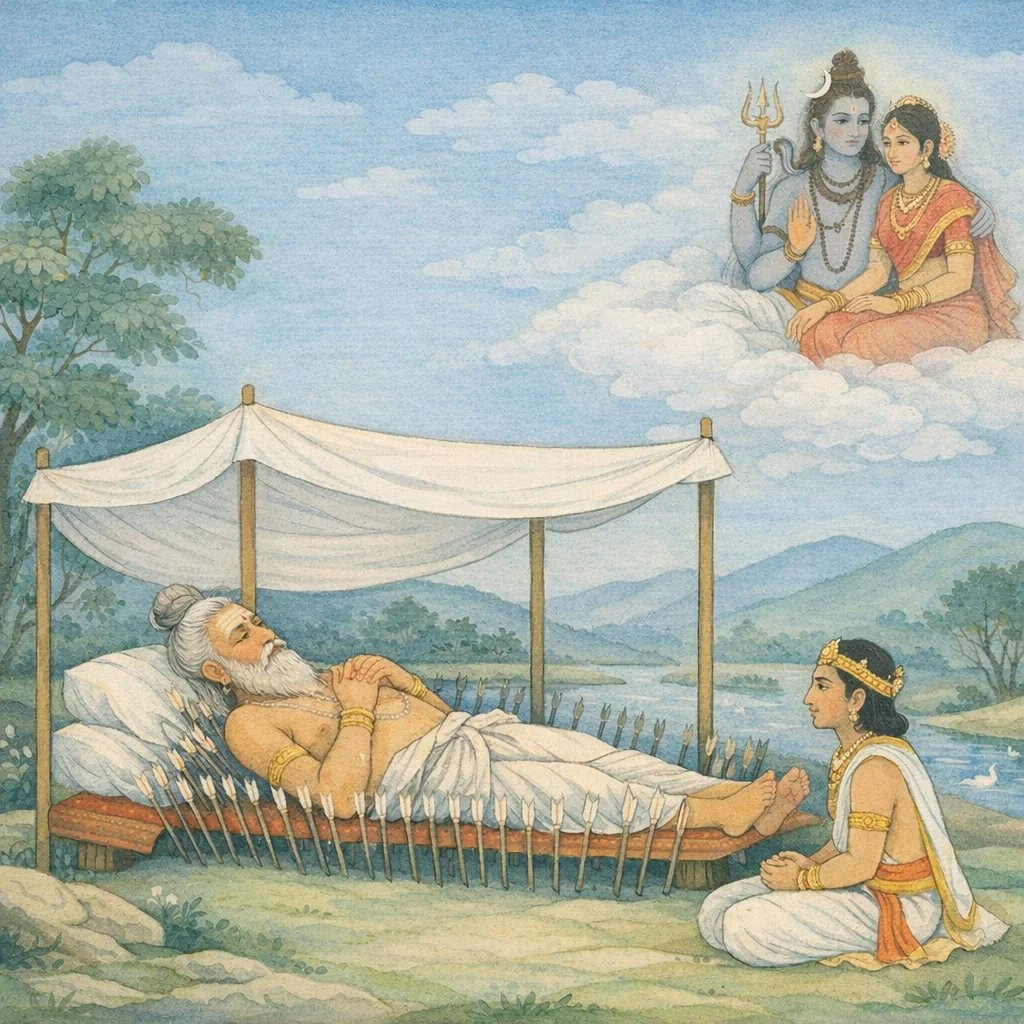
Chapter Arc: भीष्म शरशय्या पर धर्म-उपदेश की धारा में एक दिव्य मोड़ लेते हैं—वे महेश्वर के असंख्य नाम-रूपों का स्मरण कराते हुए बताते हैं कि स्तुति स्वयं साधना बन जाती है। → श्लोकों में शिव के विराट, विरोधाभासी-से प्रतीत होने वाले गुण एक-एक कर उभरते हैं—ऊर्ध्वगात्मा, पशुपति, पिनाकधृत, वराह-रूप, शत्रुहा—मानो श्रोता के भीतर प्रश्न उठे: इतने रूपों वाले देव को मनुष्य कैसे समझे, कैसे पकड़े? इसी के साथ यह भी प्रतिपादित होता है कि केवल सुनना नहीं, सुनाना-कथन-कीर्तन भी साधक को उसी भाव में स्थिर करता है। → चरम बिंदु पर अध्याय यह उद्घोष करता है कि जो सर्वभाव से महेश्वर की शरण लेते हैं, शरणागतवत्सल देव उन्हें संसार-सागर से उबारते हैं; और जो एकभक्ति से इस स्तोत्र का पाठ करते हैं, उन्हें वही परम गति प्राप्त होती है जो सांख्य-योग के साधकों को मिलती है। → भक्ति का रहस्य स्पष्ट होता है—शिव की कृपा से ही मनुष्य में अनन्य भक्ति जन्म लेती है, और वही भक्ति परम सिद्धि का द्वार बनती है। स्तुति, वंदना, अर्चना—ये सब एक ही मार्ग के विविध चरण हैं। → नारायण-नाम का स्मरण (यम के प्रति ‘नारायणाय…’ का संकेत) यह आभास देता है कि आगे उपदेश में देव-तत्त्व की एकता और नाम-रहस्य का विस्तार होगा।
Shlokas
Verse 136
ऊर्ध्वगात्मा पशुपतिर्वातरंहा मनोजव: । चन्दनी पद्मनालाग्र: सुरभ्युत्तरणो नर:,८६६ ऊर्ध्वगात्मा--देश-काल-वस्तुकृत उपाधिसे अतीत स्वरूपवाले, ८६७ पशुपति: --जीवोंके स्वामी, ८६८ वातरंहा:--वायुके समान वेगशाली, ८६९ मनोजव:--मनके समान वेगशाली, ८७० चन्दनी--चन्दनचर्चित अंगवाले, ८७१ पद्मनालाग्र:--पदानालके मूल विष्णुस्वरूप, ८७२ सुरशभ्युत्तरण:--सुरभिको नीचे उतारनेवाले, ८७३ नरः-- पुरुषरूप
Vāyu-deva said: “He is of an upward-transcending nature, the Lord of creatures; swift as the wind and as fast as the mind. His limbs are anointed with sandal, he is the very tip (essence) of the lotus-stalk, and he is the man who brought down Surabhī.”
Verse 137
कर्णिकारमहास्रग्वी नीलमौलि: पिनाकधृत् । उमापतिरुमाकान्तो जाह्नवीधृदुमाधव:,८७४ कर्णिकारमहास्रग्वी--कनेरकी बहुत बड़ी माला धारण करनेवाले, ८७५ नीलमौलि:--मस्तकपर नीलमणिमय मुकुट धारण करनेवाले, ८७६ पिनाकधृत्--पिनाक धनुषको धारण करनेवाले, ८७७ उमापति:--उमा--ब्रह्मविद्याके स्वामी, ८७८ उमाकान्तः --पार्वतीके प्राण-प्रियतम, ८७९ जाह्नवीधृत्--गंगाको मस्तकपर धारण करनेवाले, ८८० उमाधव:--पार्वतीपति
Vāyu-deva said: “He who wears a great garland of karṇikāra blossoms; whose head is crowned with a dark-blue crest-jewel; who bears the Pināka bow; the Lord of Umā, beloved of Umā; he who holds the Jāhnavī (Gaṅgā) upon his head; the husband of Umā.”
Verse 138
वरो वराहो वरदो वरेण्य: सुमहास्वन: । महाप्रसादो दमन: शत्रुहा श्वेतपिज्रल:,८८१ वरो वराह:--श्रेष्ठ वराहरूपधारी भगवान्, ८८२ वरदा:--वरदाता, ८८३ वरेण्य:--स्वामी बनाने योग्य, ८८४ सुमहास्वन:--महान् गर्जना करनेवाले, ८८५ महाप्रसाद:--भक्तोंपर महान् अनुग्रह करनेवाले, ८८६ दमन:--दुष्टोंका दमन करनेवाले, ८८७ शत्रुहा-शत्रुनाशक, ८८८ श्वैेतपिड्ुल:--अर्धनारीनरेश्वर वेशमें श्वेत-पिंगल वर्णवाले
Vāyu said: “He is the excellent Boar-incarnation, the giver of boons, and the One worthy to be chosen and served. His roar is vast and mighty. He shows great grace to devotees, subdues the wicked, destroys enemies, and appears with a fair, tawny-hued radiance.”
Verse 139
पीतात्मा परमात्मा च प्रयतात्मा प्रधानधृत् । सर्वपारश्वमुखस्त्रयक्षो धर्मसाधारणो वर:,८८९ पीतात्मा--हिरण्मय पुरुष, ८९० परमात्मा-परत्रह्म परमेश्वर, ८९१ प्रयतात्मा--विशुद्धचित्त, ८९२ प्रधानधृत--जगत्के कारणभूत त्रिगुणमय प्रधानके अधिष्ठानस्वरूप, ८९३ सर्वपार्श्वमुख:--सम्पूर्ण दिशाओंकी ओर मुखवाले, ८९४ त्र्यक्ष:-- त्रिनेत्रधारी, ८९५ धर्मसाधारणो वर:--धर्म-पालनके अनुसार वर देनेवाले
Vāyu said: “He is the golden-souled one and the Supreme Self; his inner being is disciplined and purified; he upholds Pradhāna, the primordial ground of the world. Facing in all directions, three-eyed, he grants boons in accordance with dharma—an excellent lord who makes righteousness the common measure for all.”
Verse 140
चराचरात्मा सूक्ष्मात्मा अमृतो गोवृषेश्चर: । साध्यर्षिवसुरादित्यो विवस्वान् सवितामृत:,८९६ चराचरात्मा--चराचर प्राणियोंके आत्मा, ८९७ सूक्ष्मात्मा--अति सूक्ष्मस्वरूप, ८९८ अमृतो गोवृषेश्चवर:--निष्काम धर्मके स्वामी, ८९९ साध्यर्षि:--साध्य देवताओंके आचार्य, ९०० आदित्यो वसु:--अदितिकुमार वसु, ९०१ विवस्वान् सवितामृत:-- किरणोंसे सुशोभित एवं जगत्को उत्पन्न करनेवाले अमृतस्वरूप सूर्य
Vāyu said: He is the inner Self of all moving and unmoving beings; His essence is exceedingly subtle. He is deathless, and the lord who upholds the dharma of the ‘cow and the bull’—the sustaining order of righteousness. He is the guide of the Sādhyas and the seers; He is counted among the Vasus and the Ādityas; He is Vivasvān, Savitṛ—the radiant Sun, immortal in nature, who brings forth and energizes the world.
Verse 141
व्यास: सर्ग: सुसंक्षेपो विस्तर: पर्ययो नरः । ऋतु: संवत्सरो मास: पक्ष: संख्यासमापन:,९०२ व्यास:--पुराण-इतिहास आदिके स्रष्टा वेदव्यासस्वरूप, ९०३ सर्ग:सुसंक्षेपो विस्तर:--संक्षिप्त और विस्तृत सृष्टिस्वरूप, ९०४ पर्ययो नर:--सब ओरसे व्याप्त करनेवाले वैश्वानरस्वरूप, ९०५ ऋतु:--ऋतुरूप, ९०६ संवत्सर:--संवत्सररूप, ९०७ मास:--मासरूप, ९०८ पक्ष:--पक्षरूप, ९०९ संख्यासमापन:--पूर्वोक्त ऋतु आदिकी संख्या समाप्त करनेवाले पर्व (संक्रान्ति, दर्श, पूर्णणासादि) रूप
Vāyu said: “He is Vyāsa; he is the cosmic ‘sarga’ (emanation). He is both the concise and the expansive form of creation. He is the all-pervading Vaiśvānara-like ‘Nara’. He is the season, the year, the month, the fortnight, and the very ‘completion of counting’—the calendrical junctions that bring the enumerations of time to their close.”
Verse 142
कला: काष्ठा लवा मात्रा मुहूर्ताहःक्षपा: क्षणा: । विश्वेक्षेत्र प्रजाबीज॑ लिड्रमाद्यस्तु निर्गम:,९१० कला:, ९११ काष्ठा:, ९१२ लवा:, ९१३ मात्रा:--(इत्यादि कालावयवस्वरूप), ९१४ मुहूर्ताह:क्षपा:--मुहूर्त, दिन और रात्रिरूप, ९१५ क्षणा:--क्षणरूप, ९१६ विश्वेक्षेत्रमू--ब्रह्माण्डरूपी वृक्षेके आधार, ९१७ प्रजाबीजम्--प्रजाओंके कारणरूप, ९१८ लिज्रम--महत्तत््वस्वरूप, ९१९ आद्यो निर्गमम:--सबसे पहले प्रकट होनेवाले
Vāyudeva said: “Kalās, kāṣṭhās, lavas, mātrās, muhūrtas, days and nights, and kṣaṇas—these are the measures and divisions of Time. He is the support of the universe, like the ground of a cosmic tree; He is the seed-cause of all beings; He is the subtle mark (liṅga) by which the unmanifest is inferred; and He is the first to emerge in creation.”
Verse 143
सदसद् व्यक्तमव्यक्तं पिता माता पितामह: । स्वर्गद्धारं प्रजाद्वारं मोक्षद्वारं त्रिविष्टपम्,९२० सत्--सत्स्वरूप, ९२१ असत्--असस्त्वरूप, ९२२ व्यक्तम्--साकाररूप, ९२३ अव्यक्तम--निराकाररूप, ९२४ पिता, ९२५ माता, ९२६ पितामह:, ९२७ स्वर्गद्वारम--स्वर्गके साधनस्वरूप, ९२८ प्रजाद्वारम--प्रजाके कारण, ९२९ मोक्षद्वारम् --मोक्षके साधनस्वरूप, ९३० त्रिविष्टपम्--स्वर्गके साधनस्वरूप
Vāyu said: “It is both being and non-being; the manifest and the unmanifest. It is father, mother, and grandsire. It is the gateway to heaven, the gateway to progeny, and the gateway to liberation—indeed, it is Triviṣṭapa (heaven) itself.”
Verse 144
निर्वाणं ह्वादनश्वैव ब्रह्मतोक: परा गति: । देवासुरविनिर्माता देवासुरपरायण:,९३१ निर्वाणम्--मोक्षस्वरूप, ९३२ ह्वादन:--आनन्द प्रदान करनेवाले, ९३३ ब्रह्मलोक:--ब्रह्मलोकस्वरूप, ९३४ परा. गतिः--सर्वोत्कृष्ट गतिस्वरूप, ९३५ देवासुरविनिर्माता--देवताओं तथा असुरोंके जन्मदाता, ९३६ देवासुरपरायण:-- देवताओं तथा असुरोंके परम आश्रय
Vāyudeva said: He is Nirvāṇa itself, the giver of bliss, and the very Brahma-world—the highest destination. He is the creator of both gods and asuras, and the supreme refuge upon whom both gods and asuras ultimately depend.
Verse 145
देवासुरगुरुर्देवो देवासुरनमस्कृत: । देवासुरमहामात्रो देवासुरगणाश्रय:,९३७ देवासुरगुरु:--देवताओं और असुरोंके गुरु, ९३८ देव:--परम देवस्वरूप, ९३९ देवासुरनमस्कृत:--देवताओं और असुरोंसे वन्दित, ९४० देवासुरमहामात्र:--देवताओं और असुरोंसे अत्यन्त श्रेष्ठ, ९४१ देवासुरगणाश्रय:--देवताओं तथा असुरगणोंके आश्रय लेने योग्य
Vāyu said: “He is the revered teacher of both gods and asuras; the supreme divine being, honored by gods and asuras alike; the foremost among them, and the refuge upon whom the hosts of gods and asuras may rely.”
Verse 146
देवासुरगणाध्यक्षो देवासुरगणाग्रणी: । देवातिदेवो देवर्षिदेवासुरवरप्रद:,९४२ देवासुरगणाध्यक्ष:--देवताओें तथा असुरगणोंके अध्यक्ष, ९४३ देवासुरगणाग्रणी:--देवताओं तथा असुरोंके अगुआ, ९४४ देवातिदेव:--देवताओंसे बढ़कर महादेव, ९४५ देवर्षि:--नारदस्वरूप, ९४६ देवासुरवरप्रद:--देवताओं और असुरोंको भी वरदान देनेवाले
Vāyu said: He is the presiding lord over the hosts of gods and asuras, the foremost leader among them; the God beyond the gods, a divine seer in his own right, and the giver of boons even to gods and asuras.
Verse 147
देवासुरेश्वरो विश्वो देवासुरमहे श्वरः । सर्वदेवमयो<चिन्त्यो देवतात्मा55त्मसम्भव:
Vāyu said: “He is the sovereign Lord of gods and asuras, the all-pervading One, the great ruler over both devas and asuras. He is constituted of all the gods, inconceivable to the mind; his very essence is divine, and he is self-born (self-existent).”
Verse 148
९४७ देवासुरेश्वर:--देवताओं और असुरोंके ईश्वर, ९४८ विश्व:--विराट् स्वरूप, ९४९ देवासुरमहेश्वर:--देवताओं और असुरोंके महान् ईश्वर, ९५० सर्वदेवमय:--सम्पूर्ण देवस्वरूप, ९५१ अचिन्त्य:--अचिन्त्यस्वरूप, ९५२ देवतात्मा--देवताओंके अन्तरात्मा, ९५३ आत्मसम्भव:--स्वयम्भू ।। उद्धित् त्रिविक्रमो वैद्यो विरजो नीरजो5मर: । ईड्यो हस्तीथश्चरो व्याप्रो देवसिंहो नरर्षभ:,९५४ उदभित्--वृक्षादिस्वरूप, ९५५ त्रिविक्रम:--तीनों लोकोंको तीन चरणोंसे नाप लेनेवाले भगवान् वामन, ९५६ वैद्य:--वैद्यस्वरूप, ९५७ विरज:--रजोगुणरहित, ९५८ नीरज:--निर्मल, ९५९ अमर:--नाशरहित, ९६० ईड्य:--स्तुतिके योग्य, ९६१ हस्ती श्वरः --ऐरावत हस्तीके ईश्वर--इन्द्रस्वरूप, ९६२ व्याप्र:--सिंहस्वरूप, ९६३ देवसिंह:-- देवताओंमें सिंहके समान पराक्रमी, ९६४ नर्षभ:--मनुष्योंमें श्रेष्ठ
Vāyu-deva said: He is the One who manifests as all that grows from the earth; the Three-strider who measured the worlds; the divine Physician; stainless and utterly pure; deathless. He is worthy of praise; the Lord of elephants; ever-moving and all-pervading; the Tiger—fierce in power; the Lion among the gods; and the Bull among men, the foremost of humanity.
Verse 149
विबुधोड5ग्रवर: सूक्ष्म: सर्वदेवस्तपोमय: । सुयुक्त: शोभनो वच्ञी प्रासानां प्रभवो5व्यय:,९६५ विबुध:--विशेष ज्ञानवान्, ९६६ अग्रवर:--यज्ञमें सबसे प्रथम भाग लेनेके अधिकारी, ९६७ सूक्ष्म:--अत्यन्त सूक्ष्मस्वरूप, ९६८ सर्वदेव:--सर्वदेवस्वरूप, ९६९ तपोमय:--तपोमयस्वरूप, ९७० सुयुक्त:--भक्तोंपर कृपा करनेके लिये सब तरहसे सदा सावधान रहनेवाले, ९७१ शोभन:--कल्याणस्वरूप, ९७२ वज्री--वज्रायुधधारी, ९७३ प्रासानां प्रभव:--प्रास नामक अस्त्रकी उत्पत्तिके स्थान, ९७४ अव्यय:-- विनाशरहित
Vāyudeva said: “He is truly a wise celestial, foremost in receiving the first share in sacrifice; subtle in essence; embodying all the gods; formed of austerity. Ever well-prepared (to show grace to devotees), auspicious in nature, the wielder of the thunderbolt, the unfailing source from which the weapon called ‘Prāsa’ arises—imperishable.”
Verse 150
गुहः कान््तो निज: सर्ग: पवित्र सर्वपावन: । शृद्धी शृज्धप्रियो बभ्ू राजराजो निरामय:,९७५ गुह:--कुमार कार्तिकेयस्वरूप, ९७६ कान्त:--आनन्दकी पराकाष्ठारूप, ९७७ निज: सर्ग:--सृष्टिसे अभिन्न, ९७८ पवित्रम्--परम पवित्र, ९७९ सर्वपावन:--सबको पवित्र करनेवाले, ९८० शुद्भधी--सिंगी नामक बाजा अपने पास रखनेवाले, ९८१ शूड्डप्रिय: --पर्वत-शिखरको पसंद करनेवाले, ९८२ बशभ्ू:--विष्णुस्वरूप, ९८३ राजराज:-- राजाओंके राजा, ९८४ निरामय:--सर्वथा दोषरहित
Vāyu said: “He is Guha (Skanda), the beloved and radiant one; his manifestation is intrinsic to creation itself. He is supremely pure and the purifier of all. He bears the horn (śṛṅgī) and delights in lofty peaks; he became (manifest as) Viṣṇu. He is the king of kings, utterly free from affliction and fault.”
Verse 151
अभिराम: सुरगणो विराम: सर्वसाधन: । ललाटाक्षो विश्वदेवो हरिणो ब्रह्म॒वर्चस:,९८५ अभिराम:--आनन्ददायक, ९८६ सुरगण:-- देवसमुदायरूप, ९८७ विराम:-- सबसे उपरत, ९८८ सर्वसाधन:--सभी साधनोंद्वारा साध्य, ९८९ ललाटाक्ष:--ललाटमें तीसरा नेत्र धारण करनेवाले, ९९० विश्वदेव:--सम्पूर्ण विश्वके द्वारा क्रीड़ा करनेवाले, ९९१ हरिण:--मृगरूप, ९९२ ब्रह्म॒वर्चस:--ब्रह्मतेजसे सम्पन्न
Vāyu-deva said: “He is Abhirāma, the delight-giver; Suragaṇa, embodied as the host of gods; Virāma, the one who brings all activity to rest; Sarvasādhana, attainable by every means of spiritual discipline. He is Lalāṭākṣa, the bearer of the third eye upon the forehead; Viśvadeva, the divine presence pervading the whole universe; Hariṇa, appearing in the form of a deer; and Brahmavarcasa, radiant with the splendor of sacred knowledge.”
Verse 152
स्थावराणां पतिश्नैव नियमेन्द्रियवर्धन: । सिद्धार्थ:सिद्धभूतार्थो 5चिन्त्य:सत्यव्रत: शुचि:,९९३ स्थावराणां पति:--पर्वतोंके स्वामी हिमाचलादिरूप, ९९४ नियमेन्द्रियवर्धन: --नियमोंद्वारा मनसहित इन्द्रियोंका दमन करनेवाले, ९९५ सिद्धार्थ:--आप्तकाम, ९९६ सिद्धभूतार्थ:--जिसके समस्त प्रयोजन सिद्ध हैं, ९९७ अचिन्त्य:--चित्तकी पहुँचसे परे, ९९८ सत्यव्रत:--सत्यप्रतिज्ञ, ९९९ शुचि:--सर्वथा शुद्ध
Vāyu-deva said: “He is indeed the lord of the immovable beings (the mountains). By disciplined observances he strengthens mastery over the senses. His desires are fulfilled; all his purposes are already accomplished. He is beyond the reach of ordinary thought, steadfast in a vow of truth, and wholly pure.”
Verse 153
व्रताधिप: परं ब्रह्म भक्तानां परमा गति: । विमुक्तो मुक्ततेजाश्न श्रीमान् श्रीवर्धनी जगत्,१००० व्रताधिप:--व्रतोंके अधिपति, १००१ परम्--सर्वश्रेष्ठ, १००२ ब्रह्म--देश, काल और वस्तुसे अपरिच्छिन्न चिन्मयतत्त्व, १००३ भक्तानां परमा गति:--भक्तोंके लिये परम गतिस्वरूप, १००४ विमुक्तः--नित्य मुक्त, १००५ मुक्ततेजा:--शत्रुओंपर तेज छोड़नेवाले, १००६ श्रीमान्--योगैश्वर्यसे सम्पन्न, १००७ श्रीवर्धन:--भक्तोंकी सम्पत्तिको बढ़ानेवाले, १००८ जगत्--जगत्स्वरूप
Vāyu-deva said: “He is the sovereign of vows, the Supreme Brahman; for devotees he is the highest refuge and final goal. Ever free, he unleashes irresistible splendor against foes; endowed with divine prosperity, he increases the fortune of his worshippers, and he is the very form of the world.”
Verse 154
यथाप्रधानं भगवानिति भक्त्या स्तुतो मया । यन्न ब्रह्मादयो देवा विदुस्तत्त्वेन नर्षय:
Vāyu said: “With devotion I have praised the Blessed Lord as ‘the Supreme Principle (Pradhāna) itself’—a truth that even Brahmā and the other gods, and even the sages, do not fully know in its real essence.”
Verse 155
भक््त्या त्वेवं पुरस्कृत्य मया यज्ञपतिर्विभु:
With devotion, I thus placed the all-powerful Lord of sacrifice at the forefront—honouring Him as the supreme presiding master of the rite.
Verse 156
शिवमेश्रि: स्तुवन् देव॑ नामभि: पुष्टिवर्धनी:,जो सदा योगयुक्त एवं पवित्रभावसे रहनेवाला भक्त इन पुष्टिवर्धक नामोंद्वारा भगवान् शिवकी स्तुति करता है, वह स्वयं ही उन परमात्मा शिवको प्राप्त कर लेता है
Vāyu said: The devotee who lives in purity, remains constantly disciplined in yoga, and praises Lord Śiva with these nourishing, strength-giving names, attains that Supreme Self—Śiva—by his own devoted practice.
Verse 157
नित्ययुक्तः शुचिर्भक्तः प्राप्रोत्यात्मानमात्मना,जो सदा योगयुक्त एवं पवित्रभावसे रहनेवाला भक्त इन पुष्टिवर्धक नामोंद्वारा भगवान् शिवकी स्तुति करता है, वह स्वयं ही उन परमात्मा शिवको प्राप्त कर लेता है
Vāyu said: The devotee who is ever disciplined, pure, and steadfast in devotion attains the Supreme Self by his own inner self. One who remains constantly established in yoga and, with a purified disposition, praises Lord Śiva through these strengthening and nourishing names, surely reaches that Supreme Lord Śiva Himself.
Verse 158
एतद्धि परम॑ ब्रह्म परं ब्रह्माधिगच्छति । ऋषयश्चैव देवाश्न स्तुवन्त्येतेन तत्परम्,यह उत्तम वेदतुल्य स्तोत्र परब्रह्म परमात्म-स्वरूप शिवको अपना लक्ष्य बनाता है। ऋषि और देवता भी उसके द्वारा उन परमात्मा शिवकी स्तुति करते हैं
Vāyu said: “This indeed is the supreme Brahman; by this (hymn/means of praise) one attains the highest Brahman. Sages and even the gods, using this very (stotra), offer praise to that Supreme.”
Verse 159
स्तूयमानो महादेवस्तुष्यते नियतात्मभि: । भक्तानुकम्पी भगवानात्मसंस्थाकरो विभु:,जो लोग मनको संयममें रखकर इन नामोंद्वारा भक्तवत्सल तथा आत्मनिष्ठा प्रदान करनेवाले भगवान् महादेवकी स्तुति करते हैं, उनपर वे बहुत संतुष्ट होते हैं
When disciplined, self-controlled devotees praise Mahādeva, he is deeply pleased. The Blessed Lord, compassionate toward his devotees, is the all-pervading power who establishes them in inner steadiness—settling the self in itself.
Verse 160
तथैव च मनुष्येषु ये मनुष्या: प्रधानत: । आस्तिका: श्रद्दधानाश्न बहुभिर्जन्मभि: स्तवै:,इसी प्रकार मनुष्योंमें जो प्रधानतः आस्तिक और श्रद्धालु हैं तथा अनेक जन्मतक की हुई स्तुति एवं भक्तिके प्रभावसे मन, वाणी, क्रिया तथा प्रेमभावके द्वारा सोते-जागते, चलते-बैठते और आँखोंके खोलते-मीचते समय भी सदा अनन्यभावसे उन परम सनातनदेव जगदीश्वर शिवका बारंबार ध्यान करते हैं, वे अमित तेजसे सम्पन्न हो जाते हैं तथा जो उन्हींके विषयमें सुनते-सुनाते एवं उन्हींकी महिमाका कथोपकथन करते हुए इस स्तोत्रद्वारा सदा उनकी स्तुति करते हैं, वे स्वयं भी स्तुत्य होकर सदा संतुष्ट होते हैं और रमण करते हैं
So too among human beings: those who are foremostly believers and full of faith—whose devotion has been strengthened by hymns offered across many births—become radiant with immeasurable spiritual power.
Verse 161
भक्त्या हाुनन्यमीशानं परं देव॑ सनातनम् | कर्मणा मनसा वाचा भावेनामिततेजस:,इसी प्रकार मनुष्योंमें जो प्रधानतः आस्तिक और श्रद्धालु हैं तथा अनेक जन्मतक की हुई स्तुति एवं भक्तिके प्रभावसे मन, वाणी, क्रिया तथा प्रेमभावके द्वारा सोते-जागते, चलते-बैठते और आँखोंके खोलते-मीचते समय भी सदा अनन्यभावसे उन परम सनातनदेव जगदीश्वर शिवका बारंबार ध्यान करते हैं, वे अमित तेजसे सम्पन्न हो जाते हैं तथा जो उन्हींके विषयमें सुनते-सुनाते एवं उन्हींकी महिमाका कथोपकथन करते हुए इस स्तोत्रद्वारा सदा उनकी स्तुति करते हैं, वे स्वयं भी स्तुत्य होकर सदा संतुष्ट होते हैं और रमण करते हैं
Vāyu said: “With devotion, worship the Lord Īśāna—the supreme, eternal God. By one’s deeds, mind, speech, and inner feeling, those who, with unwavering single-pointedness, repeatedly meditate on Śiva, the eternal Lord of the world—whether awake or asleep, walking or sitting, even in the simple acts of opening and closing the eyes—become endowed with immeasurable spiritual radiance. And those who listen and speak about Him, who converse about His greatness, and who continually praise Him through this hymn, themselves become worthy of praise; they remain ever content and delight in that devotion.”
Verse 162
शयाना जाग्रमाणाश्च व्रजन्नुपविशंस्तथा । उन्मिषन् निमिषंश्वैव चिन्तयन्त: पुनः पुन:,इसी प्रकार मनुष्योंमें जो प्रधानतः आस्तिक और श्रद्धालु हैं तथा अनेक जन्मतक की हुई स्तुति एवं भक्तिके प्रभावसे मन, वाणी, क्रिया तथा प्रेमभावके द्वारा सोते-जागते, चलते-बैठते और आँखोंके खोलते-मीचते समय भी सदा अनन्यभावसे उन परम सनातनदेव जगदीश्वर शिवका बारंबार ध्यान करते हैं, वे अमित तेजसे सम्पन्न हो जाते हैं तथा जो उन्हींके विषयमें सुनते-सुनाते एवं उन्हींकी महिमाका कथोपकथन करते हुए इस स्तोत्रद्वारा सदा उनकी स्तुति करते हैं, वे स्वयं भी स्तुत्य होकर सदा संतुष्ट होते हैं और रमण करते हैं
Vāyu said: Whether lying down or awake, whether walking or sitting, and even in the very acts of opening and closing the eyes, they repeatedly contemplate the Lord again and again.
Verse 163
शृण्वन्त: श्रावयन्तश्न॒ कथयन्तश्न ते भवम् | स्तुवन्तः स्तूयमानाश्न तुष्यन्ति च रमन्ति च,इसी प्रकार मनुष्योंमें जो प्रधानतः आस्तिक और श्रद्धालु हैं तथा अनेक जन्मतक की हुई स्तुति एवं भक्तिके प्रभावसे मन, वाणी, क्रिया तथा प्रेमभावके द्वारा सोते-जागते, चलते-बैठते और आँखोंके खोलते-मीचते समय भी सदा अनन्यभावसे उन परम सनातनदेव जगदीश्वर शिवका बारंबार ध्यान करते हैं, वे अमित तेजसे सम्पन्न हो जाते हैं तथा जो उन्हींके विषयमें सुनते-सुनाते एवं उन्हींकी महिमाका कथोपकथन करते हुए इस स्तोत्रद्वारा सदा उनकी स्तुति करते हैं, वे स्वयं भी स्तुत्य होकर सदा संतुष्ट होते हैं और रमण करते हैं
Vāyu said: Those who listen to the Lord’s praise, cause others to listen, and speak of Him—devotees who continually extol Him and are themselves worthy of being extolled—remain inwardly satisfied and rejoice.
Verse 164
जन्मकोटिसहस्रेषु नानासंसारयोनिषु । जन्तोर्विगतपापस्य भवे भक्ति: प्रजायते,कोटि सहस््र जन्मोंतक नाना प्रकारकी संसारी योनियोंमें भटकते-भटकते जब कोई जीव सर्वथा पापोंसे रहित हो जाता है, तब उसकी भगवान् शिवमें भक्ति होती है
Vāyu said: “Across thousands of millions of births, wandering through the many wombs and conditions of worldly existence, when a living being becomes completely free from sin, then devotion to Lord Śiva arises within that being.”
Verse 165
उत्पन्ना च भवे भक्तिरनन्या सर्वभावत: । भाविन: कारणे चास्य सर्वयुक्तस्य सर्वथा,भाग्यसे जो सर्वसाधनसम्पन्न हो गया है, उसको जगत्के कारण भगवान् शिवमें सम्पूर्णभावसे सर्वथा अनन्य भक्ति प्राप्त होती है
Vāyu said: “In one who has become fully endowed in every way, there arises unwavering devotion—wholehearted and exclusive—toward Lord Śiva, the causal source of the world. Such devotion comes with the entirety of one’s being, leaving no room for divided allegiance.”
Verse 166
एतद् देवेषु दुष्प्रापं मनुष्येषु न लभ्यते । निर्विघ्ना निश्चला रुद्रे भक्तिरव्यभिचारिणी,रद्रदेवमें निश्चल एवं निर्विघ्नरूपसे अनन्य-भक्ति हो जाय--यह देवताओंके लिये भी दुर्लभ है। मनुष्योंमें तो प्रायः ऐसी भक्ति स्वतः नहीं उपलब्ध होती है
Vāyu said: “Such unwavering devotion—free from obstacles, steady, and exclusive toward Rudra—is difficult to attain even among the gods. Among human beings it is not readily found; such devotion does not usually arise of itself.”
Verse 167
तस्यैव च प्रसादेन भक्तिरुत्पद्यते नृणाम् | येन यान्ति परां सिद्धि तद्भागवतचेतस:,भगवान् शंकरकी कृपासे ही मनुष्योंके हृदयमें उनकी अनन्यभक्ति उत्पन्न होती है, जिससे वे अपने चित्तको उन्हींके चिन्तनमें लगाकर परमसिद्धिको प्राप्त होते हैं
By his very grace, devotion arises in human beings. Through that devotion, with minds made wholly Bhagavata—absorbed in the Lord—they attain the highest perfection.
Verse 168
ये सर्वभावानुगताः: प्रपद्यन्ते महेश्वरम् । प्रपन्नवत्सलो देव: संसारात् तान् समुद्धरेत्,जो सम्पूर्ण भावसे अनुगत होकर महेश्वरकी शरण लेते हैं, शरणागतवत्सल महादेवजी इस संसारसे उनका उद्धार कर देते हैं
Vāyu said: “Those who, with their whole being aligned in every disposition, take refuge in Maheśvara—Mahādeva, who is tenderly protective toward the surrendered—lifts them up and delivers them from the bondage of worldly existence.”
Verse 169
एवमन्ये विकुर्वन्ति देवा: संसारमोचनम् । मनुष्याणामृते देवं नान्या शक्तिस्तपोबलम्,इसी प्रकार भगवानकी स्तुतिद्वारा अन्य देवगण भी अपने संसारबन्धनका नाश करते हैं; क्योंकि महादेवजीकी शरण लेनेके सिवा ऐसी दूसरी कोई शक्ति या तपका बल नहीं है जिससे मनुष्योंका संसारबन्धनसे छुटकारा हो सके
Vāyu said: “In this very way, other gods too free themselves from the bondage of worldly existence—by praising the Lord. For human beings, apart from taking refuge in the Divine (Mahādeva), there is no other power, no austerity-born strength, by which release from saṃsāra can be attained.”
Verse 170
इति तेनेन्द्रकल्पेन भगवान् सदसत्पति: । कृत्तिवासा: स्तुतः कृष्ण तण्डिना शुभबुद्धिना,श्रीकृष्ण! यह सोचकर उन इन्द्रके समान तेजस्वी एवं कल्याणमयी बुद्धिवाले तण्डि मुनिने गजचर्मधारी एवं समस्त कार्यकारणके स्वामी भगवान् शिवकी स्तुति की
Thus, O Kṛṣṇa, the sage Taṇḍi—endowed with auspicious understanding and radiant like Indra—offered praise to the blessed Lord Śiva, the wearer of the elephant-hide and the sovereign master of both cause and effect, of what is and what is not.
Verse 171
स्तवमेतं भगवतो ब्रह्मा स्वयमधारयत् । गीयते च स बुद्धयेत ब्रह्मा शंकरसंनिधौ,भगवान् शंकरके इस स्तोत्रको ब्रह्माजीने स्वयं अपने हृदयमें धारण किया है। वे भगवान् शिवके समीप इस वेदतुल्य स्तुतिका गान करते रहते हैं; अतः सबको इस स्तोत्रका ज्ञान प्राप्त करना चाहिये
Vāyu said: “This hymn to the Blessed Lord was personally taken to heart by Brahmā himself. And Brahmā is understood to sing it in the very presence of Śaṅkara. Therefore, one should seek to learn and internalize this Veda-like praise.”
Verse 172
इदं पुण्यं पवित्र च सर्वदा पापनाशनम् | योगदं मोक्षदं चैव स्वर्गदं तोषदं तथा,यह परम पवित्र, पुण्यजनक तथा सर्वदा सब पापोंका नाश करनेवाला है। यह योग, मोक्ष, स्वर्ग और संतोष--सब कुछ देनेवाला है
Vāyu-deva said: “This teaching is meritorious and purifying, and it unfailingly destroys sin. It bestows yoga (disciplined spiritual integration), grants liberation, yields heaven, and also gives contentment.”
Verse 173
एवमेतत् पठन्ते य एकभक््त्या तु शड्करम् | या गति: सांख्ययोगानां व्रजन्त्येतां गतिं तदा,जो लोग अनन्यभक्तिभावसे भगवान् शिवके स्वरूप-भूत इस स्तोत्रका पाठ करते हैं उन्हें वही गति प्राप्त होती है जो सांख्यवेत्ताओं और योगियोंको मिलती है
Thus it is. Those who recite this hymn with single-minded devotion to Śaṅkara attain that very highest state which is reached by the knowers of Sāṅkhya and by yogins.
Verse 174
स्तवमेतं प्रयत्नेन सदा रुद्रस्य संनिधौ । अब्दमेकं चरेद् भक्त: प्राप्रुयादीप्सितं फलम्,जो भक्त भगवान् शंकरके समीप एक वर्षतक सदा प्रयत्नपूर्वक इस स्तोत्रका पाठ करता है वह मनोवांछित फल प्राप्त कर लेता है
Vāyu said: “Let a devoted person recite this hymn with sustained effort, always in the presence of Rudra (Śiva). If the devotee maintains this observance for one full year, he attains the desired fruit.”
Verse 175
एतद् रहस्यं परम॑ ब्रह्मणो हृदि संस्थितम् । ब्रह्मा प्रोवाच शक्राय शक्र: प्रोवाच मृत्यवे,यह परम रहस्यमय स्तोत्र ब्रह्माजीके हृदयमें स्थित है। ब्रह्माजीने इन्द्रको इसका उपदेश दिया और इन्द्रने मृत्युको
Vāyu said: “This supreme secret—an inner mystery resting in Brahmā’s own heart—was first taught by Brahmā to Śakra (Indra), and Śakra in turn taught it to Mṛtyu (Death).”
Verse 176
मृत्यु: प्रोवाच रुद्रेभ्यो रुद्रेभ्यस्तण्डिमागमत् । महता तपसा प्राप्तस्तण्डिना ब्रह्मसझनि,मृत्युने एकादश रुद्रोंकोी इसका उपदेश किया। रुद्रोंसे तण्डिको इसकी प्राप्ति हुई। तण्डिने ब्रह्मलोकमें ही बड़ी भारी तपस्या करके इसे प्राप्त किया था
Vāyu said: “Death taught this doctrine to the Rudras; from the Rudras it reached Taṇḍi. Taṇḍi obtained it in Brahmaloka through immense austerity.”
Verse 177
तण्डि: प्रोवाच शुक्राय गौतमाय च भार्गव: । वैवस्वताय मनवे गौतम: प्राह माधव,माधव! तण्डिने शुक्रको, शुक्रने गौतमको और गौतमने वैवस्वतमनुको इसका उपदेश दिया
Vāyu said: “Bhārgava taught this instruction to Śukra and also to Gautama; and Gautama, O Mādhava, taught it to Vaivasvata Manu.”
Verse 178
नारायणाय साध्याय समाधिष्ठाय धीमते । यमाय प्राह भगवान् साध्यो नारायणो<च्युत:
Vāyu said: “To Nārāyaṇa—who is also called Sādhya—who is established in perfect absorption (samādhi), and who is supremely wise, the blessed Sādhya, Nārāyaṇa, the unfailing one (Acyuta), spoke these words to Yama.”
Verse 1543
स्तोतव्यमर्च्य वन्द्यं च कः स्तोष्यति जगत्पतिम् । श्रीकृष्ण! इस प्रकार बहुत-से नामोंमेंसे प्रधान-प्रधान नाम चुनकर मैंने उनके द्वारा भक्तिपूर्वक भगवान् शंकरका सावन किया। जिन्हें ब्रह्मा आदि देवता तथा ऋषि भी तत्त्वसे नहीं जानते। उन्हीं स्तवनके योग्य, अर्चनीय और वन्दनीय जगत्पति शिवकी कौन स्तुति करेगा?
Worthy of praise, worthy of worship, and worthy of reverence—who, indeed, can adequately extol the Lord of the universe? O Śrī Kṛṣṇa, selecting the foremost among many of His names, I have offered a devotional hymn to Bhagavān Śaṅkara. Even Brahmā and the other gods, and the seers as well, do not truly know Him in His essence. How can anyone compose a fitting praise of that Śiva—the Lord of the world—who alone is truly deserving of hymn, worship, and salutation?
Verse 1556
ततोअभ्यनुज्ञां सम्प्राप्प स्तुतो मतिमतां वर: । इस तरह भक्तिके द्वारा भगवान्को सामने रखते हुए मैंने उन्हींसे आज्ञा लेकर उन बुद्धिमानोंमें श्रेष्ठ भगवान् यज्ञपतिकी स्तुति की
Then, having obtained permission, I—praised as the best among the wise—offered a hymn of praise to the Lord, the Master of sacrifice, keeping Him directly before me through devotion and acting only by His assent.
Frequently Asked Questions
The exempla repeatedly stage the tension between inherited consequence (curses, accusations, past harm) and moral repair, resolved through refuge, disciplined conduct, and devotional recitation framed as ethically restorative.
The chapter instructs that regulated senses, purity, and sustained devotion—expressed through a structured hymn—are presented as means to stabilize the mind, remediate distress, and align personal aims with dharma.
Yes. It claims that one-year recitation with restraint and purity yields Aśvamedha-like merit and role-specific benefits (learning for brāhmaṇa, conquest for a king, gain and skill for vaiśya, auspicious posthumous well-being for śūdra), concluding with a hyperbolic measure of heavenly residence.