Adhyaya 66
Śakuntalā-Janma-Nāmakaraṇa (Birth and Naming of Śakuntalā) | शकुन्तला-जन्म-नामकरणम्
Upa-parva: Śakuntalopākhyāna (Episode of Śakuntalā’s Origin) — within Ādi Parva
Śakuntalā speaks, recounting the etiological sequence of her origin. Śakra (Indra), responding to Menakā, directs her mission, and at the appointed time Menakā proceeds with Vāyu’s assistance. She approaches the ascetic Viśvāmitra in his āśrama; Vāyu displaces her garment, creating a staged moment of exposure and modesty. Viśvāmitra, perceiving her beauty and qualities, becomes inclined toward association, and the two remain together for a long period in the forest as though it were a single day, indicating the narrative’s emphasis on desire’s power to alter perception of time. From their union Śakuntalā is born near the Himālaya foothills by the Mālinī river. Menakā, her task accomplished, abandons the child and returns to Śakra’s assembly. In the wilderness the infant is encircled and protected by birds (śakuntāḥ), preventing harm from predators. Kaṇva, arriving for ritual purification, discovers the child, brings her to the āśrama, and adopts her as a daughter. The discourse then formalizes a dharma classification of fatherhood (biological, life-giving, and nurturing/provider), and Kaṇva states that since the child was protected by birds in a solitary forest, he named her Śakuntalā. Śakuntalā concludes by asserting her social identity as Kaṇva’s daughter, while acknowledging the unknown biological father, thereby aligning personal status with recognized guardianship and naming.
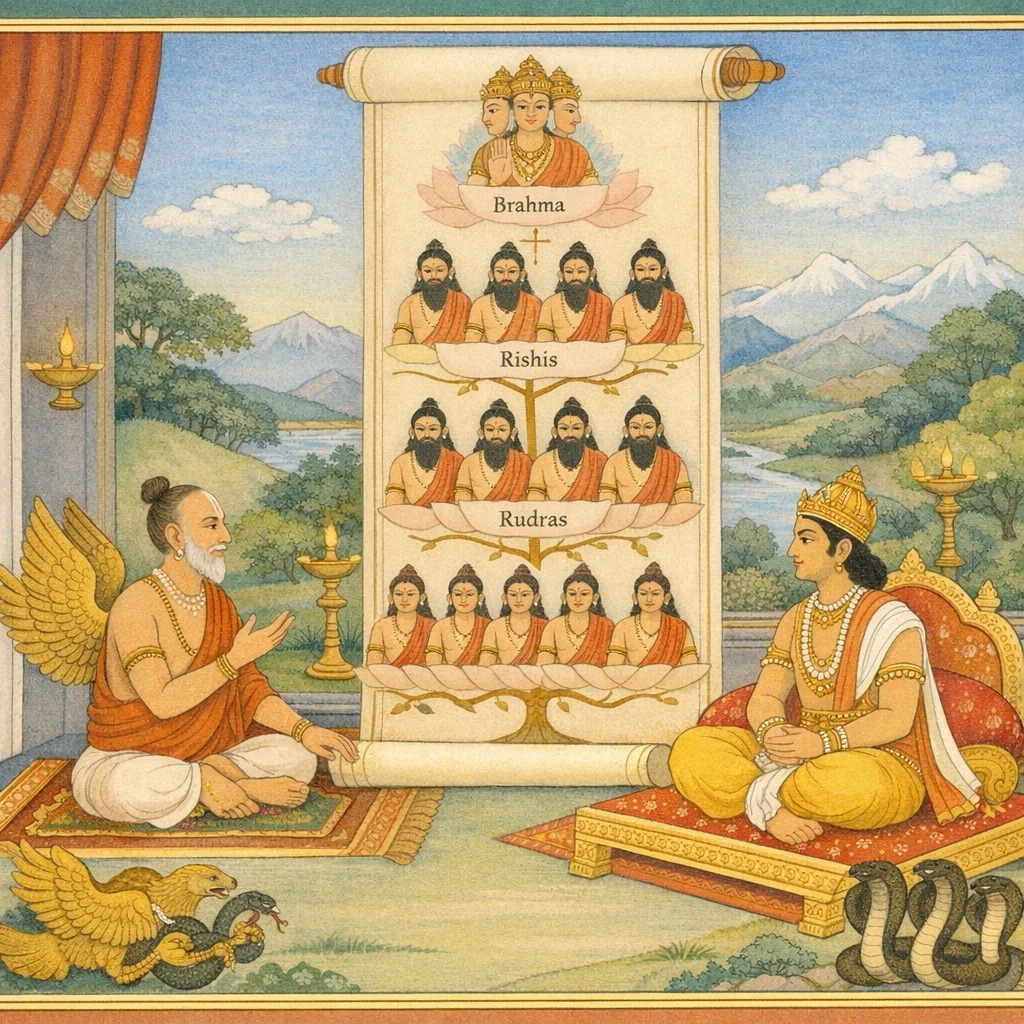
Chapter Arc: वैशम्पायन जनमेजय को ब्रह्मा के मानस-पुत्र महर्षियों की परम्परा का द्वार खोलते हैं—सृष्टि के वंश-वृक्ष में देव, ऋषि, रुद्र और विविध प्राणियों की जड़ें एक-एक कर प्रकट होती हैं। → नामों की धारा गहराती जाती है: ब्रह्मा के षड्-महर्षि (मरीचि, अंगिरा, अत्रि, पुलस्त्य, पुलह, क्रतु) और रुद्रों की एकादश गणना; फिर अग्नि-वंश, शिल्प-निर्माण की दिव्य परम्परा, और आगे कश्यप-पत्नियों से उत्पन्न पक्षी, नाग, राक्षस आदि—सृष्टि के शुभ-अशुभ दोनों प्रवाह एक साथ उभरते हैं। → कश्यप-पत्नियों की संतान-परम्परा में निर्णायक विस्तार आता है—विनता के दो विख्यात पुत्र गरुड और अरुण, तथा कद्रू के पन्नग (नाग) पुत्रों का उल्लेख; साथ ही नैऋत-राक्षसों की उत्पत्ति (निर्क्रति-नैर्ऋता) से अधर्म-प्रवृत्ति का भी स्पष्ट संकेत मिलता है। → व्यास-परम्परा का वक्ता इस वंश-वर्णन को ‘श्रवण-फल’ से बाँध देता है—जो इसे सम्यक् सुनता है वह पाप से मुक्त होकर सर्वज्ञता और श्रेष्ठ गति प्राप्त करता है। → गरुड-नाग वैर और आगे की कथाओं (अमृत, बन्धन-मोचन, शाप-परिणाम) की भूमिका बनकर अध्याय अगले प्रसंग की ओर संकेत करता है।
Shlokas
Verse 1
भीकम (2 अमान षट्षष्टितमो<5 ध्याय: महर्षियों तथा कश्यप-पत्नियोंकी संतान-परम्पराका वर्णन वैशम्पायन उवाच ब्रह्मणो मानसा: पुत्रा विदिता: षण्महर्षय: । एकादश सुता: स्थाणो: ख्याता: परमतेजस:,वैशम्पायनजी कहते हैं--राजन! ब्रह्माके मानस पुत्र छः महर्षियोंके नाम तुम्हें ज्ञात हो चुके हैं। उनके सातवें पुत्र थे स्थाणु। स्थाणुके परम तेजस्वी ग्यारह पुत्र विख्यात हैं
Vaiśampāyana said: O King, the six great seers—mind-born sons of Brahmā—have already been made known to you. The seventh was Sthāṇu; and Sthāṇu’s eleven sons, renowned for their supreme radiance, are celebrated in tradition.
Verse 2
मृगव्याधश्च सर्पश्न निर्क्रतिश्न महायशा: । अजैकपादहिर्बुध्न्य: पिनाकी च परंतप:,मृगव्याध, सर्प, महायशस्वी निर्क्रति, अजैकपाद, अहिर्डुध्न्य, शत्रुसंतापन पिनाकी, दहन, ईश्वर, परम कान्तिमान् कपाली, स्थाणु और भगवान् भव-ये ग्यारह रुद्र माने गये हैं
Vaiśampāyana said: “Mṛgavyādha, Sarpajña, the greatly renowned Nirkṛti, Ajāikapād, Ahirbudhnya, and Pinākī the foe-scorcher—these are among the Rudras named in the tradition.”
Verse 3
दहनोथथेश्वरश्वैव कपाली च महाद्युति: । स्थाणुर्भवश्व भगवान् रुद्रा एकादश स्मृता:,मृगव्याध, सर्प, महायशस्वी निर्क्रति, अजैकपाद, अहिर्डुध्न्य, शत्रुसंतापन पिनाकी, दहन, ईश्वर, परम कान्तिमान् कपाली, स्थाणु और भगवान् भव-ये ग्यारह रुद्र माने गये हैं
Vaiśampāyana said: “These are remembered as the eleven Rudras—Mṛgavyādha, Sarpa, the greatly renowned Nirkṛti, Ajāikapād, Ahirbudhnya, Śatrusaṃtāpana, Pinākī, Dahana, Īśvara, the radiant Kapālī, and the blessed Sthāṇu and Bhava.”
Verse 4
मरीचिरड्रिरा अत्रि: पुलस्त्य: पुलहः क्रतुः । षडेते ब्रह्मण: पुत्रा वीर्यवन्तो महर्षय:,मरीचि, अंगिरा, अत्रि, पुलस्त्य, पुलह और क्रतु--ये ब्रह्माजीके छः पुत्र बड़े शक्तिशाली महर्षि हैं
Vaiśampāyana said: “Marīci, Aṅgiras, Atri, Pulastya, Pulaha, and Kratu—these six are the sons of Brahmā, mighty in spiritual power and renowned as great seers.”
Verse 5
त्रयस्त्वज्धिरस: पुत्रा लोके सर्वत्र विश्लुता: । बृहस्पतिरुतथ्यश्न संवर्तश्व॒ धृतव्रता:,अंगिराके तीन पुत्र हुए, जो लोकमें सर्वत्र विख्यात हैं। उनके नाम ये हैं-- बृहस्पति, उतथ्य और संवर्त। ये तीनों ही उत्तम व्रत धारण करनेवाले हैं। मनुजेश्वर! अत्रिके बहुत-से पुत्र सुने जाते हैं। वे सब-के-सब वेदवेत्ता, सिद्ध और शान्तचित्त महर्षि हैं
Vaiśampāyana said: “Three sons of Aṅgiras are renowned everywhere in the world—Bṛhaspati, Utathya, and Saṃvarta. All three are steadfast in their vows.”
Verse 6
अत्रेस्तु बहव: पुत्रा: श्रूयन्ते मनुजाधिप । सर्वे वेदविद: सिद्धा: शान्तात्मानो महर्षय:,अंगिराके तीन पुत्र हुए, जो लोकमें सर्वत्र विख्यात हैं। उनके नाम ये हैं-- बृहस्पति, उतथ्य और संवर्त। ये तीनों ही उत्तम व्रत धारण करनेवाले हैं। मनुजेश्वर! अत्रिके बहुत-से पुत्र सुने जाते हैं। वे सब-के-सब वेदवेत्ता, सिद्ध और शान्तचित्त महर्षि हैं
Vaiśampāyana said: “O lord of men, Atri is heard to have many sons. All of them are knowers of the Veda—accomplished, serene in spirit, and great seers.”
Verse 7
राक्षसाश्च पुलस्त्यस्य वानरा: किन्नरास्तथा | यक्षाश्न मनुजव्यात्र पुत्रास्तस्य च धीमत:,नरश्रेष्ठ! बुद्धिमान् पुलस्त्य मुनिके पुत्र राक्षस, वानर, किन्नर तथा यक्ष हैं
Vaiśampāyana said: “O tiger among men, from the wise Pulastya were born sons belonging to many orders of beings—Rākṣasas, Vānaras, Kinnaras, and Yakṣas.”
Verse 8
पुलहस्य सुता राजज्छरभाश्न प्रकीर्तिता: । सिंहा: किम्पुरुषा व्याप्रा ऋक्षा ईहामृगास्तथा,राजन! पुलहके शरभ, सिंह, किम्पुरुष, व्याप्र, रीछ, और ईहामृग (भेड़िया) जातिके पुत्र हुए
Vaiśampāyana said: “O King, Pulaha’s offspring are declared to be the Śarabhas; likewise lions, Kiṃpuruṣas, tigers, bears, and also the īhāmṛgas.”
Verse 9
क्रतो: क्रतुसमा: पुत्रा: पतड़सहचारिण: । विश्रुतास्त्रिषु लोकेषु सत्यव्रतपरायणा:,क्रतु (यज्ञ)-के पुत्र क्रतुके ही समान पवित्र, तीनों लोकोंमें विख्यात, सत्यवादी, व्रतपरायण तथा भगवान् सूर्यके आगे चलनेवाले साठ हजार वालखिल्य ऋषि हुए
Vaiśampāyana said: “From Kratu were born sons equal to their father in sacrificial purity—companions of the Sun’s onward course—renowned in the three worlds, steadfast in truth, and wholly devoted to their vows. (These are the famed Vālakhilya sages, numbering sixty thousand.)”
Verse 10
दक्षस्त्वजायताड्गुष्ठाद् दक्षिणाद् भगवानृषि: । ब्रह्मण: पृथिवीपाल शान्तात्मा सुमहातपा:,भूमिपाल! ब्रह्माजीके दाहिने अँगूठेसे महातपस्वी शान्तचित्त महर्षि भगवान् दक्ष उत्पन्न हुए
Vaiśampāyana said: “From Brahmā’s right thumb was born the venerable sage Dakṣa—serene in spirit and of exceedingly great austerity, O king.”
Verse 11
वामादजायताड्गुष्ठादू भार्या तस्य महात्मन: । तस्यां पञ्चाशतं कन्या: स एवाजनयन्मुनि:,इसी प्रकार उन महात्माके बायें अँगूठेसे उनकी पत्नीका प्रादुर्भाव हुआ। महर्षिने उसके गर्भसे पचास कन्याएँ उत्पन्न की
Vaiśampāyana said: “From the left thumb of that great-souled one, his wife came into manifestation. And in her, the sage himself begot fifty daughters.”
Verse 12
ता: सर्वास्त्वनवद्याड्य: कन्या: कमललोचना: । पुत्रिका: स्थापयामास नष्ट पुत्र: प्रजापति:,वे सभी कन्याएँ परम सुन्दर अंगोंवाली तथा विकसित कमलके सदृश विशाल लोचनोंसे सुशोभित थीं। प्रजापति दक्षके पुत्र जब नष्ट हो गये, तब उन्होंने अपनी उन कन्याओंको पुत्रिका बनाकर रखा (और उनका विवाह पुत्रिकाधर्मके अनुसार ही किया)
Vaiśampāyana said: All those maidens were flawless and richly endowed, their eyes wide and lovely like fully blossomed lotuses. When Prajāpati Dakṣa’s sons were lost, he established those daughters as putrikās—treating them as heirs in the place of sons—and arranged their marriages according to the putrikā-dharma, so that lineage and ritual continuity would be preserved.
Verse 13
ददौ स दश धर्माय सप्तविंशतिमिन्दवे । दिव्येन विधिना राजन् कश्यपाय त्रयोदश,राजन! दक्षने दस कन्याएँ धर्मको, सत्ताईस कन्याएँ चन्द्रमाको और तेरह कन्याएँ महर्षि कश्यपको दिव्य विधिके अनुसार समर्पित कर दीं
Vaiśampāyana said: O King, he bestowed ten daughters upon Dharma, twenty-seven upon the Moon, and thirteen upon the sage Kaśyapa, duly giving them according to the sacred, divinely sanctioned rite.
Verse 14
नामतो धर्मपत्न्यस्ता: कीर्त्यमाना निबोध मे । कीर्तिलिक्ष्मीर्धतिर्मेधा पुष्टि: श्रद्धा क्रिया तथा,अब मैं धर्मकी पत्नियोंके नाम बता रहा हूँ, सुनो-कीर्ति, लक्ष्मी, धृति, मेथा, पुष्टि, श्रद्धा, क्रिया, बुद्धि, लज्जा और मति--ये धर्मकी दस पत्रियाँ हैं। स्वयम्भू ब्रह्माजीने इन सबको धर्मका द्वार निश्चित किया है अर्थात् इनके द्वारा धर्ममें प्रवेश होता है
Vaiśampāyana said: “Learn from me the names of Dharma’s wives as they are being recited. They are: Kīrti (Fame), Lakṣmī (Fortune), Dhṛti (Steadfastness), Medhā (Intelligence), Puṣṭi (Nourishment/Prosperity), Śraddhā (Faith), and Kriyā (Right Action).”
Verse 15
बुद्धिर्लज्जा मतिश्वैव पत्न्यो धर्मस्य ता दश | द्वाराण्येतानि धर्मस्य विहितानि स्वयम्भुवा,अब मैं धर्मकी पत्नियोंके नाम बता रहा हूँ, सुनो-कीर्ति, लक्ष्मी, धृति, मेथा, पुष्टि, श्रद्धा, क्रिया, बुद्धि, लज्जा और मति--ये धर्मकी दस पत्रियाँ हैं। स्वयम्भू ब्रह्माजीने इन सबको धर्मका द्वार निश्चित किया है अर्थात् इनके द्वारा धर्ममें प्रवेश होता है
Vaiśampāyana said: “Intelligence, modesty, and discernment—these, together with the others, are the ten wives of Dharma. The Self-born Creator (Svayambhū) has ordained them as the very ‘gateways’ of Dharma—through these qualities one gains entry into righteous living.”
Verse 16
सप्तविंशति: सोमस्य पत्न्यो लोकस्य विश्रुता: । कालस्य नयने युक्ता: सोमपत्न्य: शुचिव्रता:,चन्द्रमाकी सत्ताईस स्त्रियाँ समस्त लोकोंमें विख्यात हैं। वे पवित्र व्रत धारण करनेवाली सोमपत्नियाँ काल-विभागका ज्ञापन करनेमें नियुक्त हैं
Vaiśampāyana said: The twenty-seven wives of Soma (the Moon) are renowned throughout the world. Observing pure vows, these Moon-consorts are appointed to mark and make known the divisions and measures of time.
Verse 17
सर्वा नक्षत्रयोगिन्यो लोकयात्राविधानतः । पैतामहो मुनिर्देवस्तस्य पुत्र: प्रजापति: । तस्याष्टौ वसव: पुत्रास्तेषां वक्ष्यामि विस्तरम्,लोक-व्यवहारका निर्वाह करनेके लिये वे सब-की-सब नक्षत्र-वाचक नामोंसे युक्त हैं। पितामह ब्रह्माजीके स्तनसे उत्पन्न होनेके कारण मुनिवर धर्मदेव उनके पुत्र माने गये हैं। प्रजापति दक्ष भी ब्रह्माजीके ही पुत्र हैं। दक्षकी कन्याओंके गर्भसे धर्मके आठ पुत्र उत्पन्न हुए, जिन्हें वसुगण कहते हैं। अब मैं वसुओंका विस्तारपूर्वक परिचय देता हूँ। धर, ध्रुव, सोम, अह, अनिल, अनल, प्रत्यूष और प्रभास--ये आठ वसु कहे गये हैं
Vaiśampāyana said: In keeping with the ordered course of the world, they are all linked with names that denote the lunar mansions (nakṣatras). From the Grandsire Brahmā was born the divine sage Dharma, and Prajāpati Dakṣa too is counted among Brahmā’s sons. From Dakṣa’s daughters, Dharma had eight sons known as the Vasus; I shall now describe them in detail.
Verse 18
धरो ध्रुवश्च सोमश्न अहश्चैवानिलोडनल: । प्रत्यूषश्न प्रभासश्ष॒ वसवोडष्टौ प्रकीर्तिता:,लोक-व्यवहारका निर्वाह करनेके लिये वे सब-की-सब नक्षत्र-वाचक नामोंसे युक्त हैं। पितामह ब्रह्माजीके स्तनसे उत्पन्न होनेके कारण मुनिवर धर्मदेव उनके पुत्र माने गये हैं। प्रजापति दक्ष भी ब्रह्माजीके ही पुत्र हैं। दक्षकी कन्याओंके गर्भसे धर्मके आठ पुत्र उत्पन्न हुए, जिन्हें वसुगण कहते हैं। अब मैं वसुओंका विस्तारपूर्वक परिचय देता हूँ। धर, ध्रुव, सोम, अह, अनिल, अनल, प्रत्यूष और प्रभास--ये आठ वसु कहे गये हैं
Vaiśampāyana said: “Dhara, Dhruva, Soma, Aha, Anila, Anala, Pratyūṣa, and Prabhāsa—these eight are celebrated as the Vasus.”
Verse 19
धूम्रायास्तु धर: पुत्रो ब्रह्मुविद्यो ध्रुवस्तथा । चन्द्रमास्तु मनस्विन्या: श्वासाया: श्वसनस्तथा,धर और ब्रह्नवेत्ता ध्रुव धूम्राके पुत्र हैं। चन्द्रमा मनस्विनीके और अनिल श्वासाके पुत्र हैं। अह रताके और अनल शाण्डिलीके पुत्र हैं तथा प्रत्यूष और प्रभास ये दोनों प्रभाताके पुत्र बताये गये हैं
Vaiśampāyana said: From Dhūmrā were born Dhara and Dhruva, the knower of Brahman. From Manasvinī was born the Moon, and from Śvāsā was born Śvasana (the Wind).
Verse 20
रतायाश्चाप्यह: पुत्र: शाण्डिल्याश्व॒ हुताशन: । प्रत्यूषश्च प्रभासश्न प्रभाताया: सुतौ स्मृतो,धर और ब्रह्नवेत्ता ध्रुव धूम्राके पुत्र हैं। चन्द्रमा मनस्विनीके और अनिल श्वासाके पुत्र हैं। अह रताके और अनल शाण्डिलीके पुत्र हैं तथा प्रत्यूष और प्रभास ये दोनों प्रभाताके पुत्र बताये गये हैं
Vaiśampāyana said: ‘Ahaḥ (Day) is also said to be the son of Ratā; Hutāśana (Fire) is the son of Śāṇḍilī; and Pratyūṣa (Dawn) and Prabhāsa (Radiance) are remembered as the two sons of Prabhātā.’
Verse 21
धरस्य पुत्रो द्रविणो हुतहव्यवहस्तथा । ध्रुवस्य पुत्रो भगवान् कालो लोकप्रकालन:,धरके दो पुत्र हुए--द्रविण तथा हुतहव्यवह। सब लोकोंको अपना ग्रास बनानेवाले भगवान् काल ध्रुवके पुत्र हैं
Vaiśampāyana said: From Dhara were born two sons—Draviṇa and Hutahavyavaha. And from Dhruva was born the divine Kāla (Time), the power that ripens and consumes all worlds.
Verse 22
सोमस्य तु सुतो वर्चा वर्चस्वी येन जायते । मनोहराया: शिशिर: प्राणोडइथ रमणस्तथा,सोमके मनोहरा नामक स्टत्रीके गर्भसे प्रथम तो वर्चा नामक पुत्र हुआ, जिससे लोग वर्चस्वी (तेज, कान्ति और पराक्रमसे सम्पन्न) होते हैं, फिर शिशिर, प्राण तथा रमण नामक पुत्र उत्पन्न हुए
Vaiśampāyana said: From Soma there was born a son named Varcā—by whom people become endowed with radiance and prowess. From Manoharā were then born the sons Śiśira, Prāṇa, and Ramaṇa as well.
Verse 23
अह्वः सुतस्तथा ज्योति: शम: शान्तस्तथा मुनि: । अग्ने: पुत्र: कुमारस्तु श्रीमाञउछरवणालय:,अहके चार पुत्र हुए--ज्योति, शम, शान्त तथा मुनि। अनलके पुत्र श्रीमान् कुमार (स्कन्द) हुए, जिनका जन्मकालमें सरकंडोंके वनमें निवास था
Vaiśampāyana said: Ahva had four sons—Jyoti, Śama, Śānta, and Muni. From Agni was born the illustrious youth Kumāra (Skanda), famed as one whose early dwelling was in a thicket of reeds.
Verse 24
तस्य शाखो विशाखश्न नैगमेयश्व पृष्ठज: । कृत्तिकाभ्युपपत्तेश्न॒ कार्तिकेय इति स्मृत:,शाख, विशाख और नैगमेय---ये तीनों कुमारके छोटे भाई हैं। छः कृत्तिकाओंको मातारूपमें स्वीकार कर लेनेके कारण कुमारका दूसरा नाम कार्तिकेय भी है
Vaiśampāyana said: “Of him (Kumāra/Skanda), Śākha, Viśākha, and Naigameya were the younger brothers. And because he accepted the six Kṛttikās as his mothers, he is also remembered by the name Kārtikeya.”
Verse 25
अनिलस्य शिवा भार्या तस्या: पुत्रो मनोजव: । अविज्ञातगतिश्चैव द्वौ पुत्रावनिलस्य तु,अनिलकी भार्याका नाम शिवा है। उसके दो पुत्र हैं--मनोजव तथा अविज्ञातगति। इस प्रकार अनिलके दो पुत्र कहे गये हैं
Vaiśampāyana said: Anila (the Wind-god) has a wife named Śivā. From her were born his sons Manojava (“swift as the mind”) and Avijñātagati (“of unknowable course”). Thus, Anila is described as having these two sons.
Verse 26
प्रत्यूषस्य विदु: पुत्रमृषिं नाम्नाथ देवलम् | दौ पुत्रौ देवलस्यापि क्षमावन्ती मनीषिणौ | बृहस्पतेस्तु भगिनी वरस्त्री ब्रह्मवादिनी,देवल नामक सुप्रसिद्ध मुनिको प्रत्यूषका पुत्र माना जाता है। देवलके भी दो पुत्र हुए। वे दोनों ही क्षमावान् और मनीषी थे। बृहस्पतिकी बहिन स्त्रियोंमें श्रेष्ठ एवं ब्रह्मवादिनी थीं। वे योगमें तत्पर हो सम्पूर्ण जगत्में अनासक्त भावसे विचरती रहीं। वे ही वसुओंमें आठवें वसु प्रभासकी धर्मपत्नी थीं
Vaiśampāyana said: They know Devala to be the son of Pratyūṣa, a sage renowned by name. Devala too had two sons—both patient in temper and wise in understanding. And there was the sister of Bṛhaspati, a woman foremost among women and a speaker of brahman (spiritual truth).
Verse 27
योगसक्ता जगत् कृत्स्नमसक्ता विचचार ह । प्रभासस्य तु भार्या सा वसूनामष्टमस्य ह,देवल नामक सुप्रसिद्ध मुनिको प्रत्यूषका पुत्र माना जाता है। देवलके भी दो पुत्र हुए। वे दोनों ही क्षमावान् और मनीषी थे। बृहस्पतिकी बहिन स्त्रियोंमें श्रेष्ठ एवं ब्रह्मवादिनी थीं। वे योगमें तत्पर हो सम्पूर्ण जगत्में अनासक्त भावसे विचरती रहीं। वे ही वसुओंमें आठवें वसु प्रभासकी धर्मपत्नी थीं
Vaiśampāyana said: Absorbed in yoga, yet free from attachment, she wandered through the entire world. She was the lawful wife of Prabhāsa, the eighth among the Vasus—renowned for spiritual insight and disciplined conduct, moving everywhere without clinging, embodying the ethical ideal of inner detachment amid worldly movement.
Verse 28
विश्वकर्मा महाभागो जज्ञे शिल्पप्रजापति: । कर्ता शिल्पसहस्राणां त्रिदशानां च वर्धिकि:,शिल्पकर्मके ब्रह्मा महाभाग विश्वकर्मा उन्हींसे उत्पन्न हुए हैं। वे सहस्तरों शिल्पोंके निर्माता तथा देवताओंके बढ़ई कहे जाते हैं
Vaiśampāyana said: The illustrious Viśvakarmā was born—the lord and progenitor of the crafts. He is the maker of countless arts and crafts, and is renowned as the carpenter of the Thirty (the gods). The passage underscores that skill and workmanship, when aligned with cosmic order, are honored as sacred functions that sustain divine and human worlds.
Verse 29
भूषणानां च सर्वेषां कर्ता शिल्पवतां वर: । यो दिव्यानि विमानानि त्रिदशानां चकार ह,वे सब प्रकारके भूषणोंको बनानेवाले और शिल्पियोंमें श्रेष्ठ हैं। उन्होंने देवताओंके असंख्य दिव्य विमान बनाये हैं
Vaiśaṃpāyana said: He was the maker of every kind of ornament, the foremost among skilled artisans. It was he who fashioned the divine aerial chariots (vimānas) for the Thirty Gods—an image of excellence in craft placed in the service of the gods and cosmic order.
Verse 30
मनुष्याश्नोपजीवन्ति यस्य शिल्पं महात्मन: । पूजयन्ति च यं नित्यं विश्वकर्माणमव्ययम्,मनुष्य भी महात्मा विश्वकर्माके शिल्पका आश्रय ले जीवननिर्वाह करते हैं और सदा उन अविनाशी विश्वकर्माकी पूजा करते रहते हैं
Vaiśampāyana said: People sustain their livelihood by relying on the craft of that great-souled one, and they continually worship that imperishable Viśvakarman. The verse underscores social gratitude and reverence toward the divine source of skill and workmanship that supports human life.
Verse 31
स्तनं तु दक्षिणं भिनत्त्वा ब्रह्मणो नरविग्रह: । नि:सृतो भगवान् धर्म: सर्वलोकसुखावह:,ब्रह्माजीके दाहिने स्तनको विदीर्ण करके मनुष्यरूपमें भगवान् धर्म प्रकट हुए, जो सम्पूर्ण लोकोंको सुख देनेवाले हैं
Vaiśaṃpāyana said: Having split open Brahmā’s right breast, the blessed Lord Dharma emerged in human form—one whose very presence is meant to bring welfare and happiness to all the worlds.
Verse 32
त्रयस्तस्य वरा: पुत्रा: सर्वभूतमनोहरा: । शम: कामश्न हर्षश्ष तेजसा लोकधारिण:,उनके तीन श्रेष्ठ पुत्र हैं, जो सम्पूर्ण प्राणियोंके मनको हर लेते हैं। उनके नाम हैं--शम, काम और हर्ष। वे अपने तेजसे सम्पूर्ण जगत्को धारण करनेवाले हैं
Vaiśampāyana said: He had three excellent sons, captivating the hearts of all living beings. Their names were Śama, Kāma, and Harṣa; and by their radiance and power they were sustainers of the world—figures whose very qualities uphold social and cosmic order.
Verse 33
कामस्य तु रतिर्भार्या शमस्य प्राप्तिरड्नना | नन्दा तु भार्या हर्षस्थ यासु लोका: प्रतिछ्तिता:,कामकी पत्नीका नाम रति है। शमकी भार्या प्राप्ति है। हर्षकी पत्नी नन््दा है। इन्हींमें सम्पूर्ण लोक प्रतिष्ठित हैं
Vaiśampāyana said: Desire has Rati as its wife; Tranquillity has Prāpti as its consort. And Nandā is the wife of Joy (Harṣa). Upon these (personified powers and their unions) the worlds are said to be established—suggesting that the order of life rests on desire and attraction, the attainment that follows self-control, and the sustaining force of contentment and joy.
Verse 34
मरीचे: कश्यप: पुत्र: कश्यपस्य सुरासुरा: । जज्षिरे नृपशार्दूल लोकानां प्रभवस्तु सः,मरीचिके पुत्र कश्यप और कश्यपके सम्पूर्ण देवता तथा असुर उत्पन्न हुए। नृपश्रेष्ठ) इस प्रकार कश्यप सम्पूर्ण लोकोंके आदि कारण हैं
Vaiśampāyana said: “Kaśyapa was the son of Marīci. From Kaśyapa were born the gods and the asuras. O tiger among kings, thus Kaśyapa is regarded as a prime source of origin for the worlds.”
Verse 35
त्वाष्टी तु सवितुर्भार्या वडवारूपधारिणी । असूयत महाभागा सान्तरिक्षे5श्विनावुभौ,त्वष्टाकी पुत्री संज्ञा भगवान् सूर्यकी धर्मपत्नी हैं। वे परम सौभाग्यवती हैं। उन्होंने अश्विनी (घोड़ी).का रूप धारण करके अन्तरिक्षमें दोनों अश्विनीकुमारोंको जन्म दिया। राजन्! अदितिके इन्द्र आदि बारह पुत्र ही हैं। उनमें भगवान् विष्णु सबसे छोटे हैं, जिनमें ये सम्पूर्ण लोक प्रतिष्ठित हैं
Vaiśampāyana said: Tvaṣṭī, the wife of Savitṛ, assuming the form of a mare, gave birth in the mid-region (the sky) to the two Aśvins. The passage highlights a divine birth narrative in which a goddess adopts a specific form to bring forth beneficent deities, underscoring the cosmic order in which even extraordinary transformations serve the welfare of the worlds.
Verse 36
द्वादशैवादिते: पुत्रा: शक्रमुख्या नराधिप । तेषामवरजो विष्णुर्यत्र लोका: प्रतिष्ठिता:,त्वष्टाकी पुत्री संज्ञा भगवान् सूर्यकी धर्मपत्नी हैं। वे परम सौभाग्यवती हैं। उन्होंने अश्विनी (घोड़ी).का रूप धारण करके अन्तरिक्षमें दोनों अश्विनीकुमारोंको जन्म दिया। राजन्! अदितिके इन्द्र आदि बारह पुत्र ही हैं। उनमें भगवान् विष्णु सबसे छोटे हैं, जिनमें ये सम्पूर्ण लोक प्रतिष्ठित हैं
Vaiśampāyana said: “O lord of men, Aditi has precisely twelve sons, headed by Śakra (Indra). Of them, Viṣṇu is the youngest—he in whom all the worlds are established.”
Verse 37
त्रयस्त्रिंशत इत्येते देवास्तेषामहं तव । अन्वयं सम्प्रवक्ष्यामि पक्षैश्ष॒ कुलतो गणान्,इस प्रकार आठ वसु, ग्यारह रुद्र, बारह आदित्य तथा प्रजापति और वषट्कार--ये तैंतीस मुख्य देवता हैं। अब मैं तुम्हें इनके पक्ष और कुल आदिके उल्लेखपूर्वक वंश और गण आदिका परिचय देता हूँ
Vaiśampāyana said: “These are the thirty-three gods. Now, for your sake, I shall clearly set forth their lineage and affiliations—explaining their groupings, their ‘sides’ or divisions, and their family lines.”
Verse 38
रुद्राणामपर: पक्ष: साध्यानां मरुतां तथा । वसूनां भार्गव विद्याद् विश्वेदेवांस्तथैव च,रुद्रोंका एक अलग पक्ष या गण है, साध्य, मरुत् तथा वसुओंका भी पृथक्- पृथक् गण है। इसी प्रकार भार्गव तथा विश्वेदेवणणको भी जानना चाहिये
Vaiśampāyana said: “There is a distinct division of the Rudras; likewise, separate divisions are to be understood for the Sādhyas, the Maruts, and the Vasus. In the same way, one should also recognize the Bhārgavas and the Viśvedevas as their own classes.”
Verse 39
वैनतेयस्तु गरुडो बलवानरुणस्तथा । बृहस्पतिश्व भगवानादित्येष्वेव गण्यते,विनतानन्दन गरुड, बलवान् अरुण तथा भगवान् बृहस्पतिकी गणना आदित्योंमें ही की जाती है
Vaiśampāyana said: “Vinatā’s son Garuḍa is mighty, and so too is Aruṇa. And the venerable Bṛhaspati is also counted among the Ādityas.”
Verse 40
अश्रिनौ गुहाकान् विद्धि सर्वोषध्यस्तथा पशून् | एते देवगणा राजन कीर्तितास्ते<नुपूर्वश:,अश्विनीकुमार, सर्वोषधि तथा पशु--इन सबको गुह्मकसमुदायके भीतर समझो। राजन! ये देवगण तुम्हें क्रमश: बताये गये हैं
Vaiśampāyana said: “Know the two Aśvins, the hosts of medicinal herbs, and the animals as belonging to the class called the Guhyakas. O king, these divine groups have been enumerated to you in due order.”
Verse 41
यान् कीर्तयित्वा मनुज: सर्वपापै: प्रमुच्यते । ब्रह्मणो हृदयं भित्त्वा नि:सृतो भगवान् भूगु:,मनुष्य इन सबका कीर्तन करके सब पापोंसे मुक्त हो जाता है। भगवान् भृगु ब्रह्माजीके हृदयका भेदन करके प्रकट हुए थे
Vaiśampāyana said: “By reciting the names of those just mentioned, a person is freed from all sins. The blessed sage Bhṛgu is said to have manifested by cleaving Brahmā’s heart and emerging from it.”
Verse 42
भूगो: पुत्र: कविर्विद्वाउछुक्र: कविसुतो ग्रह: । त्रैलोक्यप्राणयात्रार्थ वर्षावर्षे भयाभये । स्वयम्भुवा नियुक्त: सन् भुवनं परिधावति,भगुके विद्वान् पुत्र कवि हुए और कविके पुत्र शुक्राचार्य हुए, जो ग्रह होकर तीनों लोकोंके जीवनकी रक्षाके लिये वृष्टि, अनावृष्टि तथा भय और अभय उत्पन्न करते हैं। स्वयम्भू ब्रह्माजीकी प्रेरणासे वे समस्त लोकोंका चक्कर लगाते रहते हैं
Vaiśampāyana said: From Bhaga was born the wise seer Kavi; and from Kavi was born Śukra, who became a planetary power (graha). For the maintenance of life in the three worlds, he brings about rain and drought, and also conditions of fear and fearlessness. Appointed by Svayambhū (Brahmā), he continually courses around the worlds, sustaining cosmic order through these alternating forces.
Verse 43
योगाचार्यो महाबुद्धिर्देत्यानाम भवद् गुरु: । सुराणां चापि मेधावी ब्रह्मबचारी यतव्रत:,महाबुद्धिमान् शुक्र ही योगके आचार्य और दैत्योंके गुरु हुए। वे ही योगबलसे मेधावी, ब्रह्मचारी एवं व्रतपरायण बृहस्पतिके रूपमें प्रकट हो देवताओंके भी गुरु होते हैं
Vaiśampāyana said: “That great-minded master of yoga became the preceptor of the Daityas; and, endowed with keen intelligence, he also became the teacher of the gods—living as a brahmacārin, disciplined and steadfast in vows.”
Verse 44
तस्मिन् नियुक्ते विधिना योगक्षेमाय भार्गवे । अन्यमुत्पादयामास पुत्र भूगुरनिन्दितम्,ब्रह्माजीने जब भृगुपुत्र शुक्रको जगत्के योगक्षेमके कार्यमें नियुक्त कर दिया, तब महर्षि भृगुने एक दूसरे निर्दोष पुत्रको जन्म दिया
When that Bhārgava was duly appointed, according to proper ordinance, to oversee the welfare and security of the worlds, the sage Bhṛgu then begot another son—blameless in conduct—so that the sacred lineage and its responsibilities might continue without interruption.
Verse 45
च्यवनं दीप्ततपसं धर्मात्मानं यशस्विनम् । यः स रोषाच्च्युतो गर्भान्मातुर्मोक्षाय भारत,जिसका नाम था च्यवन। महर्षि च्यवनकी तपस्या सदा उद्दीप्त रहती है। वे धर्मात्मा और यशस्वी हैं। भारत! वे अपनी माताको संकटसे बचानेके लिये रोषपूर्वक गर्भसे च्युत हो गये थे (इसीलिये च्यवन कहलाये)
Vaiśampāyana said: “(He was) Cyavana—an ascetic whose austerity blazed with spiritual power, righteous in conduct and renowned. O Bhārata, he was the one who, in anger, fell forth from his mother’s womb in order to deliver his mother from danger; therefore he came to be called ‘Cyavana’.”
Verse 46
आरुषी तु मनो: कन्या तस्य पत्नी मनीषिण: । और्वस्तस्यथां समभवदूरं भित्त्वा महायशा:,मनुकी पुत्री आरुषी मनीषी च्यवन मुनिकी पत्नी थी। उससे महायशस्वी और्व मुनिका जन्म हुआ। वे अपनी माताकी ऊरु (जाँघ) फाड़कर प्रकट हुए थे; इसलिये और्व कहलाये
Vaiśampāyana said: Āruṣī, the daughter of Manu, became the wife of that wise sage. From her was born the greatly renowned Aurva, who came forth by splitting his mother’s thigh; therefore he was known as Aurva. The passage underscores the extraordinary, divinely charged births of seers and the way a name can preserve the moral memory of an event.
Verse 47
महातेजा महावीरयों बाल एव गुणैर्युत: । ऋचीकस्तस्य पुत्रस्तु जमदग्निस्ततो5भवत्,वे महान् तेजस्वी और अत्यन्त शक्तिशाली थे। बचपनमें ही अनेक सदगुण उनकी शोभा बढ़ाने लगे। और्वके पुत्र ऋचीक तथा ऋचीकके पुत्र जमदग्नि हुए
Vaiśaṃpāyana said: He was of great splendor and mighty valor; even as a child he was endowed with virtues. His son was Ṛcīka, and from Ṛcīka was born Jamadagni.
Verse 48
जमदम्नेस्तु चत्वार आसन पुत्रा महात्मन: । रामस्तेषां जघन्यो5भूदजघन्यैर्गुणैर्युत: । सर्वशस्त्रेषु कुशल: क्षत्रियान्तकरो वशी,महात्मा जमदग्निके चार पुत्र थे, जिनमें परशुरामजी सबसे छोटे थे; किंतु उनके गुण छोटे नहीं थे। वे श्रेष्ठ सदगुणोंसे विभूषित थे, सम्पूर्ण शस्त्रविद्यामें कुशल, क्षत्रिय-कुलका संहार करनेवाले तथा जितेन्द्रिय थे
Vaiśampāyana said: The great-souled Jamadagni had four sons. Of them, Rāma was the youngest in birth, yet not the least in excellence—endowed with outstanding virtues. He was skilled in every weapon-discipline, a subduer of the kṣatriya order, and a master of himself.
Verse 49
ऑर्वस्यासीत् पुत्रशतं जमदग्निपुरोगमम् | तेषां पुत्रसहस्राणि बभूवुर्भुवि विस्तर:,और्व मुनिके जमदग्नि आदि सौ पुत्र थे। फिर उनके भी सहसौं पुत्र हुए। इस प्रकार इस पृथ्वीपर भृगुवंशका विस्तार हुआ
Vaiśampāyana said: Aurva had a hundred sons, with Jamadagni foremost among them. From those sons were born thousands more, and thus the Bhṛgu lineage spread widely upon the earth.
Verse 50
दौ पुत्री ब्रह्मणस्त्वन्यौ ययोस्तिष्ठति लक्षणम् । लोके धाता विधाता च यौ स्थितौ मनुना सह,ब्रह्माजीके दो पुत्र और थे, जिनका धारण-पोषण और सृष्टिरूप लक्षण लोकमें सदा ही उपलब्ध होता है। उनके नाम हैं धाता और विधाता। ये मनुके साथ रहते हैं
Vaiśampāyana said: Brahmā had two other sons, whose defining functions are always evident in the world—sustaining and ordering creation. They are named Dhātā and Vidhātā, and they abide together with Manu.
Verse 51
तयोरेव स्वसा देवी लक्ष्मी: पद्मगृहा शुभा । तस्यास्तु मानसा: पुत्रास्तुरगा व्योमचारिण:,कमलोंमें निवास करनेवाली शुभस्वरूपा लक्ष्मीदेवी उन दोनोंकी बहिन हैं। आकाशमें विचरनेवाले अश्व लक्ष्मीदेवीके मानस पुत्र हैं। राजन! वरुणके बीजसे उनकी ज्येष्ठ पत्नी देवीने एक पुत्र और एक पुत्रीको जन्म दिया। उसके पुत्रको तो बल और देवनन्दिनी पुत्रीको सुरा समझो
Vaiśampāyana said: Of those two, their own sister is the auspicious goddess Lakṣmī, who dwells in the lotus. From her mind were born the celestial horses that move through the sky.
Verse 52
वरुणस्य भार्या या ज्येष्ठा शुक्राद् देवी व्यजायत । तस्या: पुत्र बल॑ विद्धि सुरां च सुरनन्दिनीम्,कमलोंमें निवास करनेवाली शुभस्वरूपा लक्ष्मीदेवी उन दोनोंकी बहिन हैं। आकाशमें विचरनेवाले अश्व लक्ष्मीदेवीके मानस पुत्र हैं। राजन! वरुणके बीजसे उनकी ज्येष्ठ पत्नी देवीने एक पुत्र और एक पुत्रीको जन्म दिया। उसके पुत्रको तो बल और देवनन्दिनी पुत्रीको सुरा समझो
Vaiśampāyana said: Varuṇa’s eldest wife, a divine lady, conceived by Śukra. Know her son to be Bala, and her daughter to be Surā, the delight of the gods.
Verse 53
प्रजानामन्नकामानामन्योन्यपरिभक्षणात् | अधर्मस्तत्र संजात: सर्वभूतविनाशक:,तदनन्तर एक समय ऐसा आया, जब प्रजा भूखसे पीड़ित हो भोजनकी इच्छासे एक-दूसरेको मारकर खाने लगी, उस समय वहाँ अधर्म प्रकट हुआ, जो समस्त प्राणियोंका नाश करनेवाला है
Vaiśampāyana said: When the people, tormented by hunger and craving food, began to devour one another, adharma arose there—an evil that brings about the destruction of all living beings.
Verse 54
तस्यापि निर्क्रतिर्भार्या नैर््रता येन राक्षसा: । घोरास्तस्यास्त्रय: पुत्रा: पापकर्मरता: सदा,अधर्मकी स्त्री निर्क्रति हुई, जिससे नै#ऋत नामवाले तीन भयंकर राक्षस पुत्र उत्पन्न हुए, जो सदा पापकर्ममें ही लगे रहनेवाले हैं
Vaiśampāyana said: He too had a wife named Nirṛti. From her were born three dreadful rākṣasas called Nairṛtas, who were ever devoted to sinful deeds.
Verse 55
भयो महाभयश्चैव मृत्युर्भूतान्तकस्तथा । न तस्य भार्या पुत्रो वा कश्चिदस्त्यन्तको हि सः,उनके नाम इस प्रकार हैं--भय, महाभय और मृत्यु। उनमें मृत्यु समस्त प्राणियोंका अन्त करनेवाला है। उसके पत्नी या पुत्र कोई नहीं है, क्योंकि वह सबका अन्त करनेवाला है
Vaiśampāyana said: “There are (beings) named Bhaya, Mahābhaya, and Mṛtyu. Among them, Mṛtyu is the ‘Ender of beings,’ the one who brings all living creatures to their termination. For him there is no wife or son—because he himself is the very principle of ending for all.”
Verse 56
काकीं श्येनीं तथा भासीं धृतराष्ट्री तथा शुकीम् | ताम्रा तु सुषुवे देवी पठ्चैता लोकविश्रुता:,देवी तामग्राने काकी, श्येनी, भासी, धृतराष्ट्री तथा शुकी--इन पाँच लोकविख्यात कन्याओंको उत्पन्न किया
Vaiśampāyana said: The goddess Tāmrā gave birth to five daughters renowned in the world—Kākī, Śyenī, Bhāsī, Dhṛtarāṣṭrī, and Śukī.
Verse 57
उलूकान् सुषुवे काकी श्येनी श्येनान् व्यजायत । भासी भासानजनयद् गृध्रांश्रैव जनाधिप,जनेश्वर! काकीने उल्लुओं और श्येनीने बाजोंको जन्म दिया; भासीने मुर्गों तथा गीधोंको उत्पन्न किया
Vaiśampāyana said: The she-crow gave birth to owls; the she-hawk bore hawks. The bhāsī produced bhāsa-birds and also vultures, O lord of men, O ruler of the people. Thus the lineages of these birds are traced, showing how distinct natures and roles arise from their respective origins.
Verse 58
धृतराष्ट्री तु हंसांश्व कलहंसांश्व॒ सर्वश: । चक्रवाकांश्व भद्रा तु जनयामास सैव तु,कल्याणमयी धूृतराष्ट्रीने सब प्रकारके हंसों, कल-हंसों तथा चक्रवाकोंको जन्म दिया। कल्याणमय गुणोंसे सम्पन्न तथा समस्त शुभ लक्षणोंसे युक्त यशस्विनी शुकीने शुकों (तोतों)-को ही उत्पन्न किया
Vaiśampāyana said: Dhṛtarāṣṭrī gave birth to every kind of swan—swans, kalahāṃsas, and cakrāvāka birds. Likewise Bhadrā also brought forth cakrāvākas. The passage continues the genealogical catalog, presenting fertility and orderly propagation as auspicious signs within the cosmic and social order (dharma).
Verse 59
शुकी च जनयामास शुकानेव यशस्विनी । कल्याणगुणसम्पन्ना सर्वलक्षणपूजिता,कल्याणमयी धूृतराष्ट्रीने सब प्रकारके हंसों, कल-हंसों तथा चक्रवाकोंको जन्म दिया। कल्याणमय गुणोंसे सम्पन्न तथा समस्त शुभ लक्षणोंसे युक्त यशस्विनी शुकीने शुकों (तोतों)-को ही उत्पन्न किया
Vaiśampāyana said: Śukī, renowned in glory, gave birth only to śukas (parrots). Endowed with auspicious virtues, she was honored as one who bore every favorable mark.
Verse 60
नव क्रोधवशा नारी: प्रजज्ञे क्रोधसम्भवा: । मृगी च मृगमन्दा च हरी भद्रमना अपि,क्रोधवशाने नौ प्रकारकी क्रोधजनित कन्याओंको जन्म दिया। उनके नाम ये हैं--मृगी, मृगमन्दा, हरी, भद्गमना, मातंगी, शार्दूली, श्वेता, सुरभि तथा सम्पूर्ण शुभ लक्षणोंसे सम्पन्न सुन्दरी सुरसा
Vaiśampāyana said: Overpowered by anger, Krodhavaśā gave birth to nine maidens born of wrath: Mṛgī, Mṛgamandā, Harī, and Bhadgamanā.
Verse 61
मातज्ी त्वथ शार्दूली श्वेता सुरभिरेव च । सर्वलक्षणसम्पन्ना सुरसा चैव भामिनी,क्रोधवशाने नौ प्रकारकी क्रोधजनित कन्याओंको जन्म दिया। उनके नाम ये हैं--मृगी, मृगमन्दा, हरी, भद्गमना, मातंगी, शार्दूली, श्वेता, सुरभि तथा सम्पूर्ण शुभ लक्षणोंसे सम्पन्न सुन्दरी सुरसा
Vaiśampāyana said: Their names were Mataṅgī, Śārdūlī, Śvetā, Surabhī, and the lovely Surasā—endowed with every auspicious mark. These were the nine maidens born of wrath. The passage underscores how unchecked anger can become a generative force, producing consequences and lineages marked by its nature.
Verse 62
अपत्यं तु मृगा: सर्वे मृग्या नरवरोत्तम | ऋक्षाश्व मृगमन्दाया: सूमराश्न॒ परंतप,नरश्रेष्ठी समस्त मृग मृगीकी संतानें हैं। परंतप! मृगमन्दासे रीछ तथा सृमर (छोटी जातिके मृग) उत्पन्न हुए। भद्रमनाने ऐरावत हाथीको अपने पुत्ररूपमें उत्पन्न किया। देवताओंका हाथी महान् गजराज ऐरावत भद्रमनाका ही पुत्र है
Vaiśampāyana said: O best of men, all deer are the offspring of the doe. O scorcher of foes, from Mṛgamandā were born the bears and the sūmara—minor kinds of deer. Thus does the epic set down origins in ordered line, bidding the listener behold creation as a web of kinship, not a chance-made heap.
Verse 63
ततस्त्वैसवतं नागं जज्ञे भद्रमना: सुतम् । ऐरावत: सुतस्तस्या देवनागो महागज:,नरश्रेष्ठी समस्त मृग मृगीकी संतानें हैं। परंतप! मृगमन्दासे रीछ तथा सृमर (छोटी जातिके मृग) उत्पन्न हुए। भद्रमनाने ऐरावत हाथीको अपने पुत्ररूपमें उत्पन्न किया। देवताओंका हाथी महान् गजराज ऐरावत भद्रमनाका ही पुत्र है
Vaiśampāyana said: Thereafter Bhadrāmanā bore the elephant Airāvata as her son. That Airāvata—renowned as the gods’ own elephant and a mighty lord among his kind—was indeed born of her. So does the tale affirm that creation unfolds by ordered lineage, and that even the exalted are traced to sure beginnings.
Verse 64
हर्याश्ष हरयो5पत्यं वानराश्न तरस्विन: । गोलांगूलांश्व भद्रं ते हर्या: पुत्रान् प्रचक्षते,राजन! तुम्हारा कल्याण हो, वेगवान् घोड़े और वानर हरीके पुत्र हैं। गायके समान पूँछवाले लंगूरोंको भी हरीका ही पुत्र बताया जाता है। शार्दूलीने सिंहों अनेक प्रकारके बाघों और महान् बलशाली सभी प्रकारके चीतोंको भी जन्म दिया, इसमें संशय नहीं है
Vaiśampāyana said: “O king, may you be blessed. Swift horses and powerful monkeys are said to be the offspring of Hari. Likewise, the langurs with cow-like tails are also declared to be Hari’s sons.”
Verse 65
प्रजज्ञे त्वथ शार्दूली सिंहान् व्याप्राननेकश: । दीपिनश्न महासत्त्वानू सवनिव न संशय:,राजन! तुम्हारा कल्याण हो, वेगवान् घोड़े और वानर हरीके पुत्र हैं। गायके समान पूँछवाले लंगूरोंको भी हरीका ही पुत्र बताया जाता है। शार्दूलीने सिंहों अनेक प्रकारके बाघों और महान् बलशाली सभी प्रकारके चीतोंको भी जन्म दिया, इसमें संशय नहीं है
Vaiśampāyana said: Then Śārdūlī gave birth to lions, to many kinds of tigers, and also to powerful leopards; of this, O king, there is no doubt. Thus is the world’s begetting told as settled tradition, creation unfolding by lineage and not by guesswork.
Verse 66
मातड्रयपि च मातड्रानपत्यानि नराधिप । दिशां गजं तु श्वेताख्यं श्वेताजनयदाशुगम्,नरेश्वर! मातंगीने मतवाले हाथियोंको संतानके रूपमें उत्पन्न किया। श्वेताने शीघ्रगामी दिग्गज श्वेतको जन्म दिया। राजन! तुम्हारा भला हो, सुरभिने दो कन्याओंको उत्पन्न किया। उनमेंसे एकका नाम रोहिणी था और दूसरीका गन्धर्वी। गन्धर्वी बड़ी यशस्विनी थी इति श्रीमहाभारते आदिपर्वणि सम्भवपर्वणि षट्षष्टितमो5ध्याय: ।। ६६ || इस प्रकार श्रीमहाभारत आदिपववके अन्तर्गत सम्भवपर्वमें अंशावतरणविषयक छाछठवाँ अध्याय पूरा हुआ
Vaiśampāyana said: O king, Mātaṅgī too bore offspring known as the Mātaṅga elephants. And Śvetā gave birth to the swift white elephant of the quarters, famed as Śveta. Thus are the mighty set within sacred genealogy, teaching that power and eminence arise from ordered lineage and cosmic design, not from chance.
Verse 67
तथा दुहितरौ राजन् सुरभिर्वँ व्यजायत । रोहिणी चैव भद्रं ते गन्धर्वी तु यशस्विनी,नरेश्वर! मातंगीने मतवाले हाथियोंको संतानके रूपमें उत्पन्न किया। श्वेताने शीघ्रगामी दिग्गज श्वेतको जन्म दिया। राजन! तुम्हारा भला हो, सुरभिने दो कन्याओंको उत्पन्न किया। उनमेंसे एकका नाम रोहिणी था और दूसरीका गन्धर्वी। गन्धर्वी बड़ी यशस्विनी थी
Vaiśampāyana said: “O king, Surabhī bore two daughters. Blessings upon you—one was named Rohiṇī, and the other, the Gandharvī, renowned for her fame.”
Verse 68
विमलामपि भद्रें ते अनलामपि भारत । रोहिण्यां जज्ञिरे गावो गन्धर्व्या वाजिन: सुता: । सप्त पिण्डफलान् वृक्षाननलापि व्यजायत,भारत! तत्पश्चात् रोहिणीने विमला और अनला नामवाली दो कन्याएँ और उत्पन्न कीं। रोहिणीसे गाय-बैल और गन्धर्वीसे घोड़े ही पुत्ररूपमें उत्पन्न हुए। अनलाने सात प्रकारके वृक्षोंको- उत्पन्न किया, जिनमें पिण्डाकार फल लगते हैं
Vaiśampāyana said: “O noble Bharata, Rohiṇī also gave birth to two daughters named Vimalā and Analā. From Rohiṇī were born cattle (cows and bulls), and from Gandharvī were born horses as her offspring. Analā, in turn, produced seven kinds of trees bearing clustered, ball-like fruits.”
Verse 69
अनलाया: शुकी पुत्री कड़कस्तु सुरसासुत: । अरुणस्य भार्या श्येनी तु वीर्यवन्ती महाबलौ
Vaiśampāyana said: “Śukī was the daughter of Analā. Kaḍaka was the son of Surasā. Śyenī, the wife of Aruṇa, was a woman of great prowess; these were mighty and powerful beings.”
Verse 70
सम्पातिं जनयामास वीर्यवन्तं जटायुषम् । सुरसाजनयजन्नागान् कद्रू: पुत्रांस्तु पन्नगान्
Vaiśampāyana said: “Śyenī gave birth to Sampāti and to the valiant Jaṭāyu. Surasā bore the Nāgas, while Kadrū gave birth to the serpent-sons.”
Verse 71
द्वौ पुत्री विनतायास्तु विख्यातौ गरुडहारुणौ | अनलाके शुकी नामकी एक कन्या भी हुई। कंक पक्षी सुरसाका पुत्र है। अरुणकी पत्नी श्येनीने दो महाबली और पराक्रमी पुत्र उत्पन्न किये। एकका नाम था सम्पाती और दूसरेका जटायु। जटायु बड़ा शक्तिशाली था। सुरसा और कद्भूने नाग एवं पन्नग जातिके पुत्रोंको उत्पन्न किया। विनताके दो ही पुत्र विख्यात हैं, गरुड और अरुण || ६९-७० $ || (सुरसाजनयत् सपज्छितमेकशिरो धरान् । सुरसाकन्यका जातास्तिस्र: कमललोचना: ।। वनस्पतीनां वृक्षाणां वीरुधां चैव मातर: । अनला रुहा चढ़े प्रोक्ते वीरुधां चैव ता: स्मृता: ।। गृह्नन्ति ये विना पुष्पं फलानि तरव: पृथक् । अनलासुतास्ते विज्ञेया: तानेवाहुर्वनस्पतीन् ।। पुष्पै: फलग्रहान् वृक्षान् रुहाया: प्रसवान् विभो । लतागुल्मानि वल्यश्व त्वक्सारतृणजातय: ।। वीरुधाया: प्रजास्ता: स्युरत्रवंश: समाप्यते ।) सुरसाने एक सौ एक सिरवाले सर्पोंको जन्म दिया था। सुरसासे तीन कमलनयनी कन्याएँ उत्पन्न हुईं, जो वनस्पतियों, वृक्षों और लता-गुल्मोंकी जननी हुईं। उनके नाम इस प्रकार हैं--अनला, रुहा और वीरुधा। जो वृक्ष बिना फ़ूलके ही फल ग्रहण करते हैं उन सबको अनलाका पुत्र जानना चाहिये; वे ही वनस्पति कहलाते हैं। प्रभो! जो फूलसे फल ग्रहण करते हैं उन वृक्षोंको रुहाकी संतान समझो। लता, गुल्म, वल्ली, बाँस और तिनकोंकी जितनी जातियाँ हैं उन सबकी उत्पत्ति वीरुधासे हुई है। यहाँ वंशवर्णन समाप्त होता है। इत्येष सर्वभूतानां महतां मनुजाधिप । प्रभव: कीर्तित: सम्यड्मया मतिमतां वर,बुद्धिमानोंमें श्रेष्ठ रुजा जनमेजय! इस प्रकार मैंने सम्पूर्ण महाभूतोंकी उत्पत्तिका भलीभाँति वर्णन किया है। जिसे अच्छी तरह सुनकर मनुष्य सब पापोंसे पूर्णतः मुक्त हो जाता है और सर्वज्ञता तथा उत्तम गति प्राप्त कर लेता है
Vaiśampāyana said: “Vinatā had two celebrated sons—Garuḍa and Aruṇa. Surasā also produced a hundred serpents, each described as bearing a single head. From Surasā were born three lotus-eyed daughters—Anala, Ruhā, and Vīrudhā—who became mothers of vegetation: plants, trees, creepers, and shrubs. Trees that bear fruit without flowering are to be known as the offspring of Anala; these are called ‘vanaspati’. Trees that bear fruit after flowering are said to be the progeny of Ruhā. Creepers, shrubs, vines, bamboo-like growths, and the various kinds of grasses are regarded as the offspring of Vīrudhā. Here the genealogical account concludes. O king among men, best of the wise, I have thus properly recounted the origin of the great classes of beings. One who hears this attentively is freed from all sin and attains knowledge and the highest course.”
Verse 72
य॑ श्रुत्वा पुरुष: सम्यड्मुक्तो भवति पाप्मन: । सर्वज्ञतां च लभते गतिमग्रयां च विन्दति,बुद्धिमानोंमें श्रेष्ठ रुजा जनमेजय! इस प्रकार मैंने सम्पूर्ण महाभूतोंकी उत्पत्तिका भलीभाँति वर्णन किया है। जिसे अच्छी तरह सुनकर मनुष्य सब पापोंसे पूर्णतः मुक्त हो जाता है और सर्वज्ञता तथा उत्तम गति प्राप्त कर लेता है
Vaiśampāyana said: “Whoever hears this properly is wholly freed from sin; he attains omniscience and also reaches the highest state. O best of the wise, O King Janamejaya, thus have I clearly described the origin of all the great elements.”
Frequently Asked Questions
The chapter frames a dharma tension between ascetic discipline (tapas) and desire (kāma), while also raising the ethical problem of lineage and responsibility when a child is abandoned and later integrated into society through adoption.
Identity and duty are stabilized not only by biological origin but by recognized care, sustenance, and naming; dharma privileges accountable guardianship and social legitimation alongside birth.
No explicit phalaśruti is stated here; the meta-level function is etiological—explaining Śakuntalā’s name, status as Kaṇva’s daughter, and the normative framing of fatherhood within dharma discourse.