Adhyaya 68
Ratna-parīkṣā: Vajra (Diamond/Thunderbolt) — Origin, Types, Testing, Defects, Weights, and Royal Auspiciousness
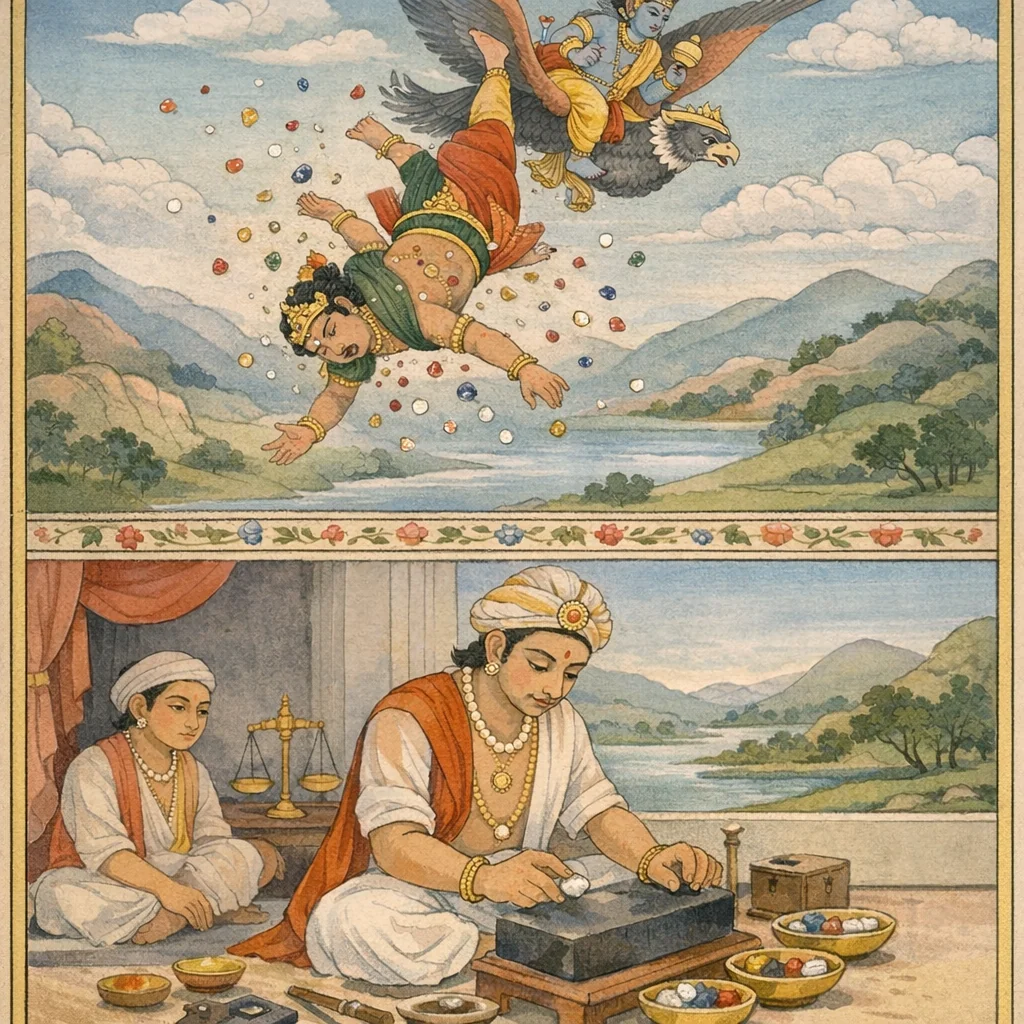
Continuing the prior adhyāya’s flow, Sūta introduces the practical discipline of ratna-parīkṣā (testing of jewels) through the tale of the Asura Bala’s rise and fall; his death for the gods’ welfare becomes the mythic source of “jewel-seeds” (ratna-bīja). As gem-fragments descend into varied lands, the chapter lists major gems and distinguishes protective substances, sin-destroyers, and defective stones. It then focuses on the vajra (diamond), Indra’s thunderbolt, also called Mādhva, describing regional varieties and color-based classes linked to deities and varṇas. The ideal vajra is sharp-pointed, symmetrical, and free from lines, spots, or cracks; broken-pronged stones are to be avoided. Wearing a flawless vajra grants prosperity and protection from poisons, serpents, fire, thieves, and hostile rites. Finally, it sets out valuation and testing: weight standards by rice-grains and mustard seeds, pricing for superior stones, proportional reductions for defects, and practical trials (alkaline marking, whetstone), concluding with the king’s jewel-bright diadem as a sign of legitimate, victorious rule and a prelude to further ratna-śāstra on other gems and auspicious royal regalia.
Shlokas
Verse 1
नाम सप्तषष्टितमो ऽध्यायः सूत उवाच / परिक्षां वच्मिरत्नानां बलो नामासुरो ऽभवत् / इन्द्राद्या निर्जितास्तेन विजेतुं तैर्न शक्यते
Sūta said: “Thus is the sixty-seventh chapter. I shall narrate the testing of the jewels. An Asura named Bala arose; by him Indra and the other gods were defeated, and they were unable to conquer him.”
Verse 2
वरव्याजेन पशुतां याचितः स सुरैर्मखे / बलो ददौ स (स्व) पशुतामतिसत्त्व सुरैर्हतः
Under the pretext of a boon, at the sacrifice the Devas asked him for the gift of cattle; Bali granted even his own herd. Yet, because of his extraordinary might, he was slain by the Devas.
Verse 3
पशुवत्स विशस्तस्तैः स्ववाक्याशनियन्त्रितः / बलो लोकोपराय देवानां हितकाम्यया
Restrained by their own words and commands, they slaughtered him like an animal—Bala—for the welfare of the gods and for the good of the world.
Verse 4
तस्य सत्त्वविशुद्धस्य विशुद्धेन च कर्मणा / कायस्यावयवाः सर्वे रत्नबीजत्वमाययुः
For that one whose inner being was purified, and whose deeds were likewise pure, all the limbs of his body attained the state of becoming “seeds of jewels”—sources of radiant merit.
Verse 5
देवानामथ यक्षाणां सिद्धानां पवनाशिनाम् / रत्नबीजंस्व(जम)यं ग्राहः सुमहानभवत्तदा
Then, among the Devas, the Yakṣas, and the Siddhas—those sustained by the life-wind—there arose at that time a very great “seizer” (grāha), born of a jewel-seed (ratna-bīja), of its own peculiar kind.
Verse 6
तेषां तु पततां वेगाद्विमानेन विहायसा / यद्यत्पपात रत्नानां बीजं क्रचन किञ्चन
As they fell with great speed from their aerial chariot through the sky, whatever seed-like particles of jewels happened to drop from them—some little fragments—fell down to the earth.
Verse 7
महोदधौ सरिति वा पवर्त कानने ऽपि वा / तत्तदाकरतां यातं स्थानमाधेयगौरवात्
Whether in the great ocean, in a river, on a mountain, or even in a forest—one attains the corresponding state and abode, by the weight of what has been implanted: prior saṃskāras and karma.
Verse 8
तेषु रक्षोविषव्यालव्याधिघ्नान्यघहानि च / प्रादुर्भवन्ति रत्नानि तथैव विगुणानि च
Among them appear gems, and also substances that ward off rākṣasas, poison, serpents, and diseases; likewise arise things that destroy sin, and also those that are defective in quality.
Verse 9
वज्रं मुक्तामणयः सपद्मरागाः समरकताः प्रोक्ताः / अपि चेन्द्रनीलमणिवरवैदूर्याः पुष्परागाश्च
Diamonds, pearl-gems, rubies (Padmarāga), and emeralds (Smarakata) are spoken of as precious gems; and also the sapphire (Indranīla), the excellent cat’s-eye (Vaidūrya), and the topaz (Puṣparāga).
Verse 10
कर्केतनं सपुलकं रुधिराख्यसमन्वितं तथा स्फटिकम् / विद्रुममणिश्च यत्नादुद्दिष्टं संग्रहे तज्ज्ञैः
The gem karketana, the pulaka, the stone called rudhirākhya, and also crystal (sphaṭika), as well as the coral-gem (vidruma)—all these have been carefully enumerated by experts in their compendia.
Verse 11
आकारवर्णौ प्रथमं गुणदोषौ तत्फलं परीक्षा च / मूल्यं च रत्नकुशलैर्विज्ञेयं सर्वशास्त्राणाम्
First, by form and color one should discern merits and defects; then its fruit (value and use), its testing, and also its price—these are to be understood by those skilled in gems, in accordance with all the śāstras.
Verse 12
कुलग्नेषूपजायन्ते यानि चोपहते ऽहनि / दौषैस्तान्यपियुज्यन्ते हीयन्ते गुणसम्पदा
Whatever is begun under an inauspicious family-omen (kulagna), and whatever is undertaken on a day that is afflicted, becomes bound up with faults; and thus one’s store of virtues and good qualities correspondingly diminishes.
Verse 13
परीक्षापरिशुद्धानां रत्नानां पृथिवीभुजा / धारणं संग्रहो वापि कार्यः श्रियमभीप्सता
A king, desiring prosperity, should wear—or duly store—only those gems that have been tested and found pure.
Verse 14
शास्त्रज्ञः कुशलाश्चापि रत्नभाजः परीक्षकाः / त एव मूल्यमात्राया वेत्तारः परिकीर्तिताः
Those who know the treatises (śāstra), who are skilled, and who examine and appraise gems—only they are said to be the true knowers of correct valuation.
Verse 15
महा प्रभावं विबुधैर्यस्यमाद्वज्रमुदाहृतम् / वज्रपूर्वा परीक्षेयं ततो ऽस्माभिः प्रकीर्त्यते
That which the wise have proclaimed to be of great power—called the Mādhva (Vishnu-related) “Vajra”—should first be examined; thereafter it will be described by us.
Verse 16
तस्यास्थिलेशो निपपात येषु भुवः प्रदेशेषु कथञ्चिदेव / वज्राणि वज्रायुधनिर्जिगीषोर्भवन्ति नानाकृतिमन्ति तेषु
Wherever even a tiny fragment of his bone happened to fall upon regions of the earth, in those very places vajras—thunderbolts of many different forms—came into being, meant for the victory of the vajra-wielder (Indra).
Verse 17
हैममातङ्गसौराष्ट्राः पौण्ड्रकालिङ्गकोसलाः / वेण्वातटाः ससौवीरा वज्रस्याष्ट विहारकाः
Haimamātaṅga and Saurāṣṭra; Pauṇḍra, Kāliṅga, and Kosala; the lands along the banks of the Veṇvā, together with Sauvīra—these are declared to be the eight domains (vihāras) of Vajra.
Verse 18
आताम्रा हिमशैलजाश्च शशिभा वेण्वातटीयाः स्मृताः सौवीरे त्वसिताब्जमेघसदृशास्ताभ्राश्च सौराष्ट्रजाः / कालिङ्गाः कन कावदातरुचिराः पीतप्रभाः कोसले श्यामाः पुण्ड्रभवा मतङ्गविषये नात्यन्तपीतप्रभाः
Those born in the Himālaya regions are reddish-brown; those of the Veṇvā river-banks are remembered as moon-like in complexion. In Sauvīra they resemble dark clouds and blue lotuses, while those born in Saurāṣṭra are tawny. The Kaliṅgas are pleasing, bright as gold; in Kosala they are yellow-hued. Those from Puṇḍra are dark-complexioned, and in the Mataṅga country the yellow radiance is not excessive.
Verse 19
अत्यर्थं लघु वर्णतश्च गुणवत्पार्श्वेषु सम्यक् समंरेखाबिन्दुकलङ्ककाकपदकत्रासादिभिर्वर्जितम् / लोके ऽस्मिन्परामाणुमात्रमपि यद्वज्रं क्रचिद्दृश्यते तस्मिन्देवसमाश्रयो ह्यवितथस्तीक्ष्णाग्रधारं यदि
Extremely light and excellent in appearance; on its sides well-formed and even; free from lines, dots, blemishes, crow-foot marks, cracks, and the like—if in this world a vajra (diamond/thunderbolt) is ever seen anywhere, even as small as an atom, then in that object the support of the Devas is truly unfailing, provided it bears a keen, sharp-edged point.
Verse 20
वज्रेषु वर्णयुक्त्या देवानामपि विग्रहः प्रोक्तः / वर्णेभ्यश्च विभागः कार्यो वर्णाश्रयादेव
Even among vajras, the embodied forms of the Devas are described according to their associated colors; and distinctions are to be made on the basis of those colors alone, for classification rests entirely upon color as its foundation.
Verse 21
हरितसितपीतपिङ्गश्यामास्ताम्राः स्वभावतो रुचिराः / हरिवरुणशक्रहुतवहपितृपतिमरुतां स्वका वर्णाः
Green, white, yellow, tawny, dark, and coppery hues are naturally beautiful. These are the respective inherent colors of Hari (Viṣṇu), Varuṇa, Śakra (Indra), Hutavaha (Agni), Pitṛpati (Yama), and the Maruts.
Verse 22
विप्रस्य शङ्खकुमुदस्फटिकावदातः स्यात्क्षत्त्रियस्य शशबभ्रुविलोचनाभः / वैश्यस्य कान्तकदलीदलसन्निकाशः शूद्रस्य धौतकरवालसमानदीप्तिः
The scripture declares: a brāhmaṇa shines radiant-white like a conch (śaṅkha), a white lotus, or crystal; a kṣatriya bears the tawny-brown hue of a hare’s eye; a vaiśya resembles the lustrous green of a banana leaf; and a śūdra gleams like a freshly polished sword-blade.
Verse 23
द्वौ वज्रवर्णौ पृथिवीपतीनां सद्भिः प्रदिष्टौ न तु सार्वजन्यौ / यः स्याज्जवाविद्रुमभङ्गशोणो यो वा हरिद्रारसन्निकाशः
The virtuous have ordained for kings two “vajra-like” (most excellent) complexions—meant not for all: one red like the hibiscus (javā) or like broken coral, and another resembling the hue of turmeric-juice.
Verse 24
ईशत्वात्सर्ववर्णानां गुणवत्सार्बवर्णिकम् / कामतो धारयेद्राजा न त्वन्यो ऽन्यत्कथञ्चन
Because the king bears lordship over all varṇas, if he is endowed with the requisite virtues he may, at his discretion, assume the marks and duties common to all varṇas; but no other person may do so in any manner.
Verse 25
अधरोत्तरवृत्तया हि यादृक् स्याद्वर्णसङ्करः / ततः कष्टतरो वज्रवर्णानां सङ्करो मतः
Indeed, when conduct becomes inverted—those below behaving as those above, and those above as those below—there arises varṇa-saṅkara, the mixing and confusion of social orders. From that, intermixture among the “vajra-like” (hard, uncompromising) classes is regarded as even more grievous.
Verse 26
न च मार्गविभागमात्रवृत्त्या विदुषा वज्रपरिग्रहो विधेयः / गुणवद्गुणसम्पदां विभूतिर्विपरीतो व्यसनोदयस्य हेतुः
Nor should a wise person take up vajra-like rigidity and obstinacy merely by hair-splitting over the ‘path’ and its subdivisions. True greatness lies in the treasure of virtues within the virtuous; the contrary disposition becomes a cause for calamity to arise.
Verse 27
एकमपि यस्य शृङ्गं विदलितमवलोक्यते विशीर्णं वा / गुणवदपि तन्न धार्यं वज्रं श्रेयो ऽर्थिभिर्भवने
Even if a vajra is otherwise excellent, if even one of its “horns” (prongs) is seen split or broken, it should not be kept in the house; for those who seek well-being, it is better to cast it away.
Verse 28
स्फुटिताग्निवि शीर्णशृङ्गदेशं मलवर्णैः पृषतैरुपेतमध्यम् / न हि वज्रभृतो ऽपि वज्रमाशु श्रियमप्याश्रयलालसां न कुर्यात्
One whose prong-region is shattered as if by fire, whose body is mottled and whose middle is stained with the color of filth—even the vajra of the Vajra-bearer (Indra) does not swiftly strike him; likewise, prosperity does not readily come to one greedy for patronage and shelter.
Verse 29
यस्यैकदेशः क्षतजावभासो यद्वा भवेल्लोहितवर्णचित्रम् / न तन्न कुर्याद्ध्रियमाणमाशु स्वच्छन्दमृत्योरपि जीवितान्तम्
If some part of the body appears as though smeared with blood, or shows mottled patches of a reddish hue, one should not disregard it; for bearing such a sign quickly brings life to its end, as though death had come of its own accord.
Verse 30
कोट्यः पार्श्वनि धाराश्च षडष्टौ द्वादशेति च / उत्तुङ्गसमतीक्ष्णाग्राः वज्रस्याकरजा गुणाः
Its corners, side-ridges, and cutting edges are said to be six, eight, or twelve—lofty, even, and razor-pointed; these are the ore-born qualities of the vajra.
Verse 31
षट्कोटि शुद्वममलं स्फुटतीक्ष्णधारं वर्णान्वितं लघु सुपार्श्वमपेतदोषम् / इन्द्रायुधांशुविसृतिच्छुरितान्तरिक्षमेवंविधं भुवि भवेत्सुलभं न वज्रम्
Even if it were fashioned with six crores of facets—perfectly pure and spotless, with a clearly sharp edge, radiant in color, light in weight, well-sided and free from defects—filling the sky with scattered rays like Indra’s rainbow, such a vajra would still not be easy to obtain upon the earth.
Verse 32
तीक्ष्णाग्रं विमलमपेतसर्वदोषं धत्ते यः प्रयततनुः सदैव वज्रम् / वृद्धिस्तं प्रतिदिनमेति यावदायुः स्त्रीसम्पत्सुतधनधान्यगोदशूनाम्
He who, with disciplined body and conduct, ever bears the flawless Vajra—sharp-pointed, pure, and free from every defect—prospers day by day throughout his lifespan: wife and household fortune, sons, wealth, grain, and cattle increase, and he is freed from the tenfold misfortunes.
Verse 33
व्यालवह्निविषव्याघ्रतस्कराम्बुभयानि च / दूरात्तस्य निवर्तन्ते कर्माण्याथर्वणानि च
For him, fears arising from serpents, fire, poison, tigers, thieves, and water turn back from afar; and Atharvanic acts—sorcery and hostile rites—also recoil from him at a distance.
Verse 34
यदि वज्रमपेतसर्वदोषं बिभृयात्तण्डुलविंशतिं गुरुत्वे / मणिशास्त्रविदो वदन्ति तस्य द्विगुणं रूपकलक्षमग्रमूल्यम्
If a flawless diamond—free from every defect—should weigh twenty grains of rice, the experts in the science of gems declare its foremost price to be double: two lakhs of rūpakas.
Verse 35
त्रिभागहीनार्धतदर्धशेषं त्रयोदशं त्रिंशदतोर्ऽद्धभागाः / अशीतिभागो ऽथ शतांशभागः सहस्रभागो ऽल्पसमानयोगः
Half diminished by three parts, and then the half of what remains; thirteen; and again the half-part derived from thirty; then an eightieth part, a hundredth part, and a thousandth part—such are the small, proportionate fractional combinations spoken of here.
Verse 36
यत्तण्डुलैर्द्वादशभिः कृतस्य वज्रस्य मूल्यं प्रथमं प्रदिष्टम् / द्वाभ्यां क्रमाद्वानिमुपागतस्य त्वेकावमानस्य विनिश्चयो ऽयम्
The value of the unit called ‘vajra’ was first stated as the value of a vajra constituted from twelve grains of rice; thereafter, by successive steps, the recognized measure is fixed—this is the determination of the standard for a single unit of valuation.
Verse 37
न चापि तण्डुलैरेव वज्राणां धरणक्रमः / अष्टाभिः सर्षपैर्गैरैस्तंण्डुलं परिकल्पयेत्
The standard of weights (dharaṇa-krama) for the “vajra” is not fixed by rice-grains alone; rather, one should define a single rice-grain (taṇḍula) as equal to eight white mustard seeds (sarṣapa).
Verse 38
यत्तु सर्वगुणैर्युक्तं वज्रं तरति वारिणि / रत्नवर्गे समस्ते ऽपि तस्य धारणमिष्यते
But the vajra (diamond), endowed with all auspicious qualities, is said to float upon water; therefore, among the entire class of gems, wearing it is considered commendable.
Verse 39
अल्पेनापि हि दोषेण लक्ष्यालक्ष्येण द्वषितम् / स्व (स) मूल्याद्दशमं भागं वज्रं लभति मानवः
Even with only a small defect—whether visible or not—an object becomes tainted; thus a person obtains the vajra only for a tenth of its proper value.
Verse 40
प्रकटानेकदोषस्य स्वल्पस्य महतो ऽपि वा / स्व (सु) मूल्याच्छतशो भागो वज्रस्य न विधीयते
Whether small or large, if a vajra displays many obvious flaws, not even a hundredth part of its proper value is assigned to it.
Verse 41
स्पष्टदोषमलङ्कारे वज्रं यद्यपि दृश्यते / रत्नानां परिकर्मार्थं मूल्यं तस्य भवेल्लघु
Even if a vajra with clear flaws is seen set in an ornament, when it is intended only for polishing other gems, its value becomes small.
Verse 42
प्रथमं गुणसम्पदाभ्युपेतं प्रतिबद्धं समुपैति यच्च दोषम् / अलमाभरणेन तस्य राज्ञो गुणहीनो ऽपि मणिर्न भूषणाय
That which at first is endowed with a wealth of virtues, yet later becomes bound and comes to bear a fault—mere ornament is not enough for such a king; even a jewel, if devoid of qualities, is not fit to be an ornament.
Verse 43
नार्या वज्रमधार्यं गुणवदपि सुतप्रसूतिमिच्छन्त्या / अन्यत्र दीर्घाचिपिटत्र्यश्राद्यगुणैर्वियुक्ताच्च
For a woman who longs to bear a son, even if she is virtuous, it is like enduring a thunderbolt—exceedingly hard; and if she is bereft of auspicious qualities such as long eyes and other good signs, it becomes harder still.
Verse 44
अयसा पुष्परागेण तथा गोमेदकेन च / वैदूर्यस्फटिकाभ्यां च काचैश्चापि पृथग्विधैः
With iron, with topaz (puṣparāga), and also with gomeda (hessonite); with cat’s-eye (vaidūrya) and crystal (sphaṭika), and likewise with various kinds of glass as well.
Verse 45
प्रतिरूपाणि कुर्वन्ति वज्रस्य कुशला जनाः / परीक्षा तेषु कर्तव्या विद्वद्भिः सुपरीक्षकैः
Skilled people can even make imitations of a diamond; therefore those gems should be examined by learned experts—thorough and discerning testers.
Verse 46
क्षारोल्लेखनशाणाभिस्तेषां कार्यं परीक्षणम् / पृथिव्यां यानि रत्नानि ये चान्ये लोहधातवः
Their testing should be carried out by alkaline marking and by whetstone examination—whether they are gems found in the earth or other metallic minerals.
Verse 47
सर्वाणि विलिखेद्वज्रं तच्च तैर्न विलिख्यते / गुरुता सर्वरत्नानां गौरवाधारकारणम्
The diamond scratches all things, yet is not scratched by them. In the same way, the intrinsic gravity of all precious gems is the very cause that upholds their worth and honor.
Verse 48
वज्रे तां वैपरीत्येन सूरयः परिचक्षते / जातिरजातिं विलिखति जातिं विलिखन्ति वज्रकुरुविन्दाः
Concerning the vajra-gem, the sages speak in a paradox: a “jāti” (a natural line or mark) scratches away an “ajāti” (an unmarked part), while the vajra and kuruvinda (diamonds) scratch away even the jāti itself.
Verse 49
वज्रैर्वज्रं विलिखति नान्येन विलिख्यते वज्रम् / वज्राणि मुक्तामणयो ये च केचन जातयः
A diamond is scratched only by diamonds; nothing else can scratch a diamond. Diamonds, pearls, and other such gems belong to that class of hard and precious substances.
Verse 50
न तेषां प्रतिबद्धानां भा भवत्यूर्ध्वगामिनी / तिर्यक् क्षतत्वात्केषाञ्चित्कथञ्चिद्यदि जायते / तिर्यग्विलिख्यमानानां सा (स) पार्श्वेषु विहन्यते
For those who are bound and restrained, their radiance does not rise upward. Even if it somehow arises in certain cases, it is harmed by being cut crosswise; and for those scraped crosswise, that radiance is struck down along the sides.
Verse 51
यद्यपि विशीर्णकोटिः सबिन्दुरेखान्वितो विवर्णो वा / तदपि धनधान्यपुत्रान्करोति सेन्द्रायुधो वज्रः
Even if the thunderbolt—the vajra, Indra’s weapon—is chipped at the tip, marked with spots and lines, or even discolored, it still brings forth wealth, grain, and sons, for it is the vajra, the weapon of Indra.
Verse 52
सौदा मिनीविस्फुरिताभिरामं राजा यथोक्तं कलिशं दधानः / पराक्रमाक्रान्तपरप्रतापः समस्तसामन्तभुवं भुनक्ति
Wearing, as described, a radiant diadem that gleams with jewel-like brilliance, the king—whose valor subdues the splendor of rival rulers—enjoys and governs the entire realm of subordinate kings.
Frequently Asked Questions
The chapter mentions examination by alkaline marking and whetstone testing, under the supervision of skilled, treatise-trained appraisers. It also emphasizes hardness criteria: the vajra scratches other substances and is not scratched by them, and it is cut only by another diamond.
If even one prong/“horn” is split or broken, the stone should be discarded for well-being. More generally, lines, dots, blemishes, crow-foot marks, cracks, stains (especially in the middle), mottling, and discoloration are treated as faults that reduce auspiciousness and value.
A foremost valuation is given for a flawless diamond weighing twenty rice-grains: two lakhs of rūpakas (double). The text then outlines fractional reductions for smaller measures and defect-based devaluation (down to one-tenth or one-hundredth). It also defines a weight equivalence: one rice-grain (taṇḍula) equals eight white mustard seeds (sarṣapa) for establishing the dharaṇa-krama (weight standard).