Adhyaya 78
Kṛṣṇa Kills Dantavakra; Balarāma’s Pilgrimage and the Slaying of Romaharṣaṇa
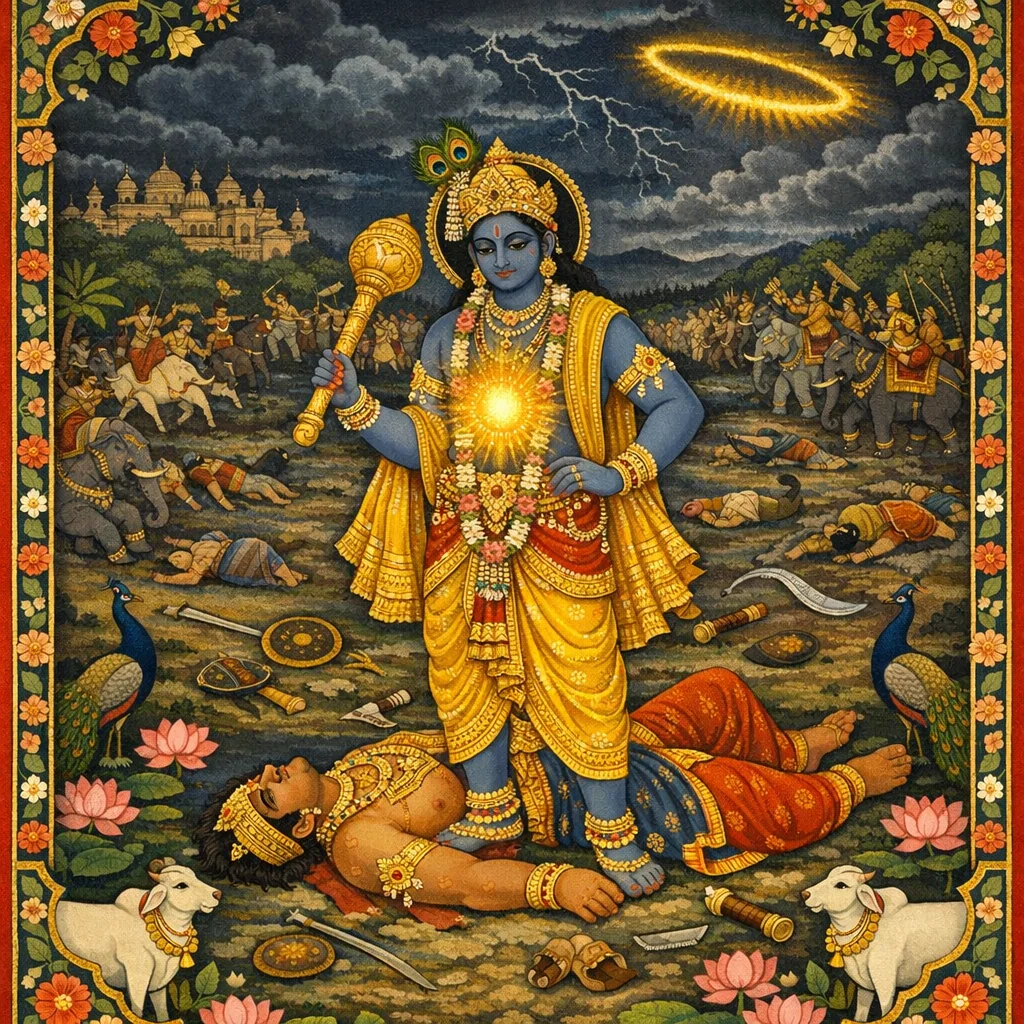
After the Dvārakā conflict in which Śālva and his Saubha airship are destroyed, allied enmity continues. Dantavakra, loyal to the fallen kings Śiśupāla, Śālva, and Pauṇḍraka, comes on foot with a club to challenge Lord Kṛṣṇa, accusing Him of betraying kinship and striking Him. Kṛṣṇa remains unmoved and kills Dantavakra with His mace Kaumodakī; a subtle light rises from the slain asura and enters Kṛṣṇa, recalling Śiśupāla’s merger, and Vidūratha is immediately beheaded by the Sudarśana disc. The Lord returns to His capital amid universal praise, and the narration affirms His perpetual victory, rejecting any notion of divine defeat. The focus then shifts to Balarāma: staying neutral as the Kurus prepare war with the Pāṇḍavas, He departs on pilgrimage. At Naimiṣāraṇya He sees Romaharṣaṇa disrespect the assembly and kills him with kuśa grass, troubling the sages about the sin of brāhmaṇa-slaughter. Balarāma accepts exemplary atonement, preserves the sages’ vow by empowering Romaharṣaṇa’s son as Purāṇa-speaker, and is charged to kill the demon Balvala and undertake a year-long circuit of sacred tīrthas—setting the stage for themes of purification, pilgrimage, and protection of sacrifice.
Shlokas
Verse 1
श्रीशुक उवाच शिशुपालस्य शाल्वस्य पौण्ड्रकस्यापि दुर्मति: । परलोकगतानां च कुर्वन् पारोक्ष्यसौहृदम् ॥ १ ॥ एक: पदाति: सङ्क्रुद्धो गदापाणि: प्रकम्पयन् । पद्भ्यामिमां महाराज महासत्त्वो व्यदृश्यत ॥ २ ॥
Śukadeva Gosvāmī said: O great King, though Śiśupāla, Śālva, and Pauṇḍraka had already gone to the next world, the wicked Dantavakra, professing friendship for them from afar, appeared on the battlefield in towering rage. Alone, on foot, club in hand, he seemed to shake the earth with his steps.
Verse 2
श्रीशुक उवाच शिशुपालस्य शाल्वस्य पौण्ड्रकस्यापि दुर्मति: । परलोकगतानां च कुर्वन् पारोक्ष्यसौहृदम् ॥ १ ॥ एक: पदाति: सङ्क्रुद्धो गदापाणि: प्रकम्पयन् । पद्भ्यामिमां महाराज महासत्त्वो व्यदृश्यत ॥ २ ॥
Śukadeva Gosvāmī said: Acting out of friendship for Śiśupāla, Śālva and Pauṇḍraka, who had all passed on to the next world, the wicked Dantavakra appeared on the battlefield in a great rage, O King. All alone, on foot and wielding a club in his hand, the mighty warrior shook the earth with his footsteps.
Verse 3
तं तथायान्तमालोक्य गदामादाय सत्वर: । अवप्लुत्य रथात् कृष्ण: सिन्धुं वेलेव प्रत्यधात् ॥ ३ ॥
Seeing Dantavakra approach, Lord Kṛṣṇa quickly picked up His club, jumped down from His chariot and stopped His advancing opponent just as the shore holds back the ocean.
Verse 4
गदामुद्यम्य कारूषो मुकुन्दं प्राह दुर्मद: । दिष्ट्या दिष्ट्या भवानद्य मम दृष्टिपथं गत: ॥ ४ ॥
Raising his club, the reckless King of Karūṣa said to Lord Mukunda, “What luck! What luck — to have You come before me today!
Verse 5
त्वं मातुलेयो न: कृष्ण मित्रध्रुङ्मां जिघांससि । अतस्त्वां गदया मन्द हनिष्ये वज्रकल्पया ॥ ५ ॥
“You are our maternal cousin, Kṛṣṇa, but You committed violence against my friends, and now You want to kill me also. Therefore, fool, I will kill You with my thunderbolt club.
Verse 6
तर्ह्यानृण्यमुपैम्यज्ञ मित्राणां मित्रवत्सल: । बन्धुरूपमरिं हत्वा व्याधिं देहचरं यथा ॥ ६ ॥
“Then, O unintelligent one, I who am obliged to my friends will have repaid my debt to them by killing You, my enemy disguised as a relative, who are like a disease within my body.”
Verse 7
एवं रूक्षैस्तुदन् वाक्यै: कृष्णं तोत्रैरिव द्विपम् । गदया ताडयन्मूर्ध्नि सिंहवद् व्यनदच्च स: ॥ ७ ॥
Thus, harassing Lord Kṛṣṇa with harsh words as one prods an elephant with sharp goads, Dantavakra struck the Lord on the head with his club and roared like a lion.
Verse 8
गदयाभिहतोऽप्याजौ न चचाल यदूद्वह: । कृष्णोऽपि तमहन् गुर्व्या कौमोदक्या स्तनान्तरे ॥ ८ ॥
On the battlefield, though struck by Dantavakra’s club, Lord Kṛṣṇa, the deliverer of the Yadus, did not budge. Instead, with His massive Kaumodakī club He struck Dantavakra in the middle of the chest.
Verse 9
गदानिर्भिन्नहृदय उद्वमन् रुधिरं मुखात् । प्रसार्य केशबाह्वङ्घ्रीन् धरण्यां न्यपतद् व्यसु: ॥ ९ ॥
His heart shattered by the club’s blow, Dantavakra vomited blood and fell lifeless to the ground, his hair disheveled and his arms and legs sprawling.
Verse 10
तत: सूक्ष्मतरं ज्योति: कृष्णमाविशदद्भुतम् । पश्यतां सर्वभूतानां यथा चैद्यवधे नृप ॥ १० ॥
A most subtle and wondrous spark of light then arose and, as all beings looked on, entered Lord Kṛṣṇa, O King, just as when Śiśupāla was slain.
Verse 11
विदूरथस्तु तद्भ्राता भ्रातृशोकपरिप्लुत: । आगच्छदसिचर्माभ्यामुच्छ्वसंस्तज्जिघांसया ॥ ११ ॥
But then his brother Vidūratha, overwhelmed with grief for his slain brother, came forward breathing heavily, sword and shield in hand, intent on killing the Lord.
Verse 12
तस्य चापतत: कृष्णश्चक्रेण क्षुरनेमिना । शिरो जहार राजेन्द्र सकिरीटं सकुण्डलम् ॥ १२ ॥
O best of kings, as he fell upon Him, Lord Kṛṣṇa with His razor-edged Sudarśana disc severed his head, together with helmet and earrings.
Verse 13
एवं सौभं च शाल्वं च दन्तवक्रं सहानुजम् । हत्वा दुर्विषहानन्यैरीडित: सुरमानवै: ॥ १३ ॥ मुनिभि: सिद्धगन्धर्वैर्विद्याधरमहोरगै: । अप्सरोभि: पितृगणैर्यक्षै: किन्नरचारणै: ॥ १४ ॥ उपगीयमानविजय: कुसुमैरभिवर्षित: । वृतश्च वृष्णिप्रवरैर्विवेशालङ्कृतां पुरीम् ॥ १५ ॥
Thus, having slain Śālva with his Saubha airship, and Dantavakra together with his younger brother—foes invincible to all others—the Lord was praised by devas, men and great sages, by Siddhas, Gandharvas, Vidyādharas and Mahoragas, and also by Apsarās, Pitṛs, Yakṣas, Kinnaras and Cāraṇas.
Verse 14
एवं सौभं च शाल्वं च दन्तवक्रं सहानुजम् । हत्वा दुर्विषहानन्यैरीडित: सुरमानवै: ॥ १३ ॥ मुनिभि: सिद्धगन्धर्वैर्विद्याधरमहोरगै: । अप्सरोभि: पितृगणैर्यक्षै: किन्नरचारणै: ॥ १४ ॥ उपगीयमानविजय: कुसुमैरभिवर्षित: । वृतश्च वृष्णिप्रवरैर्विवेशालङ्कृतां पुरीम् ॥ १५ ॥
The munis, Siddhas, Gandharvas, Vidyādharas and Mahoragas, and also the Apsarās, Pitṛs, Yakṣas, Kinnaras and Cāraṇas, likewise offered praise to that Bhagavān.
Verse 15
एवं सौभं च शाल्वं च दन्तवक्रं सहानुजम् । हत्वा दुर्विषहानन्यैरीडित: सुरमानवै: ॥ १३ ॥ मुनिभि: सिद्धगन्धर्वैर्विद्याधरमहोरगै: । अप्सरोभि: पितृगणैर्यक्षै: किन्नरचारणै: ॥ १४ ॥ उपगीयमानविजय: कुसुमैरभिवर्षित: । वृतश्च वृष्णिप्रवरैर्विवेशालङ्कृतां पुरीम् ॥ १५ ॥
As His victory was sung and He was showered with flowers, the Bhagavān, surrounded by the foremost Vṛṣṇis, entered His festively adorned capital city.
Verse 16
एवं योगेश्वर: कृष्णो भगवान् जगदीश्वर: । ईयते पशुदृष्टीनां निर्जितो जयतीति स: ॥ १६ ॥
Thus Lord Kṛṣṇa—the Yogīśvara, Bhagavān, and Lord of the universe—is ever victorious; only those of beastly vision imagine that He is sometimes defeated.
Verse 17
श्रुत्वा युद्धोद्यमं राम: कुरूणां सह पाण्डवै: । तीर्थाभिषेकव्याजेन मध्यस्थ: प्रययौ किल ॥ १७ ॥
Hearing that the Kurus were preparing for war with the Pāṇḍavas, Lord Balarāma remained neutral and departed on the pretext of bathing at holy tīrthas.
Verse 18
स्नात्वा प्रभासे सन्तर्प्य देवर्षिपितृमानवान् । सरस्वतीं प्रतिस्रोतं ययौ ब्राह्मणसंवृत: ॥ १८ ॥
After bathing at Prabhāsa and satisfying the devas, sages, forefathers, and eminent men, the Bhagavān went with brāhmaṇas to that stretch of the Sarasvatī that flows westward into the sea.
Verse 19
पृथूदकं बिन्दुसरस्त्रितकूपं सुदर्शनम् । विशालं ब्रह्मतीर्थं च चक्रं प्राचीं सरस्वतीम् ॥ १९ ॥ यमुनामनु यान्येव गङ्गामनु च भारत । जगाम नैमिषं यत्र ऋषय: सत्रमासते ॥ २० ॥
Lord Balarāma visited Pṛthūdaka, Bindu-saras Lake, Tritakūpa, Sudarśana, Viśāla, Brahma-tīrtha, Cakra-tīrtha, and the eastward-flowing Sarasvatī. O Bhārata, He also went to all the holy tīrthas along the Yamunā and the Gaṅgā, and then came to the Naimiṣa forest, where great sages were performing a long satra sacrifice.
Verse 20
पृथूदकं बिन्दुसरस्त्रितकूपं सुदर्शनम् । विशालं ब्रह्मतीर्थं च चक्रं प्राचीं सरस्वतीम् ॥ १९ ॥ यमुनामनु यान्येव गङ्गामनु च भारत । जगाम नैमिषं यत्र ऋषय: सत्रमासते ॥ २० ॥
O Bhārata, He went to all the holy tīrthas along the Yamunā and the Gaṅgā, and then reached the Naimiṣa forest, where sages sat performing a long satra sacrifice.
Verse 21
तमागतमभिप्रेत्य मुनयो दीर्घसत्रिण: । अभिनन्द्य यथान्यायं प्रणम्योत्थाय चार्चयन् ॥ २१ ॥
Recognizing the Lord upon His arrival, the sages—long engaged in the satra sacrifice—welcomed Him properly by rising, bowing down, and worshiping Him.
Verse 22
सोऽर्चित: सपरीवार: कृतासनपरिग्रह: । रोमहर्षणमासीनं महर्षे: शिष्यमैक्षत ॥ २२ ॥
After being thus worshiped along with His entourage, the Lord accepted a seat of honor. Then He noticed that Romaharṣaṇa, Vyāsadeva’s disciple, had remained seated.
Verse 23
अप्रत्युत्थायिनं सूतमकृतप्रह्वणाञ्जलिम् । अध्यासीनं च तान् विप्रांश्चुकोपोद्वीक्ष्य माधव: ॥ २३ ॥
Lord Balarāma became extremely angry upon seeing how this member of the sūta caste had failed to stand up, bow down or join his palms, and also how he was sitting above all the learned brāhmaṇas.
Verse 24
यस्मादसाविमान् विप्रानध्यास्ते प्रतिलोमज: । धर्मपालांस्तथैवास्मान् वधमर्हति दुर्मति: ॥ २४ ॥
[Lord Balarāma said:] Because this fool born from an improperly mixed marriage sits above all these brāhmaṇas and even above Me, the protector of religion, he deserves to die.
Verse 25
ऋषेर्भगवतो भूत्वा शिष्योऽधीत्य बहूनि च । सेतिहासपुराणानि धर्मशास्त्राणि सर्वश: ॥ २५ ॥ अदान्तस्याविनीतस्य वृथा पण्डितमानिन: । न गुणाय भवन्ति स्म नटस्येवाजितात्मन: ॥ २६ ॥
Although he is a disciple of the divine sage Vyāsa and has thoroughly learned many scriptures from him, including the lawbooks of religious duties and the epic histories and Purāṇas, all this study has not produced good qualities in him.
Verse 26
ऋषेर्भगवतो भूत्वा शिष्योऽधीत्य बहूनि च । सेतिहासपुराणानि धर्मशास्त्राणि सर्वश: ॥ २५ ॥ अदान्तस्याविनीतस्य वृथा पण्डितमानिन: । न गुणाय भवन्ति स्म नटस्येवाजितात्मन: ॥ २६ ॥
Rather, his study of the scriptures is like an actor’s studying his part, for he is not self-controlled or humble and vainly presumes himself a scholarly authority, though he has failed to conquer his own mind.
Verse 27
एतदर्थो हि लोकेऽस्मिन्नवतारो मया कृत: । वध्या मे धर्मध्वजिनस्ते हि पातकिनोऽधिका: ॥ २७ ॥
The very purpose of My descent into this world is to kill such hypocrites who pretend to be religious. Indeed, they are the most sinful rascals.
Verse 28
एतावदुक्त्वा भगवान् निवृत्तोऽसद्वधादपि । भावित्वात् तं कुशाग्रेण करस्थेनाहनत् प्रभु: ॥ २८ ॥
Although Lord Balarama had stopped killing the impious, Romaharsana’s death was inevitable. Thus, having spoken, the Lord killed him by picking up a blade of kusa grass and touching him with its tip.
Verse 29
हाहेति वादिन: सर्वे मुनय: खिन्नमानसा: । ऊचु: सङ्कर्षणं देवमधर्मस्ते कृत: प्रभो ॥ २९ ॥
All the sages cried out, “Alas, alas!” in great distress. They told Lord Sankarshana, “O master, You have committed an irreligious act!
Verse 30
अस्य ब्रह्मासनं दत्तमस्माभिर्यदुनन्दन । आयुश्चात्माक्लमं तावद् यावत् सत्रं समाप्यते ॥ ३० ॥
O favorite of the Yadus, we gave him the seat of the spiritual master and promised him long life and freedom from physical pain for as long as this sacrifice continues.
Verse 31
अजानतैवाचरितस्त्वया ब्रह्मवधो यथा । योगेश्वरस्य भवतो नाम्नायोऽपि नियामक: ॥ ३१ ॥ यद्येतद् ब्रह्महत्याया: पावनं लोकपावन । चरिष्यति भवाँल्लोकसङ्ग्रहोऽनन्यचोदित: ॥ ३२ ॥
You have unknowingly killed a brahmana. Of course, even the injunctions of revealed scripture cannot dictate to You, the Lord of all mystic power. But if by Your own free will You nonetheless carry out the prescribed purification for this slaying of a brahmana, O purifier of the whole world, people in general will greatly benefit by Your example.
Verse 32
अजानतैवाचरितस्त्वया ब्रह्मवधो यथा । योगेश्वरस्य भवतो नाम्नायोऽपि नियामक: ॥ ३१ ॥ यद्येतद् ब्रह्महत्याया: पावनं लोकपावन । चरिष्यति भवाँल्लोकसङ्ग्रहोऽनन्यचोदित: ॥ ३२ ॥
“You have unknowingly killed a brāhmaṇa. Of course, even the injunctions of revealed scripture cannot dictate to You, the Lord of all mystic power. But if by Your own free will You nonetheless carry out the prescribed purification for this slaying of a brāhmaṇa, O purifier of the whole world, people in general will greatly benefit by Your example.”
Verse 33
श्रीभगवानुवाच चरिष्ये वधनिर्वेशं लोकानुग्रहकाम्यया । नियम: प्रथमे कल्पे यावान् स तु विधीयताम् ॥ ३३ ॥
The Personality of Godhead said: I will certainly perform the atonement for this killing, since I wish to show compassion to the people in general. Please, therefore, prescribe for Me whatever ritual is to be done first.
Verse 34
दीर्घमायुर्बतैतस्य सत्त्वमिन्द्रियमेव च । आशासितं यत्तद्ब्रूते साधये योगमायया ॥ ३४ ॥
O sages, just say the word, and by My mystic power I shall restore everything you promised him — long life, strength and sensory power.
Verse 35
ऋषय ऊचु: अस्त्रस्य तव वीर्यस्य मृत्योरस्माकमेव च । यथा भवेद्वच: सत्यं तथा राम विधीयताम् ॥ ३५ ॥
The sages said: Please see to it, O Rāma, that Your power and that of Your kuśa weapon, as well as our promise and Romaharṣaṇa’s death, all remain intact.
Verse 36
श्रीभगवानुवाच आत्मा वै पुत्र उत्पन्न इति वेदानुशासनम् । तस्मादस्य भवेद्वक्ता आयुरिन्द्रियसत्त्ववान् ॥ ३६ ॥
The Supreme Lord said: The Vedas instruct us that one’s own self takes birth again as one’s son. Thus let Romaharṣaṇa’s son become the speaker of the Purāṇas, and let him be endowed with long life, strong senses and stamina.
Verse 37
किं व: कामो मुनिश्रेष्ठा ब्रूताहं करवाण्यथ । अजानतस्त्वपचितिं यथा मे चिन्त्यतां बुधा: ॥ ३७ ॥
Please tell Me your desire, O best of sages, and I shall certainly fulfill it. And, O wise souls, please carefully determine My proper atonement, since I do not know what it might be.
Verse 38
ऋषय ऊचु: इल्वलस्य सुतो घोरो बल्वलो नाम दानव: । स दूषयति न: सत्रमेत्य पर्वणि पर्वणि ॥ ३८ ॥
The sages said: A fearsome demon named Balvala, the son of Ilvala, comes here every new-moon day and contaminates our sacrifice.
Verse 39
तं पापं जहि दाशार्ह तन्न: शुश्रूषणं परम् । पूयशोणितविन् मूत्रसुरामांसाभिवर्षिणम् ॥ ३९ ॥
O descendant of Daśārha, please kill that sinful demon, who pours down pus, blood, feces, urine, wine and meat upon us. This is the best service You can do for us.
Verse 40
ततश्च भारतं वर्षं परीत्य सुसमाहित: । चरित्वा द्वादश मासांस्तीर्थस्नायी विशुध्यसि ॥ ४० ॥
Thereafter, for twelve months, You should circumambulate the land of Bhārata in a mood of serious meditation, executing austerities and bathing at various holy pilgrimage sites. In this way You will become purified.
Frequently Asked Questions
The text frames this as a subtle, wondrous effulgence leaving the demon and entering the Lord, paralleling Śiśupāla’s end. In Purāṇic theology, such imagery signals the Lord’s absolute sovereignty over liberation: contact with Bhagavān (even through enmity) can culminate in an extraordinary destiny, demonstrating that the Lord is the final shelter of all beings and the ultimate purifier beyond ordinary karmic outcomes.
Kuśa is ritually potent within Vedic sacrifice, and the episode emphasizes that Balarāma is not limited by ordinary weaponry: as Bhagavān’s plenary power, He can make any instrument effective. The narrative purpose is also ethical and social—highlighting that sacred learning without humility and proper conduct is condemned, and that dharma is protected by the Lord even within ritual assemblies.
Romaharṣaṇa was a disciple in Vyāsa’s lineage and a designated Purāṇa-reciter (sūta by birth). The sages lament because they had granted him an honored seat and promised him longevity for the duration of the sacrifice; they therefore frame the killing as resembling brāhmaṇa-slaughter and ask Balarāma to model prāyaścitta so society learns reverence for dharma, even though the Lord is ultimately beyond injunction.
He agrees to perform atonement to benefit the world by example, ensures continuity by installing Romaharṣaṇa’s son as Purāṇa-speaker with promised boons, and accepts the service of killing the demon Balvala who pollutes the Naimiṣa sacrifice, followed by a twelve-month pilgrimage with austerity and sacred bathing. Theologically, this shows poṣaṇa: the Lord protects yajña and dharma, and pedagogically He demonstrates how social order is restored after a disruptive act.
The chapter explicitly states neutrality: Balarāma chooses not to side with either party and departs under the pretext of bathing at holy places. This preserves his impartiality while allowing the Bhāgavatam to shift into tīrtha and yajña-centered narratives, connecting royal conflict to the wider Vedic ecosystem of sacrifice, sages, and purification.